


Community hub
Recent from talks
Contribute something
Nothing was collected or created yet.
Ben Caunt
View on Wikipedia
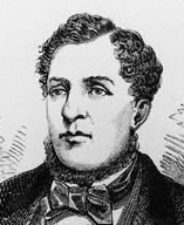
Ben Caunt (22 March 1815 – 10 September 1861) was a 19th-century English bare-knuckle boxer who became the heavyweight boxing champion known as the "Torkard Giant" and "Big Ben".
Key Information


Early life
[edit]Caunt was born on 22 March 1815 in Hucknall Torkard, in Nottinghamshire, England.[1] He stood 6 feet 2 inches (1.88 m) tall and weighed 18 stone.[2][3] He was said to be strong, durable, and willing yet also slow and clumsy. His early boxing career is not well known, but he did defeat several minor local opponents at the age of 18.
Boxing career
[edit]In 1834 he beat George Graham (of Lincolnshire). On 21 July 1835, Caunt boxed William "Bendigo" Thompson and was disqualified for an alleged foul striking Thompson while he was sitting in his corner.[4]
On 17 August 1837, Caunt fought and beat William Butler at Stoneyford in Derbyshire, and on 4 November Bill Boniford at Sunrise Hill.
On 3 April 1838, Caunt again fought William Thompson on Skipworth Common, and after 76 rounds Thompson was disqualified for going down without being struck; Caunt claimed the Heavyweight Championship of England but this was not generally accepted.[3]
On 24 June of the same year, Caunt was scheduled to again fight William Thompson but the bout was cancelled.
On 26 October 1840, Caunt defeated Bill Brassey at Six Mile Bottom in 101 rounds.
On 2 February 1841, Caunt fought Nick Ward on Crookham Common for the Heavyweight Championship of England where the crowd forced the referee to disqualify Caunt for an alleged blow striking Ward while he was down.
Caunt avenged this defeat on 11 May of the same year, defeating Ward in 35 rounds at Long Marston to become the Heavyweight Champion of England. On 10 September 1841 Caunt sailed to America to challenge Tom Hyer to a world championship bout, but Hyer never replied. Caunt returned to England on 10 March 1842 with the "American Giant" Charles Freeman.[1]

In 1845 he was challenged for the English heavyweight title by William Thompson. On 9 September Caunt lost at Stony Stratford, with a disputable decision after 93 rounds where it was alleged that Caunt went down without a blow striking him. Caunt denied this accusation and announced his retirement, only to return for a final attempt at the heavyweight crown 12 years later.
Retirement and attempted comeback
[edit]Between 1845 and 1851, Caunt worked as farm labourer and then became the landlord of the Coach and Horses pub at St Martin's Lane, a business that made him very prosperous until the premises were destroyed in a fire that killed two of his children.
In his final fight on 21 September 1857, Caunt fought Nat Langham at Home Circuit, where after 60 rounds both men were too exhausted to continue and a draw was declared.
Death and legacy
[edit]Caunt died of pneumonia on 10 September 1861 at an address in St Martin's Lane in London. He is buried outside the north transept of the Parish Church of St Mary Magdalene in Hucknall close to the grave of his two children who died in the Coach and Horses fire.[3]
It is said that Big Ben, the hour bell of the clock-tower of the Palace of Westminster, is named after this English heavyweight champion. The origin of the name is contested with Westminster's Chief Lord of the Woods and Forests, Sir Benjamin Hall. A large and ponderous man known affectionately in the House as "Big Ben", he is said to have given an impressively long speech on the subject. When, at the end of this oratorical marathon, Sir Benjamin sank back into his seat, a wag in the chamber shouted out: "Why not call him Big Ben and have done with it?" The house erupted in laughter; Big Ben had been named. This, at least, is the most commonly accepted story. However, according to the booklet written for the old Ministry of Works by Alan Phillips (1959):
Like other nice stories, this has no documentary support; Hansard failed to record the interjection. The Times had been alluding to 'Big Ben of Westminster' since 1856. Probably, the derivation must be sought more remotely. The current champion of the prize ring was Benjamin Caunt, who had fought terrific battles with Bendigo, and who in 1857 lasted sixty rounds of a drawn contest in his final appearance at the age of 42. As Caunt at one period scaled 17 stone (238 lbs, or 108 kilogrammes), his nickname was Big Ben, and that was readily bestowed by the populace on any object the heaviest of its class. So the anonymous MP may have snatched at what was already a catchphrase.[5]
— Alan Phillips
References
[edit]- ^ a b Boase, George Clement (1887). Dictionary of National Biography, 1885-1900, Volume 09. pp. 331, 332.
- ^ Hess, John (27 July 2012). "Could Big Ben lose out in Diamond Jubilee name change?". BBC News. BBC. Retrieved 1 February 2013.
- ^ a b c "Ashfield District Council: 'Big' Ben Caunt". Archived from the original on 13 June 2011. Retrieved 17 July 2017.
- ^ Walker, James (23 December 2014). "LeftLion - Ben Caunt". LeftLion. Retrieved 25 December 2018.
- ^ Phillips, Alan (1959). "The Story of Big Ben". Whitechapel Bell Foundry. Ministry of Works: Her Majesty's Stationery Office. Retrieved 25 December 2018.
Ben Caunt
View on GrokipediaEarly life
Birth and family background
Benjamin Caunt was born in 1815 near Newstead Abbey, in the parish of Hucknall Torkard, Nottinghamshire, England, into a working-class family, the son of Robert Caunt, an estate laborer at Newstead Abbey (the property of Lord Byron), and his wife Martha (née Butler). The family resided in modest circumstances in the local community.[2][4][5][6] From his youth, Caunt displayed remarkable physical attributes that set him apart in Hucknall Torkard, growing to a height of 6 feet 2½ inches with extraordinary muscular strength, though contemporaries noted his somewhat slow movement. In his prime, he weighed approximately 14 stone 7 pounds (about 200 pounds), earning him the local nickname of the "Torkard Giant" due to his imposing stature and presence among the townsfolk.[5][7][8][9] Prior to entering professional boxing around age 18, Caunt labored in the local economy, taking up roles such as blacksmithing in Hucknall Torkard, which suited his robust build but offered little beyond subsistence in the industrializing region.[10][4]Entry into boxing
Ben Caunt first became involved in boxing around the age of 18 in 1833, engaging in informal bouts against minor local opponents in Nottinghamshire, where bare-knuckle prize-fighting was a prominent part of the cultural landscape.[11] His physical build as a young blacksmith—standing 6 feet 2½ inches tall with a barrel chest and weighing approximately 14 stone 7 pounds—made him well-suited to the demands of the sport, which prized raw strength and endurance over finesse.[4][9] Drawn to pugilism by his innate power and the thriving local tradition of informal contests, Caunt trained sporadically with community figures in Hucknall Torkard, participating in unregulated fights that served as both social events and tests of manhood.[5] These early encounters helped build his confidence, though detailed records remain scarce, underscoring the unstructured nature of early 19th-century English boxing outside major prize fights. A pivotal early victory came around 1835, when Caunt defeated his relative Richard Butler in a family-related bout at Wighay Common near Hucknall, solidifying his local reputation as a formidable heavyweight prospect known for his size and punching power.[4][5] This win highlighted his potential in an era when documentation of pre-professional scraps was often limited to oral histories and community lore.Professional boxing career
Early professional fights
Caunt's professional boxing career commenced in 1834 with a victory over George Graham of Lincolnshire, marking his debut and initial success in the bare-knuckle ring.[11] A pivotal early contest took place on 21 July 1835 against William "Bendigo" Thompson near Appleby House in Nottinghamshire, under the London Prize Ring rules governing bare-knuckle fights. The bout, staked at £25 a side, endured 22 rounds before Caunt was disqualified for delivering a blow to Thompson prior to the referee's call of "Time," awarding the win to the more evasive Bendigo.[12] This disqualification underscored Caunt's fighting style, which emphasized powerful punches delivered with his imposing 6-foot-2-inch frame and over 14 stone weight, coupled with remarkable endurance for prolonged exchanges. However, it also exposed vulnerabilities to quicker, scientifically minded opponents like Bendigo, who exploited dodging and strategic timing to counter Caunt's aggression. The match attracted local spectators to the rural venue, characteristic of early professional bouts with regional appeal rather than national spectacle.[12] Caunt rebounded in 1837 with decisive victories that bolstered his record. On 17 August at Stoneyford in Nottinghamshire, he overcame William Butler in 14 rounds for £20 a side, overpowering his opponent through sheer physical dominance. Four months later, on 4 November at Sunrise Hill near Nottingham, Caunt knocked out Bill Boniford in just 6 rounds, showcasing his knockout potential against lesser-resisted foes.[12] These initial professional engagements yielded modest prize money of £25 to £50 per fight, aligning with the scale of local events in rural English settings. The encounters, particularly the contentious loss to Bendigo, foreshadowed a defining rivalry that would shape Caunt's path forward.[12]Rise to heavyweight championship
Caunt's path to the heavyweight championship began with a highly disputed bout against his longtime rival William "Bendigo" Thompson on April 3, 1838, at Skipworth Common near Nottingham. After 75 rounds of intense combat, Bendigo was disqualified for a foul—striking Caunt while he was down—awarding the victory to Caunt and allowing him to claim the English heavyweight title. However, the outcome was widely contested, as Bendigo had dominated much of the fight with his superior speed and agility, leading many in the boxing community to view Caunt's title claim as illegitimate at the time.[10] To strengthen his standing, Caunt engaged in a grueling endurance match against Bill Brassey on October 26, 1840, at Six Mile Bottom in Cambridgeshire. The fight lasted 101 rounds, spanning over three hours, and highlighted Caunt's exceptional stamina and resilience against a durable opponent known for his toughness. Caunt's victory in this marathon bout further elevated his reputation among supporters, positioning him as a legitimate contender for the championship despite ongoing skepticism from his 1838 win.[10][8] The decisive turning point came in 1841 with Caunt's encounters against Nick Ward, the reigning champion. Their initial clash on February 2 at Crookham Common in Berkshire ended abruptly after just 7 rounds when Caunt was disqualified; the referee, under pressure from an agitated crowd, ruled that Caunt had struck Ward while he was down, stripping him of the title opportunity. Undeterred, Caunt secured a rematch on May 11 at Long Marsden near Nottingham, where he prevailed after 35 punishing rounds through relentless pressure and effective counterpunching, reclaiming the championship. This win solidified Caunt's status as English heavyweight champion, which he had first claimed in 1838. By the conclusion of his career, Caunt had earned a total of £870 in prize money across his professional fights.[10][13][2] These victories built on Caunt's earlier loss to Bendigo in 1835, transforming him from an underdog into a dominant force through honed resilience and strategic adaptation in the ring.[10]Major title bouts and rivalries
Caunt first claimed the English heavyweight championship in 1838 but solidified his hold following his 1841 victory over Nick Ward, maintaining the title until 1845 amid the era's chaotic prize ring disputes and logistical challenges in arranging uncontested bouts under London Prize Ring rules. Following his title acquisition against Nick Ward, Caunt focused on high-profile challenges rather than routine defenses, with rivalries driving most significant encounters. His clashes with Ward exemplified the frequent foul controversies that plagued bare-knuckle boxing, as their initial 1841 fight ended in Caunt's disqualification for striking Ward illegally, before his successful rematch.[10] The defining rivalry of Caunt's championship years was with William "Bendigo" Thompson, a fellow Nottinghamshire fighter whose taunting style and resilience made their trilogy one of the era's most bitter feuds. Their third and decisive meeting, on 29 September 1845 at Sutfield Green near Stony Stratford, Buckinghamshire, pitted the reigning champion Caunt against the former titleholder Bendigo for the English heavyweight crown. Lasting 93 rounds over more than two hours in sweltering heat, the bout ended in controversy when Caunt sat down at the round's conclusion, only for Bendigo to pursue and strike him; referees ruled it a foul by Caunt, awarding the victory and title to Bendigo amid protests from Caunt's supporters who argued the decision was unfair and biased. This loss marked the peak of their intense antagonism, with the three fights spanning a decade and showcasing the brutality of prolonged bare-knuckle combat, where Caunt held a 1-2 record against Bendigo.[14][15][13] Post-title years saw Caunt's rivalries extend to family ties, culminating in a notable 1857 encounter with Nat Langham, his wife's brother-in-law, which served as a grudge match amid personal disputes. On 21 September 1857 at the Home Circuit in London, the exhausted fighters battled to a draw after 60 grueling rounds, highlighting Caunt's enduring competitiveness despite his age and retirement status. Across his career, Caunt's nine major prize fights yielded a record of 5 wins, 3 losses, and 1 draw, often decided by disqualifications or endurance rather than knockouts. The cumulative toll of these extended bouts, including repeated head trauma and physical strain, contributed to long-term health deterioration that plagued him in later life.[2][16]Later life and retirement
Post-boxing occupations
After retiring from active boxing in 1845 following his loss to Bendigo, Caunt worked as a farm laborer in his native Nottinghamshire, utilizing his considerable physical strength for manual agricultural tasks over the next several years.[17] His choice of such labor was influenced by lingering effects from boxing injuries, which limited more strenuous pursuits.[18] By around 1851, Caunt had relocated to London and become the landlord of the Coach and Horses public house on St. Martin's Lane, a venture that capitalized on his fame as a former heavyweight champion.[2] The establishment quickly became a popular spot for locals and boxing enthusiasts, where Caunt supplemented his income—bolstered by total career prize money of £870, equivalent to roughly £90,000 in modern terms—through serving drinks and sharing anecdotes from his pugilistic days.[2] Although he occasionally hosted informal gatherings related to the sport, he steered clear of full-time involvement in boxing promotion. Caunt had married Martha Butler Bond in 1842, and the couple raised several children, including Martha, Cornelius, Margaret, and Benjamin.[2] Their family life was upended on 4 June 1851, when a fire broke out in the upper rooms of the Coach and Horses, rapidly spreading and suffocating three individuals: Caunt's children Martha (aged 9) and Cornelius Butler Caunt (aged 6), along with the family's 18-year-old servant Ruth Lowe.[19] Caunt and his wife escaped, but the loss devastated the family emotionally and financially, as the blaze gutted the premises and required rebuilding efforts that strained their resources.[19] Despite these setbacks, Caunt persisted as a publican, maintaining a local celebrity status that drew steady patronage until the late 1850s.[2]Attempted comeback
After retiring from boxing in 1845, Ben Caunt faced severe financial hardship following the devastating fire of 1851 that destroyed his pub, the Coach and Horses in St. Martin's Lane, London, and tragically killed two of his children and the family servant.[20][19] This loss prompted his attempted comeback at age 42, driven by the need to generate income and reclaim his former fame as a heavyweight champion.[21] Additionally, the bout arose from a domestic dispute between Caunt's wife and the wife of his former protégé, Nat Langham, escalating into a grudge match to settle family tensions.[22] Caunt's preparation was minimal after over a decade away from the ring, relying primarily on his lingering physical strength rather than rigorous training.[21] At 6 feet 2 inches tall and weighing around 17 stone, he entered the fight showing signs of age-related decline, particularly in speed and endurance compared to his prime.[23] Langham, then the reigning middleweight champion and Caunt's one-time mentee from their shared Nottinghamshire roots, represented a formidable challenge despite their prior professional association.[24] On 21 September 1857, at the Home Circuit near Long Marston, the bare-knuckle contest unfolded over 60 grueling rounds, lasting more than two hours under the era's brutal rules.[20] Both fighters, exhausted and battered, were unable to continue, resulting in a draw with no clear victor declared—the only such outcome in Caunt's nine prize fights.[2] The draw effectively concluded Caunt's attempted return, as he pursued no further bouts and critics observed his diminished performance as a shadow of his championship days.[21] In the context of 19th-century bare-knuckle boxing, such a late comeback for a heavyweight was exceptionally rare, underscoring the physical toll and risks of prolonged participation in the sport.[20]Death and legacy
Circumstances of death
In the years following his attempted comeback in 1857, Ben Caunt continued to manage the Coach and Horses public house on St. Martin's Lane in London, a role he had held since retiring from boxing in 1845. However, his health began to decline significantly after the death of his wife, Martha, on 1 June 1859, which contributed to the pub losing its license amid reports of unruly behavior under his stewardship.[2][25] In 1860, Caunt contracted a severe cold while attending a pigeon racing match, from which he never fully recovered, exacerbating his ongoing respiratory issues and mental distress, including heavy drinking following the earlier loss of two young children in a fire at the pub in 1851.[2][26] Caunt died of pneumonia on 10 September 1861 at the age of 46, found deceased in his bed at the Coach and Horses after complaining of slight indisposition the previous evening. He had been under medical treatment and was reported to have worked normally the day before his death.[26] The long-term physical toll of his bare-knuckle boxing career likely contributed to his vulnerability to such respiratory ailments, a common fate among 19th-century prizefighters amid limited medical care.[27] His remains were transported to his native Hucknall Torkard for burial in the churchyard of St. Mary Magdalene Church, interred outside the north transept near the graves of his children Martha (1842–1851) and Cornelius Butler (1844–1851). The local funeral was attended by members of the boxing community, including his longtime rival William Thompson (Bendigo), who served as a pallbearer. Caunt left behind surviving children, including son Benjamin Butler Caunt (1840–1870) and daughter Margaret (1848–1918), who faced the immediate hardships of his passing without further documented family support details from the era.[28][29][25][30]Historical and modern recognition
Ben Caunt's tenure as English heavyweight champion from 1841 to 1845 positioned him as a pivotal figure bridging the raw, unregulated bare-knuckle era and the evolving professionalization of pugilism in England.[27] His nine major prize fights, marked by endurance-testing bouts often exceeding 70 rounds, exemplified the brutal physicality of the sport and influenced its tactical development, including the strategic use of height and reach advantages in heavyweight contests.[2] A contested aspect of Caunt's cultural legacy involves the nickname "Big Ben" for the Great Bell in the Palace of Westminster's Elizabeth Tower, with some accounts suggesting it derived from his imposing 6-foot-2-inch frame and fame as a heavyweight, though this theory competes with attributions to Sir Benjamin Hall, the Commissioner of Works during the bell's 1858 installation.[31] In his hometown of Hucknall, Nottinghamshire, Caunt remains a celebrated local hero, symbolizing regional pride in 19th-century sporting achievements.[8] Modern honors underscore Caunt's lasting impact on boxing heritage. He was posthumously inducted into the Bare Knuckle Boxing Hall of Fame in New York on July 11, 2020, recognizing his dominance in the sport's formative years.[17] Earlier, in 1966, he entered Ring magazine's Boxing Hall of Fame, affirming his status among pioneering heavyweights.[27] Caunt has also appeared in local media and histories, such as Nottinghamshire-focused articles and BBC features exploring his potential link to London's iconic clock.[32] Scholarly attention to Caunt reveals notable gaps, particularly in documentation of his early career before his championship rise, with records relying heavily on contemporary newspaper accounts rather than comprehensive archives. Recent analyses, however, highlight his role during the decline of bare-knuckle fighting in the 1840s, a period that preceded the 1867 adoption of gloved rules under the Marquess of Queensberry, positioning him as a transitional icon in the shift toward regulated modern boxing.[33] As a symbol of 19th-century working-class resilience, Caunt embodied the democratization of sport through prize-fighting, drawing crowds from laboring communities and elevating pugilism's social profile. While no major scholarly biographies exist, local commemorations persist, including his gravesite memorial at St Mary Magdalene Church in Hucknall, which features a plaque noting his 1841–1845 championship and serves as a site for community reflection on his legacy.[2]References
- https://en.wikisource.org/wiki/Dictionary_of_National_Biography,_1885-1900/Caunt,_Benjamin