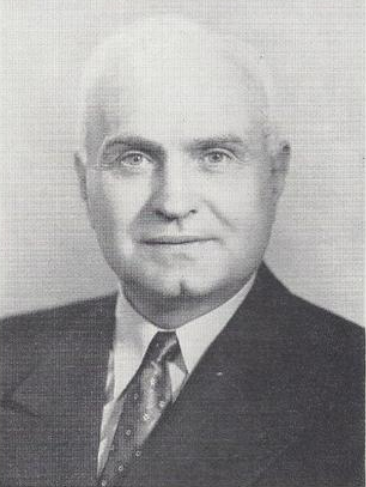

Bernie Bierman
View on Wikipedia
Bernard W. Bierman (March 11, 1894 – March 7, 1977) was an American college football coach best known for his years as head coach of the Minnesota Golden Gophers football program. Between 1934-41, his Minnesota teams won five national championships (1934, 1935, 1936, 1940, and 1941), seven Big Ten championships (1933, 1934, 1935, 1937, 1938, 1940, and 1941) and had four perfect seasons (1934, 1935, 1940, 1941). Bierman's five national championships rank him third all-time, as only Nick Saban (7) and Bear Bryant (6) have won more.[1]
Key Information


Bierman was born and raised in Minnesota and attended the University of Minnesota where he played football, basketball, and track, and was captain of the undefeated 1915 football team.
Bierman later served as the head football coach at the University of Montana (1919–1921), Mississippi A&M (1925–1926), Tulane University (1927–1931), Iowa Pre-Flight (1942), and Minnesota (1932–1941, 1945–1950). He compiled a career record of 153–65–12 as a head football coach and was inducted into the College Football Hall of Fame in 1955. Bierman was also the head basketball coach at Montana (1919–1922), Mississippi A&M (1925–1927), and Tulane (1928–1930), tallying a career college basketball coaching mark of 89–51.
Early years
[edit]
Bierman was born in 1894 to German immigrants on a farm near Springfield, Minnesota.[2] His family moved to Oklahoma when he was a baby, but returned to Minnesota, living in Waseca, Paynesville, Litchfield, and Minneapolis. The family returned to Litchfield in 1908, and it was there that Bierman attended high school and played football, baseball, and track, before graduating in 1912.[3] Bierman's high school athletic success is remarkable given his bout of osteomyelitis which confined him to crutches for 3 years as a boy.[4]
Bierman enrolled at the University of Minnesota in the fall of 1912. He played for the freshman football team in 1912 and for the varsity team in 1913, though a charley horse sidelined him early in the season. He became a starter in 1914, and as a senior, he was captain of the undefeated 1915 Minnesota Golden Gophers football team.[5][6] He won a total of seven varsity letters at Minnesota, three in football, three in track, and one in basketball.[5]
Bierman was the second of four Bierman brothers to compete in athletics at the University of Minnesota. Older brother Al Bierman played halfback for the football team in 1912 and 1913. George Bierman was the school's top broad jumper. Harlow Bierman was the youngest brother joined the football team in 1917.[7]
Coaching career
[edit]Montana
[edit]In the summer of 1916, Bierman accepted a job as the football coach at Butte High School in Butte, Montana. His Butte team outscored opponents by a total of 300 to six and was recognized as the Montana state champion. When the United States entered World War I in April 1917, Bierman enrolled in the United States Marine Corps. He served in the Marines from May 1917 until April 1919. He was promoted to second lieutenant on July 1, 1918, and to captain on July 2, 1918. He spent most of the war in Cuba.[8]
After completing his military service, he was hired in May 1919 as head football, basketball and track coach at the University of Montana. He served as head football coach at Montana from 1919 to 1921.[6] The highlight of his time at Montana was an 18–14 upset victory over Washington in October 1920. In the annual rivalry game with Montana State, Bierman's team's played to a tie in 1919 and won consecutive games in 1920 and 1921. While at Montana, Bierman met his wife Clara McKenzie.[9]
Tulane and Mississippi A&M
[edit]In 1922, Bierman returned to Minnesota working as a municipal bond trader for Wells Dickey.[9] He also coached the football team at Pillsbury Academy in Owatonna, Minnesota.[6]
Bierman later recalled that he "couldn't shake my natural love" for football, and in the summer of 1923, he accepted an offer to become a part-time assistant coach at Tulane University under his Minnesota teammate Clark Shaughnessy. He was an assistant coach for the football, basketball, and track teams at Tulane in 1923 and 1924. He continued to work part-time in the bond business while at Tulane.[10]
In April 1925, he was hired as head football coach and associate professor of physical education at Mississippi A&M.[11] The position was full time, marking the end of Bierman's time in the bond business. Bierman later recalled that football was at a "low ebb" at Mississippi A&M when he took the job and recalled that a highlight of his time there was a close 6–0 loss to the undefeated, national champion 1925 Alabama team.[12] He served as the school's head football coach in 1925 and 1926, compiling an 8–8–1 record.
In April 1927, he was hired as Tulane's head football coach.[13] After two rebuilding years, Bierman's Tulane teams did not lose a conference game and won three consecutive Southern Conference championships from 1929 to 1931.[14] The 1929 Tulane team compiled a perfect 9–0 record; the 1930 team was undefeated in conference games but lost to Big Ten champion Northwestern. In his final year at Tulane, Bierman led the 1931 team to an 11–0 record in the regular season and a No. 2 ranking in the final Dickinson System ratings.[15] The 1931 team won a berth in the 1932 Rose Bowl, losing to No. 1 USC by a 21–12 score.
Minnesota
[edit]1932 to 1941
[edit]
In January 1932, Bierman was hired to replace Fritz Crisler as Minnesota's head football coach. After a 5–3 season in 1932, Bierman led Minnesota on a nine-year run from 1933 to 1941 during which they five won national championships (1934, 1935, 1936, 1940, and 1941) and seven Big Ten championships (1933, 1934, 1935, 1937, 1938, 1940, and 1941) and four perfect seasons (1934, 1935, 1940, 1941). Bierman cited the 1934 victory over Pittsburgh as the "high spot" of the season in which the Golden Gophers "blossomed" into a great team.[16]
Bierman coached nine consensus All-Americans between 1934 and 1941: fullback Pug Lund, halfbacks George Franck and Bruce Smith, end Frank Larson, guard Bill Bevan, and tackles Ed Widseth, Dick Smith, Urban Odson, and Dick Wildung.
Bierman published his book, "Winning Football: Strategy, Psychology and Technique", in 1937.[17]
Bierman's pre-war Minnesota dynasties deployed the single wing offensive formation.[18]
Wartime military service
[edit]Bierman continued to serve in the Marine Corps reserves while coaching at Minnesota. Following the attack on Pearl Harbor, Bierman was ordered to report to active duty with the Marines in January 1942.[19] In March 1942, he was named athletic director and head football coach of the Navy's new pre-flight training school at the University of Iowa.[20] He led the 1942 Iowa Pre-Flight Seahawks football team to a 7–3 record and the No. 2 ranking in the AP's Service Poll.
In May 1943, the Navy announced that Bierman had been assigned to sea duty and would not be available to coach Iowa Pre-Flight in 1943.[21] His order to report for sea duty was remanded, and he spent the summer and early fall of 1943 at Marine Corps base in San Diego. In March 1944, he was appointed as the athletic director at the Pensacola Naval Air Station. He was released by the Navy in October 1944.[22]
1945 to 1950
[edit]After his discharge from the military, Bierman returned to Minnesota as an advisory football coach in October 1944. He resumed his role as Minnesota's head football coach in 1945 and held that post through the 1950 season. His teams did not compete for championships after the war, and he resigned as head coach in November 1950, as his 1950 team compiled a 1–7–1 record.[23]
Overall record and coaching style
[edit]In 16 years as Minnesota's head football coach, he compiled a 93-35-6 record. He was known for his quiet approach, a coach who "did not believe in whipping his players into an emotional state" before they took the field.[2] His teams ran a single-wing formation behind an unbalanced line, emphasizing a conservative running game with little use of the forward pass.[2]
Bierman was an aloof, intense head coach, whose practices were long and difficult, during which Bierman would talk to the players only to criticize their play.[24]
Family and later years
[edit]Bierman remained employed by the University of Minnesota's athletic department until his retirement in the summer of 1959.[6] He was inducted into the College Football Hall of Fame in 1955.[25][26] He was also inducted into the Minnesota Sports Hall of Fame in 1958,[27] the Louisiana Sports Hall of Fame in 1967,[28] the New Orleans Sports Hall of Fame in 1971,[29] and the University of Minnesota "M" Club Hall of Fame in 1991.[30]
After retiring in 1959, Bierman moved to southern California. During the 1960s, he continued an association with Minnesota as the color commentator on WCCO's radio broadcasts of Minnesota football.[6]
Bierman died on March 7, 1977, at Saddle Community Hospital in Laguna Hills, California, after a long illness. He was survived by his wife Clara and two sons, William A. Bierman and James Bierman.[31]
Head coaching record
[edit]Football
[edit]| Year | Team | Overall | Conference | Standing | Bowl/playoffs | AP# | |||
|---|---|---|---|---|---|---|---|---|---|
| Montana Grizzlies (Northwest Conference) (1919–1921) | |||||||||
| 1919 | Montana | 2–3–2 | 0–2–1 | T–5th | |||||
| 1920 | Montana | 4–3 | 0–3 | 7th | |||||
| 1921 | Montana | 3–3–1 | 0–2 | 6th | |||||
| Montana: | 9–9–3 | 0–7–1 | |||||||
| Mississippi A&M Aggies (Southern Conference) (1925–1926) | |||||||||
| 1925 | Mississippi A&M | 3–4–1 | 1–4 | T–15th | |||||
| 1926 | Mississippi A&M | 5–4 | 2–3 | 14th | |||||
| Mississippi A&M: | 8–8–1 | 3–7 | |||||||
| Tulane Green Wave (Southern Conference) (1927–1931) | |||||||||
| 1927 | Tulane | 2–5–1 | 2–5–1 | 18th | |||||
| 1928 | Tulane | 6–3–1 | 3–3–1 | T–10th | |||||
| 1929 | Tulane | 9–0 | 6–0 | 1st | 10 | ||||
| 1930 | Tulane | 8–1 | 5–0 | T–1st | 11 | ||||
| 1931 | Tulane | 11–1 | 8–0 | T–1st | L Rose | 2 | |||
| Tulane: | 36–10–2 | 24–8–2 | |||||||
| Minnesota Golden Gophers (Big Ten Conference) (1932–1941) | |||||||||
| 1932 | Minnesota | 5–3 | 2–3 | 6th | |||||
| 1933 | Minnesota | 4–0–4 | 2–0–4 | T–1st | |||||
| 1934 | Minnesota | 8–0 | 5–0 | T–1st | |||||
| 1935 | Minnesota | 8–0 | 5–0 | T–1st | |||||
| 1936 | Minnesota | 7–1 | 4–1 | T–2nd | 1 | ||||
| 1937 | Minnesota | 6–2 | 5–0 | 1st | 5 | ||||
| 1938 | Minnesota | 6–2 | 4–1 | 1st | 10 | ||||
| 1939 | Minnesota | 3–4–1 | 2–3–1 | 7th | |||||
| 1940 | Minnesota | 8–0 | 6–0 | 1st | 1 | ||||
| 1941 | Minnesota | 8–0 | 5–0 | 1st | 1 | ||||
| Iowa Pre-Flight Seahawks (Independent) (1942) | |||||||||
| 1942 | Iowa Pre-Flight | 7–3 | |||||||
| Iowa Pre-Flight: | 7–3 | ||||||||
| Minnesota Golden Gophers (Big Ten Conference) (1945–1950) | |||||||||
| 1945 | Minnesota | 4–5 | 1–5 | T–8th | |||||
| 1946 | Minnesota | 5–4 | 3–4 | 5th | |||||
| 1947 | Minnesota | 6–3 | 3–3 | T–3rd | |||||
| 1948 | Minnesota | 7–2 | 5–2 | 3rd | 16 | ||||
| 1949 | Minnesota | 7–2 | 4–2 | 3rd | 8 | ||||
| 1950 | Minnesota | 1–7–1 | 1–4–1 | 7th | |||||
| Minnesota: | 93–35–6 | 57–28–6 | |||||||
| Total: | 153–65–12 | ||||||||
| National championship Conference title Conference division title or championship game berth | |||||||||
| |||||||||
References
[edit]- ^ Madsen, Rob (Spring 2023). "The Cost of Conservatism: The University of Minnesota's Lofted Ideals and Fallen Football Teams". Journal of Sport History. 50 (1): 85–100. doi:10.5406/21558450.50.1.06.
- ^ a b c "Bernie Bierman, Football Coach Who Led Minnesota to Fame, Dies". The New York Times. March 9, 1977. p. 30.
- ^ Bernie Bierman (September 8, 1936). "Bernie Bierman's Own Life Story (part 1)". The Minneapolis Star. p. 17 – via Newspapers.com.
- ^ Madsen, Rob (Spring 2023). "The Cost of Conservatism: The University of Minnesota's Lofted Ideals and Fallen Football Teams". Journal of Sport History. 50 (1): 85–100. doi:10.5406/21558450.50.1.06.
- ^ a b "Bernie Bierman's Own Life Story (part 2)". The Minneapolis Star. November 9, 1936. p. 19 – via Newspapers.com.
- ^ a b c d e "Gophers legend Bernie Bierman dies". Minneapolis Tribune. March 9, 1977. pp. 1A, 6A – via Newspapers.com.
- ^ "Fourth Bierman Brother at "U" to Gain More Athletic Fame for Family". The Minneapolis Sunday Tribune. February 23, 1018. p. 6 – via Newspapers.com.
- ^ Bernie Bierman (September 10, 1936). "Bernie Bierman's Life Story (part 3)". The Minneapolis Star. p. 22 – via Newspapers.com.
- ^ a b Bernie Bierman (September 11, 1936). "Bierman's Life Story (part 4)". The Minneapolis Star. p. 24 – via Newspapers.com.
- ^ Bernie Bierman (September 12, 1936). "Bernie Bierman's Life Story (part 5)". The Minneapolis Star. p. 17 – via Newspapers.com.
- ^ "Bierman to A. & M." Daily Clarion-Ledger. April 15, 1925. p. 2 – via Newspapers.com.
- ^ Bernie Bierman (September 12, 1936). "Bernie Bierman's Life Story (part 5)". The Minneapolis Star. p. 17 – via Newspapers.com.
- ^ "Bierman Chosen Tulane Coach". The Daily Herald. April 19, 1927. p. 8 – via Newspapers.com.
- ^ Bernie Bierman (September 14, 1936). "Bernie Bierman's Life Story (part 6)". The Minneapolis Star. p. 17 – via Newspapers.com.
- ^ "Dickinson Gives Title to Trojans". Monroe Morning World. December 13, 1931. p. 8 – via Newspapers.com.
- ^ Bernie Bierman (September 15, 1936). "Bernie Bierman's Life Story (part 7)". The Minneapolis Star. p. 18 – via Newspapers.com.
- ^ Winning Football: Strategy, Psychology and Technique. Whittlesey House. 1937.
- ^ Madsen, Rob (Spring 2023). "The Cost of Conservatism: The University of Minnesota's Lofted Ideals and Fallen Football Teams". Journal of Sport History. 50 (1): 85–100. doi:10.5406/21558450.50.1.06.
- ^ "Bierman Order Hit Gopher Campus Like Bombshell". The Salt Lake Tribune. January 5, 1942. p. 10 – via Newspapers.com.
- ^ "Bierman To Iowa". The Cedar Rapids Gazette. March 5, 1942. p. 18 – via Newspapers.com.
- ^ Charles Johnson (May 11, 1943). "Lt. Colonel Bernie Bierman Is Ordered to Sea: Gopher Mentor Leaves in June". Minneapolis Star Journal. p. 21 – via Newspapers.com.
- ^ "Bierman Released, to Rejoin Gophers Oct. 15". The Minneapolis Star. October 4, 1944. p. 20 – via Newspapers.com.
- ^ "Bierman Quits as 'U' Football Coach: Will Stay Till End of Season". The Minneapolis Star. November 13, 1950. p. 1 – via Newspapers.com.
- ^ Madsen, Rob (Spring 2023). "The Cost of Conservatism: The University of Minnesota's Lofted Ideals and Fallen Football Teams". Journal of Sport History. 50 (1): 85–100. doi:10.5406/21558450.50.1.06.
- ^ Dick Gordon (July 25, 1955). "Gophers Bierman, Spears in Hall of Fame". The Minneapolis Star. p. 23 – via Newspapers.com.
- ^ "Bernie Bierman". National Football Foundation. Retrieved June 1, 2023.
- ^ "Celebrate Installation of Hall of Fame". Minneapolis Morning Tribune. December 17, 1958. p. 20 – via Newspapers.com.
- ^ "Three men enter La. Hall of Fame". Lake Charles American Press. January 20, 1967. p. 9 – via Newspapers.com.
- ^ "Bernie Bierman". Greater New Orleans Sports Hall of Fame. Retrieved June 3, 2023.
- ^ "Bernie Bierman". GopherSports.com. University of Minnesota. Retrieved February 3, 2023.
- ^ "Bernie Bierman dies at 82". The Spokesman-Review. Spokane, Washington. Associated Press. March 9, 1977. p. 21. Retrieved March 24, 2023 – via Newspapers.com
 .
.

External links
[edit]
| International | |
|---|---|
| National | |
Bernie Bierman
View on GrokipediaEarly life and playing career
Childhood and family background
Bernard William Bierman was born on March 11, 1894, on a farm near Springfield, Minnesota, to German immigrant parents who were pioneers in the region.[4][8] His father initially worked in farming before transitioning to selling food and later men's clothing as the family settled into new communities.[9] The Bierman family relocated several times during his early years, moving from Springfield to Detroit Lakes and eventually to Litchfield, Minnesota, when Bernie was a young boy, where his father established a clothing business.[10][9] These moves reflected the challenges and opportunities faced by pioneer families in rural Minnesota at the turn of the century. As a teenager, Bierman endured severe health difficulties from osteomyelitis, a debilitating bone infection in his leg that confined him to bed or crutches for extended periods and barred him from typical boyhood activities.[4][9] The condition required three surgical operations to correct, after which he regained enough mobility to participate in sports.[9] Bierman's introduction to athletics came during his sophomore year at Litchfield High School, following his recovery, marking the beginning of his involvement in organized sports.[9] In 1912, he enrolled at the University of Minnesota.[10]University of Minnesota athletic career
Bierman enrolled at the University of Minnesota in the fall of 1912, where he initially played on the freshman football team before joining the varsity squad.[10] He participated as a halfback and fullback from 1913 to 1916, earning All-Conference and All-American honors for his versatile play in the backfield.[2][10] During this period, he also competed in basketball and track, contributing to the university's athletic program across multiple sports.[2] In 1915, Bierman served as captain of the undefeated Golden Gophers football team, which finished with a 6–0–1 record and claimed the Big Ten championship after tying with the University of Chicago.[2] His leadership and on-field performance were pivotal, particularly in key games that season. For instance, against Iowa on October 23, 1915, Bierman rushed for three touchdowns, powering Minnesota to a 51–13 victory and scoring 25 of the Gophers' points in the second quarter alone.[11] In the season finale versus Wisconsin on November 20, 1915, he added two more touchdowns in a 20–3 win, helping secure the conference title despite a partial collapse of the grandstand at Camp Randall Field.[12] These efforts highlighted his rushing prowess and ability to drive the team's offensive success. Bierman's collegiate career was interrupted by World War I, during which he enlisted in the U.S. Marine Corps in 1917 and rose to the rank of captain before returning to complete his studies.[13] He graduated from the University of Minnesota in 1919.[7]Military service
World War I involvement
Bierman enlisted in the United States Marine Corps in 1917 while still a student at the University of Minnesota, where he had previously excelled as a football player from 1913 to 1915.[2][5] His enlistment interrupted his final years of studies, which he completed after the war, graduating in 1919.[8] Bierman's military service spanned from 1917 to 1919, encompassing the final years of World War I.[5] During this period, he underwent rigorous training typical of Marine Corps recruits and rose to the rank of captain by the war's end.[5] His duties included standard infantry preparation.[9] Bierman received an honorable discharge in 1919 and returned to civilian life, where his Marine Corps experience influenced his transition into coaching by instilling a heightened sense of discipline akin to that honed during his athletic career at Minnesota.[5] This period marked the end of his pre-coaching military involvement, allowing him to resume and complete his education before entering the professional ranks of football.[8]World War II contributions
Following the Japanese attack on Pearl Harbor in December 1941, Bernie Bierman, a longtime officer in the Marine Corps Reserve stemming from his World War I service, was called to active duty in January 1942 at the age of 47.[14][4] Assigned the rank of lieutenant colonel, he was initially detailed to the U.S. Navy's V-5 Pre-Flight School at the University of Iowa in Iowa City, where he served as director of physical training.[4][15] In this domestic, non-combat role during 1942, Bierman took on the additional responsibility of head coach for the school's football team, the Iowa Pre-Flight Seahawks, which consisted primarily of naval aviation cadets.[16][15] The team achieved a 7–3 record that season, including victories over several college powers and a notable 27–7 win over his former program at Minnesota, though losses came against strong opponents like Notre Dame and Ohio State.[16] Bierman's emphasis on rigorous conditioning and disciplined play mirrored his coaching philosophy, contributing to the Pre-Flight program's success in preparing cadets physically for wartime demands.[16] Bierman's service continued through 1943 and into 1944 at Camp Pendleton, California.[4] He focused on logistical and training aspects of Marine operations rather than frontline combat, leveraging his prior military experience to support aviation and physical readiness programs.[15] In October 1944, Bierman was released from active duty and returned to the University of Minnesota as an advisory football coach, resuming his full head coaching role the following year after formal discharge in 1945.[4][17]Coaching career
Montana State
Following his discharge from the United States Marine Corps after World War I service, Bernie Bierman was appointed head coach for both football and basketball at the University of Montana (then sometimes referred to in regional contexts as Montana State College) in 1919.[18] His selection was influenced by his All-American playing background at Minnesota, where he had captained the 1915 team to a Big Ten title.[19] Over three seasons from 1919 to 1921, Bierman's football teams achieved an overall record of 9–9–3.[18] Notable successes included an 18–14 upset victory over the University of Washington in October 1920—the only such win in program history at the time—and decisive triumphs in the annual rivalry against Montana State College (Bozeman), with scores of 28–0 in 1920 and 14–7 in 1921.[18] The 1920 squad also posted a program-record 133–0 shutout against Carroll College.[18] In basketball, Bierman guided the team to a 33–24 record across three seasons (7–9 in 1919–20, 12–8 in 1920–21, and 14–7 in 1921–22), helping to build the program's foundation in its early years.[20] Bierman resigned after the 1921 football season, succeeded by J. W. Stewart, to pursue business opportunities before resuming his coaching career at the major college level.[18]Mississippi State and Tulane
Bierman served as head football coach at Mississippi A&M (now Mississippi State University) from 1925 to 1926, succeeding a program that had struggled with losing records in prior years. In his first season, the Aggies finished 3–4–1 overall and 1–4 in Southern Conference play, tying for 15th place in the conference. The following year, the team improved to 5–4 overall and 2–3 in conference competition, placing 14th, for a two-year mark of 8–8–1. This effort marked a stabilization for the program, introducing more disciplined play and better preparation against regional rivals.[3][21] In 1927, Bierman moved to Tulane University in New Orleans, where he took over as head football coach, a position he held through 1931, while also serving as head basketball coach from 1928 to 1930. His Tulane football teams transformed the Green Wave into a Southern Conference powerhouse, compiling a 36–10–2 record over five seasons and securing three conference championships in 1929, 1930 (shared), and 1931. The 1929 squad went undefeated at 9–0, with a 6–0 conference mark to claim the outright title. In 1930, Tulane posted an 8–1 record, going 5–0 in conference play to share the championship, with their only loss coming to Northwestern in a non-conference game. The 1931 team achieved an 11–1 mark, including an undefeated 8–0 conference run for another title, highlighted by eight shutouts in the regular season and a No. 2 national ranking in the final Dickinson System poll before a 21–12 Rose Bowl loss to Southern California. Bierman's success stemmed from emphasizing a strong running game, solid defense, and strategic passing when needed, leading to a 28–1 streak in his final three regular seasons.[3][5][22] On the basketball court, Bierman guided Tulane to a 25–12 record over two seasons from 1928–29 to 1929–30, including a 9–5 mark in 1928–29 and 16–7 in 1929–30, with both teams competing in the Southern Conference. His approach focused on disciplined fundamentals and balanced scoring, contributing to the program's early competitiveness in the region.[23] Bierman departed Tulane after the 1931 season, resigning in December to return to his alma mater, the University of Minnesota, as head football coach, amid the Green Wave's Rose Bowl appearance. His successor, assistant Ted Cox, took over immediately.[24]University of Minnesota
Bierman returned to the University of Minnesota, his alma mater, as head football coach in 1932, initiating a transformative era for the Golden Gophers program.[2] Over his 16-year tenure from 1932 to 1950, he guided the team to five national championships in 1934, 1935, 1936, 1940, and 1941, as recognized by major selectors including the Associated Press and Dickinson System.[25] Additionally, his squads secured seven Big Ten Conference titles, establishing Minnesota as a dominant force in Midwestern college football during the 1930s and early 1940s.[26] From 1932 to 1941, prior to World War II, Bierman compiled an impressive 66–12–5 record, featuring four undefeated seasons in 1934, 1935, 1940, and 1941.[27] His offensive strategy emphasized a powerful single-wing formation behind an unbalanced line, which prioritized running plays and physical dominance to control the line of scrimmage and limit opponents' opportunities.[4] This approach not only yielded consistent victories but also fostered exceptional player development; standout examples include halfback Pug Lund, a consensus All-American in 1934 who excelled as a triple-threat back, and end Bruce Smith, the 1941 Heisman Trophy winner who anchored the final pre-war championship team.[28] Bierman's tenure was interrupted by World War II from 1942 to 1944, during which he served in military roles, including as head coach of the Iowa Pre-Flight Seahawks Navy training team in 1942.[29] He returned to Minnesota in 1945 and coached through 1950, posting a 27–23–1 record amid postwar challenges such as player shortages and roster transitions.[2] Across his full Minnesota career, Bierman achieved an overall record of 93–35–6, leaving a lasting impact through his emphasis on disciplined execution, innovative tactics, and the cultivation of athletes who became program legends.[2] His leadership elevated the Golden Gophers to national prominence, with multiple undefeated campaigns and conference dominance that defined an era of college football excellence.[25]Personal life and legacy
Family and post-retirement activities
Bierman married Clara Louise McKenzie on June 9, 1921, in Havre, Montana.[30] The couple had two sons, William A. Bierman, a lawyer based in St. Paul, Minnesota, and James McKenzie Bierman, who resided in Los Angeles, California.[4][31] During Bierman's long tenure as head football coach at the University of Minnesota from 1932 to 1950 (interrupted by military service from 1942 to 1945), he and his family made their home in the Minneapolis area, including Falcon Heights.[30] Bierman retired from coaching following the 1950 season, ending his 16-year association with the Golden Gophers.[2] After retirement, he relocated to Laguna Hills, California, where he lived until his death in 1977.[4] In his later years, Bierman remained connected to his Minnesota roots through occasional interviews and reflections on the evolution of college football, including the growing emphasis on the forward pass.[4]Honors and death
Bierman was inducted into the College Football Hall of Fame in 1955 in recognition of his coaching achievements at the University of Minnesota and other institutions.[1] He received further honors with his election to the Minnesota Sports Hall of Fame in 1958.[10] Additional recognitions included induction into the Greater New Orleans Sports Hall of Fame in 1971 for his tenure at Tulane University, the Louisiana Sports Hall of Fame in 1967, and the Tulane Athletics Hall of Fame in 1977.[7][5][8] Throughout his career, Bierman was a recipient of numerous Coach of the Year awards, particularly following Minnesota's national championships in 1934 and 1935.[2] Bierman's influence extended into popular media, where he was fictionalized in the 1938 juvenile book Coach Bernie Bierman's Brick Barton and the Winning Eleven, a story centered on football themes inspired by his coaching style.[32] His legacy continued to be examined in scholarly work, such as the 2023 article "The Cost of Conservatism: The University of Minnesota's Lofted Ideals and Fallen Football Teams" in the Journal of Sport History, which analyzes the long-term impact of his conservative coaching philosophy on the program's development.[15] Bierman died on March 7, 1977, at the age of 82 in Laguna Hills, California, following a long illness.[4] He was buried at Sunset Memorial Park Cemetery in Minneapolis, Minnesota.[33]Coaching records and style
Football achievements
Bierman's overall college football coaching record at major schools stands at 144–56–9 over 24 seasons from 1925 to 1950, yielding a .711 winning percentage.[3] Including his earlier tenure at Montana and the Iowa Pre-Flight Seahawks during World War II, some sources tally 153–65–12 (.691 with ties). His teams appeared in one bowl game, posting an 0–1 record, and secured multiple conference championships along with five national titles recognized by contemporary selectors, including the Dickinson System.[3][19] At the University of Montana from 1919 to 1921, Bierman compiled a 9–9–3 record as the Grizzlies competed as independents in the Rocky Mountain region, with no conference affiliation or bowl appearances during his tenure.[21]| Year | Team | Overall | Conf. | Finish | Coach | Bowl |
|---|---|---|---|---|---|---|
| 1919 | Montana | 2–3–2 | — | — | Bernie Bierman | — |
| 1920 | Montana | 4–3–0 | 0–3–0 | 4th (Independent) | Bernie Bierman | — |
| 1921 | Montana | 3–3–1 | — | — | Bernie Bierman | — |
| Year | Team | Overall | Conf. | Finish | Coach | Bowl |
|---|---|---|---|---|---|---|
| 1925 | Mississippi State | 3–4–1 | 1–3–0 | 12th | Bernie Bierman | — |
| 1926 | Mississippi State | 5–4–0 | 2–3–0 | 10th | Bernie Bierman | — |
| Year | Team | Overall | Conf. | Finish | Coach | Bowl |
|---|---|---|---|---|---|---|
| 1927 | Tulane | 2–5–1 | 0–4–1 | 16th | Bernie Bierman | — |
| 1928 | Tulane | 6–3–1 | 4–1–0 | 5th | Bernie Bierman | — |
| 1929 | Tulane | 9–0–0 | 6–0–0 | 2nd | Bernie Bierman | — |
| 1930 | Tulane | 8–1–0 | 5–1–0 | 3rd | Bernie Bierman | — |
| 1931 | Tulane | 11–1–0 | 5–0–0 | T–1st | Bernie Bierman | L 0–21 Rose |
| Year | Team | Overall | Conf. | Finish | Coach | Bowl |
|---|---|---|---|---|---|---|
| 1932 | Minnesota | 5–3–0 | 2–2–0 | 4th | Bernie Bierman | — |
| 1933 | Minnesota | 4–0–4 | 2–0–4 | T–1st | Bernie Bierman | — |
| 1934 | Minnesota | 8–0–0 | 5–0–0 | 1st | Bernie Bierman | — |
| 1935 | Minnesota | 8–0–0 | 6–0–0 | 1st | Bernie Bierman | — |
| 1936 | Minnesota | 7–1–0 | 4–1–0 | 2nd | Bernie Bierman | — |
| 1937 | Minnesota | 6–2–0 | 5–1–0 | T–1st | Bernie Bierman | — |
| 1938 | Minnesota | 6–2–0 | 4–2–0 | T–3rd | Bernie Bierman | — |
| 1939 | Minnesota | 3–4–1 | 2–3–1 | 7th | Bernie Bierman | — |
| 1940 | Minnesota | 8–0–0 | 7–0–0 | 1st | Bernie Bierman | — |
| 1941 | Minnesota | 8–0–0 | 5–0–0 | 1st | Bernie Bierman | — |
| 1945 | Minnesota | 4–5–0 | 2–4–0 | 8th | Bernie Bierman | — |
| 1946 | Minnesota | 5–4–0 | 2–3–1 | 8th | Bernie Bierman | — |
| 1947 | Minnesota | 6–3–0 | 4–2–0 | 3rd | Bernie Bierman | — |
| 1948 | Minnesota | 7–2–0 | 5–2–0 | 3rd | Bernie Bierman | — |
| 1949 | Minnesota | 7–2–0 | 5–1–0 | 2nd | Bernie Bierman | — |
| 1950 | Minnesota | 1–7–1 | 0–5–1 | 10th | Bernie Bierman | — |