


Community hub
Recent from talks
Contribute something
Nothing was collected or created yet.
Beth Sarim
View on Wikipedia32°46′16.36″N 117°05′56.70″W / 32.7712111°N 117.0990833°W

| Part of a series on |
| Jehovah's Witnesses |
|---|
 |
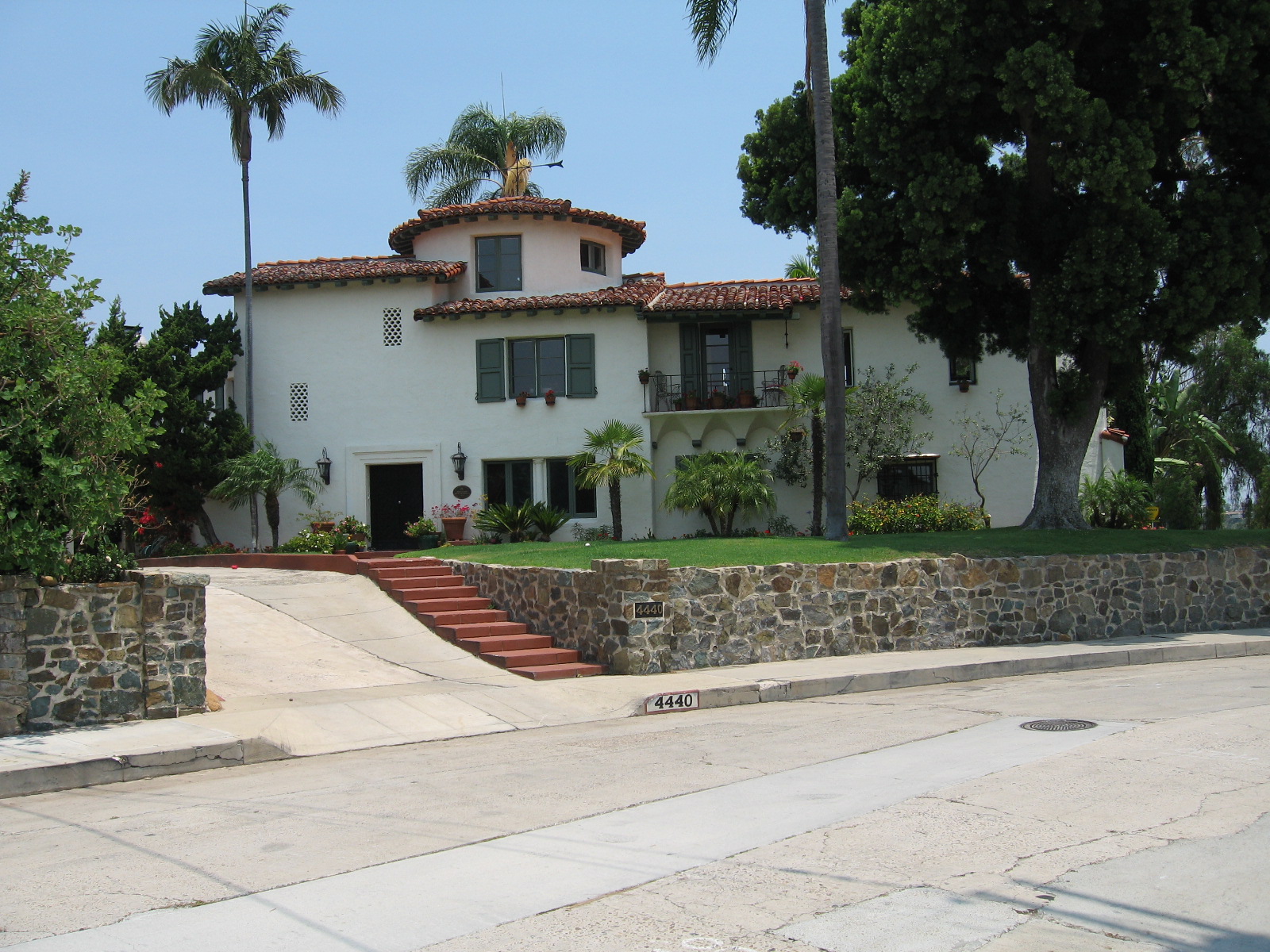
Beth Sarim (Hebrew בית שרים "House of the Princes") is a ten-bedroom mansion in San Diego, California, constructed in 1929 in anticipation of various resurrected Old Testament biblical patriarchs or prophets such as Abraham, Moses, David, Isaiah and Samuel. It was maintained by the Watch Tower Society, the parent organization used by Jehovah's Witnesses, and was also used as a winter home and executive office for Watch Tower president Joseph Franklin Rutherford. The house was sold to a private owner in 1948.
Background
[edit]
In 1918, Watch Tower publications began predicting, under the direction of Rutherford, that Old Testament patriarchs or "princes" would be resurrected back to earthly life in 1925. It was taught that these "princes" would become earth's new leaders and that their resurrection would be a prelude to the inauguration of a new earthly society and the abolition of death.[1][2][3][4][5][6][7] (It had previously been taught that these individuals were to be raised shortly after 1914.[8][9]) These "princes" would use Jerusalem as their capital, with some of the "princes" being located in other "principal parts of the earth".[10] Despite the failure of this prediction, Rutherford continued to preach their imminent return.[11]

During this time, Rutherford spent winters in San Diego, California, for health reasons,[12] and "in time, a direct contribution was made for the purpose of constructing a house in San Diego for brother Rutherford's use".[13] The property was acquired in October 1929 by Robert J Martin and was given to Rutherford in December for the nominal fee of $10 (current equivalent $183). The house was built in that year.[14]
Rutherford named the property Beth Sarim and dedicated it for the use of the expected Old Testament "princes", who were now expected to be headquartered in San Diego instead of Jerusalem.[15][16] The deed for Beth Sarim, written by Rutherford, said that the property was to be held "perpetually in trust" for the Old Testament "princes" and was to be surrendered to them once they arrived.[17][18]
It was located in the Kensington Heights section of San Diego over an area of about 100 acres (0.40 km2), landscaped with olive, date, and palm trees so that the "princes" would "feel at home".[19] The 5,100 square feet (470 m2) residence, designed by San Diego architect Richard S. Requa, is a ten-bedroom Spanish mansion with an adjacent two-car garage.[20][21][22] The building costs at the time were about $25,000 (current equivalent $458,000).[23] Writing in the book Salvation in 1939, Rutherford explained that Beth Sarim would forever be used by the resurrected "princes".[24]
Occupation
[edit]

Rutherford moved into Beth Sarim in early 1930 and served as caretaker of the property awaiting the resurrection of the "princes". Newspapers of the time reported on Rutherford's lavish lifestyle, which included a 16-cylinder Fisher Fleetwood Cadillac coupe.[25][26][27] The residence was cited by Olin R. Moyle, former legal counsel for Jehovah's Witnesses, in a letter to Rutherford in 1939, as one of the examples of "the difference between the accommodations furnished to you, and your personal attendants, compared with those furnished to some of your brethren".[28][29]
Walter F. Salter, former manager of the Canadian branch of the Watch Tower Society, also criticized Rutherford's use of Beth Sarim.[30][31] A reply to Salter's criticisms of Rutherford was published in the May 2, 1937, Golden Age, with a photocopy of a letter from W. E. Van Amburgh, Secretary-Treasurer of the Watch Tower Society, stating:[32]
Not one cent of the funds of the Watch Tower Bible and Tract Society went into the construction of the home in San Diego where Judge Rutherford does his winter work. It was the gift of friends. I did not know of the existence of the house until I read of it in The Golden Age. Not one cent of the funds of the Watch Tower Bible and Tract Society went into either of the Cadillac cars used by Rutherford at San Diego and Brooklyn. They were the gift of friends.
The magazine Consolation (successor to The Golden Age) explained that Beth Sarim served as Rutherford's winter headquarters:[33]
For twelve winters Judge Rutherford and his office force occupied Beth Sarim. It was not used as a place of ease or vacationing, but was used as a winter workshop; the books from Vindication, Book One down to and including Children were written there, as well as many Watchtower articles and booklets. The executive instructions for branches all over the earth also were transmitted from Beth-Sarim during the Judge's presence there. At Beth Sarim, Judge Rutherford completed the 1942 Yearbook material as his last work before his death. He dictated this material from his dying bed.
Rutherford's burial
[edit]Rutherford died at Beth Sarim on January 8, 1942, at the age of 72.[34][35] After his death, Rutherford's burial was delayed for three and a half months due to legal proceedings arising from his desire to be buried at Beth Sarim, which he had previously expressed to three close advisers from Brooklyn headquarters.[36][37] Witnesses collected over 14,000 signatures on a petition that Rutherford's dying wish might be granted. The May 27, 1942, Consolation explained:
As early as 1920 Judge Rutherford pointed out that the ancient witnesses or princes were promised an earthly resurrection by the Lord. In that year he delivered a public address at Los Angeles, California, entitled 'Millions Now Living Will Never Die,' in which he called attention to the expectations of the return of the men above mentioned. All the publications since emphasize the same fact. It therefore appears that the return of the princes is a fundamental teaching of the Scriptures. It is as certain as the truth of God's Word. Judge Rutherford gave much of his life in endeavoring to bring this vital matter to the people's attention. What, then, could be more fitting and appropriate before God and before men that his bones should rest on the land held in trust for the men whose coming he was privileged to announce.
Consolation condemned San Diego County officials for their refusal to grant a permit for Rutherford's burial at Beth Sarim or on a neighboring property named Beth Shan,[38][39][40] also owned by the Watchtower Society:
It was not the fate of the bones which they decided, but their own destiny. Nor is their blood on anyone else's head, because they were told three times that to fight against God, or to tamper with His servant's bones even, would bring upon them the condemnation of the Lord. ... So their responsibility is fixed, and they followed the course of Satan.
After all appeals were exhausted, Consolation stated that Rutherford's remains were shipped to New York where he was buried on April 25, 1942.[41] Critics have speculated that Rutherford was secretly buried at Beth Sarim.[42][43][44] The May 4, 1942, issue of Time noted Rutherford's burial at Rossville, New York, on Staten Island;[45] a private burial plot for Watch Tower branch volunteers is on Woodrow Road.[46] The exact grave location is unmarked; in 2002, a caretaker at Woodrow United Methodist Church and Cemetery (an adjoining graveyard) answered an inquiry about Watch Tower's plot by noting "I couldn't tell you who is buried on it because it has absolutely no markers or headstones or anything."[47]
Sale of property
[edit]
After Rutherford's death, the Watchtower Society maintained Beth Sarim for a few years,[48] before selling the property in 1948.[49] The belief that the "princes" would be resurrected before Armageddon was abandoned in 1950.[50][51][52][53] In 1954, when asked at a trial in Scotland why the property was sold, Frederick William Franz—then vice president of the Watch Tower Society—explained:[54]
Because it was there, and the prophets had not yet come back to occupy it, to make use of it, and the Society had no use for it at the time, it was in charge of a caretaker, and it was causing expense, and our understanding of the Scriptures opened up more, and more concerning the Princes, which will include those prophets, and so the property was sold as serving no present purpose.
The house is now privately owned and has been designated Historical Landmark number 474 by the City of San Diego.[55][56]
See also
[edit]References
[edit]- ^ <Please add first missing authors to populate metadata.> (June 15, 1918). "Questions Concerning Ezekiel's Temple". Watchtower. p. 6279.
- ^ J. F. Rutherford (1920). Millions Now Living Will Never Die. Watchtower. pp. 89–90. Archived from the original on 2021-02-11. Retrieved 2008-08-20. PDF version Archived 2008-07-19 at the Wayback Machine
- ^ W. E. Van Amburgh (1924). The Way to Paradise (PDF). Watchtower. pp. 215–224. Archived from the original (PDF) on 2008-06-26. Retrieved 2008-07-19.
- ^ W. E. Van Amburgh (December 31, 1924). "A Bible For the Scientist" (PDF). Golden Age. pp. 220–222. Archived from the original (PDF) on February 27, 2008.
- ^ J. F. Rutherford (1925). Comfort For the People (PDF). Watchtower. pp. 1, 9, 39. Archived from the original (PDF) on 2011-05-29. Retrieved 2008-07-25.
- ^ <Please add first missing authors to populate metadata.> (June 2, 1919). "New Date For Millennium: Russellites Now See It Coming on Earth in 1925" (PDF). The New York Times.
- ^ "'End of the World' Prophesied for 1925". The Argus. Melbourne, Australia. October 30, 1920. p. 6.News Clippings from the "Millions Now Living Will Never Die" Campaign (1919-1925) Archived 2008-06-26 at the Wayback Machine
- ^ <Please add first missing authors to populate metadata.> (October 15, 1904). "The Rank of the Ancient Worthies" (PDF). Zion's Watch Tower and Herald of Christ's Presence. p. 313. Archived from the original (PDF) on October 8, 2008. Retrieved July 28, 2008.
- ^ <Please add first missing authors to populate metadata.> (September 1, 1908). "A Father's Letter to His Son" (PDF). Watch Tower. p. 264.
- ^ J. F. Rutherford (1924). A Desirable Government (PDF). Watchtower. p. 30. Archived from the original (PDF) on 2011-05-29. Retrieved 2008-08-02.
The [prince] in authority at Jerusalem will give direction as to the carrying out of governmental affairs in different parts of the earth. With great improved broadcasting stations we can expect Abraham from Mount Zion to direct the affairs of the whole earth.
- ^ J. F. Rutherford (1932). What You Need (PDF). Watchtower. pp. 8–10. Archived from the original (PDF) on 2011-05-29. Retrieved 2008-07-20.
This prophecy shows, therefore, that Christ the King will make those faithful men the princes or visible rulers in all the earth. That means that soon you may expect to see Abraham, Enoch, Moses, David and all of these other faithful men back on earth.
- ^ Jehovah's Witnesses: Proclaimers of God's Kingdom. Watchtower. 1993. p. 76.
- ^ 1975 Yearbook of Jehovah's Witnesses. Watchtower. 1974. p. 194.
- ^ Robert J Martin (1930). "Golden Age" (PDF). Watch Tower. p. 405.
In October, 1929, I went to California and acquired the title to the ground in my name...
- ^ Edmond C. Gruss (1970). Apostles of Denial (PDF). Presbyterian & Reformed. p. 226.
[Beth-Sarim was built] to give sagging hopes for the princes' return a boost.
- ^ <Please add first missing authors to populate metadata.> (July 25, 1931). "Beth-Sarim -- Much Talked About House" (PDF). The Messenger. Watchtower. pp. 6, 8. Archived from the original (PDF) on August 15, 2017. Retrieved April 24, 2009.
- ^ John H. Ferry (February 7, 1930). "Deed" (PDF). Vol. 1741. San Diego: Country Record office. p. 69. Archived from the original (PDF) on 2 October 2011.
{{cite magazine}}: Cite magazine requires|magazine=(help) - ^ Robert J Marten (March 19, 1930). "Deed". Golden Age. Vol. XI, no. 274. Watch Tower. pp. 406–407.
- ^ "California Cults". Time. March 31, 1930. p. 60. Scan of original Time article
- ^ Jerome Beatty (November 1940). "Peddlars of Paradise" (PDF). The American. p. 54. Archived from the original (PDF) on 2012-03-19. Retrieved 2011-02-06.
- ^ Stanley High (September 14, 1940). "Armageddon, Inc" (PDF). The Saturday Evening Post. p. 52.
- ^ Gruss & Chretien. "Beth Sarim: A Monument to a False Prophet and to False Prophecy" (PDF). See [1] Archived 2010-07-18 at the Wayback Machine for Requa's contribution to architecture in California.
- ^ Edmond C. Gruss (2001). Jehovah's Witnesses: Their Claims, Doctrinal Changes and Prophetic Speculation. Xulon Press. p. 216. ISBN 978-1-931232-30-2.
- ^ J. F. Rutherford (1939). "GOD'S GOVERNMENT". Salvation. Watchtower. pp. 311–312. Archived from the original on 2016-03-03. Retrieved 2008-07-19.. See also The New World (PDF). Watchtower. 1942. pp. 104–105. Archived from the original (PDF) on 2011-05-29. Retrieved 2008-07-30.
- ^ "Interview with J.F. Rutherford". San Diego Sun. March 15, 1930. Archived from the original on 2002-11-16.
- ^ Leonard & Marjorie Chretien (1988). Witnesses of Jehovah (PDF). Harvest House. p. 45. Archived from the original (PDF) on 2011-06-01. Retrieved 2011-02-06.
To place the value of this automobile in perspective, a new Ford in 1931 cost approximately $600. A 16-cylinder Cadillac cost between $5,400 and $9,200, depending on style.
- ^ <Please add first missing authors to populate metadata.> (March 23, 1930). "Judge Awaits Next Coming of King David" (PDF). Syracuse Herald-Journal.
- ^ "Olin R. Moyle's Letter to J.F. Rutherford" (PDF). Archived from the original (PDF) on 2011-09-01. Retrieved 2011-02-06.
- ^ Tony Wills (2007). A People For His Name: A History of Jehovah's Witnesses and an Evaluation. Lulu.com. pp. 202–204. ISBN 978-1-4303-0100-4.
- ^ M. James Penton (1997). Apocalypse Delayed: The Story of Jehovah's Witnesses. University of Toronto Press. pp. 73–75. ISBN 978-0-8020-7973-2.
- ^ "W.F. Salter's Letter to J.F. Rutherford" (PDF). Archived from the original (PDF) on 2012-03-19. Retrieved 2011-02-06.
- ^ <Please add first missing authors to populate metadata.> (May 2, 1937). "Why Salter Lost His Job" (PDF). The Golden Age. Watchtower. p. 499. Archived from the original (PDF) on March 3, 2012. Retrieved January 15, 2011.
- ^ <Please add first missing authors to populate metadata.> (May 27, 1942). "San Diego's Officials Line Up Against Earth's New Princes" (PDF). Consolation. Watchtower. pp. 5–6. Archived from the original (PDF) on March 19, 2012. Retrieved February 6, 2011.
- ^ Let Your Name Be Sanctified. Watchtower. 1961. pp. 335–336. Archived from the original on 2017-08-19. Retrieved 2009-03-28.
- ^ <Please add first missing authors to populate metadata.> (January 11, 1942). "Witness Sect Founder Dies". St. Petersburg Times.
- ^ Jehovah's Witnesses - Proclaimers of God's Kingdom. p. 90.
- ^ <Please add first missing authors to populate metadata.> (January 26, 1942). "Witnesses Ask Right To Bury Leader". The Evening Independent (St Petersburg, Florida). p. 18.[permanent dead link]
- ^ Beth Shan was a 200 acre estate owned by the Watchtower Society about a mile and a half due east of Beth Sarim across the canyon in which Fairmont Avenue runs. <Please add first missing authors to populate metadata.> (February 18, 1942). "No Will Left By Rutherford, Says Secretary". The San Diego Union. p. B–7. Archived from the original on March 19, 2012. Retrieved February 6, 2011.
- ^ "Beth Shan -- The Watchtower's "House of Security"". Archived from the original on 2008-10-02.
- ^ "Beth Shan and the Return of the Princes". 9 June 2009. Retrieved 2021-12-01.
- ^ <Please add first missing authors to populate metadata.> (May 27, 1942). "San Diego's Officials Line Up Against Earth's New Princes" (PDF). Consolation. Watchtower. pp. 9, 14–16. Archived from the original (PDF) on March 19, 2012. Retrieved February 6, 2011.
- ^ Leonard & Marjorie Chretien (1988). Witnesses of Jehovah (PDF). Harvest House. p. 49. Archived from the original (PDF) on 2011-06-01. Retrieved 2011-02-06.
- ^ "San Diego Reader". June 28, 2008.
- ^ Mallios (2007). Cemeteries of San Diego. Arcadia Publishing. p. 112. ISBN 978-0-7385-4714-5.
- ^ <Please add first missing authors to populate metadata.> (May 4, 1942). "Buried". Time. Archived from the original on October 14, 2010.
- ^ "Announcements", The Watchtower, October 1, 1966, page 608
- ^ Van Amburgh, W. E. (2005). The way to paradise. An enlarged replica of the International Bible Students Association's original 1924 book. Lulu.com. pp. 45, 46. ISBN 1-4116-5971-6. Retrieved 2009-07-12.
- ^ Bill Davidson (November 22, 1946). "Jehovah's Traveling Salesmen" (PDF). Collier's. p. 75.
- ^ "Beth-Sarim". 9 June 2009. Retrieved 2021-12-01.
- ^ Jehovah's Witnesses: Proclaimers of God's Kingdom. Watchtower. 1993. p. 76.
At the time, it was believed that faithful men of old times, such as Abraham, Joseph, and David, would be resurrected before the end of this system of things and would serve as 'princes in all the earth,' in fulfillment of Psalm 45:16. This view was adjusted in 1950, when further study of the Scriptures indicated that those earthly forefathers of Jesus Christ would be resurrected after Armageddon.
- ^ Jehovah's Witnesses in the Divine Purpose (PDF). Watchtower. 1959. pp. 252–253. Archived from the original (PDF) on 2016-04-09. Retrieved 2008-07-21.
- ^ For reactions to the announcement of the change of belief, see "The 'Princes' Are Here" in 1975 Yearbook of Jehovah's Witnesses. Watchtower. 1974. pp. 213–214.
- ^ Barbara Grizzuti Harrison (1978). Visions of Glory: A History and a Memory of Jehovah's Witnesses. Simon & Schuster. pp. 180–181, 269–270. Archived from the original on February 9, 2004.
- ^ "Douglas Walsh vs. The Right Honorable James Latham Clyde, M. P. C." (PDF).
- ^ "Historical Landmarks Designated by the San Diego Historical Resources Board" (PDF).
- ^ "landmarklist.pdf" (PDF). City of San Diego. City of San Diego. Retrieved 5 February 2024.


External links
[edit]