Hubbry Logo
BiribiBiribiMain
Open search
Biribi
Community hub
Biribi
logo
8 pages, 0 posts
0 subscribers
Be the first to start a discussion here.
Biribi
Biribi
from Wikipedia
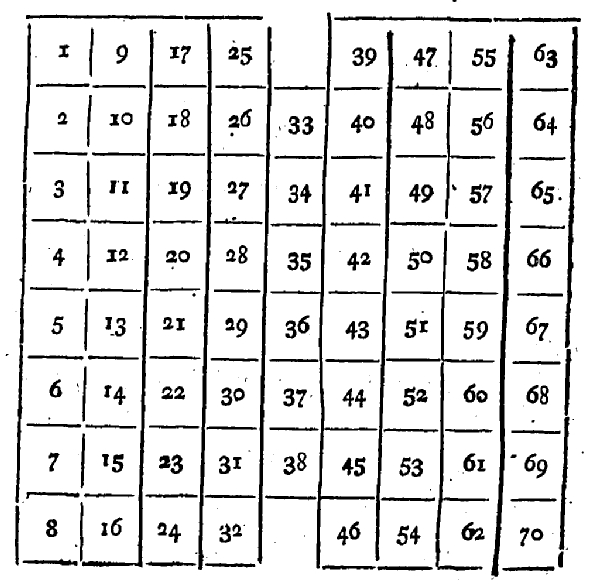
Tableau for Biribi (1788)
Richly illustrated historical Biribi board from the 18th century

Biribi, biribissi (in Italian), or cavagnole (in French), is an Italian game of chance similar to keno, played for low stakes. It is played on a board on which the numbers 1 to 70 are marked.[1] The game was banned in Italy in 1837.

The players put their stakes on the numbers they wish to back. The banker is provided with a bag from which he draws a case containing a ticket, the tickets corresponding with the numbers on the board. The banker calls out the number, and any players who backed it receive sixty-four times their stake; all other stakes go to the banker.[2]

Casanova played it in Genoa (illegally, for it was already banned there) and the South of France in the 1760s, and describes it as "a regular cheats' game".[3][4] He broke the bank (fairly, he claims) and was immediately rumored to have been in collusion with the bag-holder; such collusion, presumably, was common.[5]

In the French army, "to be sent to Biribi" was a cant term for being sent to the disciplinary battalions in Algeria.[2]

References

[edit]
Revisions and contributorsEdit on WikipediaRead on Wikipedia
from Grokipedia
Biribi, also referred to as biribissi in Italian contexts, is a historical lottery-style that originated in during the , wherein players wager on selected numbers from a predefined grid, with the winning number determined by drawing a token from a bag or similar container. Typically featuring around 70 numbers, the game offered payouts of approximately 64 times the stake for correct bets, emphasizing pure over any element of skill or strategy. It gained widespread popularity in , particularly in and during the 17th and 18th centuries, where it was commonly played in domestic settings after meals or in informal social gatherings, contributing to the era's burgeoning interest in probability and . In , variants involved betting on numbers from 1 to 72, reflecting adaptations to local preferences, while the game's simplicity and low-stakes nature made it accessible yet addictive, leading to regulatory scrutiny and eventual prohibition in by 1837 amid broader efforts to curb excesses. Scholars regard biribi as a precursor to modern casino games like , due to its number-based betting mechanics, though it lacked a and relied instead on static draws.

Origins and History

Early Development in Italy

![Interior of an Italian villa featuring a biribissi game table]float-right Biribi, referred to in Italy as biribissi or biribisso, originated as a during the era, with documented practices emerging in the 16th and early 17th centuries in regions such as and . It functioned as a rudimentary , where participants placed bets on numbers associated with Renaissance betting customs, drawing parallels to variants like cavagnole. The game's simplicity, relying solely on random draws without any element of skill, made it accessible for domestic entertainment. By the mid-17th century, printed boards for biribissi appeared, such as those produced by engraver Giovanni Giacomo de' Rossi in between 1642 and 1691, featuring grids with 42 numbered compartments. These boards facilitated play in private homes, often after evening meals, and were sometimes incorporated into public festivities like Venetian carnivals, where games thrived despite occasional prohibitions. Historical accounts highlight its prevalence in informal social settings, underscoring its role in everyday leisure rather than formalized wagering. The game's early Italian form emphasized numerical betting on chance outcomes, with tokens drawn from a to determine winners, reflecting broader European trends in probability-based amusements predating more complex developments. Despite its popularity, biribissi operated in a legally ambiguous space, frequently played illicitly in households to evade restrictions on . This domestic focus distinguished its initial phase from later public adaptations elsewhere.

Spread to France and Popularity

Biribi arrived in France from Italy in the early 18th century, succeeding earlier lottery-style games like hoca that had appeared mid-17th century. The game quickly spread to urban centers such as Paris and southern provinces, where it was played illicitly in taverns and private venues amid ongoing efforts to suppress unauthorized gambling. By the mid-18th century, biribi had achieved peak popularity across , attracting participants from to commoners through its straightforward betting on numbers 1 to 72 drawn from a bag. Contemporary memoirs, such as those of , document its appeal among elite women in the , who engaged enthusiastically despite the game's reputation for cheating and the risks of financial ruin it posed. This broad social penetration reflected and reinforced the era's burgeoning gambling culture, amplified by the "probability revolution" that familiarized players with statistical concepts like the . Variations emerged around , offering bets on individual numbers, columns, or later even-money options like red/black, further enhancing its and contributing to its ubiquity until stricter prohibitions took effect in 1787. While promoting transient social mixing in clandestine settings, biribi's prevalence also highlighted concerns in period accounts of compulsive play and losses.

Decline and Bans

In , Biribi faced early prohibitions in certain regions during the , driven by moral concerns over its potential for and economic exploitation of participants. For instance, by the 1760s, the game was already illegal in , where it was played clandestinely despite official bans reflecting broader and state efforts to curb games of chance that encouraged and financial distress among the populace. These restrictions aligned with longstanding anti-gambling sentiments prioritizing individual responsibility, as evidenced by repeated edicts against lotteries and similar pursuits that disproportionately favored operators through manipulated draws and inadequate payouts. France saw a more formalized suppression of Biribi, with repression intensifying in the and culminating in a definitive nationwide ban in 1837 amid a sweeping crackdown on all games of . This measure, enacted under King Louis-Philippe, closed gambling establishments across the country effective December 31, 1837, targeting Biribi's inherent vulnerabilities to cheating—such as rigged bags or marked numbers—and its house advantage, which systematically eroded players' funds over repeated plays. Contemporary accounts, including those from gamblers like , highlighted the game's "cheats' nature," underscoring causal links to widespread losses and social harms like indebtedness. The decline of Biribi was further hastened by competition from emerging alternatives like , which offered faster play and broader appeal while inheriting similar mechanics but evading some early scrutiny through novelty. Despite bans, the game persisted underground in both nations, with illicit operations evading enforcement and perpetuating unverifiable assertions of fairness amid persistent operator advantages. This legacy illustrates how regulatory interventions, though motivated by observable patterns of ruinous play, struggled against the enduring allure of high-variance chance games.

Rules and Gameplay

Equipment and Setup

Biribi requires a central board displaying numbers from 1 to 70, arranged in a grid layout to facilitate player viewing and betting placement. These boards were typically constructed from durable materials such as cloth or , ensuring portability and resilience in informal settings across 18th-century . The banker utilizes a simple bag, often , filled with 70 corresponding numbered tokens, balls, or paper coupons, one for each number on the board. This container serves as the random selection device, with a single item drawn blindly to reveal the outcome, emphasizing the game's reliance on unadulterated chance without mechanical interventions like wheels. Setup involves positioning the board accessibly for participants while the banker controls the draw bag, maintaining a minimalist configuration that distinguishes Biribi from more elaborate games requiring skill or apparatus. No additional tools or markers beyond these core elements are necessary, as the design prioritizes straightforward randomness over complexity.

Betting and Drawing Procedure

Players place bets by staking money or tokens directly on selected numbers marked on a board divided into 70 squares, each corresponding to a possible outcome numbered from 1 to 70. After all wagers are made, the banker publicly draws a single token or rolled paper slip bearing a number from a or container holding equivalents for each of the 70 numbers, ensuring transparency in the selection process. The extracted number is announced aloud to the participants, determining the winning outcome, with no further input or actions permitted from players, underscoring the game's foundation in pure randomness. Draws are conducted openly to minimize , though contemporary accounts describe elaborate mechanisms, such as tokens encased in wooden balls or helmets unlocked by keys, designed to deter manipulation by the banker despite occasional reports of rigging in unregulated settings. Multiple rounds may follow sequentially in a single session, with bets reset for each independent draw.

Payouts and Variations

In the standard form of Biribi, players betting on the correctly drawn number received a payout of 70 times their stake, reflecting the game's use of 70 possible numbers drawn from a or urn by the banker. This payout structure enabled the banker to retain stakes from unsuccessful bets, ensuring profitability over multiple rounds. Regional variations altered these payouts to match differing numbers of outcomes. Italian versions, such as Biribissi, frequently employed grids with 36, 48, or other counts up to 70 numbers, with payouts scaled accordingly—typically offering returns of n-1 times the stake for n numbers—to maintain a similar advantage for the house, though exact ratios depended on the organizer's setup. These adjustments influenced player expectations, as smaller grids implied higher win probabilities but potentially lower relative rewards per unit bet. French adaptations of Biribi, while retaining the core number-drawing mechanic, occasionally featured localized rules with inconsistent payout applications across sessions, as noted in period records, which fueled contemporary complaints about variability in banker conduct despite advertised odds. Such discrepancies highlighted how house retention of unclaimed stakes could exceed nominal expectations in practice, affecting perceived fairness without altering the fundamental reward for direct number matches.

Mathematical and Probabilistic Analysis

House Edge and Odds

In Biribi, 70 equally likely numbers determine outcomes, yielding a winning probability of 1/70 for any specific bet. The banker compensates winning wagers at 64 times the stake, with the original stake retained by the house irrespective of result. This structure produces an of 64/70 per unit wagered, equivalent to approximately 0.9143 units, establishing a house edge of 6/70 or precisely 8 and 4/7 percent. This disparity between true (69:1 for fairness, accounting for the house's retention of losing stakes) and the offered payout ratio embeds a systematic advantage for , as formalized in probabilistic analyses of the era. P. N. Huyn's treatise La Théorie des jeux de hasard quantifies this edge explicitly, demonstrating how the game's design precludes equilibrium between player outlays and aggregate returns. Over repeated trials, the converges outcomes to this expectation, rendering sustained player profitability improbable absent exhaustive coverage of all numbers—an impractical condition given betting constraints. Wagering exclusively on subsets of numbers further bolsters the house's position, as stakes on undrawn, unbet outcomes revert fully to the banker without payout obligation. While anecdotal streaks may suggest parity, the zero-sum mechanics—wherein player losses exclusively finance limited wins—align with rather than illusory fairness, a principle underscored by contemporaneous mathematical scrutiny during the 18th-century probability revolution.

Strategies and Fallacies

No viable strategies exist for Biribi, as the game's ensure each draw is an independent event with a fixed probability of 1 in 70 for any specific number, rendering predictive or pattern-based approaches ineffective. Players historically bet on clusters of numbers, personal , or patterns on the gaming board, believing these could exploit perceived imbalances, but such tactics merely diversified without altering the underlying odds dominated by chance. The frequently misled Biribi participants, who increased wagers on numbers absent from recent draws under the illusion they were "due," ignoring that prior outcomes exert no causal influence on subsequent independent selections from the bag of balls. This , observed in lottery-style games like Biribi, prompted overbetting during streaks, as players misinterpreted random variance as non-random momentum; for instance, analogous historical episodes post-Biribi showed bettors losing fortunes on "overdue" colors after prolonged runs. Empirical examinations of repeated random draws in similar systems confirm long-term distribution, with deviations in short sequences attributable solely to probabilistic variance rather than exploitable trends. Informed agency in Biribi required recognizing sunk costs and the game's negative , prompting cessation of play rather than escalation to recoup losses—a common pitfall normalized as mere entertainment despite the causal reality of inevitable house advantage over volume. Progressive betting systems, such as doubling stakes after losses, amplified without elevating win probabilities, as each round's outcome remained decoupled from prior results.

Cultural and Social Impact

Role in 18th-Century Society

Biribi served as an accessible form of in 18th-century and , appealing to diverse social classes through its simple mechanics and low entry stakes, which distinguished it from higher-risk games favored by the . Played in salons among nobles, as evidenced by the participation of figures like the Duchesse du in evening sessions, it acted as a social lubricant fostering interaction and in aristocratic circles. In more modest settings, including and taverns, soldiers and commoners engaged in the game for diversion, with historical anecdotes describing impromptu rounds interrupted only by routine duties. This widespread adoption underscored its role in providing affordable recreation amid the era's expanding urban amusements. Despite its recreational appeal, biribi contributed to personal financial strains, particularly among lower-class participants who wagered repeatedly despite the game's inherent house advantage, leading to cumulative losses that deepened economic disparities. Memoirs and contemporary accounts, such as those referencing ill-famed play among gamblers like , link excessive engagement in biribi and similar lotteries to debts and disrupted family finances, highlighting causal pathways from habitual betting to broader social costs like reduced household stability. While empirical data on rates specific to biribi remain sparse, the game's in a period of rising culture amplified externalities, including wealth transfers to operators that disproportionately burdened the working masses over time. These dynamics reflected underlying incentives where short-term entertainment often yielded long-term economic harm, independent of moral judgments.

Influence on Modern Gambling Games

Biribi contributed the foundational mechanic of betting on numbered grids to modern , where players stake on specific numbers or groups drawn randomly. Originating in 17th-century , the game used a board marked with numbers 1 to 70 for wagers, with outcomes determined by drawing a token from a , establishing a pure-chance framework that directly informed roulette's layout and betting options. This system retained its lottery essence in roulette but evolved post-1720 through hybridization with a , replacing the bag draw with a landing on numbered pockets to enhance perceived fairness while preserving the house's probabilistic advantage. The game's influence extended to bingo and lotto variants, mirroring their grid-based number matching without introducing skill-based elements, thus ensuring persistent house dominance through scaled edges on random draws. Biribi's 70-number format echoed in early European lotteries, promoting widespread adoption of straightforward chance betting that facilitated expansions by the , as operators capitalized on high-volume, low-payout structures for profitability. Empirical patterns from historical play, such as consistent losses due to uneven favoring , underscored how Biribi's model enabled sustainable enterprises by embedding mathematical edges in ostensibly equitable games.

Later Usage and References

Adoption as Military Slang

Following the 1837 prohibition of biribi as a game of chance in , the term "biribi" entered to denote the punitive disciplinary battalions of the , particularly those deployed in . This repurposing evoked the game's lottery-like mechanics, symbolizing the capricious and severe fate of soldiers sentenced to these units for offenses such as , , or criminal convictions during service. The slang underscored the arbitrary draw of , where assignment to biribi meant grueling labor, isolation, and high mortality rates under colonial conditions, rather than structured rehabilitation. The primary institutions termed "biribi" were the Bataillons d'Infanterie Légère d'Afrique (BILA), established in amid the to house military offenders and convicts fulfilling sentences through service. These units, often stationed in remote outposts like those in or , expanded significantly by the late , reaching five battalions of six companies each by May 1888 to accommodate growing numbers of disciplinés—soldiers degraded from regular ranks. Conditions within biribi formations involved forced marches, exposure to disease, and corporal punishments, including the cabarrier (a form of flogging), as documented in army records and survivor accounts, with annual death rates exceeding 10% in the 1880s due to , , and exhaustion. The slang's etymological persistence reflected broader army reforms post-Napoleonic era, where biribi camps served as a deterrent mechanism, assigning "random" punitive roles akin to drawing an unlucky number in the game, prioritizing deterrence through hardship over reformative ideals prevalent in prisons. By the , "envoyé au biribi" had become idiomatic for any demotion to these North African penal detachments, extending to similar facilities in and until their gradual dismantlement after scandals exposed systemic abuses in the early . This usage highlighted the causal link between infraction and unrelenting colonial frontline duty, with over 20,000 men processed through biribi annually at its peak, per military archives.

In Literature and Media

Georges Darien's 1890 novel Biribi portrays the severe conditions within French disciplinary battalions in North Africa, using the slang term "Biribi" to denote these penal units characterized by corporal punishment, arbitrary discipline, and exploitative labor. Drawing from real military experiences, the work critiques systemic abuses in the colonial army without idealization, emphasizing the dehumanizing effects on enlisted men sent there for minor infractions. Giacomo Casanova's memoirs describe encounters with Biribi as a gambling game in 1760s Genoa and southern France, where it operated illegally despite bans, and he labels it a "regular cheats' game" involving widespread fraud among players and operators. These accounts highlight the game's reputation for deception and risk, reflecting its status as a vice attracting both nobility and commoners in clandestine settings. The slang usage of Biribi for punitive military fate appears in later French literature as a metaphor for inescapable hardship, underscoring the term's evolution from a game of chance to a symbol of institutional cruelty.

References

Add your contribution
Related Hubs
User Avatar
No comments yet.