



Community hub
Recent from talks
Contribute something
Nothing was collected or created yet.
Bit error rate
View on Wikipedia | This article needs additional citations for verification. (March 2013) |
In digital transmission, the number of bit errors is the number of received bits of a data stream over a communication channel that have been altered due to noise, interference, distortion or bit synchronization errors.
The bit error rate (BER) is the number of bit errors per unit time. The bit error ratio (also BER) is the number of bit errors divided by the total number of transferred bits during a studied time interval. Bit error ratio is a unitless performance measure, often expressed as a percentage.[1]
The bit error probability pe is the expected value of the bit error ratio. The bit error ratio can be considered as an approximate estimate of the bit error probability. This estimate is accurate for a long time interval and a high number of bit errors.
Example
[edit]As an example, assume this transmitted bit sequence:
1 1 0 0 0 1 0 1 1
and the following received bit sequence:
0 1 0 1 0 1 0 0 1,
The number of bit errors (the underlined bits) is, in this case, 3. The BER is 3 incorrect bits divided by 9 transferred bits, resulting in a BER of 0.333 or 33.3%.
Packet error ratio
[edit]The packet error ratio (PER) is the number of incorrectly received data packets divided by the total number of received packets. A packet is declared incorrect if at least one bit is erroneous. The expectation value of the PER is denoted packet error probability pp, which for a data packet length of N bits can be expressed as
- ,

assuming that the bit errors are independent of each other. For small bit error probabilities and large data packets, this is approximately

Similar measurements can be carried out for the transmission of frames, blocks, or symbols.
The above expression can be rearranged to express the corresponding BER (pe) as a function of the PER (pp) and the data packet length N in bits:
![{\displaystyle p_{e}=1-{\sqrt[{N}]{(1-p_{p})}}}](https://wikimedia.org/api/rest_v1/media/math/render/svg/f5d380e45b0451c45265e199221fae5bd5b84bf9)
Factors affecting the BER
[edit]In a communication system, the receiver side BER may be affected by transmission channel noise, interference, distortion, bit synchronization problems, attenuation, wireless multipath fading, etc.
The BER may be improved by choosing a strong signal strength (unless this causes cross-talk and more bit errors), by choosing a slow and robust modulation scheme or line coding scheme, and by applying channel coding schemes such as redundant forward error correction codes.
The transmission BER is the number of detected bits that are incorrect before error correction, divided by the total number of transferred bits (including redundant error codes). The information BER, approximately equal to the decoding error probability, is the number of decoded bits that remain incorrect after the error correction, divided by the total number of decoded bits (the useful information). Normally the transmission BER is larger than the information BER. The information BER is affected by the strength of the forward error correction code.
Analysis of the BER
[edit]The BER may be evaluated using stochastic (Monte Carlo) computer simulations. If a simple transmission channel model and data source model is assumed, the BER may also be calculated analytically. An example of such a data source model is the Bernoulli source.
Examples of simple channel models used in information theory are:
- Binary symmetric channel (used in analysis of decoding error probability in case of non-bursty bit errors on the transmission channel)
- Additive white Gaussian noise (AWGN) channel without fading.
A worst-case scenario is a completely random channel, where noise totally dominates over the useful signal. This results in a transmission BER of 50% (provided that a Bernoulli binary data source and a binary symmetrical channel are assumed, see below).


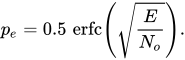
In a noisy channel, the BER is often expressed as a function of the normalized carrier-to-noise ratio measure denoted Eb/N0, (energy per bit to noise power spectral density ratio), or Es/N0 (energy per modulation symbol to noise spectral density).
For example, in the case of BPSK modulation and AWGN channel, the BER as function of the Eb/N0 is given by:
,
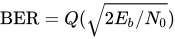
where . [2]

People usually plot the BER curves to describe the performance of a digital communication system. In optical communication, BER(dB) vs. Received Power(dBm) is usually used; while in wireless communication, BER(dB) vs. SNR(dB) is used.
Measuring the bit error ratio helps people choose the appropriate forward error correction codes. Since most such codes correct only bit-flips, but not bit-insertions or bit-deletions, the Hamming distance metric is the appropriate way to measure the number of bit errors. Many FEC coders also continuously measure the current BER.
A more general way of measuring the number of bit errors is the Levenshtein distance. The Levenshtein distance measurement is more appropriate for measuring raw channel performance before frame synchronization, and when using error correction codes designed to correct bit-insertions and bit-deletions, such as Marker Codes and Watermark Codes.[3]
Mathematical draft
[edit]The BER is the likelihood of a bit misinterpretation due to electrical noise . Considering a bipolar NRZ transmission, we have

for a "1" and for a "0". Each of and has a period of .




Knowing that the noise has a bilateral spectral density ,

is
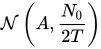
and is .
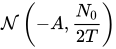
Returning to BER, we have the likelihood of a bit misinterpretation .

and
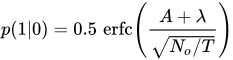
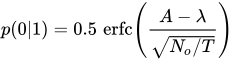
where is the threshold of decision, set to 0 when .


We can use the average energy of the signal to find the final expression :

±§
Bit error rate test
[edit]BERT or bit error rate test is a testing method for digital communication circuits that uses predetermined stress patterns consisting of a sequence of logical ones and zeros generated by a test pattern generator.
A BERT typically consists of a test pattern generator and a receiver that can be set to the same pattern. They can be used in pairs, with one at either end of a transmission link, or singularly at one end with a loopback at the remote end. BERTs are typically stand-alone specialised instruments, but can be personal computer–based. In use, the number of errors, if any, are counted and presented as a ratio such as 1 in 1,000,000, or 1 in 1e06.
Common types of BERT stress patterns
[edit]- PRBS (pseudorandom binary sequence) – A pseudorandom binary sequencer of N Bits. These pattern sequences are used to measure jitter and eye mask of TX-Data in electrical and optical data links.
- QRSS (quasi random signal source) – A pseudorandom binary sequencer which generates every combination of a 20-bit word, repeats every 1,048,575 words, and suppresses consecutive zeros to no more than 14. It contains high-density sequences, low-density sequences, and sequences that change from low to high and vice versa. This pattern is also the standard pattern used to measure jitter.
- 3 in 24 – Pattern contains the longest string of consecutive zeros (15) with the lowest ones density (12.5%). This pattern simultaneously stresses minimum ones density and the maximum number of consecutive zeros. The D4 frame format of 3 in 24 may cause a D4 yellow alarm for frame circuits depending on the alignment of one bits to a frame.
- 1:7 – Also referred to as 1 in 8. It has only a single one in an eight-bit repeating sequence. This pattern stresses the minimum ones density of 12.5% and should be used when testing facilities set for B8ZS coding as the 3 in 24 pattern increases to 29.5% when converted to B8ZS.
- Min/max – Pattern rapid sequence changes from low density to high density. Most useful when stressing the repeater's ALBO feature.
- All ones (or mark) – A pattern composed of ones only. This pattern causes the repeater to consume the maximum amount of power. If DC to the repeater is regulated properly, the repeater will have no trouble transmitting the long ones sequence. This pattern should be used when measuring span power regulation. An unframed all ones pattern is used to indicate an AIS (also known as a blue alarm).
- All zeros – A pattern composed of zeros only. It is effective in finding equipment misoptioned for AMI, such as fiber/radio multiplex low-speed inputs.
- Alternating 0s and 1s - A pattern composed of alternating ones and zeroes.
- 2 in 8 – Pattern contains a maximum of four consecutive zeros. It will not invoke a B8ZS sequence because eight consecutive zeros are required to cause a B8ZS substitution. The pattern is effective in finding equipment misoptioned for B8ZS.
- Bridgetap - Bridge taps within a span can be detected by employing a number of test patterns with a variety of ones and zeros densities. This test generates 21 test patterns and runs for 15 minutes. If a signal error occurs, the span may have one or more bridge taps. This pattern is only effective for T1 spans that transmit the signal raw. Modulation used in HDSL spans negates the bridgetap patterns' ability to uncover bridge taps.
- Multipat - This test generates five commonly used test patterns to allow DS1 span testing without having to select each test pattern individually. Patterns are: all ones, 1:7, 2 in 8, 3 in 24, and QRSS.
- T1-DALY and 55 OCTET - Each of these patterns contain fifty-five (55), eight bit octets of data in a sequence that changes rapidly between low and high density. These patterns are used primarily to stress the ALBO and equalizer circuitry but they will also stress timing recovery. 55 OCTET has fifteen (15) consecutive zeroes and can only be used unframed without violating one's density requirements. For framed signals, the T1-DALY pattern should be used. Both patterns will force a B8ZS code in circuits optioned for B8ZS.
Bit error rate tester
[edit]A bit error rate tester (BERT), also known as a "bit error ratio tester"[4] or bit error rate test solution (BERTs) is electronic test equipment used to test the quality of signal transmission of single components or complete systems.
The main building blocks of a BERT are:
- Pattern generator, which transmits a defined test pattern to the DUT or test system
- Error detector connected to the DUT or test system, to count the errors generated by the DUT or test system
- Clock signal generator to synchronize the pattern generator and the error detector
- Digital communication analyser is optional to display the transmitted or received signal
- Electrical-optical converter and optical-electrical converter for testing optical communication signals
See also
[edit]References
[edit]- ^ Jit Lim (14 December 2010). "Is BER the bit error ratio or the bit error rate?". EDN. Retrieved 14 October 2024.
- ^ BER calculation, Vahid Meghdadi, Université de Limoges, January, 2008
- ^ "Keyboards and Covert Channels" by Gaurav Shah, Andres Molina, and Matt Blaze (2006?)
- ^ "Bit Error Rate Testing: BER Test BERT » Electronics Notes". www.electronics-notes.com. Retrieved 2020-04-11.
 This article incorporates public domain material from Federal Standard 1037C. General Services Administration. Archived from the original on 2022-01-22. (in support of MIL-STD-188).
External links
[edit]Bit error rate
View on GrokipediaFundamentals
Definition
The bit error rate (BER) is a fundamental metric in digital communications that quantifies the reliability of data transmission by representing the ratio of the number of erroneous bits received to the total number of bits transmitted over a communication channel.[7][6] This measure captures the incidence of bit flips or distortions that occur due to noise, interference, or other impairments during transmission.[8] The standard notation for BER is given by: This value is typically expressed as a probability, such as , which signifies one erroneous bit per million transmitted bits.[7][9] In binary digital systems—where data is encoded as sequences of 0s and 1s—BER applies across diverse mediums, including wired connections (e.g., Ethernet cables with BER targets around ), wireless links (often experiencing BERs of or higher due to environmental factors), and optical fiber systems (where low BER is critical for high-speed data integrity).[9][10] Unlike mere counts of individual errors, BER emphasizes a probabilistic framework, enabling consistent performance evaluation and benchmarking of communication links under varying conditions, such as signal strength or channel quality.[7][4] This probabilistic perspective is essential for assessing overall link quality in real-world deployments.[7]Measurement and Units
Bit error rate (BER) is practically measured by transmitting a known reference sequence of bits through the communication system under test and comparing the received bits to the original sequence at the receiver end, with each mismatch counted as a bit error. The total number of errors is accumulated over an extended test period involving a large number of transmitted bits—often on the order of billions or more—to ensure the measurement captures representative system behavior and achieves sufficient statistical confidence. A widely adopted approach for generating these test sequences is the use of pseudorandom binary sequences (PRBS), such as PRBS-7, PRBS-15, or PRBS-31, which produce bit patterns that approximate random data while exercising the system's response to diverse transition densities and run lengths, thereby simulating real-world traffic conditions more effectively than fixed patterns.[11] The BER is fundamentally a dimensionless ratio, defined as the number of erroneous bits divided by the total number of bits transmitted during the test, and it can alternatively be expressed as a percentage for higher error rates (e.g., 1% for one error per 100 bits). However, given the extremely low error rates typical in modern digital systems—often far below 1%—BER is conventionally reported in logarithmic form as , where represents the number of orders of magnitude below unity; for instance, a BER of signifies one bit error per billion transmitted bits, facilitating compact notation and intuitive scaling for performance comparisons.[12] Acceptable BER thresholds vary by application but are critically low in reliability-sensitive domains like telecommunications to minimize data corruption and support error-correcting codes effectively; for example, international standards specify targets such as a BER not exceeding for optical line systems operating at rates up to 2.048 Mbit/s, while high-speed Ethernet links often aim for better than to ensure robust end-to-end performance.[13] Because bit errors occur as rare, random events modeled by binomial or Poisson distributions, BER measurements exhibit inherent statistical variability, with the precision improving as more bits are tested but remaining uncertain at low error rates due to potential zero-error outcomes in finite samples. To address this, confidence intervals are routinely computed alongside the point estimate of BER, providing a range (e.g., 95% confidence) within which the true error rate is likely to lie, often using methods like the Clopper-Pearson interval for binomial data or sequential Bayesian estimation to guide test duration and bound uncertainty efficiently.[14][15]Related Error Metrics
Packet Error Ratio
The packet error ratio (PER), also known as packet error rate, is defined as the ratio of the number of data packets received with at least one bit error to the total number of packets transmitted.[16][17] A packet is considered erroneous if any single bit within it is corrupted, rendering the entire packet potentially unusable without error correction mechanisms. PER is derived from the bit error rate (BER) under the assumption of independent bit errors in a binary symmetric channel. The approximate relationship is given by: where represents the average number of bits per packet.[16][17][18] This binomial approximation holds for low BER values but has limitations, such as inaccuracy in scenarios with burst errors where multiple consecutive bits are affected, violating the independence assumption.[18] In networked systems, PER serves as a key metric for evaluating data integrity at the protocol level, particularly in wireless and wired communications where erroneous packets often trigger retransmission requests or result in data loss.[16] For instance, in TCP/IP protocols, high PER can degrade throughput and increase latency, necessitating targets below 1% for high-speed links exceeding 100 Mbps.[19] In standards like LTE, the block error rate (BLER) target is typically 10% () to balance reliability and efficiency in mobile networks.[20] A notable impact of PER arises from packet size: even a low BER, such as , can yield a high PER for large packets (e.g., bits), as the probability of at least one error scales with length, emphasizing the need for forward error correction in long-packet scenarios.[16][17]Block Error Rate
The block error rate (BLER) measures the proportion of fixed-size data blocks in forward error correction (FEC) systems that contain uncorrectable errors after decoding, rendering the entire block erroneous. These blocks serve as the basic units in coded transmissions, where errors are detected via mechanisms like cyclic redundancy checks (CRC) appended to the coded data. BLER is a key metric in FEC frameworks using advanced codes such as turbo codes, employed in LTE standards for reliable data transmission, and low-density parity-check (LDPC) codes, integral to 5G NR for both uplink and downlink channels. In these systems, BLER assesses the post-decoding reliability of coded blocks, guiding link adaptation and hybrid automatic repeat request (HARQ) processes to maintain quality of service. The BLER is calculated as the ratio of erroneous blocks to the total transmitted blocks: In 5G NR, BLER targets are typically set below for control channels to ensure robust signaling, with even stricter requirements like for ultra-reliable low-latency communications (URLLC) scenarios.[21][22] The performance of BLER is significantly influenced by the code rate, which determines the redundancy level: lower code rates (higher redundancy) enhance error correction capability and reduce BLER at a given signal-to-noise ratio, though they decrease spectral efficiency. Similarly, longer block lengths generally improve coding gain and lower BLER by distributing errors more effectively across larger units, but they can increase decoding latency and risk error floors in iterative decoding algorithms like those for LDPC codes.[23]Influencing Factors
Environmental and Signal-Related Causes
Thermal noise, resulting from the random thermal motion of electrons in conductors and electronic components, represents a fundamental source of randomness in communication systems that can flip bits during transmission, thereby increasing the bit error rate (BER). This noise is inherent to all physical channels and becomes more pronounced at higher temperatures or in low-power signals. Additive white Gaussian noise (AWGN) models this thermal noise effectively in many analyses, assuming a flat power spectral density across the bandwidth and a Gaussian amplitude distribution, which simplifies BER predictions in idealized scenarios. Impulse noise, characterized by short-duration, high-amplitude bursts from sources like switching transients or man-made interference, introduces non-Gaussian disturbances that sporadically overwhelm receivers, leading to clusters of bit errors far exceeding those from continuous noise.[24] Signal attenuation through propagation paths exacerbates BER by weakening the desired signal relative to noise. Path loss, the progressive reduction in signal power due to geometric spreading and medium absorption, directly lowers received signal strength in wireless and wired systems, necessitating higher transmit powers to maintain acceptable error rates.[25] In wireless environments, multipath fading arises when signals reflect off obstacles and combine at the receiver with phase differences, causing rapid fluctuations in amplitude that distort symbols and elevate BER, particularly in urban or indoor settings.[26] For optical fiber links, chromatic and modal dispersion cause light pulses to spread temporally as different wavelengths or modes propagate at unequal velocities, inducing intersymbol interference that limits data rates and increases bit errors over long distances.[27] Environmental factors further compound these effects by introducing external perturbations. Electromagnetic interference (EMI), generated by nearby electrical equipment, power lines, or radio sources, couples into channels as unwanted energy, mimicking noise and directly contributing to bit corruptions in both wired and wireless setups.[28] In radio propagation, atmospheric phenomena such as rainfall, fog, or tropospheric turbulence attenuate signals through absorption and scattering, while also inducing scintillation that fades the received power, resulting in higher BER for links exceeding certain thresholds.[29] Crosstalk in bundled cables, where electromagnetic fields from one conductor induce voltages in adjacent ones, acts as correlated interference that degrades signal isolation, particularly at high frequencies, and raises BER in multi-channel data transmission.[30] Collectively, these environmental and signal-related causes degrade the signal-to-noise ratio (SNR), shifting operating conditions below the minimum required for low BER—typically around 10-9 to 10-12 for reliable systems—and thus amplifying overall error probabilities.[31] For instance, a 3 dB SNR drop from path loss or fading can double the BER in AWGN-dominated channels, underscoring the need for margin allocations in link budgets.System Design and Modulation Effects
In digital communication systems, the choice of modulation scheme significantly influences the bit error rate (BER) by determining the constellation's susceptibility to noise and distortion. Quadrature phase-shift keying (QPSK), which encodes two bits per symbol using four phase states, exhibits greater robustness to additive white Gaussian noise (AWGN) compared to higher-order schemes like 16-quadrature amplitude modulation (16-QAM), which packs four bits per symbol across a denser 16-point constellation. This increased density in 16-QAM reduces the minimum Euclidean distance between symbols, making it more prone to symbol errors that translate to higher BER at equivalent signal-to-noise ratios (SNRs); for instance, simulations in orthogonal frequency-division multiplexing (OFDM) systems show 16-QAM requiring approximately 4-6 dB higher SNR than QPSK to achieve a BER of .[32][33] Such trade-offs are critical in system design, as selecting higher-order modulations boosts spectral efficiency but demands enhanced error correction or power allocation to mitigate elevated error rates.[34] Bandwidth allocation and symbol rate decisions further shape BER performance through inherent trade-offs between data throughput and signal integrity. Increasing the symbol rate to support higher data rates expands the required bandwidth, which can amplify the impact of noise within the channel while potentially introducing inter-symbol interference (ISI) if the channel's dispersive effects are not adequately compensated. In bandwidth-constrained environments, such as ultra-low-power wireless systems, elevating the symbol rate beyond the channel's coherence bandwidth elevates the BER by enhancing susceptibility to phase noise and fading, often necessitating a power-bandwidth compromise where excess bandwidth is traded for improved error resilience at fixed BER targets like .[35][36] Conversely, conservative bandwidth usage with lower symbol rates minimizes these noise amplifications but limits overall capacity, highlighting the engineering balance required for reliable transmission.[37] Equalization and filtering techniques, integral to receiver design, can inadvertently elevate BER if implementations are imperfect, as they aim to counteract channel distortions but may introduce residual errors. Adaptive equalizers, such as those using least mean squares algorithms, mitigate ISI from multipath propagation, yet variations in filter length or adaptation speed can leave uncorrected distortions, leading to a BER degradation of up to 1-2 dB in high-speed channels.[38] Similarly, front-end filters in wireless local area network (WLAN) transceivers, if not precisely tuned, cause spectral regrowth or group delay variations that exacerbate symbol misalignment, resulting in measurable BER penalties even under moderate SNR conditions.[39] These design choices underscore the need for optimized filter structures to preserve signal fidelity without overcomplicating the system architecture.[40] Clock synchronization errors in serial links represent another controllable factor degrading BER, primarily through bit slips or sampling offsets that misalign data recovery. In high-speed serializers/deserializers, even minor timing drifts between transmitter and receiver clocks—arising from jitter or frequency offsets—can shift sampling points away from optimal eyes, causing bit errors that accumulate in long packets; studies indicate that synchronization mismatches exceeding 10% of the unit interval can double the BER in gigabit links. Effective clock and data recovery circuits, such as phase-locked loops, are essential to bound these errors, ensuring stable phase alignment and preventing error floors in asynchronous environments. These system-level decisions interact with environmental noise to compound BER, but their mitigation relies on precise engineering rather than external controls.[41]Mathematical Foundations
Basic BER Formula
The bit error rate (BER) is fundamentally defined through an empirical formula that quantifies the ratio of erroneous bits to the total bits transmitted or received in a communication system. This basic expression is where represents the total number of detected bit errors, and denotes the total number of bits processed over the measurement period.[42][43] This formula provides a direct, model-agnostic measure of error performance, applicable across various digital transmission scenarios. From a probabilistic perspective, the BER can be interpreted as the probability that any individual bit is received incorrectly, assuming bit errors occur independently of one another.[44] This interpretation aligns with the empirical ratio when the sample size is sufficiently large, allowing BER to serve as an estimate of the underlying error probability in statistical analyses of communication reliability. In systems incorporating forward error correction (FEC) codes, the BER is distinguished between pre-decoding (the raw error rate at the channel output before correction) and post-decoding (the residual error rate after decoding and correction).[45] Error-correcting mechanisms typically yield a significantly lower post-decoding BER compared to the pre-decoding value, demonstrating the coding gain that reduces the effective error rate—often by orders of magnitude depending on the code strength and channel conditions.[46] To illustrate, consider a scenario with 1,000 bit errors observed in a total of transmitted bits; applying the basic formula yields a BER of , a level often targeted in high-reliability systems such as fiber-optic networks.[47] BER is typically expressed in dimensionless form using scientific notation (e.g., ), with detailed units and notation conventions covered in the Measurement and Units section.Theoretical Models for BER Calculation
Theoretical models for bit error rate (BER) calculation provide foundational predictions for communication system performance under idealized conditions, building on the general BER expression as a starting point. These models assume a memoryless channel and focus on noise or fading effects to derive closed-form or integral expressions for error probability. In the additive white Gaussian noise (AWGN) channel, the BER for binary phase-shift keying (BPSK) modulation is given by where is the Gaussian Q-function, is the energy per bit, and is the noise power spectral density. This formula arises from the optimal detection threshold in a matched filter receiver, where noise is modeled as zero-mean Gaussian with variance . Extensions to other modulation schemes adjust the argument of the Q-function based on symbol energy and mapping. For quadrature phase-shift keying (QPSK), the BER is identical to BPSK, since QPSK can be decomposed into two independent BPSK signals on in-phase and quadrature components under Gray coding. For M-ary phase-shift keying (M-PSK), the BER involves more complex expressions accounting for bit-to-symbol mapping, often approximated using the symbol error rate and nearest-neighbor errors in the constellation. In Rayleigh fading channels, which model non-line-of-sight propagation with amplitude variations following a Rayleigh distribution, the average BER requires integrating the conditional BER over the instantaneous signal-to-noise ratio (SNR) distribution. For BPSK, this yields where is the instantaneous SNR, is the average SNR, and is the Rayleigh fading probability density function. This integral evaluates to the closed form highlighting the performance degradation relative to AWGN, requiring approximately 3 dB higher SNR for equivalent BER at high SNR values. These models rely on key assumptions, including bit error independence, perfect synchronization, and infinite bandwidth to neglect intersymbol interference. Limitations arise from approximations like the infinite-bandwidth assumption, which ignores pulse shaping effects, and the neglect of multipath beyond simple fading statistics, restricting applicability to narrowband or flat-fading scenarios.Analysis Techniques
Simulation and Prediction Methods
Monte Carlo simulations represent a fundamental stochastic method for estimating bit error rate (BER) in communication systems by generating large numbers of random bit streams, simulating their transmission through modeled channels (such as additive white Gaussian noise or fading environments), and statistically counting the resulting errors to approximate the BER.[48] This approach provides empirical BER estimates along with confidence intervals, which quantify the statistical reliability of the results based on the number of trials and observed errors, making it particularly useful for validating system performance under varying signal-to-noise ratios (SNR).[49] For instance, in evaluating modulation schemes like quadrature amplitude modulation, Monte Carlo methods efficiently generate BER curves versus SNR by repeating transmission cycles until a sufficient number of errors are observed for convergence.[50] To address the inefficiency of standard Monte Carlo simulations in low BER regimes—where rare error events require prohibitively many trials for accurate estimation—importance sampling techniques modify the probability distribution of the simulated noise or channel impairments to oversample error-prone scenarios, thereby reducing variance while maintaining unbiased estimates.[51] This variance reduction enables reliable BER predictions at levels as low as with orders of magnitude fewer simulations than crude Monte Carlo, as demonstrated in analyses of coded systems like turbo codes where error events are infrequent.[52] Adaptive variants of importance sampling further optimize the sampling distribution dynamically during the simulation to target the most probable failure regions, enhancing efficiency for complex channels such as Rayleigh fading.[53] Hardware-in-the-loop (HIL) simulations integrate physical prototypes or real hardware components with computational models to predict BER at the system level, allowing engineers to assess end-to-end performance in realistic setups without full deployment.[54] In HIL frameworks, actual transceivers or antennas interact with software-simulated channels and impairments, capturing BER influenced by hardware non-idealities like timing jitter or amplifier distortion, which pure software simulations might overlook. This method is especially valuable for prototyping wireless standards, such as 5G, where measured BER aligns closely with field trials while enabling rapid iteration on design parameters.[54] Software tools facilitate these simulation approaches by providing built-in libraries for BER analysis. MATLAB's Communications Toolbox supports Monte Carlo and importance sampling implementations through functions likebiterr for error counting and berconfint for confidence intervals, enabling the generation of BER versus Eb/N0 curves for various modulation and coding schemes.[55] Similarly, the NS-3 network simulator incorporates error rate models, such as the YansErrorRateModel, to compute BER based on SNR thresholds and modulation types during packet-level simulations of wireless networks.[56] These tools often serve as baselines for validating simulation results against theoretical models derived for ideal channels.[48]