



Community hub
Recent from talks
Contribute something to knowledge base
Content stats: 0 posts, 0 articles, 1 media, 0 notes
Members stats: 0 subscribers, 0 contributors, 0 moderators, 0 supporters
Subscribers
Supporters
Contributors
Moderators
Hub AI
Blowgun AI simulator
(@Blowgun_simulator)
Hub AI
Blowgun AI simulator
(@Blowgun_simulator)
Blowgun
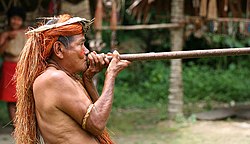
A blowgun (also called a blowpipe or blow tube) is a simple ranged weapon consisting of a long narrow tube for shooting light projectiles such as darts. It operates by having the projectile placed inside the pipe and using the force created by forced exhalation ("blow") to pneumatically propel the projectile. The propulsive power is limited by the strength of the user's respiratory muscles and the vital capacity of their lungs.
Many cultures have used such a weapon, but various indigenous and aboriginal peoples of East Asia, Southeast Asia, Western Europe, North America, Central America (the Huehuetenango region of Guatemala), and South America (the Amazon Basin and the Guianas) are best known for its historical usage.
Projectiles include seeds, clay pellets, and darts. Some cultures dip the tip of the darts in curare or other arrow poisons in order to paralyze the target. Blowguns were very rarely used by these tribes as anti-personnel weapons, but primarily to hunt small animals such as monkeys and birds. The North American Cherokee were known for making blowguns from river cane to supplement their diet with rabbits and other small creatures. The Choctaw Indians of North America also made use of cane blowguns to hunt squirrel and birds.
Blowguns are depicted in paintings on pre-Columbian pottery and are mentioned in many Mesoamerican myths. Back then and today, the Maya use a blowgun to hunt birds and small animals with spherical dry seeds and clay pellets. The clay ammunition is made slightly larger than needed (to allow for shrinkage and refinement) and stored in a shoulderbag. The outside of the dry clay pellet is shaved off and burnished right before use.
Shorter blowguns and smaller bore darts were used for varmint hunting by pre-adolescent boys in traditional Cherokee villages. They used the blowguns to reduce the population of small rodents such as rats, mice, chipmunks and other mammals that cut or gnaw into food caches, seed and vegetable stores, or that are attracted to the planted vegetables. While this custom gave the boys something to do around the village and kept them out of mischief, it also worked as an early form of pest control. Some food was also obtained by the boys, who hunted squirrels with blowguns well into the 20th century.
Today blowguns are used with tranquilizer darts to capture wildlife or to stun caged dangerous animals. Herpetologists use blowguns to capture elusive lizards with stun darts. Blowguns are also used recreationally, with either darts or paintballs.
There are several competition styles practised around the world. A standardization of competition style, based upon fukiya, is being pursued by the International Fukiyado Association and hopes to become an Olympic event. It is a 10-metre (33 ft) target shooting, using a standardized length 120 cm or 48 inch, and barrel caliber, dart shape, length and weight are free. In each round the shooter shoots 5 darts and there are 6 rounds per game, for a total of 30 darts. The target faces are 7 (6 cm), 5 (12 cm), 3 (18 cm) points. The bullseye is 160 cm or 63 inches above the floor.
Two other styles are also being pursued to make up the Olympic blowgun event, both based upon the Cherokee Annual Gathering Blowgun Competition. The Field Style competition is similar to the winter Biathlon, where the shooter runs from a starting line to a target lane, shoots and retrieves the darts, and continues to the next station. The course length varies from 400 to 800 m (440 to 870 yd) or longer, with from 9 to 16 targets at various heights and shooting distances. The final style is the Long Distance target shoot. The target is a circle of 24 cm (9 in) diameter, and the firing line is 20 m (66 ft) away. Three darts are fired by each shooter, at least one of which must stick in the target. All successful shooters move to the next round, moving back 2 m (6.6 ft) each time.
Blowgun
A blowgun (also called a blowpipe or blow tube) is a simple ranged weapon consisting of a long narrow tube for shooting light projectiles such as darts. It operates by having the projectile placed inside the pipe and using the force created by forced exhalation ("blow") to pneumatically propel the projectile. The propulsive power is limited by the strength of the user's respiratory muscles and the vital capacity of their lungs.
Many cultures have used such a weapon, but various indigenous and aboriginal peoples of East Asia, Southeast Asia, Western Europe, North America, Central America (the Huehuetenango region of Guatemala), and South America (the Amazon Basin and the Guianas) are best known for its historical usage.
Projectiles include seeds, clay pellets, and darts. Some cultures dip the tip of the darts in curare or other arrow poisons in order to paralyze the target. Blowguns were very rarely used by these tribes as anti-personnel weapons, but primarily to hunt small animals such as monkeys and birds. The North American Cherokee were known for making blowguns from river cane to supplement their diet with rabbits and other small creatures. The Choctaw Indians of North America also made use of cane blowguns to hunt squirrel and birds.
Blowguns are depicted in paintings on pre-Columbian pottery and are mentioned in many Mesoamerican myths. Back then and today, the Maya use a blowgun to hunt birds and small animals with spherical dry seeds and clay pellets. The clay ammunition is made slightly larger than needed (to allow for shrinkage and refinement) and stored in a shoulderbag. The outside of the dry clay pellet is shaved off and burnished right before use.
Shorter blowguns and smaller bore darts were used for varmint hunting by pre-adolescent boys in traditional Cherokee villages. They used the blowguns to reduce the population of small rodents such as rats, mice, chipmunks and other mammals that cut or gnaw into food caches, seed and vegetable stores, or that are attracted to the planted vegetables. While this custom gave the boys something to do around the village and kept them out of mischief, it also worked as an early form of pest control. Some food was also obtained by the boys, who hunted squirrels with blowguns well into the 20th century.
Today blowguns are used with tranquilizer darts to capture wildlife or to stun caged dangerous animals. Herpetologists use blowguns to capture elusive lizards with stun darts. Blowguns are also used recreationally, with either darts or paintballs.
There are several competition styles practised around the world. A standardization of competition style, based upon fukiya, is being pursued by the International Fukiyado Association and hopes to become an Olympic event. It is a 10-metre (33 ft) target shooting, using a standardized length 120 cm or 48 inch, and barrel caliber, dart shape, length and weight are free. In each round the shooter shoots 5 darts and there are 6 rounds per game, for a total of 30 darts. The target faces are 7 (6 cm), 5 (12 cm), 3 (18 cm) points. The bullseye is 160 cm or 63 inches above the floor.
Two other styles are also being pursued to make up the Olympic blowgun event, both based upon the Cherokee Annual Gathering Blowgun Competition. The Field Style competition is similar to the winter Biathlon, where the shooter runs from a starting line to a target lane, shoots and retrieves the darts, and continues to the next station. The course length varies from 400 to 800 m (440 to 870 yd) or longer, with from 9 to 16 targets at various heights and shooting distances. The final style is the Long Distance target shoot. The target is a circle of 24 cm (9 in) diameter, and the firing line is 20 m (66 ft) away. Three darts are fired by each shooter, at least one of which must stick in the target. All successful shooters move to the next round, moving back 2 m (6.6 ft) each time.
Recent media
Recent media