Hubbry Logo
Bob HiteBob HiteMain
Open search
Bob Hite
Community hub
Bob Hite
logo
8 pages, 0 posts
0 subscribers
Be the first to start a discussion here.
Bob Hite
Bob Hite
from Wikipedia

Key Information

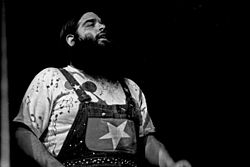
Robert Ernest Hite (February 26, 1943 – April 5, 1981), also known as "The Bear", was an American singer-songwriter, musician, and record producer who was the co-lead vocalist of the blues rock band Canned Heat from 1965 until his death in 1981.

Canned Heat

[edit]

Hite was introduced to guitarist and vocalist Alan Wilson by guitarist Henry Vestine and the two of them helped convince blues pianist Sunnyland Slim (1906–1995) to record new material. In 1965, Hite formed a band with Wilson and Vestine, forming the core of Canned Heat. They were eventually joined by Larry Taylor (bass) and Frank Cook (drums), with Adolfo de la Parra replacing Cook in 1967, finalising the band's first classic lineup. Hite primarily served as the band's co-lead vocalist, but occasionally played harmonica, flute, guitar and bass with the band.

Hite performed with Canned Heat at Monterey in June 1967 and Woodstock in August 1969. The performances were not included in the original (1970) film Woodstock, but are in the 1994 director's cut version. Hite also produced the John Lee Hooker and Canned Heat album Hooker 'N Heat (1971).[1]

Personal life

[edit]

Hite was an avid record collector, and on an episode of Playboy After Dark, revealed that he had over 15,000 78s.[2]

Death

[edit]

On April 5, 1981, during a break between sets at The Palomino Club in North Hollywood, Hite was handed a vial of heroin by a fan. He snorted it and fell into a coma, after which others unsuccessfully attempted to revive him with a large dose of cocaine. A group of roadies lifted Hite and placed him inside a van, where he died en route to the home of bandmate Adolfo de la Parra.[3][4]

References

[edit]
Revisions and contributorsEdit on WikipediaRead on Wikipedia
from Grokipedia
Bob Hite (February 26, 1943 – April 5, 1981) was an American blues-rock musician best known as the co-lead vocalist and harmonica player for the band , which he co-founded in 1965 and with which he achieved international success through hits like "On the Road Again" and performances at major festivals including Woodstock. Born Robert Ernest Hite Jr. in , into a musical family—his mother was a singer and his father had played in a dance band—Hite developed an early passion for and R&B records, becoming an avid collector who helped spark the revival in the . He earned his nickname "The Bear" due to his large stature and boisterous personality, which became synonymous with his barrelhouse singing style and onstage presence. Hite co-formed with Alan "Blind Owl" Wilson as a dedicated to preserving pre-war blues, but the group quickly evolved into a electrified blues-rock outfit after signing with in 1967 following a standout appearance at the Monterey Pop Festival. The band's breakthrough came with their self-titled debut album in 1967 and subsequent releases like (1968) and (1968), featuring Hite's distinctive vocals on chart-topping singles such as "On the Road Again" (No. 16 , Top 10 ), "" (No. 11 , Top 20 ), and "Let's Work Together" (No. 26 , No. 2 ). Their electrifying set at Woodstock in 1969 cemented their status as festival staples, while Hite's collaborations, including the live album (1971) with blues legend , helped revitalize the careers of older artists like Hooker, Sunnyland Slim, and . Throughout the 1970s, Hite continued touring relentlessly with Canned Heat despite lineup changes and personal struggles with substance abuse, contributing to albums like Hallelujah (1969) and maintaining the band's boogie-infused sound that influenced acts from ZZ Top to Phish. His powerful, emotive delivery and dedication to authentic blues earned praise from outlets like DownBeat magazine for mastering the genre's raw energy. Hite died on April 5, 1981, at age 38, from a heart attack triggered by a and overdose during a performance at the Palomino Club in North Hollywood, , marking the end of an era for Canned Heat's original lineup.

Early life

Birth and family background

Robert Ernest Hite Jr., known professionally as Bob Hite, was born on February 26, 1943, in Torrance, . His father, Robert Ernest Hite Sr., drove a bus and later worked for a computer company. Hite Sr. had earlier pursued music, playing in the dance band of before quitting due to a personal tragedy involving a friend's family. His mother, Anna Elizabeth Carson Hite, came from a musical family and had sung with Mal Hallett and his Orchestra, an East Coast swing band active in the 1920s and 1930s. Hite grew up in a musically inclined household in , where his parents' backgrounds provided early exposure to sounds of and through their own experiences and shared music. This environment fostered his innate interest in music from a young age, shaping the foundation for his later pursuits. During his youth, Hite earned the nickname "The " owing to his large stature—he eventually reached around 300 pounds—and his affable, larger-than-life personality, which complemented his booming voice and gregarious nature.

Musical influences and education

Bob Hite developed an early fascination with music through exposure to 1950s country music, Chicago blues, and pre-war blues artists, including Tommy Johnson, whose 1928 recording "Canned Heat Blues" would later inspire the name of his band. As a child in the early 1950s, he was particularly drawn to rhythm and blues performers like Fats Domino and Big Joe Turner, as well as blues shouters such as Peetie Wheatstraw and John Lee Hooker, which shaped his deep appreciation for the raw energy of these genres. This interest began in Torrance, California, where Hite began collecting records as a young child around age five, using earnings from odd jobs like shining shoes to purchase them. Lacking any formal musical education, Hite was entirely self-taught on harmonica, guitar, and , honing his skills through relentless listening, imitation, and analysis of recordings. His learning occurred informally via radio broadcasts, vinyl records, and immersion in ' vibrant local music scenes, including time spent in Westwood record shops where he traded and discovered rare 78s from the 1920s onward. Influenced by blues scholars like John Fahey, Hite built an extensive personal knowledge base, amassing thousands of singles and albums that allowed him to study the intricacies of guitar and early elements without structured instruction. Hite's passion for music extended to an aspiration to become a , driving him to deepen his expertise as a self-proclaimed musicologist through constant record exploration and sharing insights with fellow enthusiasts. This informal self-education positioned him as a knowledgeable figure in preservation long before his performing career took shape.

Career

Formation of Canned Heat

In 1965, Bob Hite, a dedicated blues record collector, co-founded in with fellow enthusiast Alan "Blind Owl" Wilson, initially as a dedicated to reviving pre-war blues traditions. The band's early lineup included Hite on co-lead vocals and harmonica, Wilson on guitar and harmonica, on guitar, along with bassists like Stuart Brotman and later , and drummers such as Keith Sawyer and eventually Frank Cook. This formation reflected Hite's longstanding passion for obscure blues recordings, which he had been amassing and sharing since his teenage years. The band derived its name from Tommy Johnson's 1928 Delta blues song "Canned Heat Blues," which recounted the perils of drinking Sterno canned fuel as a desperate substitute for alcohol—a nod to the raw, authentic Hite and Wilson sought to honor. Their initial repertoire centered on covers of classic tracks from the and , emphasizing acoustic arrangements and Hite's gritty vocal delivery alongside Wilson's and harmonica work to capture the spirit of early 20th-century performers. As the group transitioned from roots to incorporating electric elements, they maintained a focus on boogie-woogie rhythms and traditional structures, drawing directly from Hite's extensive collection of rare 78 rpm records. Canned Heat's early performances took place in intimate venues, starting with their public debut at folk club in January 1966, where they honed their acoustic sound through sets of covers and originals inspired by pre-war artists. Subsequent gigs at local spots like the Sea Witch in West Hollywood and the allowed the band to build a following, blending boogie-woogie grooves with harmonica-driven jams that showcased Hite's charismatic stage presence and the group's commitment to authenticity. These club appearances solidified their identity as revivalists, prioritizing energetic, foot-stomping renditions over commercial polish.

Breakthrough and major performances

Canned Heat's breakthrough came with their debut performance at the Monterey Pop Festival on June 17, 1967, where Bob Hite's energetic vocals on tracks like "Rollin' and Tumblin'" helped introduce the band's raw blues-rock energy to a national audience. This appearance secured their signing with later that year, marking a pivotal shift from local club gigs to major label support under Hite's leadership as co-founder and lead vocalist. The band's self-titled debut album, released in July 1967, captured their early sound and peaked at No. 76 on the 200. Follow-up releases built on this momentum: (January 1968) climbed to No. 16, showcasing extended boogie tracks that highlighted Hite's gritty delivery; (November 1968), a , reached No. 18 and delved deeper into their roots; and (July 1969) hit No. 37, blending psychedelic elements with traditional structures. Hit singles from this era propelled into the mainstream. "On the Road Again," adapted from a 1950s blues tune and featuring Hite's driving rhythm vocals, peaked at No. 16 on the in 1968. "Going Up the Country," another Wilson-Hite adaptation with flute accents, reached No. 11 in 1969 and became a defining anthem of the era. "Let's Work Together," a cover energized by Hite's lead, charted at No. 26 in 1970. Major live performances solidified their reputation, with Hite's charismatic stage presence—often riding a painted elephant or engaging crowds directly—defining their shows. At the Woodstock Festival on August 16, 1969, delivered a sunset set including "," later featured in the 1994 film, drawing nearly 400,000 attendees. They appeared on on January 20, 1969, performing tracks like "On the Road Again" in a lively television showcase. Throughout, Hite's shared vocals with Alan Wilson—Hite's deep, raspy shouts complementing Wilson's higher, harmonica-infused lines—cemented 's signature blues-rock fusion.

Later projects and contributions

Following the death of band co-founder Alan Wilson in September 1970, Bob Hite remained a central figure in , helping to navigate multiple lineup changes that included the addition of new members such as Richard Hite (Bob's brother) and Tony de la Barreda, while retaining drummer Fito de la Parra. Hite's versatility as a became increasingly vital; he contributed vocals and occasional and parts across the band's recordings, drawing on his deep knowledge of traditions to guide the group's sound during this transitional period. On the 1970 album Future Blues, Hite provided lead and backing vocals on tracks that blended raw with emerging rhythms, marking the band's evolution toward a heavier, groove-oriented style influenced by elements. This shift continued in subsequent releases like (1971), a collaboration with blues legend , where Hite served as co-producer alongside Skip Taylor, emphasizing authentic arrangements and showcasing his expertise in the genre through careful curation of Hooker's raw performances. Hite's production choices highlighted the band's instrumental synergy, with minimal overdubs to preserve the live, boogie-infused energy that defined their post-Wilson era. Despite personal and band challenges, Hite played a key role in sustaining 's rigorous touring schedule throughout the , performing at major venues across the U.S. and , including shows at the Greek Theatre in 1978, to maintain their reputation as a live blues-boogie powerhouse. While Hite occasionally made guest appearances on other artists' recordings, such as providing harmonica on select tracks, his primary commitment stayed with until his death in 1981, ensuring the band's continuity amid fluctuating lineups and stylistic explorations.

Personal life

Marriage and family

Hite married Verlie Beatrice Massey (1937–2003) on March 21, 1969, in , . The couple resided in the area and had one son, Mick Joseph Hite (1971–2000). Despite the demands of his career with , which involved frequent touring, Hite maintained a family life rooted in .

Record collecting and lifestyle

Bob Hite amassed an extensive collection of over 15,000 78 rpm records, with a particular focus on rare and pre-war items that highlighted overlooked artists from the genre's formative years. This archive not only positioned him as a respected blues preservationist but also served as a personal resource for authenticating and reviving forgotten tracks. Hite's lifestyle reflected the bohemian ethos of a dedicated enthusiast, marked by frequent heavy partying and that contributed to his substantial approximately 370-pound build. He struggled with , as was common among rock musicians of the era. His passion for , rooted in early influences, permeated these habits, blending scholarly pursuit with hedonistic excess. Hite resided in Topanga Canyon, , a vibrant enclave for artists and musicians during the late 1960s and , where his home became a central hub for informal jam sessions that drew fellow performers and fostered creative exchanges. Although Hite never commercialized his collection through formal business endeavors, it profoundly shaped Canned Heat's musical authenticity by providing direct access to obscure sources that informed the band's repertoire and style.

Death and legacy

Circumstances of death

On April 5, 1981, during a break between sets at The Palomino Club in North Hollywood, , Bob Hite, aged 38, collapsed after snorting a substance handed to him by a fan, who had already injected a gram of earlier. Hite mistook the vial for but it contained , which he inhaled through a straw. He was taken to his van en route to his home, where he was later pronounced dead. An confirmed the cause as accidental overdose from combined and intoxication resulting in , with Hite weighing 370 pounds at the time of ; the incident prompted the immediate halt of Canned Heat's , and authorities found no evidence of foul play. This tragedy reflected Hite's prior lifestyle of heavy drug and alcohol indulgences amid the rock scene's excesses.

Posthumous recognition and influence

Following Bob Hite's death in 1981, which marked a tragic endpoint to his career, continued performing and recording to fulfill contractual obligations, recruiting replacement vocalists such as Ernie Rodriguez and later Richard Hite, Bob's brother. This shift in lineup altered the band's dynamic but helped preserve its boogie-infused legacy through ongoing tours and albums, with Fito de la Parra assuming a role to sustain the group's momentum. The band's performances at the 1969 Woodstock festival, featuring Hite's vocals on hits like "Going Up the Country," gained wider visibility in the 1994 director's cut of the Woodstock film, introducing his contributions to new generations of audiences. Additionally, Canned Heat's music, often highlighting Hite's distinctive raspy delivery, has been licensed for commercial advertisements, including campaigns for General Motors and Levi's, extending the reach of his blues-rock style into popular culture. Hite is credited with helping revive interest in traditional blues among rock audiences during the late 1960s, drawing from his deep knowledge of pre-war recordings to infuse Canned Heat's sound with authentic rhythms and harmonica work. His nickname "The Bear," earned for his large stature and affable personality, continues to appear in tributes and band histories, symbolizing his enduring presence in the genre. Portions of Hite's extensive collection of over 15,000 rare 78 rpm records have been preserved and utilized posthumously; selections from it were compiled into releases like the 2008 album Rarities from the Bob Hite Vaults, curated by DJ Dr. Boogie in collaboration with Fito de la Parra, helping to safeguard overlooked rural recordings. Hite's life and death are detailed in David Kulczyk's 2009 book Death in : The Bizarre, Freakish, and Just Curious Ways People Die in the Golden State, which recounts his overdose as part of the state's eccentric fatalities. Fans and surviving bandmates, including de la Parra, mark annual remembrances of Hite through interviews, memoirs like de la Parra's , and festival appearances where his influence on revival is celebrated.

References

Add your contribution
Related Hubs
User Avatar
No comments yet.