Hubbry Logo
Harvey MandelHarvey MandelMain
Open search
Harvey Mandel
Community hub
Harvey Mandel
logo
8 pages, 0 posts
0 subscribers
Be the first to start a discussion here.
Harvey Mandel
Harvey Mandel
from Wikipedia

Key Information

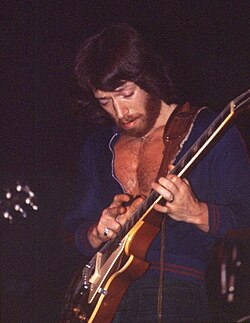
Harvey "The Snake" Mandel (born March 11, 1945)[1] is an American guitarist best known as a member of Canned Heat. He also played with Charlie Musselwhite and John Mayall as well as maintaining a solo career.

Early life

[edit]

Mandel was born in Detroit, Michigan, and grew up in Morton Grove, Illinois, a suburb of Chicago.

Career

[edit]

His first recording was the album Stand Back! Here Comes Charley Musselwhite's Southside Band in 1966 with Charlie Musselwhite.[2] Described in Legends of Rock Guitar (1997) as a "legendary" album, it was influential with Mandel's "relentless fuzztone, feedback-edged solos, and unusual syncopated phrasing."[3] He relocated to the San Francisco Bay area, performing often at The Matrix, a club where local favorites like Jerry Garcia or Elvin Bishop would sit in and jam. He then met the pioneering San Francisco disc jockey and producer Abe "Voco" Kesh (Abe Keshishian), who signed Mandel to Philips Records and produced his first solo album, Cristo Redentor, in 1968.[2] Mandel recorded with Barry Goldberg on a bootleg from Cherry Records and recorded with Graham Bond. He cut two more solo LPs for Philips, Righteous (1969) and Games Guitars Play (1970), followed by four more solo albums for the independent record label Janus in the early 1970s, which included Baby Batter.[2]

On the night that Henry Vestine quit Canned Heat, Mandel was in the band's dressing room at the Fillmore West. Mike Bloomfield joined them for the first set, and Mandel came in for the second set. His third performance with the band was the Woodstock Festival in 1969.[4] During this period, with Canned Heat bandmates Larry Taylor and Fito de la Parra, Mandel contributed to the 'Music from Free Creek' super session project. Mandel stayed with Canned Heat for a year, touring and recording material which appeared on three albums. "Let's Work Together", a song by Wilbert Harrison which was included in the album Future Blues became an international hit. He is also on the Live in Europe album recorded prior to the death of Alan Wilson.[2]

With Canned Heat bassist Larry Taylor, Mandel joined John Mayall's band for the next two years.[2] He is heard playing on the two albums from that period USA Union and Back to the Roots. In 1972, he teamed up with Don "Sugarcane" Harris, Randy Resnick on guitar, Victor Conte on bass, and Paul Lagos on drums to form the band Pure Food and Drug Act, which released one album, Choice Cuts.[2] During the 1970s Mandel released the albums Baby Batter (1970), The Snake (1972), Feel the Sound of Harvey Mandel (1974) and Shangrenade (1973),[2] in the latter employing the technique of two-handed tapping. He also released an instructional video, Harvey Mandel: Blues Guitar & Beyond.

When Rolling Stones guitarist Mick Taylor left the band, Mandel was given an audition as his replacement.[2] He recorded two tracks with the Stones for their 1976 album Black and Blue: "Hot Stuff" (providing the lead guitar solo throughout) and "Memory Motel".

Mandel acted in the 1996 film Chalk playing a surfer, which was directed by Rob Nilsson.

Post-1976

Harvey Mandel and the Snake Crew was released in 2006. Notable guest performers included Elvin Bishop, Norton Buffalo, Marcy Levy, and Nick Gravenites, plus Freddie Roulette, Pete Sears, Peter Albin, Mic Gillette, Barry Goldberg and Howard Wales. Live at Biscuits & Blues followed in 2009.

In 2009, Mandel and Larry Taylor reunited with Fito de la Parra and the rest of the current Canned Heat lineup to perform certain shows on the Canned Heat tour. Taylor, Mandel and de la Parra had all been part of the 1969 Woodstock Festival lineup. Mandel rejoined Canned Heat permanently in 2010.

In 2014, Harvey collaborated with the herbalist Ron Teeguarden on an album titled Dragons at Play, which consisted of nine tracks.

In 2015, Cleopatra Records issued a six-disc retrospective of Harvey's career featuring the first five of Harvey's solo albums, and a sixth disc containing a live performance from the Matrix Club in San Francisco, on December 24, 1968. The performance included Jerry Garcia, and Elvin Bishop.

In 2016, Harvey, along with Ryley Walker's backing band,[5] entered the recording studios at Fantasy Records, Berkeley, for two days of live studio recording, which resulted in the eight self-composed tracks which made up the album Snake Pit.

In 2017, Harvey released the 10 track album Snake Attack. According to Harvey, "I wrote all the songs, performed all the instruments and mixed and mastered all the songs myself. Working in my own home studio allowed me to do all sorts of great guitar overdubs that I'd never have been able to do in a regular studio.[6]

2022 saw the release of Who's Calling.[7]

Discography

[edit]

Solo

[edit]
  • 1968 Cristo Redentor (LP, Philips PHS 600-281)
  • 1969 Righteous (LP, Philips PHS 600-306)
  • 1970 Games Guitars Play (LP, Philips PHS 600-325)
  • 1971 Baby Batter (LP, Janus JLS-3017), also released as Electronic Progress (Bellaphon, Germany)
  • 1972 The Snake (LP, Janus JLS-3037), with Don "Sugarcane" Harris
  • 1972 Get Off in Chicago (LP, Ovation OV/1415)
  • 1973 Shangrenade (LP, Janus JLS-3047), with Don "Sugarcane" Harris
  • 1974 Feel the Sound of Harvey Mandel (LP, Janus JLS-3067)
  • 1975 The Best of Harvey Mandel (LP, Janus 7014)
  • 1993 Twist City (CD, Western Front WFE 10022)
  • 1995 Snakes & Stripes (CD, Clarity Recordings CCD-1013)
  • 1995 Harvey Mandel: The Mercury Years (Includes first 3 solo albums) (CD, PolyGram Records 314 528275-2)
  • 1997 Planetary Warrior (CD, ESP/Lightyear/WEA, 54215-2)
  • 1997 Emerald Triangle (CD, Electric Snake Productions ESP-9701)
  • 1999 Snake Live (CD, MP3.com)
  • 2000 West Coast Killers (Contains two bonus tracks not on the 2003 "West Coast Killaz" CD) (CD, MP3.com)
  • 2000 Lick This (CD, Electric Snake Productions)
  • 2003 West Coast Killaz (10-track CD also issued as 8-track "Radio Version") (CD, Electric Snake Productions)
  • 2003 NightFire featuring Harvey Mandel/Freddie Roulette (CD, Electric Snake Productions NF1470)
  • 2004 Blue Marble (CDr, Unreleased Studio w/ Terry Haggerty in possession of collector)
  • 2006 Harvey Mandel and the Snake Crew (CD, Electric Snake Productions)
  • 2009 Live at Biscuits & Blues (CD, Electric Snake Productions)
  • 2014 Dragons at Play (CD, Electric Snake Productions)
  • 2015 Snake Box (Includes first five solo albums plus "Live at the Matrix", San Francisco, CA, December 24, 1968) (CD, Cleopatra CLP-CD-2100)
  • 2016 Snake Pit (CD, Tompkins Square TSQ 5296)
  • 2017 Snake Attack (CD, RockBeat Records ROC-3357)
  • 2018 Live at Broadway Studios, San Francisco (CD, RockBeat Records ROC-3366)
  • 2019 Smoke This (CD, Out The Box Records)
  • 2022 Who's Calling (CD, Tompkins Square TSQ 5920)
  • 2024 Twist City (2024 Remaster) (Digital Download, Cleopatra CLO6487DA)
  • 2025 Snake Walk (CD, Earwig EWR-4985)

With other artists

[edit]

References

[edit]

Bibliography

[edit]
[edit]
Revisions and contributorsEdit on WikipediaRead on Wikipedia
from Grokipedia
Harvey Mandel (born March 11, 1945) is an American guitarist renowned as "The Snake" for his innovative and influential contributions to , and music through pioneering techniques. Self-taught and raised in after his birth in , , Mandel drew early inspiration from instrumental surf rock groups like and the city's vibrant scene, including artists such as and . His nickname originated from blues harmonica player , with whom he collaborated extensively in the mid-1960s, while his moniker "King of Sustain" reflects his mastery of controlled feedback and volume swells, techniques he developed alongside two-handed fretboard during that era. Mandel first gained widespread recognition as the lead guitarist for the blues-rock band , joining in 1969 and performing their iconic set at the 1969 Woodstock Festival; he contributed to key albums like Future Blues (1970) and (1971). He also played on John Mayall's albums (1970) and Back to the Roots (1971), and was briefly considered to replace in , ultimately recording tracks for their 1976 album . Throughout his career, Mandel has maintained a robust solo discography, beginning with the psychedelic album Cristo Redentor (1968) on , followed by a string of innovative Records releases in the early including The Snake (1972), Baby Batter (1971), and Shangrenade (1973). In addition to his band and solo work, Mandel has been a sought-after , appearing on recordings by Jimmy Witherspoon, , and even , while later projects include Planetary Warrior (2014) and Snake Pit (2016) on Tompkins Square Records. Diagnosed with cancer in 2011, he achieved remission by 2014 and rejoined in 2010, continuing to tour and release music, such as the 2025 album Snake Walk. His technical innovations, particularly in and sustain, have influenced subsequent generations of guitarists across genres.

Early life

Childhood and family background

Harvey Mandel was born on March 11, 1945, in , . His family relocated to the Chicago suburb of , in 1946, where he spent much of his childhood. Mandel grew up in a Jewish family amid the vibrant musical culture of the area. As a young teenager, he became immersed in the local scene, frequenting West and South Side clubs that featured prominent artists. This environment exposed him to influential blues guitarists such as , , and , shaping his early interest in music. Details on Mandel's formal education are sparse, with his focus shifting toward musical pursuits during his teenage years in ; he left school in to pursue music full-time. This foundational period in the blues-rich neighborhoods laid the groundwork for his later immersion in the city's evolving music community.

Initial musical development

Mandel acquired his first guitar around the age of 16 and became self-taught by emulating recordings of influential artists. His initial inspiration derived from the instrumental rock sounds of , which sparked his interest in guitar playing around age 16. As he progressed, Mandel immersed himself in , drawing formative influences from pioneers such as , , and , whose raw electric styles profoundly shaped his approach. Jazz guitarist also contributed key elements to his early development, introducing sophisticated phrasing and tonal nuances that blended with his blues foundation. Mandel's practice habits involved dedicated self-study through repeated listening to records and early experimentation with the instrument. Through informal local jam sessions during his youth in the Chicago area, he refined these skills before transitioning to more structured musical pursuits.

Musical career

Early collaborations and band work

In the mid-1960s, Mandel immersed himself in the vibrant scene of 's West Side clubs, including Twist City, where he honed his self-taught guitar skills alongside luminaries such as , , and . This period marked his transition from local performer to professional musician, drawing on the raw tradition that shaped his distinctive style. Mandel's early professional gigs came with harmonica virtuoso starting in 1965, as part of Musselwhite's Southside Band, where he provided lead guitar for raw, urban performances in venues. Their collaboration culminated in Mandel's contributions to Musselwhite's debut album, Stand Back! Here Comes Charley Musselwhite's Southside Band (, 1967), featuring tracks like "Baby Won't You Please Come Home" that showcased his slithering, fluid solos. In 1968, he joined keyboardist in the Barry Goldberg Reunion, a short-lived ensemble that blended -rock with psychedelic elements, building on Goldberg's prior work with . Mandel joined in early 1969 following guitarist Henry Vestine's departure, stepping in for the band's high-profile tour and performing at the Woodstock Festival on August 16, where equipment issues challenged his set but highlighted his improvisational prowess. During his year-long stint, he contributed searing guitar work to albums like Future Blues (Liberty, 1970), including the hit "Let's Work Together," and extensive European and U.S. tours that solidified 's boogie-blues reputation. Later that year, Mandel transitioned to John Mayall's Bluesbreakers, forming a core trio with bassist and violinist Don "Sugarcane" Harris; their dynamic interplay drove the album (Polydor, 1970), emphasizing Mayall's evolving American blues sound without drums. He also made brief session appearances with Pacific Gas & Electric around this time, adding guitar to their blues-funk recordings.

Solo career and innovations

Harvey Mandel's solo career launched in with his debut album Cristo Redentor on , an instrumental effort that fused roots with psychedelic and elements, highlighted by the title track—a cover of Donald Byrd's composition evoking sensibilities often linked to Brazilian rhythmic influences. The album demonstrated Mandel's emerging command of tone, utilizing sustain and subtle effects to create atmospheric depth. In the subsequent years, Mandel released a series of innovative albums on Philips and Janus Records, including Righteous (1969), Games Guitars Play (1970), Baby Batter (1971), The Snake (1972, featuring violinist Don "Sugarcane" Harris), Shangrenade (1973), and Feel the Sound of Harvey Mandel (1974). These works showcased experimental fusion of blues, rock, funk, and jazz, with Mandel pushing boundaries through improvisational phrasing and genre-blending arrangements that anticipated progressive rock developments. For instance, The Snake highlighted electric fusion with pioneering use of effects for hypnotic, slithering guitar lines. By the 1990s and early , Mandel revitalized his solo output via independent labels like Western Front, Clarity, and his own Electric Snake Productions, producing albums such as Twist City (1993), Snakes and Stripes (1995), Planetary Warrior (1997), Lick This (2000, co-produced with his son ), and West Coast Killaz (2003). These later efforts reflected an evolved style incorporating digital production, hip-hop rhythms, and techno elements while maintaining his signature foundation, often with guest collaborators enhancing the experimental edge. Throughout his solo endeavors, Mandel distinguished himself through early adoption of guitar effects pedals, such as the for swirling, modulated tones on tracks like those from Cristo Redentor, and by developing improvisational structures that emphasized fluid, extended solos in both studio and live contexts. He also pioneered the two-handed technique on , employing it in performances and recordings as early as the late , influencing subsequent players though not always receiving full credit.

Discography

Solo albums

Harvey Mandel's solo discography began with his debut album Cristo Redentor in 1968, released on (PHS 600-281). The album featured an cover of Donald Byrd's tune "Cristo Redentor," originally composed by , which became an underground radio hit in for its psychedelic style and innovative guitar work. His second solo release, Righteous, arrived in 1969 on (PHS 600-306), showcasing psychedelic smooth guitar music with tracks like "The Snake," which would become one of his signature pieces, blending heavy blues-rock elements. The album was reissued in 1990, highlighting its enduring appeal in the fusion genre. In 1970, Games Guitars Play was issued on (PHS 600-325), incorporating experimental tracks with influences, including vocals by Russell DaShiell and covers like "Senor Blues." This release marked Mandel's exploration of more guitar techniques before his shift to other labels. The 1971 album Baby Batter on Janus Records (JLS-3017) represented a blend of , , and rock, featuring a large ensemble with influences from artists like and ; it was reissued in 2003 as part of renewed interest in his early work. The Snake, released in 1972 on Janus Records (JLS-3037), featured collaborations with Don "Sugarcane" Harris and included tracks like "The Snake" and "Pegasus," emphasizing Mandel's sustain and techniques in a -rock fusion style. Shangrenade, released in 1973 on Records (JLS-3047), adopted a funk-oriented approach following his time with , with tracks like "What the Funk" demonstrating varied influences from to . In 1974, Feel the Sound of Harvey Mandel appeared on Records (JLS-3067), billed as a solo project but heavy with collaborators including members of , focusing on his blues-rock style. Later solo releases included Planetary Warrior in 1997 on Lightyear Records (54215-2), blending blues-rock with psychedelic elements. Live at Biscuits & Blues (2009, Electric Snake Productions) captured performances with a blues band and received acclaim. More recent works include Snake Pit (2016, Tompkins Square Records), a jazz-blues-rock fusion album, and Snake Walk (2025, Earwig Music), a progressive blues-rock release as of November 2025. Production across these works shifted from major labels like Philips and Janus to independent outlets for his later career.

Collaborations and contributions

Mandel's early guest appearances highlighted his emerging reputation as a versatile session guitarist in the blues scene. He provided guitar work on Charlie Musselwhite's debut album Stand Back! Here Comes Charley Musselwhite's South Side Band (1966), contributing raw, expressive solos that complemented Musselwhite's harmonica-driven sound. Similarly, during his brief tenure with , Mandel added distinctive guitar parts to (1968), infusing the band's boogie-rock tracks with his fluid, innovative phrasing. In the 1970s, Mandel expanded into high-profile rock collaborations. He served as lead guitarist on John Mayall's (1970), delivering sharp, blues-inflected riffs alongside violinist Don "Sugarcane" Harris and bassist , helping to define Mayall's transatlantic fusion style. He also recorded tracks for The ' Black and Blue (1976), providing guitar during auditions to replace Mick . Mandel joined on Barry Goldberg & Friends (1972), where his guitar work blended blues-rock with psychedelic edges, featuring cameos from and others in a loose, jam-oriented format. Throughout the and , Mandel focused on eclectic session contributions across genres. He lent guitar to projects bridging and , including contributions to ' work in the late 1960s, such as on Mandel's own Righteous (1969). Entering the 2000s, Mandel's guest spots emphasized revival and tributes. He participated in live performances and tours with artists like , drawing on shared roots. Beyond albums, Mandel provided session guitar for TV and film projects, drawing on his extensive studio experience to support narrative-driven music.

Playing style and influence

Guitar techniques

Harvey Mandel is recognized as a pioneer of the two-handed tapping technique on the guitar, which he learned from guitarist Randy Resnick and employed in live performances as early as 1968, well before its popularization by Eddie Van Halen in the late 1970s. This method involves using both hands on the fretboard to hammer notes and create fluid, rapid phrases, allowing for extended melodic lines and polyphonic effects without relying on traditional picking. Mandel showcased this innovation prominently on tracks like "The Snake" from his 1972 solo album of the same name, where the tapping contributes to the song's slithering, sustained guitar lines that blend aggression with precision. Rooted in his blues background, Mandel's fingerstyle and approach emphasizes thumb and finger independence for a fuller, more organic tone, often forgoing a pick to achieve what he describes as a "fatter, fleshier" sound. He frequently incorporates wide and expressive bends, pushing strings to their limits for emotional depth, as heard in his blues-inflected solos that evoke vocal-like phrasing. These techniques form the foundation of his style, enabling seamless transitions between single-note lines and rhythmic accents. Mandel's gear choices have long supported his idiomatic sound, favoring guitars—such as goldtop models—for their thick tone and sustain, paired with Fender amplifiers in studio settings for clarity and Marshall stacks live for added drive. Early effects like the Vox wah-wah pedal were integral to his palette, allowing rhythmic sweeps and vocal-filtered leads that enhanced his -rock phrasing. His playing fuses , , and rock elements through rapid scale runs that ascend and descend with chromatic flair, alongside chordal that layers over improvised melodies for a dense, textural approach. Over time, Mandel's techniques evolved toward cleaner tones in his later solo work, reducing heavy to highlight nuanced fingerstyle dynamics and ambient spaces. In the and beyond, he incorporated digital effects, including the VG-99 V-Guitar system, to replicate and expand upon vintage studio tricks like backwards soloing and controlled feedback, maintaining his innovative edge in live performances.

Impact on music and guitarists

Harvey Mandel's innovative fusion of blues, jazz, and rock elements played a pivotal role in shaping the and -rock scenes of the 1970s, particularly through his work with and his solo albums like Cristo Redentor (1968), which introduced psychedelic blues phrasing and experimental guitar effects to a wider audience. His ability to blend raw roots with improvisational structures and rock energy influenced the evolution of fusion genres, as seen in collaborations with artists like and , where he expanded the sonic palette of beyond traditional boundaries. This bridging act helped elevate blues-derived sounds into mainstream rock experimentation during a transformative era for American music. Mandel's guitar techniques, including early adoption of two-handed and controlled feedback, have left a lasting mark on subsequent generations of players, with crediting observations of Mandel's live performances in the late 1960s as an inspiration for similar approaches in rock guitar. Notably, his slithering, fluid phrasing and innovations predate and influenced Eddie Van Halen's popularized style, as evidenced by Mandel's demonstrations in the 1970s that showcased these methods years before Van Halen's breakthrough. Guitarists across blues-rock and fusion have emulated his phrasing and tonal experiments, recognizing Mandel as a pioneer whose work in albums like Cristo Redentor () pushed instrumental boundaries and inspired creative expression in playing. His appearance with at Woodstock in 1969, despite technical challenges, contributed to the festival's role in amplifying blues-rock's visibility to a global audience, helping to mainstream the genre's gritty authenticity amid the counterculture movement. The nickname "The Snake," bestowed by harmonica player , stems from the serpentine movement of Mandel's left hand across the fretboard, symbolizing his distinctive, sinuous style that has become emblematic of his contributions to guitar lore. Mandel's legacy endures in media portrayals of guitar history, including the 2023 documentary Born in Chicago, which highlights his role in the 1960s revival alongside figures like and , underscoring his influence on the white adoption and global dissemination of urban traditions. Scholarly works on rock guitar evolution, such as analyses of electric instrument techniques, frequently reference his innovations in feedback and as foundational to post-1960s developments in the instrument's expressive capabilities.

Later years

Recent projects and releases

Mandel's activities from 2010 onward have centered on a series of releases that blend his signature blues-rock foundations with , and psychedelic explorations, alongside selective live engagements. His 2012 live Live at Biscuit & Blues, recorded with the Snake Crew, served as a dynamic showcase of his improvisational guitar prowess in a blues-rock context, capturing energetic performances of classics and originals. Subsequent studio efforts marked a resurgence in original material. In 2014, Dragons at Play featured Mandel handling all instrumentation on original compositions, emphasizing mystical rock and blues textures through layered guitar work. This led to in 2016, his first full-length studio album since 1974, produced at with contributions from ’s band and fusing jazz-blues-rock-funk elements. Further releases included the home-recorded instrumental Snake Attack (2017), where Mandel composed, performed, and produced every track, and Smoke This (2019), a collection of self-penned songs highlighting his evolving sound. A notable highlight came in 2025 with Snake Walk, a 10-track full-length on Earwig Music that delves into progressive with psychedelic and electronic infusions, co-produced during a period of creative renewal and featuring Mandel's writing on all songs. The record incorporates themes of resilience, blending experimental guitar techniques reminiscent of his innovative style with contributions from collaborators including Dan Fischer, Steve Nevets, drummer Joel Treadwell, Pete Sears, and violinist Dick Bright across various tracks. Pre-sales began ahead of the official May 23, 2025, shipping date, allowing early access to the CD and vinyl editions. In promotion of Snake Walk, Mandel has undertaken live performances, including multiple appearances at San Francisco's Biscuits and Blues venue in May, August, and November 2025, where he previews material from the album alongside career-spanning selections. Earlier post-2012 engagements included festival outings in during a 2012 stint with in , , and , as well as sporadic U.S. shows supporting his mid-decade releases. Media coverage has underscored Mandel's enthusiasm for these projects. In an August 2025 feature in Psychedelic Baby Magazine, he discussed the joys of studio recording for Snake Walk, praising the mix of his own compositions and tailored songs from collaborators as a fresh evolution in his discography. Ongoing jazz-blues collaborations, such as those on Snake Walk, reflect his continued role as a guest contributor in genre-blending sessions.

Health challenges and resilience

In 2023 and 2024, Harvey Mandel faced severe health setbacks, including multiple hospitalizations for recurrent infections and complications from his ongoing battle with cancer. In early March 2024, he was admitted to the hospital in critical condition due to a swollen and a massive , which medical staff described as his most dire episode to date. These events built on prior infections that had required extended treatment, spanning over seven weeks in one instance, and led to an stay amid uncertain prognosis. By January 2024, Mandel had already endured several hospital visits for infections alongside frequent ophthalmologist appointments to address persistent blurry vision stemming from lost tear ducts and the need for . Mandel's vision challenges intensified in 2024, with ongoing issues in his left eye complicating his ability to play guitar, though he had undergone successful surgeries on both eyes in 2023 prior to a subsequent . Despite these obstacles, he demonstrated remarkable resilience, continuing daily guitar practice even while and recovering from treatments. His co-producer challenged him during this period to compose new material, sparking the creation of tracks that would form the basis of his 2025 album Snake Walk. By mid-2024, Mandel was discharged and resumed recording, channeling his determination into completing Snake Walk—a testament to his unyielding commitment to music at age 80. Official updates from his website portray him as a steadfast fighter who has survived "wicked infections" and cancer battles over two years, refusing to let health woes end his career. His manager and family have shared these accounts via harveymandel.net, emphasizing his upbeat spirit, while a dedicated fan network has provided crucial support through a GoFundMe campaign to cover mounting medical bills and enable his return to performing. As of March 2025, Mandel remains active, preparing for a release event for Snake Walk on May 23, 2025, in San Francisco, underscoring his enduring resolve.

References

Add your contribution
Related Hubs
User Avatar
No comments yet.