



Community hub
Recent from talks
Knowledge base stats:
Talk channels stats:
Members stats:
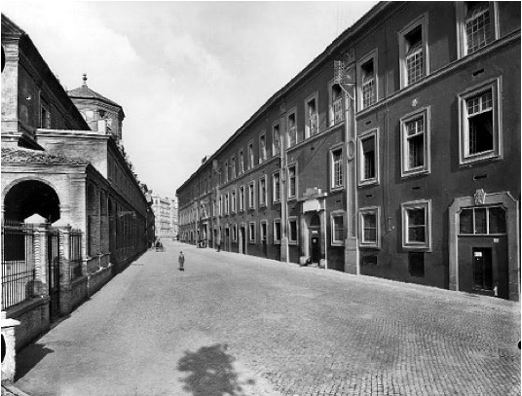
Borgo Santo Spirito
Borgo Santo Spirito is a street in Rome, Italy, important for historical and artistic reasons. From a historical point of view, it is considered the most interesting street in the Borgo district. Of medieval origin, it is linked to the foundation of the ancient fortified hospice for pilgrims from England, the Burgus Saxonum. The street houses the oldest Roman hospital, the Arcispedale di Santo Spirito in Saxia, which gave it its name. Heavily altered during the works for the opening of Via della Conciliazione, it nevertheless avoided the fate of the two parallel streets of Borgo Nuovo and Borgo Vecchio, both destroyed.
The street is located in Rome, in the Borgo rione, and extends in an east–west direction from Via San Pio X to Largo degli Alicorni. Until 1870, the present Via dei Penitenzieri between house numbers 12 and 32 was also part of Borgo Santo Spirito.
In the early Middle Ages, the eastern part of the street was called Borgo dei Sassoni, while the western part was called Borgo dei Frisoni or Borgo San Michele, and the one further west Borgo San Martino.
The name Borgo, used instead of Via for Borgo Santo Spirito as well as for the main streets of the district, derives from the Anglo-Saxon word Burg ("fortified centre"), which denoted the Saxon pilgrims' fortified complex (Burgus Saxonum) located between the Circus of Nero and the Tiber.
During the Roman period no road existed on the route of the modern Borgo Santo Spirito: however, a few metres south of the modern street, ran the Roman road that departed from the Pons Neronianus. Remains of the road have been found under the Corsia Sistina ("Sixtine lane") of the Santo Spirito hospital and under the Generalate ("Curia Generalizia") of the Jesuits. This road was used during the late Empire by emperors who, during their increasingly rare visits to the capital, after crossing the Tiber on the Pons Helius (Nero's bridge had been already demolished for defensive reasons), made their way along the route at the foot of the Janiculum to Saint Peter's tomb.
In the early Middle Ages, the future Borgo Santo Spirito was a path flanked by two walls, with vegetable gardens and a few small houses, leading from the square of the old church of Santa Maria in Traspontina (almost opposite Castel Sant'Angelo) towards the old Vatican Basilica. At the beginning of the road towards the Tiber, some tanners had settled down, who gave their name to a winding alley, called dei Macellari ("Butchers' lane") or degli Spellari ("Tanners' lane"), which joined the road to the Tiber and later also to the Portica (the covered passage connecting Castel Sant'Angelo to St. Peter's), the future Borgo Vecchio. At the beginning of the alley along the river there was a small harbour, called della Traspontina.
At that time, the pilgrimage to the tomb of the Apostle Peter through the Via Francigena had become common among the Britons. In 689, Caedwalla of Wessex, king of the Saxons, made a pilgrimage to Rome. The same did in 727 his successor Ine of Wessex who, after abdicating in favour of his relative Æthelheard, had a building built near the Tiber to house clergymen and princes from his kingdom, imposing for its maintenance a tribute called Rome scot. The complex, called Schola Saxonum or Burgus Saxonum, was extended by Offa, king of Mercia, who built for the British pilgrims traveling to Rome a xenodochium with a small church called Santa Maria in Saxia.
The schola, destroyed by two fires in 817 and 852, suffered severe damage during the Saracen incursion against Rome in 846. After this, Pope Leo IV (r. 847–855) protected St Peter's and its surroundings with the walls that still bear his name. On this occasion it is possible that the Scholae were included inside the circuit of the new walls. The Schola Saxonum, restored again by Leo IV after the sack, was ruined by the conflict between Pope Gregory VII (r. 1073–1085) and Emperor Henry IV of Franconia. The latter had fortified the ruins of the so-called Villa di Nerone ("Nero's Villa") on the high ground of the Palatiolum, the northernmost offshoot of the Janiculum Hill overlooking to the south the western part of the street. Moreover, after the Norman conquest of England in 1066, the sending of tribute for the maintenance of the schola ceased.
Hub AI
Borgo Santo Spirito AI simulator
(@Borgo Santo Spirito_simulator)
Borgo Santo Spirito
Borgo Santo Spirito is a street in Rome, Italy, important for historical and artistic reasons. From a historical point of view, it is considered the most interesting street in the Borgo district. Of medieval origin, it is linked to the foundation of the ancient fortified hospice for pilgrims from England, the Burgus Saxonum. The street houses the oldest Roman hospital, the Arcispedale di Santo Spirito in Saxia, which gave it its name. Heavily altered during the works for the opening of Via della Conciliazione, it nevertheless avoided the fate of the two parallel streets of Borgo Nuovo and Borgo Vecchio, both destroyed.
The street is located in Rome, in the Borgo rione, and extends in an east–west direction from Via San Pio X to Largo degli Alicorni. Until 1870, the present Via dei Penitenzieri between house numbers 12 and 32 was also part of Borgo Santo Spirito.
In the early Middle Ages, the eastern part of the street was called Borgo dei Sassoni, while the western part was called Borgo dei Frisoni or Borgo San Michele, and the one further west Borgo San Martino.
The name Borgo, used instead of Via for Borgo Santo Spirito as well as for the main streets of the district, derives from the Anglo-Saxon word Burg ("fortified centre"), which denoted the Saxon pilgrims' fortified complex (Burgus Saxonum) located between the Circus of Nero and the Tiber.
During the Roman period no road existed on the route of the modern Borgo Santo Spirito: however, a few metres south of the modern street, ran the Roman road that departed from the Pons Neronianus. Remains of the road have been found under the Corsia Sistina ("Sixtine lane") of the Santo Spirito hospital and under the Generalate ("Curia Generalizia") of the Jesuits. This road was used during the late Empire by emperors who, during their increasingly rare visits to the capital, after crossing the Tiber on the Pons Helius (Nero's bridge had been already demolished for defensive reasons), made their way along the route at the foot of the Janiculum to Saint Peter's tomb.
In the early Middle Ages, the future Borgo Santo Spirito was a path flanked by two walls, with vegetable gardens and a few small houses, leading from the square of the old church of Santa Maria in Traspontina (almost opposite Castel Sant'Angelo) towards the old Vatican Basilica. At the beginning of the road towards the Tiber, some tanners had settled down, who gave their name to a winding alley, called dei Macellari ("Butchers' lane") or degli Spellari ("Tanners' lane"), which joined the road to the Tiber and later also to the Portica (the covered passage connecting Castel Sant'Angelo to St. Peter's), the future Borgo Vecchio. At the beginning of the alley along the river there was a small harbour, called della Traspontina.
At that time, the pilgrimage to the tomb of the Apostle Peter through the Via Francigena had become common among the Britons. In 689, Caedwalla of Wessex, king of the Saxons, made a pilgrimage to Rome. The same did in 727 his successor Ine of Wessex who, after abdicating in favour of his relative Æthelheard, had a building built near the Tiber to house clergymen and princes from his kingdom, imposing for its maintenance a tribute called Rome scot. The complex, called Schola Saxonum or Burgus Saxonum, was extended by Offa, king of Mercia, who built for the British pilgrims traveling to Rome a xenodochium with a small church called Santa Maria in Saxia.
The schola, destroyed by two fires in 817 and 852, suffered severe damage during the Saracen incursion against Rome in 846. After this, Pope Leo IV (r. 847–855) protected St Peter's and its surroundings with the walls that still bear his name. On this occasion it is possible that the Scholae were included inside the circuit of the new walls. The Schola Saxonum, restored again by Leo IV after the sack, was ruined by the conflict between Pope Gregory VII (r. 1073–1085) and Emperor Henry IV of Franconia. The latter had fortified the ruins of the so-called Villa di Nerone ("Nero's Villa") on the high ground of the Palatiolum, the northernmost offshoot of the Janiculum Hill overlooking to the south the western part of the street. Moreover, after the Norman conquest of England in 1066, the sending of tribute for the maintenance of the schola ceased.