Hubbry Logo
BotamochiBotamochiMain
Open search
Botamochi
Community hub
Botamochi
logo
8 pages, 0 posts
0 subscribers
Be the first to start a discussion here.
Botamochi
Botamochi
from Wikipedia

Botamochi
TypeConfectionery, Rice cake
Place of originJapan
Main ingredientsglutinous rice, short-grain rice, sweet red bean paste
VariationsOhagi
  •   Media: Botamochi

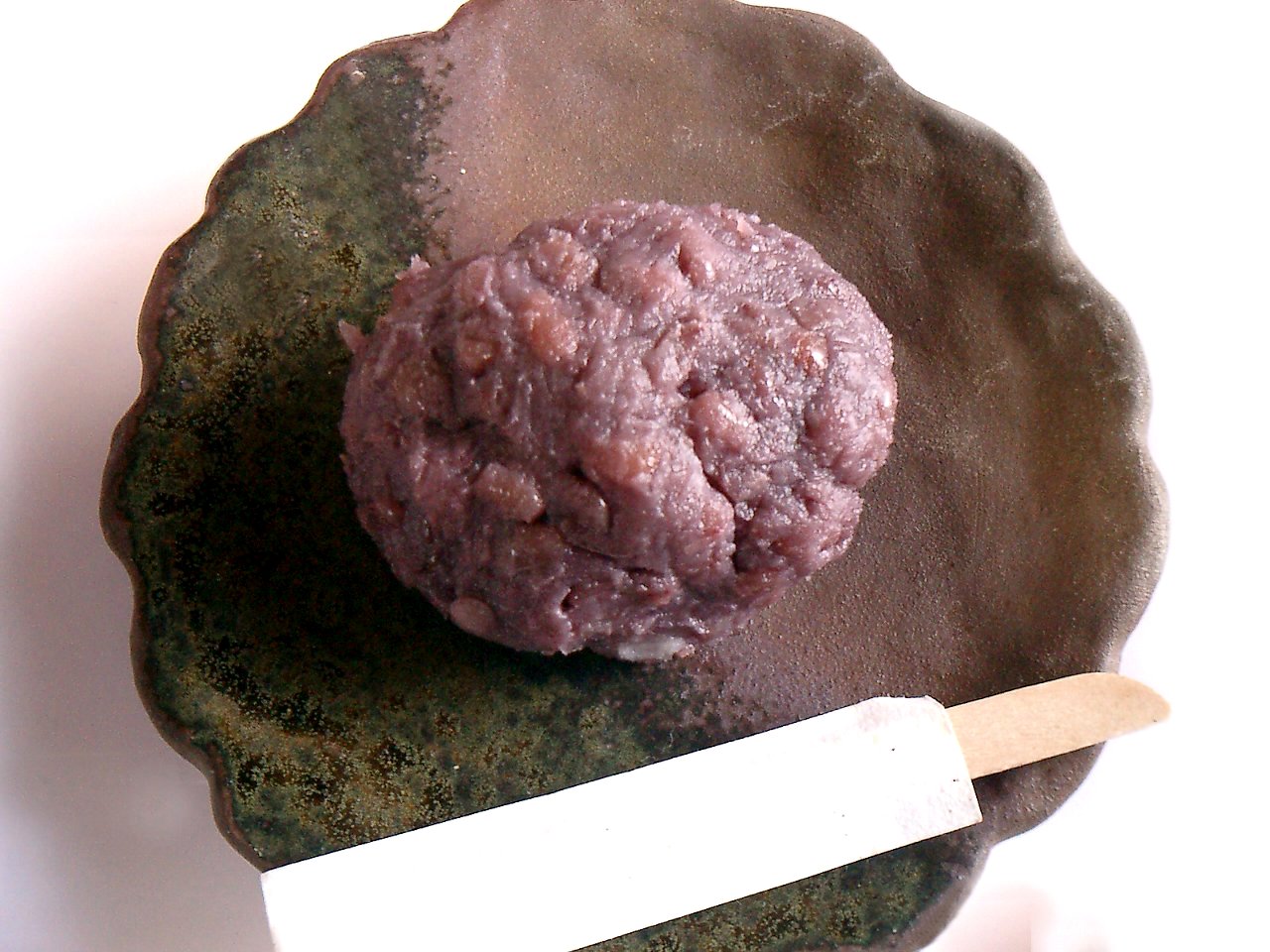
Botamochi (ぼたもち or 牡丹餅) is a wagashi (Japanese confection) made with glutinous rice, white rice (ratio of 7:3, or only glutinous rice), and sweet azuki paste (red bean paste). They are made by soaking the rice for approximately 1 hour. The rice is then cooked, and a thick azuki paste is hand-packed around pre-formed balls of rice. Botamochi is eaten as sacred food as offering during the weeks of the spring and the autumn Higan in Japan.

Another name for this kind of confection is ohagi (おはぎ), the origin and meaning of which is a subject of debate, with some saying [1] that ohagi uses a slightly different texture of azuki paste but is otherwise almost identical. It is made in autumn and some recipe variations in both cases call for a coating of soy flour to be applied to the ohagi after the azuki paste.

Botamochi (Koshian type, which is smooth and fine-grained red bean paste type)

The two different names are, some people say,[2] derived from the Botan (peony) which blooms in the spring and the Hagi (Japanese bush clover or Lespedeza) which blooms during autumn.

Botamochi is the modern name for the dish kaimochi (かいもち) mentioned in the Heian period text Uji Shūi Monogatari (宇治拾遺物語).[citation needed]

The proverb Tana kara botamochi (棚からぼたもち), literally "a botamochi falls down from a shelf", means "receiving a windfall", "a lucky break".

The term is also used for a specific pattern of Bizen ware with two, three or five round marks, as if the marks of the small balls of rice cakes were left on the plate.[3][4]

See also

[edit]

References

[edit]
Revisions and contributorsEdit on WikipediaRead on Wikipedia
from Grokipedia
Botamochi is a traditional Japanese confection, or , made from a mixture of glutinous and short-grain rice that is steamed, lightly pounded to a sticky consistency, and shaped into small balls or barrels before being coated with smooth sweet azuki bean paste known as koshian. It is closely related to ohagi, with the primary distinction being seasonal: botamochi features the smoother koshian paste and is enjoyed during the spring equinox, while ohagi uses chunkier tsubuan paste in autumn. The core ingredients of botamochi include (mochigome) and short-grain rice in a typical ratio of about 1:2, combined with azuki beans boiled and sweetened into paste, often with added sugar and a pinch of salt for balance. Preparation involves soaking and steaming the rice until soft, then pounding it just enough to break the grains partially—creating a texture called han-goroshi—before forming and coating it, a process that can vary by region or household to achieve the desired chewiness. The deep red color of the azuki paste is symbolic, believed to purify and ward off evil spirits. Botamochi traces its origins to the (794–1185), when it evolved from simple rice offerings to Buddhist deities and ancestors among the aristocracy, later spreading to commoners during the (1603–1868); it became more widely sweetened in the (1868–1912) as sugar became more accessible. It gained prominence as a seasonal sweet tied to Ohigan, the seven-day Buddhist observance around the vernal and autumnal equinoxes, when the boundary between the living and the dead is thought to thin, allowing prayers for ancestral souls. Culturally, botamochi holds deep significance in Japanese ancestral veneration, often offered at household shrines () or graves during spring Ohigan (centered on March 21) to express gratitude for fertility and renewal, with its name possibly deriving from the blooming (botan) flower of spring. In , it reinforced community bonds through shared preparation and consumption, and today it remains a homemade or store-bought staple for these rituals, sometimes varied with toppings like (roasted soybean flour) or for regional diversity.

Description

Ingredients

The primary ingredient in botamochi is , known as mochigome in Japanese, which imparts the characteristic sticky and chewy texture essential to the confection. Traditionally, this is often blended with short-grain rice (uruchimai) in varying ratios such as approximately 2:1 or 1:2 ( to short-grain) to balance chewiness with a slightly firmer structure, though some recipes use exclusively for an even more pronounced mochi-like consistency. The secondary ingredient is sweet azuki red bean paste, or anko, typically prepared as a thick, smooth koshian variety by straining cooked azuki beans to remove skins, then sweetening with sugar. This paste serves as the outer coating, providing a glossy finish and balancing the neutral rice base with its rich, earthy sweetness derived from the beans. Before cooking, the rice must be soaked in water for about 1 hour to ensure proper hydration, which enhances the and results in the desired stickiness when steamed or boiled. The contributes the foundational mochi-like elasticity and chewiness, while the azuki paste adds complementary sweetness and acts as a binding exterior layer that adheres well to the rice balls.

Physical characteristics

Botamochi are typically formed into small, rounded or oval-shaped balls, resembling a in size, with each piece weighing approximately 40 grams of before . This compact form facilitates easy handling and consumption as a bite-sized confection. The shape draws from traditional methods of lightly pounding steamed , which is then portioned and rolled without fully flattening, preserving a natural, slightly irregular contour. The exterior of botamochi features an even coating of thick azuki bean paste, known as anko, which imparts a smooth, glossy reddish-brown surface. This paste adheres closely to the , creating a uniform layer that seals in the interior while providing visual appeal through its rich color and subtle sheen from the natural sugars in the beans. In some preparations, the coating may include light imprints from the rolling process, enhancing the tactile and aesthetic quality without altering the overall simplicity. Internally, botamochi exhibit a chewy and sticky texture derived from the glutinous rice, which is only partially pounded to retain a noticeable graininess, contrasting with the soft, dense consistency of the surrounding anko paste. This duality offers a satisfying bite that begins with the yielding exterior and transitions to the resilient rice core. Sensorially, the confection presents a mild sweetness from the anko, complemented by a faint, earthy rice aroma, making it a balanced treat often enjoyed fresh within 24 hours to maintain optimal chewiness, as refrigeration can harden the rice.

Etymology and nomenclature

Botamochi

Botamochi derives its name from the Japanese term "botan mochi," where "botan" refers to the flower, scientifically known as , a celebrated for its vibrant spring blooms. This highlights the confection's connection to the flower's seasonal appearance, evoking imagery of renewal and floral abundance in Japanese tradition. The term specifically denotes the spring variant of the rice cake sweet, timed to the spring season and associated with the blooming peony flower, which symbolizes the arrival of warmer seasons. This alignment underscores botamochi's role in seasonal rituals, distinguishing it from its autumn counterpart through this floral linkage. Linguistically, "mochi" signifies the glutinous rice cake foundation, a staple in Japanese confections, which is prefixed with "botan" to specify the spring-specific iteration and infuse it with the peony's evocative qualities. This combination evolved as a descriptive label, merging the base ingredient with the emblematic flower to denote both form and temporal context in culinary . In Japanese culture, the embodies and good fortune, attributes that extend to botamochi's consumption as an auspicious treat believed to invite blessings and . These symbolic ties reinforce the confection's place in traditions honoring abundance and positive omens.

Ohagi

Ohagi serves as the autumnal nomenclature for the rice-based confection akin to botamochi, distinguished by seasonal floral associations and typically featuring a chunkier bean paste coating. The term "ohagi" derives from "hagi," the Japanese name for bush clover (Lespedeza thunbergii), a whose delicate or white flowers bloom prominently from late summer into autumn, symbolizing the transition to cooler months; this floral link is a traditional explanation, though the exact is subject to some debate. This naming convention aligns with the confection's preparation during the autumnal equinox, when hagi flowers are at their peak, mirroring the springtime use of "botamochi" tied to blooms. While sharing the identical core of and anko paste with its spring counterpart, ohagi typically uses coarser tsubu-an bean paste. In Japanese culture, bush clover holds deep symbolic resonance, frequently appearing in classical poetry such as the Manyoshu anthology to represent themes of transience, modest beauty, and contemplative reflection amid the fleeting autumn landscape. These motifs underscore the confection's role in evoking seasonal impermanence and gratitude, enhancing its cultural depth without altering its fundamental form.

History

Origins in Heian period

The earliest documented reference to botamochi appears as "kaimochi," a type of , in the medieval Japanese tale collection Uji Shūi Monogatari, compiled in the early (1185–1333), around the early 13th century. In one story (Scroll 1, Paragraph 12), kaimochi is depicted as round prepared by monks at a mountain temple, where a young pretends to sleep while observing the preparation and consumption, highlighting its role in communal temple activities. This narrative portrays kaimochi as made from (mochigome) or sometimes soba flour, coated with azuki bean paste, and traditionally associated with seasonal observances like the third evening of the first lunar month. Botamochi's origins trace to the Heian era (794–1185), when such rice-based confections emerged as simple offerings in Buddhist and rituals, symbolizing purity and devotion through the use of , a staple revered for its sticky texture representing cohesion and spiritual wholeness. During this period, mochi-like items were commonly presented to deities and ancestors at courtly and temple ceremonies, reflecting the era's syncretic religious practices where and Buddhist figures received white, unadorned rice pounded into cakes. These offerings underscored rice's sacred status in Japanese cosmology, as varieties were pounded to invoke blessings for prosperity and harmony. In its initial form, kaimochi or early botamochi was likely plain or only lightly sweetened with natural ingredients like azuki, distinguishing it from later elaborations and evolving from everyday used in household rituals to more formalized seasonal treats within aristocratic and clerical settings. This simplicity aligned with Heian court cuisine's emphasis on refined , where confections served both practical and symbolic purposes in daily and ceremonial life. Botamochi connects to broader traditions rooted in Japan's cultivation, which began around 300 BCE during the , when wet-paddy farming introduced glutinous varieties that enabled production. While rudimentary sweets from nuts and fruits predated this, the formalized use of pounded in Heian court cuisine marked a key evolution, integrating them into elite dietary and ritual practices that influenced subsequent development.

Modern usage and naming

During the (1603–1868), botamochi and ohagi spread from ritual offerings to common households, with the names becoming more distinctly associated with seasonal flowers—botamochi with spring peonies (botan) and ohagi with autumn bush clovers (hagi)—solidifying their use as equinoctial treats. This period marked the transition from earlier generic terms like kaimochi to these standardized seasonal designations, reflecting broader cultural integration of the confection in everyday life. By the (1868–1912), the availability of refined white sugar transformed botamochi into sweeter versions with smoother (red bean paste) coatings, enabling production in urban confectionery shops and expanding its appeal beyond religious rituals to casual consumption. These shop-made varieties, often molded into neat barrel shapes, became staples in markets, contributing to the treat's commercialization and wider accessibility across . In the 20th century, particularly after , home preparation of botamochi declined as busy lifestyles favored store-bought options, though sales still surge seasonally during periods. Modern home recipes often simplify the traditional 7:3 glutinous-to-regular rice ratio by using 100% for easier molding and cooking, enhancing convenience without altering the core texture. Botamochi reached international audiences in the late through communities and the global rise of , appearing in ethnic markets and fusion desserts in places like the and .

Preparation

Basic process

The preparation of botamochi begins with soaking , often mixed with a portion of short-grain for added texture, in for 30 minutes to one hour to ensure even absorption and pliability during cooking. This step hydrates the grains without excessive rinsing, preserving their starch content for stickiness. The soaked rice is then cooked, with steaming preferred in traditional methods to yield a softer, more cohesive consistency compared to boiling. In a steamer or , the rice is cooked until tender and sticky, typically taking 40-60 minutes including a post-cook resting period to allow residual steam to finish the process, but without full pounding as in denser preparations. Once cooked, the hot mixture is partially mashed or pounded—known as hangoroshi—using a wooden pestle, , or to break down about one-third to half of the grains while retaining some whole grains for a chewy yet light texture. Hands are moistened with or a mild saltwater solution to prevent sticking, and the warm mixture is hand-molded into small round balls or slightly elongated barrel shapes, each weighing around 30-50 grams, to avoid cracking from rapid cooling. Minimal additional is used during forming to maintain cohesion without diluting the . The formed pieces are placed on a lightly moistened and allowed to cool slightly at for 10-20 minutes, ensuring the surface firms just enough for subsequent without becoming soggy. This entire process, from soaking to initial cooling, typically takes 1-2 hours, making it accessible for home cooks or small-scale commercial production.

Coating application

The coating application for botamochi traditionally involves koshian, a smooth prepared by cooking azuki beans, straining them to remove skins, and sweetening the resulting paste with until it achieves a thick, spreadable consistency. This type of anko is preferred for its refined texture, which adheres evenly to the rice without lumpiness. To apply the coating, the formed rice balls—typically oval-shaped and still warm from pounding—are gently pressed by hand into a portion of koshian, often first shaped into a flat disk of about 40 grams to match the rice ball's size. The rice is centered on the paste, then cupped and rotated between lightly salted or dampened hands to press the anko around it, ensuring complete and even coverage without excess that could overshadow the subtle rice flavor. This hand-pressing technique, a hallmark of traditional preparation, allows for precise control, forming a thin protective layer that seals in moisture and enhances taste balance. Post-application, the coated botamochi are set aside at to allow the anko to firm slightly, which helps maintain structure. This process allows consumption within 12-24 hours when stored in , though may harden the texture and is best avoided; prompt consumption is ideal for optimal freshness.

Cultural significance

Association with Higan

Higan, known as ōhigan in Japanese, refers to the seven-day periods centered on the vernal equinox in spring (haru no higan, typically March 18–24) and the autumnal equinox in fall (aki no higan, typically September 20–26), during which Japanese Buddhists engage in observances to honor ancestors and reflect on the six paramitas—generosity, ethical conduct, patience, effort, concentration, and wisdom—as pathways to enlightenment. These equinox weeks symbolize a time of balance between this world (shigan, the shore of suffering) and the "other shore" (higan) of nirvana or the Pure Land, encouraging practitioners to emulate the Buddha's virtues through family gatherings, temple visits, and ancestral veneration. Botamochi holds a central place in spring Higan traditions as a sacred offering (hōyōgu), typically prepared with balls coated in smooth (koshian), while its autumn counterpart, ohagi, uses coarser paste (tsubuan) to align with the seasonal . This consumption practice underscores themes of impermanence—reflecting the Buddhist contemplation of life's transience during equinoxes—and , as families prepare and share these sweets to express gratitude and devotion to forebears. The azuki beans in the paste are believed to ward off and invoke bountiful harvests, tying the treat to both spiritual purification and agrarian roots in Buddhist rituals. In ritual contexts, botamochi is placed on household Buddhist altars () or at gravesites as an offering to the deceased, often alongside , flowers, and water, before being shared among relatives to foster communal remembrance and strengthen familial bonds. These acts of commemoration, including grave cleaning and prayers, became formalized among commoners during the (1603–1868), when observances spread beyond aristocratic circles to emphasize accessible ancestral worship. The sweetened anko paste serves as a humble of offerings to and departed souls, blending sensory comfort with profound spiritual symbolism that reflects the cycle of seasons and impermanence.

Proverbs and expressions

One prominent featuring botamochi is tana kara botamochi (棚からぼたもち), literally translating to "botamochi from the shelf," which describes an unexpected windfall or stroke of obtained without effort. This expression originates from scenarios in traditional Japanese shops or homes where botamochi, placed on high shelves for storage, might accidentally fall into the lap—or open mouth—of someone below, symbolizing serendipitous fortune. The appears in Edo-period writings as a for , highlighting botamochi's role in evoking themes of accessibility and everyday delight amid the era's cultural shifts toward popular confections. A common variation extends the phrase to tana kara botamochi ga ochiru (棚からぼたもちが落ちる), emphasizing the sudden descent of fortune, and it remains prevalent in modern everyday speech as well as collections of . Through such expressions, botamochi transcends its role as a mere treat, reinforcing its cultural image as a of comforting, attainable in .

Variations

Traditional coatings

Traditional non-anko coatings for botamochi provide subtle, dry alternatives that emphasize the natural sweetness and texture of the , offering variety during seasonal preparations. These coatings, primarily and sesame-based, emerged as Edo-period innovations to diversify the treat beyond the standard sweetened azuki bean paste, allowing for simpler, nuttier flavors especially suited to home or temple offerings during . Kinako, a fine powder made from roasted soybeans ground into flour and mixed with sugar, is dusted lightly over the surface of moistened rice balls to create a nutty, powdery finish that adheres gently without overpowering the rice's chewiness. This coating is prepared by combining approximately 50 grams of kinako with 1-2 tablespoons of granulated sugar, sifted together for even sweetness, and then applied by rolling or sprinkling the mixture onto the formed botamochi, using about 1-2 tablespoons per small batch of 6-8 pieces to ensure a subtle flavor layer. Though more commonly associated with ohagi in autumn, kinako-coated botamochi offers a similar delicate contrast in spring, evoking the treat's rustic origins among commoners who valued accessible ingredients. A variation involves toasting sesame seeds until aromatic, grinding them into a coarse paste, and sweetening with to form a crunchy, earthy topping that provides textural contrast to the soft interior. The mixture, typically 3-4 tablespoons of ground sesame blended with 1 tablespoon of , is sprinkled or gently rolled onto the damp rice balls immediately after shaping, allowing the natural oils in the seeds to help it adhere while keeping the coating light—around 1 tablespoon suffices for a batch to avoid clumping. This option gained popularity in the early through shops like Matsuzaka-ya, which introduced it as an anko alternative to enhance variety for celebrations.

Regional and modern adaptations

Contemporary adaptations have streamlined botamochi preparation for home cooks and commercial production. Many recipes now incorporate pre-made anko to reduce cooking time, allowing for quick assembly without boiling and straining azuki beans from scratch. methods have also gained popularity, where is cooked rapidly in the appliance before pounding, enabling the entire process to take under 30 minutes. In urban bakeries, vegan versions—already inherently plant-based in their traditional form—experiment with fruit-based pastes, such as or reductions, as alternatives to azuki for lighter, seasonal flavors. Japanese communities abroad have infused mochi-based sweets with local ingredients since the late . In and on the U.S. West Coast, where Japanese immigrants introduced mochi traditions in the early 1900s, adaptations often incorporate , , or other flavors while preserving the chewy texture. Packaged botamochi has become widely available in Japanese supermarkets and convenience stores, shifting from its traditional Higan-only seasonality to year-round consumption. Brands offer shelf-stable or refrigerated versions in small trays, making the sweet accessible for everyday snacking or gifting beyond periods.

References

Add your contribution
Related Hubs
User Avatar
No comments yet.