Hubbry Logo
ExpurgationExpurgationMain
Open search
Expurgation
Community hub
Expurgation
logo
8 pages, 0 posts
0 subscribers
Be the first to start a discussion here.
Expurgation
Expurgation
from Wikipedia

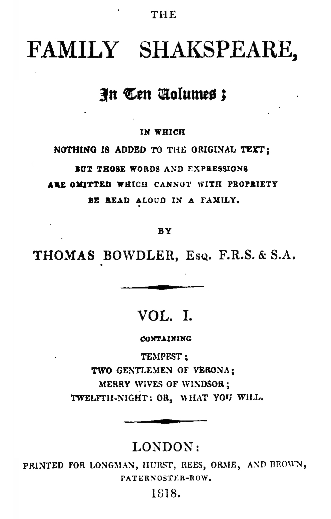
The Family Shakespeare, Thomas Bowdler's famous reworked edition of William Shakespeare's plays. 1818

An expurgation of a work, also known as a bowdlerization or fig-leafing, is a form of censorship that involves purging anything deemed noxious or offensive from an artistic work or other type of writing or media.[1][2][3][4]

The term bowdlerization is often used in the context of the expurgation of lewd material from books.[5] The term derives from Thomas Bowdler's 1818 edition of William Shakespeare's plays, which he reworked in ways that he felt were more suitable for women and children.[6] He similarly edited Edward Gibbon's Decline and Fall of the Roman Empire.[7] A less common term used in this context, also based on common editorial practice, is Ad usum Delphini, referring to a series of consciously censored classical works.[8][9]

Another term used in related discourse is censorship by so-called political correctness.[10] When this practice is adopted voluntarily, by publishers of new editions or translators, it is seen as a form of self-censorship.[3][11] Texts subject to expurgation are derivative works, sometimes subject to renewed copyright protection.[12]

Examples

[edit]

Religious

[edit]

Sexual

[edit]
  • Due to its mockery of the ancestors of the modern British royal family,[16] graphic descriptions of sex acts, and the symptoms of venereal disease,[17] the 1751 Scottish Gaelic poetry book Ais-eridh na Sean Chánoin Albannaich ("The Resurrection of the Old Scottish Language") by Alasdair mac Mhaighstir Alasdair, national poet of Scotland, continued to be republished only in heavily bowdlerized editions by puritanical censors throughout the 18th and 19th centuries.[18] The first uncensored text was published only in 2020.[19]
  • "The Crabfish" (known also as "The Sea Crabb"), an English folk song dating back to the mid-1800s about a man who places a crab into a chamber pot, unbeknownst to his wife, who later uses the pot without looking, and is attacked by the crab.[20] Over the years, sanitized versions of the song were released in which a lobster or crab grabs the wife by the nose[21] instead of by the genitals,[20] and others in which each potentially offensive word is replaced with an inoffensive word that does not fit the rhyme scheme, thus implying that there is a correct word that does rhyme. For instance, "Children, children, bring the looking glass / Come and see the crayfish that bit your mother's a-face" (arse).[22]
  • The 1925 Harvard Press edition of Montaigne's essays (translated by George Burnham Ives) omitted the essays that pertain to sex.[23]
  • A Boston-area ban on Upton Sinclair's novel Oil! – owing to a short motel sex scene – prompted the author to assemble a 150-copy fig-leaf edition with the nine offending pages blacked out as a publicity stunt.[24][25]
  • In 1938, a jazz song "Flat Foot Floogie (with a Floy Floy)" peaked at number two on US charts. The original lyrics were sung with the word "floozie", meaning a sexually promiscuous woman, or a prostitute, but record company Vocalion objected. Hence the word was substituted with the almost similar sounding title word "floogie" in the second recording. The "floy floy" in the title was a slang term for a venereal disease, but that was not widely known at the time. In the lyrics it is sung repeatedly "floy-doy", which was widely thought as a nonsense refrain. Since the lyrics were regarded as nonsense the song failed to catch the attention of censors.
  • In 1920, an American publisher bowdlerized the George Ergerton translation of Knut Hamsun's Hunger.[26]
  • Lady Chatterley's Lover by English author D. H. Lawrence. An unexpurgated edition was not published openly in the United Kingdom until 1960.
  • Several music artists have changed song titles to appease radio stations. For example, an expurgated remix of Snoop Dogg's song "Wet" was released under the title "Sweat" and Rihanna's song "S&M" had to be changed to "C'mon" in the UK.[27]

Racial

[edit]
  • Recent editions of many works—including Mark Twain's Huckleberry Finn[28] and Joseph Conrad's Nigger of the Narcissus—have found various replacements ("slave", "Indian", "soldier boy", "N-word", "children") for the word nigger. An example of bowdlerization can be plainly seen in Huckleberry Finn, in which Twain used racial slurs in natural speech to highlight what he saw as racism and prejudice endemic to the Antebellum South.[29][30]
  • Agatha Christie's 1939 book Ten Little Niggers was titled And Then There Were None for the US market in 1940, with some paperback editions calling it Ten Little Indians. UK editions continued to use the original title into the 1980s, and French editions were called Dix Petits Nègres until 2020.[31]
  • The American version of the counting rhyme "Eeny, meeny, miny, moe", which was changed by some to add the word "nigger",[32] is now sung with a different word, such as "tiger".
  • The Hardy Boys children's mystery novels (published starting in 1927) contained heavy doses of racism. They were extensively revised starting in 1959 in response to parents' complaints about racial stereotypes in the books.[33] For further information, see The Hardy Boys#1959–1979.
  • The Story of Doctor Dolittle and relevant works have been reedited to remove controversial references to and plots related to non-white characters (in particular, African ones).[34][35]

Cursing

[edit]
  • Many Internet message boards and forums use automatic wordfiltering to block offensive words and phrases from being published or automatically amend them to more innocuous substitutes such as asterisks or nonsense. This often catches innocent words, in a scenario referred to as the Scunthorpe problem: words such as 'assassinate' and 'classic' may become 'buttbuttinate' or 'clbuttic'. Users frequently self-bowdlerize their own writing by using slight misspellings, minced oaths or variants, such as 'flek', 'fcuk' or 'pron'.[36][37]
  • In a similar vein, content creators feel that the algorithms that spread their content or make it fit for revenue may turn against them, if certain topics are mentioned, prompting them to come up with euphemisms that may sound childish at times (a gynaecologist talking about lady bits to avoid vagina mistakenly prompting the algorithm to think the matter is too obscene to be worth broadcasting) or bizarre (a video-essay on a murder may reference the act as un-aliving)
  • The 2010 song "Fuck You" by CeeLo Green, which made the top-10 in thirteen countries, was broadcast as "Forget You", with a matching music video, where the changed lyrics cannot be lip-read, as insisted on by the record company.[38]
  • The 2021 song "ABCDEFU" by Gayle was also bowdlerized for radio, with the new lyrics reading: 'A, B, C, D, E, forget you', in a similar fashion to Fuck You.[39]

Other

[edit]
  • A student edition of the 1953 novel Fahrenheit 451 was expurgated to remove a variety of content. This was ironic given the subject matter of the novel involves burning books. This continued for a dozen years before it was brought to author Ray Bradbury's attention and he convinced the publisher to reinstate the material.[40][41][42][43]
  • The 2017 video game South Park: The Fractured but Whole was originally going to have the name The Butthole of Time. However, marketers would not promote anything with a vulgarity in its title, so "butthole" was replaced with the homophone "but whole".[44][45]
  • In 2023 new versions of Roald Dahl's books were published by Puffin Books to remove language deemed inappropriate. Puffin had hired sensitivity readers to go over his texts to make sure the books could "continue to be enjoyed by all today".[46] The same was done with the James Bond novels.[47]

See also

[edit]

References

[edit]
Revisions and contributorsEdit on WikipediaRead on Wikipedia
from Grokipedia
Expurgation is the deliberate removal or modification of passages deemed offensive, obscene, or morally impure from texts such as books, plays, or manuscripts, with the aim of cleansing them for broader acceptability or specific audiences. The term derives from the Latin expurgare, meaning "to purge" or "cleanse," reflecting its origins in practices of textual purification dating back to at least the early modern period. Historically, expurgation emerged prominently in religious contexts, such as the Catholic Church's efforts during the Inquisition to allow circulation of otherwise prohibited works by excising heretical or objectionable content, thereby creating a compromise between outright bans and full preservation. In literature, it gained notoriety through figures like Thomas Bowdler, whose 1807 and 1818 editions of Shakespeare's works omitted profanity, sexual references, and violence to suit family reading, coining the term "Bowdlerism" for such sanitization. This practice extended to classical Greek and Latin texts, where editors purged elements conflicting with Victorian moral standards or educational norms, often distorting original authorship and cultural context. While proponents viewed expurgation as a protective measure against immorality, critics argue it constitutes a subtle form of censorship that undermines artistic integrity and imposes subjective standards, as seen in sixteenth-century Spanish expurgation of medical texts to align with doctrinal purity. In modern discourse, expurgation differs from outright censorship by altering rather than suppressing entire works, yet both raise concerns over who determines "offensiveness" and the resultant loss of unfiltered historical or literary evidence.

Definition and Conceptual Foundations

Core Definition and Scope

Expurgation is the deliberate amendment of texts through the excision, alteration, or omission of passages considered offensive, immoral, obscene, blasphemous, or otherwise objectionable according to prevailing moral, religious, or social standards. This process aims to purify the material for broader acceptability, often preserving the overall structure and intent of the work while removing elements deemed unsuitable for specific audiences, such as children, religious adherents, or the general public. The term derives from the Latin expurgare, meaning "to purge out" or "cleanse thoroughly," reflecting its root in purification rituals akin to purging impurities from substances or doctrines. The scope of expurgation encompasses primarily literary and printed works, including books, plays, and manuscripts, where editors or censors target content related to sexuality, profanity, violence, political dissent, or theological heresy. Unlike outright censorship, which may prohibit distribution entirely, expurgation permits the circulation of a sanitized version, as seen in historical religious practices where prohibited texts were modified rather than destroyed to balance doctrinal control with access to knowledge. It has been applied across contexts, from ecclesiastical oversight in medieval Europe to editorial decisions in 19th-century publishing, and extends to modern instances like school book clubs altering children's literature to excise sensitive material. While most prevalent in textual media, analogous practices occur in visual arts or performances, though the core mechanism remains tied to purging objectionable elements to align with normative values. Expurgation's application is context-dependent, varying by era and authority; for instance, Catholic indices of expurgated books in the 16th century specified excisions for heretical content, enabling conditional approval. Its scope excludes incidental errors or factual corrections, focusing instead on subjective moral or ideological purification, which can introduce biases reflecting the expurgator's worldview rather than objective truth. Expurgation involves the deliberate removal, alteration, or omission of specific passages deemed objectionable—typically for moral, religious, or ideological reasons—from an existing text or work, with the intent of rendering it suitable for broader or more sensitive audiences while preserving the overall structure. This practice contrasts with general censorship, which encompasses a wider array of suppressive actions, including the outright prohibition, banning, or preemptive withholding of entire works from circulation, often enforced by state or institutional authority to control information flow or public discourse. For instance, whereas censorship might prevent a book's initial publication due to political dissent, expurgation modifies an already disseminated text by excising vulgarity or heresy, as seen in historical Catholic Index expurgatorius lists that specified deletions rather than total bans. Bowdlerization represents a specialized subset of expurgation, named after Thomas Bowdler (1754–1825), who in 1818 produced an edition of Shakespeare's plays with profane language and sexual references omitted or softened to make them "suitable for family reading." While expurgation broadly applies to purging any noxious content across genres and eras, bowdlerization specifically connotes prudish, Victorian-era sanitization aimed at shielding audiences from immorality, often involving not just deletion but euphemistic substitutions, though the terms are frequently synonymous in modern usage. Merriam-Webster defines bowdlerize as "to expurgate by omitting or modifying parts considered vulgar," underscoring its narrower, eponymous focus on moral propriety over comprehensive ideological cleansing. In distinction from redaction, which entails the excision of confidential, sensitive, or legally protected information—such as personal identifiers in court documents or classified details in government releases—expurgation prioritizes the elimination of content offensive to prevailing ethical standards rather than safeguarding privacy or security. Redaction, common in legal and journalistic contexts since the 20th century, preserves the document's integrity for evidentiary purposes without altering its core narrative for moral uplift, whereas expurgation seeks to "purify" the work ideologically, potentially distorting authorial intent.

Etymology and Terminology

Linguistic Origins

The term expurgation entered English as a borrowing from the Latin expurgātiōn-em (nominative expurgātiō), denoting the action of cleansing or purifying by removal of impurities. This Latin noun stems from the verb expurgāre, which combines the prefix ex- (meaning "out" or "away from") with purgāre ("to cleanse, purge, or purify"), the latter related to the Indo-European root peuə- signifying "to purify" or "to cleanse by fire." In classical Latin usage, expurgāre primarily connoted physical or ritual purification, such as clearing legal records or ritually cleansing objects, rather than specifically textual amendment. The earliest recorded English attestation of expurgation dates to around 1420, appearing in the agricultural treatise Palladius on Husbondrie, where it referred to the purging or cleansing of impurities in a non-literary context. By the 17th century, the related verb expurgate emerged in English around 1620–1678, initially in anatomical or medical senses meaning "to purge," as a back-formation from expurgation or directly from Latin expurgātus (past participle of expurgāre). This verbal form later extended to the removal of objectionable content from texts by the late 17th century, reflecting a semantic shift toward editorial purification amid growing concerns over moral and religious propriety in print. Linguistically, expurgation parallels other English terms derived from purgāre, such as purge (via Old French) and purgatory, all evoking thorough cleansing, but it uniquely emphasizes extraction (ex-) over mere expulsion. The word's adoption in English coincided with the Renaissance revival of Latin scholarship, facilitating its integration into scholarly and ecclesiastical discourse on textual integrity.

Evolution of Associated Terms

The term "expurgation" entered English usage around 1420, derived from Latin expurgātiōn-em, the nominal form of expurgāre, meaning "to cleanse out" or "purge," combining ex- ("out") and purgāre ("to purify"). Initially applied in contexts of ritual or textual purification, it evolved by the 17th century to specifically denote the amendment of books or writings by excising morally or doctrinally objectionable passages, as seen in ecclesiastical approvals for edited texts. In 1818, Thomas Bowdler published The Family Shakespeare, an edition omitting words and phrases he considered profane or indecent to render the plays suitable for family reading, prompting the coinage of "bowdlerize" as a verb in the 1830s to describe such targeted literary expurgation. By 1838, "bowdlerize" functioned as a near-synonym for "expurgate" but increasingly carried a derogatory implication of prudish over-editing that compromised artistic integrity, a connotation reinforced in 19th-century critiques of similar adaptations. Over the 20th century, associated terminology expanded beyond moral cleansing; "redaction" shifted from its classical sense of systematic arrangement (from Latin redactio, "bringing back") to modern usage emphasizing the permanent removal or blacking out of confidential details in documents, particularly post-1970s Freedom of Information Act implementations in the U.S., prioritizing privacy over ethical sanitization. This evolution reflects a broader diversification, where "expurgation" retained connotations of ideological or moral purging, while terms like "sanitization" emerged in technical and digital contexts to describe metadata stripping or data cleansing without altering core content meaning.

Historical Development

Ancient and Medieval Instances

In ancient Rome, expurgation occasionally occurred as a political measure to suppress perceived criticisms of authority. For instance, in 34 CE, under Emperor Tiberius, the tragedian Mamercus Scaurus composed a play titled Atreus that contained lines interpreted as veiled attacks on Sejanus, Tiberius's powerful prefect; the text was subjected to expurgation by authorities, after which Scaurus was charged with treason and compelled to suicide. Such interventions targeted specific objectionable passages rather than wholesale destruction, distinguishing them from contemporaneous book burnings ordered by emperors like Augustus in 12 BCE, who eliminated over 2,000 prophetic scrolls deemed spurious while preserving select Sibylline texts. Systematic moral or religious expurgation appears rarer in surviving ancient records, often conflated with editorial practices in textual transmission, such as the athetization (marking as spurious) of verses in Homeric epics by Alexandrian scholars like Aristarchus of Samothrace (c. 220–143 BCE), who occasionally justified exclusions on grounds of indecency or inconsistency, though primarily for philological reasons. During the medieval period, expurgation became more prevalent in monastic scriptoria, where Christian scribes copying classical pagan texts frequently omitted, altered, or Christianized passages deemed immoral, obscene, or antithetical to doctrine. For example, excerpts from the Roman poet Tibullus (c. 55–19 BCE) were modified between the 9th and 13th centuries by excerptors who excised erotic or pagan elements to align with ecclesiastical sensibilities. Similarly, the geographer Solinus's work underwent diction and content revisions, attributed to Irish (Scotch) monks at Lake Constance, substituting contemporary idioms for objectionable material. In religious contexts, the Church applied expurgation to heretical manuscripts to excise dissenting elements while permitting circulation of amended versions. A notable case involves a 15th-century Lollard sermon-cycle, where the scribe systematically removed Wycliffite doctrinal insertions promoting lay Bible access and anti-clericalism, rendering the text orthodox without total suppression. Methods included ink cross-outs, erasures, or omissions during recopying, often leaving physical traces like lacunae or marginal notes indicating intervention. These practices reflected a pragmatic balance between preservation of useful knowledge and doctrinal purity, though they contributed to lacunae in transmitted classical literature.

Early Modern Period and Institutionalized Expurgation

The institutionalization of expurgation in the early modern period emerged as a key mechanism of the Catholic Church's Counter-Reformation strategy to safeguard doctrinal purity amid the proliferation of printed materials following the invention of the printing press. Following the Council of Trent (1545–1563), which emphasized the need for ecclesiastical oversight of publications, Pope Paul IV issued the first comprehensive Roman Index Librorum Prohibitorum in 1559, listing heretical and immoral books while incorporating provisions for correcting salvageable texts through targeted removals. This approach distinguished outright prohibition from expurgation, allowing works with redeemable value—such as classical, scientific, or humanist texts—to circulate after objectionable passages were excised, thereby balancing suppression with the preservation of intellectual utility. In 1571, Pope Pius V established the Congregation of the Index, a dedicated Roman curial body tasked with systematically reviewing, prohibiting, and expurgating books, which formalized expurgation as an ongoing administrative process rather than ad hoc intervention. The Tridentine Index of 1564, approved by Pius IV, outlined ten rules for censorship, including the requirement to expurgate books containing errors on faith, morals, or superstition unless wholly heretical, with correctors appointed to identify and delete specific phrases or sections. By 1607, the first Roman Index Expurgatorius was published, cataloging precise passages for removal across thousands of titles, enabling owners to amend books via methods like inking, pasting over, or excising pages, after which censors would sign and date the alterations to certify compliance. Expurgation practices were particularly rigorous in Spain and Portugal, where the Inquisitions enforced them to eliminate perceived Jewish, Islamic, or Protestant influences from imported texts, extending beyond theology to scientific literature. In sixteenth-century Spain, ecclesiastic authorities systematically censored medical books, as seen in the expurgation of Amatus Lusitanus's Centuria IV (Lyons, 1580), where discussions of natural virginal pregnancy—drawing on Averroes and the Hebrew Alphabet of Ben Sira—were deleted to avert challenges to doctrines on conception and miracles. Similar measures targeted Arabic-derived medical knowledge, reflecting a broader effort to "Christianize" scholarship while mitigating risks of heterodoxy, though enforcement varied, with astronomical works like those of Tycho Brahe often escaping heavy alteration due to their perceived neutrality. These institutionalized procedures, sustained through the seventeenth and eighteenth centuries, underscored expurgation's role in maintaining orthodoxy without wholesale destruction of cultural heritage, though they imposed significant barriers to unfiltered knowledge dissemination.

Enlightenment to 19th Century Expurgation

During the Enlightenment, expurgation persisted as a tool of moral and doctrinal control despite growing advocacy for intellectual liberty. The Catholic Church upheld the Index Librorum Expurgandorum, a catalog specifying textual alterations to purge objectionable content from otherwise prohibited works, enabling their conditional circulation among the faithful. This mechanism, operational throughout the 18th century, required deletions of heretical, immoral, or politically subversive passages, reflecting institutional efforts to safeguard orthodoxy amid philosophical challenges from figures like Voltaire and Rousseau. In Protestant regions, state pre-publication censorship waned—such as in England after the Licensing Act expired in 1695—but private publishers began producing sanitized editions to appeal to morally sensitive readers, including families and educators wary of corrupting influences. By the early 19th century, expurgation intensified under Victorian moral standards, emphasizing domestic purity and public decency. Thomas Bowdler (1754–1825), collaborating with his sister Henrietta Maria Bowdler (1750–1830), released The Family Shakespeare in 1807 as a partial edition of 20 plays, expanding to all 36 in 1818; this version excised profane language, sexual innuendos, and graphic violence, removing roughly one-tenth of the original text to render it suitable for aloud reading in mixed company. The work's preface explicitly justified alterations to eliminate "words and expressions" unfit for "the ear of modesty," aligning with evangelical and bourgeois values prioritizing moral edification over textual fidelity. Bowdler's approach popularized the practice, coining "bowdlerize" as a byword for such prudish editing, and influenced subsequent family-oriented publications. Expurgation extended to classical education, where 19th-century school texts of Greek and Latin authors systematically omitted or rephrased erotic, blasphemous, or scatological elements to protect students' virtue. This was commonplace in British and American curricula, as publishers catered to parental and institutional demands for "purified" antiquity, often drawing on 18th-century precedents but scaling up amid industrialization and expanded literacy. In Catholic domains, the Church's expurgatory regime endured, with updated indices enforcing doctrinal corrections until reforms under Pope Leo XIII in 1897 shifted toward broader prohibitions. These practices underscored a tension between preserving cultural heritage and imposing contemporary ethical norms, frequently prioritizing societal protection over historical authenticity.

Methods and Techniques

Textual and Editorial Approaches

![Title page of Thomas Bowdler's The Family Shakespeare][float-right] Textual expurgation primarily involves the deletion or omission of passages deemed offensive, the substitution of milder terms for profane or indecent language, and occasional alterations to narrative elements to sanitize content. These editorial interventions aim to render texts suitable for specific audiences, such as families or religious communities, by excising material related to sexuality, profanity, violence, or heresy. In practice, changes may be implemented seamlessly without notation, preserving the illusion of textual integrity, or documented in accompanying indices for systematic correction. In Catholic censorship traditions following the Council of Trent in 1564, expurgation was formalized through the Index Expurgatorius and local codices expurgatorii, which specified exact words or passages for deletion in otherwise permissible works. Censors appointed by bishops or inquisitors performed these edits, focusing on heretical or morally hazardous content in books by Catholics or repurposed heretical texts; corrected versions were then approved for circulation, often under special permissions. This method emphasized precise excision rather than wholesale prohibition, allowing retention of "good and useful" material after purging objectionable elements. A prominent Protestant example is Thomas Bowdler's 1807 edition of The Family Shakespeare, expanded in 1818, where techniques included omitting entire characters like the prostitute Doll Tearsheet from Henry IV, Part 2, substituting exclamations such as "God!" with "Heavens!" throughout, and altering phrases like "Out, damned spot!" in Macbeth to "Out, crimson spot!" to avoid blasphemy and vulgarity. Sexual innuendos were neutralized, as in Romeo and Juliet where "the bawdy hand of the dial is now upon the prick of noon" became "the hand of the dial is now upon the point of noon," and Ophelia's suicide in Hamlet was recast as accidental drowning. These changes broadened access for Victorian families while modifying plots and expressions to eliminate perceived indecencies. In editing classical Greek and Latin texts, expurgators employed similar strategies, such as omitting sexually explicit fragments like those of Archilochus or excising lines in Catullus editions, as seen in the 1685 Delphin Classics where up to six lines were removed. Substitutions involved euphemisms, replacing explicit terms with "love" or "kiss," or coining words like "paedicate" in commentaries; offensive sections were sometimes segregated to appendices or left untranslated in Latin/Greek to evade direct confrontation. These approaches reflected moral objections within the transmission of ancient works, balancing preservation with sanitization for educational use.

Adaptations for Visual and Multimedia Content

In visual media, expurgation techniques parallel textual methods by selectively removing or obscuring objectionable elements, such as nudity or violence, through physical or digital alterations. Historically, one prominent adaptation involved affixing fig leaves or loincloths to classical sculptures to conceal genitalia, a practice originating in the Renaissance but intensifying under Catholic Church directives during the Counter-Reformation. For instance, in the 16th century, papal interventions targeted "indecent" pagan artworks in Vatican collections, leading to the addition of coverings on thousands of statues; this culminated in the 19th century when Pope Pius IX formalized such modifications to align with moral standards amid growing public access to museums. Similarly, paintings underwent overpainting, as seen in 17th-century additions of drapery to nudes in works like those by Titian, effectively purging erotic content while preserving the overall composition. For still images and photographs, expurgation often employs cropping to excise portions deemed offensive, a method documented in 19th-century illustrated books where engravings of anatomical studies were trimmed to omit explicit details. In the 20th century, darkroom techniques like airbrushing removed elements from propaganda posters or news photos, such as Soviet-era edits to eliminate purged political figures from group images. Digital adaptations since the 1990s include blurring or pixelation to anonymize or obscure sensitive areas, as in broadcast television where faces of minors or nudity are fogged to comply with decency standards; this technique, akin to textual redaction, maintains visual continuity but sacrifices detail. In film and video, expurgation primarily manifests as scene excision or re-editing to delete sequences violating moral or legal codes, a practice institutionalized by early 20th-century censorship boards. The 1930 Motion Picture Production Code (Hays Code) in the United States mandated cuts to depictions of "sex perversion," drug trafficking, or excessive brutality, resulting in the removal of entire reels from films like Scarface (1932), where over 10 minutes were trimmed for its original release to avoid bans. Techniques extended to optical printing for superimposing fades or dissolves over graphic content, while post-production dubbing replaced profane dialogue with sanitized alternatives, as in international versions of Hollywood exports adapted for conservative markets. Multimedia content, encompassing combined audio-visual formats like television and streaming, adapts expurgation through layered interventions: visual cropping or mosaicking paired with audio bleeping or muting. For example, U.S. broadcast standards enforced by the Federal Communications Commission since 1978 require excision of indecency, leading networks to pixelate nudity and insert tone overlays on expletives in real-time edits of live events, such as the 2004 Super Bowl halftime show where fleeting exposure prompted immediate post-broadcast alterations affecting millions of recordings. In video games, developers expurgate by patching textures or models, as occurred in Grand Theft Auto series re-releases where gore animations were toned down for regional approvals, preserving gameplay while altering sensory impact. These methods prioritize minimal disruption to narrative flow, contrasting sharper textual deletions, but risk introducing artifacts that underscore the intervention.

Rationales and Justifications

Moral and Religious Motivations

Religious motivations for expurgation have historically centered on preserving doctrinal purity and shielding adherents from teachings or content deemed heretical, blasphemous, or morally corrosive. The Catholic Church, as a primary institutional driver, employed expurgation to excise passages from texts that contradicted orthodoxy or promoted immorality, viewing such material as a threat to the spiritual welfare of the faithful. For instance, following the Council of Trent in 1559, the Church issued the Index Librorum Prohibitorum, which included not only outright prohibitions but also detailed expurgation guidelines specifying deletions of objectionable content to permit the distribution of sanitized versions. This approach reflected a causal understanding that exposure to uncorrected errors or vice could undermine faith and virtue, prioritizing the common good over unrestricted access. In practice, these religious imperatives extended to diverse genres, including scientific and theological works, where expurgation removed elements conflicting with ecclesiastical authority. During the sixteenth century in Spain, inquisitorial bodies systematically reviewed medical texts, deleting sections perceived as promoting superstition or doctrinal deviation, motivated by the conviction that such knowledge endangered souls and societal piety. Similarly, in Italy, Church censors targeted Hebrew literature, expurgating anti-Christian references to neutralize perceived threats to Catholic hegemony while allowing retention of otherwise neutral content. These actions underscore a rationale rooted in hierarchical guardianship of truth, where partial amendment was preferred to total suppression when feasible, aiming to mitigate harm without wholly eradicating useful knowledge. Moral motivations, often intertwined with but distinct from strictly religious ones, emphasized protecting public decency and individual character from corrupting influences such as profanity, sexual explicitness, or violence in literature. Proponents argued that expurgation enabled edifying access to classics, rendering them suitable for broad audiences, including youth and families, by aligning content with prevailing ethical standards. Thomas Bowdler exemplified this in his 1807 publication of The Family Shakespeare, a ten-volume edition from which he omitted bawdy allusions, oaths, and indelicate phrases, explicitly stating in the preface that the alterations ensured the plays could be read aloud without offense, thereby promoting moral improvement through literature. Bowdler's work, influenced by evangelical sensibilities and vice societies, sought to refine Shakespeare's "untutored" elements for domestic virtue, reflecting a broader early nineteenth-century concern that unexpurgated texts fostered vice amid rising literacy. This moral framework extended beyond Protestant England, manifesting in efforts to cleanse texts for societal upliftment, where expurgators positioned their edits as enhancements preserving artistic merit while excising moral hazards. Critics of the era, however, contended that such interventions distorted authorial intent, yet advocates maintained the primacy of ethical safeguarding, prioritizing causal prevention of moral decay over unaltered fidelity. In both religious and moral domains, expurgation thus operated on the principle that targeted removal averted greater societal or spiritual perils, substantiated by institutional endorsements and editorial prefaces advocating virtue's precedence.

Protective and Societal Rationales

Expurgation has been justified on protective grounds primarily to shield children and adolescents from exposure to obscene, violent, or sexually explicit content in literature, which proponents argue could contribute to moral corruption or psychological harm. In 1807, Thomas Bowdler published The Family Shakespeare, an edition of Shakespeare's plays with sexual references, profanity, and other objectionable passages removed or altered to render the works suitable for reading aloud in family settings, particularly to protect women and youth from vulgarity. This approach reflected a precautionary rationale that unfiltered exposure to such elements might desensitize or influence impressionable minds negatively, a view echoed in later legal precedents like Ginsberg v. New York (1968), where the U.S. Supreme Court upheld states' rights to restrict sales of material harmful to minors—even if not obscene for adults—based on evidence that such content appeals to prurient interest in youth and lacks serious value for them. Empirical studies have suggested potential links, such as increased aggressive thoughts following exposure to violent literary depictions among high school students. Societal rationales for expurgation emphasize preserving communal moral standards and preventing the broader erosion of public decency through the dissemination of unfiltered texts. Historically, Victorian-era editors and censors viewed expurgation as essential to counter the perceived risks of literary content fostering vice or undermining social order, as seen in widespread adaptations of classics to align with prevailing norms of propriety. In the United States, 19th-century Comstock Laws (1873) criminalized the mailing of obscene materials not only to protect individuals but to safeguard societal values against moral decay, with enforcement targeting literature deemed capable of corrupting public taste. Proponents argue this maintains cultural cohesion by ensuring literature reinforces rather than challenges established ethical boundaries, though such measures often rely on subjective community standards rather than uniform empirical proof of widespread harm.

Political and Ideological Drivers

In authoritarian regimes, political and ideological drivers of expurgation primarily serve to enforce conformity with state ideology, eliminate perceived threats to regime legitimacy, and rewrite narratives to glorify rulers or suppress dissent. These motivations arise from the imperative to monopolize interpretive authority over history and culture, ensuring that public discourse reinforces official doctrines rather than challenging them through alternative viewpoints. For instance, in Nazi Germany after Adolf Hitler's appointment as chancellor on January 30, 1933, the regime established the Reich Chamber of Literature under Joseph Goebbels' Propaganda Ministry, which mandated pre-publication reviews and alterations to excise "degenerate" or anti-Nazi content, such as references to Jewish intellectuals or pacifist themes in literature. This systematic editing complemented the symbolic book burnings on May 10, 1933, where over 25,000 volumes were destroyed in 34 university towns, targeting works by authors like Heinrich Heine and Sigmund Freud deemed ideologically subversive. The underlying rationale was to purify German culture of "un-German" elements, aligning texts with racial and nationalist tenets to foster Volksgemeinschaft, or national community, as articulated in Nazi propaganda. The Soviet Union under Joseph Stalin exemplified ideological expurgation through Glavlit, the state censorship apparatus founded in 1922, which routinely purged manuscripts and textbooks of material contradicting Marxist-Leninist orthodoxy or referencing disgraced figures. During the Great Purge of 1936–1938, which executed or imprisoned over 680,000 perceived enemies, historical accounts were retroactively edited—such as airbrushing Leon Trotsky from photographs and texts following his 1927 expulsion from the Communist Party—to fabricate a seamless narrative of Stalin's infallibility and the party's unbroken success. Publishers were compelled to revise encyclopedias and biographies, removing mentions of "enemies of the people" like Nikolai Bukharin, whose trial and execution in 1938 prompted widespread textual alterations to prevent ideological contamination. This practice extended to literature, where works by purged writers were bowdlerized or withdrawn, driven by the causal logic that any deviation could undermine the totalitarian control essential to Soviet power consolidation. Similar drivers operated in other 20th-century totalitarian states, such as Mao Zedong's China during the Cultural Revolution (1966–1976), where Red Guards destroyed or edited "feudal" and "bourgeois" texts to eradicate the "Four Olds" (old ideas, culture, customs, habits), resulting in the revision of classical literature and history books to emphasize proletarian struggle. These efforts reflect a broader pattern: regimes prioritize expurgation when ideological purity is seen as vital for mobilization and loyalty, often prioritizing state survival over empirical fidelity, as evidenced by the recurring adaptation of censorship techniques across fascist, communist, and other authoritarian contexts.

Criticisms and Counterarguments

Free Expression and Authenticity Concerns

Expurgation has drawn criticism for undermining free expression by enabling the retroactive suppression of ideas and language that conflict with prevailing moral or ideological standards, effectively curtailing the dissemination of unaltered viewpoints. Proponents of unrestricted speech contend that such edits preempt public engagement with challenging material, fostering a chilling effect where creators self-censor to avoid future alterations. This concern intensified in 2023 when Puffin Books revised Roald Dahl's children's novels, removing terms like "fat" and "ugly" alongside references to gender and mental health, actions decried by free speech advocates as corporate-driven censorship that prioritizes contemporary offense over authorial liberty. Similar revisions to Ian Fleming's James Bond series and R.L. Stine's Goosebumps books, which neutralized racial stereotypes and other dated elements, elicited backlash for imposing modern filters on works originally published between 1953 and the 1990s, thereby limiting readers' exposure to historical discourse. On authenticity, expurgation erodes the fidelity of original texts by substituting sanitized proxies that obscure the author's intent and the era's unvarnished realities, resulting in cultural artifacts that mislead about past human behavior and societal tensions. Historical precedents, such as Thomas Bowdler's 1818 expurgated Family Shakespeare, which excised sexual innuendos and profanity to render the plays suitable for family reading, established "bowdlerization" as a pejorative for such dilutions, criticized for stripping works of their psychological depth and rhetorical force. In contemporary publishing, the use of sensitivity readers—consultants who scrutinize manuscripts for potential cultural insensitivities—has been faulted for prioritizing ideological alignment over textual integrity, as evidenced by mandatory revisions that homogenize diverse voices and distort historical fiction's reflective accuracy. Critics, including publishing analyst Adam Szetela, argue this practice, prevalent since the mid-2010s, enforces a form of self-censorship that favors anachronistic "inclusivity" at the expense of authentic representation, potentially falsifying societal evolution by erasing evidence of prior prejudices and debates. These alterations not only compromise intellectual honesty but also threaten the public domain, where edited classics risk overshadowing originals, as seen in the 2023 Dahl controversy where revised editions were initially positioned as the default, prompting Penguin Random House to retain unedited versions alongside them following public outcry. Empirical observations from literary scholars indicate that such interventions hinder critical analysis, as readers deprived of unaltered sources cannot fully grapple with the causal links between historical language and cultural shifts, ultimately impoverishing collective understanding. While defenders invoke protective rationales, detractors maintain that authenticity demands preservation of the unexpurgated record to enable genuine progress through confrontation rather than evasion.

Long-Term Cultural and Intellectual Impacts

Expurgation has historically distorted cultural transmission by prioritizing moral conformity over fidelity to original expressions, resulting in generations encountering truncated or sanitized versions of foundational works that obscure authors' intended critiques of society. Thomas Bowdler's 1818 Family Shakespeare, which excised profane and sexually suggestive passages from 24 of Shakespeare's plays, became a dominant edition throughout the 19th century, embedding a prudish lens that diminished appreciation of the originals' psychological depth and linguistic vigor until textual scholarship revived unexpurgated editions in the early 20th century. This pattern extended to other classics, fostering a cultural milieu where discomfort with human vice was evaded rather than confronted, thereby reinforcing Victorian-era sensibilities that prioritized decorum over realism. Intellectually, expurgation impedes the development of critical thinking by insulating readers from dissonant ideas necessary for ethical maturation and historical comprehension, as unfiltered texts compel engagement with moral ambiguities that build resilience against simplistic ideologies. Legal scholarship posits that such suppression negatively affects cognitive processes, limiting exposure to diverse viewpoints and thereby constraining intellectual growth across populations. In educational contexts, sanitizing literature like Mark Twain's Adventures of Huckleberry Finn—through removal of racial epithets—deprives students of contextual analysis of 19th-century racism, reducing opportunities to dissect narrative irony and linguistic evolution while sparking unnecessary pedagogical disputes. Over centuries, these practices have homogenized intellectual discourse, eroding the archival integrity of cultural artifacts and hindering causal understanding of societal evolution, as expurgated corpora become de facto standards that propagate incomplete causal narratives. For example, persistent alterations to children's literature, such as the 2023 revisions to Roald Dahl's works replacing terms like "fat" with "enormous" to avoid offense, risk preempting intergenerational learning about linguistic shifts and authorial intent, potentially cultivating audiences ill-equipped to navigate historical texts without mediated filters. Critics argue this bowdlerization trajectory undermines authenticity in education, where shielding from controversy fosters intellectual complacency rather than empowering discernment of truth from offense. Ultimately, the cumulative effect manifests in a diluted canon that prioritizes contemporary sensitivities over enduring verities, complicating scholarly reconstruction of past worldviews and perpetuating cycles of selective memory.

Notable Examples

Religious and Scriptural Cases

In the 13th century, Christian authorities in Europe initiated systematic expurgation of Jewish religious texts, including the Talmud and other scriptural commentaries, to remove passages deemed blasphemous against Christianity. Pope Clement IV's 1264 bull Cum sit required Jews in the Crown of Aragon to submit their books to Dominican censors, who excised references to Jesus, the Virgin Mary, and Christian doctrines, often blacking out or altering text to prevent accusations of hostility. This practice expanded across Italy and the Papal States, where inquisitorial oversight led to the destruction or mandatory editing of thousands of Hebrew volumes, with owners bearing the costs of certification for "corrected" editions. By the 16th century, expurgation of Jewish texts became more formalized amid Counter-Reformation pressures, exemplified by the 1553 papal mandate under Julius III to burn uncensored Talmuds in Italy, followed by the production of expurgated versions. Jewish communities, anticipating seizures, engaged in preemptive self-censorship, hiring internal editors to omit anti-Christian material from prayer books and commentaries to evade confiscation. A notable artifact is Sefer ha-Zikuk (Book of Expurgation), compiled in Mantua in 1596 by a Jewish censor, which provided guidelines for systematically purging objectionable phrases from Hebrew scriptures and rabbinic works, allowing their survival in altered form under ecclesiastical approval. In Christian scriptural traditions, expurgation targeted heretical interpretations rather than canonical Bibles, as seen in the late medieval alteration of Lollard sermon cycles—Wycliffite texts drawing on English Bible translations—which were edited to excise anti-clerical and reformist content deemed seditious by orthodox authorities. Protestant reformers, in turn, excluded deuterocanonical books from Old Testament canons in the 16th century, effectively expurgating them from vernacular Bibles like the 1535 Coverdale version, on grounds of doctrinal impurity and lack of Hebrew originality, though this constituted selective canonization more than textual purging. Islamic scriptures faced minimal direct expurgation due to the Quran's doctrinal immutability, with historical censorship instead focusing on interpretive texts like hadiths, where Ottoman authorities in the 18th-19th centuries suppressed variant collections perceived as politically subversive or sectarian, but without altering the core Quranic text. In contrast, modern Mormon scriptural practices have involved selective omission of verses in teaching materials from the Bible, Book of Mormon, and Doctrine and Covenants to emphasize thematic consistency, though full texts remain unedited in official publications.

Literary and Classical Works

![Title page of Thomas Bowdler's The Family Shakespeare][float-right] One prominent example of literary expurgation occurred in the early 19th century with Thomas Bowdler and his sister Henrietta Maria Bowdler's editing of William Shakespeare's plays. Their The Family Shakespeare, first published anonymously in 1807 as a four-volume set containing 20 expurgated plays, aimed to render the texts suitable for family reading by omitting words and passages deemed profane, sexually suggestive, or otherwise improper for women and children. This initial edition expanded to a 10-volume set in 1818, covering all 36 plays recognized at the time, with approximately one-tenth of the original text removed, including oaths, innuendos, and violent scenes such as the blinding of Gloucester in King Lear. The Bowdlers' work, motivated by moral concerns prevalent in Regency-era Britain, popularized the practice and gave rise to the verb "to bowdlerize," denoting prudish textual alteration. Expurgation extended to classical works, particularly in pedagogical editions from the 17th to 20th centuries, where editors excised erotic, obscene, or morally objectionable content to suit school curricula. Greek authors like Aristophanes saw their comedies heavily sanitized; for instance, sexual references and scatological humor in plays such as Lysistrata were omitted or rephrased in British and American textbooks to avoid corrupting young students. Similarly, Ovid's Metamorphoses and Ars Amatoria underwent systematic removal of mythological rapes, adulterous episodes, and didactic passages on seduction, with 19th-century school editions often presenting bowdlerized versions that obscured the originals' explicit themes. Latin poets like Lucretius and Catullus faced comparable treatments, where philosophical discussions of atomic theory intertwined with Epicurean views on pleasure were curtailed to emphasize moral edification over sensual detail. These practices reflected broader Victorian anxieties about classical literature's unfiltered influence on impressionable readers, leading to dual-text editions or glossaries that euphemized sensitive terms. While intended to preserve cultural heritage, such expurgations distorted authorial intent, as evidenced by surviving unedited manuscripts and later scholarly restorations that highlight the originals' raw vitality. In the case of Shakespeare, Bowdlerized versions dominated household libraries until the late 19th century, influencing public perception of the Bard as a wholesomer figure than his Elizabethan context warranted.

Racial, Sexual, and Profane Instances

In 2011, NewSouth Books released an expurgated edition of Mark Twain's Adventures of Huckleberry Finn, edited by Alan Gribben, which replaced the racial epithet "nigger" with "slave" in 219 instances and "injun" with "Indian" to address classroom sensitivities. The publisher argued this prevented preemptive bans, though critics contended it undermined Twain's deliberate use of vernacular to critique racism. Similarly, in 2023, Ian Fleming Publications revised multiple James Bond novels, eliminating the N-word slur—used to describe Black characters—and removing or altering other racial descriptors, such as changing "Negress" to "woman" in Live and Let Die. These changes spared some slurs targeting other groups, like East Asians, while entire ethnic references were excised in books including Thunderball and Live and Let Die. Expurgation of sexual content appeared prominently in 19th-century efforts to sanitize classics for domestic audiences. Thomas Bowdler, in his 1807 Family Shakespeare (expanded to 10 volumes in 1818), excised bawdy innuendos, brothel references, and implied promiscuity across plays like Measure for Measure and Pericles, reducing the text by over 10 percent to eliminate perceived immorality. For instance, in Romeo and Juliet, Bowdler removed Mercutio's pun-laden dialogue on virginity and phallic imagery, such as altering "prick" references to neutral timekeeping metaphors. His sister Henrietta contributed to initial edits, framing the work as suitable for women and children by purging elements linking vice to physicality. Profane language faced parallel removal in Bowdler's edition, where oaths invoking divinity—"Zounds," "Sblood," or "by God's wounds"—were systematically deleted or softened to avoid blasphemy, as in Hamlet and Henry V, reflecting Victorian concerns over irreverence. This practice extended to other works, such as expurgated versions of Edward Gibbon's The History of the Decline and Fall of the Roman Empire (1826), where Bowdler omitted profane or skeptical passages deemed unfit for family piety. Modern parallels include 2023 revisions to Roald Dahl's children's books by Puffin, which toned down racially charged terms alongside profanity and sexual stereotypes, though primarily targeting descriptors like "ugly" or "beastly" in favor of neutral alternatives. In 2023, HarperCollins edited several Agatha Christie's novels to remove racial slurs and references to ethnicity, including terms describing characters as Jewish, Black, or Gypsy. Earlier, a 2015 edition of Rudyard Kipling's Just So Stories published by Groundwood Books was edited to remove racist language.

Modern Applications and Debates

Publishing Industry Practices

In the publishing industry, expurgation practices increasingly involve the employment of sensitivity readers, who are contracted specialists reviewing manuscripts for content potentially offensive to marginalized groups, such as racial stereotypes, ableist language, or gender insensitivities. These readers provide feedback on authenticity, clichés, and credibility issues related to underrepresented experiences, often leading to revisions before publication. Publishers like major houses under Penguin Random House have integrated this step routinely since the mid-2010s, with sensitivity reading becoming a standard editorial tool to mitigate risks of public backlash or accusations of cultural insensitivity. Retrospective expurgation of backlist titles—previously published works—has also gained traction, particularly for children's and classic literature containing dated language. In February 2023, Puffin Books, an imprint of Penguin, released revised editions of Roald Dahl's works, including Matilda and Charlie and the Chocolate Factory, where over 80 changes were made, such as replacing "fat" with "enormous," removing references to "ugly" characters, and excising terms like "crazy" or "mad" in favor of neutral alternatives. Similarly, in 2023, Ian Fleming Publications edited reissues of the James Bond novels, excising racial slurs and stereotypes—such as altering descriptions of ethnic characters—while adding disclaimers noting the changes to reflect contemporary attitudes without erasing historical context. These edits, often justified by publishers as ensuring accessibility for modern audiences, have prompted criticism for overriding authorial intent, with original editions sometimes reissued in parallel collections to preserve unaltered texts. Critics, including free expression advocates, argue that such practices foster self-censorship among authors and editors, who preemptively alter content to avoid scrutiny from sensitivity consultants or social media campaigns, potentially homogenizing literature and prioritizing ideological conformity over narrative authenticity. Empirical surveys of publishing professionals indicate widespread adoption, with a 2022 report noting that over 60% of editors at major U.S. houses had engaged sensitivity readers in the prior year, though data on long-term effects remains limited and contested. Proponents counter that these measures enhance inclusivity in an industry historically dominated by non-diverse perspectives, reducing unintentional harm without mandating wholesale censorship.

Digital Era Expurgation

In the digital era, expurgation manifests primarily through content moderation practices on social media platforms, where algorithms and human reviewers systematically remove, suppress, or alter user-generated content deemed violative of community guidelines, often targeting categories such as hate speech, misinformation, or violence. Platforms like Meta, YouTube, and pre-2022 Twitter employed vast teams—Meta reported over 15,000 moderators in 2021—to process billions of daily posts, resulting in millions of removals annually; for instance, Facebook deleted 20 million pieces of hate speech content in Q4 2020 alone. These practices expanded post-2016 amid concerns over election interference and extremism, leading to opaque algorithmic demotions known as "shadowbanning," where content visibility is reduced without user notification, as evidenced by internal documents from the Twitter Files releases in 2022-2023 revealing preferential treatment for certain viewpoints. Deplatforming, a severe form of digital expurgation, involves permanent account suspensions, empirically reducing targeted influencers' online attention by up to 63% on search engines like Google and 43% across other platforms after 12 months, according to a 2024 study analyzing norm-violating accounts. Notable cases include the January 2021 suspension of then-President Donald Trump's Twitter and Facebook accounts following the U.S. Capitol riot, cited by platforms as incitement risks, which correlated with a sharp drop in his digital footprint; similarly, the 2021 deplatforming of Parler from app stores led to its temporary shutdown, though it later migrated to alternative hosting. Empirical analyses of deplatforming hate-designated groups on Facebook show follower losses of 10-20% immediately post-removal, with sustained reductions in network propagation, though critics argue such labels often reflect ideological biases in moderation teams, disproportionately affecting conservative or dissenting voices as documented in leaked internal communications. Advancements in artificial intelligence have automated expurgation, with large language models like those from OpenAI and Microsoft Azure incorporating built-in filters that refuse or alter outputs containing hate, sexual, or violent content, categorized into severity levels from low to high risk. For example, Azure OpenAI's content filters block prompts or completions exceeding thresholds in risk areas like fairness or self-harm, processing queries in real-time to enforce safety alignments trained on vast datasets, which can inadvertently suppress factual discussions on controversial topics such as biological sex differences. By 2025, AI-driven moderation scaled to handle user-generated content on platforms like TikTok and X, but raised concerns over overreach, prompting the U.S. Federal Trade Commission's February 2025 inquiry into big tech's use of demonetization and access degradation as potential antitrust violations restricting speech. These systems, while reducing harmful dissemination, have been critiqued for lacking transparency and embedding institutional biases, as platforms' policy teams—often aligned with progressive norms—define enforceable harms without robust empirical validation of long-term societal benefits.

Recent Controversies and Case Studies

In February 2023, Puffin Books, an imprint of Penguin Random House, released revised editions of Roald Dahl's children's novels, including over 80 titles, with hundreds of alterations to remove or replace words and phrases deemed offensive, such as "fat" (cut from every relevant instance), "ugly," and references to characters' physical appearances, gender nonconformity, mental health, and violence. These changes, guided by sensitivity readers and the Roald Dahl Story Company, aimed to align the texts with modern sensibilities but ignited backlash from figures including Salman Rushdie and the U.K.'s then-Queen Camilla, who labeled them "absurd censorship" that eroded authorial intent and historical authenticity. In response, the publisher reversed course on March 1, 2023, committing to print both original and edited versions indefinitely to preserve access to Dahl's unaltered prose. Concurrent with the Dahl revisions, Ian Fleming Publications announced in February 2023 new "definitive" editions of the James Bond novels, expurgating racial slurs (e.g., altering epithets directed at Black characters in Live and Let Die) and softening some misogynistic depictions, such as Bond's internal monologue on a woman's death in Casino Royale. The edits, applied without altering core plots, were justified by the publisher as removing "unacceptable racial stereotypes" while retaining Fleming's 1950s-1960s voice, though detractors contended they imposed anachronistic standards, potentially confusing readers about era-specific language and diluting the series' gritty realism. Similar controversies arose around R.L. Stine's Goosebumps series in early 2023, where Scholastic edited entries to excise outdated stereotypes, including racial descriptors and gender tropes, as part of a broader trend involving sensitivity readers in children's literature. Critics of these practices, including authors and free-speech advocates, argued that retroactive alterations risked sanitizing cultural artifacts, fostering a chilling effect on future writing, and prioritizing subjective offense over empirical fidelity to source texts, with some legal scholars warning of implications for public-domain works post-2034 for Fleming's oeuvre. By 2024-2025, while U.S. book challenges reached 2,452 unique titles amid debates over content in schools, explicit expurgation cases in publishing receded in prominence, though sensitivity reading persisted amid polarized views on its necessity versus overreach.

References

Add your contribution
Related Hubs
User Avatar
No comments yet.