Hubbry Logo
MartenitsaMartenitsaMain
Open search
Martenitsa
Community hub
Martenitsa
logo
8 pages, 0 posts
0 subscribers
Be the first to start a discussion here.
Martenitsa
Martenitsa
from Wikipedia
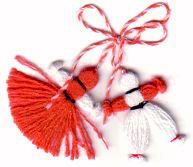
Typical Martenitsa

A Martenitsa (Bulgarian: мартеница, pronounced [ˈmartɛnit͡sa]; Macedonian: мартинка, romanizedmartinka; Greek: μάρτης, romanizedmártis [ˈmaɾ.tis]; Romanian: mărțișor [mər.t͡siˈʃor] ; Albanian: verore; Turkish: marteniçka [marteˈnit͡ʃka]) is a small piece of adornment, made of white and red yarn and usually in the form of two dolls, a white male and a red female. Martenitsi are worn from Baba Marta Day (March 1) until the wearer first sees a stork, swallow, or blossoming tree (or until the end of March (April 1)). The name of the holiday means "Grandma March" in Bulgarian and Macedonian, the holiday and the wearing of Martenitsi are a Bulgarian and Macedonian tradition related to welcoming the spring, which according to Bulgarian and Macedonian folklore begins in March.[1]

In Albania, it is worn on the March 14 (the old first day of March in the Julian calendar) to celebrate the Summer Fest (Dita e Verës). In Albania, the Summer Fest is dedicated to the ancient Goddess Diana.

It is inscribed in the UNESCO Representative List of the Intangible Cultural Heritage of Humanity. [2][3][4]

Symbolism

[edit]

A typical Martenitsa consists of two small wool dolls, Pizho and Penda (Bulgarian: Пижо и Пенда). Pizho, the male doll, is usually predominantly white; Penda, the female doll, is distinguished by her skirt and is usually predominantly red.[citation needed]

The red and white woven threads symbolize the wish for good health. They are the heralds of the coming of spring and of new life. While white as a color symbolizes purity, red is a symbol of life and passion, and so some ethnologists have proposed that, in its very origins, the custom might have reminded people of the constant cycle of life and death, the balance of good and evil, and the sorrow and happiness in human life. The Martenitsa is also a stylized symbol of Mother Nature, the white symbolizing the purity of the melting white snow and the red setting of the sun, which becomes more and more intense as spring progresses.[5] These two natural resources are the source of life. They are also associated with the male and female beginnings, and in their balance, with the need for balance in life.[citation needed]

Tradition

[edit]
Martenitsi tied to a blossoming tree, a symbol of approaching spring
Another tied Martenitsa
Blossoming Magnolia full of tied Martenitsi

Tradition dictates that Martenitsi are always given as gifts, not bought for oneself. They are given to loved ones, friends, and those people to whom one feels close.[citation needed] Beginning on the first of March, one or more are worn pinned to clothing, or around the wrist or neck, until the wearer sees a stork or swallow returning from migration, or a blossoming tree, and then removes the Martenitsa.[citation needed]

In Bulgarian folklore and Macedonian Slavic mythology the name Baba Marta (Bulgarian: Баба Марта, "Grandma March") evokes a grumpy old lady whose mood swings very rapidly. The common belief is that by wearing the red and white colors of the Martenitsa, people ask Baba Marta for mercy. They hope that it will make winter pass faster and bring spring.[citation needed] The first returning stork or swallow is taken as a harbinger of spring and as evidence that Baba Marta is in a good mood and is about to retire.[citation needed]

The ritual of finally taking off the Martenitsa is different in different parts of Bulgaria and North Macedonia. Some people tie the Martenitsa on a branch of a fruit tree, thus giving the tree health and luck, which the person wearing the Martenitsa has enjoyed themselves while wearing it.[6] Others put it under a stone with the idea that the kind of creature (usually an insect) closest to the token the next day will determine the person's health for the rest of the year. If the creature is a larva or a worm, the coming year will be healthy and full of success. The same luck is associated with an ant, the difference being that the person will have to work hard to reach success. If the creature nearest the token is a spider, then the person is in trouble and may not enjoy luck, health, or personal success.[citation needed]

Wearing one or more Martenitsi is a very popular Bulgarian and Macedonian tradition. The time during which they are worn is meant to be a joyful holiday commemorating health and long life.[citation needed]

Modern Martenitsi take a wider variety of forms and often incorporate colored beads and other elaboration.[5]

Origin

[edit]

This tradition is an important part of the Culture of Bulgaria and there is a similar tradition in North Macedonia, as well as in Greece, Albania (known as verorja), Romania and Moldova. The tradition is related to the ancient pagan history of the Balkan Peninsula and to all agricultural cults of nature. Some specific features of the ritual, especially tying the twisted white and red woolen threads, are a result of centuries-old tradition and suggest Thracian (paleo-Balkan) or possibly Hellenic or Roman origins.[7]

Some ethnographers claim that the custom can be traced in the Eleusinian Mysteries. The ancient equivalent of the modern Greek "martis" is thought to be the kroke (κρόκη). The custom is mentioned in Photios' Lexicon. It is said that the priests [μύσται] wrap a red thread [κρόκη] around their right hand and foot.[8] At that time red or otherwise colored threads were used to protect children and youths from evil spirits and witchcraft.[9][10]

An early 20th-century Bulgarian story relates the first Martenitsi to the 7th-century Battle of Ongal between the Bulgar Khan Asparuh and the Byzantines, which resulted in a decisive Bulgar victory. After the battle, the Asparuch sent doves with white threads to announce the victory to his main camp. The threads turned bloody during the flight, thus creating the first Martenitsa.[11][12]

See also

[edit]

References

[edit]
[edit]
Revisions and contributorsEdit on WikipediaRead on Wikipedia
from Grokipedia
A martenitsa is a traditional Bulgarian amulet made from intertwined and woolen or threads, often adorned with small figures or tassels, worn on the , pinned to , or attached to household items starting on to mark and herald the arrival of spring. This custom symbolizes protection against illness, evil forces, and the unpredictable weather, while promoting , , and through its exchange as gifts among and friends. The amulet is removed no later than the end of or upon sighting the first , , or blooming , after which it is tied to a budding tree, placed under a rock, or attached to a farm animal to transfer its protective qualities to nature or , often accompanied by a wish for good fortune. Rooted in ancient Thracian and agricultural rituals predating the AD, the reflects pre-Christian beliefs in the associated with fertility and the cycle of seasons, where the red thread evokes life force and blood, and white signifies purity, bones, or snow. Folklore centers on , a mythical elderly woman personifying the month of , whose capricious moods—shifting from joy to anger—mirror the erratic spring weather; legends depict her as a sister to personifications of and , emphasizing the transition from winter to renewal. In rural areas, older women traditionally craft martenitsi, passing the knowledge to younger generations, which fosters intergenerational bonds and cultural continuity. Recognized by in 2017 as part of the Representative List of the of Humanity under "Cultural practices associated to the 1st of March," the martenitsa extends beyond to related customs in neighboring countries like (martinka) and (mărţişor), highlighting shared Balkan heritage while adapting to local variations such as incorporating coins for or for added warding. Today, it promotes social cohesion through workshops in schools and museums, encourages environmental awareness by linking human well-being to natural signs of spring, and serves as a vibrant emblem of Bulgarian identity amid modernization.

History and Origins

Ancient Roots and Etymology

The Martenitsa tradition has deep roots in pre-Christian pagan practices of the , particularly Thracian agricultural rituals associated with and the renewal of spring from the BCE. These customs were tied to the veneration of a figure, central to early farming communities, where red-and-white threads symbolized the reconciliation of opposites—life and death, and purity—as protective amulets against malevolent forces during seasonal transitions. Thracian culture, flourishing from the BCE to the CE, significantly influenced these practices through worship of goddesses who embodied natural cycles. Hellenic influences appear in parallels to Demeter's cult, emphasizing agricultural rebirth, while Roman elements may connect to Mars, the god of spring and war, whose festivals marked March as a time of renewal; however, direct links to the ' remain speculative without specific evidence of thread usage in those initiations. The term "Martenitsa" derives etymologically from "," the Slavic word for , reflecting its association with the onset of spring in the adopted by Slavic peoples in the around the 9th century CE. This linguistic root underscores the tradition's timing on , a marker of seasonal change in agrarian societies. Closely linked is , an anthropomorphic figure representing "Grandma ," personifying the erratic end of winter—her white representing lingering and cold, red evoking emerging vitality—and serving as a folk embodiment of transitional weather deities in pre-Christian lore. Linguistic connections trace to ancient Indo-European roots for (*h₂weh₁-), used in twisting protective cords, and red dyes derived from madder root (), a yielding alizarin-based pigments symbolizing and life force, prevalent in Thracian and Dacian production from the 2nd millennium BCE onward. In Thracian and Dacian cultures, such seasonal markers aligned with equinoctial festivals honoring goddesses, where dyed threads denoted and the cycle. Archaeological evidence for red-and-white thread amulets is scarce due to wool's perishability, but comparative analyses of Balkan folk artifacts and textile remnants from 1st millennium BCE Thracian sites, such as those near the coast, indicate similar protective talismans used in and contexts to invoke spring renewal. These ancient practices evolved into later medieval traditions, such as those commemorating the 7th-century , where symbolic threads may have represented victory over winter-like adversity.

Legendary Foundations

One prominent legend ties the origins of Martenitsa to Khan Asparuh and the in 681 AD, a pivotal event in the founding of the . According to , Asparuh, leading the Proto-Bulgarians against Byzantine forces near the , dispatched a messenger bird carrying a white thread to his captive sister Huba (or Houba) as a signal of hope and new beginnings. When the bird was wounded en route, its blood stained the thread red, transforming it into a symbol of victory, resilience, and the transition to spring upon Asparuh's triumphant crossing of the river and establishment of the state. This narrative connects directly to the 1st of in Bulgarian folk calendars, which commemorates both the historical founding of under Asparuh and the awakening of from winter dormancy. The date symbolizes renewal, with the white-red motif evoking the promise of fertility and the end of harsh seasons in agrarian traditions. A complementary myth centers on , the personage embodying as a temperamental old woman impatient for spring's arrival after her brothers—January and —prolong the cold. In her frustration, she unleashes blizzards (white coverings) and fits of anger (red stains of blood), but dispatches birds like the to summon warmer weather; the 's delayed return heightens her impatience, mirroring March's erratic climate, until she is appeased by the first signs of renewal. Thracian-influenced tales further portray woolen figures in Martenitsa as protective talismans against winter's maladies, rooted in ancient rituals honoring the and the for safeguarding health and vitality during seasonal shifts. These narratives, emphasizing medieval and pre-Christian motifs of protection and rebirth, underscore Martenitsa's role in folkloric narratives of endurance and seasonal harmony.

Symbolism and Meaning

Color and Material Symbolism

The in the Martenitsa tradition symbolizes life force, blood, the sun's vitality, warmth, and protection against forces, drawing from ancient Balkan beliefs where it was used in rituals to invoke energy and ward off harm. This association stems from its role as an amulet promoting health and , reflecting the sun's life-giving power during the transition to spring. The color represents purity, light, , , and renewal, embodying innocence and joy while contrasting with to signify balance in nature's cycles. In , it evokes the melting of late winter, symbolizing strength and the promise of new beginnings tied to agricultural renewal. Wool, the traditional material for Martenitsa threads, symbolizes warmth against winter's chill, a connection to life through sheep in Balkan communities, and apotropaic properties that protect against illness and malevolent spirits. Its use in twisted form enhances these protective qualities, linking to ancient where amulets were spun for and seasonal safeguarding. The dual combination of red and white illustrates harmony of opposites, such as principles, winter and spring, or health and illness, with historical roots in that celebrated nature's renewal. This balance is embodied in figures like the dolls Pizho (white, male) and Penda (red, female), representing unity in .

Folklore Representations

In Bulgarian folklore, the Pizho and Penda dolls serve as prominent narrative embodiments of the Martenitsa, personifying the amulet's role in mediating between winter's end and spring's arrival. Pizho, the male doll, is fashioned primarily from white wool threads and depicted in trousers to evoke strength and purity, while Penda, the female doll, is crafted from red wool and adorned with a skirt to symbolize vitality and fertility. These figures are intertwined at the ends of twisted red and white yarns, forming a unified talisman that represents the harmonious union of opposites—often interpreted as protective siblings or romantic lovers safeguarding against misfortune. As newlyweds in folk tales, Pizho and Penda embody health, prosperity, and warding off evil, their linked forms mirroring the cyclical renewal of nature. The dolls are associated with Baba Marta, the mythical grandmother of March, whose capricious moods mirror the erratic spring weather. This symbolic interplay underscores the Martenitsa's function as a mediator in tales of seasonal transition. Beyond the dolls, Martenitsa appears in various folk motifs as a versatile woven into Slavic seasonal lore. In tales of as celestial messengers, the amulet is tied to blossoms or branches upon the bird's arrival, signifying the threads' success in repelling winter's chill and inviting verdant renewal.

Traditions and Practices

Creation and Gifting Customs

The creation of martenitsas traditionally involves handcrafting by women and elders, who twist red and white woolen yarns together to form simple yet symbolic adornments. This process begins with selecting natural wool threads, approximately 10 cm in length, which are braided or knotted by hand into bracelets, small dolls known as Pizho (the white male figure) and Penda (the red female figure), or brooches. The twisting technique ensures a tight intertwining of the colors, reflecting the unity of opposites in folklore, and is often passed down through generations in rural communities or taught in urban workshops organized by ethnographic museums. Variations in crafting emerge regionally, incorporating additional elements for enhanced protection. In areas like the , multiple colors such as yellow, green, or may be woven in alongside the core red and white, while regions like Melnik favor threads for added symbolism. Some traditions include embedding beads or small coins into the martenitsa to ward off the , particularly in central and southern , where knotting styles differ—simpler loops in the plains versus intricate tassels in mountainous areas. These customizations maintain the use of natural materials while adapting to local beliefs. Gifting martenitsas occurs primarily on March 1, known as , as an act of communal bonding among family, friends, and children, symbolizing wishes for and prosperity. Exchanges typically involve one martenitsa per or garment, scaled to the closeness of relationships, and are accompanied by verbal blessings for well-being. In core Bulgarian practice, martenitsas must be gifted freely and cannot be purchased for oneself, emphasizing the tradition's emphasis on personal connections over ; this fosters intergenerational ties, with elders often crafting and distributing them to the young. Additionally, martenitsas are sometimes tied to or fruit trees at the start of the month to invoke and protection for the household's animals and crops.

Wearing and Removal Rituals

Martenitsas are traditionally worn starting on , following their exchange as gifts among family and friends, by tying them around the or pinning them to on the or chest. They must be preserved intact and clean throughout the wearing period to maintain their protective qualities. The duration of wearing is determined by the arrival of spring's first natural signs, such as the sighting of a or , or the blooming of a , signaling the transition from winter to warmer . If no such sign appears by late March, the Martenitsa is removed on a fixed date, (Annunciation Day) or another date in late March, such as (Forty Holy Martyrs Day), to conclude the ritual. This practice is believed to shield the wearer from illness, evil influences, and the unpredictable perils of early spring , ensuring and for the year ahead. Upon removal, several ceremonial methods are observed to transfer the amulet's protective energy. The most common involves tying the Martenitsa to a blossoming branch, often while making a wish, to promote personal growth, luck, and an abundant harvest for the tree. In regional variations, it is placed under a large stone for nine days, after which the surrounding are examined as omens: a abundance of or bugs foretells good and , while fewer or specific types like spiders may indicate potential challenges. Another option is discarding it in a flowing river to symbolize a smooth and untroubled life. Children participate enthusiastically, often receiving and wearing multiple Martenitsas from relatives, sometimes adorned with playful elements like beads or figures to engage their interest in the tradition. In some families, this leads to lighthearted customs where children hide or play with their amulets while awaiting spring signs, reinforcing communal bonds during the ritual.

Regional and Cultural Variations

Core Practices in Bulgaria and North Macedonia

In , the observance of Martenitsa centers on , known as , which marks the arrival of spring through nationwide celebrations that reinforce national identity and community bonds. People exchange handmade red-and-white ornaments, typically twisted threads or small dolls named Pizho and Penda, as gifts to wish and , with the tradition emphasizing that these items must be given rather than purchased for oneself. These celebrations often include public parades, school-organized events where children craft and wear Martenitsas, and performances of folk dances that highlight regional costumes and , integrating the custom into educational and communal activities. Baba Marta, personified as a figure symbolizing the month's unpredictable weather, serves as a in these practices, blending pagan roots with some Christian elements in rituals. In rural areas, Martenitsas are publicly gifted among villagers and attached to or fruit trees to ensure prosperity and protection for animals and crops throughout the year. The custom also plays a role in family rituals, such as gifting during gatherings that strengthen kinship ties, though it is not formally tied to ceremonies like naming. In , the tradition mirrors Bulgaria's through the creation and exchange of similar red-and-white thread ornaments called Martinkas, worn to invoke spring's blessings and removed upon sighting a , , or blooming . These practices are embedded in local spring festivals, often linked to saints in the Orthodox tradition, and involve community events where families and neighbors share Martinkas to foster goodwill and ward off winter's ills. While specific feasts like those with bread and hidden coins for are more common in Macedonian New Year observances, Martinka gifting extends to communal spring gatherings that emphasize shared Slavic heritage. Shared customs across and include public gifting in villages, where elders pass down the knowledge of crafting ornaments to younger generations, often through informal family teachings or workshops, ensuring the practice's vitality. Martenitsas and Martinkas are tied to in rural settings for , reflecting a common protective intent rooted in ancient pagan influences on . During the , under communist rule, these traditions were preserved despite ideological pressures, largely through folk s and ethnographic efforts that documented and showcased them as .

Adaptations in Other Balkan Regions

In , the tradition known as Martis involves wearing a red-and-white starting on March 1 and continuing until March 31, primarily to protect the skin from the sun's early rays and ward off evil influences during the transitional weather of spring. Unlike the Bulgarian Martenitsa, which often features doll-like figures, the Greek version emphasizes a simple woven thread symbolizing purity (white) and vitality (red), with roots in ancient pagan customs linked to the . This practice shares the core symbolism of health and good fortune with the Bulgarian tradition but adapts to a fixed calendar end date rather than natural signs like or blossoms. In , the Summer Day (Dita e Verës) on features the Verore , crafted from red and white wool threads and worn to invoke , warmth, and the end of winter, reflecting ancient Illyrian pagan roots tied to solar renewal and nature's rebirth. Participants tie the bracelet on their wrists until spotting the first spring sign, such as a blooming flower, after which it is hung on a tree to bring luck and provide nesting material for birds, often accompanied by communal picnics and sweets like ballokume. This observance diverges from the March 1 timing of Martenitsa by aligning with midspring solar calculations, emphasizing collective festivities over individual gifting. In and , the amulet mirrors the red-and-white thread motif, worn from March 1 until the first sighting of a blooming tree, swallow, or , serving as a protective against harsh spring weather and symbolizing the safe passage from winter to renewal with Dacian influences evident in its ancient coin-gifting customs for prosperity. The tradition fosters intergenerational transmission through crafting workshops and emphasizes community cohesion, with the threads often adorned with small charms rather than dolls, adapting the shared Balkan symbolism to local ethnographic practices. These adaptations across the stem from shared pre-Christian agricultural cults and cultural exchanges during the Ottoman era, which facilitated the spread of amulet-making techniques and motifs among diverse ethnic groups, though local climates and calendars introduced variations in timing, materials, and rituals.

Modern Observance and Global Impact

Contemporary Adaptations and Commercialization

In the 21st century, Martenitsa designs have diversified beyond traditional woolen bracelets and dolls to include contemporary jewelry forms such as earrings, keychains, brooches, and pins, often featuring crochet elements, beads, or floral motifs for modern aesthetic appeal. These adaptations frequently incorporate synthetic fibers or cords alongside natural materials like cotton and silk, enabling adjustable, durable, and stylish variations sold through online marketplaces. Eco-friendly versions, crafted from biodegradable cotton threads and wooden or glass beads, have gained traction as sustainable alternatives to conventional wool, reducing environmental impact while preserving symbolic colors. Commercialization has transformed Martenitsa into a significant economic driver, with ramping up for domestic and tourist markets, particularly during March festivals where street vendors and pop-up stalls proliferate in cities like . platforms have further expanded reach, allowing global sales of handmade and themed items, boosting local artisans and small businesses in . However, the influx of low-cost imports, notably from since the early , has flooded markets and sparked debates over authenticity, as these often feature non-traditional shapes, colors, or materials that deviate from folk craftsmanship. Digital platforms have influenced Martenitsa observance through widespread DIY tutorials, enabling individuals to create personalized versions at using simple knotting or techniques. has amplified visibility via hashtags and shared imagery, fostering virtual exchanges and adaptations during restrictive periods, while e-shops facilitate remote gifting. Cultural shifts among urban youth in increasingly frame Martenitsa as a , with modern designs coordinated to outfits for a vibrant, contemporary look rather than solely ritualistic wear. Environmental concerns have prompted scrutiny of discarded Martenitsa polluting natural sites, particularly synthetics that degrade slowly when tied to trees, leading to calls for reusable or natural-material options to minimize waste.

UNESCO Recognition and International Spread

In 2017, the tradition of Martenitsa was inscribed on the Representative List of the of Humanity under the title "Cultural practices associated to the 1st of ," as a joint nomination by , , the Republic of , and . This recognition highlights the practice's in promoting social cohesion, intergenerational transmission, and , while emphasizing its contribution to and . The inscription aims to safeguard the custom against modern threats by encouraging community-led , , and public awareness initiatives. Bulgarian diaspora communities worldwide actively observe Martenitsa through organized events that reinforce cultural ties. In the United States, Bulgarian groups in Chicago have hosted annual Martenitsa Tree ceremonies since at least 2019, where participants decorate trees with the red-and-white amulets to symbolize spring's arrival and share traditions with local residents. Similarly, in the United Kingdom, the Little Bulgaria community in London held a 2024 Baba Marta celebration featuring Martenitsa exchanges, traditional music, and food to mark Bulgaria's Liberation Day alongside the spring ritual. In Australia, the Martenitsa Festival in Melbourne, draws hundreds annually for performances, exhibitions, and amulet-making workshops, as seen in the 2025 event organized by Folk Group BULGARI. These gatherings often parallel local spring festivals, such as evoking themes of renewal similar to St. Patrick's Day in the US, fostering cross-cultural appreciation. The tradition has gained broader international visibility through media coverage and cultural programming in the 2020s. Features in outlets like VAGABOND magazine in underscore Martenitsa's enduring appeal amid climate variability, portraying it as a timeless of and seasonal transition. Ethnographic museums worldwide, including those in the nominating countries, host workshops that introduce to global audiences, enhancing its adoption as a universal spring symbol beyond the . For instance, Bulgarian expatriate initiatives have promoted Martenitsa trees in public spaces across continents, inspiring non-Balkan communities to incorporate similar amulets in seasonal celebrations. Despite its spread, poses challenges to Martenitsa's authenticity, including commercialization and adaptation that may dilute traditional meanings. To counter this, non-governmental organizations and community groups, in collaboration with , implement preservation efforts such as educational programs and youth workshops that emphasize handmade creation and transmission. These initiatives, often led by ethnographic institutions in and diaspora centers, ensure the practice's core values of , , and connection remain intact for .

References

Add your contribution
Related Hubs
User Avatar
No comments yet.