


Community hub
Recent from talks
Contribute something
Nothing was collected or created yet.
 Flat roti, also known as chapati | |
| Alternative names | Ruti |
|---|---|
| Type | Flatbread |
| Place of origin | Indian subcontinent[1][2][3] |
| Main ingredients | Atta flour |
| Variations | Chapati, bajra roti,[4] jowar roti, chawal ki roti, makki ki roti, rumali roti, tandoori roti, wrap roti, roti canai, paratha |

Roti is a round flatbread originating from the Indian subcontinent. It is commonly consumed in many South Asian, Southeast Asian, Caribbean, East African, and Southeast African countries.
It is made from stoneground whole-wheat flour, known as atta, combined into a dough with added water.[5][6] Its defining characteristic is that it is unleavened. Naan from the Indian subcontinent, by contrast, is a yeast-leavened bread, as is kulcha. Like breads around the world, roti is a staple accompaniment to other foods.[7]
Etymology
[edit]Types
[edit]- Makki roti: corn flour roti served with sarson ka saag, a classic dish of Punjab.
- Akki roti: Rice flour roti with grated vegetables and spices, served with chutney, a famous dish of Karnataka.
- Thalipeeth roti: Maharashtrian roti is made with bajra, jowar, rice, chickpea, and spices, served with yogurt or ghee, also popular in Karnataka.
- Missi roti: Rajasthani roti similar to chapati with added spices like red chili, cumin, and turmeric, served with gravy or vegetables.
- Kuttu roti: Buckwheat flour roti with potatoes, gluten-free and common during Navratri fasting.
- Rumali roti: Thin, soft roti foldable like a handkerchief, popular in Awadhi, Mughlai, and Hyderabadi cuisine, best served with gravy.
- Gur roti: Jaggery and whole wheat flour roti, small and thick, also known as meethi roti.[9]
Preparation
[edit]Roti is made from a mixture of flour, water, and optionally salt and butter or oil.[10] They are mixed together to create a dough which is left to rest. The dough is then divided into balls which are flattened with a rolling pin to form rotis. The rotis are then cooked on a tava or pan.
Variants
[edit]-
 Roti in the Indian subcontinent
 -
 Singaporean roti prata served with curry
 -
 Plain roti paratha
 -
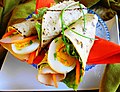 A Surinamese roti wrap with boiled egg and smoked chicken in the Netherlands
 -
 Indian thali with chapati
 -
 Tandoori roti served with other dishes in an Indian restaurant
 -
 A chef preparing rumali roti in India
 -

-
 Spicy vegetables served with rotis
 -
 Roti stuffed with bananas


Indian subcontinent
[edit]Many variations of flatbreads and roti are found in many cultures across the globe, from the Indian subcontinent to Africa to Oceania to the Malay Peninsula to the Americas.[7] The roti is a traditional flatbread from the Indian subcontinent.[11] It is normally eaten with cooked vegetables or curries; it can be used as a carrier for them.[12] It is made most often from wheat flour, cooked on a flat or slightly concave iron griddle called a tawa.[13] Traditionally, rotis have also been made from the flour of millet, maize, jowar, bajra, and even rice.[14] Tandoori roti is cooked by sticking the flattened dough to the inside wall of a tandoor oven, where it bakes quickly at a high temperature.[15][16] Chapatis are made of whole-wheat flour known as atta, mixed into a dough with water, edible oil and optional salt in a mixing utensil called a parat, and is cooked on a tava (flat skillet).[17][18] It is known as phulka in Punjabi and Saraiki, and maani in Sindhi.
Sri Lanka
[edit]In Sri Lanka, there is a variant of roti called pol roti (coconut roti),[19] made of wheat flour, and/or kurakkan flour, and scraped coconut. Sometimes, chopped green chilis and onion are added to the mixture before cooking. These are usually thicker and harder than other roti types. They are usually eaten with curries, or some types of sambol or lunu miris and considered a main meal rather than a supplement.
Another variety of roti popular in Sri Lanka is kottu roti,[20] which is made up of paratha or godamba roti, These are cut into small pieces,[20] small in size and rectangular or square in shape. Then on a square heating pan, vegetables and onions are fried. Eggs, cooked meat, or fish are added to fried vegetables and heated for a few minutes. Finally, the pieces of cut paratha are added. These are chopped and mixed by repeated pounding using heavy iron blades/spatula, the sound of which can be heard from a long distance. Depending upon what ingredients are used, the variations are vegetable, egg, chicken, beef, mutton, and fish kottu roti.[21] It is sometimes prepared and served as a fast food dish.[21]
Godamba roti is another variety found in Sri Lanka.[22] Plain godamba roti is eaten with curry[22] or it can also be wrapped around a savory filling.
| Nutritional value per 100 g (3.5 oz) | |||||||||||||||||||||||||||||||||||||||||||||
|---|---|---|---|---|---|---|---|---|---|---|---|---|---|---|---|---|---|---|---|---|---|---|---|---|---|---|---|---|---|---|---|---|---|---|---|---|---|---|---|---|---|---|---|---|---|
| Energy | 1,245 kJ (298 kcal) | ||||||||||||||||||||||||||||||||||||||||||||
46.36 g | |||||||||||||||||||||||||||||||||||||||||||||
| Sugars | 2.72 | ||||||||||||||||||||||||||||||||||||||||||||
| Dietary fiber | 4.9 g | ||||||||||||||||||||||||||||||||||||||||||||
7.45 g | |||||||||||||||||||||||||||||||||||||||||||||
11.25 g | |||||||||||||||||||||||||||||||||||||||||||||
| |||||||||||||||||||||||||||||||||||||||||||||
| Other constituents | Quantity | ||||||||||||||||||||||||||||||||||||||||||||
| Water | 33 g | ||||||||||||||||||||||||||||||||||||||||||||
| Selenium | 53.7 ug | ||||||||||||||||||||||||||||||||||||||||||||
| †Percentages estimated using US recommendations for adults,[23] except for potassium, which is estimated based on expert recommendation from the National Academies.[24] | |||||||||||||||||||||||||||||||||||||||||||||
Caribbean
[edit]Roti is eaten widely across the Caribbean, especially in countries with large Indo-Caribbean populations such as Trinidad and Tobago, Guyana, Suriname, and Jamaica. Originally brought to the islands by indentured laborers from the Indian subcontinent, roti has become a popular staple in the culturally rich cuisines of these countries. In the Caribbean, roti is commonly eaten as an accompaniment to various curries and stews. The traditional way of eating roti is to break the roti by hand, using it to sop up sauce and pieces of meat from the curry. However, in the Caribbean, the term roti may refer to both the flatbread (roti) itself and the more popular street food item, in which the roti is folded around a savory filling in the form of a wrap.
The roti wrap is the commercialization of roti and curry together as a fast-food or street-food item in the Caribbean. This wrap form of roti originated in southern Trinidad. It was first created in the mid-1940s by Sackina Karamath, who later founded Hummingbird Roti Shop in San Fernando, Trinidad and Tobago. The wrap was convenient, as the meal could be eaten faster and while on the go, as well as keeping one's hands from getting dirty. In Trinidad and Tobago, various wrapped roti are served, including chicken, conch, goat, beef, and shrimp. Vegetables can also be added including potato, pumpkin, and spinach as well a variety of local condiments, with pepper sauce (hot sauce) and mango chutney being the most popular. The roti wrap quickly gained popularity across the island and spread throughout the rest of the Caribbean. The wrap is now simply referred to as a roti or just roti. The growth in popularity has recently led to referring to the flatbread itself (roti) that surrounds the filling as a "roti skin" or "roti shell", a practice that is now common in both restaurants and commercial companies. Various types of roti are eaten throughout the West Indies. They are most prominently featured in the diets of people in Trinidad and Tobago, Guyana, and Suriname. Caribbean-style roti is primarily made from wheat flour, baking powder, salt, and water, and cooked on a tawa. Certain rotis are also made with ghee or butter.
Trinidad and Tobago
[edit]| Food | Image | Description |
|---|---|---|
| Sada roti | This is a plain roti, made of white flour. It is the simplest roti to make, and is the most commonly consumed roti in Trinidad. It is a popular breakfast option there,[25] and is enjoyed in combination with various curried meat and vegetable dishes. This type of roti is a staple food consumed for both breakfast and dinner by Trinidadians. | |
| Paratha roti | 
|
A layered roti made with butter, usually ghee (clarified butter), but any butter can be used.[26] Ghee is rubbed on both sides, then it is cooked on a tawa (a round, flat metal griddle used in Indian & Pakistani cooking). This gives the roti a crisp outside and small patches of light browning. When the roti is almost finished cooking, the cook begins to beat the roti while it is on the tawa, causing it to become light and flaky. Paratha roti is more rich and flavorful than plain roti. Paratha is enjoyed with almost any accompaniment. As with other rotis, it is commonly eaten with curries and stews. It is also traditionally eaten with fried eggs or egg dishes and a cup of tea. In Trinidad, parathas are colloquially called "buss-up shut" ("busted-up shirt") because the roti resembles a tattered and torn-up shirt. |
| Puri | 
|
This is a roti where two layers are rolled out together and cooked (after rolled it's fried directly in hot oil. Some like to first half cook it on a tawa and then fry (because the puri then soaks up less oil) in the kadhai. This type of roti is eaten with a special halva when a child is born and in the mrityubhoj(tehrvi/death ceremony). |
| Dhalpuri[27][better source needed] | 
|
A roti with a stuffing of ground yellow split peas, cumin (geera), garlic, and pepper: The split peas are boiled until they are al dente and then ground in a mill. The cumin is toasted until black and also ground. The stuffing is pushed into the roti dough, and sealed. When rolled flat, the filling is distributed within the roti. It is cooked on the tava and rubbed with oil for ease of cooking. This type of roti is most commonly eaten with a variety of curries. It is also the roti of choice for the making of wrap rotis. |
| Wrap roti | 
|
A popular wrap made by folding a combination of meat and vegetable curries inside of a dhalpuri roti: The curry or stew often contains potatoes and/or chickpeas as a filler as well as the essential meat component, although vegetarian options are common as well. Popular fillings include curried chicken, goat, conch, duck, beef, shrimp, and vegetable. An assortment of optional condiments are also common such as pepper sauce and mango chutney. |
| Aloo puri / potato puri | A roti similar to a dhalpuri, but with aloo (potato) substituted for the dhal. The aloo is boiled and milled, and spices and seasonings are added before being sealed in the dough. This aloo filling is also used when making aloo pie or aloo choka. |
Guyana
[edit]
Dosti roti is common in Guyana.[a] A small amount of fat is placed in each piece of dough before it is rolled out to make the roti softer. Usually, vegetable oil is used, but butter, or margarine can also be used. Ghee is not used in everyday cooking, but is used on special occasions, especially amongst Hindus. The roti is usually clapped by hand or beaten a bit, hot off the tava, so it softens but does not break.
- A good roti in Guyana is very soft, with layers (almost like pastry layers if possible), which remains whole.
- The type of roti is determined by what is placed in the dough before it is rolled out. Various types include dhalpuri, aloo (potato) roti, and even sugar (to keep the kids busy, while the mother finishes cooking).
- In Guyana, a rolled-out, thin, flat dough like a roti that is deep-fried in ghee is called a puri. Therefore, a dhalpuri is not really a puri.
- Another item prepared like roti is bake or bakes or floats. A Guyanese or Trinidadian fry bake seems to be more similar to an Indian puri. A bake is made with butter or margarine and has a different ratio of flour to fat. It is made much quicker than roti and is usually made in the mornings. Dough is rolled out and cut into shapes or rolled into small rounds. Guyanese bakes are fried, but bakes from other parts of the West Indies can be baked in an oven. Bakes are usually paired with a quick fry-up for breakfast or dinner, stewed saltfish, or eggs ("western" style, with onions, tomatoes, green peppers). Bakes are also made in other parts of the West Indies, including Trinidad, Barbados, and St. Vincent. In Trinidad and Tobago, a "bake and shark" is a popular street-food sandwich in which fried shark is placed between two halves of a sliced bake with local condiments. Pepper sauce, shado beni, garlic sauce, tamarind, and mango chutney are most common, as well as lettuce, tomato, and cucumber for fillers.
Suriname
[edit]In Suriname, roti refers mainly to dhalpuri or aloo puri. It is most often eaten with curried chicken. As in Trinidad and the West Indies, roti can also refer to the stuffed roti wrap. This dish is usually eaten out of hand. Due to a mass emigration of Indian Surinamese in the 1970s, roti became a popular take-out dish in the Netherlands. It usually includes chicken curry, potatoes, a boiled egg, and various vegetables, most notably the kousenband or yardlong bean. Another variation includes shrimp and aubergine. The meat with gravy, potatoes, egg, and yardlong beans are served side by side on a plate, with the aloo puri folded in fours on top.
Southeast Asia
[edit]

In Indonesia and Malaysia, the term encompasses all forms of bread besides the traditional Indian breads (like roti canai) including Western-style bread (like roti john),[29][30] as well as bing of the Chinese.[31]
In Thailand, โรตี is a popular street food that can be eaten as a dessert or as a side dish. Some Thai curries can also be accompanied with a side of roti, primarily Southern Thai curries.
In Cambodia, រ៉ូទី is a dessert that is sold as street food. It is similar to both a crêpe and paratha.
South Africa
[edit]Roti was initially introduced to South Africa by Indian migrants during the 19th century, and subsequently became incorporated into Durban cuisine. It is widely eaten by the Indian communities living in South Africa, and is either eaten as a flat bread or a wrap with locally made curries.
Roti is also often eaten in Cape Coloured and Cape Malay Communities. Two types of roti are eaten: chapati/flat roti and paratha/flaky roti. Flaky roti is also called Malay roti. When eaten with a curry filling, usually mutton, chicken or mince, the roti is called a Salomie. A roti gatsby is a popular takeaway dish where the bread of the filled gatsby, a popular sandwich is replaced several rotis and folded.
Mauritius
[edit]Similarly as with other countries that were part of the Indian diaspora, roti was introduced to Mauritius by Indian migrants/indentured labourers during the 19th century, and has since been a staple of Mauritian cuisine and a common street food.[32][33] Roti generally refers to farata (a local pronunciation of paratha), a pancake made of wheat flour and water;[32][34] other variants include dholl puri, which is layered, and stuffed with boiled and ground dal/split peas,[32][35] and ti puri, a smaller roti that is fried and usually served with seven different curries.[36]
Iran
[edit]In Iran, the two variants of roti are called khaboos[37][better source needed] and lavash. These two breads (the former of which is almost exactly prepared like Indian roti) are quite similar to other rotis.
Elsewhere
[edit]Roti shops are now abundant in Trinidad and Tobago, Guyana, Suriname, Jamaica, the United States, Canada, the United Kingdom, and the Netherlands. Owing to Canada's considerable immigrant populations from both South Asia and the Caribbean, roti and its variants are popular there. As Indo-Caribbean people moved to North American cities such as Toronto, New York City, Miami, Los Angeles, and Montreal, they exported with them the wrapped version of roti. A distinct Toronto offering is the "East Indian roti", a variation on the stuffed roti from the West Indies.[38] In some of these cultures, rotis are also being used in the place of pita bread when making burritos, quesadillas, or any other kinds of wraps.[39]
See also
[edit]
Notes
[edit]References
[edit]- ^ Alan Davidson (21 August 2014). The Oxford Companion to Food. OUP Oxford. pp. 692–. ISBN 978-0-19-104072-6.
- ^ Jim Smith (15 April 2008). Technology of Reduced Additive Foods. John Wiley & Sons. pp. 113–. ISBN 978-1-4051-4795-8.
- ^ Bruce Kraig; Colleen Taylor Sen (9 September 2013). Street Food Around the World: An Encyclopedia of Food and Culture. ABC-CLIO. pp. 301–. ISBN 978-1-59884-955-4.
- ^ Aroona Reejhsinghani (June 2004). Feast on a Diabetic Diet. B. Jain Publishers. ISBN 9788180560118.
- ^ Davidson, A.; Jaine, T. (2014). The Oxford Companion to Food. Oxford Companions. OUP Oxford. p. 692. ISBN 978-0-19-104072-6. Retrieved 9 February 2018.
- ^ Zahid, Anusha (9 October 2017). "Sunridge launches into atta". Aurora Magazine. Retrieved 9 February 2018.
- ^ a b Wrigley, C.W.; Corke, H.; Seetharaman, K.; Faubion, J. (2015). Encyclopedia of Food Grains. Elsevier Science. p. 19. ISBN 978-0-12-394786-4. Retrieved 9 February 2018.
- ^ "Rotika (रोटिका)". Spoken Sanskrit. Retrieved 25 March 2007.
- ^ "Different types of rotis made in India and why they are unique". The Times of India. ISSN 0971-8257. Retrieved 3 April 2024.
- ^ Krishna, Priya (10 October 2023). "Roti, a Shape-Shifting Global Staple, Takes a New Form: Convenience Food". The New York Times. ISSN 0362-4331. Retrieved 14 October 2023.
- ^ Kapoor, Sanjeev. Dal Roti. Popular Prakashan. ISBN 9788179915684 – via Google Books.
- ^ Choice, Antoinette; Choice, Joseph (19 December 2018). Dinosaurs Love Roti with Curry. AuthorHouse. ISBN 9781546264620 – via Google Books.
- ^ Gadia, M. (2009). The Indian Vegan Kitchen: More Than 150 Quick and Healthy Homestyle Recipes. Penguin Publishing Group. p. 234. ISBN 978-1-101-14541-8. Retrieved 9 February 2018.
- ^ Śekhara, Sumana (10 April 2019). Roti: The Prime Need. Pragatisheel Prakashan. ISBN 9789386246769 – via Google Books.
- ^ Gocmen, D.; Inkaya, A.N.; Aydin, E. (2009). "Flat Breads" (PDF). Bulgarian Journal of Agricultural Science. 15: 298–306.
- ^ Saxena, Dharmesh C.; Salimath, Paramahans V.; Rao, Punaroor Haridas (2000). "Indian wheat cultivars: their carbohydrate profile and its relation to tandoori roti quality". Food Chemistry. 68 (2): 185–190. doi:10.1016/s0308-8146(99)00174-0.
- ^ Nandita Godbole, 2016, Roti: Easy Indian Breads & Sides.
- ^ Chitra Agrawal, 2017, Vibrant India: Fresh Vegetarian Recipes from Bangalore to Brooklyn, page 35.
- ^ "Experience true variety of cuisines at Hotel Riu Sri Lanka". Daily Mirror. 9 October 2017. Retrieved 9 February 2018.
- ^ a b Taylor, G. (2017). MasterChef: Street Food of the World. Bloomsbury Publishing. p. 214. ISBN 978-1-4729-4620-1. Retrieved 9 February 2018.
- ^ a b Briggs, P. (2018). Sri Lanka. Bradt Travel Guide. Sri Lanka. Bradt Travel Guides. p. 54. ISBN 978-1-78477-057-0. Retrieved 9 February 2018.
- ^ a b Kraig, B.; Sen, C.T. (2013). Street Food Around the World: An Encyclopedia of Food and Culture. ABC-CLIO. p. 328. ISBN 978-1-59884-955-4. Retrieved 9 February 2018.
- ^ United States Food and Drug Administration (2024). "Daily Value on the Nutrition and Supplement Facts Labels". FDA. Archived from the original on 27 March 2024. Retrieved 28 March 2024.
- ^ "TABLE 4-7 Comparison of Potassium Adequate Intakes Established in This Report to Potassium Adequate Intakes Established in the 2005 DRI Report". p. 120. In: Stallings, Virginia A.; Harrison, Meghan; Oria, Maria, eds. (2019). "Potassium: Dietary Reference Intakes for Adequacy". Dietary Reference Intakes for Sodium and Potassium. pp. 101–124. doi:10.17226/25353. ISBN 978-0-309-48834-1. PMID 30844154. NCBI NBK545428.
- ^ Mason, T. (2016). Caribbean Vegan: Meat-free, Egg-free, Dairy-free Authentic Island Cuisine for Every Occasion. The Experiment. p. 67. ISBN 978-1-61519-360-8. Retrieved 9 February 2018.
- ^ Albala, K. (2011). Food Cultures of the World Encyclopedia [4 volumes]: [Four Volumes]. ABC-CLIO. p. 298. ISBN 978-0-313-37627-6. Retrieved 9 February 2018.
- ^ "Dhal Puri Recipe - NomadicGourmet.com". Archived from the original on 12 January 2010.
- ^ Rickford, J.R. (1978). A Festival of Guyanese Words. University of Guyana. p. 127. Retrieved 9 February 2018.
- ^ Makmoer, Haryanto (2003). Roti manis & donat. Gramedia Pustaka Utama. ISBN 9789792201833.
- ^ Kamus Dewan (in Malay) (3rd ed.). Dewan Bahasa Dan Pustaka. 2002. ISBN 9789836244567.
- ^ Goh Sang Seong (2014). Bahasa Cina-Bahasa Melayu: Kebolehterjemahan Budaya (in Malay). Penang, Malaysia: Penerbit USM. pp. 33–34. ISBN 978-983-861-752-9.
- ^ a b c The rough guide to Mauritius. Rough Guides. 2015. ISBN 978-0-241-01424-0. OCLC 905661042.
- ^ Republic of Mauritius. "Mauritian Cuisine". Retrieved 8 June 2021.
- ^ Exotic Holiday Mauritius. "Farata (Traditional Mauritian Name)". Archived from the original on 8 June 2021. Retrieved 8 June 2021.
- ^ Grihault, Nicki (14 January 2018). "Get stuffed in Mauritius … on dholl puri, the perfect savoury pancake". The Guardian. Retrieved 8 June 2021.
- ^ Restaurants.mu. "Ti Puri Sept Cari". Retrieved 8 June 2021.
- ^ "Khaboos (Iranian Roti) Recipe". Archived from the original on 24 August 2007. Retrieved 15 July 2012.
- ^ "A Simple Recipe for This Indian-Influenced Roti Flatbread". The Spruce Eats.
- ^ "What Is Roti?". Food Network. Retrieved 25 April 2024.
| Main and side dishes |
| ||||||
|---|---|---|---|---|---|---|---|
| Snacks and sauces | |||||||
| Breads | |||||||
| Beverages | |||||||
| Sweetmeats | |||||||
| Bangladeshi diaspora | |||||||


| Balochi |  | ||||
|---|---|---|---|---|---|
| Kashmiri | |||||
| Muhajir |
| ||||
| Pashtun | |||||
| Punjabi |
| ||||
| Saraiki | |||||
| Sindhi | |||||
| Common dishes |
| ||||
| Pakistani diaspora | |||||


Indonesian breads | |
|---|---|

| Asia |
|  |
|---|---|---|
| Europe | ||
| Africa | ||
| America | ||
| Foods |
|  |
|---|---|---|
| By location | ||
| Mobile catering | ||
| Lists |
| |
Origins and Etymology
Etymology
The term "roti" originates from the Sanskrit word roṭikā (रोटिका), which denotes a type of bread or a round, flat bread made from ground grains.[7] This Sanskrit term is connected to verbal roots such as roṭ ("to strike against") and the unattested roñc ("to crush or press in"), reflecting actions associated with grinding flour or rolling dough, with possible deeper ties to Proto-Indo-European concepts of milling or wheeling through related Indo-Aryan developments.[7] The word evolved through Middle Indo-Aryan Prakrit languages, particularly Sauraseni and Maharashtri Prakrit forms like roṭṭa, which simplified the Sanskrit diminutive suffix and emphasized the bread's rice flour or wheaten base.[8] From Prakrit, the term passed into modern Indo-Aryan languages, notably Hindi-Urdu roṭī, where it broadly signifies unleavened bread as a staple food. This form influenced regional variants, such as Tamil roṭṭi (ரொட்டி), borrowed directly from Sanskrit via Prakrit intermediaries and denoting a wheaten cake or flatbread.[9] Similarly, in Southeast Asian contexts, Malay roti derives from Tamil roṭṭi, entering through trade and migration routes, and retains the core meaning of bread while adapting to local preparations.[9] In broader flatbread terminology, "roti" contrasts with Persian nān (نان), an unrelated term from Proto-Iranian nāna- meaning leavened or oven-baked bread, highlighting linguistic distinctions in Indo-Iranian branches where "roti" emphasizes simple, griddle-cooked varieties.[10] European languages adopted "roti" during the British colonial era in India, with English first recording it around 1830–1840 from Hindi-Urdu, entering via administrative and culinary exchanges in the Indian subcontinent.Historical Development
The origins of roti trace back to the Indus Valley Civilization around 3300–1300 BCE, where archaeological evidence from sites like Mohenjo-Daro, Harappa, Kalibangan, Dholavira, and Rakhigarhi reveals grinding stones used for processing wheat and millet into dough for early flatbreads.[11] These findings indicate that unleavened breads, similar to modern roti, formed a staple in the diet of this ancient urban society, prepared using basic stone tools and clay ovens.[12] During the Vedic period (circa 1500–500 BCE), roti-like flatbreads evolved further, with texts such as the Rigveda and Yajurveda referencing grain-based preparations, including barley and wheat dough shaped into rounds for rituals and daily sustenance.[11] The spread along ancient trade routes facilitated the exchange of wheat cultivation and baking techniques across the Indian subcontinent and into Central Asia. By the medieval era, Islamic influences from Persian and Central Asian invaders introduced the tandoor oven around the 12th–16th centuries, revolutionizing roti baking by allowing high-heat clay oven cooking that produced crisp, puffed varieties integrated into Mughal cuisine.[11] European colonial expansion in the 16th–19th centuries disseminated roti beyond Indian subcontinent, as Indian merchants and migrants carried culinary practices to Southeast Asia, where wheat-based flatbreads adapted into local forms like roti canai in Malaysia and Indonesia through interactions with Tamil and Gujarati communities.[13] Similarly, British colonial policies transported approximately 500,000 Indian indentured laborers to the Caribbean between 1838 and 1917, embedding roti in island cuisines as a portable wrap for curries, evolving into dhalpuri and buss-up shut in Trinidad and Guyana.[14] In the 20th century, post-independence Indian migrations accelerated roti's globalization, with diaspora communities establishing it in East Africa—where over 360,000 Indians settled by the 1950s—and Western countries like the UK and US through labor and professional relocations after 1947.[15] These movements, driven by decolonization and economic opportunities, transformed roti into a symbol of cultural continuity, adapted with local ingredients in African and Western contexts.[16]Preparation and Types
Preparation Methods
Roti is traditionally prepared using simple, whole ingredients to create a soft, unleavened flatbread. The core components include whole wheat atta flour, water, and optional additions like a pinch of salt or a small amount of ghee or oil for enhanced pliability. A typical dough consistency is achieved with a roughly 2:1 ratio of flour to water by volume, though adjustments are made gradually to ensure the dough is soft yet non-sticky.[17][18] The preparation begins with mixing the flour, salt, and any oil or ghee in a bowl, followed by incorporating warm water incrementally while kneading to form a smooth ball. Kneading typically lasts 5-10 minutes by hand to develop gluten for elasticity, resulting in a pliable dough that holds together without cracking. The dough is then covered and rested for 15-30 minutes, allowing the flour to fully hydrate and relax the gluten strands for easier rolling later.[19][17][18] After resting, the dough is divided into equal portions, each shaped into a smooth ball about the size of a golf ball. These balls are rolled out into thin circles, approximately 6-8 inches in diameter and 2-3 mm thick, using a floured surface to maintain evenness. While a rolling pin is the most common tool for precision and uniformity, traditional hand-patting techniques—pressing and clapping the dough between oiled palms—can be used for a rustic texture, particularly in some home settings.[17][18][19] Cooking occurs on a preheated tawa, a flat cast-iron or non-stick griddle, at medium heat to avoid burning. The rolled roti is placed on the hot surface and cooked for 30-60 seconds per side, flipping once bubbles form and light brown spots appear, indicating trapped steam has caused puffing. For a baked variation, roti can be prepared in a tandoor oven, where the dough is slapped onto the clay walls to cook at higher temperatures (around 400-500°C) for a charred, chewy exterior in about 1-2 minutes total.[17][18][20] Common issues during preparation include sticking and failure to puff. To prevent sticking, the work surface and dough are lightly dusted with dry atta flour during rolling, and the tawa is ensured to be sufficiently hot without excess oil. Puffing relies on steam generated from moisture in the dough; this is achieved by rolling evenly thin to trap air pockets and gently pressing the edges with a cloth or spatula while cooking to distribute heat and encourage expansion.[17][21][19]Common Types
Chapati, also known as roti in many contexts, is a fundamental unleavened flatbread made primarily from whole wheat flour (atta), water, and sometimes salt, resulting in a soft, thin, and slightly chewy texture when freshly cooked on a tawa or griddle.[22] This simple preparation yields a pliable bread that puffs slightly during cooking, making it ideal for scooping accompaniments like curries or dal.[23] Paratha represents a richer variation, characterized by its layered, flaky texture achieved through folding and rolling dough made from whole wheat flour, water, and generous applications of ghee or oil between layers, often resulting in a golden, crisp exterior.[22] It can be plain or stuffed with fillings such as spiced potatoes in aloo paratha, enhancing its indulgent quality and providing a heartier bite compared to simpler rotis.[24] Rumali roti, meaning "handkerchief bread," is an exceptionally thin variant crafted from a mixture of all-purpose flour and whole wheat flour dough stretched and twirled by hand before cooking over an open flame or on a convex surface, yielding a delicate, almost translucent texture that is light and crisp.[25] This technique creates a gossamer-like flatbread that contrasts sharply with thicker rotis, often served folded to capture its intricate folds.[26] Makki ki roti, or cornmeal roti, differs by using yellow maize flour (makki ka atta) as the primary ingredient, mixed with water and minimal salt to form a dense, gluten-free dough that produces a coarser, yellowish flatbread with a hearty, slightly crumbly texture when cooked on a griddle.[27] Popular in northern India, especially during winter, its robust consistency pairs well with hearty greens like mustard saag, providing a warming staple.[28]Regional Variants
Indian subcontinental Variants
In the Indian subcontinent, roti variants reflect regional agricultural availability and culinary traditions, with adaptations using local grains like millets and rice alongside wheat. These breads are integral to daily meals across India, Pakistan, Bangladesh, and Sri Lanka, often incorporating spices or stuffings tailored to local tastes.[29] In India, Pakistan, and Bangladesh, millet-based rotis such as bajra roti, made from pearl millet flour, are staples in rural diets, valued for their nutritional density and suitability to arid climates.[6] Similarly, jowar roti, prepared from sorghum flour, provides a gluten-free alternative popular in semi-arid regions like Maharashtra and Rajasthan, where it is rolled thin and cooked on a griddle.[6] Tandoori roti, a thicker wheat-based flatbread baked in a clay oven for a charred flavor, is common in Punjabi and Pakistani cuisines, often served in restaurants and homes.[30] Stuffed variants like thepla, a Gujarati specialty, incorporate fenugreek leaves and spices into whole wheat dough, making it flavorful and portable for travel or snacks.[31] Sri Lankan roti adaptations emphasize coconut and frying techniques. Pol roti, a soft flatbread mixed with grated coconut and spices like green chilies and onions, is typically pan-fried and enjoyed as a breakfast item.[32] Godamba roti consists of thin, oil-soaked wheat dough stretched paper-thin and fried until crisp, serving as a versatile wrap or base.[33] Kottu roti transforms godamba or paratha by chopping it into strips and stir-frying with vegetables, meat, and curry spices, creating a popular street food dish.[34] These rotis are commonly paired with lentil preparations like dal, vegetable curries such as sabzi, or plain yogurt to balance flavors in everyday meals. In Punjab, makki ki roti—a dense cornmeal flatbread—is seasonally enjoyed during winters with sarson da saag, a mustard greens curry, for its warming qualities.[35] Ayurvedic influences promote whole grain rotis for their digestive benefits and alignment with dosha balance, favoring unrefined flours like wheat or millets. Regional flour availability shapes variations, such as rice flour-based akki roti in South India, where it is mixed with vegetables and steamed or griddled for a light texture.[36][37]Southeast Asian Variants
In Southeast Asia, roti has evolved from its Indian roots through influences from Malay, Indonesian, and Thai culinary traditions, particularly via Indian Muslim immigrants and traders who introduced layered flatbreads in the 19th century. These adaptations emphasize flaky textures achieved through meticulous dough manipulation, often integrating local flavors and serving as versatile street foods in halal vending contexts. Unlike simpler Indian subcontinental forms, Southeast Asian variants frequently incorporate margarine or ghee for enhanced crispiness and pair with curries, sweet toppings, or fillings, reflecting a fusion of savory and dessert styles.[38][39][40] Roti canai, a staple in Malaysia and Indonesia, is a flaky, pulled-dough flatbread reminiscent of paratha, typically enjoyed as a breakfast item with curry or dhal. Originating from Indian Muslim immigrants who settled in Penang and Melaka during the 19th century, it features a dough of wheat flour, water, salt, and ghee, which is repeatedly stretched, oiled, and folded to create airy, multilayered sheets before being griddled until golden and crisp. The use of margarine in modern preparations enhances flakiness, and it is commonly served at mamak stalls—halal eateries run by Indian Muslims—highlighting its role in everyday Malaysian and Indonesian street food culture.[41][39][38] In Singapore, roti prata represents a crisp-edged evolution of the same base, prized for its customizable toppings and served with curry gravies. The dough undergoes extensive slapping and stretching to form thin, lacy layers, then fried to achieve a shatteringly crisp exterior, often topped with egg, cheese, onions, or even sardines for savory options. Sweet iterations incorporate condensed milk, bananas, or chocolate, making it a popular late-night snack at hawker centers, where its preparation showcases the skill of tossing and folding to prevent tearing. This variant underscores Singapore's multicultural food scene, blending Indian techniques with local innovations in a halal-friendly format.[39][42] Thai roti, particularly the sweet street food form, transforms the flatbread into a dessert folded around fillings like banana or chocolate, drizzled with condensed milk and fried to a chewy-crisp finish. Introduced by Indian Muslim communities in Ayutthaya centuries ago, it draws from paratha methods but emphasizes sweetness, with vendors stretching a sweetened dough (incorporating condensed milk and butter) into paper-thin sheets, adding ripe bananas or chocolate, then folding and pan-frying for about 4-5 minutes per side. Often sold from mobile carts in tourist areas, this halal-adapted treat highlights Thailand's Islamic culinary heritage and its appeal as an indulgent, portable snack.[43][40][44]Caribbean Variants
In the Caribbean, roti evolved from the flatbreads brought by Indian indentured laborers who arrived between 1838 and 1917 to work on plantations in British and Dutch colonies, including Trinidad, Guyana, and Suriname, blending Indian culinary traditions with local ingredients and techniques to create portable, filling meals suited to tropical climates.[45] This fusion reflects the laborers' resilience, as they adapted staples like wheat flour dough to accompany spicy curries, turning roti into a cultural emblem of Indo-Caribbean heritage now central to festivals such as Diwali.[46] Trinidadian roti, often considered a national dish, typically features dhalpuri—a thin, griddled flatbread stuffed with ground split peas for added texture and flavor—wrapped around bold curried fillings like chicken, potatoes, chickpeas, or vegetables, forming a burrito-like portable meal popular for lunch or street food.[46] Another variant, buss-up shut, is a flaky paratha-style roti cooked until crisp and then torn into soft, layered pieces resembling a "busted-up shirt," ideal for scooping curries and emphasizing the dish's indulgent, hands-on appeal in everyday Trinidadian dining.[46] In Guyana, sada roti represents a simpler, plain baked flatbread made from flour, baking powder, and water, cooked on a tawa for a rustic, roasted flavor and often served at breakfast alongside salted fish or fried potatoes to provide a hearty, no-fuss accompaniment.[47] Buss-up shut, known locally as oil roti, offers a contrasting flaky texture achieved by layering dough with fat and clapping it during cooking to create airy pockets, commonly paired with curried dishes for lunch or dinner to enhance the meal's saucy elements.[48] Surinamese roti draws from Indian laborer influences, prepared as a thin, griddled wheat flatbread rolled with leavening agents and often filled or served with vegetable and chicken curries spiced with cumin, coriander, and turmeric, incorporating local additions like green beans for a vibrant, spiced profile.[49] It frequently pairs with pom, a Creole-influenced oven-baked stew of grated tayer root, chicken, and citrus, blending Indian, Javanese, and European elements into a celebratory dish that highlights Suriname's multicultural cuisine.[50]African and Other Variants
In South Africa, particularly within the Durban Indian community, roti serves as a staple accompaniment to local fusion dishes like bunny chow, a street food originating from Indian laborers in the early 20th century. Bunny chow consists of a hollowed-out quarter loaf of white bread filled with curry—often mutton, chicken, or beans—but is frequently paired with roti or chapati-like sides such as vetkoek, a fried dough bread resembling puri, to sop up the spicy gravy. This adaptation reflects the Indian diaspora’s influence on South African cuisine, where roti provides a soft, unleavened contrast to the hearty bread vessel.[51][52] In Mauritius, farata represents a multi-layered variant of roti, akin to paratha, prepared by folding and rolling dough with oil or ghee to create flaky layers, then cooked on a hot griddle without additional fat for a lighter texture. Often enjoyed as street food, farata is commonly served alongside dholl puri—a thin roti stuffed with spiced yellow split peas (chana dal)—and paired with bean curry, tomato-based rougaille, or chutney for added flavor. This combination highlights Mauritian Creole influences from Indian indentured workers, emphasizing portable, affordable meals.[53][54] East African communities in Kenya and Tanzania feature a thicker, more layered chapati, an adaptation of roti introduced by Indian traders and laborers in the 19th century. Unlike the thinner Indian versions, this chapati is pan-fried in oil or ghee, which is coiled into the dough before rolling to produce a crispy exterior and soft, spiral interior, making it ideal for tearing and dipping into stews like nyama choma or vegetable curries. Its popularity as a everyday staple underscores the integration of Indian flatbreads into Swahili coastal cuisines.[55] Iranian flatbreads like lavash and sangak share structural similarities with roti, both being thin wheat-based flatbreads often baked in tannur (clay) ovens, a technique shared across the region through historical trade and interactions. Lavash, a soft, rectangular sheet ideal for wrapping kebabs or dips, and sangak, a pebble-baked whole-wheat bread with a textured, sesame-seed crust, are daily staples served with grilled meats or yogurt, echoing roti’s versatility in meals. Lavash has ancient roots in the Middle East, while sangak was first documented in the 11th century CE.[56][57][58] Beyond Africa, roti appears in North American diaspora communities through Caribbean-influenced shops, where it is sold as wraps filled with curried fillings like goat, potato, or chickpeas, adapting the flatbread into portable sandwiches popular in cities like Toronto and New York. In Oceania, Fijian Indian communities—descended from 19th-century indentured laborers—have localized roti by pairing it with coconut-infused curries using taro or cassava, maintaining the basic flour-water dough but incorporating Pacific ingredients for milder flavors suited to island palates.[46][59]Cultural and Nutritional Aspects
Cultural Significance
In Indian subcontinental households, roti serves as a daily staple, embodying simplicity and sustenance while fostering family bonds through the traditional hand-making process often led by women. This practice reinforces cultural continuity and communal harmony, as the preparation of fresh roti from whole wheat flour becomes a shared ritual that connects generations and evokes a sense of home and comfort.[60][16][61] Roti holds profound ritual importance in religious contexts, particularly in Hindu and Sikh traditions, where it symbolizes equality, gratitude, and spiritual nourishment. In Sikh langars, the community kitchens of gurdwaras, roti is prepared and served communally to all visitors regardless of background, underscoring the principle of egalitarianism central to Sikhism and promoting unity through shared meals.[62][63] In Hindu practices, roti is offered during pujas and festivals like Diwali as prasad, signifying devotion and the provision of sustenance from the divine, with special variations such as stuffed or fried rotis enhancing celebratory feasts.[60][64] Among diaspora communities, roti represents immigrant resilience and cultural identity, adapting to new environments while preserving heritage. In Caribbean settings, such as during Carnival celebrations in Trinidad, Notting Hill, or Miami, roti features prominently in street foods and communal gatherings, symbolizing the fusion of Indian indenture-era migrations with local flavors and serving as a marker of Indo-Caribbean pride and endurance.[65][66][67] Similarly, in South Africa's Indian communities, roti is central to Heritage Day observances, where it accompanies curries in meals that honor the legacy of indentured laborers and their contributions to multicultural cuisine.[68][69] In modern contexts, roti has evolved with vegan and gluten-free adaptations using alternative flours like rice or chickpea, making it accessible for diverse dietary needs while maintaining its role in global fusion cuisines, such as Singapore's roti john, an omelette-stuffed sandwich using the term 'roti' generically for bread and influenced by Malay and British elements.[70][71][72]Nutritional Profile
A standard plain wheat roti, prepared commercially, provides approximately 297 kcal per 100 grams, with a macronutrient breakdown consisting of 46 grams of carbohydrates, 7.5 grams of fat, and 9.6 grams of protein. It is also a notable source of dietary fiber at about 5 grams per 100 grams, which supports digestive health, and selenium at 54 micrograms per 100 grams, contributing to antioxidant defense.[73][74][75] Nutritional content varies by type and preparation. For instance, rotis made from millet flours, such as bajra or ragi, often exhibit higher protein levels (around 11-12 grams per 100 grams) and mineral content like calcium and iron, while maintaining a lower glycemic index compared to wheat-based versions, aiding in steadier blood sugar control.[76] In contrast, parathas, which incorporate layers of ghee or oil, can add over 200 kcal per serving due to the extra fat, significantly increasing overall caloric density.[77] From a health perspective, whole grain rotis promote digestion through their fiber content, which adds bulk to stool and fosters gut microbiota balance.[78] However, versions made with refined flour may cause rapid blood sugar spikes owing to their higher glycemic index (around 70–80), whereas whole wheat variants have a lower to medium index (typically 45–62), reducing this risk.[79][80] For those with gluten sensitivities, gluten-free alternatives like rice flour rotis offer a viable option without compromising basic nutritional structure.[81] Compared to naan, roti generally contains less fat (7.5 grams versus 10-15 grams per 100 grams in butter-enriched naan), making it a lighter choice. When paired with vegetables, roti becomes suitable for diabetic diets, as the fiber and low-to-moderate glycemic response help manage insulin levels effectively.[82][83]| Nutrient (per 100g plain wheat roti) | Amount | % Daily Value (approx.) |
|---|---|---|
| Calories | 297 kcal | 15% |
| Carbohydrates | 46 g | 17% |
| Fat | 7.5 g | 10% |
| Protein | 9.6 g | 19% |
| Dietary Fiber | 5 g | 18% |
| Selenium | 54 µg | 98% |
References
- https://en.wiktionary.org/wiki/%E0%A4%B0%E0%A5%8B%E0%A4%9F%E0%A4%BF%E0%A4%95%E0%A4%BE
- https://en.wiktionary.org/wiki/%E0%A4%B0%E0%A5%8B%E0%A4%9F%E0%A5%80