Hubbry Logo
Bridgeforth StadiumBridgeforth StadiumMain
Open search
Bridgeforth Stadium
Community hub
Bridgeforth Stadium
logo
8 pages, 0 posts
0 subscribers
Be the first to start a discussion here.
Bridgeforth Stadium
Bridgeforth Stadium
from Wikipedia

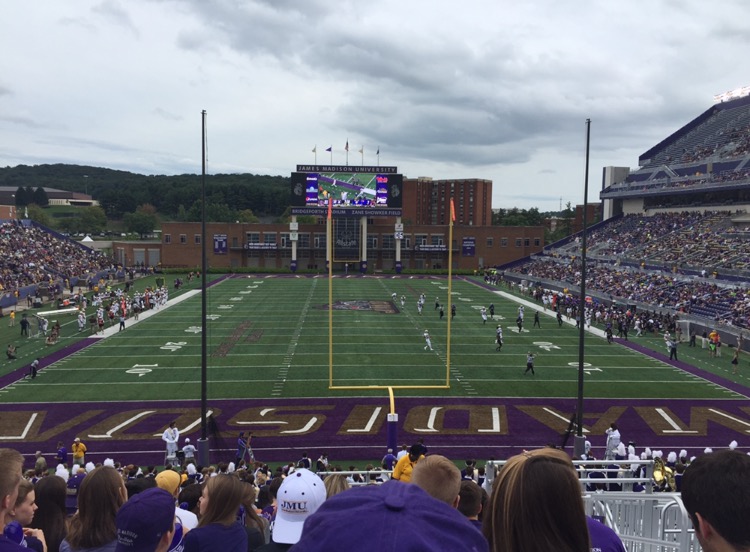
Bridgeforth Stadium is a football stadium located on the campus of James Madison University in Harrisonburg, Virginia. It is home to the James Madison Dukes football team and the playing surface is named Zane Showker Field.

Key Information

With a seating capacity of 24,877, Bridgeforth Stadium is currently the twelfth-largest stadium in the Sun Belt Conference.

History

[edit]
View from west grandstand in 2007

Opened as Madison Stadium in 1975, the original seating capacity was approximately 5,200.[3] Designed as a multi-purpose facility, it hosted football, track and field, lacrosse, and field hockey events. In addition, the stadium contained indoor racquetball courts, several classrooms, support space for the JMU ROTC program, and administrative offices for JMU varsity athletic teams and media relations.

In 1981, the stadium then called JMU Stadium, underwent its first expansion which included a second set of seats giving it a total capacity of more than 12,000. The stadium was again renamed in 1990 for William E. Bridgeforth, former member of the JMU Board of Visitors. In 2003 the field was named in honor of JMU benefactor Zane Showker (whose name is also on the building for JMU's School of Business). In 2004, the university added a new scoreboard with video replay features, which was dismantled after the 2010 season as part of a significant renovation of the entire facility. It was replaced by a much larger video scoreboard behind the south endzone. In 2006, the existing artificial turf was replaced with FieldTurf. The stadium is situated in the Lakeside area of campus, and is adjacent to the multimillion-dollar Plecker Athletic Center and a five-story parking deck.[4]

A statue of the school's mascot, Duke Dog, sits on the stadium's exterior.

Renovation

[edit]

A major stadium renovation and expansion project began in December 2009. The expansion included the demolition of the then existing west stands, removal of the track, and the construction of a $62 million, two-tiered complex in its place.[5] After completion in August 2011, Bridgeforth Stadium's seating capacity was raised to 24,877 permanent seats. In addition to increased seating, the expansion included the construction of a larger video and scoreboard, the addition of 17 suites, a club lounge with chairback seating, and increased stadium lighting. All total, the completion of the Bridgeforth Stadium and Zane Showker Field complex, including the Plecker Athletic Performance Center and parking deck, represents an investment of approximately $90 million.

On September 10, 2011, the Dukes played for the first time in the newly expanded stadium. In front of a sellout crowd of 25,102 fans, the Dukes defeated the Blue Devils of Central Connecticut State University by a score of 14–9.

Notable games

[edit]

Some of the recent notable games in JMU history that have been played at Bridgeforth Stadium are:

  • The 20–13 victory over University of Delaware in 2004
  • The 2008 35–32 victory over Appalachian State
  • The 38–35 victory over Wofford in the first round of the 2008 FCS playoffs
  • The 31–27 victory over Villanova in the second round of the 2008 FCS playoffs
  • The 2010 victory over the FCS #1 William and Mary, 30–24
  • The 14–9 victory over Central Connecticut State in the 2011 debut of the newly renovated Bridgeforth Stadium
  • The 27–26 double overtime victory over William & Mary, the 31–24 come back victory over William & Mary
  • The 2015 59–49 loss against Richmond in front of a record 26,069 fans on the heels of a visit from ESPN's College GameDay
  • The 2015 38–29 win over Villanova clinching JMUs first CAA football title since 2008.
  • The record setting 84–7 win over Rhode Island in 2016.
  • The 2016 55–20 win over New Hampshire in the FCS Second round
  • The 2016 65–7 win over Sam Houston State in the FCS Quarterfinals
  • A 30–8 win over Villanova in 2017 on the heels of a return visit from College GameDay
  • A 51-16 win over South Dakota State in the 2017 FCS Semifinals to send JMU to their second consecutive FCS National Championship Game
  • A 44-7 win over Middle Tennessee in 2022 in their first game as a member of the FBS subdivision of football and as a member of the Sun Belt Conference
  • The 2022 26-12 loss against Marshall set a new single-game attendance record of 26,159 fans in their second home game as a member of the Sun Belt Conference
  • A 30-27 win over Old Dominion on October 28, 2023 saw a new Bridgeforth Stadium attendance record as 26,239 fans saw James Madison's 11th consecutive victory
  • A 26-23 OT loss to Appalachian State University in front of 25,838 fans following College GameDay's third visit to Harrisonburg and first visit after JMU's FBS transition during the 2023 season saw the team's 13-game winning streak come to an end. This loss led to the University dropping plans for a lawsuit against the NCAA over bowl eligibility.[6]

Largest crowds

[edit]
Rank Attendance Date Game result
1 26,239 October 28, 2023 #25 James Madison 30, Old Dominion 27
2 26,159 October 22, 2022 Marshall 26, James Madison 12
3 26,069 October 24, 2015 #11 Richmond 59, #4 James Madison 49
4 26,064 September 30, 2023 James Madison 31, South Alabama 23
5 25,993 October 14, 2017 #1 James Madison 30, #11 Villanova 8
6 25,838 November 18, 2023 #18 James Madison 23, Appalachian State 26
7 25,786 September 28, 2024 James Madison 63, Ball State 7
8 25,742 October 1, 2011 #9 James Madison 31, #10 Richmond 7
9 25,622 October 10, 2024 James Madison 39, Coastal Carolina 7
10 25,484 October 6, 2018 #10 Elon 27, #2 James Madison 24

Panorama

[edit]
A panorama of the stadium before 2013

See also

[edit]

References

[edit]
[edit]
Revisions and contributorsEdit on WikipediaRead on Wikipedia
from Grokipedia
Bridgeforth Stadium, officially known as Bridgeforth Stadium/Zane Showker Field, is an stadium located on the campus of (JMU) in , serving as the primary home venue for the JMU Dukes football team. Opened in 1975 with an initial capacity of 5,200 seats, the stadium underwent significant expansions, including an enlargement in 1981 that increased seating to 12,000, and a major $62 million renovation completed in 2011 that boosted capacity to 24,877 while adding modern amenities such as a 1,000-seat club level, 16 luxury suites, enhanced press facilities, and a video . The field surface, named Zane Showker Field in 2003 after a major donor, has been upgraded multiple times with , most recently in 2022 to support JMU's transition to the Football Bowl Subdivision (FBS) and the Sun Belt Conference. The has hosted numerous notable events, including JMU's football games that contributed to multiple FCS national championships in the and , as well as the program's FBS debut season in 2022. Its record attendance of 26,239 was set on October 28, 2023, during a game against . In recent years, JMU has pursued further enhancements to elevate the fan experience, including the addition of premium seating options for the 2025 football season, such as chairback seats with drink rails in sections 4 and 5, and four open-air 14-person suites in the south endzone. As of 2025, the university is in the master planning stage for potential expansion to address growing attendance demands in the Sun Belt .

History and Development

Origins and Construction

The of Madison Stadium marked a significant milestone in the development of University's athletic infrastructure, primarily to establish a permanent home for the Dukes football program following its transition to a full varsity schedule in 1974. At the time, the program was competing at the level, and the new facility addressed the need for a dedicated on-campus venue as football gained prominence under coach Challace McMillin, replacing earlier temporary arrangements. began in 1974, allowing the team to play its first home games at the site (named Madison Field) that season with temporary seating; the facility was positioned adjacent to existing campus athletic areas, facilitating access to training and support while supporting the university's growing emphasis on intercollegiate sports under President Ronald E. Carrier's vision. The permanent stadium opened on September 20, 1975, with an initial seating capacity of approximately 5,200, making it the first facility in to feature an synthetic surface, affectionately dubbed "Ron's Rug" in reference to President Carrier. This design choice prioritized durability and low maintenance for the football field while allowing for potential use in other events, though it primarily served as the home for Dukes football games. The stadium enhanced connectivity within JMU's sports infrastructure, enabling efficient shared use for practices and events without disrupting academic operations. The inaugural game at the fully completed Madison Stadium took place on September 20, , when the Dukes hosted , securing a 21-16 in a contest that highlighted the program's emerging competitiveness. This opening match drew a crowd to the new venue and set the tone for the season, during which JMU achieved an undefeated 9-0-1 record, including five conference wins in the Virginia College Athletic Association. The stadium's debut underscored its foundational role in fostering and athletic success, laying the groundwork for future expansions that would build upon its original structure.

Naming History

Bridgeforth Stadium opened in 1975 under the name Madison Stadium, reflecting its location on the of then-Madison College. This initial designation lasted until 1981, when the facility was renamed JMU Stadium amid expansions and the university's formal transition to status in 1977. The change to JMU Stadium aligned with broader rebranding efforts to emphasize the institution's evolving identity and growing athletic prominence. In 1990, the stadium received its current name, Bridgeforth Stadium, in honor of William E. Bridgeforth, a longtime JMU supporter, benefactor, and former member of the Board of Visitors from . Bridgeforth's family continued to play an active role in university affairs, underscoring the naming as a tribute to sustained community and institutional contributions. The renaming ceremony highlighted his legacy during a period of athletic development at JMU. The playing field was designated Zane Showker Field in 2003 to honor alumnus and benefactor Zane D. Showker, a former Board of Visitors member and rector whose supported JMU athletics and education, including the School of Business building. This addition formalized the full name as Bridgeforth Stadium/Zane Showker Field, with a resolution passed by the Board of Visitors to recognize Showker's enduring support. The dedication enhanced the venue's profile as a key campus landmark tied to notable generosity.

Renovations and Expansions

Early Expansions

The early expansions of Bridgeforth Stadium, originally constructed in 1975 with an initial of 5,200, began in response to the rapid growth of University's football program following its elevation to NCAA Division I-AA status. In 1981, the stadium underwent its first significant enlargement, adding a second set of seats that increased capacity to 12,000 and was completed in time for the . This upgrade was driven by the Dukes' on-field achievements, including their first appearance in the NCAA Division I-AA playoffs that same year, which highlighted the need for a larger venue to accommodate rising attendance as an independent program. Throughout the 1980s and 1990s, the stadium saw incremental improvements to support the team's continued competitiveness, though no major structural additions occurred until later. The facility's original surface, installed upon opening in 1975, provided a durable playing field for the multi-purpose venue but required maintenance amid increasing usage. By the early , as JMU football solidified its status with multiple playoff berths, further enhancements focused on field quality. A key update came in 2006, when the aging AstroTurf— in place since the 2000 season—was replaced with , an infill synthetic surface designed for enhanced player safety and longevity. In 2013, the synthetic turf was upgraded under warranty. This change addressed wear from heavy play and aligned with broader trends in FCS facilities, allowing the stadium to better host postseason contests. Overall, these early expansions enabled Bridgeforth to accommodate larger crowds for FCS playoff games, marking a pivotal step in its evolution from a modest venue to a regional football hub.

2011 Major Renovation

The 2011 major renovation of Bridgeforth Stadium, officially known as Bridgeforth Stadium/Zane Showker Field, represented a transformative overhaul for University's football facility, addressing longstanding capacity constraints and modernizing amenities to support the program's growing ambitions. Announced on , 2009, the project was designed to commence immediately following the 2009 football season and span approximately 20 months, though it unfolded in two distinct phases to minimize disruptions to gameplay. Phase I, from late fall 2009 through summer 2010, involved the demolition of the existing west and construction of a new lower-tier , allowing temporary to accommodate fans during the 2010 season. Phase II, beginning after the November 13, 2010, home game and concluding in August 2011, added the upper deck and permanent north seating, ultimately increasing the stadium's capacity from roughly 15,000 to 24,877 seats—an addition of about 10,000 permanent seats overall. This expansion built upon smaller prior adjustments from the 1980s and 1990s, enabling JMU to host larger crowds and elevate its competitive profile within the Colonial Athletic Association. Funded at a total cost of $62 million, the renovation encompassed a comprehensive scope that enhanced both spectator experience and operational infrastructure. Key additions included 17 luxury suites in the new west stands, each accommodating up to 16 guests with indoor and outdoor seating options, alongside a 1,006-seat club level featuring an 8,000-square-foot lounge for premium ticketholders. The project also integrated a state-of-the-art and operations facility positioned above the existing Robert and Frances Plecker Athletic Performance Center, which had opened in , thereby streamlining media and team within the broader complex. Further improvements focused on functionality, such as a new 24-by-60-foot video scoreboard in the south , upgraded sound and lighting systems, and expanded concession areas in the lower tier for better during events. While a dedicated new parking deck was not constructed as part of this phase, the overall site work optimized access by reallocating former parking areas into the expanded grandstand footprint, supporting increased attendance without major external expansions. The renovated stadium debuted on September 10, 2011, with JMU securing a 14–9 victory over in the season opener, drawing a near-capacity crowd and marking a pivotal moment in the facility's evolution. This overhaul not only resolved overcrowding issues from high-demand games but also positioned Bridgeforth as a more versatile venue, capable of hosting enhanced game-day atmospheres with improved visibility, comfort, and revenue-generating premium spaces. The immediate impacts included boosted sales—nearing 7,000 packages—and a surge in booster parking allocations closer to the venue, fostering greater community engagement and financial sustainability for JMU athletics.

Recent and Planned Upgrades

Following University's (JMU) transition to Football Bowl Subdivision (FBS) play in the in 2022, Bridgeforth Stadium underwent targeted adaptations to meet Division I standards. These included updating the artificial turf surface with markings to support the transition to FBS and improve durability. In 2019, a full replacement with Revolution 360 had been completed, featuring updated designs. Sound systems and broadcast facilities, upgraded in 2021 ahead of the transition, were further optimized post-2022 to handle increased media demands, building on the baseline established by the 2011 major renovation. In April 2025, JMU announced the addition of four new field-level suites in the South , adjacent to the Plecker Athletics Performance Center, set to debut for the 2025 football season. These open-air, 14-person suites—totaling 56 premium seats—feature high-back mesh chairs with cupholders, swivel seating around bar tables, and options for dedicated and beverage service, along with potential in-suite televisions and restrooms. The suites aim to elevate premium seating experiences and generate additional revenue for athletic operations, with each suite priced at $33,058 for the season, comprising $16,058 in ticket costs, a $14,000 Duke Club Seat Contribution, and a minimum $3,000 donation to the Proud and True Fund. As of June 2025, JMU's master plan includes conceptual visions for a potential expansion of Bridgeforth Stadium to address growing attendance demands in the FBS era. This conceptual-stage effort involves consultations with architecture firms such as Sasaki, Populous, and Architects, focusing on capacity increases and ancillary features like an indoor practice facility. Following concept development, the next steps include cost estimation, securing donor funding, and obtaining state approval, with university investments aligned to broader athletic department growth through enhanced ticket revenues and contributions. sellouts for three consecutive years underscore the financial momentum supporting these plans.

Facilities and Features

Capacity and Seating

Bridgeforth Stadium has an official of 24,877 following the 2011 renovation, which positions it as the 11th-largest venue in the Sun Belt Conference among its 14 football stadiums. The stadium's seating is primarily divided between the East and West grandstands, which provide the bulk of the spectator areas with chairback seats, alongside north sections for additional general admission. Premium options include a 1,000-seat club level with enhanced amenities, 16 luxury suites accommodating up to 16 guests each (featuring outdoor seating and indoor viewing areas), and four new field-level suites added in the south for the 2025 season, each designed for groups of up to 14 with high-back mesh chairs and cupholders. The venue's record attendance stands at 26,239, achieved during the October 28, 2023, game against , which surpassed the official capacity through standing-room accommodations and a complete sellout. For accessibility, Bridgeforth Stadium features ADA-compliant seating and companion spaces located behind the 100-level lower sections and 300-level upper sections, ensuring compliance with federal standards for inclusive viewing. Family-friendly provisions include dedicated family restrooms and a mothers area to support attendees with young children.

Field and Surface

Zane Showker Field at Bridgeforth Stadium adheres to standard NCAA football dimensions, measuring 120 yards in total length—including the 100-yard playing area and two 10-yard s—and 53 1/3 yards in width. The field is oriented north-south, with the north end zone featuring a video installed in 2004 and the south end zone positioned above the Plecker Athletic Performance Center. The playing surface transitioned from natural grass to synthetic turf with the installation of in 2006, marking a significant upgrade for durability and reduced maintenance needs. Subsequent replacements occurred in 2013 and 2019, with the latter introducing a more advanced system designed for superior drainage to mitigate flooding issues common in the Harrisonburg area. In 2022, the turf received design updates to commemorate JMU's transition to the Sun Belt Conference, further enhancing player safety through improved traction and shock absorption. Maintenance responsibilities fall under James Madison University's Facilities Management, which manages turf care, landscape upkeep, and sports field operations to meet NCAA Division I FBS standards for playable conditions. Off-season refurbishments, including drainage improvements and periodic surface evaluations, ensure compliance with these requirements and support consistent athletic performance. Distinctive elements of the field include purple-painted end zones emblazoned with "" lettering in gold, complemented by purple turf borders along the sidelines and a wider purple perimeter, all incorporating JMU's official colors for enhanced branding during gameplay.

Additional Amenities

The Robert & Frances Plecker Athletic Performance Center, located adjacent to Bridgeforth Stadium, serves as an integrated facility supporting JMU's athletic programs with a 7,000-square-foot weight room equipped for strength and conditioning, a 5,000-square-foot area featuring rehabilitation and services, and the football team's locker room known as "The Battle Zone." This center connects directly to the stadium's south , facilitating seamless access for athletes during games and practices. Complementing these structures, the Champions Drive Parking Deck, a five-tiered facility with 500 spaces and pedestrian bridges linking to the stadium, was constructed in to enhance accessibility for fans and staff. Visitor amenities at Bridgeforth Stadium include conveniently located concessions offering a variety of food and beverage options, such as , pretzels, and specialty items like Champions Philly cheesesteaks, distributed across sections like the east side and club areas. Restrooms are integrated into the lower tier for easy access, while a dedicated fan store in the same area provides merchandise for attendees. Tailgating is supported in designated parking lots surrounding the stadium, including the R1 Lot for students near D-Hub and areas like Godwin Field and P Lot, with policies emphasizing cleanup to maintain campus standards. For enhanced experiences, 2025 expansions introduced the East Side Premium Area with 564 mesh-style seats featuring bar rails for concessions and belongings, alongside four Endzone Field Level Suites accommodating up to 14 guests each with fixed seating and cupholders. Technological features bolster the stadium's operations and fan engagement, including a 24-by-60-foot LED video scoreboard installed in the south in , which was upgraded in 2021 along with the sound system and the addition of a ribbon display above the east side box. Robust coverage and LED lighting systems have been implemented to improve connectivity and visibility for spectators. Broadcast facilities, comprising a press and communications operations established in , support and game productions with dedicated booths and TV configurations enhanced in 2015. Sustainability efforts at Bridgeforth Stadium include recycling programs managed by JMU Recycling, with bins placed in parking lots and tailgating areas to promote waste reduction during events. These initiatives align with broader university practices for , though specific energy-efficient lighting details beyond general LED upgrades remain integrated into ongoing facility maintenance.

Events and Records

Home Team and Conference Affiliation

Bridgeforth Stadium has served as the primary home venue for the (JMU) Dukes football team since its opening in 1975. The Dukes typically host 6 home games per season at the stadium, aligning with standard scheduling patterns that include conference and non-conference matchups. The team's conference affiliations have evolved alongside its competitive divisions. JMU football competed at the NCAA Division I Football Championship Subdivision (FCS) level as a member of the Colonial Athletic Association (CAA) from 1993 to 2021, as an independent program from 1980 to 1992. In 2022, the program elevated to the Football Bowl Subdivision (FBS) and joined the Sun Belt Conference, where it has remained through the present season. This shift marked JMU's full integration into FBS competition, enabling participation in bowl games starting in 2024. While primarily dedicated to football, the stadium accommodates occasional non-athletic events, including university commencements and competitions. For instance, it has hosted JMU's universitywide commencement ceremonies in past years, such as in 1993 and various occasions through the 2000s, though the Convocation Center often serves as an alternative venue. The Marching Royal Dukes band utilizes the facility for rehearsals and hosts the annual competition, a regional event. Prior to 2003, Bridgeforth also supported soccer matches, but it has since focused exclusively on football for athletic programming. Football games at Bridgeforth Stadium draw significant crowds, with historical annual attendance averaging around 20,000 fans per home game, contributing to the local Harrisonburg through increased spending on , dining, and retail. Recent seasons have seen higher averages, such as 25,071 in 2024, reflecting the program's growing profile in FBS play. These events amplify JMU's broader economic footprint, which totaled $593 million for the Harrisonburg in 2022, with athletics—including football—playing a key role in tourism and business activity.

Notable Games

One of the most memorable games in Bridgeforth Stadium's history occurred on November 6, 2004, when the defeated the Blue Hens 20–13 in the first round of the NCAA Division I-AA . This victory, highlighted by an 87-yard punt return touchdown by Cortez Thompson and a crucial defensive stand at the goal line, propelled JMU along their path to the program's first that season. Four years later, on September 20, 2008, the fifth-ranked Dukes staged a dramatic comeback against the top-ranked , overcoming a 21–0 halftime deficit to win 35–32 in front of a sold-out crowd. The second-half surge, which included 35 unanswered points, marked one of the biggest upsets in FCS history and solidified Bridgeforth as a venue for high-stakes playoff contention. Transitioning to the FBS era, Bridgeforth Stadium hosted its inaugural Division I-A game on September 3, 2022, where the Dukes dominated the 44–7. Quarterback Todd Centeio threw for six touchdowns in the rout, showcasing JMU's readiness for FBS competition and drawing a near-capacity crowd to the renovated facility. The following year, on October 28, 2023, the 25th-ranked Dukes edged in-state rival Old Dominion 30–27 in a thriller, extending their win streak to 11 games before a record crowd that underscored the stadium's growing prominence in play. Bridgeforth has been the site of intense rivalry matchups, including the annual series against the , which dates back to 1975 and features 39 meetings as of 2023, with JMU holding a 21–18 edge. The –VMI Keydet rivalry, spanning over 20 games since 1975, adds to the stadium's tradition of regional battles, highlighted by JMU's consistent dominance in recent FCS playoff clashes. Emerging rivalries are gaining traction, exemplified by the scheduled November 22, 2025, matchup against the , marking the first meeting between the programs and promising a cross-country showdown in Harrisonburg. Key milestones at the stadium include the September 10, 2011, debut of the major renovation, where JMU narrowly defeated Central Connecticut State 14–9 before a then-record 25,102 fans, inaugurating the expanded 25,000-seat capacity. Post-FBS transition, the first sellout came during the 2023 game against Old Dominion, filling all 25,000 seats and reflecting heightened fan enthusiasm for the program's elevation.

Largest Crowds

The largest crowds at Bridgeforth Stadium have consistently occurred during high-profile (JMU) football games, often involving rivalries or special events like , reflecting the venue's growing popularity since its expansions. The all-time record attendance is 26,239, set on October 28, 2023, during a 30–27 victory over . This marked the first time the stadium surpassed 26,000 fans, surpassing the previous mark amid intense (CAA) competition. The second-highest crowd was 26,159 on October 22, 2022, in a matchup against , which ended in a 26–12 loss for JMU but highlighted the boost from promotional events. Rounding out the top three is 26,069 fans on October 24, 2015, for a thriller against the , resulting in a 59–49 defeat but establishing an early post-renovation benchmark.
RankAttendanceDateOpponentResult
126,239October 28, 2023Old DominionJMU 30–27
226,159October 22, 2022MarshallMarshall 26–JMU 12
326,069October 24, 2015RichmondRichmond 59–JMU 49
These record-setting figures underscore broader attendance trends at Bridgeforth Stadium, where crowds have risen dramatically since the 2011 renovation increased capacity from approximately 15,700 to 24,877 seats. Prior to the upgrade, typical home games drew around 10,000 fans, limited by the smaller footprint; post-renovation, the 2011 season averaged 25,002 attendees, ranking third nationally among Football Championship Subdivision (FCS) programs. JMU's transition to Football Bowl Subdivision (FBS) status in 2022 further elevated interest, with that year's average reaching 22,966 despite a transitional schedule, driven by heightened rivalries and national exposure. By 2023, averages exceeded 25,000, fueled by promotions such as family weekends and CAA/Sun Belt Conference matchups. To manage peak demand exceeding the official seating capacity, Bridgeforth Stadium employs standing-room-only sections and overflow areas, allowing additional fans beyond the 24,877 permanent seats. These accommodations, including dedicated student and alumni zones, have been essential for sellouts, where late arrivals often stand along sidelines or end zones. For instance, the 2023 record crowd utilized such spaces to accommodate the surge. In the 2025 season, early indicators suggest continued strong turnout, with the August 30 opener against Weber State drawing 24,965 fans despite rainy conditions. The November 15, 2025, matchup versus Appalachian State drew 25,298 fans, one of the season's largest crowds, in a 58–10 JMU victory, building on the teams' competitive Sun Belt Conference history and the stadium's capacity limits that often necessitate overflow usage.

References

Add your contribution
Related Hubs
User Avatar
No comments yet.