


Community hub
Recent from talks
Contribute something
Nothing was collected or created yet.
Farthing (British coin)
View on Wikipedia
United Kingdom | |
| Value | 1/4d sterling |
|---|---|
| Mass | 2.83 g |
| Diameter | 20.19 mm |
| Thickness | 0.666 mm |
| Edge | Plain |
| Composition | Bronze |
| Years of minting | 1860–1956 |
| Obverse | |
 | |
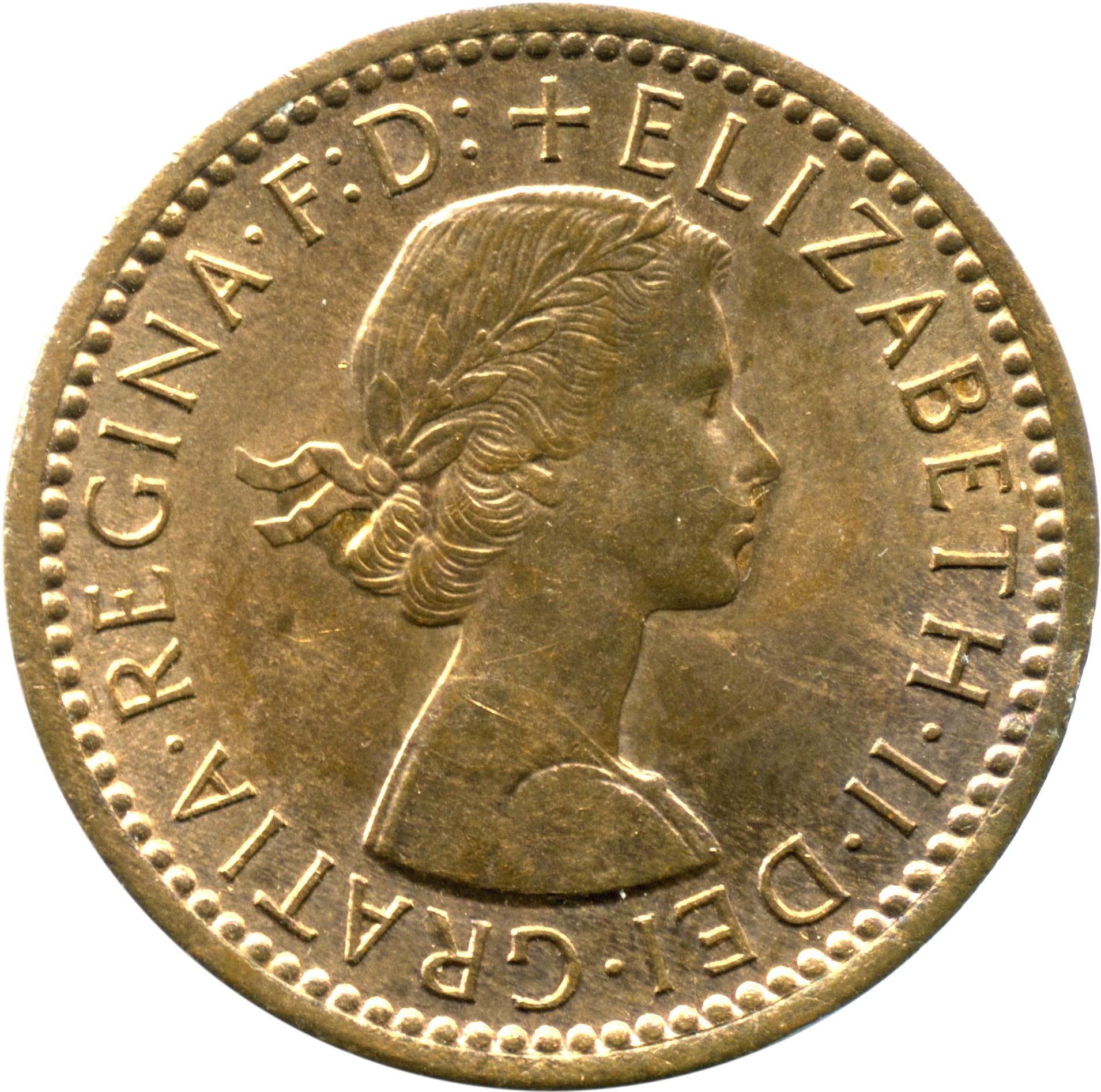
| Design | Elizabeth II |
| Designer | Mary Gillick |
| Design date | 1953 |
| Reverse | |
 | |
| Design | Wren (Britannia on earlier mintages) |
| Designer | Harold Wilson Parker |
| Design date | 1937 |
The farthing (from Old English fēorðing, from fēorða, a fourth) was a British coin worth one quarter of a penny, or 1/960 of a pound sterling. Initially minted in copper, and then in bronze, it replaced the earlier English farthing. Between 1860 and 1971, the farthing's purchasing power ranged between 12p and 0.2p in 2017 values.[1]
The farthing's reverse bore an image of Britannia until 1937, when a wren was introduced. As with all British coins, the obverse bore the image of the reigning monarch.[2] The farthing ceased to be legal tender in the United Kingdom on 1 January 1961.[3]
History
[edit] |
A British copper farthing succeeded the English farthing after England and Scotland were united into the Kingdom of Great Britain in 1707, although not immediately. Under Queen Anne, a small number of pattern farthings were struck, but none for circulation, as so many English farthings from previous reigns were still available. Some British copper farthings were struck in the reigns of George I and George II. By the accession of George III, in 1760, many counterfeits were in circulation, and the Royal Mint stopped minting copper coins in 1775. The next farthings were the first struck by steam power, in 1799 by Matthew Boulton at his Soho Mint, under licence. Boulton coined more in 1806, and the Royal Mint resumed production in 1821. The farthing was struck regularly under George IV and William IV, by then with a design very like a smaller version of the penny.

Values less than a pound were usually written in terms of shillings and pence, e.g. three shillings and six pence (3/6d.), pronounced "three and six" or "three and sixpence". Values of less than a shilling were simply written in pence, e.g. (8d.), pronounced "eightpence". A price with a farthing in it would be written like this: (21⁄4d.), pronounced "twopence [or tuppence] farthing", or (1/31⁄4d.), pronounced "one and threepence [or thruppence] farthing" or (19/113⁄4), pronounced "nineteen and eleven three farthing(s)". 19/113⁄4 was a value used to make goods seem "significantly" cheaper than £1, usage similar to the modern £0.99 (which is also the approximate purchasing power in 2021 of 113⁄4d in 1961, the year when the farthing was withdrawn from circulation).[4]
The first bronze farthings were struck in 1860, in the reign of Queen Victoria, with a new reverse designed by Leonard Charles Wyon. This shows a seated Britannia, holding a trident, with the word FARTHING above. Between 1860 and 1895 there is a lighthouse to Britannia's left and a ship to her right. Various minor adjustments were made over the years to the level of the sea around Britannia and the angle of her trident. Some issues feature toothed edges to the coin, while others feature beading.

After 1860, seven different obverses were used. Edward VII, George V, George VI and Elizabeth II each had a single obverse for the farthings produced during their respective reigns. Over the long reign of Queen Victoria, two different obverses were used. The farthing of 1860 carried the so-called "bun head", or "draped bust" of Queen Victoria on the obverse. The inscription around the bust read VICTORIA D G BRITT REG F D (abbreviated Latin: Victoria by the grace of God queen of Britain defender of the faith). This was replaced in 1895 by the "old head", or "veiled bust". The inscription on these coins read VICTORIA DEI GRA BRITT REGINA FID DEF IND IMP (Victoria by the grace of God queen of Britain defender of the faith empress of India).
Farthings issued during the reign of Edward VII feature his likeness and bear the inscription EDWARDVS VII DEI GRA BRITT OMN REX FID DEF IND IMP (Edward VII by the grace of God king of all Britons defender of the faith emperor of India). Similarly, those issued during the reign of George V feature his likeness and bear the inscription GEORGIVS V DEI GRA BRITT OMN REX FID DEF IND IMP (George V by the grace of God king of all Britons defender of the faith emperor of India).
A farthing of King Edward VIII (reigned 1936) does exist, dated 1937, but technically it is a pattern coin, one produced for official approval, which it was due to receive at about the time that the King abdicated, and in the event no farthings bearing his likeness were ever issued. The pattern has a left-facing portrait of the king, who considered this to be his best side, and consequently broke the tradition of alternating the direction in which the monarch faces on coins — some viewed this as indicating bad luck for the reign; the inscription on the obverse is EDWARDVS VIII D G BR OMN REX F D IND IMP (Edward VIII by the grace of God king of all Britons defender of the faith emperor of India).
One feature of the pattern farthing of Edward VIII was a redesigned reverse displaying the wren, one of Britain's smallest birds. From 1937 this appeared on the regular-issue farthings of George VI and was continued on the farthings of Elizabeth II until the last issue in 1956.
George VI coins feature the inscription GEORGIVS VI D G BR OMN REX F D IND IMP (George VI by the grace of God king of all Britons defender of the faith emperor of India) before 1949, and GEORGIVS VI D G BR OMN REX FIDEI DEF (George VI by the grace of God king of all Britons defender of the faith) thereafter. Unlike the penny, farthings were minted throughout the early reign of Elizabeth II, bearing the inscription ELIZABETH II DEI GRA BRITT OMN REGINA F D (Elizabeth II by the grace of God queen of all Britons defender of the faith) in 1953, and ELIZABETH II DEI GRATIA REGINA F D (Elizabeth II by the grace of God queen defender of the faith) thereafter.
Obverse designs
[edit]-
 George II
 -
 George III
 -
 George IV
 -
 William IV
 -
 Victoria (young)
 -
 Victoria (old)
 -
 Edward VII
 -
 George V
 -
 George VI
 -
 Elizabeth II


Mintages
[edit]| Victoria (Veiled bust) |
|---|
|
| Edward VII |
|---|
|
| George V |
|---|
|
| George VI |
|---|
|
| Elizabeth II |
|---|
|
See also
[edit]


References
[edit]- ^ "Purchasing Power of British Pounds from 1270 to Present". measuringworth.com. Retrieved 17 July 2016.
- ^ Michael, Thomas and Cuhaj, George S. Collecting World Coins: Circulating Issues 1901 - Present (Krause Publications, 2001)
- ^ Cavendish, Richard (12 December 2010). "The Farthing's Last Day". History Today. Retrieved 21 December 2020.
- ^ Face value fixed in 1970; real/retail value likely to be considerably higher
External links
[edit]
- British Coins – information about British coins (from 1656 to 1952)
- Collection of copper & bronze pennies of Great Britain
- About Farthings – a photographic collection of farthings
- British Farthings – photographic reference and history of minting
Farthing (British coin)
View on GrokipediaOverview and Denomination
Value and Role in Currency
The term "farthing" derives from the Old English word feorthing, meaning "a fourth part" or "fourth-thing," reflecting its subdivision of the penny.[6] In the British pre-decimal monetary system, known as £sd (librae, solidi, denarii), the farthing held a nominal value of one quarter of a penny, denoted as 1/4d and equivalent to 0.25 pence, positioning it as the smallest unit of currency with 960 farthings equaling one pound sterling.[6] This value underscored its role alongside the penny and halfpenny in facilitating precise, fractional payments within the imperial economy.[2] Throughout the 19th and 20th centuries, the farthing served as the primary denomination for everyday small transactions, enabling affordable exchanges in daily life and commerce across Britain.[2] It was particularly common for low-value purchases in imperial Britain, supporting the economic fabric of a society where minor expenditures required the finest granularity of coinage.[6] Its utility persisted into the mid-20th century, even gaining heightened importance during World War II amid rationing and price controls, though it circulated less freely than larger fractions like the halfpenny.[2] Post-World War II inflation progressively eroded the farthing's practical relevance, as rising prices diminished the need for such a minute denomination in routine transactions.[2] By the 1950s, commercial demand had waned sufficiently that minting ceased in 1956, with the coin fully demonetized on December 31, 1960, marking the end of its role in Britain's evolving currency system ahead of decimalization in 1971.[2]Physical Specifications and Materials
The physical specifications of the British farthing evolved considerably from its origins as a small silver coin to its final bronze form, adapting to economic needs and metallurgical advancements while maintaining its role as minor currency. Early hammered examples from the medieval era, minted under monarchs such as Henry III (1216–1272) and Edward I (1272–1307), were typically silver with diameters ranging from 8 to 13 mm and weights of 0.2 to 0.5 grams, making them among the smallest circulating coins of the time.[7][8] By the 17th century, the shift to base metals addressed silver shortages and counterfeiting issues; copper farthings introduced under James I (1603–1625) measured 12 to 15 mm in diameter and weighed approximately 0.5 grams, often featuring irregular shapes like ovals in later issues. Tin-based farthings with embedded copper plugs, issued during Charles II's reign (1660–1685), were larger at 23 to 24 mm in diameter and 5.4 to 6.0 grams in weight, designed to incorporate a minimal amount of higher-value metal for authenticity.[9][10] The 18th and early 19th centuries saw further standardization for copper farthings; from 1694 onward, they consistently featured a 22 mm diameter and weight of around 4.72 grams (72.9 grains), with tolerances established under the Coinage Act 1816 to ensure uniformity in purity (near-pure copper) and dimensions across Royal Mint productions. These coins had plain edges, lacking milled reeding as anti-counterfeiting features were deemed unnecessary for such low-denomination pieces.[11][9] In 1860, production transitioned to bronze—an alloy of 95% copper, 4% tin, and 1% zinc—for greater durability and cost efficiency, reducing the diameter to 20 mm and weight to 2.83 grams (43.75 grains), specifications that persisted unchanged through the reigns of Victoria to Elizabeth II until the final minting in 1956. The plain edge remained standard, with official tolerances for weight (±2%) and composition enforced by the Royal Mint to maintain quality control.[12][13][9]Historical Development
Origins in Medieval England
The farthing, valued at one quarter of a silver penny, emerged as a distinct coin denomination in England during the late 13th century as part of a major currency reform initiated by King Edward I in 1279. Prior to this, the farthing existed informally as a quarter-section of a penny, often created by cutting the larger coin, but Edward I's recoinage standardized smaller denominations to improve circulation and reduce such practices. This reform introduced the round silver farthing alongside the halfpenny and groat, all struck to the sterling standard of 92.5% silver purity, with the farthing weighing approximately 0.36 grams and measuring 11-12 mm in diameter.[14][15] These early farthings were produced using hammered coinage techniques, where blank discs of silver or occasionally billon (a silver-copper alloy) were struck between two dies using a hammer, resulting in irregular shapes and varying weights due to the manual process. Under Edward II and Edward III, the sterling standard was maintained, though the farthing's weight was slightly reduced in 1335 to about 0.33 grams amid broader adjustments to combat wear and clipping, ensuring consistency in the long cross reverse design that divided the coin into quadrants to prevent further cutting. By the 16th century, under Henry VIII, the Great Debasement (1544-1551) severely impacted the farthing's composition, progressively reducing silver content from 92.5% to as low as 25% by alloying with more copper, driven by fiscal needs for warfare; this made the coins smaller (under 9 mm) and more base-metal oriented, with the final silver farthings issued during Edward VI's reign (1547-1553). After Edward VI, no official farthings were minted for over a century, with private copper tokens filling the need for small change from 1613 onward.[14][16][16][1] In parallel, Scottish coinage before the 1707 Union featured prototypes akin to the English farthing, such as subdivisions of the bawbee—a silver coin worth six pence Scots introduced in the 16th century under James V—which included half-bawbees and smaller cut fractions serving similar low-value roles, though minted separately to reflect Scotland's distinct monetary system. Silver farthings in England ceased production after Edward VI's reign, paving the way for a shift to copper production in subsequent years.[17][2]Evolution Through the 19th and 20th Centuries
The farthing experienced a significant revival in copper during the late 18th century under George III, driven by wartime coin shortages and counterfeiting issues. In 1797, Matthew Boulton secured a contract with the government to produce copper coinage at his Soho Mint in Birmingham, utilizing innovative steam-powered presses to enhance efficiency and quality. This marked the first use of steam technology for British coin minting, enabling the production of durable coins resistant to counterfeiting. Farthings were specifically issued starting in 1799, weighing approximately 5.8–6.6 grams with a diameter of 23–24 mm, featuring George III's laureate bust on the obverse and Britannia on the reverse.[18][19] By the mid-19th century, the farthing underwent standardization under Queen Victoria as part of broader coinage reforms amid the Industrial Revolution's economic expansion. The Coinage Act of 1860 authorized the replacement of pure copper with a bronze alloy (95% copper, 4% tin, 1% zinc), which was more cost-effective and harder-wearing, inspired by French bronze coinage introduced in 1852. This change aligned the farthing's weight at around 2.83 grams and diameter of 20 mm, facilitating easier handling and production at 40 pence per pound of metal, compared to the previous copper standard. Bronze farthings entered circulation in 1860, with initial designs by Leonard Charles Wyon showing a Britannia reverse, and older copper farthings were gradually demonetized by 1869 to encourage the transition.[20] The farthing's production continued annually during World War I (1914-1918), with mintages maintaining or increasing to meet circulation needs. During World War II, production increased significantly from 1939–1945 to support small transactions amid rationing, with mintages reaching tens of millions annually, as the Royal Mint prioritized essential wartime materials while addressing metal shortages through relocation and efficiency measures. Despite this, the farthing retained utility for small transactions during rationing periods. In 1937, the reverse design shifted from Britannia to a wren, created by engraver Harold Wilson Parker, symbolizing Britain's native wildlife and continuing through the postwar years until 1956.[21][22] Post-1945, the farthing's circulation declined amid rising inflation and early decimalization discussions, rendering its quarter-penny value increasingly obsolete for everyday use. Inflation eroded purchasing power, with prices rising by about 74% from 1945 to 1959 according to the Retail Prices Index, making the farthing's nominal value—equivalent to less than a modern penny—impractical for vending machines and small retail. Parliamentary debates, such as the 1945 Commons discussion on decimal systems, highlighted inefficiencies in the imperial currency, including low-denomination coins like the farthing, as Britain grappled with postwar reconstruction and balance-of-payments crises. These economic pressures culminated in the decision to halt minting in 1956, though the coin remained legal tender until December 31, 1960, paving the way for decimal reforms.[23][24][2][25]Design Features
Obverse Portraits and Inscriptions
The obverse of the British farthing, featuring the reigning monarch's portrait and accompanying Latin inscriptions, evolved significantly from simplistic medieval designs to more detailed effigies reflecting artistic and regal advancements. During the reign of Edward I (1279–1307), the farthing's obverse displayed a forward-facing crowned bust of the king within a beaded circle, emphasizing a rudimentary profile that prioritized recognizability over intricacy.[14] The inscription typically read "EDWARDVS REX" or abbreviated forms like "E R ANGLIE," proclaiming the monarch's title as King of England, with variations shortening the legend after 1280 to accommodate the smaller flan size.[7] These early designs, struck in silver at royal mints such as London and York, marked the transition from cut pennies to dedicated coinage, focusing on the sovereign's authority through minimalistic portraiture.[26] The introduction of official copper farthings in 1672 under Charles II featured a laureate and cuirassed bust of the king facing left on the obverse, with the inscription "CAROLVS A CAROLO" (Charles, son of Charles). This design style, emphasizing classical elements, continued through subsequent reigns with adjustments for each monarch's facing direction per tradition. For example, James II's farthings (1685–1688) showed a draped bust facing right, inscribed "IACOBVS II DEI GRATIA," while under George I (1714–1727), the obverse depicted a laureate head facing left with "GEORGIUS D G MAG BRI FR ET HIB REX." In the 19th century, obverse portraits became more refined, incorporating draped bust styles influenced by neoclassical engraving techniques. For George IV (1820–1830), Italian engraver Benedetto Pistrucci crafted a laureate head facing left, adorned with a laurel wreath and draped shoulders, symbolizing classical heroism and imperial dignity.[27] The inscription evolved to "GEORGIUS IV DEI GRATIA," incorporating "by the Grace of God" to affirm divine right, a formula that persisted in variations across subsequent reigns.[3] Under Queen Victoria (1837–1901), the obverse shifted through multiple effigies: the Young Head (1838–1886) by William Wyon depicted a youthful laureate bust facing left, followed by the Jubilee Head (1887–1893) by Joseph Edgar Boehm, showing an older, veiled profile to commemorate her Golden Jubilee.[28] These portraits, inscribed with "VICTORIA DEI GRATIA BRITT: REG: F: D:" (Victoria, by the Grace of God, Queen of the Britains, Defender of the Faith), reflected the era's emphasis on imperial symbolism and the monarch's enduring reign.[10] Pistrucci's influence extended indirectly through his advocacy for high-relief engraving standards, which informed later Victorian designs despite his primary work on higher denominations.[29] The 20th century saw further diversification in portrait styles, adapting to technological advances in minting while maintaining the tradition of left-facing effigies for continuity. Edward VII's farthings (1901–1910) featured a bare head by George William de Saulles, with simplified drapery and the inscription "EDWARDVS VII DEI GRA: BRITT: OMN: REX FID: DEF: IND: IMP:" (Edward VII, by the Grace of God, King of All the Britains, Defender of the Faith, Emperor of India).[9] George V's reign (1911–1936) introduced multiple obverse variants: the initial portrait by Bertram Mackennal (1911–1924) showed an uncrowned bare head with hollow neck truncation, later modified in 1925 for a filled neck and adjusted lettering to improve striking quality. The inscription remained "GEORGIVS V DEI GRA: BRITT: OMN: REX F: D: IND: IMP:" until 1927, when "IND: IMP:" was omitted following the 1926 Imperial Conference.[30] For Elizabeth II (1953–1956), the early effigy by Mary Gillick portrayed a young laureate head facing right, opposite to her father George VI's left-facing portrait, adhering to the tradition of alternating directions between reigns, adorned with a wreath of roses, thistles, and shamrocks, inscribed "ELIZABETH II DEI GRATIA REGINA F. D." (Elizabeth II, by the Grace of God, Queen, Defender of the Faith).[31] This effigy, emphasizing post-war modernity and the monarch's approachable youth, paired with the reverse to convey national unity in the final years of farthing production.[32]Reverse Designs and Symbolism
The reverse designs of British farthing coins evolved significantly over centuries, reflecting both practical needs and cultural symbolism, while maintaining a focus on national identity and economic utility. In medieval England, farthing reverses featured straightforward cross motifs to combat counterfeiting and clipping. Under Edward I, the 1279 recoinage introduced the long cross design, with arms extending to the coin's edges and often accompanied by pellets in each quadrant, ensuring the silver content remained verifiable and reducing the temptation to shave metal from the periphery. This practical symbolism underscored the crown's commitment to monetary integrity during a period of currency reform.[26] From the late 17th century onward, the reverse prominently displayed Britannia, a personification of Britain first adopted on official copper farthings in 1672 under Charles II. Depicted as a seated warrior goddess wielding a trident in her right hand and resting on a shield emblazoned with the Union Jack in her left, she faced right against a backdrop of waves, embodying Britain's naval supremacy and imperial resilience amid the Anglo-Dutch Wars. Tin farthings issued between 1684 and 1692 retained this motif, inscribed with "BRITANNIA" on the reverse.[33] This Britannia design endured through the 18th and 19th centuries with subtle refinements, such as adjustments to her helmet or robe details for artistic clarity. During the Victorian period (1860–1901), she symbolized the empire's global stability and maritime power, seated in flowing robes with a plumed helmet; a minor variation in 1895 aligned with the obverse's veiled head portrait but preserved the core iconography. The motif persisted into the early 20th century under Edward VII and George V, reinforcing continuity in British coinage aesthetics until 1936.[2] In 1937, under George VI, the reverse underwent a major shift to a wren perched on a twig, designed by engraver Harold Wilson Parker (originally prepared for Edward VIII). This naturalistic emblem, with the date above and "FARTHING" below, evoked the bird's status as Britain's smallest native species, paralleling the coin's modest value and perhaps alluding to the everyday resilience of the British populace amid economic challenges. The wren design continued until production ended in 1956.[4]Production and Circulation
Minting Processes and Locations
The production of British farthings began with hammered coinage at the Tower of London Mint, established around 1279 during the reign of Edward I. Blanks of silver or base metal were hand-cut and placed between two engraved dies, with one worker striking the upper die using a hammer to imprint the design; this manual process continued for farthings until approximately 1662, producing irregular coins prone to wear and clipping.[34][35] The transition to machine-minting occurred in 1662 at the same Tower Mint location, introducing horse-powered rolling mills to prepare uniform blanks, screw presses for striking at about 30 coins per minute, and edge-marking devices to deter counterfeiting through reeding or lettering on higher denominations, though farthings retained plain edges. Copper farthings, however, saw limited milled production until the late 18th century due to persistent counterfeiting issues with lightweight fakes, prompting the government to contract private innovators.[35][36][37] In 1799, Matthew Boulton’s Soho Mint in Birmingham pioneered steam-powered minting for copper farthings, using Boulton’s patented presses to strike coins at high volume with precise edges and uniform weight, achieving up to 70 coins per minute and significantly reducing counterfeits by producing durable, standardized pieces. The Royal Mint adopted similar steam technology after relocating to Tower Hill in 1810, resuming farthing production in 1821 with Boulton-supplied machinery that incorporated blank annealing—heating and slow cooling to soften metal for clearer strikes—and alloy mixing for consistent copper composition.[18][38][36] By the mid-19th century, counterfeiting persisted, particularly with plated base-metal imitations, leading to the 1860 shift to bronze alloy (95% copper, 4% tin, 1% zinc) for farthings, which required refined melting and mixing processes at the Royal Mint to ensure homogeneity before casting into strips, rolling, and blanking. To address striking flaws in early bronze trials, the Mint introduced toothed borders in August 1860, replacing beaded ones for better definition, while private contractors like Heaton & Sons in Birmingham produced some 1860 farthings using acquired Soho equipment for efficient, steam-driven output. Heaton's Mint handled select Victorian farthing issues (marked "H" under the date) from 1874 to 1882, employing comparable alloy preparation, annealing, and machine-pressing techniques to meet Royal Mint standards during peak demand.[20][39][20] In the 20th century, farthing production at the Royal Mint's Tower Hill facility shifted to electric-powered presses around 1900, enabling faster rates of up to 100 coins per minute and precise control over annealing cycles to maintain bronze integrity amid wartime demands; these automated processes enhanced uniformity, directly contributing to the farthing's consistent diameter and weight until its discontinuation in 1956. Although the Mint relocated to Llantrisant in 1968 with advanced electric and hydraulic presses, this postdated farthing minting.[36]Mintage Figures and Variants
The production of British farthings spanned several centuries, with mintage figures influenced by economic needs, material changes, and technological advancements at the Royal Mint and contracted facilities like the Soho Mint. Early silver farthings under Edward I (1272–1307) were part of the 1279 recoinage, with annual outputs typically ranging from 100,000 to 1.5 million coins to support widespread small-denomination transactions across England.[26] These figures, derived from die studies and archival estimates, highlight the scale of medieval currency reform efforts.[40] In the late 18th and early 19th centuries, copper farthings under George III (1760–1820) were struck intermittently due to counterfeiting concerns and wartime demands during the Napoleonic era. The 1799 issue, produced at the Soho Mint, totaled approximately 4.2 million coins, while the 1806–1807 series added several million more, marking a brief resurgence to meet circulating needs amid economic pressures.[18] The shift to bronze in 1860 under Queen Victoria (1837–1901) dramatically increased output, with 27.2 million farthings minted from 1860 to 1863 alone as part of a comprehensive recoinage to replace debased copper coins.[20] Annual production during Victoria's reign generally ranged from 1 to 6 million. This peak reflected Britain's industrial expansion and the farthing's role in everyday retail transactions. Later 20th-century mintages declined as the farthing's utility waned, with George V (1910–1936) issues averaging 5–10 million annually, dropping to around 2 million for the final Elizabeth II farthings in 1956.[9] Low-mintage rarities are prized among collectors for their scarcity. The 1875 farthing, struck without a mint mark at the Royal Mint, had a production of just 713,000, the lowest of the Victorian bronze series due to reduced demand. Similarly, the 1881 farthing without 'H' (Heaton Mint mark) totaled about 1.3 million, while wartime constraints during World War II limited some George VI issues, such as the 1949–1952 second-type farthings to under 5 million combined.[9] Proof sets from 1954, including the farthing, were produced in limited quantities estimated at fewer than 10,000, primarily for collectors and official presentations.[41]| Year/Reign | Mintage | Notes/Source |
|---|---|---|
| Edward I (annual avg., 1279–1307) | 100,000–1.5 million | Silver; recoinage output[26] |
| George III, 1799 | ~4.2 million | Copper, Soho Mint[18] |
| Victoria, 1860–1863 (total) | 27.2 million | Bronze recoinage[20] |
| Victoria, 1875 | 713,000 | Lowest Victorian bronze |
| Elizabeth II, 1954 proof | <10,000 | Part of proof sets[41] |