Hubbry Logo
BroadaxeBroadaxeMain
Open search
Broadaxe
Community hub
Broadaxe
logo
8 pages, 0 posts
0 subscribers
Be the first to start a discussion here.
Contribute something
Broadaxe
Broadaxe
from Wikipedia
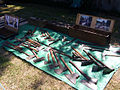
A very large, single-bevel broadaxe

A broadaxe is a large broad-headed axe. There are two categories of cutting edge on broadaxes, both are used for shaping logs into beams by hewing. On one type, one side is flat, and the other side beveled, a basilled edge, also called a side axe,[1] single bevel, or chisle-edged axe.[2] On the other type, both sides are beveled, sometimes called a double bevel axe, which produces a scalloped cut.

American broadaxe circa 1800

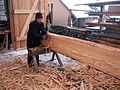
On the basilled broadaxe the handle may curve away from the flat side to allow an optimal stance by the hewer in relation to the hewn surface, and to allow clearance for the hewer's hands. The flat blade is to make the surface flat but can only be worked from one direction and is right-handed or left-handed. The double bevel axe has a straight handle and can be swung with either side against the wood. A double-beveled broad axe can be used for chopping or notching as well as hewing. When used for hewing, notches are chopped in the side of the log down to a marked line, a process called scoring. The pieces of wood between these notches are removed with an axe, a process called joggling,[3] and then the remaining wood is hewn to the line.

History

[edit]

Broad axes have been used since ancient times until the end of the 19th century in Europe and North America. Broadaxes were commonly used in manufacture of square timbers for wooden shipbuilding, log building, timber framing, and railroad ties sometimes called axe ties.[4][5] Some broad axes are of a shape where part of the axe is called a beard so the axe is called a long-bearded axe.

Modern uses

[edit]

Since the introduction of sawmills and modern power tools, the use of this tool is now uncommon in manufacturing but still used in restoration carpentry or undeveloped regions.

[edit]

See also

[edit]

References

[edit]
Revisions and contributorsEdit on WikipediaRead on Wikipedia
from Grokipedia
A broadaxe, also known as a hewing axe, is a specialized characterized by its broad, rectangular blade beveled on one side and a short , designed for precisely squaring logs into flat beams or timber by slicing off thin chips rather than chopping. The blade, typically forged from iron with a , measures around 9 to 12 inches in length and width, while the is usually 20 to 30 inches long to allow for controlled, two-handed use close to the work surface. Historically, the broadaxe was an indispensable tool for early settlers and lumber workers in during the , enabling the of log houses, timber-frame , bridges, and by converting round logs into usable squared beams after and debarking. Originating in patterns developed in and adapted locally—such as the "Canada pattern" with a small poll for hammering—it played a central role in the Ottawa Valley's lumbering and agricultural industries from the 1800s onward, with over 150 axe-makers active between 1860 and 1915. In regions like and , tools stamped by makers such as H. Bragg or D. Taft & Sons were produced using crucible-forged steel, reflecting the era's advancements in edge tool tied to iron works like Katahdin. The tool's design varies by regional tradition, including the English broadaxe with a bent or offset handle to protect the user's knuckles during hewing, and the German "goosewing" style featuring a straight handle with a canted socket and wing-shaped blade for enhanced maneuverability. Left-handed versions were rarer and often commanded higher wages for skilled users in camps. Beyond , broadaxes found application in for initial log shaping, as seen in mid-20th-century examples used by Australian shipwrights, underscoring their enduring role in traditional craftsmanship despite the rise of powered tools. The hewing process, guided by lines snapped on the log, not only produced structural timber but also generated wood chips for chinking cabin walls, leaving distinctive axe marks visible in historic structures today.

Overview

Definition and Purpose

The broadaxe, also known as a hewing axe or side axe, is a specialized tool featuring a wide, flat designed specifically for hewing timber rather than chopping or trees. It typically has a single on the blade for right- or left-handed use, with the opposite side flat to rest against the wood surface during strikes, though some variations include a double-bevel configuration. This design distinguishes it from general-purpose axes by prioritizing precision in shaping over brute force cutting. The primary purpose of the broadaxe is to square round logs into beams or planks by systematically removing wood from one side at a time, producing flat surfaces ideal for in and log construction. By hewing along the , it transforms irregular into structural elements suitable for buildings, bridges, and ties, offering an efficient method for preparing wood before further processing like sawing. In contrast to narrower felling axes or hatchets used for severing trunks, the broadaxe employs a significantly wider cutting edge—typically 8 to 12 inches across—to cover more surface area per strike while aligning with for controlled, splinter-free removal. Its , usually 24 to 36 inches long, enhances by enabling powerful, sweeping motions that efficiently plane large areas of timber with reduced effort compared to shorter-handled tools.

Design Features

The broadaxe features a distinctive blade design optimized for hewing timber, typically broad and rectangular or D-shaped in cross-section, with one side sharpened to a and the other side flat or slightly convex to facilitate smooth passes along the wood surface without digging in. This allows the tool to plane large faces of logs efficiently, producing flat surfaces for beams or planks. The often includes an eye, a socket-like opening in the head for securing the , and may incorporate an optional poll—a hammer-like extension at the rear of the head—for additional utility in striking or balancing the tool. Traditionally, the is forged from high-carbon , which provides the necessary hardness and edge retention for repeated impacts on dense wood, while earlier examples combined iron bodies with inserted cutting edges. Handles are commonly made from or wood, selected for their straight grain, flexibility, and superior shock absorption to reduce vibration during use. Modern broadaxes may employ alloy s, like AISI 4140, for enhanced durability and corrosion resistance in the . Total tool weight generally ranges from 3 to 6 pounds, balancing power with maneuverability. Blade geometry emphasizes functionality, with a straight or slightly curved to follow the of the wood, and thickness that tapers gradually from the poll toward the edge for improved balance and reduced fatigue. This taper, often starting thicker near the eye for structural , ensures the blade slices cleanly without excessive binding. Handle attachment involves inserting the tapered end into the eye and securing it with wooden or metal wedges driven into a kerf at the top, preventing loosening from repeated strikes; some designs use pins for added stability in heavy-duty applications. Handles are ergonomically shaped, with a slight curve or offset for comfortable one- or two-handed grips, allowing precise control during hewing.

History

Origins in Europe

Axes in general trace their origins to the in , evolving from rudimentary hand axes dating to circa 2000 BCE, which were pear-shaped stone tools gradually replaced by and variants with socketed designs for secure . These early axes, including palstaves from 1500–1000 BCE, featured flared blades suited for basic tasks across and . By the Iron Age, beginning around 500 BCE in , iron forging enabled the production of broader-bladed axes that superseded models, marking a key advancement in woodworking efficiency. Celtic communities in Central and , from approximately 800 BCE to 1 CE, utilized these iron axes for timber shaping, while Roman adaptations during 1–5 CE refined designs for construction in provinces like and . The specialized broadaxe, with its single-beveled blade for hewing, emerged during the medieval period from the 12th to 15th centuries, benefiting from enhanced forge techniques that produced wider blades optimized for slicing logs into flat surfaces along the grain. These advancements supported and , such as the oak roofs of completed in 1401, where carpenters like Hugh Herland used hewing tools. Carpenter guilds in and exerted influence on tool standardization during this era, promoting consistent broadaxe designs for squaring timbers in large-scale projects. In , the Carpenters' Company, with roots in 14th-century ordinances from 1333 and formalized by 1477, regulated craft practices that included hewing tools for timber work. 's guilds similarly advanced broadaxe use in tied to shipyards and framing. The first textual and depictions of broadaxes appear in 14th- and 15th-century sources, such as illustrations in the Omne Bonum manuscript depicting axes in contexts and the Hours showing broad axes in timber preparation. Axes spread culturally across for constructing log cabins and fortifications, adapting to regional needs from the early medieval period onward. In , log construction techniques influenced , using axes for notched-corner cabins and processing timbers for palisades and framing.

Development in the Americas

The broadaxe was introduced to the by European settlers in the 1600s, particularly through Finnish and Swedish colonists who established along the in 1638. These settlers brought the technique of horizontal log construction from , adapting it to local timber resources such as , white oak, cedar, , and , which differed in density and workability from European softwoods. The tool was essential for hewing logs flat to create smooth surfaces for stacking in log cabins, a process that required minimal equipment beyond a felling axe, broadaxe, and . For instance, early structures like the Nothnagle Log House in (circa 1638–1643) exemplify this adaptation, where broadaxes squared round logs for durable frontier dwellings. During the 18th and 19th centuries, the broadaxe evolved into distinctly American patterns to suit the demands of dense hardwoods like and expansive forests. Innovations included shorter, wider blades for improved balance and reversible handles that allowed the head to be flipped for right- or left-handed use, providing better control and reducing knuckle interference during hewing—features absent in earlier European goosewing designs introduced by German settlers. accelerated this development, with factories like the Collins Company in , established in 1826, manufacturing ready-to-use broadaxes alongside other edge tools using water-powered machinery and later hydroelectric dams, enabling output of millions of units by the mid-1800s. The broadaxe played a pivotal role in key 19th-century events, including the expansion of railroads after the 1830s, where "tie hackers" used Western and Canadian patterns to hew square crossties from logs, supporting track construction across the continent until the 1930s. Broadaxes were used in wooden shipbuilding, including during the Civil War era for squaring timbers along the East Coast and Great Lakes. By the late 1800s, steam-powered sawmills began supplanting hand-hewing with broadaxes, processing logs more efficiently and leading to a decline in traditional use by the early 20th century. Socioeconomically, the broadaxe was indispensable for frontier homesteading, empowering settlers to process timber rapidly without machinery for log homes, barns, and clearing land, thus facilitating westward expansion and self-sufficient communities in the 19th century.

Types and Variations

Regional Styles

Broadaxes exhibit significant regional variations in design, shaped by local timber types, craftsmanship traditions, and practical needs for hewing logs into beams. In Europe, styles diverged between symmetrical and asymmetrical forms to accommodate different hewing techniques. Scandinavian broadaxes, such as those produced in Sweden, feature symmetrical double-bevel blades that allow for bilateral use, enabling efficient hewing from either side of the log without repositioning the tool. This design facilitates precise squaring of softwoods common in Nordic forests, with the straight edge parallel to the handle for controlled cuts. In contrast, British side axes typically have a single-beveled edge on one side, with the opposite face flat, produced in right- or left-handed variants to suit the user's dominant hand and promote smoother, chisel-like strikes against the wood grain. Across the Atlantic, American broadaxes evolved from European imports but adapted for denser hardwoods and larger-scale . The standard American incorporates a straight handle and a flat-backed , often with a single , allowing the tool to ride flat against the timber for accurate hewing while minimizing bounce on irregular surfaces. Regional subtypes, such as the derived from German goosewing designs, feature a winged eye for secure handle attachment and edges up to 13 inches wide, optimized for squaring and other eastern hardwoods. Canadian variants, including the , show influences from French colonial trade networks, with lighter polls to reduce weight for prolonged use in remote fur-trading outposts and birch-heavy environments. In other regions, adaptations reflect unique environmental demands. Asian applications remain limited, but in Japanese timber framing, the masakari (carpenter's broadaxe) serves a comparable role to broadaxes, with a broad for hewing posts and joints in cedar and , emphasizing precision over heavy chopping. These stylistic differences arise from factors like local wood density, which necessitates blade width and bevel angles for effective chip removal; user , driving asymmetrical designs in Britain and America; and trade routes, which spread hybrid forms.

Specialized Forms

The hewing axe represents the foundational specialized form of the broadaxe, featuring a single-bevel optimized for squaring logs into beams or timbers. Its includes a broad, flat head with a cutting edge typically 8 to 12 inches wide, ground on one side only to allow clean, vertical strikes that remove bark and irregularities while leaving a flat surface. The is offset or angled relative to the blade eye, ensuring the user's knuckles remain clear of the wood during swings, and early American versions often incorporated a removable head that could be reversed for left- or right-handed use. The carpenter's broadaxe is a refined variant suited for precision finishing in trades, often including a poll (the flat, non-cutting end of the head) that serves as a light for driving chisels or during assembly work. Its single-bevel edge, similar to the hewing axe, facilitates smooth planing of surfaces, making it essential for converting rough-hewn logs into finished beams in frame construction. Shipwright's axes adapt the broadaxe for maritime applications, particularly in shaping and fitting curved planks for hulls, with a distinctive slightly curved or adze-like blade that allows for hollowing and beveling along angles. These axes feature an offset, often right-handed configuration to provide better control and a high finish on hewn timbers, constructed from high-carbon for the blade welded to a milder steel eye and neck. Historical examples, such as 19th-century mast broadaxes, emphasize durability for repetitive strikes on large-scale tasks. The double-bit broadaxe is a less common variant designed for efficiency in prolonged hewing operations, equipped with two opposing blades on a single head—one sharply honed for fine cutting and the other blunter or flat for rough work or safety. Developed around 1850, this form weighs 2.5 to 5 pounds with a 26- to 42-inch handle, allowing alternation between blades to maintain sharpness without pausing for honing. It extends the broadaxe's utility in timber processing by combining rough and finishing capabilities in one tool. Modern replicas of broadaxes cater to historical reenactments and preservation efforts, often produced as lightweight versions weighing around 3.5 pounds with ergonomic handles to reduce fatigue during demonstrations. These reproductions replicate traditional single- or double-bevel designs using high-carbon steel blades, sometimes stamped rather than fully hand-forged for cost efficiency, while maintaining offset handles and sheaths for authenticity. Manufacturers like Gränsfors Bruk offer customizable angles and grinds to match period-specific forms, supporting educational and cultural uses without the weight of tools.

Traditional Uses

Hewing Techniques

The basic hewing process with a broadaxe involves several sequential steps to transform a round log into a squared timber. First, the log is debarked using a or bark spud and secured on supports such as yokes or blocks at knee height to ensure stability during work. The desired flat surface is then marked by scribing the outline with a or axe and snapping a straight between nails driven at the log's ends, establishing the "to the line" method for achieving straight edges. Scoring follows, where a single-bit axe is used to make initial cuts perpendicular to the log's length, typically 3-6 inches apart and to the depth of the chalk line, creating notches that facilitate wood removal; for larger logs, V-shaped juggle notches spaced 10-12 inches apart may be chopped and split to remove bulk material. Hewing proper is then performed with the broadaxe, striking from the top down in overlapping passes to chip away the wood between the scores, working progressively from the bottom of the log upward to avoid splitting along the . The broadaxe blade is swung straight down, parallel or slightly angled to the , to break off clean chips while following for precision; any stuck chips are promptly removed to prevent glancing blows that could damage the tool or workpiece. Body positioning is critical for control and safety: during scoring, the user stands atop the log with feet spread for balance, using an extended-arm swing, while hewing often involves standing beside the log with legs apart or one knee on the log and the other on the ground, ensuring the workpiece is firmly secured to minimize movement. Safety measures include wearing protective gear such as gloves, , and sturdy boots, as well as maintaining a sharp blade to reduce effort and risk of slips. Orientation to the wood's is essential to minimize splitting and ensure clean cuts, with strikes aligned parallel to the annual rings to follow the natural direction. Marking tools like levels or scribes aid in aligning the chalk line perpendicular to the log's axis, accounting for any taper in the timber. in hewing progresses from rough removal, where 1-2 inches of material may be taken per pass in initial stages, to finer work for achieving smooth surfaces suitable for , often refined further with an or . Proficiency develops through practice, as the technique demands strength, timing, and an understanding of wood behavior, with experienced hewers producing uniform faces marked only by subtle axe impressions.

Applications in Construction

In timber framing, the broadaxe was essential for squaring logs into beams suitable for mortise-and-tenon joints, enabling the construction of durable barns, houses, and other structures in 18th- and 19th-century America. For instance, in American log homes of the 18th century, hewn beams provided the structural framework for walls and roofs, allowing for tight-fitting assemblies that enhanced stability and weather resistance. This application transformed round logs into rectangular timbers, facilitating the erection of multi-story buildings in frontier settlements where sawmills were scarce. In , particularly during the , broadaxes were employed to hew planks and timbers for hulls and masts, contributing to the construction of fast vessels like clipper ships. Ship carpenters used the tool to shape and logs into straight-edged components, ensuring watertight seams and structural integrity essential for long ocean voyages. This labor-intensive process supported the rapid expansion of maritime trade, with hewn timbers forming the backbone of hulls that could withstand heavy loads and rough seas. For infrastructure projects, broadaxes played a key role in preparing railroad ties and bridge timbers, as well as shoring supports in operations. Tie hacks, specialized workers, used broadaxes to hew logs into uniform crossties from the through the early , supplying millions for expanding rail networks across . In bridge construction, squared timbers provided foundational supports for wooden spans over rivers and canyons, while in , hewn props and caps reinforced underground tunnels against collapse. A could produce up to 25 ties per day from softwoods like lodgepole pine, demonstrating the tool's role in scaling up these critical projects. The broadaxe's efficiency markedly improved construction timelines; a single worker could hew a log into a usable beam in several hours, compared to days required with less specialized axes or primitive methods (as demonstrated in a 2019 timber-framing project). This enabled faster assembly of frames and ties that accelerated building projects in resource-limited environments.

Modern Applications

Contemporary Woodworking

In contemporary woodworking, the broadaxe has experienced a revival among eco-builders specializing in sustainable timber framing for log homes and cabins, where it is used to hand-hew timbers for structural and aesthetic purposes. This practice emphasizes ecologically sound harvesting and energy-efficient designs, often integrating the broadaxe after initial rough cuts made with power tools like chainsaws to streamline workflows while maintaining traditional craftsmanship. Companies such as Broadaxe Timberworks highlight its role in creating durable, nail-free joinery that supports long-lasting, environmentally friendly structures. Artisan woodworkers employ the broadaxe for hand-hewing custom beams, furniture, and occasional sculptures, valuing the tool's ability to impart unique, textured surfaces that enhance rustic in off-grid constructions like remote cabins. This technique is particularly popular in small-scale projects where the broadaxe's precision allows for personalized shaping without industrial machinery, appealing to builders seeking self-sufficient, low-impact builds. Modern broadaxes incorporate safety features such as angled handles with ergonomic grips to keep hands clear of the workpiece, reducing injury risk during hewing, and are often paired with protective gear like sheaths and gloves for user safety. In hybrid workflows, artisans combine the broadaxe with chainsaws for efficiency, using the former for fine finishing after mechanical roughing. These tools are widely available, with hand-forged models from blacksmiths like Gränsfors Bruk priced around $270–$380, while mass-produced versions start at approximately $100, catering to both professional and hobbyist markets through specialty suppliers. As a low-energy alternative to powered machinery, the broadaxe minimizes carbon emissions and use in , while preserving the wood's and texture for enhanced durability and visual appeal in sustainable builds.

Cultural and Preservation Roles

The broadaxe holds significant cultural symbolism across various historical contexts, often representing craftsmanship, resilience, and societal transformation. In 19th-century American literature, Walt Whitman immortalized the tool in his poem "Song of the Broad-Axe" from Leaves of Grass, portraying it as an emblem of the pioneering spirit that shaped the American West, embodying unity in diversity and the mystic evolution of democracy from constructive building to broader human progress. On the American frontier, the broadaxe was essential for settlers, including German immigrants who introduced goosewing variants to Pennsylvania for hewing logs into cabins and beams, marking it as a cornerstone of pioneer self-reliance and community building. In African American history, broadaxe heads from mid-19th to mid-20th-century plantations in Georgia highlight its role in enslaved labor for hewing timber in agricultural infrastructure, underscoring themes of endurance and forced contribution to Southern economy. In modern cultural contexts, the broadaxe persists in heritage demonstrations and educational programs that revive traditional . For instance, in , —once known as for its lumber boom—19th-century broadaxes like those manufactured by J.J. Higgins are now documented through projects at and showcased at sites such as Cumberland Heritage Village Museum, preserving the tool's legacy in regional identity and industry history. These efforts emphasize the axe’s distinctive hewing marks as cultural artifacts, bridging past industrial practices with contemporary appreciation for handcraft. Preservation efforts underscore the broadaxe's role in maintaining historic structures, particularly log buildings. The U.S. Forest Service's guide Dovetails and Broadaxes: Hands-On Preservation advocates combining broadaxes with modern tools like chainsaws to hew replacement logs, ensuring repairs match original craftsmanship and adhere to Secretary of the Interior's Standards for Historic Properties, thus safeguarding tangible links to and early settlement . In museum collections, broadaxe artifacts are preserved to document their historical roles. For example, the National Museum of African American and Culture preserves broadaxe heads to document slavery-era tools, integrating them into exhibits on labor and . These initiatives not only protect the tools themselves but also revive hewing techniques for authentic restoration of timber-framed sites worldwide.

References

Add your contribution
Related Hubs
Contribute something
User Avatar
No comments yet.