


Community hub
Recent from talks
Contribute something
Nothing was collected or created yet.
Buddy Baer
View on Wikipedia
Jacob Henry "Buddy" Baer (June 11, 1915 – July 18, 1986) was an American boxer and later an actor with parts in seventeen films, as well as roles on multiple television series in the 1950s and 1960s.[2][3]
Key Information


In 1941, he came extremely close to boxing stardom at Washington's Griffith Stadium, when in the opinion of most ringside officials, Joe Louis gave him a disqualifying late sixth-round hit in a title match that should have made Baer the world heavyweight champion. He lost to Louis in a rematch for the title the following year but remained solidly ranked among the top heavyweights in the early 1940s. In 2003, Baer was chosen for The Ring magazine's list of 100 greatest punchers of all time. He was the younger brother of boxing heavyweight champion and actor Max Baer, and the uncle of actor Max Baer Jr.
Boxing career
[edit]Baer was born in Denver, Colorado,[2][1] on June 11, 1915, to father Jacob, a butcher, and mother Dora Bales. However, a few sources, such as his brother Max, list his birthplace as Omaha, Nebraska. He moved with his family to California in 1928, living first in Livermore in 1926 and then Hayward, before settling in the early 1930s in Sacramento, where he would later retire. Both Buddy and his brother Max had a large Jewish following, for they claimed Jewish ancestry on their father's side and frequently wore a Star of David on their boxing trunks. Neither brother, however, appeared to be observant or openly religious, and their claims of Jewish heritage were questioned by trainer Ray Arcel.[4][5] Standing at 6' 6+1⁄2" (1.99 m), Baer fought from 1934 to 1942. Baer's manager during the largest portion of his boxing career was Ancil Hoffman, who also managed Max's career for a period.[1]
Early career
[edit]In his professional debut, Baer knocked out Tiny Abbott, 1:54 into the first round on September 23, 1934, in Eureka, California. A boxer of some repute, the towering 6' 8" Abbott had twice faced Baer's brother Max, and though it was Baer's first time in the ring, the more experienced Abbott was nearing the end of his career. Baer had a long winning streak following his debut fight until he met Babe Hunt. On January 10, 1935, Baer was defeated in a four-round bout, losing on points to Hunt at Boston's Rickard Recreation Center.[1] The loss was Baer's first in thirteen straight fights, twelve of which Baer won by knockout. Though Hunt had a bad second round, he came back strongly in the third and fourth to win by unanimous decision.[6]
He completed a technical knockout of Jack O'Dowd at 2:10 into the second round at Detroit's Olympia Stadium on January 4, 1935. On a ticket that included Joe Louis, the total audience reached 15,853. The crowd witnessed a performance from Baer, who outweighed his opponent by 29 pounds, less than his typical advantage. In an odd victory, O'Dowd, who seemed to lack the will to fight, was down five times in the first round, in a few instances without actually being hit.[7][8] Though O'Dowd had faced the great Joe Louis the previous year, he showed no desire to mix with Baer and appeared thoroughly outmatched. [citation needed]
Frank Connolly, a former Golden Gloves champion, fell to Baer on March 20, 1935, in a convincing first-round knockout at the Oakland Auditorium before a substantial early-career crowd of 9,500. The final blow was a right hook that started low and came up with enormous power to knock out Connolly, who weighed 245, only a pound heavier than Baer.[9]
Baer defeated Al Delaney on July 18, 1935, in a four-round knockout at Buffalo's Offerman Stadium. In a complete victory, Baer had Delaney down five times before the referee counted him out 34 seconds into the fourth round from a right behind the ear.[10] In the opening round, Baer was knocked to his knees by a strong left, but he recovered, and had his own way for the rest of the match.[11]
Match with Ford Smith
[edit]On the ticket of the Max Baer-Joe Louis match, he had one of his most lucrative bouts on September 4, 1935, when he lost a six-round wind-up match to Ford Smith in New York before an immense crowd of 90,000 fans at Yankee Stadium.[12] Baer tried to overpower Smith in the early rounds with his punching ability, but Smith moved, blocked, and weathered the storm. In later rounds, Baer was less effective with intermittent looping blows that Smith countered with sharp, short punches to the body. Baer was tired in the last round, and though he had an advantage in reach and weight, he did little damage in his final rally, having lost speed and precision in his blows. The more experienced Smith took four of the six rounds.[13][14] According to one source, his purse for the match, which was the most heavily attended in New York history, was $42,000. Louis, who won the title match against brother Max, had a purse of $200,000.[2][1]
At this early stage of his career, Baer suffered a rare loss on April 22, 1936, dropping a six-round decision to Frenchman Andre Lenglet at Oakland's Municipal Auditorium. Baer looked strong in the first and had a brief rally in the fifth but lost his chance when Lenglet snapped back with a defense. One reporter, who wrote that Lenglet won each round by a large margin, noted that Baer failed to score with a telling blow throughout the match. Lenglet scored well with short left jabs to the face, and followups to the midriff and his frequent changes of pace confused Baer's ability to use his strong right.[15]
In an important match on May 24, 1937, Baer outpointed Jack London, later the holder of the Commonwealth Boxing Council's Heavyweight title from 1944 to 1945. Baer won on points in a ten-round decision at Swansea, England, and though he had a significant advantage in height of nearly eight inches, he had only twenty pounds in weight over the sturdy London boxer.[16][1] Two weeks earlier, Baer had defeated Jim Wilde at Harringay Arena in a fourth-round technical knockout. With dominance and punching power, he had Wilde down three times in the first round and for a count of eight in the third. After being knocked to the canvas for a count of five in the opening of the fourth, the referee called the match. British rules required ending a bout after five knockdowns.[17][18]
Match with top contender Abe Simon
[edit]He brought a stop to seasoned Jewish heavyweight Abe Simon before 25,000 fans, on August 30, 1937, scoring a technical knockout at Yankee Stadium in 2:38 of the third round. Though Simon punished Baer severely in the first and had him hanging from the ropes with a two-fisted attack, Baer rallied in the second with sharp left jabs and a stinging right cross and had Simon down and then staggering in the third when the referee called the fight. Both fighters had exceptional weight and reach and though Baer had a two-inch advantage in height, Simon, a giant himself, actually outweighed Baer by seven pounds.[19][20]
Painful loss to Gunar Barlund
[edit]Baer lost to gifted Finnish boxer Gunnar Barlund on March 4, 1938, before 8,565 fans in a seventh-round technical knockout at Madison Square Garden. Baer had a forty-pound weight advantage over Barlund, and 5+1⁄2-inch advantage in height, but lacked stamina and heart as the fight progressed. Baer performed well in the first, cutting Barlund's forehead and nose with stinging left jabs and an occasional right, while Barlund lost points for low blows. In the second, however, Gunnar reached Baer with a few punches and then getting his range, took the second, third, and fourth. Baer maintained an edge in the fifth, and though both showed fatigue, Gunnar took the sixth, scoring at least ten straight rights and lefts without a return. In the seventh, Barlund drove Baer into the ropes with a heavy barrage. He followed him across the ring when Baer retreated and continued his attack, Baer seeming to give up, dropping his hands to his sides during the attack, and after coming from a clinch signaling the referee to end the fight. The referee asked Baer, apparently hurt, if he wished to continue, and decided to stop the fight, 1:36 into the seventh. Baer made no excuses for his performances but believed his layoff from the ring had affected his timing and ability to connect punches, particularly his right. Barlund successfully circled away from Baer's hard overhand right.[21][22]
Three wins; Savold, Mann, and Blackshear
[edit]He defeated Lee Savold in an important match on October 30, 1939, in an eight-round newspaper decision before 3,500 in Des Moine, Iowa. After a brief exchange, Baer had his opponent down for a count of eight in the first round from a right uppercut, and though Savold battled hard in the remaining rounds, he struggled to connect blows after his rough first round.[23][24] Most reporters gave five rounds to Baer with only two to Savold in the hotly contested match.[25]
He defeated Nathan Mann on May 3, 1940, before 5000, in a seventh-round technical knockout at New York's Madison Square Garden.[1] In the match, Baer took the first four rounds, but Mann took the next four with cutting hooks to the head and body. A savage right hook in the opening of the seventh severely cut Mann's eye, causing his handlers to end the fight.[26]
Winning in a three-round technical knockout before 4,000 fans, he defeated accomplished boxer Harold Blackshear, who maintained a winning record and a 50% knockout percentage, on December 17, 1940, at Oakland's Auditorium. Baer had the advantages of roughly five inches in reach, 5.5 inches in height, and 49 pounds in weight, as well as his superior punching ability. He toyed with Blackshear for the first two-and-a-half rounds, before commencing a clubbing and brutal assault in the third that led to the end of the charity bout. Many at ringside considered the bout a mismatch. Although he pocketed $2,500 for the contest, Baer had faced stronger opposition in the recent past, as Blackshear had dropped his last two fights, suffering a loss and a strong knockout.[27]
Loss to Eddie Blunt in Oakland
[edit]Baer lost to Eddie Blunt on January 15, 1941, at the Auditorium in Oakland in a ten-round points decision. Though Baer was a 3-1 favorite in the early betting, Blunt won eight of the ten rounds. Despite a weight disadvantage of twenty-four pounds, Blunt kept Baer off balance with long lefts and stiff uppercuts throughout the match, and by the fifth had cut Baer's eyes, after which Baer kept losing ground. The fifth through seventh rounds were hard fought with both boxers fighting toe to toe.[28] Though Baer attempted a rally in the tenth, it was far too late to make up the points differential, though he managed to win the round. In the words of one reporter, "Baer took one of the most beautiful shellackings of his erratic career".[29] Baer required stitches above both eyes, and it was evident he would need a break before his next fight.[30]
In a ramp up to a heavyweight title match, he defeated colorful contender Tony Galento before 8,500 fans on April 8, 1941, in a seventh-round technical knockout in Washington, D.C., when Galento had to discontinue the bout due to a broken hand. Galento took the first round backing Baer into the ropes with a few hard rights, but the second was even, and Baer took the remaining rounds. Baer used his superior reach in the remaining rounds to keep Galento from boring in, and in the fourth, he staggered Galento with a hard right to the mouth. Another solid blow in the sixth caused Galento to lose his mouthpiece, and there were some hard punches, but the match featured no knockdowns. The win was a solid one for Baer.[31][1] Baer succeeded in connecting with solid lefts to Galento's head and both lefts and rights to his body.[32]
World heavyweight title contender
[edit]
The highlight of his boxing career came in his two attempts to take the heavyweight boxing championship from Joe Louis. In their first fight on May 23, 1941, Baer caught Louis with a powerful left hook in the first round and knocked the champion out of the ring. Louis, however, hurt but unfazed, climbed back in before the count of ten, though many ringside believed Louis benefited from a long count. Louis eventually won the fight on a disqualification after he had knocked down Baer three times in the sixth. Baer claimed that his third knockdown came shortly after the bell had rung to end the sixth round. In the seventh, when Baer's handlers refused to leave the ring as they protested what they believed was a late hit in the sixth, the referee, Arthur Donovan, disqualified Baer in a technical knockout for not resuming the match. In a controversial decision, the referee believed the last hit came before or during the final bell, but most ringside officials, including the official timekeeper, knockdown timekeeper, and both judges believed the final blow came after the bell, which should have disqualified Louis. The final decision of the boxing commissioner favored the referee, and Louis retained the title. Regardless of the decision, many ringside believed Louis would have eventually won the fight, as he punished Baer repeatedly in the sixth, and had fully recovered from his knockdown in the first. Baer, nonetheless, came closer to defeating Louis and taking the title than any of the other opponents Louis would face, until losing to Ezzard Charles in 1950.[33][34]
In their rematch in Madison Square Garden, on January 9, 1942, before an estimated crowd of 19,000, Louis knocked Baer out in the first, after downing him two previous times. His second knockdown, after a barrage of blows and a thundering left hook, resulted in a count of nine. After rising to his feet again, Baer was battered around the ring and floored for the last time with a straight right to the head that put him down for a seven count. Unable to get up, the count was completed and the fight ended. Baer subsequently remarked, "The only way I could have beaten Louis that night was with a baseball bat."[1][35] A year later he said, "I had to quit. I injured my neck in an auto crash before the fight".[36]
Professional boxing record
[edit]All information in this section is derived from BoxRec,[37] unless otherwise stated.
Official record
[edit]| 66 fights | 57 wins | 7 losses |
|---|---|---|
| By knockout | 53 | 2 |
| By decision | 4 | 4 |
| By disqualification | 0 | 1 |
| Newspaper decisions/draws | 2 | |
All newspaper decisions are officially regarded as “no decision” bouts and are not counted in the win/loss/draw column.
| No. | Result | Record | Opponent | Type | Round, time | Date | Age | Location | Notes |
|---|---|---|---|---|---|---|---|---|---|
| 66 | Loss | 57–7 (2) | Joe Louis | KO | 1 (15), 2:56 | Jan 9, 1942 | 26 years, 212 days | Madison Square Garden, New York City, New York, U.S. | For NYSAC, NBA, and The Ring heavyweight titles |
| 65 | Loss | 57–6 (2) | Joe Louis | DQ | 7 (15), 3:00 | May 23, 1941 | 25 years, 346 days | Griffith Stadium, Washington, D.C., U.S. | For NYSAC, NBA, and The Ring heavyweight titles; Baer disqualified after his manager refused to leave the ring |
| 64 | Win | 57–5 (2) | Tony Galento | TKO | 7 (10) | Apr 8, 1941 | 25 years, 301 days | Uline Arena, Washington, D.C., U.S. | |
| 63 | Loss | 56–5 (2) | Eddie Blunt | PTS | 10 | Jan 15, 1941 | 25 years, 218 days | Auditorium, Oakland, California, U.S. | |
| 62 | Win | 56–4 (2) | Harold Blackshear | TKO | 3 (10), 2:45 | Dec 17, 1940 | 25 years, 189 days | Auditorium, Oakland, California, U.S. | |
| 61 | Win | 55–4 (2) | Valentin Campolo | KO | 1 (12), 1:53 | Jun 6, 1940 | 24 years, 361 days | Madison Square Garden, New York City, New York, U.S. | |
| 60 | Win | 54–4 (2) | Nathan Mann | TKO | 7 (12), 1:36 | May 3, 1940 | 24 years, 327 days | Madison Square Garden, New York City, New York, U.S. | |
| 59 | Win | 53–4 (2) | Lee Savold | NWS | 8 | Oct 30, 1938 | 23 years, 141 days | Coliseum, Des Moines, Iowa, U.S. | |
| 58 | Win | 53–4 (1) | Charley Neaves | KO | 2 (10) | Oct 13, 1938 | 23 years, 124 days | Municipal Auditorium, Kansas City, Missouri, U.S. | |
| 57 | Win | 52–4 (1) | Maxie Doyle | TKO | 3 (10) | Oct 12, 1938 | 23 years, 123 days | Little Rock, Wyoming, U.S. | |
| 56 | Win | 51–4 (1) | Sandy McDonald | KO | 2 (10) | Oct 5, 1938 | 23 years, 116 days | Hubber Park, Lubbock, Texas, U.S. | |
| 55 | Win | 50–4 (1) | Big Boy Brackey | TKO | 2 (10), 1:10 | Apr 4, 1938 | 22 years, 297 days | Olympic Auditorium, Los Angeles, California, U.S. | |
| 54 | Win | 49–4 (1) | Chuck Crowell | KO | 1 (10), 0:54 | Mar 10, 1938 | 22 years, 272 days | Madison Square Garden, New York City, New York, U.S. | |
| 53 | Loss | 48–4 (1) | Gunnar Bärlund | TKO | 7 (10) | Mar 4, 1938 | 22 years, 266 days | Madison Square Garden, New York City, New York, U.S. | |
| 52 | Win | 48–3 (1) | Eddie Hogan | TKO | 3 (10), 2:21 | Dec 17, 1937 | 22 years, 189 days | Madison Square Garden, New York City, New York, U.S. | |
| 51 | Win | 47–3 (1) | Abe Simon | TKO | 3 (6), 2:38 | Aug 30, 1937 | 22 years, 80 days | Yankee Stadium, New York City, New York, U.S. | |
| 50 | Win | 46–3 (1) | Jack London | PTS | 10 | May 24, 1937 | 21 years, 347 days | Vetch Field, Swansea, Wales | |
| 49 | Win | 45–3 (1) | Jim Wilde | TKO | 4 (10) | May 6, 1937 | 21 years, 329 days | Harringay Arena, Harringay, London, England | |
| 48 | Win | 44–3 (1) | Patrick Michael Barry | KO | 1 (10), 2:46 | Dec 9, 1936 | 21 years, 181 days | Chicago Stadium, Chicago, Illinois, U.S. | |
| 47 | Win | 43–3 (1) | Salvatore Ruggirello | KO | 2 (10) | Oct 19, 1936 | 21 years, 130 days | Maple Leaf Gardens, Toronto, Ontario, Canada | |
| 46 | Win | 42–3 (1) | Art Oliver | KO | 4 (6) | Oct 8, 1936 | 21 years, 119 days | Platteville, Wisconsin, U.S. | |
| 45 | Win | 41–3 (1) | Babe Davis | KO | 6 (6) | Oct 6, 1936 | 21 years, 117 days | Coliseum, Evansville, Indiana, U.S. | |
| 44 | Win | 40–3 (1) | Verne Trickle | KO | 5 (6) | Sep 21, 1936 | 21 years, 102 days | Sheldon, Iowa, U.S. | |
| 43 | Win | 39–3 (1) | Pret Ferrar | NWS | 6 | Sep 14, 1936 | 21 years, 95 days | Coliseum, Des Moines, Iowa, U.S. | |
| 42 | Win | 39–3 | Fred Schultz | KO | 1 (4), 1:28 | Sep 7, 1936 | 21 years, 88 days | Rock Springs, Wyoming, U.S. | |
| 41 | Win | 38–3 | Babe Hunt | KO | 1 (6) | Sep 4, 1936 | 21 years, 85 days | Rock Springs, Wyoming, U.S. | |
| 40 | Win | 37–3 | Jack Conroy | KO | 1 (10) | Sep 2, 1936 | 21 years, 83 days | Lincoln Field, Twin Falls, Idaho, U.S. | |
| 39 | Win | 36–3 | James J. Russell | KO | 1 (6) | Aug 31, 1936 | 21 years, 81 days | Memorial Ball Park, Coeur d'Alene, Idaho, U.S. | |
| 38 | Win | 35–3 | Don Baxter | PTS | 6 | Aug 29, 1936 | 21 years, 79 days | Recreation Park, Lewiston, Idaho, U.S. | |
| 37 | Win | 34–3 | Bill Devere | KO | 2 (6), 0:07 | Aug 25, 1936 | 21 years, 75 days | Multnomah Stadium, Portland, Oregon, U.S. | |
| 36 | Win | 33–3 | Mickey Simpson | KO | 2 (6) | Aug 24, 1936 | 21 years, 74 days | Armory, Marshfield, Oregon, U.S. | |
| 35 | Win | 32–3 | Ray Jarecki | KO | 1 (6), 0:34 | Jul 24, 1936 | 21 years, 43 days | Ogden Stadium, Ogden, Utah, U.S. | |
| 34 | Win | 31–3 | Rags Wood | KO | 1 (4) | Jul 17, 1936 | 21 years, 36 days | Convention Hall, Ada, Oklahoma, U.S. | |
| 33 | Win | 30–3 | James Merriott | KO | 1 (?) | Jul 16, 1936 | 21 years, 35 days | Coliseum, Tulsa, Oklahoma, U.S. | |
| 32 | Win | 29–3 | Charles Montgomery | KO | 1 (4) | Jul 13, 1936 | 21 years, 32 days | Avey's Open-Air Arena, Oklahoma City, Oklahoma, U.S. | |
| 31 | Loss | 28–3 | Andre Lenglet | PTS | 6 | Apr 22, 1936 | 20 years, 316 days | Auditorium, Oakland, California, U.S. | |
| 30 | Win | 28–2 | Jack Petric | KO | 1 (4) | Mar 25, 1936 | 20 years, 288 days | Auditorium, Oakland, California, U.S. | |
| 29 | Win | 27–2 | Harold Murphy | PTS | 4 | Mar 2, 1936 | 20 years, 265 days | Civic Auditorium, San Francisco, California, U.S. | |
| 28 | Win | 26–2 | Wally Hunt | KO | 1 (4), 1:36 | Feb 19, 1936 | 20 years, 253 days | Auditorium, Oakland, California, U.S. | |
| 27 | Loss | 25–2 | Ford Smith | PTS | 6 | Sep 24, 1935 | 20 years, 105 days | Yankee Stadium, New York City, New York, U.S. | |
| 26 | Win | 25–1 | Jack Doyle | KO | 1 (6), 2:38 | Aug 29, 1935 | 20 years, 79 days | Madison Square Garden, New York City, New York, U.S. | |
| 25 | Win | 24–1 | Artie Suess | TKO | 4 (6) | Jul 26, 1935 | 20 years, 45 days | Boardwalk Arena, Long Branch, New Jersey, U.S. | |
| 24 | Win | 23–1 | Al Delaney | KO | 4 (4), 0:34 | Jul 18, 1935 | 20 years, 37 days | Offermann Stadium, Buffalo, New York, U.S. | |
| 23 | Win | 22–1 | Frank Wotanski | KO | 1 (4), 0:54 | Jun 25, 1935 | 20 years, 14 days | Yankee Stadium, New York City, New York, U.S. | |
| 22 | Win | 21–1 | Big Boy Brackey | KO | 1 (4), 1:42 | May 23, 1935 | 19 years, 346 days | Broadway Auditorium, Buffalo, New York, U.S. | |
| 21 | Win | 20–1 | Ed Anderson | PTS | 4 | Apr 18, 1935 | 19 years, 311 days | National Guard Armory, Kalamazoo, Michigan, U.S. | |
| 20 | Win | 19–1 | Tommy Davenport | KO | 1 (6) | Apr 17, 1935 | 19 years, 310 days | I.M.A. Auditorium, Flint, Michigan, U.S. | |
| 19 | Win | 18–1 | John "Corn" Griffin | KO | 2 (4) | Apr 12, 1935 | 19 years, 305 days | Chicago Stadium, Chicago, Illinois, U.S. | |
| 18 | Win | 17–1 | Harry Nelson | TKO | 3 (10) | Apr 10, 1935 | 19 years, 303 days | Civic Auditorium, Grand Rapids, Michigan, U.S. | |
| 17 | Win | 16–1 | Frank Connolly | KO | 1 (6) | Mar 20, 1935 | 19 years, 282 days | Auditorium, Oakland, California, U.S. | |
| 16 | Win | 15–1 | Tommy Davenport | KO | 1 (10) | Jan 28, 1935 | 19 years, 231 days | Municipal Stadium, Miami, Florida, U.S. | |
| 15 | Win | 14–1 | Monty Hogan | KO | 1 (4), 0:31 | Jan 21, 1935 | 19 years, 224 days | Rikard Recreation Center, Boston, Massachusetts, U.S. | |
| 14 | Loss | 13–1 | Babe Hunt | PTS | 4 | Jan 10, 1935 | 19 years, 213 days | Rikard Recreation Center, Boston, Massachusetts, U.S. | |
| 13 | Win | 13–0 | Jack O'Dowd | TKO | 1 (6), 2:10 | Jan 4, 1935 | 19 years, 207 days | Olympia Stadium, Detroit, Michigan, U.S. | |
| 12 | Win | 12–0 | Gene Stanton | TKO | 1 (6) | Dec 28, 1934 | 19 years, 200 days | Chicago Stadium, Chicago, Illinois, U.S. | |
| 11 | Win | 11–0 | Henry Surrette | KO | 1 (4), 2:47 | Dec 21, 1934 | 19 years, 193 days | Boston Garden, Boston, Massachusetts, U.S. | |
| 10 | Win | 10–0 | Bumbo Myers | KO | 2 (4), 2:00 | Dec 19, 1934 | 19 years, 191 days | Wheeling, West Virginia, U.S. | |
| 9 | Win | 9–0 | Bob Cook | KO | 1 (6) | Dec 14, 1934 | 19 years, 186 days | Convention Hall, Kansas City, Missouri, U.S. | |
| 8 | Win | 8–0 | Mickey McGoorty | TKO | 1 (6), 1:22 | Dec 10, 1934 | 19 years, 182 days | Public Hall, Cleveland, Ohio, U.S. | |
| 7 | Win | 7–0 | Red Fields | TKO | 1 (6), 0:50 | Dec 6, 1934 | 19 years, 178 days | Coliseum, Des Moines, Iowa, U.S. | |
| 6 | Win | 6–0 | Johnny Baker | KO | 2 (6), 0:35 | Dec 4, 1934 | 19 years, 176 days | Waterloo Theatre, Waterloo, Iowa, U.S. | |
| 5 | Win | 5–0 | Frank Ketter | KO | 1 (4), 0:25 | Nov 23, 1934 | 19 years, 165 days | Chicago Stadium, Chicago, Illinois, U.S. | |
| 4 | Win | 4–0 | Gene Garner | KO | 1 (6), 1:31 | Nov 13, 1934 | 19 years, 155 days | Olympic Auditorium, Los Angeles, California, U.S. | |
| 3 | Win | 3–0 | Jack Petric | KO | 5 (6) | Oct 24, 1934 | 19 years, 135 days | Auditorium, Oakland, California, U.S. | |
| 2 | Win | 2–0 | Max Brown | KO | 1 (4), 1:30 | Oct 10, 1934 | 19 years, 121 days | Auditorium, Oakland, California, U.S. | |
| 1 | Win | 1–0 | Tiny Abbott | KO | 1 (8), 1:54 | Sep 23, 1934 | 19 years, 104 days | Eureka, California, U.S. |
Unofficial record
[edit]| 66 fights | 59 wins | 7 losses |
|---|---|---|
| By knockout | 53 | 2 |
| By decision | 6 | 4 |
| By disqualification | 0 | 1 |
Record with the inclusion of newspaper decisions in the win/loss/draw column.
| No. | Result | Record | Opponent | Type | Round, time | Date | Age | Location | Notes |
|---|---|---|---|---|---|---|---|---|---|
| 66 | Loss | 59–7 | Joe Louis | KO | 1 (15), 2:56 | Jan 9, 1942 | 26 years, 212 days | Madison Square Garden, New York City, New York, U.S. | For NYSAC, NBA, and The Ring heavyweight titles |
| 65 | Loss | 59–6 | Joe Louis | DQ | 7 (15), 3:00 | May 23, 1941 | 25 years, 346 days | Griffith Stadium, Washington, D.C., U.S. | For NYSAC, NBA, and The Ring heavyweight titles; Baer disqualified after his manager refused to leave the ring |
| 64 | Win | 59–5 | Tony Galento | TKO | 7 (10) | Apr 8, 1941 | 25 years, 301 days | Uline Arena, Washington, D.C., U.S. | |
| 63 | Loss | 58–5 | Eddie Blunt | PTS | 10 | Jan 15, 1941 | 25 years, 218 days | Auditorium, Oakland, California, U.S. | |
| 62 | Win | 58–4 | Harold Blackshear | TKO | 3 (10), 2:45 | Dec 17, 1940 | 25 years, 189 days | Auditorium, Oakland, California, U.S. | |
| 61 | Win | 57–4 | Valentin Campolo | KO | 1 (12), 1:53 | Jun 6, 1940 | 24 years, 361 days | Madison Square Garden, New York City, New York, U.S. | |
| 60 | Win | 56–4 | Nathan Mann | TKO | 7 (12), 1:36 | May 3, 1940 | 24 years, 327 days | Madison Square Garden, New York City, New York, U.S. | |
| 59 | Win | 55–4 | Lee Savold | NWS | 8 | Oct 30, 1938 | 23 years, 141 days | Coliseum, Des Moines, Iowa, U.S. | |
| 58 | Win | 54–4 | Charley Neaves | KO | 2 (10) | Oct 13, 1938 | 23 years, 124 days | Municipal Auditorium, Kansas City, Missouri, U.S. | |
| 57 | Win | 53–4 | Maxie Doyle | TKO | 3 (10) | Oct 12, 1938 | 23 years, 123 days | Little Rock, Wyoming, U.S. | |
| 56 | Win | 52–4 | Sandy McDonald | KO | 2 (10) | Oct 5, 1938 | 23 years, 116 days | Hubber Park, Lubbock, Texas, U.S. | |
| 55 | Win | 51–4 | Big Boy Brackey | TKO | 2 (10), 1:10 | Apr 4, 1938 | 22 years, 297 days | Olympic Auditorium, Los Angeles, California, U.S. | |
| 54 | Win | 50–4 | Chuck Crowell | KO | 1 (10), 0:54 | Mar 10, 1938 | 22 years, 272 days | Madison Square Garden, New York City, New York, U.S. | |
| 53 | Loss | 49–4 | Gunnar Bärlund | TKO | 7 (10) | Mar 4, 1938 | 22 years, 266 days | Madison Square Garden, New York City, New York, U.S. | |
| 52 | Win | 49–3 | Eddie Hogan | TKO | 3 (10), 2:21 | Dec 17, 1937 | 22 years, 189 days | Madison Square Garden, New York City, New York, U.S. | |
| 51 | Win | 48–3 | Abe Simon | TKO | 3 (6), 2:38 | Aug 30, 1937 | 22 years, 80 days | Yankee Stadium, New York City, New York, U.S. | |
| 50 | Win | 47–3 | Jack London | PTS | 10 | May 24, 1937 | 21 years, 347 days | Vetch Field, Swansea, Wales | |
| 49 | Win | 46–3 | Jim Wilde | TKO | 4 (10) | May 6, 1937 | 21 years, 329 days | Harringay Arena, Harringay, London, England | |
| 48 | Win | 45–3 | Patrick Michael Barry | KO | 1 (10), 2:46 | Dec 9, 1936 | 21 years, 181 days | Chicago Stadium, Chicago, Illinois, U.S. | |
| 47 | Win | 44–3 | Salvatore Ruggirello | KO | 2 (10) | Oct 19, 1936 | 21 years, 130 days | Maple Leaf Gardens, Toronto, Ontario, Canada | |
| 46 | Win | 43–3 | Art Oliver | KO | 4 (6) | Oct 8, 1936 | 21 years, 119 days | Platteville, Wisconsin, U.S. | |
| 45 | Win | 42–3 | Babe Davis | KO | 6 (6) | Oct 6, 1936 | 21 years, 117 days | Coliseum, Evansville, Indiana, U.S. | |
| 44 | Win | 41–3 | Verne Trickle | KO | 5 (6) | Sep 21, 1936 | 21 years, 102 days | Sheldon, Iowa, U.S. | |
| 43 | Win | 40–3 | Pret Ferrar | NWS | 6 | Sep 14, 1936 | 21 years, 95 days | Coliseum, Des Moines, Iowa, U.S. | |
| 42 | Win | 39–3 | Fred Schultz | KO | 1 (4), 1:28 | Sep 7, 1936 | 21 years, 88 days | Rock Springs, Wyoming, U.S. | |
| 41 | Win | 38–3 | Babe Hunt | KO | 1 (6) | Sep 4, 1936 | 21 years, 85 days | Rock Springs, Wyoming, U.S. | |
| 40 | Win | 37–3 | Jack Conroy | KO | 1 (10) | Sep 2, 1936 | 21 years, 83 days | Lincoln Field, Twin Falls, Idaho, U.S. | |
| 39 | Win | 36–3 | James J. Russell | KO | 1 (6) | Aug 31, 1936 | 21 years, 81 days | Memorial Ball Park, Coeur d'Alene, Idaho, U.S. | |
| 38 | Win | 35–3 | Don Baxter | PTS | 6 | Aug 29, 1936 | 21 years, 79 days | Recreation Park, Lewiston, Idaho, U.S. | |
| 37 | Win | 34–3 | Bill Devere | KO | 2 (6), 0:07 | Aug 25, 1936 | 21 years, 75 days | Multnomah Stadium, Portland, Oregon, U.S. | |
| 36 | Win | 33–3 | Mickey Simpson | KO | 2 (6) | Aug 24, 1936 | 21 years, 74 days | Armory, Marshfield, Oregon, U.S. | |
| 35 | Win | 32–3 | Ray Jarecki | KO | 1 (6), 0:34 | Jul 24, 1936 | 21 years, 43 days | Ogden Stadium, Ogden, Utah, U.S. | |
| 34 | Win | 31–3 | Rags Wood | KO | 1 (4) | Jul 17, 1936 | 21 years, 36 days | Convention Hall, Ada, Oklahoma, U.S. | |
| 33 | Win | 30–3 | James Merriott | KO | 1 (?) | Jul 16, 1936 | 21 years, 35 days | Coliseum, Tulsa, Oklahoma, U.S. | |
| 32 | Win | 29–3 | Charles Montgomery | KO | 1 (4) | Jul 13, 1936 | 21 years, 32 days | Avey's Open-Air Arena, Oklahoma City, Oklahoma, U.S. | |
| 31 | Loss | 28–3 | Andre Lenglet | PTS | 6 | Apr 22, 1936 | 20 years, 316 days | Auditorium, Oakland, California, U.S. | |
| 30 | Win | 28–2 | Jack Petric | KO | 1 (4) | Mar 25, 1936 | 20 years, 288 days | Auditorium, Oakland, California, U.S. | |
| 29 | Win | 27–2 | Harold Murphy | PTS | 4 | Mar 2, 1936 | 20 years, 265 days | Civic Auditorium, San Francisco, California, U.S. | |
| 28 | Win | 26–2 | Wally Hunt | KO | 1 (4), 1:36 | Feb 19, 1936 | 20 years, 253 days | Auditorium, Oakland, California, U.S. | |
| 27 | Loss | 25–2 | Ford Smith | PTS | 6 | Sep 24, 1935 | 20 years, 105 days | Yankee Stadium, New York City, New York, U.S. | |
| 26 | Win | 25–1 | Jack Doyle | KO | 1 (6), 2:38 | Aug 29, 1935 | 20 years, 79 days | Madison Square Garden, New York City, New York, U.S. | |
| 25 | Win | 24–1 | Artie Suess | TKO | 4 (6) | Jul 26, 1935 | 20 years, 45 days | Boardwalk Arena, Long Branch, New Jersey, U.S. | |
| 24 | Win | 23–1 | Al Delaney | KO | 4 (4), 0:34 | Jul 18, 1935 | 20 years, 37 days | Offermann Stadium, Buffalo, New York, U.S. | |
| 23 | Win | 22–1 | Frank Wotanski | KO | 1 (4), 0:54 | Jun 25, 1935 | 20 years, 14 days | Yankee Stadium, New York City, New York, U.S. | |
| 22 | Win | 21–1 | Big Boy Brackey | KO | 1 (4), 1:42 | May 23, 1935 | 19 years, 346 days | Broadway Auditorium, Buffalo, New York, U.S. | |
| 21 | Win | 20–1 | Ed Anderson | PTS | 4 | Apr 18, 1935 | 19 years, 311 days | National Guard Armory, Kalamazoo, Michigan, U.S. | |
| 20 | Win | 19–1 | Tommy Davenport | KO | 1 (6) | Apr 17, 1935 | 19 years, 310 days | I.M.A. Auditorium, Flint, Michigan, U.S. | |
| 19 | Win | 18–1 | John "Corn" Griffin | KO | 2 (4) | Apr 12, 1935 | 19 years, 305 days | Chicago Stadium, Chicago, Illinois, U.S. | |
| 18 | Win | 17–1 | Harry Nelson | TKO | 3 (10) | Apr 10, 1935 | 19 years, 303 days | Civic Auditorium, Grand Rapids, Michigan, U.S. | |
| 17 | Win | 16–1 | Frank Connolly | KO | 1 (6) | Mar 20, 1935 | 19 years, 282 days | Auditorium, Oakland, California, U.S. | |
| 16 | Win | 15–1 | Tommy Davenport | KO | 1 (10) | Jan 28, 1935 | 19 years, 231 days | Municipal Stadium, Miami, Florida, U.S. | |
| 15 | Win | 14–1 | Monty Hogan | KO | 1 (4), 0:31 | Jan 21, 1935 | 19 years, 224 days | Rikard Recreation Center, Boston, Massachusetts, U.S. | |
| 14 | Loss | 13–1 | Babe Hunt | PTS | 4 | Jan 10, 1935 | 19 years, 213 days | Rikard Recreation Center, Boston, Massachusetts, U.S. | |
| 13 | Win | 13–0 | Jack O'Dowd | TKO | 1 (6), 2:10 | Jan 4, 1935 | 19 years, 207 days | Olympia Stadium, Detroit, Michigan, U.S. | |
| 12 | Win | 12–0 | Gene Stanton | TKO | 1 (6) | Dec 28, 1934 | 19 years, 200 days | Chicago Stadium, Chicago, Illinois, U.S. | |
| 11 | Win | 11–0 | Henry Surrette | KO | 1 (4), 2:47 | Dec 21, 1934 | 19 years, 193 days | Boston Garden, Boston, Massachusetts, U.S. | |
| 10 | Win | 10–0 | Bumbo Myers | KO | 2 (4), 2:00 | Dec 19, 1934 | 19 years, 191 days | Wheeling, West Virginia, U.S. | |
| 9 | Win | 9–0 | Bob Cook | KO | 1 (6) | Dec 14, 1934 | 19 years, 186 days | Convention Hall, Kansas City, Missouri, U.S. | |
| 8 | Win | 8–0 | Mickey McGoorty | TKO | 1 (6), 1:22 | Dec 10, 1934 | 19 years, 182 days | Public Hall, Cleveland, Ohio, U.S. | |
| 7 | Win | 7–0 | Red Fields | TKO | 1 (6), 0:50 | Dec 6, 1934 | 19 years, 178 days | Coliseum, Des Moines, Iowa, U.S. | |
| 6 | Win | 6–0 | Johnny Baker | KO | 2 (6), 0:35 | Dec 4, 1934 | 19 years, 176 days | Waterloo Theatre, Waterloo, Iowa, U.S. | |
| 5 | Win | 5–0 | Frank Ketter | KO | 1 (4), 0:25 | Nov 23, 1934 | 19 years, 165 days | Chicago Stadium, Chicago, Illinois, U.S. | |
| 4 | Win | 4–0 | Gene Garner | KO | 1 (6), 1:31 | Nov 13, 1934 | 19 years, 155 days | Olympic Auditorium, Los Angeles, California, U.S. | |
| 3 | Win | 3–0 | Jack Petric | KO | 5 (6) | Oct 24, 1934 | 19 years, 135 days | Auditorium, Oakland, California, U.S. | |
| 2 | Win | 2–0 | Max Brown | KO | 1 (4), 1:30 | Oct 10, 1934 | 19 years, 121 days | Auditorium, Oakland, California, U.S. | |
| 1 | Win | 1–0 | Tiny Abbott | KO | 1 (8), 1:54 | Sep 23, 1934 | 19 years, 104 days | Eureka, California, U.S. |
After boxing
[edit]Baer retired from boxing after the second Louis bout and enlisted in the United States Army Air Forces at McClellan Air Force Base in 1942, the early years of America's involvement in World War II.[2]
With the war over, and his Army discharge complete in September 1945, he returned to Sacramento and started his most successful business, Buddy Baer's Bar of Music at 1411 11th Street, which he opened with Fred Cullincini. He dabbled with less success in a variety of other businesses, including a health food store, a clothing shop, heavy equipment sales and real estate.[2] After his brother Max's death in 1959 of a heart ailment, he served as the national chairman for the Fraternal Order of Eagles Max Baer Heart Fund.[38] He later worked as a marshal or sergeant at arms for the California State Legislature in the 1970s.[5] For a number of years he supported himself as a nightclub singer, putting his bass-baritone voice to use at such places as New York's Leon and Eddie's, and the Charles Club in Baltimore. He performed in 1952 with Pearl Bailey at the Paramount Theatre in New York.[36][5]
Final years
[edit]Baer's last years were spent battling ailments that included diabetes, hypertension, and Alzheimer's disease. After a transfer from Sutter Memorial Hospital, he was admitted to the Martinez Veterans Hospital one week before his death and died on July 18, 1986, in Martinez, California. He was survived by his wife Vicki Farrell Brumbelow—whom he had married in 1964—a daughter Sheila, and three grandchildren. Baer had three previous marriages.[2][39] His body is buried in East Lawn Sierra Hills Memorial Park in Sacramento. Both Buddy and his brother Max were known as the "professional good guys" or "the genial giants". After their deaths, Sacramento sports reporter Billy Conlin wrote, "When they died, the 'sweet science' lost two of the sweetest!"
Partial filmography
[edit]- Take It from Me (1937) - Kid Brody
- Africa Screams (1949) - Boots Wilson
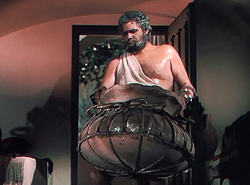
- Quo Vadis (1951) - Ursus, Lygia's bodyguard
- Two Tickets to Broadway (1951) - Sailor on Bus
- Flame of Araby (1951) - Hakim Barbarossa
- Jack and the Beanstalk (1952) - Sgt. Riley / The Giant
- The Big Sky (1952) - Romaine
- Fair Wind to Java (1953) - King
- Dream Wife (1953) - Vizier
- The Marshal's Daughter (1953) - Buddy Baer - Poker Game Player
- Jubilee Trail (1954) - Nicolai Gregorovitch Karakozeff 'Handsome Brute'
- Slightly Scarlet (1956) - Lenhardt
- Hell Canyon Outlaws (1957) - Henchman Stan
- Giant from the Unknown (1958) - Vargas the Giant
- Once Upon a Horse... (1958) - Beulah's Brother
- Snow White and the Three Stooges (1961) - Hordred
- The Magic Fountain (1961) - Big Benjamin (voice)
- The Bashful Elephant (1962) - Tavern Owner
- Ride Beyond Vengeance (1966) - Mr. Kratz (final film role)[40]
Television
[edit]In 1957, Baer appeared in an episode of television's Gunsmoke, the episode entitled, "Never Pester Chester". In 1958, Baer appeared in an episode of the syndicated Adventures of Superman TV series, playing the role of Atlas, a circus strongman, who is duped by his fellow circus performers into stealing for them. They tell him that Superman is a crook and that he can help right the Man of Steel's wrongs by doing so.
In 1958, Baer appeared in Season 1 Episode 33 of Wagon Train, “The Daniel Hogan Story”. He played a boxer nicknamed “The Tinsmith”.
Baer's other television credits included guest roles on The Abbott and Costello Show, Adventures of Superman, Captain Midnight, Cheyenne, Circus Boy, Climax!, Have Gun – Will Travel, Peter Gunn, Rawhide, Sky King, Wagon Train, Tales of the Vikings, Toast of the Town, and in the adventure series Sheena, Queen of the Jungle. Baer’s most memorable character role was, perhaps, Stobo, on the aforementioned episode of Gunsmoke.[41]
References
[edit]- ^ a b c d e f g h i "Buddy Baer Boxing Record". Boxrec. Retrieved April 3, 2020.
- ^ a b c d e f g Conlin, Bill, "Buddy Baer, The Gentle Giant of Boxing", The Sacramento Bee, Sacramento, California, pg. 35, 15 July 1986
- ^ "Buddy Baer, Ex-Boxer, Dies; Lost Two Fights to Joe Louis". The New York Times (National ed.). July 20, 1986. p. 1001022.
- ^ The Jewish Boxer's Hall of Fame, Blady, Ken, (1988) Shapolsky Publishers, Inc., New York, NY, pgs. 208-9.
- ^ a b c "Nice Guy Boxer Buddy Baer Dies", Sacramento Bee, Sacramento, California, pg. 3. 19 July 1986
- ^ "Buddy Baer Beaten", The Boston Globe, Boston, Massachusetts, pg. 27, 11 January 1935.
- ^ Ward Charles, "Champion Baer Clowns Four Rounds", Detroit Free Press, Detroit, Michigan, pg. 13, 5 January 1935
- ^ Down five times in the first in "Buddy Baer Beats O'Dowd", The Tampa Tribune, Tampa, Florida, pg. 15, 5 January 1935.
- ^ "Buddy Baer Puts Connolly Out in Opening Round", The Hanford Sentinel, Hanford, California, pg. 6, 21 Mar 1935.
- ^ "Baer Gains Another Knockout", Times Union, Brooklyn, New York, pg. 11, 19 July 1935.
- ^ "Buddy Knocks Out Delaney in Fourth Round", The Tampa Tribune, Tampa, Florida, pg. 13, 19 July 1935.
- ^ "Joe Louis Kayoes Maxie Baer", Santa Cruz Sentinel, Santa Cruz, California, pg. 7, 25 September 1935.
- ^ Four of six rounds in "Buddy Baer is Given Licking", Stockton Independent, Stockton, California, pg. 6, 25 September 1935.
- ^ "Montana Boy Too Smart, Fast", The San Francisco Examiner, San Francisco, California, pg. 22, 25 September 1935.
- ^ "Max's Brother Fails to Land Damaging Blow", The Press Democrat, Oakland, California, pg. 4, 23 April 1936.
- ^ "Buddy Baer Wins", El Paso Times, El Paso, Texas, pg. 8, 25 May 1937.
- ^ "Buddy Baer Stops Wilde in Fourth", Star-Phoenix, Saskatoon, Saskatchewan, Canada, pg. 18, 7 May 1937.
- ^ Down for count of five in fourth in "Buddy Baer Halts Welsh Rival", The Salt Lake Tribune, Salt Lake City, Utah, pg. 26, 7 May 1937.
- ^ "Prelim Kayo to Balsamo", Democrat and Chronicle, Rochester, New York, pg. 21, 31 August 1937.
- ^ Simon was down in third in "Buddy Baer Checks Abe Simon in Third", Boston Globe, Boston, Massachusetts, pg. 11, 31 August 1937.
- ^ Conrad, Harold, "Barlund's KO Yields Answer on Young Giant", The Brooklyn Daily Eagle, Brooklyn, New York, pg. 11, 5 Mar 1938
- ^ Mahon, Jack, "Barlund Knocks Out Buddy Baer in the Seventh", Daily News, New York, New York, pg. 92, 5 March 1938.
- ^ Cordero, Tony, Round-by-Round, The Des-Moines Register, Des-Moines, Iowa, pg. 8, 31 October 1930
- ^ "Buddy Baer Gets Decision in Des Moine Over Savold", The Sacramento Bee, Sacramento, California, pg. 16, 31 October 1939
- ^ "Savold Beaten But Wins Followers", The Des-Moines Tribune, Des-Moines, Iowa, pg. 15, 31 October 1939
- ^ "Buddy Baer Takes TKO over Mann", Napa Journal, Napa, California, pg. 5, 4 May 1940.
- ^ Cohen, Art, "Cohn-ing Tower, A Cruel Inhuman Sight", Oakland Tribune, Oakland, California, pg. 13, 18 December 1940.
- ^ "Buddy Baer Loses Nod to Blunt", News Pilot, San Pedro, California, pg. 6, 16 January 1941
- ^ Buddy Baer Takes Beating", Ventura County Star-Free Press, Ventura County, California, pg. 10, 16 January 1941.
- ^ "Buddie Baer is Handed Terrific Walloping By Eddie Blunt in Bay Bout", The Sacramento Bee, Sacramento, California, pg. 20, 16 January 1941.
- ^ "Buddy Baer Forces Tony Galento to Quit", The Los Angeles Times, Los Angeles, California, pg. 25, 9 April 1941
- ^ Buddy Baer Stops Tony, "Democrat and Chronicle", Rochester, New York, pg. 25, 9 April 1941.
- ^ The Bell rang after the last blow in the sixth in McCann, Dick "No Reversal of Fight Verdict", Daily News, New York, New York, pg. 395, 25 May 1941.
- ^ The last hit came after the bell in Considine, Bob, "Buddy Baer Seen Dethroning Louis", Democrat and Chronicle, New York, New York, pg. 21, 25 May 1941.
- ^ Cuddy, Jack, "Right-hand Blow Finished Buddy", Democrat and Chronicle, pg. 17, 10 January 1942.
- ^ a b "Donner, and Walters, "Buddy Baer, Who Knocked Joe Louis Out of the Ring in '41, Has Finally Landed on His Own Feet"". People Magazine, vol. 6, no. 13. Retrieved April 3, 2020.
- ^ "BoxRec: Buddy Baer".
- ^ Zezzo, Mickey, "Fighter-Singer-Actor Buddy Baer was a Fiddler on the Roof Rich Man at Heart", Dayton Daily News, Dayton, Ohio, pg. pg. 30, 27 July 1986
- ^ "Buddy Baer Dies", San Francisco Examiner, San Francisco, California, pg. 20, 19 July 1986
- ^ All films listed, but in different order in "Buddy Baer Filmography". IMDb. Retrieved May 3, 2020.
- ^ "Never Pester Chester", episode of Gunsmoke originally broadcast November 16, 1957. Internet Movie Database (IMDb), a subsidiary of Amazon.com, Seattle, Washington. Retrieved August 7, 2017.
External links
[edit]

- Buddy Baer at IMDb
- Boxing record for Buddy Baer from BoxRec (registration required)
- Baer Stops Galento in Seventh, Tony Claiming Broken Left Hand
- Louis Wins in Seventh Round When Buddy Baer Is Disqualified by Referee
- Louis Scores First-Round Knockout Over Buddy Baer in Charily Encounter; Louis Pounds Baer to Canvas Twice for 9-Counts Before Finishing Him in 2:56

Buddy Baer
View on GrokipediaEarly life
Birth and family background
Jacob Henry Baer, known as Buddy Baer, was born on June 11, 1915, in Denver, Colorado.[4][5] He was the son of Jacob Baer, a German immigrant and non-practicing Jew born in 1875 who worked as a butcher and laborer, and Dora Bales, born in 1878 of Scottish descent.[6][7][8] The Baer family had relocated from Omaha, Nebraska—where Buddy's older brother Max was born in 1909 and older sister Frances in 1905—to Denver, Colorado, prior to Buddy's birth, then moved to Durango shortly afterward.[4] Buddy was the younger brother to Max, who later became world heavyweight champion, and Frances May Baer (1905–1991), as well as the older brother to sister Bernice Jeanette Baer (1911–1987).[6][9] The family also included an adopted son, August Silva.[10] Raised in a working-class environment amid the economic challenges of early 20th-century America, Buddy grew up influenced by his father's manual labor in the meatpacking and ranching trades, which shaped the family's modest circumstances in rural Colorado.[4][11] From a young age, Buddy exhibited remarkable physical attributes, including exceptional height and a robust build that would eventually contribute to his adult stature of approximately 6 feet 7 inches.[5][12] His brother Max's rising fame in boxing served as an early motivator for Buddy's interest in sports.[4]Entry into boxing
Buddy Baer's interest in boxing was sparked by the success of his older brother, Max Baer, who became the world heavyweight champion in June 1934. After the family's relocation to California in 1922, Buddy observed Max's rise in the sport, which motivated him to pursue boxing himself around the age of 18.[4] The family boxing legacy, particularly Max's achievements, played a key role in drawing Buddy toward the ring as a way to emulate his sibling's path.[1] Although Buddy had no formal amateur boxing experience, he began developing his skills through informal training and sparring sessions, where local mentors guided his initial efforts in the sport.[4] These early encounters highlighted his physical advantages, including a towering height of 6 feet 6 inches and exceptional natural punching power, which quickly became evident during sparring and helped build his confidence.[4] His robust physique, honed from ranch work on the family property after their move to Livermore, California in 1922, further complemented his budding abilities in the squared circle.[4] Facing economic hardships amid the Great Depression, Buddy decided to turn professional in 1934 at the age of 19, seeking financial stability through boxing as opportunities in other fields were limited.[4] This transition marked the end of his preparatory phase and the start of a career under trainer Izzy Klein and manager Ancil Hoffman, leveraging his innate strengths to compete at the highest levels.[4]Boxing career
Professional debut and early bouts
Buddy Baer made his professional boxing debut on September 23, 1934, defeating Tiny Abbott by first-round knockout in Eureka, California.[13] This quick victory highlighted his raw punching power against minor opponents, setting a tone for his early career as a heavyweight contender.[4] In his initial years, Baer rapidly built an impressive record, securing approximately 20 wins by the end of 1935, the majority by knockout, often in the opening rounds.[4] He faced regional heavyweights on the West Coast circuits, including knockouts over opponents like Max Brown, Jack Petric, and Corn Griffin, demonstrating his ability to overwhelm lesser-known fighters with explosive force.[13] His first loss came on January 10, 1935, to Babe Hunt, but Baer rebounded with additional stoppages, such as against Tommy Davenport.[13] A notable early bout occurred on September 24, 1935, when he dropped a six-round decision to Ford Smith at Yankee Stadium in the Bronx, marking one of his few early setbacks against a more experienced regional opponent.[13] Baer's fighting style was aggressive and power-oriented, leveraging his towering 6-foot-6 frame and long reach to deliver devastating punches that led to 13 straight knockouts in his first 13 fights, nine of which ended in the first round.[4] Born in Denver, Colorado, he honed his skills in local gyms, drawing brief influence from his brother Max Baer's training techniques during the early phases of his development.[4] This approach allowed him to establish momentum against West Coast heavyweights, positioning him for greater challenges ahead.[13]Rise to contention and key matches
Baer's ascent in the heavyweight ranks gained momentum in the late 1930s following a significant setback against Finnish contender Gunnar Barlund on March 4, 1938, at Madison Square Garden in New York. Despite entering as a heavy favorite due to his imposing 6-foot-6½-inch frame and 43-pound weight advantage, Baer was outboxed and stopped by technical knockout in the seventh round after absorbing punishing body shots and a final right hand that left him unable to continue.[14] This loss highlighted tactical vulnerabilities in Baer's defense against skilled infighters, though his early career power—demonstrated in quick knockouts during his debut phase—remained a cornerstone of his style.[2] Rebounding strongly, Baer compiled an impressive string of victories in 1939 and 1940 that showcased his knockout prowess and elevated his standing among top heavyweights. Notable among these was a unanimous decision win over the durable Lee Savold on October 30, 1939, in Des Moines, Iowa, where Baer floored his opponent in the first round en route to dominating the 10-round bout. He followed with a seventh-round technical knockout of Nathan Mann on May 3, 1940, at Madison Square Garden, dropping the veteran twice in the decisive round to force Mann's retirement due to punishment. Another highlight came against Harold Blackshear on December 17, 1940, in Oakland, California, where Baer secured a third-round technical knockout, underscoring his ability to finish ranked opposition swiftly. These triumphs, part of a broader streak including quick stoppages of lesser-known foes like Al Massey and Sandy McDonald, positioned Baer as a legitimate contender in a division dominated by Joe Louis, who held the world title unchallenged since 1937. A brief stumble occurred on January 15, 1941, when Baer dropped a 10-round points decision to Eddie Blunt at the Oakland Auditorium, marking one of his rare defeats against non-elite opposition. Blunt's aggressive swarming tactics exploited Baer's tendency to fight tall and upright, landing repeated hooks to the body and head while Baer struggled to utilize his reach effectively.[15] Despite this tactical lapse, Baer's overall momentum carried forward, highlighted by a seventh-round technical knockout victory over contender Tony Galento on April 8, 1941, in Washington, D.C., earning him a No. 7 ranking in the heavyweight division by mid-1941 and bouts in premier venues like Madison Square Garden, where he competed amid Louis's reign of frequent title defenses.[16][17]World heavyweight title challenges
Buddy Baer's initial bid for the world heavyweight championship occurred on May 23, 1941, against reigning champion Joe Louis at Griffith Stadium in Washington, D.C.[18] The towering challenger, at 6 feet 6 inches and 237 pounds, created an early sensation by landing a left hook that sent Louis through the ropes in the first round, drawing a crowd of 23,912.[19] Louis, however, quickly regained composure and unleashed a barrage, flooring Baer twice in the sixth round and once more after the bell, which sparked controversy. In the seventh round, Baer's handlers refused to let him continue, resulting in a disqualification victory for Louis.[18] The disputed finish, amid claims of a late punch, prompted calls for a rematch, which materialized on January 9, 1942, at Madison Square Garden in New York City.[19] Baer, now weighing 250 pounds, entered after a brief training camp focused on bolstering his power punching under the guidance of his brother, former champion Max Baer, at Pompton Lakes, New Jersey.[20] Yet, Louis's exceptional hand speed and precise combinations overwhelmed Baer from the outset; a devastating right hand followed by hooks dropped him twice, leading to a first-round knockout at 2:56 before a crowd of 19,000.[21] These back-to-back defeats against the unbeaten Louis marked the pinnacle and swift conclusion of Baer's title aspirations, as his reliance on raw power failed to counter the champion's technical superiority.[19] Following the rematch—his final professional bout—Baer retired from boxing and enlisted in the U.S. Army as World War II escalated.[1]Professional record and retirement
Buddy Baer's professional boxing record is documented as 58 wins, 7 losses, and 53 knockouts according to BoxRec and The Ring magazine records.[2][22] Unofficial tallies vary, with some accounts listing different figures, reflecting differences in how certain exhibition or disputed bouts are classified.[4] His career spanned from 1934 to 1942, during which he demonstrated formidable punching power, particularly in the heavyweight division. The breakdown of his record by outcome method highlights his knockout prowess:| Outcome Method | Wins | Losses |
|---|---|---|
| KO/TKO | 53 | 2 |
| Decision | 5 | 5 |