Hubbry Logo
Bugatti EB 112Bugatti EB 112Main
Open search
Bugatti EB 112
Community hub
Bugatti EB 112
logo
8 pages, 0 posts
0 subscribers
Be the first to start a discussion here.
Bugatti EB 112
Bugatti EB 112
from Wikipedia
Bugatti EB 112
Overview
ManufacturerBugatti Automobili S.p.A.
Production
  • 1993 (first prototype)
  • 1998 (later examples)[1]
Assembly
  • Italy: Modena (first prototype)
  • Monaco (later examples)
DesignerGiorgetto Giugiaro at Italdesign
Body and chassis
ClassConcept full-size luxury car (F)
Body style4-door fastback saloon
LayoutFront-engine all-wheel-drive
Related
Powertrain
Engine6.0 L Bugatti V12
Transmission6-speed manual
Dimensions
Wheelbase3,100 mm (122.0 in)
Length5,070 mm (199.6 in)
Width1,960 mm (77.2 in)
Height1,405 mm (55.3 in)
Kerb weight1,800 kg (3,968 lb)
Chronology
PredecessorBugatti Type 57
SuccessorBugatti EB 218

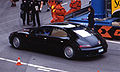
The Bugatti EB 112 is a concept 4-door fastback saloon presented by Bugatti Automobili S.p.A. in 1993. Giorgetto Giugiaro of Italdesign was responsible for designing the car.[2] The EB 112 features a 456 PS (335 kW; 450 hp) V12 engine and permanent four-wheel drive system.

Design

[edit]

Bugatti S.p.A. commissioned Giorgetto Giugiaro of Italdesign to create a full-size saloon version of the EB 110 sports car. The result was the EB 112, which was a retro-styled four-door fastback saloon reminiscent of older Bugatti models, such as the well-known Type 57 Galibier. The body was made entirely of aluminium, with a carbon-fibre chassis shared with the EB 110.

Powertrain

[edit]

Power comes from a V12 engine generating a power output of 456 PS (335 kW; 450 hp) and 479 lb⋅ft (649 N⋅m) of torque. The engine featured 5 valves per cylinder, and has a displacement of 6.0-litres opposed to the EB110's 3.5-litres. The engine is placed behind the front wheels, more towards the center of the car inside of the wheelbase to have a much better weight distribution. The EB 112 features permanent all-wheel drive. The car can accelerate from 0–100 km/h (62 mph) in 4.3 seconds and has a claimed top speed of 300 km/h (186 mph).[3]

Production

[edit]

Bugatti debuted the EB 112 in March 1993, at the Geneva Motor Show. It received mixed reviews due to its unconventional design. However, Automobile magazine had named the car "The most beautiful car in the world" when it was introduced.[3]

Since the Bugatti EB 112 was a concept car, the development was undertaken in the factory and the show car was completed on the assembly line. When Bugatti Automobili S.p.A. went bankrupt in 1995, some assets of the company were purchased by businessman Gildo Pallanca Pastor. The assets included spare parts and three unfinished EB 112 saloons. Two of those were completed in 1998 by his firm Monaco Racing Team located in Monaco. One car was finished in Black exterior colour and the other was finished in Anthracite colour.[1][4][5] Each of the three cars are slightly different, as the red car has bumper integrated taillights opposed to having them placed above the rear bumper on the other cars. The blue design study (repainted in the same red as the working prototype)[6] differs from the others because it has more aerodynamic enhancements, such as a subtle front splitter and a rear lip spoiler just below the rear window.

The EB 112 had several cars meant to be an evolution of its 4-door design. The first is the EB 218, with a W18 engine and larger dimensions. The second was the 16C Galibier, a concept luxury saloon conceived and developed in 2009.

Owners

[edit]

A black EB 112 (s/n 39003), once owned by Gildo Pallanca Pastor, the current CEO and owner of the French car company Venturi, was spotted being driven around in Monaco in 2013. The car was sold to Marc Gindorf, a German collector in Monaco in 2016.[1][7] The first working prototype (red, s/n 39001) is owned by Italdesign while a third car finished in dark Anthracite exterior colour was sold to a Russian individual by Pastor's firm, Monaco Racing Team, which completed the car.[8] Today the black EB 112 is the only car out of the three, which is totally homologated.

The s/n 39002 was sold in 2021.[9]

References

[edit]
[edit]
Revisions and contributorsEdit on WikipediaRead on Wikipedia
from Grokipedia
The EB 112 is a unveiled by Bugatti Automobili S.p.A. at the 1993 Motor Show, representing the company's ambitious vision for a four-door luxury sedan that blended retro styling with performance. Designed by renowned Italian stylist of Italdesign, it featured an all-aluminum body constructed over a carbon fiber monocoque chassis shared with the EB 110 , evoking the elegant lines of the pre-World War II SC Atlantic while introducing a new "Berline-Coupé" segment for high-performance saloons. Powered by a naturally aspirated 6.0-liter (5,994 cc) with 60 valves, the EB 112 delivered 460 horsepower at 6,300 rpm and 590 Nm (435 lb-ft) of torque at 3,000 rpm, paired with a six-speed and permanent all-wheel drive (38% front, 62% rear distribution). This setup enabled impressive performance, including a 0-100 km/h (0-62 mph) acceleration time of 4.3 seconds and a top speed of 300 km/h (186 mph), all within a vehicle measuring 5,070 mm in length and weighing approximately 1,750 kg (3,858 lbs). Development of the EB 112 began in the early 1990s under Bugatti Automobili S.p.A., founded in 1987 by Italian entrepreneur Romano Artioli to revive the historic French marque, with the car positioned as a more practical companion to the mid-engine EB 110 sports car. The design incorporated nostalgic elements like the signature horseshoe grille—which later influenced the Bugatti Veyron—and chrome accents, while modern features included independent double-wishbone suspension, ventilated disc brakes, and a luxurious interior with leather upholstery and wood trim. Although initially met with mixed reviews for its unconventional four-door layout on a supercar platform, the EB 112 was later hailed as "the most beautiful car in the world" by Automobile Magazine and recognized as a visionary project that pioneered the fusion of grand touring comfort with extreme engineering. Only three prototypes were ultimately built between 1993 and 1998, with assembly handled in Modena, Italy, and completion of two units by the Monaco Racing Team after Bugatti's bankruptcy in 1995 derailed production plans originally slated for 1996. The EB 112's legacy endures as a spiritual predecessor to modern hypercars like the Veyron and , demonstrating the brand's early commitment to blending heritage-inspired aesthetics with cutting-edge technology in the luxury performance segment. The three surviving prototypes remain privately owned, with one retained by Italdesign, and have been occasionally displayed at events to celebrate the model's 30th anniversary in 2023.

Development

Project background

In the late 1980s, Italian entrepreneur acquired the rights to the marque and founded Automobili S.p.A. in 1987, aiming to revive the historic French brand with a focus on high-performance luxury vehicles. This revival marked the first major effort to resurrect since its decline after , establishing a new Italian-based operation in Campogalliano near to produce modern interpretations of the brand's engineering legacy. The EB 112 project was initiated in the early 1990s, shortly after the 1991 debut of the EB 110 , as a strategic expansion to offer a four-door luxury sedan that would complement the two-seater in Bugatti's lineup. Artioli envisioned the EB 112 as a grand touring saloon capable of blending supercar performance with practical elegance for affluent buyers seeking versatile high-end transport. The concept made its public debut at the 1993 , where it was presented as a bold demonstration of Bugatti's ambitions to enter the segment of performance-oriented luxury sedans beyond pure supercars. This unveiling highlighted the brand's intent to diversify its portfolio while maintaining its reputation for innovation and exclusivity. Drawing inspiration from Bugatti's pre-war heritage, particularly the Type 57 models like the Galibier and SC Atlantic, the EB 112 sought to modernize the marque's tradition of luxurious, performance-driven grand tourers. Artioli commissioned for the styling, ensuring the project echoed the timeless aesthetics of Ettore Bugatti's era in a contemporary context.

Design process

The design of the Bugatti EB 112 was led by renowned Italian designer through his firm Italdesign, which was commissioned to create a retro-futuristic 4-door saloon that honored the brand's heritage while incorporating modern aesthetics. Giugiaro and his team began by closely analyzing historic Bugatti saloons from the 1920s and 1930s, such as the Type 57 SC Atlantic, Type 55, Type 32 Tank, and Type 57 Tank, to reinterpret their classic lines with sinuous, flowing forms and creative freshness. This collaboration stemmed from Romano Artioli's vision to expand Bugatti's lineup into luxury sedans without diluting the marque's prestige. Key inspirations drew from the elegance of 1930s models, blending their curved, sweeping bodywork and chrome accents—evident in features like the prominent horseshoe grille and a longitudinal rib running along the bonnet, roof, and rear—with 1990s aerodynamic principles to achieve a low-drag profile suitable for high-speed grand touring. The resulting styling evoked a "Berline-Coupé" form, merging nostalgic proportions with forward-looking fluidity to position the EB 112 as a landmark in saloon car design. Development commenced in 1992 with initial sketches and partnership formation between Automobili and Italdesign, progressing rapidly to the construction of the first prototype by early 1993. This timeline included iterative refinements and testing to optimize , culminating in the car's debut at the 1993 Motor Show, where it arrived under its own power. The interior emphasized opulent luxury tailored for five passengers, featuring a spacious cabin upholstered in premium with (or briarwood) accents throughout the , door panels, and center console to evoke classic refinement over aggressive sportiness. Analog instrumentation and high-tech touches, such as an integrated system with a monitor, balanced traditional craftsmanship with contemporary convenience.

Technical features

Body and chassis

The Bugatti EB 112 featured an all-aluminum body constructed over a carbon-fiber , providing a balance of lightweight construction and structural rigidity suitable for a grand touring sedan. This design was derived from the EB 110 , marking an innovative adaptation of racing-derived technology to a four-door luxury vehicle for enhanced strength without excessive weight. The resulting curb weight was approximately 1,750 kg, contributing to the car's agile handling characteristics despite its spacious interior. In terms of dimensions, the EB 112 measured 5,070 mm in length, 1,960 mm in width, 1,405 mm in height, and had a of 3,100 mm, creating a sleek profile that emphasized aerodynamic efficiency and interior room for four passengers. These proportions supported its role as a full-size luxury , with a front track of 1,667 mm and rear track of 1,656 mm for stable road presence. The suspension system employed independent double-wishbone setups at both the front and rear, paired with coil springs to deliver composed handling and grand touring comfort on varied surfaces. This configuration allowed precise wheel control, minimizing body roll during dynamic maneuvers while maintaining ride quality for long-distance travel. For braking, the EB 112 was equipped with ventilated disc brakes on all four wheels, integrated with an (ABS) to ensure high-speed stability and controlled stops under demanding conditions. The front and rear rotors measured 332 mm in diameter, providing robust dissipation of heat during repeated high-performance use. The vehicle rolled on 255/55 ZR17 tires mounted to 8.5J x 17 alloy wheels, offering a firm grip and ride compliance tailored to its all-wheel-drive platform. This tire specification supported the car's emphasis on balanced performance and luxury, with uniform sizing front to rear for even traction distribution.

Powertrain and performance

The Bugatti EB 112 featured a 6.0-liter naturally aspirated V12 engine, with a displacement of 5,994 cc and 60 valves (five per cylinder). This engine delivered 460 PS (450 hp) at 6,300 rpm and 590 Nm (435 lb⋅ft) of torque from 3,000 rpm, emphasizing smooth power delivery for grand touring. It utilized multi-point fuel injection for precise metering, contributing to reliable operation in a luxury sedan context. The power was routed through a six-speed to a permanent all-wheel drive system, configured in a front-engine layout with a 38% front, 62% rear distribution favoring the rear for enhanced dynamics. This drivetrain evolved from the EB 110's technology, prioritizing traction and balance over outright aggression. The exhaust system incorporated quad tailpipes, tuned to produce a refined V12 exhaust note that aligned with the vehicle's luxury sedan aspirations. Performance metrics highlighted the EB 112's capabilities, with 0-100 km/h acceleration in 4.3 seconds and a governed top speed of 300 km/h (186 mph). Fuel consumption was estimated at 15-20 L/100 km in combined driving, reflecting the engine's thirst in urban and highway scenarios. The powertrain's integration supported near-ideal , aiding stability during high-speed travel.

Production and prototypes

Manufacturing history

The initial prototype of the Bugatti EB 112, chassis number 39001 finished in red, was assembled at the factory in , , and unveiled at the 1993 Motor Show. This sole completed example at the time featured an aluminum body over a carbon-fiber shared with the EB 110 supercar, intended as a showcase for a luxury four-door sedan with a 6.0-liter producing 460 horsepower. Bugatti Automobili S.p.A. declared in September 1995 amid severe financial difficulties, leading to the company's and halting all development and production plans for the EB 112. The project had envisioned series production starting in late 1994, with an intended annual output of around 300 units priced over $1 million each, but economic challenges and the high development costs derailed these ambitions. Following the liquidation, Bugatti's assets—including unfinished EB 112 chassis, bodies, and spare parts from the original inventory—were acquired by , owner of the Monaco Racing Team. In 1998, his team completed two additional prototypes using these stored components: chassis number 39002 in dark anthracite and chassis number 39003 in black, both assembled in . These efforts marked the end of EB 112 manufacturing, resulting in a total of only three vehicles ever built, with no further series production due to the persistent economic fallout from the .

Surviving examples and ownership

Only three Bugatti EB 112 prototypes were ever completed, each preserving the model's unique blend of luxury sedan design and engineering following the company's 1995 bankruptcy. These vehicles, assembled using assets acquired by entrepreneur , including spare parts from the EB 110 program, represent the entirety of the EB 112's physical legacy. All three have been meticulously maintained in near-original condition, with occasional servicing drawing on EB 110 supplier networks to ensure drivability while minimizing alterations. The red prototype, bearing serial number 39001, was constructed by Italdesign Giugiaro and debuted at the 1993 Geneva Motor Show. Retained by Italdesign since its completion, it has served primarily as a display piece at automotive events and the designer's facilities, with limited road use to preserve its originality. As of 2023, it remains in Italdesign's collection in Italy, occasionally featured in exhibitions celebrating Bugatti's history. The anthracite prototype, serial number 39002, was finalized by the Monaco Racing Team in early 2000 using incomplete assets from the original project. Delivered to Swiss Bugatti importer Chevalley S.A. and registered in in February 2003, it accumulated just 3,900 km under believed single ownership before being offered for sale in 2021 through German dealer Schaltkulisse. Prior reports indicated private ownership by a Russian collector in the early , though its low-mileage status and fully operational condition persisted through the listing, which highlighted its rarity without a reserve price. No confirmed sale occurred by late 2021, and its whereabouts remain private as of 2025, with the vehicle recently photographed in January 2025. The black prototype, serial number 39003, also completed by the Monaco Racing Team, entered the collection of , who personally drove it in during the mid-2010s. With under 1,000 km on the , it was auctioned at Artcurial Motorcars in in 2016, selling for €1.98 million to German collector Marc Gindorf. Gindorf has since maintained it in roadworthy condition, with sightings confirming its use at events like the 2019 Pebble Beach Concours d'Elegance and occasional drives in as recently as 2024. Due to their extreme rarity and , the EB 112 prototypes have seen steady valuation appreciation, estimated at $2-3 million each as of 2023, reflecting broader market growth in pre-VW collectibles. The 2016 sale of the black example set a benchmark, while the 2021 listing for the anthracite car underscored demand, with experts noting a 50% increase in comparable values over the prior five years. Preservation efforts, including non-invasive maintenance, continue to support their appeal among high-end collectors.

Legacy and influence

Impact on future Bugatti models

The Bugatti EB 218 concept, introduced in 1999 shortly after Group's acquisition of the brand, directly evolved from the EB 112 by refining its four-door sedan architecture into a more imposing luxury saloon. Designed once again by at Italdesign, the EB 218 retained the EB 112's emphasis on grand touring versatility while integrating 's newly developed , producing 547 horsepower for enhanced performance in a similar profile. The EB 112's engineering innovations, including its carbon fiber monocoque chassis and permanent all-wheel-drive system with a 38/62 front/rear split, foreshadowed technical advancements in later production models. These elements contributed to the lightweight, high-grip platforms seen in the Veyron and , where carbon fiber construction and AWD became hallmarks for balancing extreme speed with luxury usability in variants. By demonstrating Bugatti's capability for opulent, performance-oriented sedans, the EB 112 underscored a strategic pivot toward versatile grand tourers, which influenced Volkswagen's 1998 acquisition and the brand's revival through hypercar-focused development. This direction emphasized singular, high-impact projects like the over broader lineups, aligning with the group's resources for global prestige. The EB 112's unrealized path to production, halted by Automobili SpA's 1995 , offered critical insights into financial risks, shaping Volkswagen's risk-averse strategy in the by concentrating investments on proven hypercar concepts rather than untested luxury expansions.

Cultural and collector significance

The EB 112 garnered significant media attention upon its unveiling at the 1993 Geneva Motor Show, where it was hailed as a "what if" for a luxury super sedan, blending retro styling with cutting-edge in a manner that captivated automotive journalists. Reviews emphasized its role as a bold proposition for a four-door , positioning it as an icon of potential unfulfilled paths in high-end . In 2023, marked the model's 30th anniversary with an official retrospective, underscoring its enduring influence as a pioneer that anticipated the evolution of performance saloons. The EB 112 has appeared in select exhibitions, highlighting its status as a milestone. One is housed in the Italdesign museum collection, where it stands alongside other notable concepts, allowing enthusiasts to appreciate its fluid, retro-inspired form up close. Its extreme rarity—limited to just three —fuels intense collector interest, with examples occasionally surfacing in high-profile sales that underscore demand among aficionados of obscure history. This scarcity elevates it to the level of other legendary unproduced concepts, evoking the allure of automotive experiments that capture the imagination of preservationists. In contemporary culture, the EB 112 symbolizes the opulent excess of automotive ambition, with its lavish V12 power and aluminum silhouette reflecting an era of unrestrained innovation. It has inspired virtual representations, appearing as a custom luxury sedan in the CGI sequences of and its related film Kingsglaive: Final Fantasy XV. Additionally, manufacturers have produced detailed replicas, such as 1:43 kits from Provence Moulage, catering to collectors who value its hypothetical grandeur.

References

Add your contribution
Related Hubs
User Avatar
No comments yet.