Hubbry Logo
Bugatti EB 218Bugatti EB 218Main
Open search
Bugatti EB 218
Community hub
Bugatti EB 218
logo
8 pages, 0 posts
0 subscribers
Be the first to start a discussion here.
Bugatti EB 218
Bugatti EB 218
from Wikipedia
Bugatti EB 218
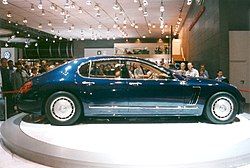
Bugatti EB 218 at the 1998 IAA
Overview
ManufacturerBugatti Automobiles S.A.S.
Production1999
DesignerGiorgetto Giugiaro at Italdesign
Body and chassis
Classconcept car
Body style4-door saloon
LayoutFront-engine, all-wheel-drive
Related
Powertrain
Engine6,250 cubic centimetres (381 cu in), 72 Valve W18
Power output555 brake horsepower (414 kW) @ 6800 RPM
479 pound force-feet (649 N⋅m) @ 4000 rpm
Transmission5-speed automatic
Dimensions
Wheelbase3,000 mm (118.1 in)
Length5,349 mm (210.6 in)
Width1,989 mm (78.3 in)
Height1,455 mm (57.3 in)
Curb weight2,177 kg (4,799 lb)
Chronology
PredecessorBugatti EB 112
SuccessorBugatti 16C Galibier

The Bugatti EB 218 saloon is the second concept car presented by Bugatti under the ownership of the Volkswagen Auto Group. The EB 218 was designed by Giorgetto Giugiaro, who also designed the EB 112, the car's predecessor and the EB 118, the car's 2-door variant.[1] The EB 218 can be considered as an update of the EB 112, a concept saloon introduced by Bugatti Automobili SpA in 1993. The EB 218 features Volkswagen's unconventional W18 engine and permanent four-wheel drive borrowed from the Lamborghini Diablo VT.

Design

[edit]
The design of the EB 218 draws inspiration from the Bugatti Type 101 Guillore 4-door saloon
EB 218 interior

Bugatti commissioned Giorgetto Giugiaro of Italdesign to update the EB 112 concept that he designed for Bugatti Automobili SpA in 1993. The EB218's wheelbase measures 3 m (118.1 in) and it has a total length of 5,385 mm (212.0 in). This makes the EB 218 longer than the EB 112 by 315 mm (12.4 in). The most notable visual differences between the EB 218 and the EB 112 is a redesigned hood, bumpers and lights. The overall design is far less controversial[citation needed] than the EB 112's "Droopy hatchback-saloon" design and has a much more of a typical saloon shape rather than the EB 112's hatchback shape. The interior design is very simple yet extremely luxurious, with beige leather seats and a large wooden dashboard which manages to keep all the instruments and vents "composed". The EB 218 draws inspiration from the classic Type 101 Guillore.

Debut

[edit]

Bugatti introduced the EB 218 at the 1999 Geneva Motor Show,[2] one year after its 2-door counterpart was introduced at the 1998 Paris Auto Show.

Powertrain

[edit]

The EB 218 uses the same W18 engine and permanent four wheel drive powertrain that debuted in the 1998 EB 118. The same technology was used in the 1999 18/3 Chiron concept car.

Power comes from a Volkswagen-designed, 563 PS (414 kW; 555 hp) and 479 lb⋅ft (649 N⋅m), W18 engine. This engine design was extremely unconventional due to the unusual firing order of the engine. The EB 218 W18 engine is composed of three banks of six cylinders with a sixty degree offset between each cylinder bank. In contrast, the W16 engine in Bugatti's (Under Volkswagen ownership) first production car, the 2005 Veyron EB 16.4 features two banks of 8 cylinders, it is basically two W8 engines. The Volkswagen W16 engine is not the same as W engines from the pre war cars or the W18. The Volkswagen W16/W12/W8 engines are actually two banks of VR engines. In the case of the later Veyron they took the W12 from Bentley, which is two times VR6, chopped of 4 cylinders to make a W8 and then doubled that. Note that the W18 was actually a "real" W engine with 3 banks of 6 cylinders. The EB 218 has the permanent all-wheel drive taken from the Lamborghini Diablo VT sports car.

References

[edit]
[edit]
Revisions and contributorsEdit on WikipediaRead on Wikipedia
from Grokipedia
The EB 218 is a luxury four-door saloon developed by Automobili under ownership and designed by , unveiled at the 1999 Motor Show as an evolution of the 1993 EB 112 prototype, powered by a 6.3-liter naturally aspirated producing 555 horsepower but never advancing to production. Measuring 5,375 mm in length with a 118-inch , the EB 218 featured a front-engine layout, permanent all-wheel drive derived from the VT, and a five-speed , emphasizing versatility for a high-performance luxury sedan. Its exterior design incorporated revised curvatures for the bumpers, headlights, and bonnet to accommodate the W18 engine's packaging, while the interior drew on influences with plush leather, wood veneers, and Alcantara for a focus on comfort and craftsmanship. The EB 218 played a key role in Bugatti's early revival under , acquired in , by demonstrating the W18 engine's adaptability beyond coupes into larger saloon formats and paving the way for technologies later refined in the Veyron. With an estimated top speed of around 155 mph and 0-60 mph acceleration in approximately 4.5 seconds, it highlighted the brand's ambition for ultra-luxury performance vehicles, though it remained a non-production "dream car" ready for series output in concept form.

Development

Background

The Volkswagen Group acquired the Bugatti brand in 1998, marking a significant revival of the historic marque after its previous independent attempt under Romano Artioli had faltered due to financial difficulties in the mid-1990s. This acquisition provided Bugatti with substantial resources and engineering expertise, enabling the development of new concept vehicles to redefine the brand's future. The EB 218 emerged as the second concept car under Volkswagen's ownership, following the EB 118 coupe unveiled in 1998, which introduced the innovative W18 engine concept to the public. The EB 218 served as an updated successor to the EB 112 saloon, a pioneering four-door concept originally developed in 1993 during the Artioli era as part of an independent effort to resurrect without corporate backing. With Volkswagen's involvement, the project shifted to a more structured, resource-intensive development process, allowing for refinements that aligned the saloon with the group's technological ambitions while honoring Bugatti's grand touring heritage. This transition from an autonomous revival to VW-supported innovation underscored the marque's evolution toward sustainable luxury production. Drawing inspiration from historical models, particularly the Type 101 Guillore saloon of the 1950s, the EB 218 aimed to blend classic proportions with contemporary engineering to revive the brand's saloon legacy. Development of the EB 218 was initiated shortly after the acquisition and finalized for its public reveal in 1999, positioning it as a key step in Volkswagen's vision for Bugatti's resurgence.

Design Process

The design process for the Bugatti EB 218 began in 1998 when , having recently acquired the brand, commissioned to reinterpret and update the EB 112 concept originally created by the firm in 1993. Lead designer oversaw the refinements, focusing on enhancing the saloon's proportions and aesthetics to align with Volkswagen's vision for a modern luxury while preserving 's heritage. This collaboration emphasized iterative development under Volkswagen's oversight, transforming the EB 112's more compact form into a larger, more imposing presence suitable for a flagship sedan. Key iterative changes included lengthening the body from the EB 112's 5,070 mm to 5,375 mm, which improved the overall stance and interior space for enhanced luxury appeal. Giugiaro also adjusted the curvature of the bumpers, headlights, and bonnet to create a more fluid and contemporary aesthetic, refining the EB 112's lines for better aerodynamic flow and visual harmony. These modifications were developed through close coordination between Italdesign's styling team and engineers, ensuring the design balanced artistic expression with production feasibility. Engineering contributions from the integrated advanced technical elements, notably adapting the permanent all-wheel-drive system from the VT to handle the saloon's power delivery and provide superior traction. Material selections prioritized performance and opulence, with aluminum employed for the body panels and space-frame structure to reduce weight while maintaining structural integrity and a premium finish. This approach underscored the process's emphasis on lightweight construction to enhance the EB 218's dynamic capabilities as a luxury vehicle.

Design

Exterior Styling

The EB 218 features a four-door saloon configuration with a well-balanced, elegant shape that reinterprets classic aesthetics in a modern context, drawing inspiration from the brand's designs through curvaceous fenders and a roofline that evokes the fluidity of pre-war models like the Type 57. Designed by at Italdesign, the exterior emphasizes luxury and sportiness with a wide track and long wheelbase paired with short overhangs, creating a powerful yet refined stance that highlights the car's elongated proportions. The front adopts a retro-futuristic aesthetic, centered on the iconic horseshoe grille—a hallmark of heritage—flanked by rounded, soft-edged wraparound headlight lenses positioned at the corners for a cohesive, integrated look, while the curved bonnet and bumpers contribute to smoother compared to earlier concepts. This subtly nods to elegance while incorporating contemporary fluidity, with the grille's re-proportioned curves enhancing airflow without compromising the marque's traditional visual identity. At the rear, the EB 218 presents a sloping tail that accentuates its overall and sense of stability, featuring integrated taillights that blend seamlessly into the bodywork and a subtle diffuser element for a clean, understated finish. A hidden rear spoiler deploys at higher speeds to aid , maintaining the saloon's sophisticated profile without overt aggression. The body measures 5,375 mm in , 1,990 mm in width, and 1,455 mm in height, proportions that underscore the exterior's elongated, luxurious presence while preserving a low-slung, dynamic . The debut example was finished in a pearlescent "Blu Notte Perlato" paint with chrome accents on select trim elements, enhancing the aluminum exterior panels' premium sheen and complementing the design's elegant, jewel-like detailing. This color choice, paired with wheels, reinforces the EB 218's fusion of historical motifs with forward-looking luxury saloon styling.

Interior Features

The interior of the Bugatti EB 218 adopted an Art Deco-inspired design, emphasizing opulent craftsmanship and passenger comfort to align with the brand's heritage of luxury saloons. Crafted with high-quality materials, the cabin featured light walnut wood inlays for a warm, elegant ambiance, complemented by silk-finish "" leather that framed key elements like the instrument panel. This combination evoked classic luxury while providing a refined, harmonious space for four occupants. Seating arrangements prioritized individual comfort, with four dedicated seats upholstered in the signature beige-toned . The front seats included electrically adjustable head restraints emblazoned with the EB emblem, ensuring ergonomic support for the driver and passenger. Rear seats were notably spacious and generous, incorporating integrated footrests to enhance long-journey relaxation in this concept saloon configuration. The dashboard and controls maintained a timeless aesthetic, featuring oval-shaped analog gauges set within the leather-framed panel for clear readability and a nod to traditional luxury motoring. A center console housed essential climate controls, blending seamlessly with the wooden elements, while a for navigation was cleverly integrated beneath a movable , preserving the cabin's uncluttered elegance. Steering wheel-mounted buttons facilitated sequential gear changes, allowing intuitive interaction without diverting attention from the road. Space utilization in the EB 218 benefited from its extended of 3,335 mm, which provided ample rear legroom and contributed to a practical trunk capacity suitable for a luxury four-door . This design choice maximized passenger-focused comfort, setting it apart as a versatile interior while maintaining the car's overall low curb weight for refined ride quality.

Debut and Reception

Geneva Debut

The Bugatti EB 218 was unveiled at the 1999 Geneva Motor Show in March, marking it as the brand's first four-door saloon concept following its acquisition by the . This presentation positioned the EB 218 as a flagship demonstration of Bugatti's revived luxury heritage, building on the EB 118 coupé shown the previous year at the . The concept was displayed statically on the stand, alongside other high-profile exhibits from the conglomerate, such as advanced prototypes emphasizing innovative engineering and opulent design. The exhibition highlighted the EB 218's elegant lines and premium materials, evoking Bugatti's pre-war grand touring elegance without any on-track or driving demonstrations to maintain focus on its conceptual allure. Accompanying press materials from underscored the W18 engine's adaptability, showcasing its potential not only for high-performance coupés but also for spacious luxury sedans, thereby illustrating the powertrain's versatility in diverse body styles. The debut garnered significant media interest at the event, which attracted hundreds of thousands of visitors, as it symbolized Bugatti's post-revival ambition to blend historic prestige with modern supercar technology.

Critical Response

The Bugatti EB 218 received praise for its refined styling, which addressed the polarizing aesthetics of the earlier EB 112 concept by adopting a more harmonious and production-feasible form. of Italdesign refined the design to evoke classic proportions while incorporating modern elements, resulting in a four-door saloon that balanced luxury with subtle sportiness. Critics noted the EB 218's retro-inspired design as somewhat conservative for a brand positioning itself in the hypercar segment, with its elongated and traditional sedan silhouette prioritizing elegance over aggressive dynamism. As a static without extensive on-road testing, evaluations focused on its visual and theoretical appeal rather than proven handling, limiting deeper performance critiques at the time. Automotive media provided positive coverage of the EB 218's luxury potential, with outlets like Top Gear highlighting its opulent interior as a "soft play area for the children of billionaires," featuring plush leather, walnut trim, and influences that set new benchmarks for high-end cabins. MotorTrend described it as a lavishly appointed evolution of prior studies, emphasizing its role in Volkswagen's brand revival efforts. While it garnered no major awards, the generated significant buzz, underscoring Bugatti's ambition to expand beyond two-seaters. In market terms, the EB 218 was perceived as a promising platform for a luxury sedan, aligning with Group's strategy to compete in the ultra-premium segment alongside and . However, its complexity and development costs, combined with a pivot toward the performance-oriented Veyron, prevented production, redirecting focus to hypercars instead.

Technical Specifications

Powertrain

The Bugatti EB 218 features a naturally aspirated W18 engine with a displacement of 6.3 liters (6,255 cc), configured as three banks of six cylinders in a 60-degree "W" arrangement and equipped with direct petrol injection, double overhead camshafts, and 72 valves. This engine delivers 555 PS (408 kW; 547 hp) at 6,800 rpm and 650 Nm (479 lb-ft) of torque at 4,000 rpm, providing substantial low-end pull suitable for a luxury sedan. The powertrain requires premium unleaded fuel to optimize performance and combustion efficiency. Mounted longitudinally at the front of the vehicle, the engine integrates with a permanent all-wheel drive system derived from the VT, ensuring balanced traction distribution across all wheels. This layout highlights the powertrain's adaptability for sedan versatility while maintaining high-performance dynamics. The incorporates four tailpipes to produce a distinctive, resonant sound that underscores the engine's character. Power is transmitted through a 5-speed automatic gearbox with electronic controls, sourced from technology to enable smooth shifts and reliable operation under demanding conditions. As a , specific figures were projected but not finalized through production testing.

Chassis and Dimensions

The Bugatti EB 218 employed an aluminum spaceframe chassis, which provided a lightweight yet rigid foundation essential for superior handling and structural integrity in a high-performance luxury sedan. This construction technique balanced weight reduction with durability, contributing to the vehicle's grand touring capabilities. The suspension consisted of an aluminum multi-link setup at both the front and rear axles, designed to deliver precise wheel control, enhanced ride comfort, and responsive dynamics under varied conditions. Complementing this was a permanent all-wheel-drive adapted from the VT, ensuring optimal traction and stability for the EB 218's substantial power output. Key dimensions underscored the sedan's elongated, stable profile: a of 3,335 mm supported balanced and interior spaciousness, while the overall length measured 5,375 mm, width 1,990 mm, and height 1,455 mm. The weight stood at 2,177 kg, reflecting the aluminum-intensive build that prioritized without compromising luxury. The EB 218 rolled on 18-inch wheels shod with 285/50 R18 tires, selected to optimize grip, , and composure during extended high-speed travel. This configuration enhanced the chassis's inherent qualities, promoting confident handling across diverse road surfaces.

Legacy

Influence on Bugatti Models

The EB 218 served as a significant precursor to the 2009 sedan , embodying a luxury saloon ethos that emphasized grand touring versatility for high-performance vehicles. The EB 218's four-door configuration and Art Deco-inspired interior highlighted 's potential to blend opulent sedan practicality with extreme engineering, directly informing the Galibier's hyper-luxury four-seater design that revisited the brand's pre-war Type 57 Galibier heritage while adapting modern W16 power for family-oriented applications. The W18 engine platform introduced in the EB 218, a 6.3-liter unit producing 555 PS, laid foundational groundwork for Bugatti's powertrain evolution, ultimately influencing the Veyron's development by demonstrating the sedan's feasibility for high-output applications. Although the production Veyron shifted to an 8.0-liter quad-turbocharged W16 engine to achieve 1,001 PS and speeds exceeding 400 km/h, the EB 218's W18 validated the scalability of multi-cylinder configurations for diverse body styles, proving that such power could be packaged in a luxury saloon without compromising refinement. This engineering proof-of-concept encouraged further exploration of high-displacement engines in subsequent Bugatti prototypes, bridging the gap between concept experimentation and production hypercars. On a broader scale, the EB 218 influenced the Group's luxury vehicle strategy by showcasing Bugatti's revival as a marque capable of diverse body styles beyond traditional coupes, including four-door explorations that aligned with VW's ambition to position the brand at the pinnacle of automotive prestige. Under Ferdinand Piëch's leadership following the 1998 acquisition, the concept reinforced technical innovations like permanent four-wheel drive—borrowed from the VT—while testing market viability for ultra-luxury sedans, though VW ultimately prioritized two-door hypercars like the Veyron to capitalize on performance exclusivity. Despite its non-production status, the EB 218 had no direct successor but played a crucial role in validating Bugatti's post-revival potential for body style diversification, ensuring the brand's legacy extended beyond speed-focused icons to encompass sophisticated saloon interpretations. This conceptual validation under VW ownership helped solidify Bugatti's identity as an innovator in luxury performance, paving the way for future experiments like the Galibier even as production efforts focused on dominance.

Preservation Status

Only one prototype of the Bugatti EB 218 was constructed, and following its tour on the international show circuit in 1999, it remained in the possession of the , the parent company of at the time. The has been preserved in its original configuration, with no major production intended, and was loaned for display at the Mullin Automotive Museum in , where it was exhibited in unrestored condition alongside other Bugatti concepts during the . Following the museum's closure in February 2024, the vehicle's whereabouts align with Group's archival practices for historical prototypes, likely stored at facilities in , , or , , to maintain its silver exterior livery and tan leather interior for potential future exhibitions. The prototype is not available for public driving or sale, serving instead as a non-operational exhibit in Bugatti's heritage collections, occasionally featured at brand events to highlight the marque's design evolution under ownership.

References

Add your contribution
Related Hubs
User Avatar
No comments yet.