


Community hub
Recent from talks
Contribute something
Nothing was collected or created yet.
Molsheim
View on Wikipedia
 | You can help expand this article with text translated from the corresponding article in French. (December 2008) Click [show] for important translation instructions.
|
Molsheim (French pronunciation: [mɔlsɛm]; also [mɔlsajm] ⓘ) is a commune and a subprefecture in the Bas-Rhin department in Grand Est in north-eastern France.[3] The total population in 2017 was 9,312. Molsheim had been a very fast-growing city between the French censuses of 1968 and 1999, passing from 5,739 to 9,335 inhabitants, but this increase came to a noticeable halt since.[4] The urban unit of Molsheim had 26,925 inhabitants in 2017, from 16,888 in 1968.[5] Molsheim is part of the metropolitan area of Strasbourg.[3]
Key Information


Cityscape
[edit]The old town of Molsheim is well preserved and contains a considerable number of old houses and buildings of typically Alsatian architecture. The most notable buildings are the medieval Tour des Forgerons, the Renaissance Metzig, the baroque (although built in late gothic style) Église des Jésuites – an inordinately large church insofar as it could house the entire population of the town when built – and the classical Hôtel de ville. The former monastery La Chartreuse, partly destroyed in the French Revolution, now houses a museum; covering an area of 3 hectares (7.4 acres), it used to be a genuine city within the city.
-
 Nave and choir of Église des Jésuites
 -
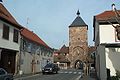 Porte des forgerons
 -
 Cloister of the former Chartreuse (Carthusian monastery)
 -
 Metzig (lateral view)
 -
 Town hall
 -
 House of canons
 -
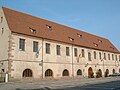 Hôtel de la monnaie (old money manufacture)
 -
 Railway station


History
[edit]Excavations carried out to the north of Molsheim in 1935 revealed the presence of many Merovingian tombs (sixth and seventh centuries), along the old Roman road going to Avolsheim. "Mollesheim" was first mentioned about 820, in a deed of donating a vineyard of the bishop Adeloch to the chapter of Saint-Thomas. Bishop Adeloch is buried in the church of Saint-Thomas in Strasbourg.
In 1219, the Holy Roman Emperor Frederick II granted the town many rights and franchises. By 1263 Molsheim was already surrounded by a wall which, in the medieval sense, made the town a city. However, the bishops of Strasbourg continued to own properties in Molsheim, resulting in conflicts with the Germanic emperors, a quarrel that was resolved in 1308 in favor of Bishop Jean de Dürbheim (German: Johann I. von Straßburg). Jean de Dürbheim enlarged the city wall in 1318 and built a château. When the bishop died in 1328, he was entombed in the chapel of a hospice he had founded, the future site of the Jesuit church, which is the present parish church of Molsheim. His tomb is still visible today.
Molsheim as a center of the Counter-Reformation
[edit]
The strength of the Protestant Reformation in the Alsace and especially Strasbourg put pressure on Catholic institutions. In 1580 Laurent Gutjahr, the abbot of Altorf, acquired property in Molsheim; the Benedictines, established since the 11th century in Altorf, a town lacking fortifications, moved here for safety behind the ramparts of Molsheim. Also in 1580, the Jesuits established a school in Molsheim which Leopold V, Archduke of Austria. Similarly, in 1591, due to the suppression of the Carthusians in Strasbourg, members of the order moved to Molsheim and built a convent, the splendid stained glass of which was partly destroyed during the French Revolution. The stained glass that survived the Revolution was eventually transferred to Strasbourg.
.jpg)
In 1592, with the death of the bishop Jean de Manderscheid, a conflict arouse between the catholic parishioners of Molsheim and the protestant majority in the chapter of the diocese of Strasbourg, who elected Johann Georg von Brandenburg) as the bishop of Strasbourg; in opposition the catholics elected Charles of Lorraine (bishop of Metz and Strasbourg). This resulted in the Strasbourg Bishops' War (1592–1604), with a dismal effect on Molsheim. In 1618 the Thirty Years' War broke out, ending with the Peace of Westphalia in which control of Molsheim was transferred from the Holy Roman Empire to France.
Since 1648
[edit]Molsheim was part of the Holy Roman Empire until 1648 (end of the Thirty Years' War and Peace of Westphalia), when it found itself located on the French side of the border. Between 1871 and 1919, the German speaking[citation needed] city was part of the German Reich. Between June 1940 and 1944/45, during World War II, parts of France were occupied and administrated by Nazi Germany.
During Operation Northwind (January 1945), the Wehrmacht unsuccessfully tried an offensive in the region.
Coat of arms
[edit]The town's coat of arms features a breaking wheel of gold, in which a nude man with a golden halo is interlaced and bound, against an azure field. The coat of arms is based on a seal of 1263 representing the martyrdom of Saint George.
Language
[edit]Historically, several languages have been spoken in the Alsace region (which included Molsheim), depending on what nation or country has claimed this region and whether some language was imposed or, was willingly adopted. The history of Alsace records such power struggles and language swaps. Linguistically speaking, this city is located in what is considered the Northern Low Alemannic zone of the historical region of Alsace. Prior to the intense "francophonization" in that and other regions of France, after World War II, that dialect of Alsatian, which itself is a derivative of the mentioned Low Alemannic German dialect, was spoken by the majority of the inhabitants of Molsheim. Currently, most people in Molsheim can speak French, which is rapidly replacing Alsatian as the latter declines.[6][7]
Toponymy
[edit]It was attested in the form "Mollesheim" (Molles + heim) around 820. (See History of Molsheim). Albert Dauzat and Charles Rostaing did not comment on the origin of the first element, Molles-, they simply associated it with the name of another town, Molring (called "Mollering" around 1304) which would be formed with the surname Moller. Moller might be an alternative spelling of Möller, which, in turn, is a variant of Müller ("miller").[8] The [r] at the end of Moller would have been assimilated to [s]". Ernest Nègre explains this toponym by the Germanic personal name Mudila [9][10] + suffix -heim (home, house, small settlement, village) from Proto-Germanic through Old High German.[11] Leon Dominian wrote that the "Alemanni are responsible for the suffix "heim" in Alsace. Towns and villages with names bearing this suffix are restricted to the plain". He also explained that the -ingen suffix is a later Allemannic alternative to -heim, which, in time, shortened to -ing or, was frenchified as -ange.[12]
Economy
[edit]At the Mercedes-Benz plant in Molsheim (Mercedes-Benz Custom Tailored Trucks), trucks are converted into special-purpose vehicles: fire trucks, garbage trucks, municipal vehicles (snow plows, sweepers, etc.), military transporters and other heavy-duty transporters such as the Mercedes-Benz Arocs/Actros SLT.
The lighting manufacturer Osram operates a plant in Molsheim.
Molsheim is also the headquarters of Merck subsidiary Millipore S.A.S., which produces laboratory equipment, and of Messier-Bugatti, a subsidiary of Safran (aerospace technology).
In 2005, production of the Bugatti Veyron restarted in Dorlisheim near Molsheim.
Molsheim station has rail connections to Strasbourg,[13] Sélestat[14] and Épinal.
See also
[edit]References
[edit]- ^ "Répertoire national des élus: les maires" (in French). data.gouv.fr, Plateforme ouverte des données publiques françaises. 6 June 2023.
- ^ "Populations de référence 2022" (in French). National Institute of Statistics and Economic Studies. 19 December 2024.
- ^ a b Commune de Molsheim (67300), INSEE
- ^ "Évolution et structure de la population en 2017: Commune de Molsheim (67300)". INSEE. Retrieved 10 September 2020.
- ^ "Évolution et structure de la population en 2017: Unité urbaine 2020 de Molsheim (67401)". INSEE. Retrieved 17 June 2022.
- ^ "What Language to they actually Speak in Alsace?". 31 January 2014.
- ^ Laura Leichtfried (23 February 2017). "Alsace: culturally not quite French, not quite German". British council. Retrieved 2 March 2023.
- ^ Albert Dauzat and Charles Rostaing, Dictionnaire étymologique des noms de lieux en France, Larousse, Paris, 1963, p. 462.
- ^ Noms de personne sur le territoire de l'ancienne Gaule du VIe au XIIe siècle, I, 169 b
- ^ Ernest Nègre, Les Noms die Lieux du Tarn, 1959.
- ^ "Reconstruction:Proto-Germanic/Haimaz". 29 May 2021.
- ^ "The Project Gutenberg eBook of the Frontiers of Language and Nationality in Europe, by Leon Dominian".
- ^ de:Bahnstrecke Strasbourg–Saint-Dié
- ^ de:Bahnstrecke Sélestat–Saverne
This article incorporates text from a publication now in the public domain: Chisholm, Hugh, ed. (1911). "Molsheim". Encyclopædia Britannica. Vol. 18 (11th ed.). Cambridge University Press. p. 677.

External links
[edit]

References
[edit]
| International | |
|---|---|
| National | |
| Geographic | |
| Other | |

Molsheim
View on GrokipediaMolsheim is a commune and subprefecture in the Bas-Rhin department of the Grand Est region in northeastern France, located in the historic Alsace province at the mouth of the Bruche River where it joins the Ill.[1][2] With a population of 9,328 as of the 2022 census, the town features preserved medieval and Renaissance architecture alongside its role as the birthplace of the Bugatti automobile marque, founded there in 1909 by Italian engineer Ettore Bugatti.[3][4] Historically, Molsheim received town status from Holy Roman Emperor Frederick II in 1220 and later became an episcopal and university center during the Reformation era, hosting influential religious orders such as the Jesuits from 1580 to 1765 and the Carthusians from 1598 to 1792.[1][5] These periods left enduring landmarks, including the Baroque Église des Jésuites, the cloister of the former Chartreuse monastery now housing a museum of archaeology, art, and history, and defensive structures like the Porte des Forgerons.[2][6] The town's strategic position facilitated its growth as a spiritual and administrative hub, with half-timbered houses and Renaissance mansions reflecting its prosperous past.[7] In the modern era, Molsheim's economy and cultural identity are prominently tied to its automotive heritage, with Bugatti's original factory site symbolizing engineering excellence and the brand's revival under Volkswagen Group ownership from 1998 onward, culminating in high-performance hypercars produced at the Atelier in the Château Saint Jean.[8][4] Beyond manufacturing, the commune maintains subprefecture functions since 1919 and supports local viticulture along the Alsace Wine Route, while annual events like the Bugatti Festival underscore its blend of historical preservation and innovative legacy.[9][10]
Geography and Environment
Location and Topography
Molsheim is situated in the Bas-Rhin department of the Grand Est region in northeastern France, at geographic coordinates approximately 48°32′N 7°29′E.[11] The commune lies about 18 kilometers west-southwest of Strasbourg, within the Bruche River valley, where the river flows northward toward its confluence with the Ill River.[12] This positioning places Molsheim along the eastern foothills of the Vosges Mountains, facilitating access to both the Rhine plain and upland areas.[13] The terrain around Molsheim features gently rolling hills and alluvial deposits from the Bruche River, contributing to fertile plains conducive to viticulture and agriculture. Elevations range from about 165 meters to 371 meters above sea level, with an average of around 180 meters in the town center.[14] The proximity to the Vosges Mountains, rising sharply to the west, creates a transitional microclimate shielded from prevailing westerly winds, resulting in relatively milder conditions compared to higher elevations.[15] Molsheim's urban layout centers on a compact historic core originally defined by medieval fortifications, including remnants such as the Porte des Forgerons, a fortified gate reflecting the town's defensive adaptations to the surrounding valley topography. Modern expansions have extended beyond these original walls, incorporating residential and industrial zones while preserving the walled enclosure's outline in the older districts.[1]Climate and Natural Features
Molsheim lies within a temperate oceanic climate classified as Köppen Cfb, featuring moderate temperatures influenced by both Atlantic maritime air masses and continental effects from the nearby Vosges Mountains.[16] The annual mean temperature stands at 10.8°C, with monthly averages ranging from approximately 2°C in January to 20°C in July.[16] Winters remain mild, rarely dropping below -8°C, while summers peak around 26°C highs, seldom exceeding 32°C.[17] Annual precipitation totals roughly 1,068 mm, distributed fairly evenly but with higher rainfall in autumn and winter, supporting consistent soil moisture without extreme aridity. The Bruche River, originating at 690 m elevation and classified as a Category I waterway for its high water quality, traverses Molsheim in its lower 30 km course toward the Ill River confluence, aiding regional drainage in the alluvial valley.[18] This hydrology has facilitated settlement by mitigating water scarcity but introduced flood vulnerabilities, as evidenced by historical inundations in the low Bruche valley affecting local agriculture and infrastructure.[19] Surrounding land use emphasizes agriculture on fertile alluvial and loess-derived soils, which provide essential drainage and mineral retention conducive to viticulture in the broader Alsace context, though Molsheim's valley terrain yields mixed arable outputs tied to these edaphic properties.[20] Empirical records indicate low mineral fertility in some stony substrata, correlating with structured wines from nearby vineyards, while clay-marl variants enhance water-holding capacity for crop viability.[21]Historical Development
Origins and Medieval Period
Archaeological evidence indicates human settlement in the Molsheim area dating to the Roman period, with excavations uncovering traces of an early agglomeration, while Merovingian tombs from the 6th-7th centuries suggest continuity into the early Middle Ages.[22] The earliest documentary reference to Molsheim, recorded as villa Mollesheim, appears in a Carolingian-era charter circa 820, detailing a donation of vineyards by Bishop Adaloch of Strasbourg to the chapter of Saint-Thomas, portraying it as a rural estate tied to episcopal lands.[23] [24] Under the control of the Bishops of Strasbourg, Molsheim transitioned from a feudal estate to a market town by the 13th century, benefiting from its position along emerging trade routes in the Alsace wine-producing region. A foundational charter issued on February 4, 1220, marked its formal development, amid disputes between the bishops and the Hohenstaufen emperors, whose Germanic imperial ambitions highlighted Alsace's strategic border location between Frankish and Teutonic spheres.[25] [26] By 1246, following the Hohenstaufen decline, the bishop regained full authority, issuing a 1252 charter that referenced Molsheim as a fortified oppidum.[27] Medieval fortifications, constructed primarily between 1250 and 1320 to replace earlier defenses, enclosed the growing settlement by 1263, with the Porte des Forgerons (Blacksmiths' Gate) erected in the early 14th century as a key remnant.[28] [1] Trade flourished via guilds such as those of blacksmiths, butchers, and winegrowers, leveraging proximity to Rhine-adjacent routes and local viticulture, though economic activity remained subordinate to episcopal oversight rather than independent burgher autonomy.[29]Counter-Reformation and Religious Centrality
The Jesuit College in Molsheim was established in 1580 as a strategic initiative to bolster Catholic education and counter the spread of Protestantism from nearby Strasbourg.[30] This institution quickly positioned the town as a key center for the Counter-Reformation in Alsace, attracting pupils for rigorous training in Catholic doctrine and theology.[30] Under Habsburg influence within the Holy Roman Empire, the college benefited from imperial backing, which facilitated its expansion into a broader network of religious and educational facilities.[31] In 1618, Pope Paul V and Holy Roman Emperor Matthias elevated the college to the status of an "Academy," effectively granting it university privileges focused on philosophy and theology, making Molsheim Alsace's primary Catholic higher education hub until the early 18th century. Complementary monasteries of the Benedictines, Carthusians, and Capuchins augmented this centrality, fostering an influx of Catholic clergy and scholars that reinforced institutional control over religious life.[30] These efforts systematically curtailed Protestant influence locally, through educational dominance and clerical oversight, preserving Catholic hegemony amid regional confessional fragmentation. The centralized authority embodied by the Jesuits ensured cultural and doctrinal continuity, as their structured seminaries and colleges outlasted transient political shifts until the order's broader suppression.[31] The college operated with university functions until the Jesuits' expulsion in 1765, preceding the papal suppression decree of 1773, after which its role diminished. While some accounts emphasize voluntary revival, the coercive elements—such as inquisitorial zeal evident in contemporaneous witch trials executing 76 individuals between 1590 and 1630, including 33 children—underscore the institutional power dynamics that prioritized recatholicization over ecumenical accommodation.[30]19th-20th Century Shifts and Industrialization
Following the Franco-Prussian War, Molsheim, situated in Alsace, was annexed to the German Empire under the Treaty of Frankfurt on May 10, 1871, along with most of Alsace and northern Lorraine, excluding Belfort. [32] This territorial shift integrated the town into the Reichsland Alsace-Lorraine, prompting Germanization policies that included administrative restructuring and cultural assimilation efforts, though met with widespread local resistance manifesting in protests, emigration, and persistent Francophone sympathies. [33] Between 1871 and 1872, an opt-out clause allowed residents to retain French citizenship and depart; while Alsace-Lorraine's total population exceeded 1.5 million, approximately 191,000 applications were filed, with around 50,000 individuals ultimately leaving, reflecting demographic tensions but also a core that remained despite incentives for relocation. [33] The region reverted to French control after the Armistice of November 11, 1918, and the Treaty of Versailles in 1919, restoring Molsheim to France until its reannexation by Nazi Germany in 1940 as part of Operation Weserübung's broader conquests. [32] During this second German occupation (1940–1944), intensified forced labor and ideological pressures exacerbated resistance patterns, including sabotage and evasion of conscription into the Wehrmacht, with Alsatian censuses and post-war records indicating higher rates of desertion and underground activity compared to integrated German territories. [33] These recurrent Franco-German contests fostered a localized economy less reliant on distant imperial supply chains, encouraging autonomous manufacturing to mitigate border-related disruptions in trade and resources. Industrialization in Molsheim gained momentum with the establishment of Automobiles E. Bugatti in 1909 by Italian engineer Ettore Bugatti, who selected the town—then under German administration in Alsace-Lorraine—for its available infrastructure, including a decommissioned dye works converted into the initial factory site. [34] Production commenced in 1910 with early models, leveraging the region's skilled metalworkers and proximity to Strasbourg's engineering talent, which provided a buffer against the political volatility of the annexed territory. [4] This venture introduced automotive manufacturing, spurring pre-World War I workforce expansion through recruitment of local artisans, though exact figures remain sparse; the instability of Alsace-Lorraine's status incentivized such ventures by prioritizing self-sufficient operations capable of adapting to potential sovereignty shifts. [34] By the 1920s, following the return to French sovereignty, Bugatti's innovations, such as the Type 35 race car's victories in events like the 1924 Grand Prix de Lyon and Targa Florio, underscored the factory's role in elevating Molsheim's profile in precision engineering, though sustained growth was interrupted by wartime requisitions. [4] The interplay of territorial flux and nascent industry highlighted causal links wherein geopolitical uncertainty drove investment in durable, export-oriented production, insulating the local economy from national upheavals. [34]Post-War Recovery and Recent Events
Following the liberation of Alsace in late 1944 and formal reintegration into France after World War II, Molsheim underwent reconstruction amid widespread infrastructure damage, including the devastation of the historic Bugatti factory, which had been repurposed during the occupation. Local industries, previously tied to pre-war manufacturing, faced initial disruptions but benefited from national recovery programs emphasizing infrastructure repair and economic stabilization. By the late 1940s, basic services resumed, with the railway station serving as a key node for material transport and population mobility.[35] Demographic recovery reflected broader regional trends, with Molsheim's population rising from 5,739 residents in 1968 to 9,312 by 2017, driven by suburbanization from nearby Strasbourg and influxes tied to industrial employment. This growth, documented by France's Institut national de la statistique et des études économiques (INSEE), outpaced national averages in the Bas-Rhin department, underscoring resilience despite challenges like the post-1950s decline in traditional Bruche Valley sectors such as textiles and light manufacturing, which shifted toward specialization in precision engineering.[36] A pivotal milestone in industrial revival came in 2005, when Volkswagen Group reestablished Bugatti Automobiles S.A.S. in Molsheim, repurposing the site's heritage for hypercar production starting with the Veyron model assembled at the Château Saint Jean facility. This move capitalized on the town's engineering legacy, creating high-skill jobs and positioning Molsheim as a niche hub for luxury automotive innovation amid broader European deindustrialization pressures.[8][37] Recent events highlight sustained vitality, exemplified by the 2025 Bugatti Festival marking the 20th anniversary of the Veyron, which drew global enthusiasts for parades, tours through the Vosges Mountains, and displays at Parc des Jésuites, organized by Enthousiastes Bugatti Alsace. Complementing this, expansions in advanced manufacturing—such as Safran's 2025 inauguration of machining and surface treatment facilities for landing gear—reinforce Molsheim's adaptation to high-value sectors like aerospace components, countering legacy industrial erosion through targeted investments.[38][39]Governance and Administration
Local Governance Structure
Molsheim's local governance adheres to the French communal system, wherein a municipal council (conseil municipal) of 33 members, elected by universal suffrage for six-year terms, holds legislative authority over communal affairs. The council selects the mayor (maire) and up to four deputy mayors (maires adjoints) from its ranks, who execute decisions and manage daily administration. This structure, governed by the French municipal code (Code général des collectivités territoriales), emphasizes decentralized decision-making on matters such as urban planning, public services, and local infrastructure.[40] The current mayor, Laurent Furst, has led the commune since 1995, securing re-election in the 2020 municipal elections with a council reflecting a center-right orientation aligned with his Les Républicains affiliation. The 33 councilors deliberate in public sessions, approving the annual budget—reported at approximately €25 million in operating expenses for recent years—and policies on zoning, which enforce strict preservation standards in the historic core while permitting controlled industrial expansion, as evidenced by sustained heritage site integrity alongside steady population levels from 9,335 in 2015 to 9,472 in 2020.[41][42] As the seat of the Molsheim arrondissement's subprefecture (sous-préfecture), the commune coordinates with departmental authorities on broader administrative oversight, but municipal autonomy prevails for local fiscal and infrastructural decisions, including maintenance of public facilities and enforcement of building codes that have preserved 16th- and 17th-century structures amid modern developments like automotive sector growth. Empirical indicators of policy efficacy include low variance in municipal debt ratios and consistent service delivery, with no major fiscal shortfalls noted in audited reports.[42][43]Administrative Role and Divisions
Molsheim functions as the sub-prefecture of the arrondissement of Molsheim within the Bas-Rhin department, representing the French state at the local level under the authority of the prefecture in Strasbourg. The sub-prefect oversees the implementation of national policies, coordinates public services such as education and infrastructure projects, manages electoral processes, regulates associations, and processes administrative matters related to foreigners and public order, in accordance with the French Code of Internal Security and general administrative framework.[44][45] The arrondissement of Molsheim encompasses 77 communes across an area of 771.2 square kilometers, with a combined population of 104,391 residents as of the 2021 census.[46] This subdivision facilitates decentralized governance, enabling localized coordination on state directives while aggregating data for departmental planning; for instance, the arrondissement's structure supports efficient service delivery, with the sub-prefecture handling over 5,000 annual administrative requests including vehicle registrations and association declarations.[47][48] At the intermunicipal level, Molsheim anchors the Communauté de communes de la région de Molsheim-Mutzig, established in 1997, which integrates 18 communes and approximately 41,381 inhabitants as of January 1, 2024. This entity promotes fiscal decentralization by pooling resources for shared competencies like urban planning, economic promotion, and environmental management, covering 160.19 square kilometers and enhancing administrative efficiency through joint budgeting exceeding €20 million annually.[49][50]Demographics and Society
Population Trends and Statistics
The population of Molsheim has exhibited steady growth since the post-war period, increasing from 5,739 inhabitants in 1968 to a peak of 9,382 in 2006, before stabilizing around 9,300 in recent decades.[3] This expansion reflects the broader baby boom effects in France following World War II, with annual growth rates averaging approximately 1.5% between 1968 and 1999.[51] By 2022, the commune recorded 9,328 residents, yielding a population density of 859.7 inhabitants per square kilometer.[3]| Year | Population |
|---|---|
| 1968 | 5,739 |
| 1975 | 6,649 |
| 1982 | 6,928 |
| 1990 | 7,973 |
| 1999 | 9,335 |
| 2006 | 9,382 |
| 2011 | 9,142 |
| 2016 | 9,286 |
| 2022 | 9,328 |