


Community hub
Recent from talks
Contribute something
Nothing was collected or created yet.
Kitti's hog-nosed bat
View on Wikipedia
| Kitti's hog-nosed bat | |
|---|---|

| |
Scientific classification 
| |
| Kingdom: | Animalia |
| Phylum: | Chordata |
| Class: | Mammalia |
| Order: | Chiroptera |
| Superfamily: | Rhinolophoidea |
| Family: | Craseonycteridae Hill, 1974 |
| Genus: | Craseonycteris Hill, 1974 |
| Species: | C. thonglongyai
|
| Binomial name | |
| Craseonycteris thonglongyai Hill, 1974
| |

| |
| Kitti's hog-nosed bat range | |

Kitti's hog-nosed bat (Craseonycteris thonglongyai), also known as the bumblebee bat or hog-nosed bat, is a near-threatened species of bat and the only extant member of the family Craseonycteridae. It occurs in western Thailand and southeast Myanmar, where it occupies limestone caves along rivers.
Kitti's hog-nosed bat is the smallest species of bat and arguably the world's smallest mammal by body length (the Etruscan shrew is regarded as the smallest by body mass). It has a reddish-brown or grey coat, with a distinctive pig-like snout. Colonies range greatly in size, with an average of 100 individuals per cave. The bat feeds during short activity periods in the evening and dawn, foraging around nearby forest areas for insects. Females give birth annually to a single offspring.
Although the bat's status in Myanmar is not well known, the Thai population is restricted to a single province and may be at risk of extinction. Its potential threats are primarily anthropogenic, and include habitat degradation and the disturbance of roosting sites.[1]
Description
[edit]
Kitti's hog-nosed bat is small at about 29 to 33 mm (1.1 to 1.3 in) in length and 2 g (0.071 oz) in mass,[2][3] hence the common name of "bumblebee bat". It is the smallest species of bat and may be the world's smallest mammal, depending on how size is defined. The main competitors for the title are small shrews; in particular, the Etruscan shrew may be lighter at 1.2 to 2.7 g (0.042 to 0.095 oz) but its body is longer, measuring 36 to 53 mm (1.4 to 2.1 in) from its head to the base of the tail.[4]
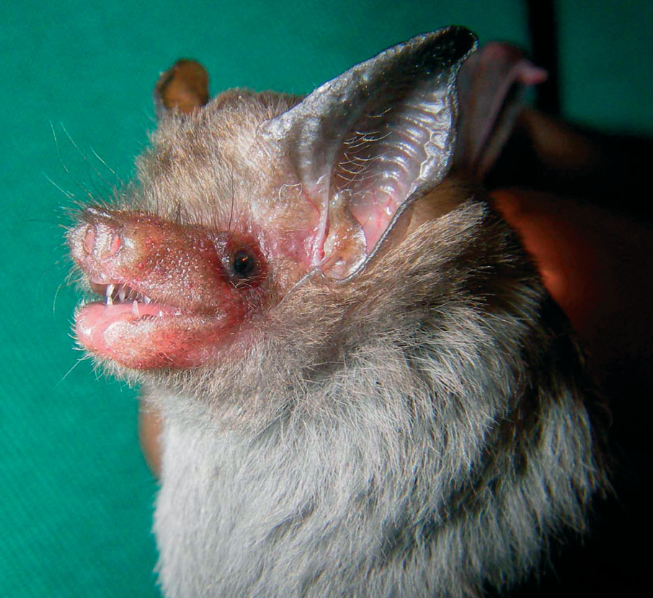
The bat has a distinctive swollen, pig-like snout[3] with thin, vertical nostrils.[5] Its ears are relatively large, while its eyes are small and mostly concealed by fur.[6] In the jaw, the premaxillae are not fused with surrounding bones, and the coronoid process is significantly reduced.[7] Its teeth are typical of an insectivorous bat.[6] The dental formula is 1:1:1:3 in the upper jaw and 2:1:2:3 in the lower jaw,[5] with large upper incisors.[6]
The bat's upperparts are reddish-brown or grey, while the underside is generally paler.[6] The wings are relatively large and darker in colour, with long tips that allow the bat to hover.[3] The second digit of the wing is made of a single short phalanx. And the humerus has an increased number of locking tubercles on its head and beyond. There is a considerable fusion in the axial skeleton, concerning the thoracic (three posterior vertebrae), lumbar (two posterior) and sacral (all) sections. The bat has particularly slender legs, with rather thin fibula.[7] Despite having two caudal vertebrae, Kitti's hog-nosed bat has no visible tail.[6] There is a large web of skin between the hind legs (the uropatagium) which may assist in flying and catching insects, although there are no tail bones or calcars to help control it in flight.[3][6][8]
Range, habitat and diversity
[edit]Kitti's hog-nosed bat occupies limestone caves along rivers within dry evergreen or deciduous forests.[3] In Thailand, it is restricted to a small region of the Tenasserim Hills in Sai Yok District, Kanchanaburi Province, within the drainage basin of the Khwae Noi River.[3][9] While Sai Yok National Park in the Dawna Hills contains much of the bat's range, some Thai populations occur outside the park and are therefore unprotected.[3]
Since the 2001 discovery of a single individual in Myanmar, at least nine separate sites have been identified in the limestone outcrops of the Dawna and Karen Hills outside the Thanlwin, Ataran, and Gyaing Rivers of Kayin and Mon States.[9] The Thai and Myanmar populations are morphologically identical, but their echolocation calls are distinct.[9] It is not known whether the two populations are reproductively isolated.[9]
Despite its restricted geographical range and specialized habitat requirements, Kitti's hog-nosed bat exhibits remarkable genetic diversity within its populations. Molecular analyses using microsatellite markers have revealed moderate levels of genetic differentiation among cave roosts in Thailand and Myanmar, suggesting historical isolation and limited gene flow between populations.
Biology and reproductive structure
[edit]
Kitti's hog-nosed bat roosts in caves in limestone hills, far from the entrance. While many caves contain only 10 to 15 individuals, the average group size is 100, with a maximum of about 500. Individuals roost high on walls or roof domes, far apart from each other.[10] Bats also undertake seasonal migration between caves.
Kitti's hog-nosed bat has a brief activity period, leaving its roost for only 30 minutes in the evening and 20 minutes at dawn. These short flights are easily interrupted by heavy rain or cold temperatures.[10] During this period, the bat forages within fields of cassava and kapok or around the tops of bamboo clumps and teak trees, within one kilometre of the roosting site.[3][10] The wings seem to be shaped for hovering flight, and the gut contents of specimens include spiders and insects that are presumably gleaned off foliage. Nevertheless, most prey is probably caught in flight.[10] Main staples of the bat's diet include small flies (Chloropidae, Agromyzidae, and Anthomyiidae), hymenopterans, psocopterans, and spiders.[10][11]
Kitti's hog-nosed bat suggest a unique reproductive strategy characteristic of microchiropterans. Females of this species typically give birth to a single offspring per reproductive event, with births occurring during the dry season between March and May. Maternity colonies composed of a small number of females are formed within cave roosts, providing communal protection and thermoregulatory benefits for nursing offspring. Male mating behaviors, such as courtship vocalizations and scent marking, have been documented in captive populations, indicating potential sexual selection mechanisms.
Taxonomy
[edit]Kitti's hog-nosed bat is the only extant species in the family Craseonycteridae, which is grouped in the superfamily Rhinolophoidea as a result of molecular testing. Based on this determination, the bat's closest relatives are members of the families Hipposideridae and Rhinopomatidae.[5]
Kitti's hog-nosed bat was unknown to the world at large prior to 1974. Its common name refers to its discoverer, Thai zoologist Kitti Thonglongya. Thonglongya worked with a British partner, John E. Hill, in classifying bats of Thailand; after Thonglongya died suddenly in February 1974, Hill formally described the species, giving it the binomial name Craseonycteris thonglongyai in honour of his colleague.[12][13][7]
Ecological role and conservation
[edit]As a microchiropteran species, Kitti's hog-nosed bat plays a crucial ecological role in its habitat, primarily as an insectivore. This species preys predominantly on small flying insects, including mosquitoes, moths, and beetles. By controlling insect populations, particularly those of agricultural pests and disease vectors, Kitti's hog-nosed bat contributes to ecosystem balance and human well-being. Furthermore, its presence in cave ecosystems may also influence nutrient cycling and the distribution of guano-dependent organisms.
As of the species' review in 2019, Kitti's hog-nosed bat is listed by the IUCN as near-threatened, with a downward population trend.[1]
Soon after the bat's discovery in the 1970s, some roosting sites became disturbed as a result of tourism, scientific collection, and even the collection and sale of individuals as souvenirs. However, these pressures may not have had a significant effect on the species as a whole, since many small colonies exist in hard-to-access locations, and only a few major caves were disturbed. Another potential risk is the activity of local monks, who have occupied roost caves during periods of meditation.[10]
Currently, the most significant and long-term threat to the Thai population could be the annual burning of forest areas, which is most prevalent during the bat's breeding season. In addition, the proposed construction of a gas pipeline from Myanmar to Thailand may have a negative impact.[14][10] Threats to the Myanmar population are not well known.[3][15]
In 2007, Kitti's hog-nosed bat was identified by the Evolutionarily Distinct and Globally Endangered project as one of its Top 10 "focal species".[16]
See also
[edit]References
[edit]- ^ a b c Bates, P.; Bumrungsri, S.; Francis, C. (2019). "Craseonycteris thonglongyai". IUCN Red List of Threatened Species. 2019 e.T5481A22072935. doi:10.2305/IUCN.UK.2019-3.RLTS.T5481A22072935.en. Retrieved 20 May 2023.
- ^ Donati, Annabelle (1993). "Which mammal is the smallest?". I Wonder which Snake is the Longest: And Other Neat Facts about Animal Records. Western Publishing Company. p. 8. ISBN 978-0-307-11326-9.
- ^ a b c d e f g h i "Bumblebee bat (Craseonycteris thonglongyai)". EDGE Species. Archived from the original on 21 September 2010. Retrieved 2008-04-10.
- ^ "Mammal record breakers: The smallest!". The Mammal Society. Archived from the original on July 13, 2007. Retrieved 2008-04-10.
- ^ a b c Hulva & Horáček (2002). "Craseonycteris thonglongyai (Chiroptera: Craseonycteridae) is a rhinolophoid: molecular evidence from cytochrome b". Acta Chiropterologica. 4 (2): 107–120. doi:10.3161/001.004.0201.
- ^ a b c d e f Goswami, A. 1999. Craseonycteris thonglongyai, Animal Diversity Web. Retrieved on 11 April 2008.
- ^ a b c Hill, John Edwards (1974). "A new family, genus and species of bat (Mammalia: Chiroptera) from Thailand". Bulletin of the British Museum (Natural History) Zoology. 27 (7): 301–336. doi:10.5962/bhl.part.22979. INIST PASCAL7536011187.
- ^ Meyers, P. (1997). "Bat Wings and Tails". Animal Diversity Web. Archived from the original on 2 April 2009. Retrieved 12 April 2008.
- ^ a b c d MJR Pereira, Maria João Ramos; et al. (October 2006). "Status of the world's smallest mammal, the bumble-bee bat Craseonycteris thonglongyai, in Myanmar". Oryx. 40 (4): 456–463. doi:10.1017/S0030605306001268.
- ^ a b c d e f g Hutson, A. M.; Mickleburgh, S. P.; Racey, P. A. (2001). "Microchiropteran Bats: Global Status Survey and Conservation Action Plan". Gland, Switzerland: IUCN/SSC Chiroptera Specialist Group. IUCN. Archived from the original on 12 March 2008.
- ^ "Craseonycteris thonglongyai (bumblebee bat)". Animal Diversity Web.
- ^ J. E. Hill & Susan E. Smith (1981-12-03). "Craseonycteris thonglongyai". Mammalian Species (160): 1–4. doi:10.2307/3503984. JSTOR 3503984.
- ^ Schlitter, Duane A. (February 1975). "Kitti Thonglongya, 1928-1974". Journal of Mammalogy. 56 (1): 279–280. doi:10.2307/1379641. JSTOR 1379641.
- ^ Rajesh, Noel (1997-03-15). "Project disaster". Down To Earth. Retrieved 2024-01-11.
- ^ "Dawna Tenasserim Landscape project leaflet". WWF. 2014-02-18. Retrieved 2024-01-11.
- ^ "Protection for 'weirdest' species". BBC News. 16 January 2007.
Further reading
[edit]- Clare, Elizabeth L.; Lim, Burton K.; Fenton, M. Brock; Hebert, Paul D. N. (26 July 2011). "Neotropical Bats: Estimating Species Diversity with DNA Barcodes". PLOS ONE. 6 (7) e22648. Bibcode:2011PLoSO...622648C. doi:10.1371/journal.pone.0022648. PMC 3144236. PMID 21818359.
- Jones, Gareth; Webb, Peter I.; Sedgeley, Jane A.; O'Donnell, Colin F. J. (December 2003). "Mysterious Mystacina: how the New Zealand short-tailed bat( Mystacina tuberculata ) locates insect prey". Journal of Experimental Biology. 206 (23): 4209–4216. Bibcode:2003JExpB.206.4209J. doi:10.1242/jeb.00678. PMID 14581591.
- Law, Bradley; Park, Kirsty J.; Lacki, Michael J. (2016). "Insectivorous Bats and Silviculture: Balancing Timber Production and Bat Conservation". Bats in the Anthropocene: Conservation of Bats in a Changing World. pp. 105–150. doi:10.1007/978-3-319-25220-9_5. ISBN 978-3-319-25218-6.
- Magalhães de Oliveira, Hernani Fernandes; Camargo, Nícholas Ferreira; Hemprich-Bennett, David R.; Rodríguez-Herrera, Bernal; Rossiter, Stephen J.; Clare, Elizabeth L. (11 May 2020). "Wing morphology predicts individual niche specialization in Pteronotus mesoamericanus (Mammalia: Chiroptera)". PLOS ONE. 15 (5) e0232601. Bibcode:2020PLoSO..1532601M. doi:10.1371/journal.pone.0232601. PMC 7213686. PMID 32392221.
- Heim, Olga; Treitler, Julia T.; Tschapka, Marco; Knörnschild, Mirjam; Jung, Kirsten (31 July 2015). "The Importance of Landscape Elements for Bat Activity and Species Richness in Agricultural Areas". PLOS ONE. 10 (7) e0134443. Bibcode:2015PLoSO..1034443H. doi:10.1371/journal.pone.0134443. PMC 4521758. PMID 26231029.
- Moreno, Claudia E.; Halffter, Gonzalo (2001). "Spatial and temporal analysis of α, β and γ diversities of bats in a fragmented landscape". Biodiversity and Conservation. 10 (3): 367–382. Bibcode:2001BiCon..10..367M. doi:10.1023/a:1016614510040.
- Thabah, Adora; Rossiter, Stephen J.; Kingston, Tigga; Zhang, Shuyi; Parsons, Stuart; Mya, Khin Mya; Akbar, Zubaid; Jones, Gareth (27 April 2006). "Genetic divergence and echolocation call frequency in cryptic species of Hipposideros larvatus s.l. (Chiroptera: Hipposideridae) from the Indo-Malayan region". Biological Journal of the Linnean Society. 88 (1): 119–130. doi:10.1111/j.1095-8312.2006.00602.x.
