Hubbry Logo
Surface liftSurface liftMain
Open search
Surface lift
Community hub
Surface lift
logo
8 pages, 0 posts
0 subscribers
Be the first to start a discussion here.
Surface lift
Surface lift
from Wikipedia
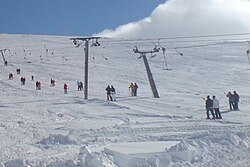
T-bar lift, a style of surface lift, in Åre, Sweden.

A surface lift is a type of cable transport for mountain sports in which skiers, snowboarders, or mountain bikers remain on the ground as they are pulled uphill. While they were once prevalent, they have been overtaken in popularity by higher-capacity and higher-comfort aerial lifts, such as chairlifts and gondola lifts. Today, surface lifts are most often found on beginner slopes, small ski areas,[1] and peripheral slopes. They are also often used to access glacier ski slopes because their supports can be anchored in glacier ice due to the lower forces and realigned due to glacier movement.

Surface lifts have some disadvantages compared to aerial lifts: they require more passenger skill and may be difficult for some beginners (especially snowboarders, whose boards point at an angle different than the direction of travel) and children; sometimes they lack a suitable route back to the piste; the snow surface must be continuous; they can get in the way of skiable terrain; they are relatively slow in speed and have lower capacity.

Surface lifts have some advantages over aerial lifts: they can be exited before the lift reaches the top, they can often continue operating in wind conditions too strong for a chairlift, their lines are more flexible; being able to turn outwards of the cable loop, they require less maintenance and are much less expensive to install and operate.

History

[edit]

The first surface lift was built in 1908 by German Robert Winterhalder in Schollach/Eisenbach, Hochschwarzwald, Germany, and started operations February 14, 1908.[2] A steam-powered toboggan tow, 950 feet (290 m) in length, was built in Truckee, California, in 1910.[3][4][5] The first skier-specific tow in North America was apparently installed in 1933 by Alec Foster at Shawbridge in the Laurentians outside Montreal, Quebec.[6][7]

The Shawbridge tow was quickly copied at Woodstock, Vermont, in New England, in 1934 by Bob and Betty Royce, proprietors of the White Cupboard Inn. Their tow was driven by the rear wheel of a Ford Model A. Wallace "Bunny" Bertram took it over for the second season, improved the operation, renamed it from Ski-Way to Ski Tow,[8] and eventually moved it to what became the eastern fringe of Vermont's major southern ski areas, a regional resort still operating as Saskadena Six. Their relative simplicity made tows widespread and contributed to an expansion of the sport in the United States and Europe. Before tows, only people willing to walk uphill could ski. Suddenly relatively non-athletic people could participate, greatly increasing the appeal of the sport. By 1937, more than 100 tow ropes were operating in the U.S..[9]

Rope tow

[edit]

A rope tow consists of a cable or rope running through a bullwheel (large horizontal pulley) at the bottom and one at the top, powered by an engine at one end.

In the simplest case, a rope tow is where passengers grab hold of a rope and are pulled along while standing on their skis or snowboards and are pulled up a hill. The grade of this style of tow is limited by passenger grip strength and the fact that sheaves (pulleys that support the rope above the ground) cannot be used.

Handle tow

[edit]
Handle tow in Valle del Sol

A development of the simple rope tow is the handle tow (or pony lift), where plastic or metal handles are permanently attached to the rope. These handles are easier to grip than a rope, making the ski lift easier to ride.

Nutcracker tow

[edit]
Nutcracker and belt

Steeper, faster and longer tows require a series of pulleys to support the rope at waist height and hence require the use of some sort of "tow gripper". Several were designed and used in the 1930s and 40s, but the most successful was the "nutcracker" attached to a harness around the hips.[10][11] To this is attached a clamp, much like the nutcracker from which it derives its name, which the rider attaches to the rope. This eliminates the need to hold on to the rope directly. This system was used on many fields worldwide from the 1940s, and remains popular at 'club fields', especially in New Zealand.[12] This type of ski lift is often referred to as a nutcracker tow.

J-bar, T-bar, and platter lift

[edit]
A J-bar lift
Two hangers of a platter lift

J-bar, T-bar, and platter lifts are employed for low-capacity slopes in large resorts and small local areas. These consist of an aerial cable loop running over a series of wheels, powered by an engine at one end. Hanging from the rope are a series of vertical recoiling cables, each attached to a horizontal J- or T-shaped bar – which is placed behind the skier's buttocks or between the snowboarder's legs – or a plastic button or platter that is placed between the skier's legs. Snowboarders place the platter behind the top of their front leg or in front of their chest under their rear arm and hold it in position with their hands. These pull the passengers uphill while they ski or snowboard across the ground.

Platter lifts are often referred to as button lifts, and may occasionally feature rigid poles instead of recoiling cables.

The modern J-bar and T-bar mechanism was invented in 1934 by the Swiss engineer Ernst Constam,[13][14] with the first lift installed in Davos, Switzerland.[15] J-bars were installed in other Swiss and French resorts, and starting in 1935 in New Hampshire[16] and Australia. A J-bar was installed at Rib Mountain (now Granite Peak Ski Area), Wisconsin, in 1937. The Ski Hoist at Charlotte Pass in Australia dates from 1938.[17]

The first T-bar lift in the United States was installed in 1940 at the Pico Mountain ski area.[18] It was considered a great improvement over the rope tow.

J-bars are no longer used at most ski areas. Some operators have combined T-bar and platter lifts, attaching both types of hanger to the cable, giving skiers and snowboarders a choice. Hangers designed to tow sledges uphill are installed on some slopes by operators, and some operators convert hangers in the summer to tow cyclists uphill.

Detachable platter or Poma lift

[edit]

A variant of the platter lift is the detachable surface lift, commonly known as a Poma lift”, after the company which introduced them. Unlike most other platter lifts, which are similar to T-bars with the stick attached to a spring box by a retractable cord, Poma lifts have a detachable grip to the tow cable with the button connected to the grip by a semi-rigid pole. Platters return to the bottom station, detach from the cable, and are stored on a rail until a skier slides the platter forwards to use it. Most detachable surface lifts operate at speeds of around 4 m/s (13 ft/s; 8.9 mph; 14 km/h), while platters and T-bars can operate up to 3.0 m/s (9.8 ft/s; 6.7 mph; 11 km/h), although are generally slower. When the grip attaches to the cable, the passenger's acceleration is lessened by the spring-loaded pole.

Conveyor lift

[edit]
A magic carpet in use, operated by two attendants

A conveyor lift is a conveyor belt that works similar to an airport moving sidewalk to transport skiers. It is sometimes referred to as magic carpet. At the top, the belt pushes the passengers onto the snow and they slide away. Conveyor lifts are geared towards beginners and families.[19] These lifts are limited to shallow grades because they depend on friction between the belt surface and the skis or board to keep riders in place. Their slow speed, limited distance, and capacity generally confines them to beginner and novice areas.

References

[edit]
Revisions and contributorsEdit on WikipediaRead on Wikipedia
from Grokipedia
A surface lift, also known as a drag lift, is a type of system used in , , and other mountain sports to pull riders uphill while they remain in contact with the snow surface, typically by gripping a moving , bar, or disc attached to an overhead cable. These lifts are distinguished from aerial lifts, such as chairlifts or gondolas, by their ground-level operation, which eliminates the need for passengers to load into elevated carriers. Surface lifts originated in the early as one of the first mechanized methods to assist uphill travel on slopes, evolving from rudimentary -based systems in the 1900s to more practical rope tows by the 1930s. Key innovations included the rope tow, patented in designs by inventors like Gerhard Mueller in 1932 and first installed in the U.S. at , in 1934, on Gilbert's Hill by the Royce family and associates. The J-bar and T-bar, patented by Ernst Constam in 1934, introduced T- or J-shaped bars that accommodate one or two riders side-by-side, while platter or button lifts (pomas), developed by Jean Pomagalski in 1936, use discs that attach between a rider's legs for individual transport. Other variants include nutcracker tows, which use spring-loaded grips on ropes and are common in club fields, and early lifts like those at Pass in 1934. In modern ski resorts worldwide, surface lifts remain widely used for beginner and intermediate terrain due to their low cost, simplicity, and minimal infrastructure requirements, often spanning short to moderate distances, though some exceed 6,000 feet (1.1 km). They offer advantages in harsh weather, including high wind resistance from their low-profile design and reduced maintenance needs compared to aerial systems. However, they can be less comfortable for novices, as riders must actively balance and grip the apparatus, and they generally have lower capacity than detachable chairlifts. As of , over 1,100 surface lifts operate across North American resorts, serving as essential tools for learning areas and efficient transport in variable conditions.

Overview

Definition and Purpose

A surface lift is a type of ski lift that transports skiers and snowboarders uphill by pulling or dragging them along the snow surface using a continuously moving cable or belt system attached to towing devices, without elevating passengers off the ground. This contrasts with aerial lifts, such as chairlifts or gondolas, which suspend users above the terrain. Surface lifts encompass various towing mechanisms, including rope tows, T-bars, and platter lifts, and are classified under passenger ropeway standards that ensure safe operation. The primary purpose of surface lifts is to deliver efficient, low-cost uphill transport on beginner and intermediate slopes, facilitating broader access to and activities at resorts. These systems support continuous passenger flow in fixed-grip configurations, where users grip and release without halting the mechanism, thereby enhancing operational throughput compared to manual ascent methods. Surface lifts evolved from early manual climbing practices to mechanized solutions, significantly improving the accessibility of slopes by minimizing physical exertion and enabling more frequent runs. In typical scenarios, surface lifts are integral to ski school programs, where they help novices develop balance and confidence on gentle , and to terrain parks, allowing riders quick laps for practicing jumps and features. Their ground-level design also makes them ideal for shorter distances and windy conditions, where they provide reliable transport without the vulnerabilities of elevated systems.

Comparison to Aerial Lifts

Surface lifts differ from aerial lifts, such as chairlifts and gondolas, primarily in their ground-level operation, which keeps passengers in contact with the snow rather than suspending them above it. This design leads to distinct trade-offs in efficiency, comfort, and applicability. While aerial lifts excel in transporting larger groups over longer distances and steeper , surface lifts are often preferred for shorter runs, beginner areas, and environments where simplicity and reliability are paramount. One key advantage of surface lifts is their lower installation and maintenance costs, as they require no extensive tower structures beyond basic supports, making them far more economical than aerial lifts, which can cost millions to install due to complex cabling and elevation systems. They also facilitate faster loading times, often without the need for attendants to assist with seating, and are more resistant to wind sway, allowing operation in conditions that might halt aerial lifts. Additionally, surface lifts are energy-efficient for moderate vertical runs up to 1000 m and easier for young children or those with mobility issues in controlled settings, as users remain on their or boards. However, surface lifts present several disadvantages compared to aerial lifts. They demand greater user skill to balance and grip the carrier, which can challenge absolute or snowboarders, potentially leading to falls or discomfort from the pulling force. Speeds are generally slower, with most operating at 150-250 meters per minute, versus 300-360 meters per minute line speeds for detachable , resulting in longer travel times for passengers. Capacity is also limited, typically handling 1-2 passengers per carrier at 800-1,440 skiers per hour, in contrast to aerial lifts' 2-4 or more per chair at over 2,000 skiers per hour; this makes surface lifts less suitable for high-volume or steep above moderate slopes, and they perform poorly in deep powder.
AspectSurface LiftsAerial Lifts (e.g., Detachable Chairlifts)
Capacity (skiers/hour)800-1,4402,000+
Typical Speed (m/min)150-250300-360 (line speed)
Passenger Load1-2 per carrier2-4+ per chair
Vertical SuitabilityUp to 1000 m, moderate slopesLonger rises, steeper terrain
Environmentally and economically, surface lifts offer a smaller with reduced material use and lower , ideal for small , learning zones, or sensitive areas like glaciers where aerial could disrupt ecosystems. This supports their use in niche applications, though aerial lifts dominate for broader resort operations due to higher throughput.

History

Early Developments

The origins of surface lifts trace back to the early in , where rudimentary cable systems inspired mechanized uphill transport for . The first documented surface lift emerged in 1908 in Schollach, , in the Black Forest, invented by farmer and innkeeper Robert Winterhalder. Powered by a waterwheel from his nearby mill, this drag lift featured a continuous overhead cable spanning 280 meters with a 32-meter vertical rise, allowing one skier or tobogganist at a time to grip and be pulled uphill. Winterhalder patented the design in 1907 as a "continuous with coupling device for tobogganists and skiers," but it operated only briefly due to lack of investors and was not commercialized. In the United States, the inaugural surface lift appeared around 1910 at Hilltop Winter Sports Park in , consisting of a steam-powered rope tow approximately 950 feet long designed primarily for toboggans. This installation, utilizing an old railroad engine house for power, represented an early adaptation of industrial cable systems to winter recreation, though it was not yet optimized for skiers. Early surface lifts were confined to short distances due to technological constraints of the era. These challenges delayed widespread adoption until refinements in the and paved the way for more durable tow systems.

Mid-20th Century Innovations

The mid-20th century marked a pivotal era for surface lifts, transitioning from experimental setups to commercially viable systems that fueled the expansion of recreational . A precursor in was the first tow installed in 1932 at Shawbridge (now Prévost), , which inspired subsequent designs. In the United States, the first practical tow was installed in January 1934 on Gilbert's Hill in , powered by a Model T Ford engine and constructed by local enthusiasts including Wallace "Bunny" Bertram, Gilbert, and . This innovation, inspired by frustration with uphill climbing, allowed skiers to be pulled continuously up a 300-foot slope, dramatically increasing access to slopes and sparking immediate interest among ski communities. By the late , tows proliferated across the region, with installations at over 100 sites, transforming modest hills into organized ski areas and laying the groundwork for the sport's mass appeal. Europe contributed significantly to surface lift advancements during this period, with French engineer Jean Pomagalski inventing the detachable button lift in 1936 at . Known as the , this system featured lightweight aluminum buttons attached to a circulating , enabling higher speeds of up to 200 meters per minute and easier detachment for loading and unloading compared to fixed-rope designs. The invention addressed key limitations in early tows, such as low capacity and user discomfort, and quickly gained traction in French and Swiss resorts, influencing global standards for efficient uphill transport. Following , surface lifts saw accelerated commercialization and diversification in the 1940s and 1950s, driven by returning veterans and a postwar economic boom that popularized . In 1937, Aspen's Ski Club installed the area's first surface lift, a "Boat Tow" using wooden toboggans on steel cables powered by a surplus mine hoist, which carried two skiers per "boat" up Aspen Mountain and exemplified adaptive engineering in emerging Western U.S. resorts. Concurrently, the T-bar lift, invented by Swiss engineer Ernst Constam in 1934 and refined through the decade, entered widespread U.S. use; the first American installation occurred in fall 1940 at Pico Mountain, , where the dual-skier design improved stability and throughput on steeper terrain. The debut of events at the in heightened international awareness and demand for reliable lift infrastructure, contributing to the proliferation of over 100 rope tows by the early 1940s. The period's innovations catalyzed explosive growth in the U.S. industry, with surface lifts expanding to several hundred by 1960, as resorts like those in and the Rockies integrated them to accommodate surging participation from approximately 200,000 skiers in 1940 to over 5 million annually by the late 1950s. This boom, propelled by affordable installations and the sport's cultural rise, established surface lifts as essential to modern operations before the dominance of aerial chairlifts.

Types

Rope Tows

Rope tows represent the most basic type of surface lift, featuring a continuous loop of or cable powered by an electric or gasoline motor and positioned parallel to the slope. Skiers and snowboarders manually grip the moving , which pulls them uphill at typical speeds of around 200 meters per minute. This design, introduced in the early , relies on the rider's ability to maintain a secure hold throughout the ascent. A common variant is the handle tow, where wooden or plastic handles are attached to the rope at intervals of approximately 10-15 , accommodating one or two users per . These tows have been widely used on beginner slopes since , providing an accessible entry-level lift option that emphasizes the development of arm strength for gripping and balance. Riders approach the rope from the side, grasp a handle with both hands, and allow the motion to carry them up, often requiring practice to avoid falls on icy or crowded runs. Another variant, the nutcracker tow, employs a metal clamping device that securely grips the rope and connects to the rider's clothing or a dedicated harness via a short tether. Popular in the mid-, particularly from the to 1960s on steeper terrain, this design allowed for hands-free towing but was largely phased out in many U.S. resorts by the late . Today, systems persist in select international club fields, such as those in , where they demand intermediate skill levels and proper gear like reinforced gloves to mitigate hazards. Rope tows generally serve runs of 100-300 meters in length and achieve capacities of 400-800 skiers per hour, making them suitable for low-volume, areas with their simple, low-maintenance setup. Installation costs for these systems remain relatively low compared to aerial lifts, depending on length and site preparation. Unlike grip lifts, which use fixed bars or for more stable towing, rope tows demand direct manual engagement with the haul rope.

Grip Lifts

Grip lifts, also known as drag lifts with attached carriers, utilize a continuous cable from which hangers extend with grips such as bars or discs that passengers secure to their clothing or harnesses for uphill transport. These systems provide greater stability than simple tows, particularly on moderate to steeper slopes, by keeping passengers oriented parallel to the fall line. Configurations range from individual to shared use, with the cable operating at the slope's angle to minimize lateral forces. The J-bar lift features a single angled bar shaped like an inverted "J," designed for one passenger who positions it between their legs, with the hook catching the rear of the pants or jacket for secure towing. Invented by Swiss engineer Ernst Constam in 1934, the first J-bar was installed that year in , , marking an early advancement in surface lift technology. These lifts typically operate at speeds of up to 2 meters per second (120 meters per minute) on moderate slopes with gradients of 15-25 degrees, suitable for beginner and intermediate terrain. The T-bar lift employs dual bars forming a "T" shape, accommodating two passengers positioned side-by-side, each straddling one arm between their legs for balanced pulling. Also developed by Ernst Constam, the T-bar received a Swiss in 1934, with the world's first operational unit installed in in 1935 as the Bolgen lift, spanning 270 meters and rising 60 meters. This design facilitates social riding for pairs or small groups but demands coordination to maintain even spacing and avoid twisting. Operating speeds generally reach 2-2.5 meters per second (120-150 meters per minute), though some modern fixed-grip models exceed 3 meters per second (180 meters per minute). Platter lifts, commonly called button or disc lifts, consist of a circular platter attached to a flexible pole that passengers place between their legs, pressing against the body for propulsion without requiring clothing attachment. Invented by French engineer Jean galski in 1936, the first platter lift was installed that year at , , revolutionizing individual surface transport. This configuration offers ease for beginners compared to rope tows, as the disc provides passive support and reduces the need for active gripping. Fixed-grip platter lifts typically run at 1.5-2 meters per second (90-120 meters per minute), serving novice skiers on gentle terrain. A detachable variant of the platter lift enhances efficiency through grips that automatically attach and detach from the cable at loading and unloading stations, allowing high-speed operation on the main line while slowing to 0.5 meters per second (30 meters per minute) at terminals for safe entry and exit. Detachable platters were first developed in by Jean Pomagalski, with patents for the system filed as early as 1935 and further refinements in the 1940s; they saw widespread adoption by manufacturers like from the mid-20th century onward. These systems achieve line speeds up to 4 meters per second (240 meters per minute), boosting transport capacity to over 1,500 passengers per hour per side, significantly higher than fixed-grip counterparts. Fixed-grip grip lifts, including J-bars, T-bars, and , are commonly installed on green (beginner) runs due to their slower speeds and simplicity, providing a gentle introduction to lift usage. In contrast, detachable versions predominate on (intermediate) runs, where their higher throughput and reduced wait times support greater traffic volumes without compromising accessibility.

Conveyor Lifts

Conveyor lifts, commonly referred to as magic carpets, feature a continuous rubber belt forming a loop, typically enclosed in a modular with an optional canopy tunnel for weather protection. The belt, often equipped with a high-grip surface like chevron patterns for traction on , is driven by an at the head end, allowing passengers to stand or sit directly on it without attachments. These systems are designed for short hauls of 20 to 100 meters, with adjustable support legs to conform to and depths up to 28 inches, and belt widths ranging from 24 to 36 inches to accommodate 1 to 4 users abreast. Speeds are adjustable but generally operate between 0.3 and 1 m/s to ensure safe boarding and alighting. The variant emphasizes accessibility for novices, featuring a fully covered that shields users from wind and while facilitating easy entry and exit. First introduced in by Rocky Mountain Conveyor & Equipment, this design gained widespread adoption in the for its simplicity in beginner zones. Modern versions incorporate features like point heating at the discharge end to melt and buildup, improving reliability and comfort in cold conditions. These lifts are primarily deployed in base-area loading zones or nursery slopes with gentle inclines under 10 degrees, where they transport skiers, snowboarders, and tubers over distances suited to skill-building. Capacities reach up to 4,500 passengers per hour, depending on belt length and motor power from 5 to 60 horsepower, making them efficient for high-volume, low-angle areas. As an alternative to rope tows, they provide seamless access for novices without the need for manual gripping. Key advantages include the elimination of gripping mechanisms, which minimizes fall risks and eases use for very young children or those with limited mobility, while the enclosed design and slow pace further enhance safety. Their modular construction requires no permanent foundation and can be assembled in a day.[](http://www.magiccarpetlifts.com/w winter-sports/faq/)

Operation

Mechanical Principles

Surface lifts operate through a drive system powered by an electric or diesel motor, typically rated between 10 and 50 kW, which rotates a bullwheel to propel the haul rope or conveyor belt along the slope. The bullwheel, often lined with rubber or synthetic material for grip, engages the rope to transmit rotational motion into linear movement. Tension in the rope is maintained by counterweight systems or hydraulic rams at the return terminal, automatically adjusting to compensate for variations in load, temperature, or rope elongation, ensuring the system remains taut without excessive sag or strain. The cable mechanics involve a continuous haul , with diameters commonly ranging from 8 to 14 mm, forming an endless loop between the drive terminal at the base and the return terminal at the top. This is supported by intermediate towers with sheaves to guide it along the terrain. In fixed-grip configurations, carriers such as handles or bars are rigidly attached to the , limiting operational speeds to avoid discomfort during loading. Detachable-grip systems, conversely, employ spring-loaded clutches that allow carriers to disengage from the faster-moving (up to 4 m/s) for slower loading zones, reattaching via cams on the bullwheel for uphill travel. Force dynamics govern the propulsion, where the required pulling force balances gravitational and frictional components to achieve steady ascent. The equation for this force is: F=mg(sinθ+μcosθ)F = mg (\sin \theta + \mu \cos \theta) Here, mm is the combined mass of passengers and carriers, gg is the acceleration due to gravity (9.8 m/s²), θ\theta is the slope angle, and μ\mu is the coefficient of friction between skis and snow (typically 0.03–0.1). The mgsinθmg \sin \theta term counters the downhill gravitational pull, while μmgcosθ\mu mg \cos \theta accounts for frictional resistance parallel to the slope. This formulation ensures safe acceleration without skiers slipping or the rope overloading, with typical values yielding forces around 1–2 kN per carrier on moderate slopes. For instance, pulling 272 kg up an 18.9° incline at μ=0.1\mu = 0.1 requires approximately 1106 N. System capacity and speed are interrelated through the throughput formula: C=60vnpC = 60 \cdot v \cdot n \cdot p where CC is hourly capacity in passengers per hour, vv is rope speed in meters per minute, nn is the number of carriers per meter (inverse of spacing), and pp is passengers per carrier (usually 1–2 for surface lifts). Fixed-grip surface lifts commonly operate at 2–3 m/s (120–180 m/min), with carrier spacings of 10–20 m, yielding maximum capacities of around 1200 passengers per hour on beginner slopes. Detachable variants can exceed 3.5 m/s for higher throughput up to 1400 per hour, prioritizing efficiency on busier terrain while maintaining grip integrity.

Safety and Maintenance

Surface lifts incorporate several built-in safety features to protect passengers during operation. Emergency stop buttons are positioned at regular intervals along the lift line, allowing attendants or skiers to halt the system immediately in case of an incident. Anti-rollback devices on the drive bullwheel prevent backward movement of the haul rope under or power failure, ensuring controlled stops. Padded carriers on grip lifts, such as T-bars and , minimize injury from falls or collisions by cushioning impacts, while clear signage at loading areas instructs users on proper positioning and loading techniques to avoid mishaps. Common hazards in surface lift operation include falls due to poor grip on carriers, particularly on icy or steep , which are mitigated through constant attendant and the inherently slow operating speeds of 400-600 feet per minute that allow quick intervention. Cable failures, such as snaps or displacements, pose a of uncontrolled stops but are prevented by mandatory annual inspections that examine integrity, tension, and alignment in accordance with ANSI B77.1-2022 standards. Maintenance routines for surface lifts emphasize proactive checks to ensure reliability and compliance with safety regulations. Daily visual inspections focus on detecting , misalignment, or debris on carriers, ropes, and towers, with entries logged in operational records as required by ANSI B77.1-2022. Bi-annual tests verify tension using hydraulic or systems to account for environmental factors like changes, while sheaves and bearings receive quarterly or as needed to reduce and prevent premature . Major overhauls, including full shutdowns for component replacement such as carriers or drive systems, occur every 10-20 years depending on usage and age, often triggered by state-mandated audits. Incident statistics indicate that surface lifts generally have lower injury rates compared to aerial lifts due to their ground-level design and simpler mechanics; however, user errors like improper loading contribute disproportionately to surface lift incidents.

References

Add your contribution
Related Hubs
User Avatar
No comments yet.