Hubbry Logo
AbnerAbnerMain
Open search
Abner
Community hub
Abner
logo
8 pages, 0 posts
0 subscribers
Be the first to start a discussion here.
Abner
Abner
from Wikipedia

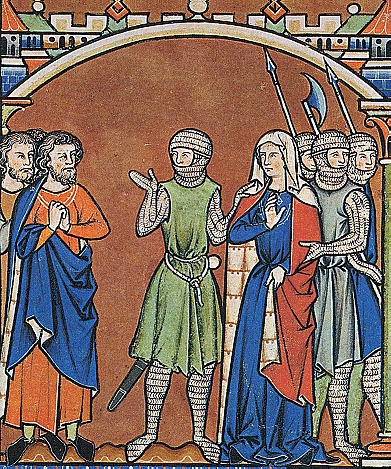
Abner (in green) taking Michal away from Paltiel (Morgan Bible, 1240s).

In the Hebrew Bible, Abner (Hebrew: אַבְנֵר ʾAḇnēr) was the cousin of King Saul and the commander-in-chief of his army.[1] His name also appears as אבינר בן נר‎ "Abiner son of Ner", where the longer form Abiner means "my father is Ner".[2]

Biblical narrative

[edit]

Abner is initially mentioned incidentally in Saul's history,[3] first appearing as the son of Ner, Saul's uncle, and the commander of Saul's army. He then comes to the story again as the commander who introduced David to Saul following David's killing of Goliath. He is not mentioned in the account of the disastrous battle of Gilboa when Saul's power was crushed. Seizing the youngest but only surviving of Saul's sons, Ish-bosheth, also called Eshbaal, Abner set him up as king over Israel at Mahanaim, east of the Jordan. David, who was accepted as king by Judah alone, was meanwhile reigning at Hebron, and for some time war was carried on between the two parties.[4]

The only engagement between the rival factions told at length was preceded by an encounter at Gibeon between 12 chosen men from each side, in which all 24 seem to have perished.[5][a] In the general engagement which followed, Abner was defeated and put to flight. He was closely pursued by Asahel, brother of Joab, who is said to have been "light of foot as a wild roe".[6] As Asahel would not desist from the pursuit, though warned, Abner was compelled to slay him in self-defense, planting his spear in the ground and allowing Asahel to impale himself. This originated a deadly feud between the leaders of the opposite parties, for Joab, as next of kin to Asahel, was by the law and custom of the country the avenger of his blood.[4] However, according to Josephus, in Antiquities, book 7, chapter 1, Joab had forgiven Abner for the death of his brother, Asahel, the reason being that Abner had slain Asahel honorably in combat after he had first warned Asahel and tried to knock the wind out of him with the butt of his spear.

Abner with Rizpah

For some time afterward, the war was carried on, the advantage being invariably on the side of David. At length, Ish-bosheth lost the main prop of his tottering cause by accusing Abner of sleeping with Rizpah,[7] one of Saul's concubines, an alliance which, according to contemporary notions, would imply pretensions to the throne.[8]

Abner was indignant at the rebuke, and immediately opened negotiations with David, who welcomed him on the condition that his wife Michal should be restored to him. This was done, and the proceedings were ratified by a feast. Almost immediately after, however, Joab, who had been sent away, perhaps intentionally, returned and slew Abner at the gate of Hebron. The ostensible motive for the assassination was a desire to avenge Asahel, and this would be a sufficient justification for the deed according to the moral standard of the time (although Abner should have been safe from such a revenge killing in Hebron, which was a City of Refuge). The conduct of David after the event was such as to show that he had no complicity in the act, though he could not venture to punish its perpetrators.[9][4]

David had Abner buried in Hebron, as stated in 2 Samuel 3:31–32,[10] "And David said to all the people who were with him, 'Rend your clothes and gird yourselves with sackcloth, and wail before Abner.' And King David went after the bier. And they buried Abner in Hebron, and the king raised his voice and wept on Abner's grave, and all the people wept."[11]

Shortly after Abner's death, Ish-bosheth was assassinated as he slept,[12] and David became king of the reunited kingdoms.[13]

Rabbinical literature

[edit]

Midrashic writings establish Abner as the son of the Witch of En-dor (Pirḳe R. El. xxxiii.), and the hero par excellence in the Haggadah (Yalḳ., Jer. 285; Eccl. R. on ix. 11; Ḳid. 49b). Conscious of his extraordinary strength, he exclaimed: "If I could only catch hold of the earth, I could shake it" (Yalḳ. l.c.)—a saying which parallels the famous utterance of Archimedes, "Had I a fulcrum, I could move the world." According to the Midrash (Eccl. R. l.c.) it would have been easier to move a wall six yards thick than one of the feet of Abner, who could hold the Israelitish army between his knees. Yet when his time came, Joab smote him. But even in his dying hour, Abner seized his foe like a ball of thread, threatening to crush him. Then the Israelites came and pleaded for Joab's life, saying: "If thou killest him we shall be orphaned, and our women and all our belongings will become a prey to the Philistines." Abner answered: "What can I do? He has extinguished my light" (has wounded me fatally). The Israelites replied: "Entrust thy cause to the true judge [God]." Then Abner released his hold upon Joab and fell dead to the ground (Yalḳ. l.c.).

The rabbis agree that Abner deserved this violent death, though opinions differ concerning the exact nature of the sin that entailed so dire a punishment on one who was, on the whole, considered a "righteous man" (Gen. R. lxxxii. 4). Some reproach him that he did not use his influence with Saul to prevent him from murdering the priests of Nob (Yer. Peah, i. 16a; Lev. R. xxvi. 2; Sanh. 20a)—convinced as he was of the innocence of the priests and of the propriety of their conduct toward David, Abner holding that as leader of the army David was privileged to avail himself of the Urim and Thummim (I Sam. xxii. 9–19). Instead of contenting himself with passive resistance to Saul's command to murder the priests (Yalḳ., Sam. 131), Abner ought to have tried to restrain the king. Others maintain that Abner did make such an attempt, but in vain, and that his one sin consisted in that he delayed the beginning of David's reign over Israel by fighting him after Saul's death for two years and a half (Sanh. l.c.). Others, again, while excusing him for this—in view of a tradition founded on Gen. xlix. 27, according to which there were to be two kings of the house of Benjamin—blame Abner for having prevented a reconciliation between Saul and David on the occasion when the latter, in holding up the skirt of Saul's robe (I Sam. xxiv. 11), showed how unfounded was the king's mistrust of him. Saul was inclined to be pacified; but Abner, representing to him that David might have found the piece of the garment anywhere—possibly caught on a thorn—prevented the reconciliation (Yer. Peah, l.c., Lev. R. l.c., and elsewhere). Moreover, it was wrong in Abner to permit Israelitish youths to kill one another for sport (II Sam. ii. 14–16). No reproach, however, attaches to him for the death of Asahel, since Abner killed him in self-defense (Sanh. 49a).

It is characteristic of the rabbinical view of the Bible narratives that Abner, the warrior pure and simple, is styled "Lion of the Law" (Yer. Peah, l.c.), and that even a specimen is given of a halakic discussion between him and Doeg as to whether the law in Deut. xxiii. 3 excluded Ammonite and Moabite women from the Jewish community as well as men. Doeg was of the opinion that David, being descended from the Moabitess Ruth, was not fit to wear the crown, nor even to be considered a true Israelite; while Abner maintained that the law affected only the male line of descent. When Doeg's dialectics proved more than a match for those of Abner, the latter went to the prophet Samuel, who not only supported Abner in his view, but utterly refuted Doeg's assertions (Midr. Sam. xxii.; Yeb. 76b et seq.).

One of the most prominent families (Ẓiẓit ha-Kesat) in Jerusalem in the middle of the first century of the common era claimed descent from Abner (Gen. R. xcviii.).[14]

Tomb of Abner

[edit]

The site known as the Tomb of Abner is located not far from the Cave of the Patriarchs in Hebron and receives visitors throughout the year. Many travelers have recorded visiting the tomb over the centuries.

David and the tomb of Abner. Artist unknown. 19th century.

Benjamin of Tudela, who began his journeys in 1165, wrote in the journal, "The valley of Eshkhol is north of the mountain upon which Hebron stood, and the cave of Makhpela is east thereof. A bow-shot west of the cave is the sepulchre of Abner the son of Ner."[15]

A rabbi in the 12th century records visiting the tomb as reprinted in Elkan Nathan Adler's book Jewish Travellers in the Middle Ages: 19 Firsthand Accounts.[16] The account states, "I, Jacob, the son of R. Nathaniel ha Cohen, journeyed with much difficulty, but God helped me to enter the Holy Land, and I saw the graves of our righteous Patriarchs in Hebron and the grave of Abner the son of Ner." Adler postulates that the visit must have occurred prior to Saladin's capture of Jerusalem in 1187.

Rabbi Moses Basola records visiting the tomb in 1522. He states, "Abner's grave is in the middle of Hebron; the Muslims built a mosque over it."[17] Another visitor in the 1500s states that "at the entrance to the market in Hebron, at the top of the hill against the wall, Abner ben Ner is buried, in a church, in a cave." This visit was recorded in Sefer Yihus ha-Tzaddiqim (Book of Genealogy of the Righteous), a collection of travelogues from 1561. Abraham Moshe Lunz reprinted the book in 1896.[18]

Menahem Mendel of Kamenitz, considered the first hotelier in the Land of Israel,[19] wrote about the Tomb of Abner is his 1839 book Korot Ha-Itim, which was translated into English as The Book of the Occurrences of the Times to Jeshurun in the Land of Israel. He states, "Here I write of the graves of the righteous to which I paid my respects. Hebron – Described above is the character and order of behavior of those coming to pray at the Cave of ha-Machpelah. I went there, between the stores, over the grave of Avner ben Ner and was required to pay a Yishmaeli – the grave was in his courtyard – to allow me to enter."[20]

The author and traveler J. J. Benjamin mentioned visiting the tomb in his book Eight Years in Asia and Africa (1859, Hanover). He states, "On leaving the Sepulchre of the Patriarchs, and proceeding on the road leading to the Jewish quarter, to the left of the courtyard, is seen a Turkish dwelling house, by the side of which is a small grotto, to which there is a descent of several steps. This is the tomb of Abner, captain of King Saul. It is held in much esteem by the Arabs, and the proprietor of it takes care that it is always kept in the best order. He requires from those who visit it a small gratuity."[21]

The British scholar Israel Abrahams wrote in his 1912 book The Book of Delight and Other Papers, "Hebron was the seat of David's rule over Judea. Abner was slain here by Joab, and was buried here – they still show Abner's tomb in the garden of a large house within the city. By the pool at Hebron were slain the murderers of Ishbosheth..."[22]

Tomb of Abner

Over the years the tomb fell into disrepair and neglect. It was closed to the public in 1994. In 1996, a group of 12 Israeli women filed a petition with the Supreme Court requesting the government to reopen the Tomb of Abner.[23] More requests were made over the years[24] and eventually arrangements were made to have the site open to the general public[dubiousdiscuss] on ten days throughout the year corresponding to the ten days that the Isaac Hall of the Cave of the Patriarchs is open.[25] In early 2007 new mezuzot were affixed to the entrance of the site.[26]

[edit]
  • 1960, David and Goliath (film) – Abner is portrayed by Massimo Serato. In this version, Abner tries to murder David (Ivica Pajer) when he returns in triumph after killing Goliath. However, here Abner is slain by King Saul (Orson Welles).
  • 1961, A Story of David (film) – Abner is portrayed by Welsh actor David Davies.
  • 1976, The Story of David (television series) – Younger version of Abner is portrayed by Israeli actor Yehuda Efroni. Older version of Abner is portrayed by British actor Brian Blessed.
  • 1985, King David (film) – Abner is portrayed by English actor John Castle. King David portrayed by Richard Gere.
  • 1997, King David (musical) – written by Tim Rice and Alan Menken. Abner is portrayed by American actor Timothy Shew.
  • 1997, David (television drama) – Abner is portrayed by Richard Ashcroft.
  • 2009, Kings (television series) – Abner portrayed by Wes Studi as General Linus Abner. The series is set in a multi-ethnic Western culture similar to that in the present-day United States, but with characters drawn from the Bible.
  • 2012, Rei Davi (Brazilian television series) – Abner is portrayed by Iran Malfitano.
  • 2025, House of David – Abner is portrayed by Oded Fehr

Notes

[edit]

References

[edit]
[edit]
Revisions and contributorsEdit on WikipediaRead on Wikipedia
from Grokipedia
Abner son of Ner (Hebrew: אַבְנֵר בֶּן־נֵר ʾAḇnēr ben Nēr) was the first cousin of , the inaugural king of the united Kingdom of , and served as commander-in-chief of his army, as detailed in the Hebrew Bible's . A Benjamite by tribal affiliation, Abner played a pivotal military role during Saul's reign, including oversight of forces in conflicts with the . Following Saul's death at the Battle of , Abner anointed Saul's son as king over the remaining Israelite territories excluding Judah, sparking a with , who had been anointed as Saul's successor. This period saw Abner lead Ish-bosheth's forces, notably in the Battle of Gibeon where he killed Asahel, brother of David's commander , in during pursuit. Eventually defecting to amid disputes with Ish-bosheth, Abner negotiated terms for David's kingship over all but was assassinated by in revenge for Asahel's death, prompting to publicly mourn him as a great leader whose loss prolonged national strife.

Identity and Background

Genealogy and Role in Saul's Court

Abner was the son of Ner, a Benjamite from the same tribal lineage as Israel's first king, . According to 1 Samuel 14:50–51, Ner served as 's uncle, with Kish identified as 's father and both Ner and Kish as sons of Abiel, thereby positioning Abner as 's first and reinforcing their shared within the Benjaminite . This relation provided Abner with inherent access to 's inner during the establishment of the monarchy. A parallel genealogy in 1 Chronicles 9:35–39 lists Ner as the father of Kish (and thus of Saul), alongside Abner as Ner's son, which would render Abner Saul's rather than ; biblical scholars attribute such variances to potential name repetitions (e.g., two individuals named Ner), customs, or condensed ancestral listings typical of ancient Hebrew records, without resolving to contradiction in core lineage. Abner held the critical role of of Saul's army, as explicitly stated in 1 Samuel 14:50, entrusting him with oversight of military operations at the monarchy's inception around 1020 BCE. In this capacity, he functioned as a stabilizing force amid the challenges of unifying disparate Israelite tribes against Philistine incursions, supporting Saul's efforts to centralize authority beyond the decentralized judge-led confederacy of prior centuries.

Name Etymology and Symbolic Interpretations

The name Abner, rendered in Hebrew as אֲבִינֵר (ʾĂḇînēr), originates from the combination of אָב (ʾāḇ), denoting "," and נֵר (nēr), signifying "lamp" or "," yielding the meaning "my father is a lamp" or "father of light." This theophoric structure is typical of ancient Hebrew names, where "" often implies divine or ancestral authority, and "lamp" evokes notions of guidance, enlightenment, or divine presence, as lamps symbolized illumination in ancient Near Eastern contexts. Traditional interpretations link the name's connotation of light to Abner's pivotal military and advisory roles, portraying him as a stabilizing "light" amid Israel's monarchical upheavals, such as his command under and facilitation of Ish-bosheth's kingship, though the biblical texts themselves prioritize narrative events over explicit etymological symbolism. Some analyses suggest the "father of light" aspect underscores paternal-like leadership and strategic insight, aligning with his depiction as Saul's cousin and army chief who navigated alliances and conflicts, yet such readings remain inferential rather than directly attested in scripture. These symbolic associations, while not universally emphasized in primary sources, highlight how Hebrew could encode aspirational qualities of and direction without implying deterministic character traits.

Military Service under Saul

Command of Saul's Army

Abner ben Ner, Saul's paternal cousin, was appointed commander of the Israelite army early in the king's reign, as recorded in 1 Samuel 14:50, which identifies him as the son of Ner, Saul's uncle, and places him at the head of military operations amid escalating Philistine threats. This position underscored Abner's central role in organizing tribal levies into a more cohesive force, transitioning from decentralized clan-based warfare to a structure capable of sustained campaigns, as evidenced by the army's mobilization at Micmash and during the Philistine incursions described in 1 Samuel 13–14. His leadership facilitated rapid responses to enemy raids, maintaining Israel's defensive posture against Philistine dominance in the coastal plains and hill country. In the Philistine wars, Abner's command proved instrumental in key engagements, such as the pursuit and rout of Philistine forces following major clashes, where Israelite troops under his oversight recovered territory and inflicted casualties on superior-equipped foes. For instance, during the campaign at Michmash, the army's coordinated ambush and exploitation of panic among Philistine garrisons highlighted tactical discipline, with Abner overseeing the integration of Saul's select troops—numbering around 3,000 elite fighters—into effective maneuvers that disrupted enemy supply lines and chariot divisions. These actions demonstrated Abner's organizational skills in a pre-professional army reliant on levies, enabling Saul to centralize military authority and reduce vulnerabilities from fragmented tribal responses, a causal shift toward monarchic consolidation evident in the text's depiction of standing garrisons over ad hoc assemblies. Abner's loyalty to Saul remained steadfast throughout these conflicts, prioritizing the king's directives in army deployment despite internal pressures like prophetic rebukes or logistical strains from iron weapon shortages. His oversight extended to camp security and strategic positioning, as seen in 1 Samuel 26, where, though criticized for a lapse in vigilance during a nighttime , he exemplified the essential for holding Philistine advances at bay until Saul's final years. This era of service established Abner as a competent general whose efforts preserved Israelite sovereignty amid persistent external aggression, without reliance on foreign alliances or mercenaries.

Introduction of David to Saul and Early Interactions

Following David's defeat of the Philistine champion , Saul, who had observed the confrontation, directed a query to Abner, the of his : "Abner, whose son is that young man?" Abner admitted ignorance of David's lineage, responding, "As your soul lives, O , I do not know," and Saul instructed him to investigate. This exchange positioned Abner as Saul's immediate military , tasked with identifying promising warriors amid battlefield developments. Upon David's return from the victory, Abner fulfilled the order by bringing the youth—still holding Goliath's severed head—before , facilitating the formal audience. David then declared, "I am the son of your servant Jesse the Bethlehemite," integrating him further into the royal sphere. Abner's role here underscored his function as an intermediary between the field command and the throne, bridging the warrior class with monarchical oversight in a non-adversarial context. The account in 1 Samuel 17:55–58 appears to conflict with the preceding chapter 16:14–23, where David enters 's service as a harpist to soothe the king's troubled spirit and as an armor-bearer, implying prior familiarity with both and Abner. Biblical scholars often explain this as reflecting the book's composite nature, drawing from distinct traditions: one portraying David's gradual court entry (chapter 16) and another his abrupt emergence as an unknown prodigy post-Goliath (chapter 17). Others propose 's question targeted David's paternal lineage specifically—for potential rewards, alliances, or tribal affiliations—rather than his overall identity, preserving coherence without assuming court-wide amnesia. In either view, Abner's involvement highlights his observational duty without evidencing early personal tensions with David, who soon gained favor through valor and service.

Transition After Saul's Death

Installation of Ish-bosheth as King

Following the death of Saul and his sons Jonathan, Abinadab, and Malchishua at the Battle of , Abner, Saul's cousin and army commander, retreated eastward across the with surviving Saulide forces and family members, including Saul's son (also known as Eshbaal in parallel accounts). This withdrawal to in served a strategic purpose, positioning the group in a fortified Transjordanian city beyond immediate Philistine control, which had intensified after their victory at Gilboa and occupation of key western sites like Beth-shan. In , Abner proclaimed king, extending authority over , the Ashurites, Jezreel, , Benjamin, and claiming all , though Judah aligned separately with . , approximately forty years old at the time, thus initiated a rival kingship rooted in Benjaminite and northern tribal loyalties, with Abner effectively acting as given Ish-bosheth's limited personal prominence in prior narratives. This installation, sustaining Saulide rule for roughly two years, demonstrated Abner's pragmatic exercise of military influence to preserve dynastic continuity amid fragmented tribal allegiances, countering any presumption of unified Israelite consensus for immediate Davidic dominance. The named territories reflect empirical regional backing, particularly from Benjamin (Saul's tribe) and adjacent areas, highlighting causal tribal divisions rather than ideological inevitability in the .

Battle of Gibeon and Killing of Asahel

Abner, commander of Ish-bosheth's forces, led his troops from to Gibeon, where they encountered and David's servants assembled at the pool of Gibeon. Abner proposed a representative between twelve young men from each side to settle the rivalry without full-scale engagement, stating, "Let the young men arise and compete before us." This turned lethal, with all twenty-four participants killing one another, escalating into a broader melee where Ish-bosheth's troops initially prevailed but soon fled toward . David's forces, including , Abishai, and the swift-footed , pursued the retreating army to the hill of Ammah. singled out Abner for pursuit, ignoring terrain and pleas to desist, as Abner twice urged him to veer off and engage lesser foes, warning, "Why should I strike you to the ground? How then could I lift up my face to your brother ?" When persisted, Abner drove the butt end of his spear backward through 's midsection in a defensive maneuver, killing him on the spot and leaving the body beside the road. This act aligned with of ancient Near Eastern conflicts, where relentless pursuit of a superior invited lethal response, particularly to avert ensuing blood feuds through unnecessary . The battle concluded with Abner rallying his men into a defensive formation resembling a and appealing to to halt the slaughter, questioning, "Shall the sword devour forever? Do you not know that the end will be bitter?" agreed, ending the engagement; casualties totaled 360 dead from Benjamin and Ish-bosheth's forces against 20 from David's side, including , underscoring the tactical disparity and Abner's efforts to contain the civil strife. The disproportionate losses on Abner's side reflected defensive positioning amid retreat, as his troops withdrew across the to under cover of night. Asahel's death, though justifiable as against an unyielding aggressor, planted seeds of vendetta, as and Abishai later cited it in retaliatory actions.

Defection to David and Political Maneuvering

Reasons for Switching Allegiance

In the midst of the between the houses of and , confronted over allegations of sexual relations with , one of 's concubines. This accusation, made explicitly during a period when Abner "was making himself strong in the house of ," implied an attempt by Abner to claim royal authority, as consorting with a king's concubine symbolized succession or usurpation in ancient Near Eastern . Abner's furious response—"So may do to Abner and more if I do not accomplish for what the has sworn to him"—marked the immediate catalyst for his , framing the personal insult as a breach that eroded his to . The timing of the accusation, amid Abner's growing influence and the weakening Saulide position after military setbacks like the Battle of Gibeon, underscores a pragmatic : Ish-bosheth's challenge threatened Abner's military and political leverage within the northern tribes. Abner then initiated contact with David, invoking the prophetic anointing of David by and God's oath to transfer the kingdom from Saul's house to 's as the basis for . This appeal, while rooted in earlier divine declarations, served Abner's adaptation to the evident decline of Ish-bosheth's viability, evidenced by faltering tribal support and 's consolidating power in Judah and beyond. Scholars note that such shifts in allegiance reflect the fluid tribal dynamics of Israel, where commanders like Abner prioritized viable leadership amid Saulide fragmentation rather than ideological fidelity.

Negotiations with David

Abner initiated contact with by dispatching messengers to , where held court, proposing a covenant with the declaration, "To whom does the land belong? Make your covenant with me, and indeed my hand shall be with you to bring all to you." consented to the alliance on the condition that , Saul's daughter and 's first wife—whom he had married for the bride price of one hundred Philistine foreskins—be returned to him, thereby reinforcing his dynastic ties to Saul's house. Abner then secured Ish-bosheth's approval to retrieve from her husband Paltiel son of Laish, who accompanied her partway before being sent back, underscoring Abner's influence over the northern regime despite Ish-bosheth's nominal kingship. Subsequently, Abner traveled covertly to accompanied by twenty men from his entourage, where hosted them with a feast and formalized the pact, highlighting Abner's strategic value as army commander in potentially unifying the tribes under . During the meeting, Abner pledged to assemble the elders of and the —key power bases loyal to Saul's lineage—to ratify the transfer of kingship to , leveraging his military authority to facilitate broader allegiance without immediate confrontation. David escorted Abner and his party from the city, sending them forth in , a that temporarily bridged the divide between the rival factions amid ongoing civil strife. This exchange positioned Abner as a pivotal broker in the shift toward pan-tribal , contingent on his ability to deliver northern support through command over Saul's former forces.

Death and Immediate Aftermath

Assassination by Joab

Upon Abner's departure from after negotiating a covenant with , , unaware of the reconciliation or acting despite it, dispatched messengers to retrieve Abner from the cistern of Sirah outside the city, luring him back under undisclosed pretenses. At the gate of , drew Abner aside for private conversation and stabbed him in the stomach, resulting in his immediate death. This location held significance, as served as a and site of refuge, where blood vengeance was traditionally restricted to prevent cycles of retaliation within protected bounds. The biblical narrative explicitly attributes Joab's action to vengeance for the slaying of his brother during the skirmish at Gibeon, where Abner had thrust a through Asahel in after repeated warnings to desist from pursuit. Joab's brother Abishai collaborated in the killing, aligning with tribal norms of collective kinship responsibility in blood redemption, known as go'el ha-dam (avenger of blood), which obligated kin to exact retribution for violent deaths, even those occurring in wartime contexts. Such practices reflected broader ancient Near Eastern customs where unresolved feuds perpetuated intergenerational violence unless mediated by asylum or covenant. Commentators note a potential secondary motive in Joab's fear that Abner's and military stature posed a direct challenge to his own command under , though the text prioritizes the fraternal vendetta without endorsing or elaborating on political intrigue. The underscored the tension between personal honor codes and emerging monarchical authority, as Joab bypassed 's oversight in pursuing retribution outside formal battle.

David's Response and Burial

Upon learning of Abner's assassination by , David instructed all his servants to mourn, tear their clothes, gird themselves with sackcloth, and lament before Abner as he was carried through . David himself fasted until evening, refusing food despite entreaties from the people of , declaring his refusal to eat until he had shown proper grief for Abner's death. This public display of mourning served to publicly dissociate David from the act, positioning him as blameless while appealing to Abner's supporters among the northern tribes. The people observed David's fasting and questioned it, to which he responded that he would not partake in sustenance while Abner lay unburied, emphasizing the warrior's stature. David composed a , proclaiming, "Should Abner die as a fool dies? Your hands were not bound, nor your feet put into fetters; as one falls before the wicked, you have fallen," contrasting Abner's honorable death with that of a common criminal slain in . All the people and wept bitterly over Abner, underscoring his significant influence and the widespread recognition of his military and political prominence. Abner's body was buried in , with following the and the entire assembly of present, evidencing the broad attendance that reflected Abner's stature across tribes. In a subsequent address to his servants, asserted his and his kingdom's innocence in the matter, stating, "I and my kingdom are guiltless before the forever from the blood of Abner the son of Ner," while acknowledging on the perpetrator. He invoked a on Joab's house for the unpunished killing, wishing afflictions like and feebleness upon Joab's descendants, yet refrained from immediate execution of Joab, citing his indispensable role as a amid ongoing conflicts. This calculated restraint balanced symbolic condemnation with pragmatic retention of Joab's forces, aiding 's consolidation of power without alienating key allies.

Traditional and Scholarly Interpretations

Rabbinical and Midrashic Expansions

Rabbinical sources present Abner as a figure of significant intellectual and moral capacity, yet ultimately culpable for his failings. Midrashic on 1 Samuel 24 depicts him as a " in learning," underscoring his deep knowledge and scholarly stature, which David acknowledges by addressing him as "my father" in rebuke. This portrayal emphasizes Abner's potential for spiritual elevation, evidenced by his eventual defection to David as an act of partial repentance for prior loyalties to . However, Talmudic analysis critiques Abner's moral lapses, attributing his violent death to specific sins of omission. 92a holds him accountable for failing to restrain Saul's persecution of , while Yoma 22b condemns his silence during Saul's slaughter of the priests at Nob, interpreting these delays in rebuke as complicity that forfeited his merit despite military prowess. Such views balance admiration for his capabilities against demands for proactive righteousness, rejecting unqualified praise. Certain midrashic traditions introduce legendary elements diverging from the biblical core, such as Pirke de-Rabbi 33's claim that Abner was the son of the , linking his origins to necromantic lore absent from Scripture. This accretion, while illustrating interpretive creativity, constitutes non-historical rather than authoritative expansion, as rabbinic consensus prioritizes scriptural fidelity over such embellishments. Overall, these expansions highlight Abner's tragic archetype: a capable leader whose unheeded precluded full redemption.

Historicity and Archaeological Context

The historicity of Abner as Saul's military commander and relative rests primarily on the detailed narrative in the Books of 1 and 2 Samuel, which depict him leading the Saulide faction amid tribal conflicts around 1020–1000 BCE during the transition from tribal confederation to monarchy. No contemporary extra-biblical inscriptions or artifacts directly name Abner in a narrative context, reflecting the scarcity of monumental records from early , where highland settlements produced limited compared to contemporaneous lowland or coastal cultures. A Hebrew bulla inscribed with ʾAb-ner, dated to the BCE and excavated at Shiloh, attests to the name's use in Judahite or Israelite administration, though its link to the biblical figure remains unproven due to common . Archaeological evidence from Iron Age I sites supports the broader plausibility of the Saulide-Davidic strife as reflecting real geopolitical shifts, including Philistine incursions prompting centralized military responses and the consolidation of Benjaminite and Judahite tribes. Fortified settlements like , radiocarbon-dated to circa 1025–975 BCE, indicate emerging administrative hierarchies with masonry and storage facilities consistent with a nascent monarchy's needs, countering minimalist arguments that dismiss 10th-century as anachronistic. The absence of direct Saulide artifacts aligns with the period's —modest highland villages yielding and collared-rim jars rather than royal stelae—yet the narrative's depiction of inter-tribal warfare at Gibeon fits the tactical realities of chariot-poor forces relying on clashes in contested regions. Scholarly assessments, drawing on first-principles of kinship-based and post-crisis power dynamics, view Abner's maneuvers—sustaining Ish-bosheth's claim amid Saul's dynastic vacuum—as causally realistic for a fragmented tribal society lacking norms, rather than idealized fiction. While some maximalist reconstructions affirm a United kernel around 1000 BCE, evidenced by the Tel Dan Stele's reference to the "House of David" circa 850 BCE, debates persist over low vs. high chronologies; however, convergence on non-minimalist interpretations has grown with data from sites like Timna's copper production, suggesting Edomite subjugation feasible under Davidic expansion. This framework privileges the biblical account's empirical alignment with settlement patterns and conflict over skeptical denials unsubstantiated by contradictory finds, acknowledging academia's occasional overemphasis on later Assyrian-era projections while grounding Saulide events in verifiable transitions.

Legacy and Cultural Impact

Religious Significance Across Traditions

In Jewish , Abner is elevated beyond his biblical role as a military commander, with depicting him as a profound scholar known as the "Lion of the Law," whose reputation extended globally. Texts such as the (Yer. Peah) and Babylonian Talmud ( 17a) attribute to him expertise in Jewish law, portraying him as Saul's instructor in and crediting his defection with enabling Israel's unification under , the prophesied messianic precursor. Yet, midrashic interpretations critique Abner's moral hesitancy, noting his failure to rebuke Saul's persecutions earlier or to atone fully for killing David's nephew , positioning him as a flawed of divine will in contrast to David's and decisiveness. This dual valuation underscores Abner's instrumental role in covenantal history without absolving his tactical ambiguities, grounded in scriptural rather than hagiographic idealization. Christian theological treatments of Abner remain peripheral, lacking the typological depth applied to figures like or , but serving in homiletic contexts to exemplify the tensions of allegiance amid divine sovereignty. Commentaries often highlight Abner's pragmatic shift to as an acknowledgment of God's anointed, drawing parallels to calls for discerning true authority over personal or tribal loyalties, as in 2 Samuel 3's negotiations. Sermons, such as those cautioning against incomplete submission to revealed truth, portray Abner negatively for prioritizing political calculus over prophetic insight, with his assassination by illustrating unchecked vengeance's disruption of redemptive progress (2 Samuel 3:27-39). Such readings eschew unsubstantiated messianic prefigurations, emphasizing instead empirical lessons on loyalty's consequences within the Davidic narrative's historical framework, without extending to Christological absent textual warrant. Islamic tradition contains no direct references to Abner, as Quranic and accounts of Israelite history focus on prophets like Dawud () and (Saul) while omitting secondary military figures like Abner ben Ner. Any purported connections in later folklore lack attestation in primary sources, rendering claims of significance speculative and unverifiable.

Representations in Literature, Film, and Modern Culture

In cinematic adaptations of biblical stories, Abner appears as a secondary figure, often streamlined to highlight military loyalty and intrigue rather than his full narrative arc. The 1960 film David and Goliath, directed by Richard Pottier and Ferdinando Baldi, casts as Abner, depicting him as Saul's scheming captain who orchestrates plots against the young , including sending him into Philistine territory under false pretenses of . This portrayal amplifies Abner's antagonism, diverging from textual nuances of his later to . Similarly, the 1976 television miniseries The Story of David, starring as , features as the elder Abner (with Yehuda Efroni as the younger), framing him as a key player in Saul's court amid rivalries with Joab, culminating in David's public mourning of his assassination. The 1985 epic King David, directed by and starring , includes as Abner, emphasizing his command role in early conflicts. More contemporary productions continue this trend of simplification. In the 2025 Amazon Prime series House of David, portrays Abner as Saul's steadfast army commander, focusing on his tactical decisions during tribal wars while downplaying interpretive ambiguities in his . These adaptations generally fidelity to Abner's prowess and by treachery but condense his negotiations and honors, prioritizing dramatic tension over exhaustive scriptural detail. In non-biblical literature and pop culture, Abner's name persists as a cultural referent without direct narrative ties. The long-running comic strip Li'l Abner, created by Al Capp and syndicated from 1934 to 1977, centers on a brawny, naive hillbilly protagonist from the satirical backwoods enclave of Dogpatch; while the character's name echoes the biblical figure—potentially as a phonetic or thematic nod to strength and simplicity—its storylines of absurd social commentary and romance bear no substantive connection. Occasional modern allusions invoke Abner symbolically in discussions of leadership transitions or betrayal in military histories, such as analogies to pragmatic commanders navigating civil strife, though these remain anecdotal rather than canonical reinterpretations.

References

Add your contribution
Related Hubs
User Avatar
No comments yet.