Hubbry Logo
CalcataCalcataMain
Open search
Calcata
Community hub
Calcata
logo
8 pages, 0 posts
0 subscribers
Be the first to start a discussion here.
Calcata
Calcata
from Wikipedia

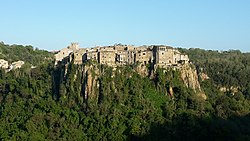
Calcata (locally Cargàta)[3] is a comune and town in the Province of Viterbo in the Italian region Lazio, located 47 km (29 miles) north of Rome by car, overlooking the valley of Treja [it] river.

Key Information

Calcata borders the following municipalities: Faleria, Magliano Romano, Mazzano Romano, Rignano Flaminio.

In the 1930s, the hill town's fortified historic centre was condemned by the government for fear that the volcanic cliffs the ancient community was built upon would collapse. Local residents moved to nearby Calcata Nuova. In the 1960s, the emptied historical centre began to be repopulated by artists and hippies who squatted in its medieval stone and masonry structures. Many of the squatters eventually purchased their homes, the government reversed its condemnation order, and the residents of what had become an artistic community began restoring the ancient town. This trend has continued. The town has a thriving artistic community which was described in The New York Times in 2007 as what "may be the grooviest village in Italy, home to a wacky community of about 100 artists, bohemians, aging hippies and New Age types."[4] The love of artists for this place, together with the interest of the inhabitants of nearby Rome, who come here to relax on weekends, has made this village one of the most enchanting and culturally vibrant in central Italy.

The historical centre now includes restaurants, cafes, and art galleries.

Main sights

[edit]
  • Old Town
  • Palazzo Baronale degli Anguillara, dating from the 10th to 13th century but restored from 1995.[5][6]
  • Church of Santissimo Nome di Gesù, dating from the 14th century but restored from 1793.
  • Troni di Calcata (Thrones of Calcata), tuff sculptures by artist Costantino Morosin.
  • Church of San Cornelio e San Cipriano in Calcata Nuova designed by architect Paolo Portoghesi.[7]
  • Sub-urban Park of Treja Valley.
  • Remains of the Faliscan temple of Monte Li Santi (outside the village).
  • Remains of the Faliscan town of Narce (outside the village).
  • Opera Bosco - Museum of Art in Nature. The museum was opened to the public in 1996 by a collective of artists led by Anne Demijttenaere and Costantino Morosin. It features about 50 artworks made only with natural material from the wood. The museum is a path through a lush forest in which artworks arise.

Holy Prepuce of Calcata

[edit]

According to legends of the village of Calcata, in 1527 a soldier in the German army sacking Rome looted the Sanctum sanctorum. When he was eventually captured in the village, he hid the jeweled reliquary containing the Holy Prepuce in his cell, where it was discovered in 1557. It was officially venerated by the Catholic Church in Calcata since that time, with the Vatican's offering a ten-year indulgence to pilgrims. Calcata became a popular site for pilgrimage.[8]

Again in 1856, however, the Charroux Abbey rediscovered what it considered to be the true Holy Prepuce, which it claimed to have received from Charlemagne. It had been lost for centuries. The rediscovery led to a clash with people over the established Holy Prepuce of Calcata, which had been officially venerated by the Church for hundreds of years.[8] In 1900, the Catholic Church solved the dilemma by ruling that anyone writing or speaking of the Holy Prepuce would be excommunicated with the status of a toleratus. In 1954, after much debate, the punishment was changed to the harsher degree of excommunication with the status of a vitandus (shunned). Later the Second Vatican Council removed the Day of the Holy Circumcision from the church calendar in its review of holy days and obligations.[8]

In reality, it was more than two years before 11 October 1962, the date when the Second Vatican Council began, that a 25 July 1960 decree of Pope John XXIII[9] enacted a wide-ranging revision of the General Roman Calendar, which included changing the name of the 1 January feast from "Circumcision of the Lord and Octave of the Nativity" to "Octave of the Nativity", with no change of the Gospel reading about the circumcision of the child Jesus.[10]

Roger Peyrefitte, in his novel Les Clés de Sainte Pierre (1955),[11] written using information attributed to Mgr Léon Gromier (1879–1965), Canon of St. Peter's, gives details of the 1954 discussion of such relics and of a pilgrimage to Calcata, including what appears to be an authentic description of the relic as: "two greyish membranes with an undertone of pink, curled into balls" lying on a crystal disk.

Calcata continued to stage an annual procession on the Day of the Holy Circumcision to honor the relic. In 1983, however, parish priest Dario Magnoni announced, "This year, the holy relic will not be exposed to the devotion of the faithful. It has vanished. Sacrilegious thieves have taken it from my home." He had reportedly kept it in a shoebox in the back of a wardrobe. Citing the Vatican's decree of excommunication, Magnoni refuses to further discuss the event, as does the Vatican. As a result, villagers' theories of the crime vary from theft for lucrative resale to an effort by the Vatican to quietly put an end to the practice it had attempted to end by excommunication years ago. Some residents speculate that Magnoni may have been the culprit.[8]

References

[edit]
[edit]
Revisions and contributorsEdit on WikipediaRead on Wikipedia
from Grokipedia
Calcata is a small medieval village and in the , in the region of , perched precariously on a cliff overlooking the densely wooded Treja Valley, about 40 kilometers north of . With a of approximately 900 residents as of 2025, it forms part of the Treja Valley Regional Park and is renowned for its preserved historic core, narrow cobblestone alleys, and bohemian atmosphere shaped by an influx of artists and eccentrics since the late . The area's human habitation dates back over 3,000 years to the Faliscan and Etruscan civilizations, with archaeological evidence including nearby necropolises and the ancient of Narce, which overlooked the Treja River and influenced the region's cultural development. During the medieval period, Calcata emerged as a fortified hilltop settlement under the control of noble families like the Anguillara, featuring crenellated walls, a baronial palace, and a housing relics such as the purported of Christ—believed to have been kept there until its mysterious disappearance in 1983. By , the village faced abandonment due to landslides and structural instability in the , prompting residents to relocate to the nearby Calcata Nuova; however, starting in the , a wave of countercultural squatters, artists, and enthusiasts restored the abandoned stone houses, reversing demolition orders and transforming Calcata into a vibrant haven for creativity, esoteric pursuits, and alternative lifestyles. Today, Calcata Vecchia (Old Calcata) captivates visitors with its subterranean dwellings, artisan workshops, art galleries like the open-air Opera Bosco, and a quirky blend of ancient and modern , including shops selling , cards, and handmade crafts, all set against the lush natural backdrop of the regional park's trails and Etruscan ruins. The village's revival has preserved its cultural and natural heritage, making it a unique destination that embodies Italy's transition from historical obscurity to contemporary artistic enclave.

Geography

Location and Topography

Calcata is a comune situated in the within the region of central Italy, approximately 47 km north of by road. Overlooking the valley of the Treja River, it lies at coordinates 42°13′N 12°25′E. The territory encompasses an area of 7.63 km² and shares borders with the adjacent municipalities of Faleria to the north and east, Mazzano Romano to the west, Magliano Romano to the south, and Rignano Flaminio to the east. Topographically, Calcata is perched atop a prominent cliff formed of , a porous characteristic of the region's , at an of 172 m above . This elevated position provides dramatic views of the surrounding Treja Valley, with its steep gorges and lush, forested slopes. The landscape's rugged terrain, shaped by ancient volcanic activity, has long influenced the site's defensiveness and isolation. The comune features two distinct settlements: Calcata Vecchia, the historic medieval village clinging to the tufa cliff's summit, and Calcata Nuova, a modern community established in the 1930s on the adjacent plateau about 2 km away. This division arose from the original site's geological vulnerabilities. The tufa formations, while architecturally significant, pose ongoing risks due to the rock's susceptibility to and landslides, which have caused cliff collapses and structural instability over time, notably prompting evacuations in the early 20th century.

Climate and Environment

Calcata experiences a hot-summer (Köppen Csa), marked by mild, wet winters and hot, dry summers. Average annual temperatures hover around 15°C, with July and August highs typically reaching 32°C and January lows averaging 5°C. totals approximately 800 mm yearly, concentrated in autumn and winter, while summers remain arid with fewer than 20 rainy days. Nestled within the Treja Valley Regional Park, Calcata's environment features diverse lush vegetation, including downy oak and hop hornbeam woodlands alongside Mediterranean maquis such as and . The park supports rich , with notable fauna including wild boars as the most common and various among the avian . Conservation efforts in the Treja Valley Regional Park, established in 1982, emphasize protecting the area's natural, landscape, and cultural heritage, including archaeological sites like Etruscan necropolises and extensive natural trails for . The underlying volcanic rock, porous in nature, enhances for local water sources while influencing soil permeability and nutrient retention.

History

Ancient Origins

The Treja Valley, where Calcata is situated, exhibits evidence of human presence dating back to the period, with small caves serving as shelters and possible worship sites. More substantial settlements emerged during the Middle around the 14th century BCE, characterized by high-ground villages adapted to the volcanic landscape for defensive purposes. By the 9th century BCE, during the , the area saw repopulation, establishing the foundations for later Faliscan communities amid the valley's strategic terrain. These prehistoric occupations are inferred from regional archaeological surveys in the Ager Faliscus, highlighting Calcata's role in early hilltop fortifications. Calcata's ancient significance is tied to the Faliscan civilization, which flourished from the 6th to 4th centuries BCE in the southern region, distinct from but influenced by neighboring Etruscans. The nearby settlement of Narce, located just south of Calcata on three hills (Narce, Monte Li Santi, and Pizzo Piede), served as a key Faliscan center established by the 8th century BCE, featuring walls, sanctuaries, and extensive necropolises with over 300 tombs containing votive offerings like masks and . These necropolises, including sites at La Petrina and I Tufi, indicate a vibrant funerary culture and trade networks, with Calcata likely functioning as a peripheral hilltop outpost for defense against incursions. The Faliscans maintained an Italic language and customs, such as worship of deities like Juno Curitis, separate from Etruscan traditions despite cultural exchanges in ceramics and religion during the 7th–6th centuries BCE. The transition to Roman dominance began in the late 4th century BCE, with the Faliscan territory progressively incorporated into Roman following conflicts with Etruscan allies. By the 3rd century BCE, after the Roman conquest of Falerii in 241 BCE—which ended a final Faliscan —the region was fully integrated into the , losing autonomy but benefiting from infrastructural developments. While direct Roman artifacts in Calcata itself are scarce, the broader Ager Faliscus saw enhanced connectivity through roads like the Via Amerina and elements of aqueduct systems supplying nearby settlements, facilitating administrative and economic ties to . This marked the end of the distinct Faliscan identity. With origins around the 10th century BCE, the region's communities evolved into Roman provincial life.

Medieval Development and the Holy Relic

During the Middle Ages, Calcata emerged as a fortified village perched on a tuff promontory, leveraging its natural defensive features shaped by millennia of erosion from the Treja River. Under the rule of the Anguillara family, a powerful baronial lineage in Latium from the 11th to 15th centuries, the settlement developed into a strategic stronghold. The family constructed the Baronial Palace around the 11th century, featuring a crenellated tower that served as a key defensive element, while medieval stone and tufa houses formed enclosing walls to protect against invasions by rival factions and external threats in the volatile Lazio region. This era marked Calcata's transition from an ancient Faliscan outpost to a feudal center, with the Anguillara enhancing its fortifications to consolidate control over surrounding territories. A pivotal moment in Calcata's medieval legacy occurred in 1557, when the —believed to be the foreskin from Jesus's circumcision—was discovered during renovations in a local or church setting. The relic had arrived in Calcata following the 1527 Sack of Rome, looted by a German who hid it upon his capture and imprisonment in the village. Venerated as a sacred relic, it was enshrined in the , constructed by the Anguillara around 1300, where the high altar was later adapted in 1600 to accommodate it in a dedicated niche. The relic's authenticity was affirmed by a series of reported miracles, including storms and perfumed mists, prompting the Church to grant a 10-year to pilgrims, which drew devotees from across and elevated Calcata to a renowned pilgrimage site. Annual processions on the Feast of the Circumcision further cemented its cultural significance, fostering regional fame and economic benefits through visitor influxes that supported local commerce and religious activities. The relic's prominence waned in the early following a 1900 papal decree by , which threatened for anyone writing or speaking about the , aiming to curb excessive relic veneration amid growing skepticism. This edict, reaffirmed in 1954 under as subjecting promoters to "infamous and to be avoided" , diminished pilgrimages and contributed to Calcata's gradual obscurity, as the site's spiritual draw faded without formal endorsement. The relic's fate was sealed in when it vanished from a shoebox in the home of local priest Dario Magnoni, who publicly decried "sacrilegious thieves" and canceled the annual ; the Vatican confirmed the loss but offered no further details, leaving theories of sale or deliberate destruction unresolved. This event marked the end of public worship, underscoring the relic's role in sustaining Calcata's medieval prestige before its socio-economic decline.

Modern Decline and Artistic Revival

In the , during the Fascist era, the Italian government condemned Calcata's historic old town (Calcata Vecchia) due to concerns over the stability of its volcanic foundations, which were feared to be subsiding and at risk of collapse. Residents were forcibly relocated about half a mile away to a newly constructed settlement known as Calcata Nuova, leaving the medieval village largely abandoned and on the verge of . By the , Calcata Vecchia had become a near-ghost town, inhabited by only a handful of holdouts and feral animals, as the original agricultural community dwindled amid the exodus. The village's revival began in the late 1960s and early 1970s, when a wave of Italian and international hippies, artists, and bohemians began in the abandoned stone houses and caves, drawn to its isolation and countercultural potential. These newcomers repaired crumbling structures, cleared debris, and gradually purchased properties from original owners, transforming the site into a creative enclave. Their efforts culminated in successfully lobbying the government to reverse the condemnation order in the 1970s, after demonstrating the cliffs' relative stability and the viability of habitation. This countercultural influx marked a profound social shift, evolving Calcata from a fading agricultural outpost into a bohemian haven attracting international residents in pursuit of alternative lifestyles free from mainstream industrialization. Key milestones in the revival included community-led restoration projects in the , which focused on stabilizing pathways and buildings amid ongoing threats from the surrounding Treja Valley. By , Calcata had gained wider recognition as a vibrant artistic , featured in as "the grooviest village in ," home to around 100 eccentric residents fostering a unique blend of and . Preservation efforts continue today, with locals and authorities monitoring geological risks to ensure the village's endurance against natural while maintaining its revived identity. During this period, the population rebounded from mere dozens to over a hundred, reflecting the influx of artists and seekers.

Demographics and Administration

Population and Composition

Calcata's current population stands at approximately 901 residents as of the 2025 estimate, with a population density of 118 inhabitants per square kilometer across its 7.63 km² area. The demonym for locals is Calcatesi. This small-scale community reflects broader trends in rural Lazio, where low population growth persists amid Italy's national demographic challenges. The demographic composition features a blend of long-established Italian families and a notable presence of international artists and expatriates, comprising about 9.4% foreign citizens as of recent data. The population skews older, with 26.2% of residents aged 65 and above, indicative of an aging local base; however, a younger demographic influx began in the 1960s as creative individuals from Italy and abroad settled in the village, revitalizing its social fabric. Historically, Calcata's experienced significant fluctuations, reaching a medieval peak of around 1,000 inhabitants before a sharp 20th-century decline due to structural instability concerns that prompted mass exodus starting in . By the , the historic center had dwindled to under 100 residents, nearly abandoned until the artistic revival spurred gradual repopulation to current levels. Vital statistics mirror rural Italian patterns, with a low birth rate—Lazio's provincial fertility rate at 1.08 children per woman in —and net migration influenced primarily by the village's appeal to artists seeking an unconventional .

Government and Economy

Calcata functions as a within the in the region of , governed by a standard local administrative structure that includes a (sindaco), an executive committee (giunta comunale), and a (consiglio comunale), all elected by residents every five years. The current mayor, Cristian Di Giovanni, was elected on June 9, 2024, representing the civic list Impegno Comune per Calcata, and oversees municipal policies in coordination with provincial and regional authorities. As a , the aligns with regional policies aimed at heritage protection, including oversight from the regional cultural department to ensure compliance with conservation standards for tuffa rock formations and . The local economy is predominantly tourism-oriented, drawing visitors to the town's unique clifftop setting and artistic heritage, supplemented by artisan workshops producing crafts such as and jewelry. Eco-tourism in the surrounding Valle del Treja supports sustainable activities like guided nature walks, while limited , focused on olives and grains, occurs in the valley below. Small businesses thrive through in creative sectors, contributing to without heavy reliance on traditional industry. Since the early 2000s, regional and grants have funded restoration efforts for historic buildings and infrastructure, fostering growth in enterprises and enhancing the town's appeal as a cultural destination. These developments have spurred a modest expansion of craft-based commerce, including jewelry and studios that cater to tourists. Key challenges include maintaining the balance between increasing and preserving the fragile and medieval structures, with local policies emphasizing controlled visitor access. In the 2020s, initiatives within the Parco Regionale Valle del Treja have promoted a through eco-friendly projects, such as trail maintenance and programs, to support .

Culture and Society

Artistic Community

Calcata's artistic community traces its origins to the , when the village's abandoned medieval structures attracted squatters and countercultural figures fleeing and societal norms. These early settlers, drawn by the low cost and isolation of the tufa-carved hilltop, included Italian intellectuals and international bohemians who initially occupied empty homes before negotiating purchases and restorations. Over decades, this influx evolved into a permanent colony, comprising around 60 to 100 residents—primarily painters, sculptors, musicians, and performers from , (such as , , and the ), and further afield—who have transformed the village into a vibrant hub of creative expression. The social fabric of Calcata emphasizes communal living and collaborative practices, with residents sharing restored cave dwellings and narrow alleys that double as informal gathering spaces. Open studios and workshops, often housed in ancient excavations, encourage cross-disciplinary exchanges among artists, fostering a sense of rooted in alternative lifestyles. A notable undercurrent involves esoteric and interests, inspired by local legends of primeval energies emanating from the volcanic subsoil, which some attribute to the area's prehistoric Etruscan roots and historical associations with —beliefs that resonate with the community's bohemian ethos and attract those exploring spiritual or philosophies. Prominent figures have anchored this community, including sculptor Costantino Morosin, a native who relocated to Calcata in the and became integral to its revival through large-scale environmental works that integrate local stone. Other key residents, such as painter Caterina Satta, who has lived and worked there for over three decades, and puppeteer Marijcke van der Maden, exemplify the international draw, pulling in creators seeking an unjudged space for experimentation. This allure extends to aging hippies and performers, solidifying Calcata's reputation as a refuge for nonconformists. The community's cultural impact lies in its shift from a site of religious —centered on a long-lost holy relic—to a secular enclave of , a transformation catalyzed by the influx amid the village's near-demolition. This evolution has permeated pop culture, with Calcata serving as a setting for films like Andrei Tarkovsky's (1983) and inspiring literary depictions of bohemian idylls, while its "grooviest village" moniker from media coverage underscores its enduring symbol of artistic reinvention.

Festivals and Traditions

Calcata's festivals and traditions embody a distinctive blend of ancient esoteric and the countercultural influences of the hippie movement that revitalized the village in the mid-20th century. These events, often centered on , , and communal rituals, are predominantly organized by local residents, including artists and artisans, to promote cultural exchange and environmental consciousness within the context of the Regional Park of the Treja Valley. The Calcata Ecofestival stands as the village's premier annual gathering, occurring in mid-September over three days and dedicated to themes of humanity, , , , , and interpersonal relations. It includes performances, interactive workshops on , sessions, and theatrical shows at the Capomandro open-air theater, emphasizing eco-friendly practices that resonate with the surrounding natural park. Resident-led, the festival draws participants from the artistic community for hands-on activities that highlight and innovative . Complementing the Ecofestival are seasonal traditions rooted in pagan and esoteric customs, infused with hippie-era expressions of freedom and . The summer solstice celebration features guided walks, communal gatherings, and a culminating , evoking ancient rites while incorporating modern artistic performances. Similarly, the Night of the Witches on October 31 honors through music, magic shows, and ritualistic dances around bonfires, blending medieval legends of with the bohemian customs established by 1960s settlers who transformed Calcata into an artistic haven. Additional events, such as annual art openings and theater productions at Capomandro, further integrate these traditions, with resident artists hosting exhibitions and site-specific performances that attract cultural enthusiasts. Recent iterations of these gatherings, including the inaugural Coordinate Festival in 2025, have incorporated multidisciplinary elements like and environmental dialogues, reinforcing Calcata's commitment to evolving traditions amid contemporary challenges. markets occasionally accompany these occasions, showcasing local crafts and fostering community-driven economic and cultural interactions.

Tourist Attractions

Historic Architecture

Calcata's historic architecture exemplifies medieval defensive design, shaped by its cliff location in the Valle del Treja, where structures were built to exploit the natural for protection against invasions. The village's built heritage primarily dates from the 10th to 14th centuries, featuring robust stone construction typical of hill towns, with elements of Romanesque and early Gothic influences adapted to the rugged terrain. Key landmarks include the Palazzo Baronale degli Anguillara and the Church of Santissimo Nome di Gesù, both integral to the fortified layout that once housed a revered relic, contributing to the site's historical significance. The Palazzo Baronale degli Anguillara, originating around the year 1000 as a fortress and expanded through the 13th century under the influential Anguillara family, stands as Calcata's dominant structure, overseeing the village from its elevated position. This medieval incorporates defensive features such as thick stone walls, a prominent battlemented tower for , and a pointed-arch gateway that marks the main entrance to the borgo, reflecting the era's emphasis on amid regional conflicts. Internal spaces reveal frescoes depicting the Anguillara lineage, uncovered during conservation work that removed layers of overpainting and soot. Acquired by the Valle del Treja Regional Park in 1987, the palazzo underwent comprehensive restoration starting in 1995, directed by architect , which preserved its structural integrity while adapting it for cultural uses like exhibitions and events. A further intervention in 2015 enhanced the visibility of these historical frescoes, ensuring the building's role as a preserved emblem of feudal power. The Church of Santissimo Nome di Gesù, constructed in the and substantially restored in 1793, anchors the village's central piazza and showcases a blend of architectural styles, including subtle Gothic elements such as pointed arches in its interior detailing. Built initially in the 1300s on a site tied to local devotion, the church once served as the repository for a holy relic that drew pilgrims, underscoring its spiritual and communal importance in medieval Calcata. Its stone facade and simple design align with the austere aesthetics of regional ecclesiastical architecture, prioritizing functionality over ornamentation while integrating with the surrounding defensive ensemble. The 1793 restorations addressed structural wear from centuries of exposure, maintaining the church's role as a focal point for village life. Calcata's overall village layout forms a compact, labyrinthine network of narrow, irregular alleys paved with stone, interconnected by arches and clustered around tuff-built houses that cascade down the cliff edge, many of which include subterranean dwellings excavated into the and used historically as homes and storage, now often restored for workshops and attractions, creating a natural fortress optimized for defense. These medieval stone residences, often two or three stories with thick walls and minimal windows, were designed to withstand sieges, while ancient gates—such as the arched portal bearing family coats of arms—control access and reinforce the perimeter. The cliff-side positioning not only provided strategic vantage points but also integrated the with the erosive volcanic , where buildings seem to emerge from the rock itself. This organic, pedestrian-only configuration preserves the medieval principles of enclosure and surveillance. Preservation efforts in Calcata intensified from the onward, driven by threats of and landslides that had prompted partial evacuations in the mid-20th century, with interventions focusing on stabilizing the foundations and reinforcing cliff-edge structures. The Valle del Treja Park's initiatives, including the 1995 palazzo restoration and subsequent projects through the 2010s and , employed techniques like rock bolting and drainage systems to combat geological instability, averting further decline. These works have facilitated , transforming historic buildings—such as the palazzo and abandoned stone houses—into art galleries and cultural venues, blending conservation with the village's artistic revival to sustain its medieval fabric. By the , ongoing monitoring and minimal-intervention repairs have ensured the preservation of the core historic structures, supporting while honoring the site's defensive heritage.

Art Installations and Museums

Calcata's art scene prominently features outdoor installations that blend contemporary creativity with the , particularly through the Opera Bosco . This open-air experimental laboratory of in spans three hectares of woodland within the Parco Regionale Valle del Treja and was inaugurated in 1996. The site hosts permanent installations crafted exclusively from locally sourced , such as wood, stone, and vegetation, emphasizing symbiosis between art and the environment. Over the decades, hundreds of international and local artists, along with students from fine arts academies during annual residencies, have contributed works exploring themes of , , and ecological harmony. Representative examples include large-scale sculptures that evolve with the seasons, like woven branch structures and stone formations that mimic organic growth, creating an immersive dialogue between human imagination and the forest . A notable installation within Opera Bosco is the Troni di Calcata (Thrones of Calcata), a series of throne-like sculptures carved from local tufo stone by Venetian Costantino Morosin in 1996. These monumental seats, measuring up to 230 cm in width and 120 cm in height, are strategically placed along woodland trails, inviting visitors to interact with the landscape as if enthroned in nature's domain. Morosin's designs integrate seamlessly with the surrounding cliffs and vegetation, symbolizing a mythical connection to the earth's ancient forms and enhancing the park's eco-art narrative. Beyond the woods, Calcata's village core hosts artisan workshops that function as living installations, where creators demonstrate techniques in leatherworking, ceramics, , and jewelry making amid restored medieval structures. These spaces, often tucked into ivy-draped arches, allow visitors to observe and participate in the creative process, bridging traditional craftsmanship with modern artistic expression. Temporary exhibits further animate the area, with rotating displays of contemporary works housed in venues like the Palazzo Baronale Anguillara, a restored 13th-century palace that hosts curated shows and cultural events. Access to these installations is facilitated through the Treja Park's network of free trails, which weave through the valley's gorges and connect to Opera Bosco's dedicated paths. Guided tours, available on weekends from 10:00 to 17:00 (with advance booking for weekdays), highlight the eco-art focus and provide interpretive insights into the works' environmental integration; entry to Opera Bosco costs €10 for adults. In recent years, the site has expanded with new installations during seasonal laboratory sessions, maintaining its commitment to sustainable art practices.

References

Add your contribution
Related Hubs
User Avatar
No comments yet.