Hubbry Logo
BomarzoBomarzoMain
Open search
Bomarzo
Community hub
Bomarzo
logo
8 pages, 0 posts
0 subscribers
Be the first to start a discussion here.
Bomarzo
Bomarzo
from Wikipedia
Church of Santa Maria della Valle.

Key Information

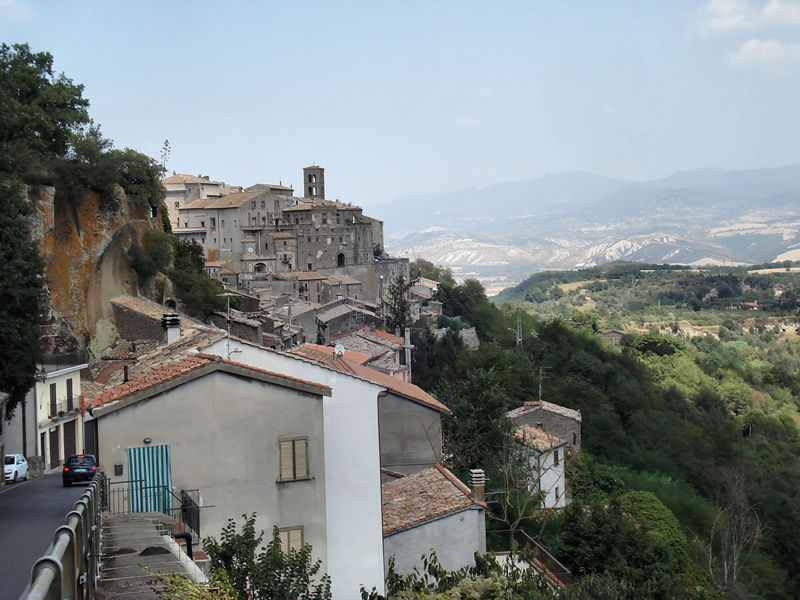
Bomarzo is a town and comune of the province of Viterbo (Lazio, Central Italy), in the lower valley of the Tiber. It is located 14.5 kilometres (9.0 mi) east-northeast of Viterbo and 68 kilometres (42 mi) north-northwest of Rome.

History

[edit]

The city's current name is a derivation of Polymartium, first mentioned in the Historia Langobardorum by Paulus Diaconus. The etymology "polis martium", city of Mars, suggests a Roman origin. However, archeological evidence for a Roman city has not been found so far. However, a Roman brickmaking factory established nearby may have been owned by Domitia Calvilla, the mother of the Emperor Marcus Aurelius.

It was a historical fiefdom of the Orsini family, whose castle is at the edge of the densely built town, until it was sold to Ippolito Lante Montefeltro della Rovere in 1645. Lante was elevated to the title of Duke of Bomarzo.

Main sights

[edit]

Bomarzo's main attraction is a garden, usually referred to as the Bosco Sacro (Sacred grove) or, locally, Bosco dei Mostri ("Monsters' Grove"), named after the many larger-than-life sculptures, some sculpted in the bedrock, which populate this predominantly barren landscape.

A sphinx at the entrance of the Park of the Monsters.
Bomarzo

It is the work of Pier Francesco Orsini, called Vicino (1528–1588), a condottiero or mercenary and a patron of the arts. He was greatly devoted to his wife Giulia Farnese, daughter of Galeazzo Farnese, Duke of Latera, (not to be confused with her maternal great-aunt Giulia Farnese) and when she died, he created the gardens. The design has been attributed to Pirro Ligorio, a well known architect and antiquarian of the time.

The park of Bomarzo was intended not to please, but to astonish, and like many Mannerist works of art, its symbolism is arcane; for example, one large sculpture is of one of Hannibal's war elephants, which mangles a Roman legionary, and another is a statue of Ceres lounging on the bare ground, with a vase of "fruits of the earth" perched on her head.

The many monstrous statues appear to be unconnected to any rational plan and appear to have been strewn almost randomly about the area, sol per sfogare il Core ("just to set the heart free") as one inscription on an obelisk says.

Enigmatic verses in Italian by Annibale Caro, Bitussi and Cristoforo Madruzzo, some of them now eroded, were inscribed onto stone beside the sculptures.

The reason for the layout and design of the garden is largely unknown: perhaps they were meant as a foil to the perfect symmetry and layout of the great Renaissance gardens nearby at Villa Farnese at Caprarola and Villa Lante at Bagnaia. Next to a formal exedra is a tilting building, the so-called Casa Storta or Twisted House.

A small octagonal temple was added about twenty years later to honor Orsini's wife, Giulia Farnese.

During the nineteenth century and well into the twentieth, the garden became overgrown and neglected but in the 1970s a program of restoration was implemented by the Bettini family, and today the garden, which remains private property, is a major tourist attraction. In recent years, a number of the stone sculptures have had fences put around them.

The surreal nature of the Parco dei Mostri appealed to Jean Cocteau and the great surrealist Salvador Dalí, who discussed it at great length. The poet André Pieyre de Mandiargues wrote an essay devoted to Bomarzo. Niki de Saint Phalle was inspired by Bomarzo when she created her Tarot Garden in Tuscany. The story behind Bomarzo and the life of Pier Francesco Orsini are the subject of a novel by the Argentinian writer Manuel Mujica Láinez (1910–1984), Bomarzo (1962). Mujica Láinez himself wrote a libretto based on his novel, which was set to music by Alberto Ginastera (1967). The opera Bomarzo premièred in Washington in 1967 but in Argentina it was banned by the military dictatorship. The Dutch magic-surrealist painter Carel Willink used several of the park's statue groups in his paintings, including The Eternal Cry and Balance of Forces. A mystery novel by Linda Lappin, Signatures in Stone (2013), investigates the symbolism of the Sacred Grove, its relation to the myth of Persephone, and recent theories concerning the designer of the park.

Sources

[edit]
  • Guida al Parco dei Mostri. Vitorchiano: Società Giardino di Bomarzo. 2002.
  • Elli Mosayebi, Christian Mueller Inderbitzin "Bomarzo - Beobachtungen anhand einer neuen Karte", Institut für Landschaftsarchitektur, ETH Zürich, 2005, ISBN 3-906441-06-7
  • Richtsfeld, Bruno J.: Der "Heilige Wald" von Bomarzo und sein "Höllenmaul". In: Metamorphosen. Arbeiten von Werner Engelmann und ethnographische Objekte im Vergleich. Herausgegeben von Werner Engelmann und Bruno J. Richtsfeld. München 1989, S. 18 - 36.

References

[edit]
[edit]
Revisions and contributorsEdit on WikipediaRead on Wikipedia
from Grokipedia
Bomarzo is a small in the , in the northern region of , situated in the lower Valley approximately 14 kilometers east-southeast of and about 80 kilometers north of . With a population of around 1,677 as of 2025, it is best known for the Sacro Bosco (Sacred Wood), also called the Park of the Monsters, a unique 16th-century Mannerist monumental complex featuring oversized sculptures of mythological figures, animals, and architectural elements carved from local peperino stone. The town's history traces back to Etruscan settlements from the BCE, when it served as a strategic point for controlling trade routes in the region, with nearby sites like the ancient settlement of Piammiano-Statonia providing evidence of early Etruscan and Roman activity. After declining under Roman rule following the Battle of Vadimone in 283 BCE, Bomarzo revived in the early CE amid barbarian invasions, becoming a medieval episcopal seat known as Polimartium and eventually annexed to by the . From 1360, the held dominion over the area, fostering significant development, including the renovation of the medieval Orsini Palace—originally a castle—under designs by architect Baldassarre starting in 1519. The town's population peaked at 2,278 in 1901 before stabilizing at its current levels. The Sacro Bosco, the defining feature of Bomarzo, was commissioned around 1552 by Pier Francesco Orsini (1523–1585), known as Vicino Orsini, possibly as a memorial to his late wife , with contributions from architect Pirro Ligorio. This enigmatic park, often regarded as one of the earliest modern sculpture gardens, spans a wooded hillside and includes bizarre, larger-than-life figures such as a snarling (mascherone) with the inscription Ogni pensiero vola ("Every thought flies away"), Greek sphinxes, a leaning house tilted at 23 degrees, statues of gods like Saturn and , and a small temple. Drawing on , Etruscan influences, and personal symbolism, the Sacro Bosco reflects interests in antiquity and the , evoking an alternate vision of Lazio's ancient landscape. Beyond the park, Bomarzo features Etruscan necropolises and rupestrian sites within the nearby Monte Casoli , underscoring its deep archaeological heritage.

Geography

Location and Topography

Bomarzo is situated at geographic coordinates 42°28′N 12°14′E in the , within the region of . The town lies approximately 14.5 km east-northeast of and 68 km north-northwest of , positioned in the lower River valley. This strategic placement along the valley facilitated historical and movement, influencing early settlement patterns by providing access to fertile lands and river transport routes. The municipality encompasses an area of 39.65 km², with the town itself perched on prominent spurs of peperino—a volcanic rock—rising to an elevation of 263 m above . These rocky outcrops extend into the surrounding landscape, creating a dramatic of steep ridges and undulating . Bomarzo is enveloped by the volcanic Cimini Mountains to the north and dense, lush forests that cover the nearby hills, contributing to a verdant and secluded setting. The interplay of these features with the valley below has long defined the area's physical character, promoting isolated hilltop settlements for defense and resource access. The region's location falls within the historical bounds of former Etruscan territory, part of the broader area rich in ancient volcanic soils and riverine geography. This not only shaped prehistoric habitation but also informed later landscape integrations, such as the Park of the Monsters, where the natural peperino formations and forested slopes were incorporated into the site's whimsical architecture.

Climate and Environment

Bomarzo experiences a hot-summer classified as Csa under the Köppen system, characterized by mild, wet winters and hot, dry summers. The average annual temperature hovers around 14°C, with summer highs reaching up to 32°C in and , while winter lows dip to about 1°C in . Annual totals approximately 800 mm, concentrated primarily in the fall and winter months, with being the wettest at around 86 mm, supporting seasonal vegetation growth without excessive flooding in the valleys. The local environment is shaped by volcanic origins, featuring peperino—a porous rock formed from ancient Cimino eruptions—that enriches the soil's fertility and influences retention for nearby agriculture. Dense woodlands of , , and Mediterranean maquis cover the surrounding valleys, providing for wildlife such as birds and small mammals, while the River plays a key role in regional by regulating and fostering riparian along its banks. These features create a resilient adapted to the area's moderate seismic and volcanic history. Conservation efforts in Bomarzo focus on protecting these forests and volcanic landscapes through the Riserva Naturale Monte Casoli, a 285-hectare established in 1999 to preserve native woodlands and geological formations amid growing pressures. Italy's National Biodiversity Strategy to 2030, adopted in 2023, supports broader in protected areas nationwide, including measures to mitigate climate impacts on volcanic terrain. This mild climate supports year-round visits to sites like the Park of the Monsters, though peak occurs in spring and fall to avoid summer heat.

History

Ancient and Etruscan Periods

The area encompassing modern Bomarzo formed part of ancient Etruria, a region in central Italy where Etruscan civilization flourished from the 8th to the 3rd centuries BCE, with evidence of human activity in the Tiber River valley dating back to the 7th–6th centuries BCE. Archaeological surveys indicate early Etruscan settlements in the Tiberine hinterland, including the site of Piammiano-Statonia near Bomarzo, where geophysical investigations using electrical tomography have revealed structural layouts suggestive of organized habitation and land use during the Etruscan period. These settlements were integrated into the broader network of southern Etruria, facilitating interactions with nearby centers such as Tarquinia, though Bomarzo's role appears more localized. Excavations in the , particularly from the , uncovered extensive es south and west of the ancient town site, perched on a cliff overlooking the valley, featuring rock-cut tombs with chambers up to 13 feet by 7 feet and painted interiors. Artifacts from these sites, including over 200 mirrors (specchi), helmets, shields (one 3 feet in now in the Gregorian Museum), pottery, and sarcophagi such as that of Vel Urinates in the , point to established trade networks exchanging goods with other Etruscan communities and Mediterranean partners. The Pianmiano yielded additional bronzes and pottery, underscoring religious practices centered on funerary rites and possibly , characteristic of Etruscan . A prominent feature is the Etruscan Pyramid, known as Sasso del Predicatore, a carved peperino (volcanic ) boulder serving as an , dated to the 7th–6th centuries BCE and standing approximately 10 meters high with a base around 16 meters long and 8 meters wide. It includes a 20-step staircase leading to a small basin for ablutions and additional steps to a main platform, likely used for ritual sacrifices or soothsaying by haruspices, oriented toward significant landscape features associated with Etruscan cosmology. The structure was first documented by local researchers Giovanni Lamoratta and Giuseppe Maiorano in 1991, with full clearance of overlying vegetation in 2008 by Salvatore Fosci, revealing its integration into a near the Finestraccia site, which contains a 7th-century BCE with priestly inscriptions. This monument highlights the area's role in Etruscan religious landscapes before Roman expansion incorporated the region.

Roman and Medieval Periods

Bomarzo's Roman origins are tied to the ancient settlement of Statonia, located to the north, which was integrated into the Roman administrative region of following the conquest of . The settlement declined after the Battle of Vadimone in 283 BCE but revived in the early CE amid barbarian invasions, becoming an episcopal seat known as Polimartium before being annexed to by the . The etymology of the name derives from the Latin "Polymartium," interpreted as "city of Mars," reflecting its early Roman-era significance in the valley. Archaeological evidence includes Roman baths constructed in opus incertum near the site, indicating settlement continuity from the BCE onward. A notable aspect of Roman economic activity in the area was a brickmaking near the Tiber River, operated by the prominent Domitii family and possibly owned by Domitia Lucilla (mother of ) in the 2nd century CE. This facility produced stamped bricks and tiles used in major Roman structures, such as in , and exported amphorae across the Mediterranean, underscoring Bomarzo's role in imperial supply chains. In the medieval period, Bomarzo—known as Polymartium—emerged as a strategic locale in the valley amid the transition from to feudal structures, first documented in the 8th-century by , which describes Lombard forces advancing through the region toward during conflicts with papal authorities. The settlement was re-established between the 8th and 9th centuries under papal influence, as evidenced by the local cathedral's incorporation of an Early Medieval dating to this era, signaling the imposition of Christian feudal organization. By the 9th and 10th centuries, documents record Bomarzo's growing role in the feudal system, serving as a defensive outpost in ongoing Lombard-papal rivalries and incursions along the trade routes. The saw the construction of initial fortifications, including elements of a tower on Monte Casoli, to counter raids and secure noble interests in the valley. These developments marked the shift to localized noble control preceding the Orsini family's 15th-century acquisition, with the site evolving into a fortified village by the 13th century.

Renaissance and Orsini Era

The Orsini family, a prominent Roman noble lineage, acquired Bomarzo as a fiefdom in the 15th century, with formal control solidified through a 1502 deed that bequeathed the territory to Gian Corrado Orsini following a division of family holdings. This branch of the Orsini, known as the Mugnano line, had roots in the region dating back to the 14th century via papal grants, establishing Bomarzo as a strategic papal state enclave amid the Viterbo countryside. Gian Corrado's son, Pier Francesco Orsini (1523–1583), commonly called Vicino, inherited the duchy around 1542 after a succession dispute was resolved in his favor by Cardinal Alessandro Farnese, marking the peak of Orsini influence in the area. Politically, the Orsini leveraged Bomarzo's position within the to forge alliances with powerful families like the Farnese, who ascended to the papacy in 1534 under Paul III. Vicino Orsini served as a condottiere in the 1550s Habsburg-Valois wars under Farnese command, enhancing his regional standing and securing papal protections, including annual census payments to the Camera Apostolica documented in 1548, 1549, 1551, and 1567. These ties positioned Bomarzo as a minor but loyal in the intricate web of central Italian politics, where Orsini barons navigated papal and imperial pressures from the era of Sixtus IV through Clement VII. In , Vicino's marriage to , a relative of the cardinal, further cemented these Farnese alliances, blending political strategy with personal loyalty as Giulia managed estate affairs during his military absences, such as his 1553–1555 captivity. Under Vicino's , Bomarzo flourished as a center of cultural innovation, with the duke supporting humanist scholars and artists in a Mannerist vein reflective of the era's intellectual currents. He commissioned architectural and artistic projects, possibly involving the architect Pirro Ligorio, and dedicated endeavors to , fostering a legacy of eclectic that included translations of antiquarian texts by figures like Francesco Sansovino. This era's cultural output, exemplified briefly by the Park of the Monsters as a to his wife, underscored Orsini amid regional power dynamics. Orsini control waned after Vicino's death, culminating in the 1645 sale of the fief to Ippolito Lante Montefeltro , who elevated it to ducal status and shifted its trajectory.

Demographics and Economy

Population and Demographics

As of January 2025, the of Bomarzo has an estimated resident population of 1,677, reflecting a decline from 1,810 in 2017. The stands at approximately 42.3 inhabitants per square kilometer across its 39.64 km² area. The local for residents is Bomarzesi. Population trends in Bomarzo indicate a gradual decline of about -0.3% annually since 2021, with the figure fluctuating between 1,679 and 1,692 in recent years. Historical data from ISTAT reveal peaks in the mid-20th century, reaching 2,271 in 1936 and 2,206 in 1951, driven by agricultural prosperity, followed by significant emigration and rural depopulation that reduced numbers by over 20% by 1971. The demographic composition remains predominantly Italian, with foreign residents comprising around 7% of the total (approximately 120 individuals as of recent counts). The features an aging structure, with over 25% (452 individuals) aged 65 and above in 2023, highlighting challenges like low . Recent ISTAT vital statistics for 2023 report a of 3.6 per 1,000 inhabitants (6 births) and a death rate of 13.6 per 1,000 (23 deaths), resulting in a negative natural balance of -17. , particularly to the of the Monsters, has helped stabilize the by attracting seasonal residents and supporting local retention.

Economy

Bomarzo's economy relies heavily on , supported by the fertile volcanic soils of the surrounding region in province. The area produces high-quality extra virgin from local groves and hazelnuts, particularly the Nocciola Romana variety, which benefits from the mineral-rich of the nearby Cimini Mountains. Wine production, including varieties like Aleatico, also contributes, drawing on the region's viticultural heritage. Small-scale , such as sheep and cattle rearing, supplements these activities in this rural setting. Tourism has emerged as a key economic driver, largely due to the Park of the Monsters, which attracts approximately 40,000 to 95,000 visitors annually, providing substantial revenue through entrance fees, accommodations, and related services that enhance local GDP. Pre-2020 visitor numbers exceeded 50,000 yearly, with post-pandemic recovery evident in sustained attendance and increased promotion of the site's unique sculptures. In the 2020s, initiatives like the Holistic Tourism project have promoted eco-tourism and sustainable cultural experiences, including renovated medieval accommodations and of local food and wine traditions to foster . These efforts align with broader EU-supported rural programs emphasizing environmental heritage, such as paths through the Fosso di Castello Waterfalls and Montecasoli . Unemployment in Bomarzo aligns closely with the regional average of about 6.3% in 2024, reflecting stable labor conditions influenced by and .

Culture and Attractions

Park of the Monsters

The Park of the Monsters, also known as the Sacro Bosco or Sacred Wood, is a Mannerist sculpture garden commissioned by Pier Francesco Orsini, Duke of Bomarzo, between 1552 and 1585. Orsini, often called Vicino, initiated the project in the mid-16th century as a tribute to his late wife, Giulia Farnese, incorporating themes of mythology, fantasy, and personal allegory to express his grief and philosophical reflections. The surreal sculptures, carved from local peperino stone, were designed in a Mannerist style emphasizing grotesque and dreamlike elements, with attributions to sculptors such as Simone Mosca and architect Pirro Ligorio, though exact authorship remains uncertain due to lost records. The garden's creation reflects Orsini's fascination with classical literature, including works by Ovid and Dante, blending art, magic, and the irrational to challenge Renaissance ideals of harmony and proportion. Spanning a wooded 3-hectare area, the features a labyrinthine layout without fixed paths, encouraging visitors to wander through a surreal of over 30 monumental sculptures depicting mythical creatures, giants, and hybrid beings. Prominent examples include the mouth, a massive hellish facade where entrants can climb inside for an echo effect symbolizing the ; the tilting Casa Pendente, an intentionally off-kilter house evoking instability; paired Sphinxes guarding riddles; the , carrying a war tower inspired by Hannibal's legend; and the Temple, a classical rotunda honoring Orsini's wife . Many sculptures bear enigmatic inscriptions in Italian and Latin, such as "You who enter here with mind / Leave firmness outside," inviting intellectual and emotional disorientation, and "Just to relieve the heart," underscoring the garden's intent. As of , the park continues to draw scholarly attention, featured in Archaeology Magazine for its enduring mysteries. Following Orsini's death in 1585, the park fell into neglect and obscurity, overgrown and forgotten for centuries until its rediscovery after . In the 1970s, Tina Severi and her husband Giovanni Bettini acquired and restored the site, clearing vegetation and preserving the sculptures to revive its accessibility. Today, it holds tentative World Heritage status as part of the "Villas of the " listing, recognizing its unique Mannerist innovation. The park has influenced modern artists, notably , who visited in 1938 and drew surrealist inspiration from its forms, and , whose echoes its monumental, mythical style. Its legacy extends to literature and music through Manuel Mujica Láinez's 1967 novel Bomarzo, a hallucinatory narrative centered on Orsini, and Alberto Ginastera's adaptation of the same name, premiered in 1967, which explores themes of power and madness.

Other Historical Sites

The historic center of Bomarzo, known locally as Il Dentro, features a medieval layout perched on spurs of peperino rock overlooking the Valley, designed to control ancient trade routes. Its narrow, cobblestone streets wind through ancient stone houses and small squares, preserving the town's compact, fortified character from the . At the heart of Il Dentro stands the 16th-century Palazzo Orsini, constructed between 1519 and 1583 on the foundations of a 13th-century Orsini Castle, incorporating ruins of the earlier medieval fortress such as defensive walls and towers. Today serving as the town hall, the palazzo exemplifies adapted for residential and administrative use, with robust peperino facades and interiors featuring frescoes like Lorenzo Berrettini's 1660-1661 Allegory of War and Peace. Nearby, the Church of Santa Maria della Valle, situated between the historic center and surrounding valleys, was built in the 16th century, possibly incorporating earlier elements, with arched portals and simple stonework. This small, elegant structure highlights Bomarzo's religious heritage, complementing the town's ancient Etruscan roots. Access to the Etruscan Pyramid, a rock-cut monument dating to the 7th-6th centuries BCE, provides a direct link to Bomarzo's prehistoric past as an Etruscan settlement. Carved from a single block of volcanic in the nearby Tacchiolo Valley, the pyramid measures about 30 feet tall with 28 steps leading to a summit altar, likely used by haruspices for rituals; it was rediscovered and made publicly accessible in 2008 via marked hiking paths. Additional attractions include exhibits within Palazzo Orsini, managed in collaboration with local universities, displaying artifacts like ancient farm tools that illustrate regional history. Archaeological trails, such as the two-hour Monte Casoli path from the town center, guide visitors through Etruscan necropolises and rock-cut features, enhancing exploration of the area's ancient sites. In the 2020s, ongoing efforts by regional authorities have focused on trail maintenance and signage improvements for sites like the , ensuring sustainable access amid growing tourism. These landmarks, tied to the Orsini family's enduring legacy, offer a grounded contrast to the imaginative elements of nearby attractions.

References

Add your contribution
Related Hubs
User Avatar
No comments yet.