
Recent from talks
Call centre
Knowledge base stats:
Talk channels stats:
Members stats:
Call centre
A call centre (Commonwealth spelling) or call center (American spelling; see spelling differences) is a managed capability that can be centralised or remote that is used for receiving or transmitting a large volume of enquiries by telephone. An inbound call centre is operated by a company to administer incoming product or service support or information inquiries from consumers. Outbound call centres are usually operated for sales purposes such as telemarketing, for solicitation of charitable or political donations, debt collection, market research, emergency notifications, and urgent/critical needs blood banks. A contact centre is a further extension of call centres' telephony based capabilities, administering centralised handling of individual communications including letters, faxes, live support software, social media, instant message, and email.
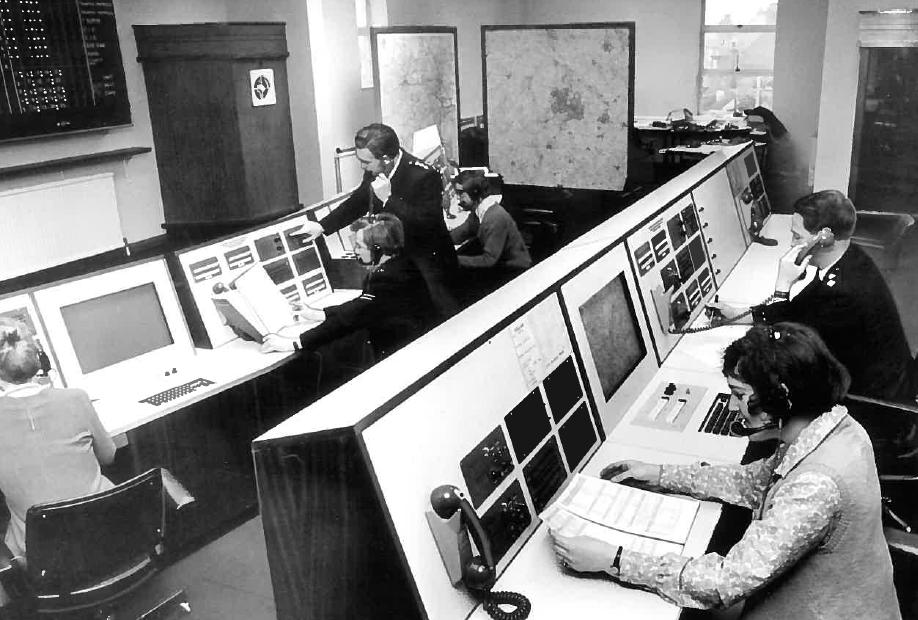
A call centre was previously seen as an open workspace for call centre agents, with workstations that included a computer and display for each agent and were connected to an inbound/outbound call management system, and one or more supervisor stations. It can be independently operated or networked with additional centres, often linked to a corporate computer network, including mainframes, microcomputer, servers and LANs. It is expected that artificial intelligence-based chatbots will significantly impact call centre jobs and will increase productivity substantially. Many organisations have already adopted AI-based chatbots to improve their customer service experience.
The contact centre is a central point from which all customer contacts are managed. Through contact centres, valuable information can be routed to the appropriate people or systems, contacts can be tracked, and data may be gathered. It is generally a part of the company's customer relationship management infrastructure. The majority of large companies use contact centres as a means of managing their customer interactions. These centres can be operated by either an in-house department responsible or outsourcing customer interaction to a third-party agency (known as Outsourcing Call Centres).
Answering services, as known in the 1960s through the 1980s, earlier and slightly later, involved a business that specifically provided the service. Primarily, by using an off-premises extension (OPX) for each subscribing business, connected at a switchboard at the answering service business, the answering service would answer the otherwise unattended phones of the subscribing businesses with a live operator. The live operator could take messages or relay information, doing so with greater human interactivity than a mechanical answering machine. Although undoubtedly more costly (the human service, the cost of setting up and paying the phone company for the OPX on a monthly basis), it had the advantage of being more ready to respond to the unique needs of after-hours callers. The answering service operators also had the option of calling the client and alerting them to particularly important calls.
The origins of call centres date back to the 1960s with the UK-based Birmingham Press and Mail, which installed Private Automated Business Exchanges (PABX) to have rows of agents handling customer contacts. By 1973, call centres had received mainstream attention after Rockwell International patented its Galaxy Automatic Call Distributor (GACD) for a telephone booking system as well as the popularisation of telephone headsets as seen on televised NASA Mission Control Center events.
During the late 1970s, call centre technology expanded to include telephone sales, airline reservations, and banking systems. The term "call centre" was first published and recognised by the Oxford English Dictionary in 1983. The 1980s saw the development of toll-free telephone numbers to increase the efficiency of agents and overall call volume. Call centres increased with the deregulation of long-distance calling and growth in information-dependent industries.
As call centres expanded, workers in North America began to join unions such as the Communications Workers of America and the United Steelworkers. In Australia, the National Union of Workers represents unionised workers; their activities form part of the Australian labour movement. In Europe, UNI Global Union of Switzerland is involved in assisting unionisation in the call center industry, and in Germany Vereinte Dienstleistungsgewerkschaft represents call centre workers.
During the 1990s, call centres expanded internationally and developed into two additional subsets of communication: contact centres and outsourced bureau centres. A contact centre is a coordinated system of people, processes, technologies, and strategies that provides access to information, resources, and expertise, through appropriate channels of communication, enabling interactions that create value for the customer and organisation. In contrast to in-house management, outsourced bureau contact centres are a model of contact centre that provide services on a "pay per use" model. The overheads of the contact centre are shared by many clients, thereby supporting a very cost effective model, especially for low volumes of calls. The modern contact centre includes automated call blending of inbound and outbound calls as well as predictive dialling capabilities, dramatically increasing agents' productivity. New implementations of more complex systems require highly skilled operational and management staff that can use multichannel online and offline tools to improve customer interactions.
Hub AI
Call centre AI simulator
(@Call centre_simulator)
Call centre
A call centre (Commonwealth spelling) or call center (American spelling; see spelling differences) is a managed capability that can be centralised or remote that is used for receiving or transmitting a large volume of enquiries by telephone. An inbound call centre is operated by a company to administer incoming product or service support or information inquiries from consumers. Outbound call centres are usually operated for sales purposes such as telemarketing, for solicitation of charitable or political donations, debt collection, market research, emergency notifications, and urgent/critical needs blood banks. A contact centre is a further extension of call centres' telephony based capabilities, administering centralised handling of individual communications including letters, faxes, live support software, social media, instant message, and email.
A call centre was previously seen as an open workspace for call centre agents, with workstations that included a computer and display for each agent and were connected to an inbound/outbound call management system, and one or more supervisor stations. It can be independently operated or networked with additional centres, often linked to a corporate computer network, including mainframes, microcomputer, servers and LANs. It is expected that artificial intelligence-based chatbots will significantly impact call centre jobs and will increase productivity substantially. Many organisations have already adopted AI-based chatbots to improve their customer service experience.
The contact centre is a central point from which all customer contacts are managed. Through contact centres, valuable information can be routed to the appropriate people or systems, contacts can be tracked, and data may be gathered. It is generally a part of the company's customer relationship management infrastructure. The majority of large companies use contact centres as a means of managing their customer interactions. These centres can be operated by either an in-house department responsible or outsourcing customer interaction to a third-party agency (known as Outsourcing Call Centres).
Answering services, as known in the 1960s through the 1980s, earlier and slightly later, involved a business that specifically provided the service. Primarily, by using an off-premises extension (OPX) for each subscribing business, connected at a switchboard at the answering service business, the answering service would answer the otherwise unattended phones of the subscribing businesses with a live operator. The live operator could take messages or relay information, doing so with greater human interactivity than a mechanical answering machine. Although undoubtedly more costly (the human service, the cost of setting up and paying the phone company for the OPX on a monthly basis), it had the advantage of being more ready to respond to the unique needs of after-hours callers. The answering service operators also had the option of calling the client and alerting them to particularly important calls.
The origins of call centres date back to the 1960s with the UK-based Birmingham Press and Mail, which installed Private Automated Business Exchanges (PABX) to have rows of agents handling customer contacts. By 1973, call centres had received mainstream attention after Rockwell International patented its Galaxy Automatic Call Distributor (GACD) for a telephone booking system as well as the popularisation of telephone headsets as seen on televised NASA Mission Control Center events.
During the late 1970s, call centre technology expanded to include telephone sales, airline reservations, and banking systems. The term "call centre" was first published and recognised by the Oxford English Dictionary in 1983. The 1980s saw the development of toll-free telephone numbers to increase the efficiency of agents and overall call volume. Call centres increased with the deregulation of long-distance calling and growth in information-dependent industries.
As call centres expanded, workers in North America began to join unions such as the Communications Workers of America and the United Steelworkers. In Australia, the National Union of Workers represents unionised workers; their activities form part of the Australian labour movement. In Europe, UNI Global Union of Switzerland is involved in assisting unionisation in the call center industry, and in Germany Vereinte Dienstleistungsgewerkschaft represents call centre workers.
During the 1990s, call centres expanded internationally and developed into two additional subsets of communication: contact centres and outsourced bureau centres. A contact centre is a coordinated system of people, processes, technologies, and strategies that provides access to information, resources, and expertise, through appropriate channels of communication, enabling interactions that create value for the customer and organisation. In contrast to in-house management, outsourced bureau contact centres are a model of contact centre that provide services on a "pay per use" model. The overheads of the contact centre are shared by many clients, thereby supporting a very cost effective model, especially for low volumes of calls. The modern contact centre includes automated call blending of inbound and outbound calls as well as predictive dialling capabilities, dramatically increasing agents' productivity. New implementations of more complex systems require highly skilled operational and management staff that can use multichannel online and offline tools to improve customer interactions.
Recent media