Hubbry Logo
Online chatOnline chatMain
Open search
Online chat
Community hub
Online chat
logo
8 pages, 0 posts
0 subscribers
Be the first to start a discussion here.
Online chat
Online chat
from Wikipedia

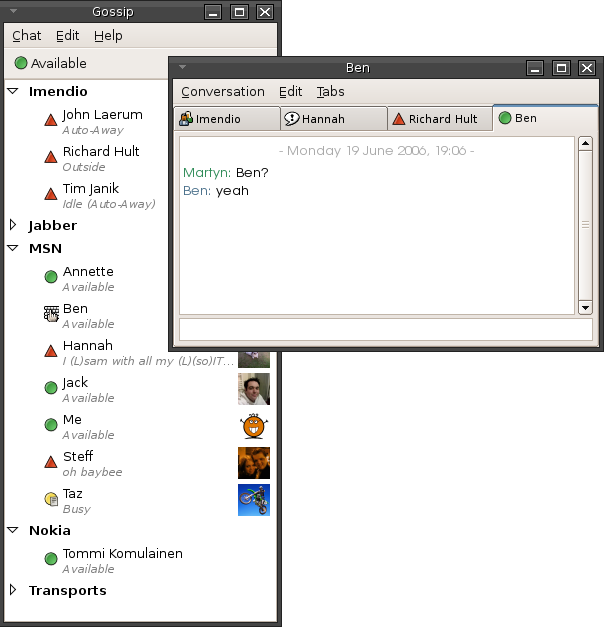
In this typical online chat program, the window to the left shows a list of contacts, and the window to the right shows a conversation between the user and one of those contacts.

Online chat is any direct text-, audio- or video-based (webcams), one-on-one or one-to-many (group) chat (formally also known as synchronous conferencing), using tools such as instant messengers, Internet Relay Chat (IRC), talkers and possibly MUDs or other online games. Online chat includes web-based applications that allow communication – often directly addressed, but anonymous between users in a multi-user environment. Web conferencing is a more specific online service, that is often sold as a service, hosted on a web server controlled by the vendor. Online chat may address point-to-point communications as well as multicast communications from one sender to multiple receivers and voice and video chat, or may be a feature of a web conferencing service.

Online chat in a narrower sense is any kind of communication over the Internet that offers a real-time transmission of text messages from sender to receiver. Chat messages are generally short in order to enable other participants to respond quickly. Thereby, a feeling similar to a spoken conversation is created, which distinguishes chatting from other text-based online communication forms such as Internet forums and email. The expression online chat comes from the word chat which means "informal conversation".

Synchronous conferencing or synchronous computer-mediated communication (SCMC) is any form of computer-mediated communication that occurs in real-time; that is, there is no significant delay between sending and receiving messages.[1] SCMC includes real-time forms of text, audio, and video communication. SCMC has been highly studied in the context of e-learning.[2]

History

[edit]

The first online chat system was called Talkomatic, created by Doug Brown and David R. Woolley in 1973 on the PLATO System at the University of Illinois. It offered several channels, each of which could accommodate up to five people, with messages appearing on all users' screens character-by-character as they were typed. Talkomatic was popular among PLATO users into the mid-1980s. In 2014, Brown and Woolley released a web-based version of Talkomatic.[3]

The first online system to use the actual command "chat" was created for The Source in 1979 by Tom Walker and Fritz Thane of Dialcom, Inc.[4]

Other chat platforms flourished during the 1980s. Among the earliest with a GUI was BroadCast, a Macintosh extension that became especially popular on university campuses in America and Germany.[5]

The first transatlantic Internet chat took place between Oulu, Finland and Corvallis, Oregon in February 1989.[6]

The first dedicated online chat service that was widely available to the public was the CompuServe CB Simulator in 1980,[7][8] created by CompuServe executive Alexander "Sandy" Trevor in Columbus, Ohio. Ancestors include network chat software such as UNIX "talk" used in the 1970s.[citation needed]

Chat is implemented in multiple video-conferencing tools. A study of chat use during work-related videoconferencing found that chat during meetings allows participants to communicate without interrupting the meeting, plan action around common resources, and enables greater inclusion.[9] The study also found that chat can cause distractions and information asymmetries between participants.

Types

[edit]

According to the type of media used, synchronous conferencing can be divided into[2]

  • audio conferencing: only audio is used
  • video conferencing: Both audio (voice) and video and pictures are used.

According to the number of access point used, synchronous conferencing can be divided into

  • point-to-point: Only two computers are connected end to end.
  • multi-point: Two or more than two computers are connected.

Methods

[edit]

Some of the methods used in synchronous conferencing are:

  • Chat (text only): Multiple participants can be logged into the conference and can interactively share resources and ideas. There is also an option to save the chat and archive it for later review.
  • Voice (telephone or voice-over IP): This is a conference call between the instructor and the participating students where they can speak through a built-in microphone or a headset.
  • Video conferencing: This may or may not require the participants to have their webcams running. Usually, a video conference involves a live feed from a classroom or elsewhere or content.
  • Web conferencing: This includes Webinar (Web-based seminar) as well. Unlike in video conferencing, participants of web conferencing can access a wider variety of media elements. Web conferences are comparatively more interactive and usually incorporate chat sessions as well.
  • Virtual worlds: In this setup, students can meet in the virtual world and speak with each other through headsets and VoIP. This can make learning more productive and engaging when the students can navigate the worlds and operate in their avatar.[10]

Synchronous vs asynchronous conferencing

[edit]

Both synchronous and asynchronous conferencing are online conferencing where the participants can interact while being physically located at different places in the world. Asynchronous conferencing allows the students to access the learning material at their convenience while synchronous conferencing requires that all participants including the instructor and the students be online at the time of the conference.[2]

While synchronous conferencing enables real-time interaction of the participants, asynchronous conferencing allows participants to post messages and others can respond to it at any convenient time. Sometimes a combination of both synchronous and asynchronous conferencing is used. Both methods give a permanent record of the conference.[11]

Critical factors for effective implementation

[edit]

There are four critical factors identified for implementing synchronous conferencing for effective instruction to the students[2]

  • Video and audio quality which depends on technical factors like higher bandwidth and processing capabilities of the system.
  • Training time depends on the familiarity and proficiency of the instructors and the students with the technology.
  • Teaching strategies depend on the adaptability of the instructors to the new methods, preparing appropriate and effective training materials, and motivating students.
  • Direct meeting of the instructor and the students.

Synchronous conferencing in higher education

[edit]

Synchronous conferencing in education helps in the delivery of content through digital media. Since this is real-time teaching, it also brings the benefits of face-to-face teaching in distance learning.[12] Multiple higher education institutions offer well-designed quality e-learning opportunities. Some of the advantages of synchronous conferencing in education are:[13][14]

  • Helps the students to connect with not only their teachers and peers but also with recognized experts in the field regardless of the geographical distance and different time zones.
  • Provides opportunities for both the teachers and the students to expand their knowledge outside the classroom.
  • Helps students who are home-bound or limited mobility to connect with their classrooms and participate in learning.
  • Helps the faculties to conduct classes when they are not able to come to classes due to an emergency.
  • Supports real-time collaboration, interaction, and immediate feedback
  • Encourage students to learn together and in turn, develop cultural understanding
  • Personalized learning experience for the students
  • Real-time discussion opportunities for students promoting student engagement
  • Active interaction can lead to an associated community of like-minded students
  • Saves travel expenses and time

Implementation of educational technology

[edit]

The tools for implementing synchronous conferencing depend on the type of educational problem addressed. This is in turn decides the method of synchronous conferencing to be used and the tool to be used in the learning context. The tool selected addresses the problem of improving the learning outcomes which cannot be solved with an asynchronous environment. There are a number of tools and platforms available for synchronous conferencing.[13]

  • Smartphone applications
  • Web conferencing tools
  • Video conferencing tools
  • Video and hangout platforms
  • Shared whiteboards

The selection of tools and platforms also depends on the group size which depends on the activity for the course design.

Chatiquette

[edit]

The term chatiquette (chat etiquette) is a variation of netiquette (Internet etiquette) and describes basic rules of online communication.[15][16][17] These conventions or guidelines have been created to avoid misunderstandings and to simplify the communication between users. Chatiquette varies from community to community and generally describes basic courtesy. As an example, it is considered rude to write only in upper case, because it appears as if the user is shouting. The word "chatiquette" has been used in connection with various chat systems (e.g. Internet Relay Chat) since 1995.[18][19]

Chatrooms can produce a strong sense of online identity leading to impression of subculture.[20]

Chats are valuable sources of various types of information, the automatic processing of which is the object of chat/text mining technologies.[21]

Limitations

[edit]

Some limitations for synchronous conferencing in learning are:[13][22]

  • Disjointed discussions, not connected in time
  • Lack of effective moderation and/or clear guidelines for learners
  • Difficulty in collaborating on online projects
  • Lack of proper communication with the instructor and students.
  • Technical issues may arise if not analysed and planned in advance
  • Lack of familiarity with the tools
  • Limited time to complete the learning activity and to incorporate interactions with the learners

Social criticism

[edit]

Criticism of online chatting and text messaging include concern that they replace proper English with shorthand or with an almost completely new hybrid language.[23][24][25]

Writing is changing as it takes on some of the functions and features of speech. Internet chat rooms and rapid real-time teleconferencing allow users to interact with whoever happens to coexist in cyberspace. These virtual interactions involve us in 'talking' more freely and more widely than ever before.[26] With chatrooms replacing multiple face-to-face conversations, it is necessary to be able to have quick conversation as if the person were present, so some learn to type as quickly as they would normally speak. Some critics[who?] are wary that this casual form of speech is being used so much that it will slowly take over common grammar; however, such a change has yet to be seen.

With the increasing population of online chatrooms there has been a massive growth[27] of new words created or slang words, a number of them documented on the website Urban Dictionary. Sven Birkerts wrote:

"as new electronic modes of communication provoke similar anxieties amongst critics who express concern that young people are at risk, endangered by a rising tide of information over which the traditional controls of print media and the guardians of knowledge have no control on it".[28]

In Guy Merchant's journal article Teenagers in Cyberspace: An Investigation of Language Use and Language Change in Internet Chatrooms; Merchant says

"that teenagers and young people are in the leading the movement of change as they take advantage of the possibilities of digital technology, drastically changing the face of literacy in a variety of media through their uses of mobile phone text messages, e-mails, web-pages and on-line chatrooms. This new literacy develops skills that may well be important to the labor market but are currently viewed with suspicion in the media and by educationalists.[26]

Merchant also says "Younger people tend to be more adaptable than other sectors of society and, in general, quicker to adapt to new technology. To some extent they are the innovators, the forces of change in the new communication landscape."[26] In this article he is saying that young people are merely adapting to what they were given.

Synchronous conferencing protocols

[edit]

Synchronous conferencing protocols include:

  • IRC (Internet Relay Chat)
  • PSYC (Protocol for Synchronous Conferencing)
  • SILC (Secure Internet Live Conferencing protocol)
  • XMPP (Extensible Messaging and Presence Protocol)
  • SIMPLE (instant messaging protocol) (Session Initiation Protocol for Instant Messaging and Presence Leveraging Extensions)

Software and protocols

[edit]

The following are common chat programs and protocols:

Chat programs supporting multiple protocols:

Web sites with browser-based chat services:

See also

[edit]

References

[edit]
Revisions and contributorsEdit on WikipediaRead on Wikipedia
from Grokipedia
Online chat is a form of synchronous communication conducted over the , enabling real-time exchange of text-based messages, and often extending to audio, video, or elements, between individuals in one-on-one conversations or within groups. This technology facilitates immediate interaction akin to face-to-face dialogue, typically through dedicated applications, web interfaces, or integrated platforms, and supports features such as private messaging, group discussions, , and status indicators like typing notifications or online presence. The roots of online chat emerged in the late 1980s with the creation of Internet Relay Chat (IRC), developed by in August 1988 at the in as a replacement for a bulletin board system chat program. IRC enabled multiple users across connected servers to participate in text-based channels for real-time discussions, marking one of the first widespread protocols for multi-user online interaction on the . Building on this foundation, the 1990s saw the proliferation of instant messaging (IM) services, beginning with in 1996, created by the Israeli company Mirabilis, which introduced user-friendly features like contact lists, file transfers, and searchable user directories for personal and group chats. Over the subsequent decades, online chat evolved significantly with the advent of graphical user interfaces and mobile integration. Early 2000s platforms like AOL Instant Messenger (AIM, launched 1997) and MSN Messenger (1999) popularized IM among mainstream consumers, incorporating emojis, voice calls, and webcam support. The shift to smartphones in the late 2000s accelerated this growth, with apps such as (2009) and (2011) emphasizing multimedia sharing and cross-platform accessibility, transforming online chat into a ubiquitous tool for personal, professional, and . By the and , integration into (e.g., Facebook Messenger, 2011) and workplace tools (e.g., Slack, 2013) expanded its scope to include collaborative features like threaded conversations, bots, and video conferencing, while addressing privacy concerns through advanced security measures such as . Today, online chat underpins global connectivity, supporting everything from casual social exchanges to interactions and virtual communities, with billions of daily messages exchanged across diverse platforms. Its enduring significance lies in providing low-latency, accessible communication that enhances efficiency, fosters relationships, and drives digital economies, though it also raises challenges related to data privacy and .

History

Early Developments

The origins of online chat trace back to mid-20th-century computing experiments that enabled multi-user interactions on shared mainframe systems. The (Programmed Logic for Automatic Teaching Operations) system, developed at the University of Illinois starting in 1960, evolved to support multi-user terminal sharing by 1968 with the introduction of PLATO III, which connected up to 20 terminals to a central computer for time-shared access, laying essential groundwork for collaborative digital environments despite its primary focus on . This capability allowed simultaneous user sessions, foreshadowing the interactive features central to chat systems, though initial interactions were limited to lesson-based sharing rather than dedicated messaging. A pivotal advancement came in 1971 when Murray Turoff, working for the U.S. Office of Emergency Preparedness, created the Emergency Management Information System and Reference Index (EMISARI), which incorporated the Party Line function as the earliest known synchronous chat tool for real-time text communication among dispersed users across 10 regional offices. Party Line replaced inefficient conferences by enabling dozens of participants to type and view messages instantly on shared screens, marking the first government-deployed computer-mediated chat and influencing subsequent designs for group coordination. Building directly on PLATO's infrastructure, developers Doug Brown and David R. Woolley introduced in 1973, the first multi-user application, which supported up to five participants in real-time group conversations via scrolling windows that displayed keystrokes as they occurred, simulating a persistent shared . 's innovative interface, dividing the screen into conversation panes for multiple rooms, fostered immediate social engagement and became a staple for PLATO's growing user base of students and researchers. The late 1970s brought broader accessibility through bulletin board systems (BBS), standalone dial-up services that facilitated text-based exchanges on personal computers. The inaugural BBS, known as , was developed by Ward Christensen and Randy Suess in February 1978 amid a blizzard, using a computer and to allow users to post and read messages asynchronously, emulating a physical corkboard for hobbyist discussions. These systems proliferated rapidly, with thousands emerging by the early , relying on phone lines for low-cost connectivity and enabling niche communities to share files and notes, though synchronous chat remained rudimentary or absent in most implementations. Commercial services soon capitalized on this momentum; launched CB Simulator in 1980 as its pioneering real-time chat feature, mimicking lingo and channels to attract over 10,000 users for live discussions on topics from news to gaming. Further milestones highlighted the shift toward consumer-oriented platforms. In November 1985, Quantum Computer Services debuted (Q-Link) for Commodore 64 and 128 users, featuring People Connection as a vibrant chat department that supported , group rooms, and even integrated games, attracting subscribers through bundled software and affordable hourly rates. This service, later evolving into , emphasized user-friendly interfaces tailored to home computers, bridging hobbyist BBS with structured social features. The true transition to internet-scale chat occurred in August 1988, when Finnish programmer deployed the first Internet Relay Chat (IRC) server at the to replace a local BBS talk program, introducing a client-server protocol for multi-channel, server-linked conversations accessible via the nascent . IRC's open design quickly spread globally, supporting thousands of simultaneous users across networks and standardizing text-based chat as a core utility.

Modern Evolution

The evolution of online chat in the modern era began with the widespread adoption of graphical clients during the late boom. AOL Instant Messenger (AIM), launched in 1997, popularized key features such as buddy lists for tracking online contacts and away messages to indicate user status, transforming real-time communication into a more personal and interactive experience. By the early , AIM had attracted tens of millions of users, particularly among teens and young adults, establishing as a cultural staple. This period also saw the rapid rise of competing web-based chat services, which expanded functionality beyond basic text exchange. ICQ, introduced in 1996, gained massive adoption in the early 2000s for its cross-platform compatibility and support for file transfers, enabling users to share documents and media directly within conversations. Microsoft followed with MSN Messenger in 1999, which included file-sharing capabilities starting in version 3.0 around 2001, allowing seamless transfers of up to several megabytes. Similarly, Yahoo! Messenger, launched in 1998 as Yahoo! Pager, integrated file sharing for items up to 1 GB, along with features like PC-to-PC calling, further embedding chat into everyday digital interactions. These platforms collectively drove the shift from command-line tools to user-friendly interfaces, fostering global connectivity amid the dot-com expansion. The mid-2000s marked a pivotal mobile shift, as chat applications leveraged networks to replicate functionality without carrier fees. Messenger (BBM), released in 2005, pioneered push-based messaging on mobile devices with features like read receipts and group chats, appealing to business users and young demographics alike. , launched in 2009 initially for and soon expanded to other platforms, offered simple, cross-platform texting over internet , quickly disrupting traditional markets. By 2025, had grown to over 3 billion monthly active users worldwide, underscoring its role in making mobile chat ubiquitous in both developed and emerging regions. Social media integration further accelerated chat's evolution, blending it with broader networking features. introduced Chat in 2008 as an in-app sidebar for real-time messaging among friends, which evolved into the standalone Facebook Messenger app in 2011, adding video calls and stickers to enhance engagement. In 2015, launched as a voice- and text-based platform tailored for gaming communities, featuring organized channels for group discussions and low-latency audio, which broadened its appeal to non-gamers for collaborative use. Recent advancements have incorporated , immersive environments, and enhanced privacy. Starting in 2023, AI-driven features powered by models like began integrating into messaging apps, enabling natural language assistance for tasks such as drafting replies or generating content within chats, as seen in platforms like Snapchat's My AI (launched in 2023) and in (launched in 2024). Metaverse platforms like , released on in February 2017, introduced immersive chat through avatar-based virtual worlds, allowing users to interact via voice and gestures in shared 3D spaces. Privacy standards advanced significantly after Edward Snowden's 2013 revelations on government surveillance, prompting widespread adoption of (E2EE) in apps like by 2016, ensuring only sender and recipient could access messages. Globally, exemplified chat's multifunctionality when launched in 2011 by in , combining with payment services via , which processed trillions in transactions annually. As of June 2025, had 1.38 billion monthly active users, nearly all in , where it serves as an all-in-one "super app" for social, commercial, and daily activities. This integration highlighted chat's transformation into a cornerstone of digital economies, particularly in regions with high mobile penetration.

Types

Text-Based Chat

Text-based chat refers to real-time or near-real-time exchange of typed messages between individuals or groups through digital platforms, enabling synchronous without reliance on audio or visual elements. This form of interaction, often called synchronous text-based communication, allows participants to type and receive messages almost instantaneously, fostering dialogic exchanges in virtual environments. Common formats in text-based chat include one-on-one private messaging for direct conversations, group chats that support multi-user interactions in shared rooms, and channels designed for themed discussions, such as the persistent #channels in Internet Relay Chat (IRC) where users join topic-specific forums for ongoing dialogue. These structures facilitate both intimate exchanges and broader community engagement, with channels often maintaining a continuous presence for users to join at any time. Core features of text-based chat enhance expressiveness and organization despite the limitations of . Emoticons, such as the :-) first proposed by Carnegie Mellon professor Scott Fahlman on September 19, 1982, to distinguish jokes in online discussions, originated as simple punctuation-based symbols to convey tone. Abbreviations like (laugh out loud), which emerged around 1989 in early online forums, and BRB (be right back), popularized in 1990s chatrooms, allow for concise communication in fast-paced exchanges. Threading, where replies are nested under original messages for context, supports organized discussions by linking responses to specific parts of a conversation, reducing confusion in group settings. Prominent platforms exemplify text-based chat's versatility. IRC, developed in the late , uses persistent channels for group discussions and remains a foundational protocol for text-only multiplayer interactions. Slack, a workspace-focused tool for enterprise teams, reported approximately 42 million daily as of early 2025, emphasizing threaded channels and integrations for professional collaboration. Telegram offers secret chats with and optional self-destruct timers, allowing messages to vanish after a set period from 1 second to 1 week, enhancing in one-on-one or small group text exchanges. Text-based chat's advantages include minimal bandwidth requirements, making it suitable for low-data connections, and high on text-only devices like feature phones or screen readers. However, its disadvantages stem from the absence of non-verbal cues such as tone or expressions, often leading to miscommunication or misunderstandings in interpreting intent.

Multimedia Chat

Multimedia chat refers to online communication that integrates with real-time audio, video, and file-sharing capabilities to enable more immersive and expressive interactions among users. This form of chat extends beyond traditional text-based exchanges by incorporating elements, allowing participants to convey emotions, share visual content, and engage in synchronous verbal or visual discussions, which enhances context and reduces misunderstandings in digital conversations. Voice chat represents a foundational aspect of multimedia chat, leveraging Voice over Internet Protocol (VoIP) technology to facilitate real-time audio communication alongside text. , launched in August 2003, pioneered widespread VoIP adoption by enabling free computer-to-computer calls and low-cost international , setting the stage for integrated voice features in chat applications. More contemporary platforms like have advanced voice chat through dedicated servers that support group audio sessions, including spatial audio integration for (VR) environments as of 2025, which simulates 3D sound positioning to heighten immersion in gaming and social VR spaces. These voice elements allow users to transition seamlessly from typing to speaking, fostering more natural dialogues in online communities. Video chat builds on voice capabilities by adding visual elements, typically using webcams to enable face-to-face interactions in real time. Zoom, first publicly released in January 2013, initially targeted business meetings but evolved into a versatile tool for casual video chats, incorporating features like screen sharing and virtual backgrounds to support collaborative and social use cases. By 2025, Zoom reported approximately 300 million daily active users participating in meetings and chats, underscoring its role in everyday multimedia communication. Video chat platforms often include options for group calls, enabling multiple participants to join simultaneously for discussions that blend video feeds with text overlays and shared media. Beyond audio and video, multimedia chat incorporates diverse features such as animated GIFs, stickers, and live streaming to enrich expressive potential. Stickers, static or animated images used to punctuate messages, gained prominence in Apple's iMessage with the iOS 10 update in September 2016, allowing users to download customizable packs directly within the app for quick sharing. GIFs, short looping video clips, have long served as a dynamic alternative to static images in chats, while platforms like Twitch, launched in June 2011, integrate live video streaming with persistent text chat, enabling viewers to interact in real time during broadcasts through emotes, polls, and shared clips. File sharing complements these by permitting the upload and exchange of documents, images, and videos within chat interfaces, streamlining collaborative workflows. Technical enablers underpin the functionality of multimedia chat, with bandwidth and compression standards playing critical roles in ensuring reliable performance. High-definition (HD) video chat typically requires 1-2 Mbps of bandwidth and 0.75-1.5 Mbps of for a single participant, scaling to 1-4 Mbps in group settings to accommodate multiple streams without significant lag. The H.264 () standard, finalized in 2003, remains a for video compression in chat applications, achieving high efficiency by reducing file sizes up to 50% compared to predecessors while maintaining quality, making it ideal for bandwidth-constrained environments like mobile devices. In practice, multimedia chat supports diverse use cases, particularly in remote work and social connectivity. Microsoft Teams exemplifies its application in hybrid work models, where the platform facilitates a mix of in-office and remote collaboration through integrated video calls, chat, and to support flexibility and team cohesion. Socially, features like Apple's group calls, introduced in October 2018 with iOS 12.1, allow up to 32 participants to engage in multi-video sessions, promoting casual group interactions among friends and family via shared screens and audio. These implementations highlight how multimedia chat adapts to evolving needs, from professional productivity to personal bonding.

Methods

Synchronous Methods

Synchronous methods in online chat facilitate live exchanges where messages are delivered and displayed immediately to participants, who must all be online and active concurrently to maintain the interaction. This approach mimics the immediacy of verbal conversations, enabling fluid, back-and-forth in text-based or formats. The core mechanisms for achieving this real-time functionality include client-server polling and . Polling involves clients repeatedly sending HTTP requests to the server at short intervals to check for new messages, which ensures updates but can lead to higher server load and delays due to the request-response cycle. , by contrast, create a persistent, full-duplex connection over a single TCP socket, allowing the server to push updates directly to clients with minimal overhead and lower latency. The protocol was formalized as an IETF standard in RFC 6455, published in December 2011. Prominent examples of synchronous methods include live Internet Relay Chat (IRC) sessions, which enable real-time group messaging through a client-server model where users join channels for instantaneous discussions. Similarly, in relies on end-to-end real-time delivery via FunXMPP, a customized version of the XMPP protocol, over persistent TCP connections, ensuring messages appear promptly upon sending. Performance is critical for user satisfaction, with recommended latency below 250 milliseconds to deliver a seamless experience where delays feel negligible. To manage interruptions like network dropouts, reconnection protocols automatically detect disconnections and re-establish sessions, preserving and continuity. These methods power diverse applications, such as in-game party chat in titles like , where players coordinate strategies in real time during multiplayer sessions, and live tools, enabling agents to resolve queries instantly through embedded chats. Unlike asynchronous methods, synchronous approaches demand concurrent presence for effective engagement.

Asynchronous Methods

Asynchronous methods in online chat enable participants to engage in threaded conversations without requiring simultaneous online presence, allowing users to send messages and respond at their own convenience. This form of communication decouples the sender and receiver in time, fostering flexibility in interactions that span different schedules or time zones. Such methods contrast with real-time exchanges by prioritizing thoughtful responses over immediacy. At their core, asynchronous chat systems employ store-and-forward mechanisms, where messages are queued on a central server and delivered upon the recipient's next connection, ensuring reliable transmission without live . For instance, in platforms like Slack, this is implemented through threaded replies that organize discussions into nested structures, permitting users to contribute to ongoing dialogues asynchronously while maintaining context. Similarly, chains can mimic chat-like exchanges by appending responses to prior messages, creating a persistent record of the conversation. Prominent examples include Reddit's forum-style persistent threads, introduced since the platform's launch in 2005, which support extended, non-real-time discussions across communities. In messaging apps like , asynchronous use is facilitated by features such as read receipts, which indicate when messages are viewed after a delay, allowing conversations to pause and resume without pressure for instant replies. These systems often incorporate timestamps to log message send and read times, push notifications to signal new activity, and archiving functions to preserve threads for future reference, enhancing and historical . In professional settings, asynchronous methods support collaboration by enabling tools like Basecamp to handle updates through structured check-ins, such as daily work summaries or weekly plans, which teams review and respond to independently. This approach is particularly valuable in 2025's environments, where it helps mitigate meeting fatigue by replacing constant synchronous demands with written, self-paced exchanges that promote deeper focus and work-life balance.

Technical Foundations

Protocols

Online chat protocols are standardized sets of rules that define the formatting, transmission, and security of messages exchanged between clients and servers in chat systems. These protocols ensure reliable, interoperable communication by specifying how data packets are structured, routed, and protected across networks. Key early protocols include Internet Relay Chat (IRC), defined in RFC 1459 in 1993, which supports text-based channels for multi-user discussions over TCP connections. Extensible Messaging and Presence Protocol (XMPP), formalized by the IETF in 2004 through RFC 3920, enables extensible, XML-based messaging and presence with support for across servers. (SIP), outlined in RFC 3261 in 2002, serves as a signaling protocol primarily for initiating voice and multimedia sessions in chat applications. Modern standards have expanded capabilities for richer interactions. , developed through W3C and IETF working groups starting in 2011, facilitates audio and video communication directly in browsers without plugins, using APIs for media streams and data channels. The Matrix protocol, launched in 2014, provides a decentralized framework for real-time communication, including end-to-end encrypted messaging and federation across independent servers. Security in chat protocols often incorporates to protect against and tampering. (TLS), standardized by the IETF in the late 1990s as an evolution of SSL, encrypts data transmission channels for most modern chat systems. Off-the-Record (OTR) messaging, introduced in 2004, adds with features like deniability and to protocols. Interoperability is enhanced through , which allows users on different servers to communicate seamlessly. For instance, XMPP's federation enabled cross-platform chat in from its 2005 launch until 2013, when support was discontinued.

Software and Platforms

Online chat software and platforms encompass a wide array of desktop, mobile, and web-based applications that enable real-time communication through text, voice, and . Cross-platform compatibility is a cornerstone of these tools, allowing seamless across devices and operating systems to support diverse user needs from personal messaging to professional . Among consumer-oriented platforms, , owned by Meta since 2014, dominates with over 3 billion monthly active users as of March 2025, emphasizing and privacy enhancements such as disappearing messages introduced following its controversial 2021 policy update that expanded data sharing with but prompted subsequent privacy-focused features. Signal, launched in 2014 by the non-profit , prioritizes security with default for all communications and boasts 70-100 million monthly active users in 2025, appealing to privacy-conscious individuals through minimal . In the enterprise sector, Slack, publicly launched in 2013 and acquired by in 2021, facilitates team collaboration with over 2,500 third-party app integrations as of 2025, enabling workflows with tools like and Zoom. , introduced in 2017, serves over 320 million active users globally in 2025 and incorporates AI-powered bots such as Copilot for meeting summaries, real-time transcription, and intelligent recaps to enhance . Niche platforms cater to specific communities; Discord, originally designed for gamers and launched in 2015, supports voice, video, and text chat with approximately 259 million monthly active users in 2025, fostering persistent servers for gaming clans and online communities. Telegram, founded in 2013, offers advanced features like customizable bots for automation and broadcast channels for large-scale messaging, reaching over 1 billion monthly active users by March 2025. Emerging trends highlight open-source solutions and AI integration; Element, built on the Matrix protocol, promotes decentralized, federated chat for data sovereignty, gaining traction in 2025 amid European Union initiatives to reduce reliance on proprietary platforms through sovereign tech funds and government adoptions. Additionally, AI assistants are embedding into chats, exemplified by xAI's Grok integration into the X (formerly Twitter) app in 2024, enabling contextual queries on posts and real-time information via pop-up access.

Applications in Education

Synchronous Uses

Synchronous uses of online chat in education refer to live, real-time text-based interactions that facilitate immediate communication between students, instructors, and peers within virtual classrooms. This form of chat enables instantaneous exchanges, such as quick questions during lectures or collaborative discussions, distinguishing it from delayed formats like . By supporting real-time engagement, synchronous chat mimics the immediacy of in-person interactions, allowing participants to respond promptly and build a in online learning environments. The primary benefits of synchronous chat include providing instant feedback, which enhances understanding and reduces more effectively than asynchronous methods like that involve response delays. It also promotes collaborative brainstorming, where participants can co-create ideas in real time, fostering deeper engagement and a stronger sense of belonging compared to solitary exchanges. Students often report higher participation levels through these tools, as the live format encourages active involvement and helps combat isolation in virtual settings. In practice, synchronous chat is integrated into various educational platforms for specific applications. For instance, Zoom's chat feature has seen increased adoption for hours since , allowing students to send quick, private messages to instructors during drop-in sessions, often escalating to video if needed, which supports flexible faculty-student interactions in universities. Moodle's Chat activity enables real-time synchronous discussions within courses, complementing forum-based threads with live components for immediate group or individual exchanges. Similarly, servers, such as Study Together, host university study groups with 24/7 virtual rooms featuring text chat, voice, and screen-sharing for peer collaboration, helping students maintain focus through timed sessions like Pomodoro. During the from 2020 to 2022, synchronous chat proved particularly valuable in platforms like Collaborate, where features such as breakout groups facilitated real-time interactions in distance learning, leading to superior cognitive achievement and sustained learning outcomes compared to non-interactive methods. Studies highlighted high student engagement in text-based chats, with participation rates exceeding pre-pandemic in-person levels and contributing to positive impacts on retention by reducing isolation and enhancing a sense of belonging. For example, synchronous sessions using tools like Blackboard's chat increased attendance and active involvement, correlating with improved persistence in courses. Looking toward 2025, trends in synchronous chat are evolving with (VR) integrations, such as spatial chat in platforms like Engage VR, where users interact in immersive 3D environments like simulated historical sites, enabling contextual real-time discussions that boost emotional connection to material by 3.75 times and confidence in applying concepts by 275%, based on a study of VR training. These VR classrooms support across diverse locations, with the VR market projected to grow significantly, emphasizing interactive, spatially aware chat for enhanced retention and motivation.

Implementation Strategies

Implementing online chat in educational settings begins with thorough planning and needs assessment to ensure equitable access and effective integration. Educators and administrators must evaluate factors such as class size, which can influence chat tool scalability—for instance, tools like Microsoft Teams support up to 1,000 interactive participants in meetings, suitable for lectures with real-time chat, but require bandwidth considerations for smaller groups of 20-50 students to maintain real-time interaction. Device access is another critical element; surveys indicate that while 82% of K-12 households in California had reliable computer access by fall 2020, disparities persist, necessitating assessments via tools like school-wide surveys to identify gaps before deployment. Integration with learning management systems (LMS) such as Canvas is essential for seamless functionality, where chat features can be embedded through APIs or plugins like Canvas Conversations, allowing instructors to link discussions directly to course modules and track engagement without switching platforms. Strategic deployment often involves hybrid models that blend synchronous chat with recorded sessions to accommodate diverse schedules and . In these approaches, live chat sessions via platforms like Zoom enable real-time Q&A, while recordings with auto-generated transcripts allow asynchronous review, as demonstrated in HyFlex models where students choose between in-person, online synchronous, or online asynchronous participation. To support this, training programs focused on are vital; curricula from organizations like Common Sense Education emphasize skills such as safe online communication and ethical chat etiquette, with workshops helping educators facilitate inclusive discussions and address technical issues. These strategies enhance flexibility, particularly in post-pandemic environments where hybrid formats have seen widespread adoption. Challenges in implementation include the and privacy compliance, which can hinder broad adoption. In rural areas, approximately 27% of adults lacked home access in 2023, a figure that underscores ongoing inequities for relying on chat tools, with projections for 2025 indicating persistent gaps despite federal initiatives like the E-Rate program. Privacy regulations such as FERPA in the U.S. and GDPR in Europe mandate secure data handling in chat platforms; for example, tools must encrypt student interactions and obtain consent for to protect educational records from unauthorized access. Compliance tools like automated Data Protection Impact Assessments (DPIAs) help institutions audit chat features against these standards. Best practices emphasize moderation and to foster safe and inclusive environments. Moderation tools, including AI-driven filters in platforms like Bolt AI Assistants, automatically detect and flag or inappropriate language in real-time, allowing educators to intervene promptly. features such as text-to-speech (TTS) integration, available in tools like ReadSpeaker, convert chat messages to audio for students with visual impairments or , complying with standards like Section 508 and enhancing participation for diverse learners. Institutions should prioritize platforms with built-in reporting mechanisms and regular audits to maintain these protections. Evaluation of chat implementations relies on metrics like participation rates to measure impact and refine approaches. Studies show that meaningful chat participation reaches 89% in well-designed sessions, with regular engagement from 74% of students averaging over 400 messages per course, serving as key indicators of student involvement and knowledge retention. Post-2023 AI tools, such as QuillBot and ChatGPT integrations, enable auto-summarization of chat logs, condensing discussions into key insights for instructors to assess comprehension without manual review; as of 2025, 86% of education organizations report using AI tools. These metrics, combined with feedback surveys, guide iterative improvements to ensure chat tools align with pedagogical goals.

Social and Cultural Dimensions

Etiquette and Norms

Chatiquette, the specific to online chat environments, originated as an extension of broader netiquette principles outlined in RFC 1855, a 1995 document by the that provided foundational guidelines for networked communications, including real-time interactions like IRC and MUDs. These rules were adapted for the fast-paced nature of chats, emphasizing brevity and awareness to accommodate rapid exchanges without overwhelming participants. Early adopters in online communities built upon netiquette's core tenets, such as respecting others' time and avoiding disruptions, to create chat-specific conventions that promoted smooth, respectful dialogue. Key rules of chatiquette include avoiding all uppercase letters, which is universally interpreted as shouting and can escalate tensions in group settings. Users are encouraged to "lurk before you leap," meaning to observe ongoing conversations in group chats before contributing, to grasp the group's tone, norms, and participants. Respecting is paramount, prohibiting unsolicited direct messages (DMs) or probing for personal details like real names, ages, or locations without consent, as chats are assumed non-secure unless encrypted. Common norms in online chats involve using emote commands, such as "/me [action]" originated in IRC and adopted in platforms like and Twitch, to describe actions in third person (e.g., "/me waves hello") for expressive, non-verbal communication without cluttering text. Threading replies—responding directly under a specific rather than in the main chat—helps maintain and prevents overwhelming group discussions with off-topic interruptions. Cultural variations influence these norms; for instance, in Asian online chats, users often employ indirect politeness strategies, such as softened language or excessive emoticons to convey harmony and avoid confrontation, reflecting high-context communication styles prevalent in regions like and . Modern updates to chatiquette in 2025 address , including guidelines requiring disclosure of AI or bot use in interactions to prevent , as mandated by California's SB 243, the first U.S. enforcing safeguards for companion chatbots by clearly stating they are not human. Internationally, the EU AI Act (effective 2024-2025) imposes requirements on high-risk AI systems, including chatbots, to ensure transparency and risk mitigation. On platforms like Twitch, anti-harassment measures include customizable timeouts—defaulting to 10 minutes—to temporarily mute disruptive users, integrated into broader policies prohibiting hateful conduct and . Enforcement of these norms relies on community moderators who monitor chats, issue warnings, or bans for violations, supplemented by automated filters that detect and block spam, , or inappropriate content in real-time. Tools like AI-powered systems proactively scan messages for breaches, allowing platforms to maintain safe environments while empowering volunteer mods to focus on nuanced issues.

Criticisms and Limitations

Online chat systems often face significant technical limitations, particularly in for large group interactions. In chats involving over 1,000 users, platforms commonly experience lag and performance degradation due to the high volume of real-time message processing and across servers. This issue arises from the computational demands of broadcasting messages to numerous endpoints, leading to delays that disrupt fluid communication. Additionally, online chat is heavily dependent on stable connectivity, where interruptions or low bandwidth can cause message loss, disconnections, or incomplete threads, exacerbating in regions with unreliable . Privacy concerns represent a major drawback of online chat, with frequent data breaches exposing user information. For instance, a 2019 vulnerability in allowed attackers to install via missed voice calls, potentially affecting all 1.5 billion users at the time by compromising . Unencrypted chats further enable by third parties, including governments or hackers, who can intercept messages in transit over public networks, leading to unauthorized access to personal conversations. Social criticisms highlight the harmful interpersonal dynamics fostered by online chat. is prevalent, with over 30% of teens having experienced it at some point according to 2025 data. Furthermore, excessive use contributes to , with users spending around 30 minutes daily on major chat apps like , which has been linked to increased anxiety and reduced in . Ethical issues in online chat include the rapid spread of within group chats, where unverified claims can propagate virally without mechanisms, influencing during events like elections. Closed platforms exacerbate echo chambers, as algorithmic curation and private groups reinforce users' existing biases, limiting exposure to diverse viewpoints. In 2025, the emergence of AI-generated deepfakes, including fabricated audio and video in chats, has further eroded trust, with scammers using them to mimic real users in deception schemes. Broader societal impacts of online chat include a noted decline in face-to-face communication skills, as prolonged reliance on text-based interactions diminishes nonverbal cue interpretation and development among frequent users. The digital divide also excludes non-users, particularly in underserved communities without , perpetuating inequalities in social connectivity and information sharing.

References

Add your contribution
Related Hubs
User Avatar
No comments yet.