



Community hub
Recent from talks
Knowledge base stats:
Talk channels stats:
Members stats:
Candi of Indonesia
A candi (from Kawi caṇḍi, pronounced [tʃandi] ⓘ) is a Hindu or Buddhist temple in Indonesia, mostly built during the Zaman Hindu-Buddha or "Hindu-Buddhist period" between circa the 4th and 15th centuries.
The Kamus Besar Bahasa Indonesia defines a candi as an ancient stone building used for worship, or for storing the ashes of cremated Hindu or Buddhist kings and priests. Indonesian archaeologists describe candis as sacred structures of Hindu and Buddhist heritage, used for religious rituals and ceremonies in Indonesia. However, ancient secular structures such as gates, urban ruins, pools and bathing places are often called candi too, while a shrine that specifically serves as a tomb is called a cungkup.
In Hindu Balinese architecture, the term candi refers to a stone or brick structure of single-celled shrine with portico, entrance and stairs, topped with pyramidal roof and located within a pura. It is often modeled after East Javanese temples, and functions as a shrine to a certain deity. To the Balinese, a candi is not necessarily ancient, since candis continue to be (re-)built within these puras, such as the reconstructed temple in Alas Purwo, Banyuwangi.
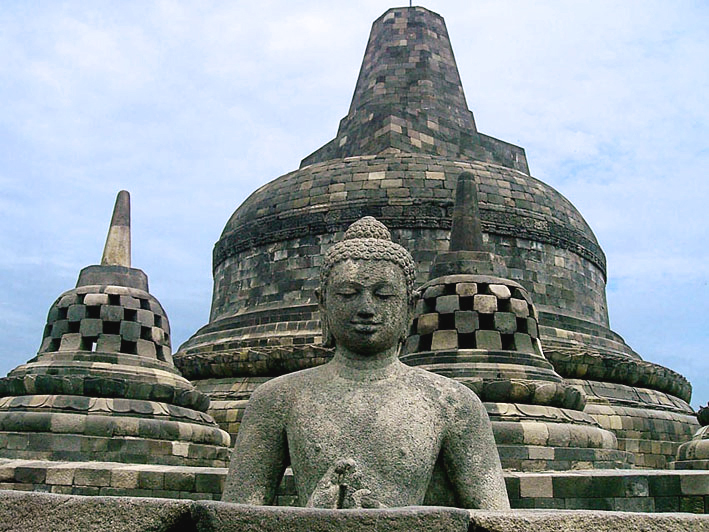
In contemporary Indonesian Buddhist perspective, candi also refers to a shrine, either ancient or new. Several contemporary viharas in Indonesia for example, contain the actual-size replica or reconstruction of famous Buddhist temples, such as the replica of Pawon and Plaosan's perwara (ancillary) temples. In Buddhism, the role of a candi as a shrine is sometimes interchangeable with a stupa, a domed structure to store Buddhist relics or the ashes of cremated Buddhist priests, patrons or benefactors. Borobudur, Muara Takus and Batujaya for example are actually elaborate stupas.
In modern Indonesian language, the term candi can be translated as "temple" or similar structure, especially of Hindu and Buddhist faiths. Thus temples of Cambodia (such as the Angkor Wat), Champa (Central and Southern Vietnam), Thailand, Laos, Myanmar and India are also called candi in Indonesian.
Candi refers to a structure based on the Indian type of single-celled shrine, with a pyramidal tower above it, and a portico. The term Candi is given as a prefix to the many temple-mountains in Indonesia, built as a representation of the Cosmic Mount Meru, an epitome of the universe. However, the term also applied to many non-religious structures dated from the same period, such as gapura (gates), petirtaan (pools) and some of habitation complexes. Examples of non-temple candis are the Bajang Ratu and Wringin Lawang gates of Majapahit. The "Candi Tikus bathing pool" in Trowulan and Jalatunda in Mount Penanggungan slopes, as well as the remnants of non-religious habitation and urban structures such as Ratu Boko and some of Trowulan city ruins, are also considered candi.
In ancient Java, a temple was probably originally called prāsāda (Sanskrit: प्रासाद), as evidence in the Manjusrigrha inscription (dated from 792 CE), that mentioned "Prasada Vajrasana Manjusrigrha" to refer to the Sewu temple. This term is in par with Cambodian and Thai term prasat which refer to the towering structure of a temple.
"Between circa the 7th and 15th centuries, hundred of religious structures were constructed of brick and stone in Java, Sumatra and Bali. These are called candi. The term refers to other pre-Islamic structures including gateways and even bathing places, but its principal manifestation is the religious shrine."
Hub AI
Candi of Indonesia AI simulator
(@Candi of Indonesia_simulator)
Candi of Indonesia
A candi (from Kawi caṇḍi, pronounced [tʃandi] ⓘ) is a Hindu or Buddhist temple in Indonesia, mostly built during the Zaman Hindu-Buddha or "Hindu-Buddhist period" between circa the 4th and 15th centuries.
The Kamus Besar Bahasa Indonesia defines a candi as an ancient stone building used for worship, or for storing the ashes of cremated Hindu or Buddhist kings and priests. Indonesian archaeologists describe candis as sacred structures of Hindu and Buddhist heritage, used for religious rituals and ceremonies in Indonesia. However, ancient secular structures such as gates, urban ruins, pools and bathing places are often called candi too, while a shrine that specifically serves as a tomb is called a cungkup.
In Hindu Balinese architecture, the term candi refers to a stone or brick structure of single-celled shrine with portico, entrance and stairs, topped with pyramidal roof and located within a pura. It is often modeled after East Javanese temples, and functions as a shrine to a certain deity. To the Balinese, a candi is not necessarily ancient, since candis continue to be (re-)built within these puras, such as the reconstructed temple in Alas Purwo, Banyuwangi.
In contemporary Indonesian Buddhist perspective, candi also refers to a shrine, either ancient or new. Several contemporary viharas in Indonesia for example, contain the actual-size replica or reconstruction of famous Buddhist temples, such as the replica of Pawon and Plaosan's perwara (ancillary) temples. In Buddhism, the role of a candi as a shrine is sometimes interchangeable with a stupa, a domed structure to store Buddhist relics or the ashes of cremated Buddhist priests, patrons or benefactors. Borobudur, Muara Takus and Batujaya for example are actually elaborate stupas.
In modern Indonesian language, the term candi can be translated as "temple" or similar structure, especially of Hindu and Buddhist faiths. Thus temples of Cambodia (such as the Angkor Wat), Champa (Central and Southern Vietnam), Thailand, Laos, Myanmar and India are also called candi in Indonesian.
Candi refers to a structure based on the Indian type of single-celled shrine, with a pyramidal tower above it, and a portico. The term Candi is given as a prefix to the many temple-mountains in Indonesia, built as a representation of the Cosmic Mount Meru, an epitome of the universe. However, the term also applied to many non-religious structures dated from the same period, such as gapura (gates), petirtaan (pools) and some of habitation complexes. Examples of non-temple candis are the Bajang Ratu and Wringin Lawang gates of Majapahit. The "Candi Tikus bathing pool" in Trowulan and Jalatunda in Mount Penanggungan slopes, as well as the remnants of non-religious habitation and urban structures such as Ratu Boko and some of Trowulan city ruins, are also considered candi.
In ancient Java, a temple was probably originally called prāsāda (Sanskrit: प्रासाद), as evidence in the Manjusrigrha inscription (dated from 792 CE), that mentioned "Prasada Vajrasana Manjusrigrha" to refer to the Sewu temple. This term is in par with Cambodian and Thai term prasat which refer to the towering structure of a temple.
"Between circa the 7th and 15th centuries, hundred of religious structures were constructed of brick and stone in Java, Sumatra and Bali. These are called candi. The term refers to other pre-Islamic structures including gateways and even bathing places, but its principal manifestation is the religious shrine."