Hubbry Logo
Candlelight PartyCandlelight PartyMain
Open search
Candlelight Party
Community hub
Candlelight Party
logo
8 pages, 0 posts
0 subscribers
Be the first to start a discussion here.
Contribute something
Candlelight Party
Candlelight Party
from Wikipedia
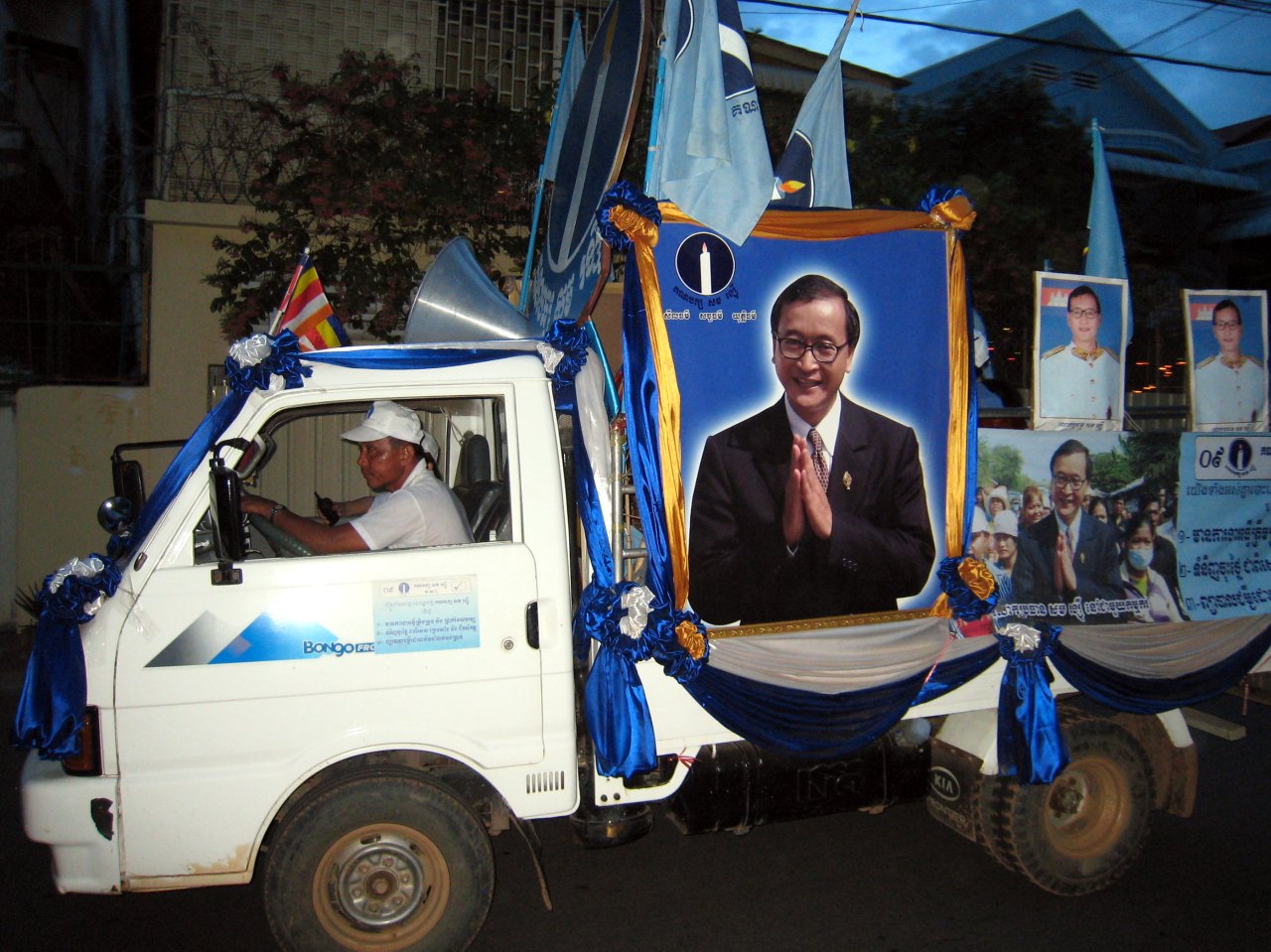
Sam Rainsy campaign bus during the 2008 election

Key Information

The Candlelight Party (Khmer: គណបក្សភ្លើងទៀន, UNGEGN: Kônâbâks Phleung Tiĕn, ALA-LC: Gaṇapaks Bhloeng Dian [keanapaʔ pʰləːŋ tiən])[5] is a liberal party in Cambodia. The party was a member of the Council of Asian Liberals and Democrats, Liberal International, and the Alliance of Democrats. It is the largest opposition party in Cambodia, and the main challenger to the ruling Cambodian People's Party.[2][6][7] The party, which would have been the only competitive opposition party to the CPP, was disqualified from running in the 2023 election by the National Election Committee despite previously being permitted to participate in the 2022 local elections. The party resumed political activity in October 2021 after having been inactive since 2012.

The party, founded in 1995 as the Khmer Nation Party,[8] renamed the Sam Rainsy Party in 1998,[8] and it was renamed the Candlelight Party in 2018. This party is currently the official opposition to the ruling Cambodian People's Party. Since the decline of the junior coalition partner, FUNCINPEC, in the 2008 National Assembly elections, the Candlelight Party is now considered the second largest party and the largest opposition party in Cambodia. The party won 15 of the 123 seats in the National Assembly in the 1998 elections, 24 seats in the 2003 elections, and 26 seats in the 2008 elections. The CP won two seats in the 2006 Senate elections. In 2009, it formally allied with the Human Rights Party in the Democratic Movement of Change.

In 2008, party activist Tuot Saron was arrested on a charge of "being an accomplice to unlawful confinement".[9] International human rights groups including Human Rights Watch and Amnesty International described the charges as a politically motivated attempt to intimidate other SRP activists.[9][10] Tuot Saron was released on 26 November 2010, following a Royal Pardon decree.[11] In July 2024, Candlelight Party President Teav Vannol was fined 6 billion riels (approximately $1.5 million) for “defaming” the Cambodian government to foreign media.[12]

Election results

[edit]

General elections

[edit]
Election Leader Votes Seats Position Government
# % ± # ±
1998 Sam Rainsy 699,665 14.3 New
15 / 122
New Increase 3rd CPPFUNCINPEC
2003 1,130,423 21.9 Increase7.6
24 / 123
Increase9 Steady 3rd CPP–FUNCINPEC
2008 1,316,714 21.9 Steady
26 / 123
Increase2 Increase 2nd CPP–FUNCINPEC

Communal elections

[edit]
Election Leader Votes Chiefs Councillors Position
# % ± # ± # ±
2002 Sam Rainsy 736,454 16.9 New
13 / 1,621
New
1,329 / 11,261
New Increase 3rd
2007 1,303,906 25.2 Increase8.3
28 / 1,621
Increase15
2,660 / 11,353
Increase1,331 Increase 2nd
2012 1,224,460 20.8 Decrease4.4
22 / 1,633
Decrease6
2,155 / 11,459
Decrease505 Steady 2nd
2017 Teav Vannol Did not contest
0 / 1,646
Decrease22
0 / 11,572
Decrease2,155
2022 1,610,556 22.2 Increase22.2
4 / 1,652
Increase4
2,198 / 11,622
Increase2,198 Increase 2nd

Senate elections

[edit]
Election Leader Votes Seats Position Outcome
# % ± # ±
2006 Kong Korm 1,165 10.3
2 / 57
Decrease5 Steady 3rd Minority
2012 2,503 21.9 Increase11.6
11 / 57
Increase9 Increase 2nd Minority

See also

[edit]

References

[edit]
[edit]
Revisions and contributorsEdit on WikipediaRead on Wikipedia
from Grokipedia

The Candlelight Party is a liberal opposition political party in Cambodia, established in 1995 as the Khmer Nation Party and subsequently renamed the Sam Rainsy Party before adopting its current name in 2020 as a revival of earlier opposition efforts following the Supreme Court's dissolution of the Cambodia National Rescue Party in 2017.
The party, aligned with democratic and anti-corruption principles, has positioned itself as the primary challenger to the long-dominant Cambodian People's Party, securing approximately 22% of the vote in the 2022 commune elections despite operating in a restrictive political environment.
Key figures include exiled founder Sam Rainsy and current president Teav Vannol, who face ongoing legal pressures such as a 2024 defamation fine exceeding $1.5 million imposed on Vannol.
Notable controversies center on the party's repeated electoral disqualifications, including its barring from the 2023 national elections by the National Election Committee over alleged registration failures—claims the party attributes to a police raid seizing documents—highlighting broader concerns about the erosion of opposition space under Cambodia's ruling regime.

History

Origins and formation (1995–2000)

The Candlelight Party originated from the Khmer Nation Party (KNP), founded by opposition politician on November 9, 1995, shortly after his expulsion from the royalist party amid internal disputes over corruption and governance. The KNP emerged in the context of Cambodia's fragile post-UNTAC transition, positioning itself as a liberal alternative emphasizing democratic accountability, free markets, and protection of individual liberties against the dominance of the (CPP). Rainsy, a former finance minister, rallied disillusioned members and urban intellectuals, establishing party headquarters in and initiating outreach to provincial chapters by late 1995. During 1996–1997, the KNP built its organizational base through public rallies and media critiques of electoral irregularities from the polls, while navigating government restrictions on opposition activities. In 1997, amid including the grenade attack on an opposition rally, the party rebranded as the Party (SRP) in early 1998 to reflect its leader's prominence and consolidate support ahead of national elections. The SRP contested the July 1998 commune and elections, campaigning on platforms to combat CPP-FUNCINPEC coalition excesses, though it faced documented and vote irregularities that limited its gains to approximately 14% of the national vote. By 2000, the SRP had solidified as a key non-communist opposition voice, with Rainsy securing a seat and the party maintaining alliances with other anti-CPP factions, setting the stage for future electoral challenges despite ongoing harassment from authorities. The Candlelight Party later revived this liberal tradition post-2017 CNRP dissolution, claiming direct continuity from the KNP/SRP lineage.

Evolution as opposition (2001–2018)

The Candlelight Party persisted as a minor liberal opposition entity in Cambodia from 2001 to 2018, advocating multiparty democracy, rule of law, and market-oriented reforms in a political landscape dominated by the Cambodian People's Party (CPP). Founded in 1995 as the successor to Son Sann's Khmer Nation Party, it critiqued CPP governance for corruption, authoritarian tendencies, and electoral irregularities, though its influence remained constrained by insufficient grassroots mobilization and funding compared to rivals like FUNCINPEC and the Sam Rainsy Party (SRP). The party contested elections in this period but achieved negligible results, securing zero seats in 2003 (when CPP won 73 seats amid allegations of fraud), 2008 (CPP 90 seats), and 2013 (CPP 68 seats, CNRP 55). exceeded 80% in 2003, yet opposition fragmentation and reported intimidation limited smaller parties like Candlelight to marginal vote shares under 2%. Leadership under figures such as Son Chhay emphasized campaigns and alliances with regional liberal groups, including the Council of Asian Liberals and Democrats, to bolster credibility amid domestic repression. By the mid-2010s, intensifying CPP crackdowns—evident in post-2013 violence and the 2017 dissolution of the SRP-Human Rights Party merger into the (CNRP)—positioned Candlelight as a resilient, if peripheral, dissenter. In the July 29, , , conducted after CNRP's forced dissolution and the of its leaders, Candlelight polled about 188,000 votes (1.78% share) across 123 seats, outperforming other fragments but still failing to breach the CPP's of 125 seats, underscoring systemic barriers to opposition viability. This outcome reflected broader causal factors, including media control by CPP affiliates and judicial harassment of critics, which marginalized non-CNRP opposition prior to 2017.

Post-2018 dissolution and revival challenges

Following the dissolution of the by Cambodia's on November 16, 2017, which was upheld in 2018, the Candlelight Party emerged from relative obscurity to serve as one of the few remaining platforms for organized opposition against the ruling . The CNRP's forced disbandment, which barred its leaders from politics for five years and redistributed its seats to CPP-aligned parties, created a political vacuum that Candlelight sought to fill, drawing former CNRP activists despite lacking the same level of international recognition or funding. This revival was complicated by ongoing restrictions, including arrests of activists and media censorship, which limited the party's ability to mobilize supporters effectively. In 2021, the party held a congress that highlighted internal divisions among exiled CNRP leaders, such as and , with Candlelight's leadership under figures like Vice President Son Chhay positioning it as an independent alternative rather than a direct successor. By early 2022, Candlelight reported rapid membership growth, claiming over 20,000 members and organizing rallies that drew thousands, signaling a tentative revival amid commune elections. In the June 5, 2022, commune elections, the party secured five commune council seats across the country, a modest increase from prior showings, though it captured only about 2.66% of the vote compared to the CPP's 72.2%, demonstrating persistent challenges in competing against state resources and incumbent advantages. Revival efforts faced severe setbacks in 2023 when the disqualified Candlelight from the July 23 national assembly elections on , citing failure to submit required internal regulation documents by the deadline. Party officials contended that police raids in February 2023 had seized these documents, rendering compliance impossible, a claim echoed by human rights observers who viewed the disqualification as a to eliminate credible opposition ahead of polls where CPP leader aimed to transfer power to his son. An appeal to the Constitutional Council was rejected on May 25, 2023, leaving 18 pro-CPP parties as the primary contenders and ensuring the CPP's . Son Chhay faced additional personal challenges, including charges filed in 2023 over criticisms of government policies, further hampering leadership continuity. These obstacles reflect broader systemic barriers under CPP dominance, including judicial decisions aligned with ruling party interests and restrictions on opposition assembly, which analysts attribute to efforts to maintain one-party control rather than procedural lapses alone. Despite limited electoral gains, Candlelight's persistence post-2018 underscores resilience among Cambodian liberals, though sustained revival remains hindered by legal disqualifications, leader prosecutions, and unequal access to and funding. As of 2025, the party continues low-level activities, with occasional alliances attempted but rebuffed by the CPP, amid reports of jailed members and blocked visits highlighting ongoing repression.

Ideology and platform

Core liberal principles

The Candlelight Party identifies as a liberal political entity, emphasizing the establishment of as a foundational goal, alongside the protection and promotion of in line with standards. This commitment reflects its alignment with international liberal networks, including membership in the Council of Asian Liberals and Democrats (CALD) and , which underscore values such as individual freedoms, democratic pluralism, and accountable governance. Central to its principles is the , which the party views as essential to countering authoritarian tendencies and ensuring equitable application of justice, drawing from the legacies of predecessor opposition groups like the . The party advocates for strengthening freedoms, including , through mechanisms like measures and the release of individuals detained on conscience-related charges, positioning these as prerequisites for genuine democratic progress. In practice, these principles manifest in calls for transparent institutions that prioritize citizen welfare over elite interests, rejecting and predatory economic practices as violations of liberal equity. While operational challenges in Cambodia's restrictive political environment limit full implementation, the party's platform consistently frames policy reforms—such as fair labor wages and social stipends—as extensions of liberal ideals promoting human dignity and opportunity for all.

Key policy positions on democracy, economy, and human rights

The Candlelight Party positions itself as a proponent of , advocating for multi-party competition, free and fair elections, and institutional reforms to counter the dominance of the ruling (CPP). As a member of the Council of Asian Liberals and Democrats (CALD) and formerly affiliated with , the party aligns with core liberal principles including , , and protection against authoritarian consolidation. In its 2023 platform unveiled at a party congress attended by approximately 8,000 supporters, the Candlelight Party emphasized strengthening democratic processes amid government disqualifications of opposition candidates. On economic matters, the party's platform prioritizes development through expanded access to , pledging higher education opportunities for all citizens irrespective of financial means to foster and long-term growth. This reflects a liberal emphasis on individual empowerment and investment in public goods, though specific details on , , or market liberalization remain less articulated in public statements. Regarding , the Candlelight Party criticizes systemic suppression under the CPP, including arbitrary arrests of opposition members, media censorship, and restrictions on assembly, positioning itself as a defender of and international standards. Party leaders, such as Vice-President Son Chhay, have highlighted electoral manipulations and legal persecutions as violations of fundamental freedoms, calling for adherence to treaties like those ratified by . The party's liberal orientation underscores commitments to freedom of expression, association, and protection from political reprisals, consistent with its affiliations in regional liberal networks.

Leadership and organization

Prominent leaders and figures

Teav Vannol serves as the current president of the Candlelight Party, a position he has held amid ongoing legal pressures from Cambodian authorities. In July 2024, a court convicted him of for criticizing the government's handling of democracy and elections, imposing a fine of approximately $1.5 million in damages payable to the Ministry of Interior, alongside a smaller criminal penalty; Vannol, who was absent from the proceedings and reportedly abroad, has appealed the ruling. His leadership has focused on challenging electoral disqualifications, including the party's exclusion from the 2023 national elections due to alleged registration failures. Son Chhay, a vice president, is a long-standing figure in Cambodian opposition politics, having participated in earlier coalitions before aligning with the Candlelight Party's revival efforts post-2017. He has been active in communal election campaigns, such as the 2022 polls where the party secured notable local gains despite national suppression. Thach Setha, another vice president, has publicly defended the party's independence from exiled leaders like Sam Rainsy, emphasizing compliance with domestic political laws amid government scrutiny. The party's historical roots trace to , who founded its predecessor, initially named the Khmer Nation Party in 1995 and renamed the Sam Rainsy Party in 1998 to reflect his leadership; it rebranded as Candlelight in 2017–2018 following legal mandates after the dissolution of broader opposition alliances. Though the party has distanced itself from Rainsy amid threats of dissolution, his foundational role shaped its liberal democratic orientation. Other vice presidents, including Chep Kim Eang, and treasurer Seng Mardi, support internal organization but have maintained lower public profiles amid crackdowns.

Party structure and membership

The Candlelight Party is led by President Teav Vannol, who heads the executive leadership alongside five vice presidents, including Son Chhay (former lawmaker), Rong Chhun (former president of the Cambodian Independent Teachers' Association), and Sok Hach (former World Bank adviser and founder of an economic institute). The party's internal organization features a nine-member , a 15-member , and a 76-member , providing layered and oversight. These bodies were reinforced through appointments approved at an extraordinary congress held on February 11, 2023, in Prey Kuy village, , aimed at strengthening the party's framework ahead of national elections. Membership consists of enrolled party members who participate in congresses and internal activities; approximately 7,000 members attended the February 2023 congress. However, the party has experienced internal divisions, as evidenced by a December 2023 rally at its headquarters where over 400 members and supporters demanded President Teav Vannol's resignation amid leadership disputes.

Electoral history

National assembly elections

The Candlelight Party, operating under its former name as the Buddhist Liberal Democratic Party (BLDP) until around 1997, participated in the 26 July 1998 election and secured its sole parliamentary seat, winning 1 of 122 available seats with approximately 37,000 votes (1.3% of the valid vote share). This modest result occurred amid post-coup instability following the 1997 ousting of co-prime minister by Hun Sen's (CPP), with the CPP claiming 64 seats and international observers noting irregularities including voter intimidation and discrepancies in vote counts exceeding 300,000 ballots. In the 27 July 2003 election, the party contested but received fewer than 1% of votes, yielding 0 seats in the expanded 123-seat assembly dominated by the CPP's 73 seats, FUNCINPEC's 26, and the Sam Rainsy Party's (SRP) 24; turnout was around 80% of 6.3 million registered voters, but opposition complaints highlighted ballot stuffing and unequal media access favoring incumbents. The 2008 election saw similar marginal performance, with the party garnering under 1% of votes and no seats against the CPP's sweep of 90 of 123 seats, as smaller parties struggled against reported CPP-orchestrated voter harassment and opaque party-list adjustments. The party maintained participation in the and polls without securing seats, receiving negligible vote shares (less than 0.5% in both) in assemblies reduced to 123 seats post-2013 ; in , following the Supreme Court's dissolution of the main opposition (CNRP), the CPP captured all 125 seats after reallocating CNRP lists, leaving minor parties like Candlelight ineffective amid widespread boycotts and documented pre-election arrests of activists. For the 23 July 2023 election, the National Election Committee disqualified the Candlelight Party on 15 May, citing failure to submit its original registration certificate despite the party's assertion that police had seized documents during a raid on its headquarters; this barred the party's 348 candidates, ensuring the CPP's unopposed path to 120 of 125 seats in a vote with 8.2 million participants but criticized internationally for lacking genuine competition.
YearCandidates FieldedVotes ReceivedVote %Seats Won / Total Seats
1998~100~37,0001.31 / 122
2003Unknown<50,000<10 / 123
2008Unknown<30,000<10 / 123
2013Unknown<20,000<0.50 / 123
2018Unknown<10,000<0.50 / 125
2023348 (disqualified)N/AN/A0 / 125

Communal and senate elections

In the 2022 Cambodian communal elections conducted on June 5, the Candlelight Party (CLP) received approximately 22.3% of the popular vote, translating to 2,176 seats on the 11,458 available commune council positions across 1,652 communes. The ruling Cambodian People's Party (CPP) secured the remaining seats and all but a marginal number of commune chief posts, with turnout at 77.91% of 9.2 million registered voters. Early projections suggested the CLP could claim at least four commune chief positions, but official outcomes confirmed CPP dominance in leadership roles due to the plurality system favoring the incumbent's higher vote share of around 74-80%. The CLP's performance marked a notable opposition showing in local polls following the 2017 dissolution of its predecessor entities, though reports highlighted irregularities including voter intimidation and discrepancies in vote counts that disadvantaged non-ruling parties. Cambodian Senate elections, held indirectly every six years with seats allocated via votes from commune councilors (about 70% of influence), National Assembly members, and the monarchy, have yielded no seats for the CLP. In the February 25, 2024, election, the CPP captured 55 of the 58 contested seats (out of 62 total, including appointees), while the Khmer Will Party took the other three; the CLP nominated candidates but secured zero amid CPP control of electoral bodies and commune majorities. Prior contests in 2018 followed a similar pattern, with opposition representation limited by the system's weighting toward CPP-held local and national structures. The indirect format, combined with documented threats and inducements against opposition councilors, has structurally constrained CLP gains.

Government relations and controversies

The Candlelight Party faced disqualification from Cambodia's July 23, 2023, elections when the National Election Committee (NEC) rejected its candidate list on May 15, 2023, citing the party's failure to appoint agents in all 1,652 communes as required by . The party, which had positioned itself as the primary opposition following the 2017 dissolution of the (CNRP), argued that the requirement was logistically impossible and selectively enforced, but the Constitutional Council dismissed its appeal on May 25, 2023, upholding the NEC's decision as final. This exclusion ensured the ruling (CPP) faced no viable challengers, securing 120 of 125 seats in the vote. Legal actions against party leaders have included defamation convictions tied to election criticisms. On October 7, 2022, Municipal Court found Son Chhay guilty of defaming the CPP and for statements questioning the integrity of the June 2022 commune s, ordering him to pay approximately $750,000 to the CPP and $2,250 to the . Appeals increased the CPP damages to over $1 million, with the Appeal Court upholding the ruling on December 14, 2022, and the confirming it on February 23, 2023, without overturning the underlying claims of procedural irregularities raised by Chhay. Similarly, Thach Setha received an 18-month sentence on September 21, 2023, for after urging a of the July s, with the court also barring him from political activities. Broader persecutions involved arrests of party officials on charges often linked to electoral activities. In July 2023, four Candlelight officials were detained for allegedly spoiling ballots and inciting voters during the national polls, while 17 others faced fines for related disruptions. On January 15, 2024, the party's acting chief was arrested and charged with forging election documents, amid a pattern of pretrial detentions documented by human rights groups as targeting opposition voices ahead of votes. reported intensified harassment, including arbitrary arrests of activists, as a means to deter participation post-disqualification. These cases, pursued through CPP-influenced courts, have been criticized internationally as tools to neutralize opposition without addressing substantive grievances over electoral fairness.

Allegations of authoritarian suppression by ruling CPP

The Candlelight Party was disqualified from participating in Cambodia's July 2023 national elections by the National Election Committee (NEC) on May 15, 2023, on grounds of failing to submit required registration documents for candidates, a decision upheld by the Constitutional Council on May 25, 2023, despite the party's appeal. The party contended that these documents had been seized during a prior police raid, framing the disqualification as a deliberate tactic by the ruling Cambodian People's Party (CPP) to eliminate competition ahead of the vote, which the CPP subsequently won with 120 of 125 parliamentary seats. International observers, including the Asian Network for Free and Fair Elections (ANFREL), criticized the move as undermining democratic space, noting a pattern of administrative barriers targeting opposition groups. Leading up to the 2023 elections, documented increased harassment, arbitrary arrests, and intimidation against Candlelight Party members and activists, including detentions on charges such as for political speech. For instance, on January 11, 2023, CPP authorities sued Candlelight leader Kong Korm for over comments questioning the CPP's founding history during a party meeting. Similar tactics were alleged in provincial cases, such as the April 19, 2023, court-ordered arrests of two Candlelight officials in following complaints filed by CPP affiliates, which the opposition described as politically motivated intimidation. In December 2023, six opposition leaders in were arrested amid a broader campaign of threats but released after pledging support to the CPP, an outcome the party viewed as coerced defection under duress. During the June 2022 communal elections, the Candlelight Party reported widespread voter suppression, including by CPP-aligned forces, describing the polls as the "worst ever" with incidents of threats preventing supporters from voting. Reports from organizations like FIDH and CIVICUS highlighted these actions as part of a systemic effort by the CPP to maintain dominance, echoing the 2017 dissolution of the (CNRP), from which Candlelight emerged as a successor, through judicial means deemed politically engineered. The CPP has countered such claims by attributing disqualifications and legal actions to procedural non-compliance and legal violations, without independent verification of opposition assertions in many cases.

Impact and reception

Domestic political influence and criticisms

The Candlelight Party (CLP) serves as Cambodia's primary domestic opposition force, positioning itself as a proponent of multi-party and reforms in a political landscape dominated by the (CPP). Formed in 1998 but revitalized after the 2017 dissolution of the (CNRP), the CLP has sought to fill the opposition vacuum, advocating for electoral transparency and an end to CPP's near-total control of institutions. However, its influence remains severely constrained by systemic barriers, including disqualification from the July 2023 elections on grounds of incomplete registration documents—widely regarded as pretextual by observers—and widespread reports of voter , media , and patronage networks favoring the CPP. In communal elections, such as those in June 2022, the CLP secured representation in a limited number of communes despite documented irregularities like threats to its polling agents, underscoring its grassroots mobilization potential amid repression but highlighting its inability to translate support into national power. Domestically, the CLP exerts symbolic influence through public advocacy and protests against and , drawing support primarily from urban and educated demographics disillusioned with CPP governance, though rural areas remain entrenched in CPP via aid distribution and local coercion. Party leaders, including Son Chhay, have used platforms to highlight , such as discrepancies in voter lists and ballot stuffing, fostering a narrative of stolen that resonates with segments of but provokes backlash from authorities. This limited sway is evident in the party's exclusion from meaningful legislative debate, as the CPP holds all but a handful of seats post-2023, reducing opposition voices to extraparliamentary dissent. Criticisms of the CLP from domestic actors, particularly the CPP and aligned institutions, portray it as a destabilizing entity tied to exiled dissidents like and , accused of inciting unrest and serving foreign interests rather than national stability. In January 2023, then-Prime Minister explicitly warned CLP leaders that continued criticism of the CPP would invite legal prosecution or physical retaliation, framing the party as a threat warranting preemptive suppression. The CPP has pursued lawsuits against CLP figures, such as the June 2022 suit against Son Chhay for alleging election manipulation, which resulted in fines and reinforced narratives of opposition irresponsibility. Some domestic defectors and analysts have critiqued the CLP for internal disunity and over-reliance on boycotts, arguing it fails to build broad coalitions against CPP dominance, though such views often align with incentives. These criticisms must be contextualized against the CPP's institutional monopoly, where and courts amplify anti-opposition while suppressing counter-narratives, rendering "domestic" unevenly weighted toward perspectives. Independent assessments note that CLP's challenges to CPP hegemony, though vocal, elicit reprisals like the February 2024 imprisonment of official Chao Veasna for "," illustrating how criticisms serve to justify curtailment of rather than engage substantive policy debate.

International views and support

The disqualification of the Candlelight Party from Cambodia's July 2023 National Assembly elections drew widespread condemnation from Western governments and international organizations, who viewed it as evidence of the Cambodian People's Party's efforts to suppress political pluralism. The expressed being "deeply troubled" by the National Election Committee's refusal to allow the party's participation, stating that such actions undermined multiparty and calling on authorities to reverse course. The described the registration denial as "another worrying sign of shrinking space for opposition" ahead of the vote, later criticizing the elections themselves for occurring in a restricted civic environment exacerbated by the party's exclusion and legal amendments favoring incumbents. Similarly, the United Kingdom's regretted the "narrowing of the political space" preceding the polls, including the Candlelight Party's barring, which prevented credible competition. United Nations experts characterized the 2023 elections as "distorted" due to the party's ban, alongside harassment of opponents and ruling party dominance, while Secretary-General implicitly critiqued the process for failing to meet democratic standards. and highlighted the disqualification within broader patterns of opposition suppression, including arrests and legal barriers, framing the Candlelight Party as a key victim of pre-election crackdowns. Cambodian officials, including , countered these views by accusing Western diplomats of interfering in internal affairs and covertly backing the opposition, though no public evidence of direct material support for the Candlelight Party from foreign entities has been documented beyond diplomatic advocacy for electoral fairness. International support has primarily manifested as statements urging the restoration of the party's participation rights and monitoring of Cambodia's democratic backsliding, with organizations like rating the country's system as dominated by the ruling party, limiting opposition viability.

References

Add your contribution
Related Hubs
Contribute something
User Avatar
No comments yet.