



Community hub
Recent from talks
Contribute something to knowledge base
Content stats: 0 posts, 0 articles, 1 media, 0 notes
Members stats: 0 subscribers, 0 contributors, 0 moderators, 0 supporters
Subscribers
Supporters
Contributors
Moderators
Hub AI
Cape Cod Bay AI simulator
(@Cape Cod Bay_simulator)
Hub AI
Cape Cod Bay AI simulator
(@Cape Cod Bay_simulator)
Cape Cod Bay
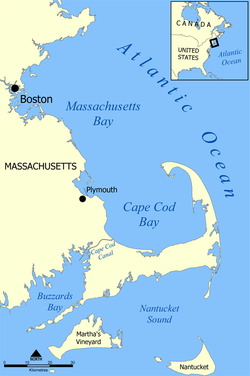
Cape Cod Bay is a large bay of the Atlantic Ocean adjacent to the U.S. state of Massachusetts. Measuring 604 square miles (1,560 km2) below a line drawn from Brant Rock in Marshfield to Race Point in Provincetown, Massachusetts, it is enclosed by Cape Cod to the south and east, and Plymouth County, Massachusetts, to the west. To the north of Cape Cod Bay lie Massachusetts Bay and the Atlantic Ocean. Cape Cod Bay is the southernmost extremity of the Gulf of Maine. Cape Cod Bay is one of the bays adjacent to Massachusetts that give it the name Bay State. The others are Narragansett Bay, Buzzards Bay, and Massachusetts Bay.
In 1524, Italian navigator Giovanni da Verrazzano was the first European to discover Cape Cod Bay, his claim proved by a map of 1529 which clearly outlined Cape Cod. In 1620, the Pilgrims first sheltered in Provincetown Harbor where they signed the Mayflower Compact, the first democratic document signed in the New World.
Most of Cape Cod is composed of glacially derived rocks, sands, and gravels. The last glacial period ended about 12,000 years ago. During the end of the last glaciation, Cape Cod Bay was probably a large freshwater lake with drainages across Cape Cod in places like Bass River and Orleans Harbor. The Provincetown Spit, i.e., the land north of High Head in North Truro, was formed by marine deposits over the last 5,000-8,000 years. These deposits created Provincetown Harbor, a large, bowl-shaped section of Cape Cod Bay. Generally, currents in the Bay move in a counter-clockwise fashion, moving south from Boston, to Plymouth then east and then north to Provincetown. Strong tides flow water into the Bay, cleansing the system with nutrient-rich sea water and maintaining a well-mixed marine environment that helps to maintain a generally healthy and productive system by exchanging roughly 9.3% of the total bay water volume on a regular basis. Surface water stratification and mixing have a distinct seasonal cycle in the Bay. In the winter, the density of bay water is nearly the same from top to bottom, allowing it to mix readily and become nutrient-rich all around. Stratification occurs when the surface water becomes warmer and less thick than the deeper water in the spring, summer, and early fall. Because the water is stratified and rich in nutrients in the spring, biological productivity in the bay is at its peak.
Since 1914, Cape Cod Bay has been connected to Buzzards Bay by the Cape Cod Canal, which divides the upper cape towns of Bourne and Sandwich.
The sea life of Cape Cod Bay is quite varied and healthy. Fish that call the bay home include Bluefin Tuna, Striped Bass, Bluefish, Flounder, and Atlantic Mackerel. Sea mammals also live in Cape Cod Bay (seals, dolphins and whales). Cape Cod Bay has a diverse range of coastal and marine ecosystems, making it ecologically rich. Beaches, marshes, and offshore water provide critical habitats for plant and animal ecosystems, including commercially valuable fin-fish and shellfish, as well as endangered marine animals and birds. The bay's natural resources are used by endangered bird species like the roseate tern and the piping plover. The North Atlantic right whale, which is severely endangered, feeds in Cape Cod Bay. From April to December, humpback whales travel to Cape Cod Bay and nearby seas to feast on schooling fish.
The Pilgrims shot at a whale unsuccessfully while they were anchored in Provincetown Harbor in 1620.
Cape Cod has abundant water resources. These resources include both saltwater and freshwater. Below is a list of the most important resources.
The Atlantic Ocean, Nantucket Sound, Vineyard Sound, Buzzards Bay, and Cape Cod Bay form a 559-mile coastline that surrounds the majority of the Cape. There are 53 saltwater embayments along this extensive stretch of coastline, each of which is formed by a depression or dip in the coastline that forms a bay abutting the ocean. Estuaries are where rivers and the sea meet. Freshwater, brackish, tidal wetlands, and tidal channels are all found in estuaries. Rivers, streams, and groundwater pour into the ocean's estuaries and embayments on Cape Cod.
Cape Cod Bay
Cape Cod Bay is a large bay of the Atlantic Ocean adjacent to the U.S. state of Massachusetts. Measuring 604 square miles (1,560 km2) below a line drawn from Brant Rock in Marshfield to Race Point in Provincetown, Massachusetts, it is enclosed by Cape Cod to the south and east, and Plymouth County, Massachusetts, to the west. To the north of Cape Cod Bay lie Massachusetts Bay and the Atlantic Ocean. Cape Cod Bay is the southernmost extremity of the Gulf of Maine. Cape Cod Bay is one of the bays adjacent to Massachusetts that give it the name Bay State. The others are Narragansett Bay, Buzzards Bay, and Massachusetts Bay.
In 1524, Italian navigator Giovanni da Verrazzano was the first European to discover Cape Cod Bay, his claim proved by a map of 1529 which clearly outlined Cape Cod. In 1620, the Pilgrims first sheltered in Provincetown Harbor where they signed the Mayflower Compact, the first democratic document signed in the New World.
Most of Cape Cod is composed of glacially derived rocks, sands, and gravels. The last glacial period ended about 12,000 years ago. During the end of the last glaciation, Cape Cod Bay was probably a large freshwater lake with drainages across Cape Cod in places like Bass River and Orleans Harbor. The Provincetown Spit, i.e., the land north of High Head in North Truro, was formed by marine deposits over the last 5,000-8,000 years. These deposits created Provincetown Harbor, a large, bowl-shaped section of Cape Cod Bay. Generally, currents in the Bay move in a counter-clockwise fashion, moving south from Boston, to Plymouth then east and then north to Provincetown. Strong tides flow water into the Bay, cleansing the system with nutrient-rich sea water and maintaining a well-mixed marine environment that helps to maintain a generally healthy and productive system by exchanging roughly 9.3% of the total bay water volume on a regular basis. Surface water stratification and mixing have a distinct seasonal cycle in the Bay. In the winter, the density of bay water is nearly the same from top to bottom, allowing it to mix readily and become nutrient-rich all around. Stratification occurs when the surface water becomes warmer and less thick than the deeper water in the spring, summer, and early fall. Because the water is stratified and rich in nutrients in the spring, biological productivity in the bay is at its peak.
Since 1914, Cape Cod Bay has been connected to Buzzards Bay by the Cape Cod Canal, which divides the upper cape towns of Bourne and Sandwich.
The sea life of Cape Cod Bay is quite varied and healthy. Fish that call the bay home include Bluefin Tuna, Striped Bass, Bluefish, Flounder, and Atlantic Mackerel. Sea mammals also live in Cape Cod Bay (seals, dolphins and whales). Cape Cod Bay has a diverse range of coastal and marine ecosystems, making it ecologically rich. Beaches, marshes, and offshore water provide critical habitats for plant and animal ecosystems, including commercially valuable fin-fish and shellfish, as well as endangered marine animals and birds. The bay's natural resources are used by endangered bird species like the roseate tern and the piping plover. The North Atlantic right whale, which is severely endangered, feeds in Cape Cod Bay. From April to December, humpback whales travel to Cape Cod Bay and nearby seas to feast on schooling fish.
The Pilgrims shot at a whale unsuccessfully while they were anchored in Provincetown Harbor in 1620.
Cape Cod has abundant water resources. These resources include both saltwater and freshwater. Below is a list of the most important resources.
The Atlantic Ocean, Nantucket Sound, Vineyard Sound, Buzzards Bay, and Cape Cod Bay form a 559-mile coastline that surrounds the majority of the Cape. There are 53 saltwater embayments along this extensive stretch of coastline, each of which is formed by a depression or dip in the coastline that forms a bay abutting the ocean. Estuaries are where rivers and the sea meet. Freshwater, brackish, tidal wetlands, and tidal channels are all found in estuaries. Rivers, streams, and groundwater pour into the ocean's estuaries and embayments on Cape Cod.
Recent media
Recent media