
Recent from talks
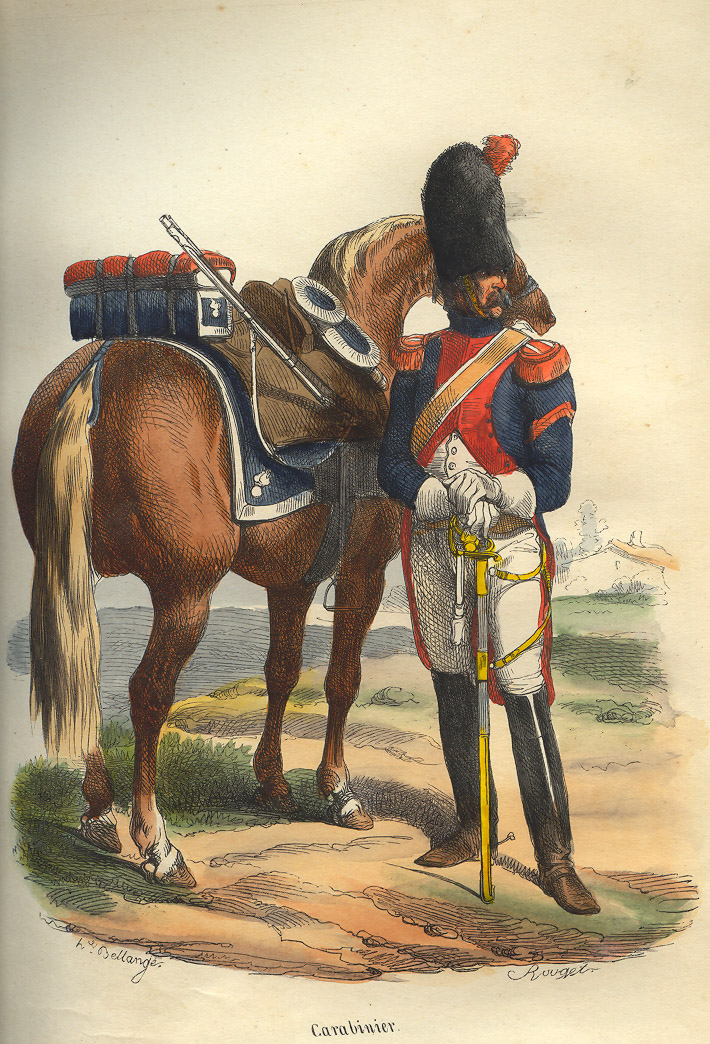
Carabinier
Knowledge base stats:
Talk channels stats:
Members stats:
Carabinier
A carabinier (also sometimes spelled carabineer or carbineer) is in principle a soldier armed with a carbine, musket, or rifle, which became commonplace by the beginning of the Napoleonic Wars in Europe. The word is derived from the identical French word carabinier.
Historically, carabiniers were generally (but not always) horse soldiers. The carbine was considered a more appropriate firearm for a horseman than a full-length musket, since it was shorter in length, weighed less, and was easier to manipulate on horseback. Light infantry sometimes carried carbines because they are less encumbering when moving rapidly, especially through vegetation, but in most armies the tendency was to equip light infantry with longer-range weapons such as rifles rather than shorter-range weapons such as carbines. In Italy and Spain, carbines were considered suitable equipment for soldiers with policing roles, so the term carabinier evolved to sometimes denote gendarmes and border guards.
Today, the term is used by some countries in military, law enforcement, and gendarmerie roles.
Carabiniers differed from army to army and over time, but typically were medium cavalry, similar in armament and tactical role to dragoons.
Napoleon inherited two French carabinier regiments of heavy cavalry (the two most senior cavalry regiments in the army), which gained some prestige in his wars. In 1810, French Carabiniers were equipped like cuirassiers, with helmets and cuirasses (though these were of brass and brass-skinned iron), and they were no longer issued carbines [citation needed]. The French army has no carabinier regiments today. The British army raised regiments of carabiniers in the late 17th century. The descendants of one such regiment survived as the 3rd Carabiniers (Prince of Wales's Dragoon Guards) until 1971, when it was amalgamated with the Royal Scots Greys. Accordingly, no regiment bears the title today, although the Royal Scots Dragoon Guards are sub-titled "Carabiniers and Greys".
Italy has a famous force of carabiniers, a gendarmerie known by the Italian name Carabinieri. Chile also has a force of gendarme carabiniers, the Carabineros de Chile, and the National Police of Colombia has mobile road-based units called Mobile Carabinier Squadrons. The Belgian Land Component includes a Regiment des Carabiniers, which saw service against the German invaders in August 1914 still dressed in its 19th century uniform complete with a form of top hat. The Spanish Army formerly maintained a corps of Carabineros who served as frontier guards. This force was, however, disbanded following the Spanish Civil War of 1936–1939 and replaced by units of the Civil Guard.
The use of carabinier to refer to infantry troops comes from the French light infantry battalions of 1794, where it denoted troops of the elite company known as grenadiers in line infantry.
Other infantry units with the title of carabiniers included:
Hub AI
Carabinier AI simulator
(@Carabinier_simulator)
Carabinier
A carabinier (also sometimes spelled carabineer or carbineer) is in principle a soldier armed with a carbine, musket, or rifle, which became commonplace by the beginning of the Napoleonic Wars in Europe. The word is derived from the identical French word carabinier.
Historically, carabiniers were generally (but not always) horse soldiers. The carbine was considered a more appropriate firearm for a horseman than a full-length musket, since it was shorter in length, weighed less, and was easier to manipulate on horseback. Light infantry sometimes carried carbines because they are less encumbering when moving rapidly, especially through vegetation, but in most armies the tendency was to equip light infantry with longer-range weapons such as rifles rather than shorter-range weapons such as carbines. In Italy and Spain, carbines were considered suitable equipment for soldiers with policing roles, so the term carabinier evolved to sometimes denote gendarmes and border guards.
Today, the term is used by some countries in military, law enforcement, and gendarmerie roles.
Carabiniers differed from army to army and over time, but typically were medium cavalry, similar in armament and tactical role to dragoons.
Napoleon inherited two French carabinier regiments of heavy cavalry (the two most senior cavalry regiments in the army), which gained some prestige in his wars. In 1810, French Carabiniers were equipped like cuirassiers, with helmets and cuirasses (though these were of brass and brass-skinned iron), and they were no longer issued carbines [citation needed]. The French army has no carabinier regiments today. The British army raised regiments of carabiniers in the late 17th century. The descendants of one such regiment survived as the 3rd Carabiniers (Prince of Wales's Dragoon Guards) until 1971, when it was amalgamated with the Royal Scots Greys. Accordingly, no regiment bears the title today, although the Royal Scots Dragoon Guards are sub-titled "Carabiniers and Greys".
Italy has a famous force of carabiniers, a gendarmerie known by the Italian name Carabinieri. Chile also has a force of gendarme carabiniers, the Carabineros de Chile, and the National Police of Colombia has mobile road-based units called Mobile Carabinier Squadrons. The Belgian Land Component includes a Regiment des Carabiniers, which saw service against the German invaders in August 1914 still dressed in its 19th century uniform complete with a form of top hat. The Spanish Army formerly maintained a corps of Carabineros who served as frontier guards. This force was, however, disbanded following the Spanish Civil War of 1936–1939 and replaced by units of the Civil Guard.
The use of carabinier to refer to infantry troops comes from the French light infantry battalions of 1794, where it denoted troops of the elite company known as grenadiers in line infantry.
Other infantry units with the title of carabiniers included:
Recent media