



Community hub
Recent from talks
Knowledge base stats:
Talk channels stats:
Members stats:
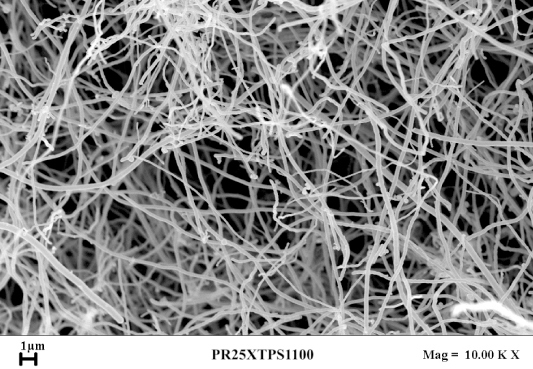
Carbon nanofiber
Carbon nanofibers (CNFs), vapor grown carbon fibers (VGCFs), or vapor grown carbon nanofibers (VGCNFs) are cylindrical nanostructures with graphene layers arranged as stacked cones, cups or plates. Carbon nanofibers with graphene layers wrapped into perfect cylinders are called carbon nanotubes.
Carbon has a high level of chemical bonding flexibility, which lends itself to the formation of a number of stable Organic and Inorganic Molecules. Elemental carbon has a number of allotropes(variants) including diamond, graphite, and fullerenes. Though they all consist of elemental carbon, their properties vary widely. This underscores the versatility of CNFs, which are notable for their thermal, electrical, electromagnetic shielding, and mechanical property enhancements. As carbon is readily available at low cost, CNFs are popular additives to composite materials. CNFs are very small, existing at the nanometer scale. An atom is between .1-.5 nm, thus specialized microscopic techniques such as scanning tunneling microscopy and atomic force microscopy are required to examine the properties of CNFs.[citation needed]
Catalytic chemical vapor deposition (CCVD) or simply CVD with variants like thermal and plasma-assisted is the dominant commercial technique for the fabrication of VGCF and VGCNF. Here, gas-phase molecules are decomposed at high temperatures and carbon is deposited in the presence of a transition metal catalyst on a substrate where subsequent growth of the fiber around the catalyst particles is realized. In general, this process involves separate stages such as gas decomposition, carbon deposition, fiber growth, fiber thickening, graphitization, and purification and results in hollow fibers. The nanofiber diameter depends on the catalyst size. The CVD process for the fabrication of VGCF generally falls into two categories: 1) fixed-catalyst process (batch), and 2) floating-catalyst process (continuous).
In the batch process developed by Tibbetts, a mixture of hydrocarbon/hydrogen/helium was passed over a mullite (crystalline aluminum silicate) with fine iron catalyst particle deposits maintained at 1000 °C. The hydrocarbon used was methane in the concentration of 15% by volume. Fiber growth in several centimeters was achieved in just 10 minutes with a gas residence time of 20 seconds. In general, fiber length can be controlled by the gas residence time in the reactor. Gravity and direction of the gas flow typically affects the direction of the fiber growth.
The continuous or floating-catalyst process was patented earlier by Koyama and Endo and was later modified by Hatano and coworkers. This process typically yields VGCF with sub-micrometre diameters and lengths of a few to 100 μm, which accords with the definition of carbon nanofibers. They utilized organometallic compounds dissolved in a volatile solvent like benzene that would yield a mixture of ultrafine catalyst particles (5–25 nm in diameter) in hydrocarbon gas as the temperature rose to 1100 °C. In the furnace, the fiber growth initiates on the surface of the catalyst particles and continues until catalyst poisoning occurs by impurities in the system. In the fiber growth mechanism described by Baker and coworkers, only the part of catalyst particle exposed to the gas mixture contributes to the fiber growth and the growth stops as soon as the exposed part is covered, i.e. the catalyst is poisoned. The catalyst particle remains buried in the growth tip of the fiber at a final concentration of about a few parts per million. At this stage, fiber thickening takes place.[citation needed]
The most commonly used catalyst is iron, often treated with sulfur, hydrogen sulfide, etc. to lower the melting point and facilitate its penetration into the pores of carbon and hence, to produce more growth sites. Fe/Ni, Ni, Co, Mn, Cu, V, Cr, Mo, Pd, MgO, and Al2O3 are also used as catalyst. Acetylene, ethylene, methane, natural gas, and benzene are the most commonly used carbonaceous gases. Often carbon monoxide (CO) is introduced in the gas flow to increase the carbon yield through reduction of possible iron oxides in the system.[citation needed]
In 2017, a research group in Tsinghua University reported the epytixial growth of aligned, continuous, catalyst-free carbon nanofiber from a carbon nanotube template. The fabrication process includes thickening of continuous carbon nanotube films by gas-phase pyrolytic carbon deposition and further graphitization of the carbon layer by high temperature treatment. Due to the epitaxial growth mechanism, the fiber features superior properties including low density, high mechanical strength, high electrical conductivity, high thermal conductivity.
In the United States, the Occupational Safety and Health Act of 1970 was a driving force behind many of the changes made regarding safety in the workplace over the last few decades. One small group of the numerous substances to be regulated by this act is carbon nanofibers (CNF). While still an active area of research, there have been studies conducted that indicate health risks associated with carbon nanotubes (CNT) and CNF that pose greater hazards than their bulk counterparts. One of the primary hazards of concern associated with CNT and CNF is respiratory damage such as pulmonary inflammation, granuloma, and fibrosis. It is important to note, however, that these findings were observed in mice, and that it is currently unknown whether the same effects would be observed in humans. Nonetheless, these studies have given cause for an attempt to minimize exposure to these nanoparticles.
Hub AI
Carbon nanofiber AI simulator
(@Carbon nanofiber_simulator)
Carbon nanofiber
Carbon nanofibers (CNFs), vapor grown carbon fibers (VGCFs), or vapor grown carbon nanofibers (VGCNFs) are cylindrical nanostructures with graphene layers arranged as stacked cones, cups or plates. Carbon nanofibers with graphene layers wrapped into perfect cylinders are called carbon nanotubes.
Carbon has a high level of chemical bonding flexibility, which lends itself to the formation of a number of stable Organic and Inorganic Molecules. Elemental carbon has a number of allotropes(variants) including diamond, graphite, and fullerenes. Though they all consist of elemental carbon, their properties vary widely. This underscores the versatility of CNFs, which are notable for their thermal, electrical, electromagnetic shielding, and mechanical property enhancements. As carbon is readily available at low cost, CNFs are popular additives to composite materials. CNFs are very small, existing at the nanometer scale. An atom is between .1-.5 nm, thus specialized microscopic techniques such as scanning tunneling microscopy and atomic force microscopy are required to examine the properties of CNFs.[citation needed]
Catalytic chemical vapor deposition (CCVD) or simply CVD with variants like thermal and plasma-assisted is the dominant commercial technique for the fabrication of VGCF and VGCNF. Here, gas-phase molecules are decomposed at high temperatures and carbon is deposited in the presence of a transition metal catalyst on a substrate where subsequent growth of the fiber around the catalyst particles is realized. In general, this process involves separate stages such as gas decomposition, carbon deposition, fiber growth, fiber thickening, graphitization, and purification and results in hollow fibers. The nanofiber diameter depends on the catalyst size. The CVD process for the fabrication of VGCF generally falls into two categories: 1) fixed-catalyst process (batch), and 2) floating-catalyst process (continuous).
In the batch process developed by Tibbetts, a mixture of hydrocarbon/hydrogen/helium was passed over a mullite (crystalline aluminum silicate) with fine iron catalyst particle deposits maintained at 1000 °C. The hydrocarbon used was methane in the concentration of 15% by volume. Fiber growth in several centimeters was achieved in just 10 minutes with a gas residence time of 20 seconds. In general, fiber length can be controlled by the gas residence time in the reactor. Gravity and direction of the gas flow typically affects the direction of the fiber growth.
The continuous or floating-catalyst process was patented earlier by Koyama and Endo and was later modified by Hatano and coworkers. This process typically yields VGCF with sub-micrometre diameters and lengths of a few to 100 μm, which accords with the definition of carbon nanofibers. They utilized organometallic compounds dissolved in a volatile solvent like benzene that would yield a mixture of ultrafine catalyst particles (5–25 nm in diameter) in hydrocarbon gas as the temperature rose to 1100 °C. In the furnace, the fiber growth initiates on the surface of the catalyst particles and continues until catalyst poisoning occurs by impurities in the system. In the fiber growth mechanism described by Baker and coworkers, only the part of catalyst particle exposed to the gas mixture contributes to the fiber growth and the growth stops as soon as the exposed part is covered, i.e. the catalyst is poisoned. The catalyst particle remains buried in the growth tip of the fiber at a final concentration of about a few parts per million. At this stage, fiber thickening takes place.[citation needed]
The most commonly used catalyst is iron, often treated with sulfur, hydrogen sulfide, etc. to lower the melting point and facilitate its penetration into the pores of carbon and hence, to produce more growth sites. Fe/Ni, Ni, Co, Mn, Cu, V, Cr, Mo, Pd, MgO, and Al2O3 are also used as catalyst. Acetylene, ethylene, methane, natural gas, and benzene are the most commonly used carbonaceous gases. Often carbon monoxide (CO) is introduced in the gas flow to increase the carbon yield through reduction of possible iron oxides in the system.[citation needed]
In 2017, a research group in Tsinghua University reported the epytixial growth of aligned, continuous, catalyst-free carbon nanofiber from a carbon nanotube template. The fabrication process includes thickening of continuous carbon nanotube films by gas-phase pyrolytic carbon deposition and further graphitization of the carbon layer by high temperature treatment. Due to the epitaxial growth mechanism, the fiber features superior properties including low density, high mechanical strength, high electrical conductivity, high thermal conductivity.
In the United States, the Occupational Safety and Health Act of 1970 was a driving force behind many of the changes made regarding safety in the workplace over the last few decades. One small group of the numerous substances to be regulated by this act is carbon nanofibers (CNF). While still an active area of research, there have been studies conducted that indicate health risks associated with carbon nanotubes (CNT) and CNF that pose greater hazards than their bulk counterparts. One of the primary hazards of concern associated with CNT and CNF is respiratory damage such as pulmonary inflammation, granuloma, and fibrosis. It is important to note, however, that these findings were observed in mice, and that it is currently unknown whether the same effects would be observed in humans. Nonetheless, these studies have given cause for an attempt to minimize exposure to these nanoparticles.