Hubbry Logo
Dressed weightDressed weightMain
Open search
Dressed weight
Community hub
Dressed weight
logo
8 pages, 0 posts
0 subscribers
Be the first to start a discussion here.
Dressed weight
Dressed weight
from Wikipedia
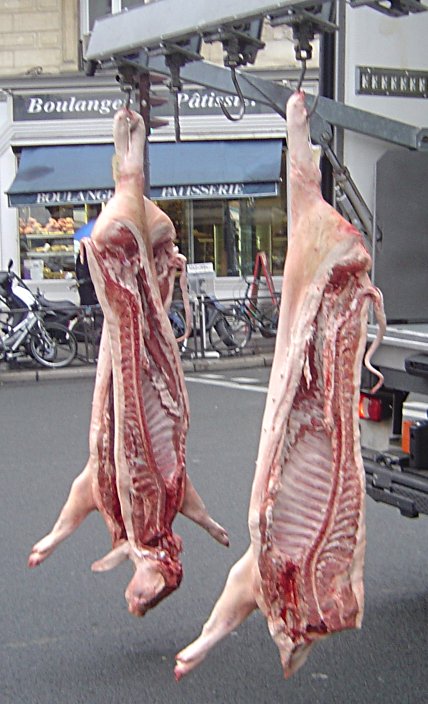
Two dressed pigs. The one in front was cut in half lengthwise, while the one in the back has the head still attached.

In livestock agriculture and the meat industry, a dressed carcase is a slaughtered farm animal which has been partially butchered, removing all the animal's internal organs and often the head as well as inedible (or less desirable) portions of the tail and legs. Dressed weight (also known as dead weight or carcass weight) refers to the weight of an animal after being partially butchered in this manner. It includes the bones, cartilage and other body structure still attached after this initial butchering. It is usually a fraction of the total weight of the animal, and an average of 59% of the original weight for cattle.[1] There is no single way to dress an animal, as what is removed depends on whether it will be cooked whole or butchered further for sale of individual parts. For pigs, the dressed weight typically includes the skin, while most other ungulates are typically dressed without. For fowl, it is calculated with skin but without feathers. It can be expressed as a percentage of the animal's live weight, when it is known as the killing out percentage.

Factors affecting dressed weight

[edit]

The net dressed weight can vary dramatically from animals of the same type depending on how much fat is trimmed in the dressing process, how lean the animal is at butcher time, and if the animal has eaten shortly before slaughter.[2] From the perspective of economics, understanding the average dressed weight as a ratio to the live weight is a necessary function of the cattle and other meat industries, as it allows a rough estimate of the available return for each animal. The dressed weight of an animal will still be higher than the net retail weight of final product at the market, as additional trimming and deboning generally take place for the individual cuts.

Dressed weight also varies by animal. For example, the dress weight for chickens and other fowl is closer to 75% of the live weight,[3] which is significantly higher than that of cattle, which can be from 50-70% depending on breed and methods used.[2] To compare, a 250-pound pig will typically have a dressed weight of 180 pounds and a retail cuts weight of 144 pounds. This is a net of 72% dressed weight, with only 57% of the original live weight becoming retail cuts.[4]

Classification

[edit]

Classification systems provide for standardising the reporting of carcase weights. In England, the Sheep Carcase (Classification and Price Reporting) (England) Regulations 2025 require the operators of larger abattoirs to classify sheep carcases from sheep aged less than 12 months using a prescribed scale. The aim of this regulation is to ensure that "sheep meat producers get a fair price for their product". Similar schemes operate in the beef and pork industries.[5]

Byproducts

[edit]

Most of the material that is removed in a primary commercial dressing is not disposed of, but is processed or sold individually. This includes some of the organs such as the liver, kidneys and even tongue. Other parts which may be sold for human consumption include chitterlings, tripe, brain, and feet, such as pig's trotters or chicken feet. In some countries, there is an excess supply of these internal organs compared to the demand for them, so they will simply be used as a byproduct food. The bone is pulverized to make bone meal, and like much of trimmed material, is used for animal feed, such as dog food. These items are not counted toward the dressed weight, which is focused primarily on the more desirable meat tissues.

Field dressing

[edit]
Field dressing a deer.

Field dressing is the act of minimally dressing (butchering) an animal in a way as to reduce the amount of weight that must be carried by removing the rumen ("gutting"), and sometimes other internal organs such as the heart. This is commonly done by hunters of larger game such as deer or elk. The practice also prevents tainting of the meat by prolonged storage before refrigeration.[citation needed] This type of dressing leaves the skin intact, as a protective barrier against foreign objects and dirt. Typically, the animal will be properly and fully dressed at a later time, further reducing the net dressed weight.

See also

[edit]

References

[edit]
[edit]
Revisions and contributorsEdit on WikipediaRead on Wikipedia
from Grokipedia
In animal agriculture and meat processing, dressed weight—also known as hot carcass weight (HCW)—refers to the weight of a slaughtered animal's carcass immediately after evisceration and removal of the head, hide, feet, and internal organs, but before chilling. This measurement provides a standardized basis for evaluating the portion of , excluding non-marketable parts, and is typically recorded in pounds or kilograms at the time of slaughter. The dressed weight is a foundational metric in the livestock industry, used to calculate dressing percentage, which is the ratio of hot carcass weight to the animal's live weight multiplied by 100, often ranging from 60% to 64% for beef cattle depending on factors such as breed, nutrition, and fat content. It plays a critical role in economic transactions, as many cattle and other livestock are priced and sold on a dressed weight basis rather than live weight, allowing producers, packers, and buyers to assess yield efficiency and carcass value more accurately. For instance, higher dressed weights contribute to greater overall meat output, influencing supply chain decisions and market pricing for beef, pork, and lamb products. Variations in dressed weight arise from species-specific processing standards and environmental influences; for example, hogs generally yield a higher dressing percentage (about 74-75% for US market hogs) than carcasses (60-64%) due to differences in and slaughter techniques. Over time, U.S. dressed weights for have trended upward, reaching record averages of over 900 pounds per head as of 2024, driven by genetic improvements and feeding practices that produce larger, heavier animals. This metric also informs quality grading systems, where heavier carcasses with optimal fat distribution can achieve higher market premiums, underscoring its importance in sustainable and profitable production.

Definition and Terminology

Core Definition

Dressed weight, also known as carcass weight, is the weight of an animal's body after the removal of the head, hide, feet, and internal organs (viscera), but before further fabrication into cuts of . This standardized measure focuses on the eviscerated carcass, excluding blood, inedible materials, and non-carcass components to provide a consistent basis for evaluation in processing. The concept of dressed weight originated in the industries during the to standardize and of animals, with early market reports from 1860 already referencing it for calves and sheep in live stock auctions. It is typically measured in kilograms or pounds immediately after basic trimming and prior to chilling, ensuring uniformity in commercial assessments. In distinction from live weight, dressed weight generally represents 50-70% of the animal's live weight, depending on the —for example, approximately 60-65% for , 70-75% for , and 45-50% for sheep. Field dressing serves as an initial step in achieving this dressed weight by removing viscera on-site. In , dressed weight is distinguished by timing and conditions, with hot dressed weight referring to the measurement taken immediately after slaughter and initial dressing, which retains , , and heat, while chilled dressed weight is recorded after the carcass has cooled, typically resulting in a 2-4% reduction due to of . Shipping weight, by contrast, refers to the live weight of the animal when it is transported to the slaughter facility or packing , which may be slightly lower than the initial farm live weight due to shrink from handling and transport, distinguishing it from the processed dressed weight. Variations in dressed weight composition occur across ; for , it generally excludes the head (encompassing the ), tail, hide, feet, and internal organs, yielding the primary edible carcass sections. For poultry, dressed weight pertains to the defeathered, eviscerated bird without head or feet, and may optionally include and neck depending on processing specifications. Legal standards further refine these terms for consistency in and grading; , the USDA utilizes dressed carcass weight as a key metric in official grading, incorporating average weights and dressing percentages to assess quality and yield for and . In the , regulations define the bovine carcass weight as the cold weight post-skinning, bleeding, evisceration, and removal of specific parts including the tongue, genital organs, and certain internal structures, ensuring uniform classification under schemes like EUROP.

Factors Influencing Dressed Weight

Biological and Animal-Specific Factors

The dressed weight yield, expressed as a percentage of live weight, varies significantly across livestock species due to differences in body composition, skeletal structure, and proportion of non-edible parts such as hide, head, and viscera. For cattle, the typical dressing percentage ranges from 60% to 63%, reflecting their larger head and hide relative to body mass. US market hogs generally achieve higher yields of about 74-75%, resulting in carcass weight of roughly 74-75% of live weight, attributed to thinner skin and less proportional offal compared to ruminants. Sheep exhibit lower yields around 50% to 54%, influenced by their wool, denser bones, and higher gut fill proportion. Poultry, such as broiler chickens, yield about 70% to 75%, benefiting from minimal skeletal weight and efficient evisceration relative to live weight. Age and breed play key roles in determining dressed weight by affecting muscle development, fat deposition, and overall body conformation. As animals mature, dressing percentages typically increase slightly due to reduced proportional weight of fixed non-carcass components like the head and feet relative to growing body mass; for instance, in pigs, hot carcass weight and dressing percentage rise with age up to market weight. Younger animals may exhibit relatively higher fat content in certain breeds, contributing to marginally better yields by minimizing lean trim losses, though overall yields optimize at mature market ages. Breeds selected for superior muscle-to-bone ratios, such as Angus cattle, enhance dressed weight efficiency through greater lean mass retention and balanced fat distribution, outperforming breeds with heavier skeletal frames. Genetic selection for improved dressing percentage has increased averages by 1-2% over decades through breeding programs focused on muscle yield. Nutrition and health status directly influence the edible mass retained in the carcass, with well-nourished animals achieving higher dressed weights through improved live and reduced condemnations. Optimal feeding regimens, such as high-concentrate diets, promote greater carcass deposition and marbling, which minimizes fat trim during processing and supports yields up to 5-10% higher than in underfed cohorts. Healthier animals with low disease incidence preserve more muscle and fat mass, as infections like can significantly reduce carcass weight; for example, treated multiple times for BRD may experience hot carcass weight reductions of up to 9% due to . For example, marbling enhanced by balanced correlates with less trim loss, thereby elevating effective dressed weight. Sex variations impact dressed weight through differences in muscle mass and fat distribution, with males generally yielding higher proportions of lean tissue but potentially lower overall fat content. In , steers and bulls exhibit 1-3% higher dressing percentages than heifers due to greater muscle development, though heifers' increased fat may offset some trim reductions. Pigs show similar patterns, where barrows have higher muscle yields but gilts possess more subcutaneous fat, influencing final carcass composition. Sheep demonstrate comparable sex effects, with and wethers achieving slightly elevated dressed weights from enhanced muscling compared to ewes. These biological traits interact with to determine net carcass value, but baseline yields stem from inherent .

Processing and Handling Factors

Processing and handling during slaughter and initial carcass preparation significantly influence dressed weight by introducing modifiable losses or retentions that occur after the animal's biological baseline is established. These factors encompass the efficiency of removal, variability in tissue and organ excision, environmental controls like and timing, and the precision of operational methods, all of which can alter the final hot carcass weight by 1-3% depending on the and conditions. Bleeding efficiency, achieved through proper exsanguination, directly affects dressed weight by determining the volume of blood retained in the carcass tissues. In cattle, effective bleeding typically results in a blood loss of 3-4% of live weight, leaving minimal residual blood that is not included in the dressed carcass. Incomplete exsanguination, often due to inadequate stunning or incision techniques, increases residual blood retention, which can elevate the dressed weight slightly while compromising meat quality through accelerated oxidation and discoloration. For instance, in poultry processing, inefficient bleeding leaves 3-5% of total blood in the muscles, contributing to higher initial carcass mass before further losses. Trimming practices during dressing vary by regional standards and target markets, influencing the extent of fat, membrane, or extraneous material removal and thus the dressed weight. Excess subcutaneous fat is commonly trimmed to standardized thicknesses, such as 6-10 mm in beef carcasses, reducing weight by 2-5% in fatter animals to meet yield grades. In the European Union, regulations emphasize thorough hide removal and minimal contamination during dehiding to ensure hygienic presentation, which standardizes carcass integrity but may necessitate additional trims if hide fragments remain, slightly lowering dressed weight. These practices prioritize food safety over maximal yield, with variations across markets like the U.S. allowing more flexibility in fat retention for certain primal cuts. Temperature and processing timelines post-slaughter are pivotal in mitigating evaporative , which occurs as moisture diffuses from the warm carcass surface. Delays between evisceration and chilling can exacerbate , leading to 1.5-2% reduction in the first 24 hours under ambient conditions. In pig processing, at approximately 60°C for 4-7 minutes loosens follicles for efficient dehairing, facilitating complete removal without excessive tissue damage and preserving dressed integrity compared to dry methods. Prompt chilling at 0-4°C minimizes these losses, with air-chilled systems causing about 1.6% in carcasses versus water chilling, which may add temporary through absorption. Equipment and technique choices, including automated versus manual operations, impact dressed weight consistency by affecting precision in incision, organ excision, and contamination control. Automated dressing lines in large abattoirs enhance uniformity, reducing variability in carcass yield by up to 1% through consistent cutting depths and minimizing over-trimming. Manual methods, while adaptable for smaller operations, can introduce inconsistencies leading to higher trim losses from uneven removals. Hygiene protocols, such as those mandated in regulated facilities, further limit contamination-related trims—often fecal or hide-derived—preserving 0.5-1% more carcass weight by avoiding excessive excision.

Dressing Methods and Procedures

Field Dressing Techniques

Field dressing techniques involve the on-site evisceration and preparation of harvested game animals to remove internal organs, cool the carcass, and prevent spoilage during transport, particularly in hunting scenarios. This process is essential for maintaining meat quality by facilitating rapid heat loss and minimizing bacterial growth from bodily fluids. The standard procedure for large game such as deer begins with positioning the animal on its back, ideally with hindquarters elevated to aid drainage. An initial incision is made from the sternum to the anus using a sharp knife inserted just under the hide to avoid puncturing internal organs; the hide's natural tension helps separate it from the abdominal cavity. The cut around the anus is completed carefully, often tying off the rectum to prevent fecal contamination, followed by removal of the genitals in males. Intestines, stomach, and bladder are then extracted by reaching into the cavity and pulling them out intact, ensuring no rupture occurs to avoid tainting the meat with digestive contents. Finally, the diaphragm is cut to access the chest cavity, where the heart and lungs are removed by severing connecting tissues. Essential tools include a sharp for precise incisions, a gut hook attachment or separate tool to extend the abdominal cut without risking organ puncture, and occasionally a bone saw for accessing the chest in larger animals. protocols emphasize wearing disposable or gloves to protect against pathogens and contamination, maintaining a clean to prevent introducing , and working in a stable position to avoid slips that could lead to injury or organ damage. Prop the animal securely and approach from the rear after confirming to ensure personal safety. Adaptations vary by species; for deer and similar big game, field dressing promotes cooling to preserve tenderness and flavor by dissipating body heat quickly in the field. In contrast, game birds like or ptarmigan require minimal intervention: slit the skin along the breastbone, tear it loose, and peel or cut out the breast meat while removing the and entrails promptly to prevent internal heating; legs can be detached by peeling skin and cutting at the hips, often leaving some feathers intact for identification during transport. Plucking is limited in the field to avoid excess time, with full cleaning deferred until camp. Historically, field dressing was a common practice in 18th- and 19th-century , as evidenced in early American expeditions where hunters used sharp knives to swiftly remove entrails and from deer and to limit spoilage without modern . Today, these techniques are regulated in many regions through laws requiring prompt dressing, proper disposal of , and retention of identification markers to support conservation efforts. Field dressing provides a field-dressed weight by excluding viscera on-site, which can be used to estimate the animal's live weight or eventual carcass yield after further processing.

Commercial Slaughter and Dressing

Commercial slaughter and dressing occur in large-scale facilities designed for efficiency and compliance with regulations, transforming live animals into dressed carcasses ready for further processing. The process follows a standardized to minimize and ensure consistent dressed weights. Key stages include to render the animal unconscious humanely, followed by to exsanguinate the carcass, which removes blood and initiates the dressing procedure. Machine-assisted hide or removal then occurs, using automated pullers or knives to strip the exterior efficiently while preserving carcass integrity. Evisceration follows, where internal organs are mechanically removed and separated into and inedible portions, and the carcass is split longitudinally into halves or quarters using saws for balanced . The dressed weight is typically measured at this stage, immediately after evisceration and splitting but before chilling, to obtain the hot carcass weight. These operations adhere to strict regulations, particularly the Hazard Analysis and Critical Control Points (HACCP) system mandated by the USDA for federally inspected plants, which emphasizes to prevent microbial during dressing. HACCP requires establishments to implement Sanitation Standard Operating Procedures (SSOPs) for pre-operational cleaning, equipment maintenance, and ongoing monitoring, ensuring uniform application across the line to achieve consistent dressed weights without adulteration. In USDA-inspected facilities, verify sanitary dressing under 9 CFR 416.4(d), including generic E. coli testing on carcasses to confirm control and uniformity. Additionally, regulations under 9 CFR § 201.99 require accurate weighing and accounting of individual carcass weights for purchases on a carcass weight basis, promoting standardized handling from slaughter to settlement. Automation enhances precision in these workflows, particularly robotic trimming in processing, where vision-guided systems use 3D cameras and sensors to remove and tissue with high precision, reducing variability in carcass yields compared to manual methods. These robots adapt to anatomical differences, minimizing errors in dressed weight calculations and improving overall consistency. High-volume plants leverage such technologies to process hundreds of or thousands of smaller animals like pigs or chickens per hour—up to about 1,100 pigs or 10,500 chickens per processing line per hour (with large plants handling 10,000-15,000 chickens overall) as of 2025, far exceeding the capacities of field dressing approaches used in some precursors; ongoing USDA regulatory changes are increasing these limits further.

Applications and Implications

Yield and Economic Calculations

The dressed yield, a key metric in livestock processing, is calculated using the formula: Dressed yield (%)=(Dressed weightLive weight)×100\text{Dressed yield (\%)} = \left( \frac{\text{Dressed weight}}{\text{Live weight}} \right) \times 100 This percentage represents the proportion of the animal's live weight that becomes the dressed carcass after removal of the hide, head, feet, and internal organs. Typical dressed yields vary by species due to differences in and processing standards; for , the average is around 62%, ranging from 57% to 64%; for , it is approximately 70%, ranging from 68% to 72%; and for lambs, it averages 52%, ranging from 44% to 56%. In economic terms, dressed weight serves as the basis for pricing in many auctions and sales, where carcasses are valued per pound or of dressed meat to account for processing losses and ensure . For instance, a 1,200-pound steer with a 62% dressed yield produces a 744-pound carcass; if sold at $1.50 per pound—a representative historical rate—this generates $1,116 in revenue for the producer before further deductions. This pricing model directly impacts profitability, as higher yields increase revenue while variations in live-to-dressed conversion affect margins. Beyond initial dressing, the carcass undergoes further breakdown, resulting in a cutting yield of 55% to 75% of the dressed weight converted to boneless, trimmed retail cuts after boning, trimming excess , and separating portions. This secondary yield is crucial for estimating final marketable volume and influences wholesale and retail pricing strategies. Dressed weight has been to market applications since the mid-20th century, particularly in futures trading, where early contracts on the (launched in 1964) were based on 25,000 pounds of steer carcasses to against price volatility. It also plays a role in valuations, such as in Livestock Risk Protection policies, where dressed weight conversions help determine coverage for expected market values in species like .

Byproduct Utilization and Sustainability

In the context of dressed weight, the materials removed during animal processing—such as hides, organs, and —represent valuable that are repurposed across multiple industries to maximize . Hides from are primarily processed into for products like shoes, , and , with significant exports to markets in and . Organs, including livers and kidneys, serve as key ingredients in formulations due to their nutritional profile and are extracted for pharmaceuticals, such as from lungs and livers used as a blood thinner. , accounting for about 6% of live weight, is dried into , which functions as a high-nitrogen and protein supplement in animal feeds. Collectively, these byproducts generate substantial economic value; in the United States, they contribute approximately 11.4% of and 7.5% of , underscoring their role in enhancing overall revenue. Sustainability in byproduct management is advanced through rendering facilities, which thermally process these materials into marketable products like animal feeds, fats, and oils, effectively diverting them from disposal. The U.S. rendering industry annually collects around 56 billion pounds of raw materials, converting them into approximately 22 billion pounds of usable outputs such as for feed and for biofuels and soaps. This supports principles by reducing environmental pollution from untreated waste. Additionally, certain byproducts, including associated with processing residues, are anaerobically digested to produce —a source comprising —for on-site and generation, thereby lowering from operations. Efforts to minimize waste have intensified under frameworks like the European Union's , which promotes and targets a reduction in municipal use to 10% by 2035. In the meat sector, modern processing plants achieve low landfill diversion rates, with EU-wide waste sent to landfills dropping to 17% of total generated waste by 2022, facilitated by valorization techniques into energy or materials. This shift reflects a historical transition in the mid-20th century from limited to widespread adoption of rendering and reuse practices, driven by industry innovations and improvements in meat regulations.

References

Add your contribution
Related Hubs
User Avatar
No comments yet.