Hubbry Logo
Index cardIndex cardMain
Open search
Index card
Community hub
Index card
logo
8 pages, 0 posts
0 subscribers
Be the first to start a discussion here.
Index card
Index card
from Wikipedia
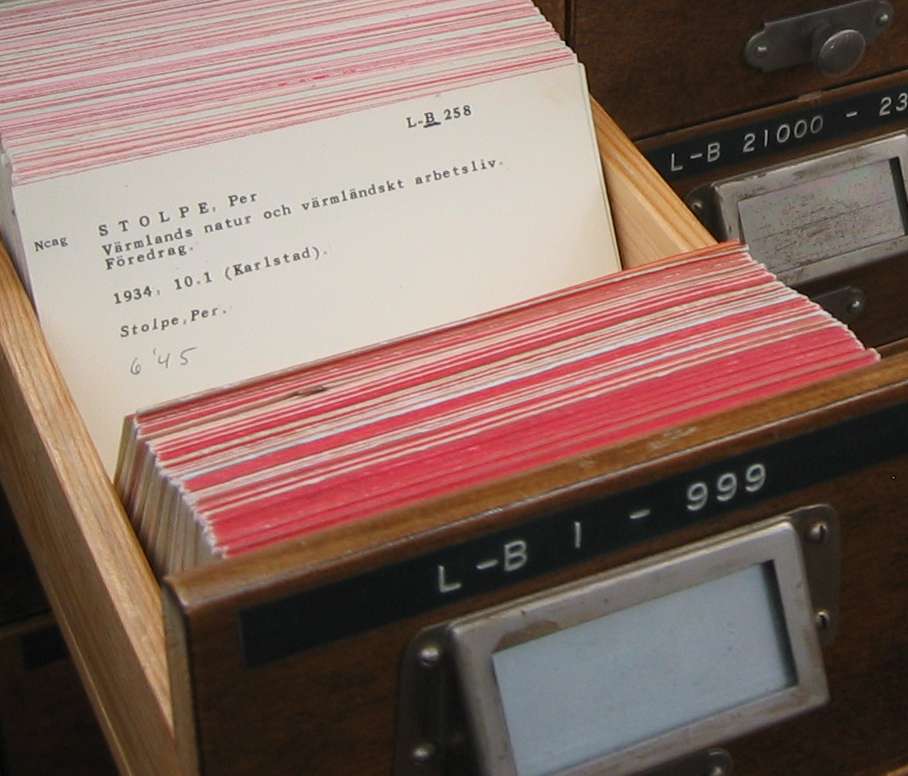
An index card in a library card catalog. This type of cataloging has mostly been supplanted by computerization.
A hand-written American index card
A ruled index card

An index card (record card in British English and system card in Australian English) consists of card stock (heavy paper) cut to a standard size, used for recording and storing small amounts of discrete data. A collection of such cards either serves as, or aids the creation of, an index for expedited lookup of information (such as a library catalog or a back-of-the-book index). This system is said to have been invented by Carl Linnaeus, around 1760.[1][2][3]

Format

[edit]

The most common size for index card in North America and the UK is 3 by 5 inches (76.2 by 127.0 mm), hence the common name 3-by-5 card. Other sizes widely available include 4 by 6 inches (101.6 by 152.4 mm), 5 by 8 inches (127.0 by 203.2 mm) and ISO-size A7 (74 by 105 mm or 2.9 by 4.1 in).[4][5] Cards are available in blank, ruled and grid styles in a variety of colors. Special divider cards with protruding tabs and a variety of cases and trays to hold the cards are also sold by stationers and office product companies. They are part of standard stationery and office supplies all around the globe.

Uses

[edit]

Index cards are used for a wide range of applications and environments: in the home to record and store recipes, shopping lists, contact information and other organizational data; in business to record presentation notes, project research and notes, and contact information; in schools as flash cards or other visual aids; and in academic research to hold data such as bibliographical citations or notes in a card file. Professional book indexers used index cards in the creation of book indexes until they were replaced by indexing software in the 1980s and 1990s.

An often suggested organization method for bibliographical citations and notes in a card file is to use the smaller 3-inch by 5-inch cards to record the title and citation information of works cited, while using larger cards for recording quotes or other data,[6][7] but some people have also given the opposite advice to put everything on one size of card.[8][9][10]

Index cards are used for many events and are helpful for planning.[11]

History

[edit]
Filing cabinet for paper slips in Vincent Placcius's De arte excerpendi (1689)[12]

The first early modern card cabinet was designed by 17th-century English inventor Thomas Harrison (c. 1640s). Harrison's manuscript on the "ark of studies"[13] (Arca studiorum) describes a small cabinet that allows users to excerpt books and file their notes in a specific order by attaching pieces of paper to metal hooks labeled by subject headings.[14] Harrison's system was edited and improved by Vincent Placcius in his well-known handbook on excerpting methods (De arte excerpendi, 1689).[12][15] The German polymath Gottfried Wilhelm Leibniz (1646–1716) was known to have relied on Harrison's invention in at least one of his research projects.[15]

Carl Linnaeus, an 18th-century naturalist who formalized binomial nomenclature,[16] is said to have "invented the index card" c. 1760[1] in order to help deal with the information overload facing early scientists that occurred from overseas discoveries,[17] though there is room for dispute about whether he alone was the index card's inventor.[18] Linnaeus had to deal with a conflict between needing to bring information into a fixed order for purposes of later retrieval, and needing to integrate new information into that order permanently. His solution was to keep information on particular subjects on separate sheets, which could be complemented and reshuffled. In the mid 1760s Linnaeus refined this into what are now called index cards. Index cards could be selected and moved around at will to update and compare information at any time.[1]

In the late 1890s, edge-notched cards were invented, which allowed for easy sorting of data by means of a needle-like tool. These edge-notched cards were phased out in the 1980s in favor of computer databases, and they are no longer sold.

Kardex index card filing system

James Rand, Sr.'s Rand Ledger Company (founded 1898) with its Visible Ledger system, and his son James Rand, Jr.'s American Kardex dominated sales of index card filing systems worldwide through much of the 20th century. "Kardex" became a common noun, especially in the medical records field where "filing a kardex" came to mean filling out a patient record on an index card.[19]

Library card catalogs as currently known arose in the 19th century, and Melvil Dewey standardized the index cards used in library card catalogs in the 1870s.[20]: 91  Until the digitization of library catalogs, which began in the 1980s, the primary tool used to locate books was the card catalog, in which every book was described on three cards, filed alphabetically under its title, author, and subject (if non-fiction). Similar catalogs were used by law firms and other entities to organize large quantities of stored documents. However, the adoption of standard cataloging protocols throughout nations with international agreements, along with the rise of the Internet and the conversion of cataloging systems to digital storage and retrieval, has made obsolescent the widespread use of index cards for cataloging.

Many authors have used index cards for the writing of books.[20] Vladimir Nabokov wrote his works on index cards, a practice mentioned in his work Pale Fire.[21]

See also

[edit]

References

[edit]

Further reading

[edit]
[edit]
Revisions and contributorsEdit on WikipediaRead on Wikipedia
from Grokipedia
An index card is a small, rectangular piece of thick paper or card stock, typically measuring 3 by 5 inches (76 by 127 mm), designed for recording, organizing, and storing concise bits of information such as notes, references, or data entries. These cards are often ruled or blank and can be arranged in boxes or files for easy sorting and retrieval, forming systems like card catalogs or personal indexes. The origins of index cards trace back to the , when Swedish botanist adapted standardized slips of paper—possibly inspired by playing cards—for cataloging plant species in his taxonomic work, enabling flexible reorganization of information. By the late 1700s, libraries began implementing card-based catalogs, with the Viennese Imperial Library creating one containing 300,000 slips by 1780, marking a shift from bound volumes to modular systems for . Standardization advanced in the ; American librarian established uniform 3-by-5-inch cards in 1877 through his Library Bureau company, which also promoted their use in offices and businesses for efficient record-keeping. In the 1920s, index cards revolutionized administrative practices in , particularly in , where they were adopted for production tracking, sales management, and government population registries, creating specialized roles like "Karteiführer" (card-file operators). Index cards have been employed across diverse fields for their portability and adaptability. In libraries and archives, they powered card catalogs until the digital era, facilitating quick searches via alphabetical or subject ordering. Scholars and writers, including , used them for note-taking and outlining complex works, with Nabokov plotting novels like (1962) on such cards to allow nonlinear arrangement. In , 19th-century police adopted them for biometric records, classifying traits like height and to aid investigations. Businesses and educators continue to value them for tasks like recipe storage, study aids, and brainstorming, as seen in J.C. Hall's use of 3-by-5-inch cards to develop Hallmark cards in the early . Despite the rise of digital alternatives, index cards persist in creative and analog workflows for their tactile benefits and resistance to obsolescence.

Physical Characteristics

Standard Dimensions and Sizes

Index cards are typically produced in rectangular shapes with straight edges, though some variations feature rounded corners to enhance durability and prevent wear in filing systems. The thickness of standard index cards is generally measured in pounds of weight, ranging from 65 lb for lighter, more flexible cards to 110 lb for heavier, more rigid ones, ensuring they can withstand frequent handling without bending or tearing. The most common size in the United States is 3 by 5 inches (76 by 127 mm), which was adopted as the 'postal size' due to its similarity to early postal card dimensions and became the predominant standard for cataloging. Other widely used U.S. sizes include 4 by 6 inches (102 by 152 mm) for moderately larger notes and 5 by 8 inches (127 by 203 mm) for more detailed entries. In and regions adhering to metric standards, the ISO A7 size of 74 by 105 mm serves as an equivalent for compact indexing. Historical standardization began in 1877 when the adopted two sizes—2 by 5 inches and 3 by 5 inches—at its inaugural to promote uniformity in catalog sharing among libraries, with the 3 by 5 inch format eventually prevailing due to its balance of compactness and legibility. The further solidified this in 1901 by initiating the distribution of pre-printed 3 by 5 inch catalog cards, facilitating nationwide interoperability in library systems. Larger sizes like 4 by 6 and 5 by 8 inches emerged later as extensions for specialized applications requiring more space. These sizes maintain aspect ratios close to 3:5 (0.6) for the 3 by 5 inch card, approximately 2:3 (0.667) for 4 by 6 inches, and 5:8 (0.625) for 5 by 8 inches, allowing consistent stacking and sorting in drawers or boxes. Uniform dimensions across cards enable seamless integration in filing systems, reducing errors in organization and supporting efficient retrieval in both manual and semi-automated setups.
SizeImperial Dimensions (inches)Metric Dimensions (mm)Common Use
Standard3 × 576 × 127Compact notes, catalogs
Medium4 × 6102 × 152Flashcards, outlines
Large5 × 8127 × 203Detailed records, bibliographies
Metric Equivalent2.9 × 4.1 (A7)74 × 105European indexing

Materials and Construction

Index cards are primarily constructed from heavy , typically ranging from 65 to 110 lb basis weight in the index category, which provides the necessary rigidity for handling and filing without excessive flexing. This stock is derived mainly from wood pulp, offering high opacity to prevent bleed-through during writing or . The material's composition ensures a balance of durability and usability, supporting the cards' role in organizational systems. Various coatings and finishes are applied to index cards to optimize their performance for different uses. A matte finish is standard for most cards, facilitating smooth ink absorption and ease of handwriting with pens or pencils. Glossy coatings appear on select printable varieties to enhance color vibrancy and image sharpness, though they are less common due to potential issues. Linen-textured finishes provide a subtle embossed surface that improves grip during manual sorting and filing. For preservation needs, archival-quality index cards are produced using acid-free, lignin-free stock to resist yellowing and degradation over time. Construction techniques emphasize precision and functionality in the final product. Die-cutting ensures clean, uniform edges that resist fraying and align neatly in storage systems. Perforations are incorporated in some multi-card sheets or , allowing easy detachment while maintaining structural until separated. Ruling options include blank surfaces for flexible notation, pre-printed horizontal lines for structured writing, grid patterns for diagrams or charts, and indexed tabs on divider cards for quick and categorization. These elements contribute to the cards' versatility without compromising their compact form. Durability is a core attribute of index cards, achieved through the heavy basis weight that confers resistance to bending, tearing, and creasing during repeated use. Acid-free formulations further protect against fading from exposure to or air, ensuring legibility in long-term archives. Modern production increasingly emphasizes , with many cards made from recycled content—often 30% or more —and certified for recyclability, reducing environmental impact while maintaining quality.

Applications

Traditional Organizational Uses

Index cards have played a pivotal role in library cataloging systems, particularly through card catalogs that facilitated the indexing of book collections. In these systems, individual cards recorded bibliographic details such as author, title, and subject, with separate cards created for each category to allow for alphabetical sorting and cross-referencing. This approach enabled librarians to maintain comprehensive, searchable records of vast holdings; for instance, by the early 20th century, the distributed standardized printed cards to over 400 institutions, supporting efficient retrieval in institutional settings. In personal and business filing, index cards supported organized storage of discrete information, often in rotary or drawer-based systems. The , a cylindrical rotating file introduced in 1956, exemplified this by holding contact cards with names, addresses, and phone numbers, allowing quick manual access in offices for sales, networking, and administrative tasks. Similarly, cards were employed for recipe organization in households, where 3-by-5-inch formats captured ingredients, instructions, and categories like desserts or mains, enabling alphabetical or thematic arrangement in wooden or metal boxes—a practice dating to the mid-20th century when printed recipe cards became common. Businesses also used them for inventory tracking, with cards detailing stock items, quantities, and suppliers in sortable files, predating computerized ledgers. Within scientific data management, served as foundational tools for cataloging specimens and references, particularly in and research . In botanical and zoological collections, cards documented specimen details such as descriptions, locations, and classifications. In bibliographic management, research institutions employed cards to index references from publications, creating sortable that supported reviews and cross-disciplinary inquiries without relying on bound volumes. The enduring appeal of index cards in these organizational contexts stems from their inherent advantages, including portability for fieldwork or , low production costs using simple , and tactile manipulation that permitted intuitive sorting and cross-referencing independent of electrical power. Standard dimensions, such as 3-by-5 inches, further aided filing by fitting compactly into drawers or pockets. These qualities made them reliable for institutional and personal use well into the late , even as digital systems emerged.

Educational and Study Applications

Index cards serve as effective flashcards in educational contexts, particularly for systems that promote long-term through timed reviews. The front-back design accommodates a prompt, such as a question or term, on one side and the corresponding answer or explanation on the reverse, encouraging active recall essential for subjects like foreign languages, , and . This format leverages the physical nature of index cards, allowing users to shuffle and handle them repeatedly for reinforced practice. A key technique employing index cards is the , which categorizes cards into multiple boxes or stacks based on the user's proficiency; cards answered correctly advance to less frequent review intervals, while errors return them to more intensive daily practice. This method optimizes study time by focusing on weaker areas, making it suitable for accumulating knowledge in modular units across academic disciplines. Beyond flashcards, index cards function as versatile study aids for distilling complex information into portable summaries, such as outlining key facts, constructing timelines of historical events, or recording mathematical formulas for quick reference during review sessions. Grouping cards by thematic clusters enables modular learning, where students can target specific topics without revisiting entire notebooks, enhancing flexibility for exam preparation. In classroom settings, educators often prepare index cards for targeted drills, such as quick-response quizzes on grammar rules or scientific terms, to foster immediate feedback and engagement. Student-led projects, like collaborative vocabulary builders, involve creating and exchanging personalized card sets to practice definitions and usage in context, promoting peer teaching. For learners with special needs, index cards can be adapted with larger print sizes to accommodate visual impairments, improving accessibility and readability during independent study. Research demonstrates the efficacy of index card-based flashcards in boosting retention rates over passive linear methods, as active and facilitate deeper encoding and retrieval. In , for example, students using physical flashcards for and reported higher exam scores and sustained knowledge compared to those relying solely on lecture notes. Similarly, law school trainees applying with index cards for rules and case precedents achieved improved performance on bar exams, underscoring their value in high-stakes professional training.

Creative and Research Methods

Index cards have long facilitated nonlinear thinking in creative and scholarly pursuits, enabling users to capture discrete ideas and rearrange them to reveal emergent connections. One seminal method is the system, developed by German sociologist , which employs index cards to create a networked repository of . Each card holds an atomic note—a single, self-contained idea—assigned a unique alphanumeric ID, such as 1a2b, allowing for branching links that form a dynamic web of associations rather than a linear . Luhmann's system powered his extraordinary productivity, yielding dozens of books and hundreds of scholarly articles on by treating the card index as a "tool of thought" that simulates ongoing communication and serendipitous discovery. In literary composition, index cards support fragmented writing and structural experimentation, as exemplified by authors who used them to develop characters and narratives. composed his novels, including , on index cards, jotting individual scenes or character details before physically rearranging them to refine plot sequences and thematic arcs. Similarly, French theorist amassed over 12,250 cards from 1943 to 1980, using slips one-quarter the size of a standard page to record quotations, nascent ideas, and sentence fragments that he continually reordered like a "game of patience" to explore essay forms. Barthes viewed this practice as embracing "controlled accident," transforming archival notes into creative outputs such as Sade, Fourier, Loyola and , where fragments resisted totalization and mirrored his theories of textual pleasure. For scholarly literature reviews, index cards enable thematic synthesis by abstracting key elements from sources into modular units. Researchers extract paraphrased facts, quotes, or findings onto individual cards, noting the topic, source details, and page numbers to maintain , then sort them into topical piles that reveal patterns across studies in fields like or . This method, still valued for its tangibility despite digital alternatives, supports hybrid approaches where scanned articles are summarized on cards for manual reconfiguration, fostering deeper conceptual integration over rote compilation. In creative brainstorming, index cards promote visual mapping and ideation by allowing physical rearrangement to prototype ideas in , , and . Design practitioners use card decks, such as the 77-card Design Heuristics set, to prompt diverse solutions during sessions, with studies showing they enhance conceptual variety among novice designers by providing tangible stimuli for overcoming blocks. In journalism, teams at outlets like and employ card-like Post-it notes to cluster insights and assumptions on boards, identifying themes through spatial grouping that informs story structures. This tactile process, rooted in tools like IDEO's method cards since the , underscores index cards' role in facilitating collaborative, iterative across disciplines.

Historical Development

Origins and Early Innovations

The origins of the index card emerged during the Enlightenment, driven by empiricist principles and the urgent need for systematic amid an explosion of data from global explorations. Predecessors to the index card included ancient Roman wax tablets, which functioned as reusable, portable tools for recording and reorganizing information, and medieval slips, employed by scholars for loose-leaf annotations and cataloging in manuscripts. These analog methods addressed early challenges in but were limited by their materials and fixed formats, setting the stage for more versatile paper-based innovations in the . The pivotal invention is attributed to Swedish naturalist , who in 1767 proposed and implemented slip-based cataloging for natural specimens while preparing the 12th edition of his seminal work . Linnaeus utilized small, standardized paper slips—typically measuring about 5 by 3 inches—to record modular entries on plants and animals, allowing for the classification of thousands of received daily from correspondents. This system enabled easy insertion, removal, and rearrangement of information, transforming rigid bound books into dynamic, updatable collections that supported his and hierarchical . Over 1,000 such slips survive, demonstrating how Linnaeus managed through discrete, interchangeable units that foreshadowed concepts. Early adoption of systems appeared in the 1780s within botanical gardens and museums, where naturalists applied Linnaean methods to organize specimen data and references, building on his modular approach to accommodate ongoing discoveries. For instance, the Imperial Court Library in established one of the first institutional card catalogs in 1780, using paper slips to index approximately 300,000 book holdings in a searchable format. These developments underscored the index card's role in shifting from static texts to flexible tools for empirical analysis.

Widespread Adoption in the 19th and 20th Centuries

The widespread adoption of index cards accelerated in the late 19th century through institutional efforts to standardize information management. In 1877, Melvil Dewey founded the Library Bureau in Boston to supply libraries with uniform card catalogs, cabinets, and related equipment, marking a pivotal step in professionalizing library operations across the United States. By the 1890s, numerous U.S. libraries transitioned to the 3x5 inch card format, which became the de facto standard for bibliographic entries due to its compactness and compatibility with emerging filing systems. This shift enabled efficient cataloging of growing collections, with the Library Bureau producing and distributing pre-printed cards to streamline inventory tracking. In scientific and governmental sectors, index cards facilitated innovations during the same period. The U.S. Census Bureau's 1890 implementation of Herman Hollerith's punched-card system served as a precursor to automated tabulation for recording and sorting demographic information. Building on this foundation, IBM's tabulating machines in the 1920s and 1930s incorporated card-sorting mechanisms, revolutionizing business and administrative workflows by handling vast datasets in industries like and . The use of index cards spread globally after , particularly in European archives seeking to reconstruct and organize wartime records amid post-conflict recovery. By the , their popularity peaked with extensive application in phone directories, files, and archival systems worldwide, supporting high-volume in an era of bureaucratic expansion. This era saw index cards integral to diverse operations, from corporate record-keeping to scientific research notes. Technological advancements further entrenched index cards' utility through synergies with contemporary tools. Integration with typewriters allowed for rapid, uniform printing of entries directly onto cards, enhancing legibility and scalability for professional use. Specialized vertical filing drawers and cabinets, often produced by firms like the Library Bureau, optimized storage and access, accommodating thousands of cards per unit while promoting durability for frequent handling.

Decline with Digital Alternatives

The advent of digital technologies in the 1970s initiated a significant decline in the use of index cards, particularly in institutional settings like libraries. The Online , operational since August 26, 1971, enabled the first online bibliographic records, allowing libraries to shift from manual card filing to shared digital databases and thereby reducing reliance on physical cards. This transition accelerated in the 1980s with the proliferation of personal computers and database software, such as dBase II released in 1980, which structured data in tabular formats reminiscent of card-based organization but offered electronic storage and retrieval. By the , the factors driving this decline—superior search speeds, scalability for vast datasets, and lower long-term costs compared to printing and maintaining physical cards—had led to widespread adoption of online systems in libraries. For instance, the froze its main card catalog on December 31, 1980, after which digital alternatives dominated, with most U.S. libraries completing the switch by the mid-1990s. OCLC's production of library cards, which peaked at 131 million annually in 1985, plummeted to just 1.6 million by 2009, reflecting a decline exceeding 98% as card printing services were phased out entirely by 2015. Despite this obsolescence, index cards retained persistent niches, especially among creative professionals who valued their tactile, non-linear flexibility alongside digital tools. In the 2000s, writers such as employed index cards to organize complex narratives for books like The Immortal Life of (2010), using them to map research and plot points before integrating with word processing software. Post-2010, a revival emerged within "slow productivity" movements emphasizing deliberate, distraction-free work, as seen in analog systems like Ugmonk's Analog (launched 2021), which repurposed index cards for daily task planning to counter digital overload. The legacy of index cards endures in digital innovations they inspired, including early hypertext systems; Paul Otlet's 1930s "universal repertoire" of 15 million linked index cards prefigured associative information trails, influencing Vannevar Bush's 1945 concept and, ultimately, hypertext structures in wikis. As cultural artifacts, surviving card catalogs are preserved in institutions such as the and Cornell University's Olin Library basement, symbolizing a pre-digital era of .

Production and Variations

Manufacturing Processes

The manufacturing of index cards begins with raw material processing to produce card stock paper. Wood chips or recycled paper fibers are converted into pulp through chemical pulping, where materials like and break down to yield strong, elastic fibers suitable for heavy-weight . The pulp is refined by blending, cleaning, and screening to achieve uniform consistency, often using softwoods such as or for durability. This pulp suspension, diluted to about 1% fiber content, is formed into continuous sheets on a Fourdrinier machine, where it spreads onto a moving wire mesh belt, and water is drained via vacuum boxes and foils, creating a wet web with 75-80% moisture reduction. For index card stock, the process adjusts for higher basis weights (typically 90-110 lb), resulting in thicker sheets through controlled pulp flow and layering. The web then passes through press sections with rollers to squeeze out additional water (down to 45-55% moisture) and is dried using steam-heated cylinders at around 130°C, achieving 4-5% final moisture. Optional with clay or polymers follows, applied to enhance surface smoothness and printability for rulings. The resulting large sheets undergo , where rulings, lines, and branding are applied using offset or for precise, high-volume on . Automated systems inspect for defects in print alignment, thickness uniformity (ensuring consistent 0.010-0.015 inch gauge), and edge quality during this stage. Sheets are then cut to standard dimensions, such as 3x5 or 4x6 inches, via high-speed rotary die-cutting machines that use steel-rule dies to produce clean, uniform separations without burrs. This process handles thousands of sheets per hour, minimizing waste through precise registration. Cut cards are bundled into reams of 100-500 units, often shrink-wrapped or boxed for protection, and prepared for distribution in automated packaging lines. Since the 2000s, has emphasized , incorporating post-consumer recycled content (up to 100% in some products) and water-based inks to reduce environmental impact while preserving strength and opacity. Producers like TOPS Products, which manufacture index cards in the , integrate these practices in their facilities.

Specialized and Regional Variants

Punched variants of index cards, featuring pre-drilled holes near the bottom edge, were developed for secure rod filing in systems, allowing cards to be threaded onto metal rods within drawers to prevent removal or misplacement during handling. This design integrated with the system, where standardized 3x5-inch cards cataloged book details alphabetically or by subject, facilitating efficient retrieval in card catalogs. Tabbed variants, with reinforced cutouts or tabs along the top edge, enabled quick visual sorting and alphabetical organization in filing cabinets, commonly used in early 20th-century libraries for patron access. Edge-notched cards represent a specialized for encoding in applications, where notches cut into the card's perimeter correspond to binary or categorical codes for subjects, allowing mechanical sorting with needles or rods to isolate relevant cards. This system supported superimposed coding, enabling multiple attributes per card without complex machinery, and was particularly effective for small-scale literature reviews or bibliographic indexing in academic settings. Researchers in fields like chemistry and employed these cards for inverted indexing, where subject terms could be selectively retrieved by notching patterns, improving efficiency over manual searches. Regional standards reflect adaptations to local printing norms and cultural practices. In , index cards sized at 91x55 mm align with the meishi format, often used as hybrids for compact or contact organization in professional settings, produced on thick paper for durability. European variants commonly follow DIN A6 dimensions of 105x148 mm, favored for archival storage due to their compatibility with standard filing systems and stock that ensures long-term preservation of records. Colored index cards, in hues like red, blue, and yellow, facilitate categorization in non-Western offices, particularly in regions, where they aid project tracking and visual workflow management by assigning colors to priorities or departments. Themed products extend functionality for niche environments. Waterproof variants, typically 3x5 inches and made from vinyl or synthetic materials, withstand exposure to moisture during fieldwork, such as environmental surveys or outdoor data collection, where traditional paper would degrade. Magnetic-backed cards, with a layer on the reverse, adhere to whiteboards for dynamic task boards or brainstorming sessions, allowing repositioning without damage in collaborative office or educational spaces. Eco-variants from , emerging in during the , utilize renewable fibers for sustainable production, reducing content by up to 73% while maintaining rigidity for note organization, as seen in FSC-certified options for environmentally conscious markets. Custom printing services enable personalization of index cards with logos, text, or QR codes, often via on-demand digital presses that integrate scannable elements linking to digital resources, thus blending analog filing with electronic access for modern hybrid workflows. These adaptations, available through platforms supporting , allow users to embed company branding or URLs directly on cards, enhancing utility in professional networking or inventory tracking.

References

Add your contribution
Related Hubs
User Avatar
No comments yet.