Hubbry Logo
Library catalogLibrary catalogMain
Open search
Library catalog
Community hub
Library catalog
logo
8 pages, 0 posts
0 subscribers
Be the first to start a discussion here.
Contribute something
Library catalog
Library catalog
from Wikipedia

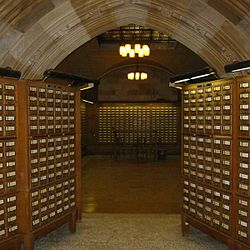
The card catalog at Yale University's Sterling Memorial Library
Another view of the SML card catalog
The card catalog in Manchester Central Library
Library of Congress Main Reading Room
Finding aids are utilized to assist information professionals and help researchers find materials within an archive[1]
The Card Catalog at the Library of Congress

A library catalog (or library catalogue in British English) is a register of all bibliographic items found in a library or group of libraries, such as a network of libraries at several locations. A catalog for a group of libraries is also called a union catalog. A bibliographic item can be any information entity (e.g., books, computer files, graphics, realia, cartographic materials, etc.) that is considered library material (e.g., a single novel in an anthology), or a group of library materials (e.g., a trilogy), or linked from the catalog (e.g., a webpage) as far as it is relevant to the catalog and to the users (patrons) of the library.

The earliest library catalogs were lists, handwritten or enscribed on clay tablets and later scrolls of parchment or paper. As codices (books with pages) replaced scrolls, so too did library catalogs become like handwritten ledgers and, in some cases, printed books. During the late 18th century through mid-19th century, cataloguing on paper slips or cards gradually replaced ledgers and books as the main medium for library catalogs, and in the 20th it was long ubiquitous. The card catalog was a familiar sight to library users for generations. Computerized cataloguing developed gradually from the mid-20th, and by the late 20th and early 21st, it had mostly replaced card catalogs. The advent of the web brought about ubiquitous use of online public access catalogs (OPACs). Some people still informally refer to the online catalog as a "card catalog".[2]

The largest international library catalog in the world is the WorldCat union catalog managed by the non-profit library cooperative OCLC.[3] In January 2021, WorldCat had over half a billion catalog records representing three billion library holdings.[4]

Card catalog at Yale

Goal

[edit]
Illustration from Manual of library classification and shelf arrangement, 1898

Antonio Genesio Maria Panizzi in 1841[5] and Charles Ammi Cutter in 1876[6] undertook pioneering work in the definition of early cataloging rule sets formulated according to theoretical models. Cutter made an explicit statement regarding the objectives of a bibliographic system in his Rules for a Printed Dictionary Catalog.[7] According to Cutter, those objectives were

  1. to enable a person to find a book of which any of the following is known (Identifying objective):
    • the author
    • the title
    • the subject
    • the date of publication
  2. to show what the library has (Collocating objective)
    • by a given author
    • on a given subject
    • in a given kind of literature
  3. to assist in the choice of a book (Evaluating objective)
    • as to its edition (bibliographically)
    • as to its character (literary or topical)

These objectives can still be recognized in more modern definitions[8] formulated throughout the 20th century.

Other influential pioneers in this area were Shiyali Ramamrita Ranganathan and Seymour Lubetzky.[9]

Cutter's objectives were revised by Lubetzky and the Conference on Cataloging Principles (CCP) in Paris in 1960/1961, resulting in the Paris Principles (PP).

A more recent attempt to describe a library catalog's functions was made in 1998 with Functional Requirements for Bibliographic Records (FRBR), which defines four user tasks: find, identify, select, and obtain.[10]

A catalog helps to serve as an inventory or bookkeeping of the library's contents. If an item is not found in the catalog, the user may continue their search at another library.

Card

[edit]

A catalog card is an individual entry in a library catalog containing bibliographic information, including the author's name, title, and location. Eventually the mechanization of the modern era brought the efficiencies of card catalogs. It was around 1780 that the first card catalog appeared in Vienna. It solved the problems of the structural catalogs in marble and clay from ancient times and the later codex—handwritten and bound—catalogs that were manifestly inflexible and presented high costs in editing to reflect a changing collection.[11] The first cards may have been French playing cards, which in the 1700s were blank on one side.[12]

In November 1789, during the dechristianization of France during the French Revolution, the process of collecting all books from religious houses was initiated. Using these books in a new system of public libraries included an inventory of all books. The backs of the playing cards contained the bibliographic information for each book and this inventory became known as the "French Cataloging Code of 1791".[13][14]: 30–31 

English inventor Francis Ronalds began using a catalog of cards to manage his growing book collection around 1815, which has been denoted as the first practical use of the system.[15][16] In the mid-1800s, Natale Battezzati, an Italian publisher, developed a card system for booksellers in which cards represented authors, titles and subjects. Very shortly afterward, Melvil Dewey and other American librarians began to champion the card catalog because of its great expandability. In some libraries books were cataloged based on the size of the book while other libraries organized based only on the author's name.[17] This made finding a book difficult.

The first issue of Library Journal, the official publication of the American Library Association (ALA), made clear that the most pressing issues facing libraries were the lack of a standardized catalog and an agency to administer a centralized catalog. Responding to the standardization matter, the ALA formed a committee that quickly recommended the 2-by-5-inch (5 cm × 13 cm) "Harvard College-size" cards as used at Harvard and the Boston Athenaeum. It also suggested that a larger card, approximately 3 by 5 inches (8 cm × 13 cm), would be preferable. By the end of the nineteenth century, the bigger card won out, mainly to the fact that the 3-by-5-inch (8 cm × 13 cm) card was already the "postal size" used for postcards.

Melvil Dewey saw well beyond the importance of standardized cards and sought to outfit virtually all facets of library operations. To the end he established a Supplies Department as part of the ALA, later to become a stand-alone company renamed the Library Bureau. In one of its early distribution catalogs, the bureau pointed out that "no other business had been organized with the definite purpose of supplying libraries". With a focus on machine-cut index cards and the trays and cabinets to contain them, the Library Bureau became a veritable furniture store, selling tables, chairs, shelves and display cases, as well as date stamps, newspaper holders, hole punchers, paper weights, and virtually anything else a library could possibly need. With this one-stop shopping service, Dewey left an enduring mark on libraries across the country. Uniformity spread from library to library.[14]

Dewey and others devised a system where books were organized by subject, then alphabetized based on the author's name. Each book was assigned a call number which identified the subject and location, with a decimal point dividing different sections of the call number. The call number on the card matched a number written on the spine of each book.[17] In 1860, Ezra Abbot began designing a card catalog that was easily accessible and secure for keeping the cards in order; he managed this by placing the cards on edge between two wooden blocks. He published his findings in the annual report of the library for 1863 and they were adopted by many American libraries.[13]

Work on the catalog began in 1862 and within the first year, 35,762 catalog cards had been created. Catalog cards were 2 by 5 inches (5 cm × 13 cm); the Harvard College size. One of the first acts of the newly formed American Library Association in 1908 was to set standards for the size of the cards used in American libraries, thus making their manufacture and the manufacture of cabinets, uniform.[12] For almost a century (1901-1997), the LOC (U.S. Library of Congress) printed and sold copies of its own catalog cards to libraries in the United States, reducing duplication of work in cataloguing across libraries.[14]: 133–144  OCLC, a major supplier of catalog cards, printed the last one in October 2015.[18]

In a physical catalog, the information about each item is on a separate card, which is placed in order in the catalog drawer depending on the type of record. If it was a non-fiction record, Charles A. Cutter's classification system would help the patron find the book they wanted in a quick fashion. Cutter's classification system is as follows:[19]

  • A: encyclopedias, periodicals, society publications
  • B–D: philosophy, psychology, religion
  • E–G: biography, history, geography, travels
  • H–K: social sciences, law
  • L–T: science, technology
  • X–Z: philology, book arts, bibliography

Some libraries with OPAC access still have card catalogs on site, but these are now strictly a secondary resource and are seldom updated. Many libraries that retain their physical card catalog will post a sign advising the last year that the card catalog was updated. Some libraries have eliminated their card catalog in favor of the OPAC for the purpose of saving space for other use, such as additional shelving. The old cabinets are resold, as many people enjoy owning them for storage of personal effects in the home.

Types

[edit]
Sample card catalog record
Card from card catalog: The fine art of literary mayhem by Myrick Land

Traditionally, there are the following types of catalog:

  • Author catalog: a formal catalog, sorted alphabetically according to the names of authors, editors, illustrators, etc.
  • Subject catalog: a catalog that sorted based on the Subject.
  • Title catalog: a formal catalog, sorted alphabetically according to the article of the entries.
  • Dictionary catalog: a catalog in which all entries (author, title, subject, series) are interfiled in a single alphabetical order. This was a widespread form of card catalog in North American libraries prior to the introduction of the computer-based catalog.[20]
  • Keyword catalog: a subject catalog, sorted alphabetically according to some system of keywords.
  • Mixed alphabetic catalog forms: sometimes, one finds a mixed author / title, or an author / title / keyword catalog.
  • Systematic catalog: a subject catalog, sorted according to some systematic subdivision of subjects. Also called a Classified catalog.
  • Shelf list catalog: a formal catalog with entries sorted in the same order as bibliographic items are shelved. This catalog may also serve as the primary inventory for the library.

History

[edit]
Hellenistic catalog of the Gymnasium of Taormina
The catalog of the Library of the Republic of Venice, published in 1624.
A card catalog in the University Library of Graz

The earliest librarians created rules for how to record the details of the catalog. By 700 BCE the Assyrians followed the rules set down by the Babylonians. The seventh century BCE Babylonian Library of Ashurbanipal was led by the librarian Ibnissaru who prescribed a catalog of clay tablets by subject. Subject catalogs were the rule of the day, and author catalogs were unknown at that time. The frequent use of subject-only catalogs hints that there was a code of practice among early catalog librarians and that they followed some set of rules for subject assignment and the recording of the details of each item. These rules created efficiency through consistency—the catalog librarian knew how to record each item without reinventing the rules each time, and the reader knew what to expect with each visit. The task of recording the contents of libraries is more than an instinct or a compulsive tic exercised by librarians; it began as a way to broadcast to readers what is available among the stacks of materials. The tradition of open stacks of printed books is paradigmatic to modern American library users, but ancient libraries featured stacks of clay or prepaper scrolls that resisted browsing.[citation needed]

As librarian, Gottfried van Swieten introduced the world's first card catalog (1780) as the Prefect of the Imperial Library, Austria.[11]

During the early modern period, libraries were organized through the direction of the librarian in charge. There was no universal method, so some books were organized by language or book material, for example, but most scholarly libraries had recognizable categories (like philosophy, saints, mathematics). The first library to list titles alphabetically under each subject was the Sorbonne library in Paris. Library catalogs originated as manuscript lists, arranged by format (folio, quarto, etc.) or in a rough alphabetical arrangement by author. Before printing, librarians had to enter new acquisitions into the margins of the catalog list until a new one was created. Because of the nature of creating texts at this time, most catalogs were not able to keep up with new acquisitions.[21]

When the printing press became well-established, strict cataloging became necessary because of the influx of printed materials. Printed catalogs, sometimes called dictionary catalogs, began to be published in the early modern period and enabled scholars outside a library to gain an idea of its contents.[22] Copies of these in the library itself would sometimes be interleaved with blank leaves on which additions could be recorded, or bound as guardbooks in which slips of paper were bound in for new entries. Slips could also be kept loose in cardboard or tin boxes, stored on shelves. The first card catalogs appeared in the late 19th century after the standardization of the 5 in. x 3 in. card for personal filing systems, enabling much more flexibility, and toward the end of the 20th century the online public access catalog was developed (see below). These gradually became more common as some libraries progressively abandoned such other catalog formats as paper slips (either loose or in sheaf catalog form), and guardbooks. The beginning of the Library of Congress's catalog card service in 1911 led to the use of these cards in the majority of American libraries. An equivalent scheme in the United Kingdom was operated by the British National Bibliography from 1956[23] and was subscribed to by many public and other libraries.

  • c. Seventh century BCE, the royal Library of Ashurbanipal at Nineveh had 30,000 clay tablets, in several languages, organized according to shape and separated by content. Assurbanipal sent scribes to transcribe works in other libraries within the kingdom.[24]
  • c. Third century BCE, Pinakes by Callimachus at the Library of Alexandria was arguably the first library catalog.
  • 9th century: Libraries of Carolingian Schools and monasteries employ library catalog system to organize and loan out books.[25][26][27]
  • c. 10th century: The Persian city of Shiraz's library had over 300 rooms and thorough catalogs to help locate texts these were kept in the storage chambers of the library and they covered every topic imaginable.[28]
  • c. 1246: Library at Amiens Cathedral in France uses call numbers associated with the location of books.[29]
  • c. 1542–1605: The Mughul emperor Akbar was a warrior, sportsman, and famous cataloger. He organized a catalog of the Imperial Library's 24,000 texts, and he did most of the classifying himself.[30]
  • 1595: Nomenclator of Leiden University Library appears, the first printed catalog of an institutional library.
  • Renaissance Era: In Paris, France The Sorbonne Library was one of the first libraries to list titles alphabetically based on the subject they happened to fall under. This became a new organization method for catalogs.[31]
  • Early 1600s: Sir Thomas Bodley divided cataloging into three different categories. History, poesy, and philosophy.[32]
  • 1674: Thomas Hyde's catalog for the Bodleian Library.
  • 1791: The French Cataloging Code of 1791[33]
  • 1815: Thomas Jefferson sells his personal library to the US government to reestablish the Library of Congress after British troops burned the first one during the War of 1812.[14]: 53–62  He had organized his library by adapting Francis Bacon's organization of knowledge, specifically using Memory, Reason, and Imagination as his three areas, which were then broken down into 44 subdivisions.[14]: 60–62 
  • 1874/1886: Breslauer Instructionen (English: Wroclaw instructions) by Karl Dziatzko
  • 1899: Preußische Instruktionen (PI) (English: Prussian instructions) for scientific libraries in German-speaking countries and beyond
  • 1932: DIN 1505
  • 1938: Berliner Anweisungen (BA) (English: Berlin instructions) for public libraries in Germany
  • 1961: Paris Principles (PP), internationally agreed upon principles for cataloging
  • 1967: Anglo-American Cataloguing Rules (AACR)
  • 1971: International Standard Bibliographic Description (ISBD)
  • 1976/1977: Regeln für die alphabetische Katalogisierung (RAK) (English: Rules for alphabetical cataloging) in Germany and Austria

More about the early history of library catalogs has been collected in 1956 by Strout.[34]

Sorting

[edit]
Librarian at the card files at a senior high school in New Ulm, Minnesota (1974)

In a title catalog, one can distinguish two sort orders:

  • In the grammatical sort order (used mainly in older catalogs), the most important word of the title is the first sort term. The importance of a word is measured by grammatical rules; for example, the first noun may be defined to be the most important word.
  • In the mechanical sort order, the first word of the title is the first sort term. Most new catalogs use this scheme, but still include a trace of the grammatical sort order: they neglect an article (The, A, etc.) at the beginning of the title.

The grammatical sort order has the advantage that often, the most important word of the title is also a good keyword (question 3), and it is the word most users remember first when their memory is incomplete. To its disadvantage, many elaborate grammatical rules are needed, so many users may only search with help from a librarian.

In some catalogs, persons' names are standardized (i. e., the name of the person is always cataloged and sorted in a standard form) even if it appears differently in the library material. This standardization is achieved by a process called authority control. Simply put, authority control is defined as the establishment and maintenance of consistent forms of terms – such as names, subjects, and titles – to be used as headings in bibliographic records.[35] An advantage of the authority control is that it is easier to answer question 2 (Which works of some author does the library have?). On the other hand, it may be more difficult to answer question 1 (Does the library have some specific material?) if the material spells the author in a peculiar variant. For the cataloger, it may incur too much work to check whether Smith, J. is Smith, John or Smith, Jack.

For some works, even the title can be standardized. The technical term for this is uniform title. For example, translations and re-editions are sometimes sorted under their original title. In many catalogs, parts of the Bible are sorted under the standard name of the book(s) they contain. The plays of William Shakespeare are another frequently cited example of the role played by a uniform title in the library catalog.

Many complications about alphabetic sorting of entries arise. Some examples:

  • Some languages know sorting conventions that differ from the language of the catalog. For example, some Dutch catalogs sort IJ as Y. Should an English catalog follow this suit? And should a Dutch catalog sort non-Dutch words the same way? There are also pseudo-ligatures which sometimes come at the beginning of a word, such as Œdipus. See also Collation and Locale (computer software).
  • Some titles contain numbers, for example 2001: A Space Odyssey. Should they be sorted as numbers, or spelled out as Two thousand and one? (Book-titles that begin with non-numeral-non-alphabetic glyphs such as #1 are similarly very difficult. Books which have diacritics in the first letter are a similar but far-more-common problem; casefolding of the title is standard, but stripping the diacritics off can change the meaning of the words.)
  • de Balzac, Honoré or Balzac, Honoré de? Ortega y Gasset, José or Gasset, José Ortega y? (In the first example, "de Balzac" is the legal and cultural last name; splitting it apart would be the equivalent of listing a book about tennis under "-enroe, John Mac-" for instance. In the second example, culturally and legally the lastname is "Ortega y Gasset" which is sometimes shortened to simply "Ortega" as the masculine lastname; again, splitting is culturally incorrect by the standards of the culture of the author, but defies the normal understanding of what a 'last name' is—i.e. the final word in the ordered list of names that define a person—in cultures where multi-word-lastnames are rare. See also authors such as Sun Tzu, where in the author's culture the surname is traditionally printed first, and thus the 'last name' in terms of order is in fact the person's first-name culturally.)

Classification

[edit]

In a subject catalog, one has to decide on which classification system to use. The cataloger will select appropriate subject headings for the bibliographic item and a unique classification number (sometimes known as a "call number") which is used not only for identification but also for the purposes of shelving, placing items with similar subjects near one another, which aids in browsing by library users, who are thus often able to take advantage of serendipity in their search process.

Online

[edit]
Dynix, an early but popular and long-lasting online catalog
Card Division, United States Library of Congress, 1910s or 1920s

Online cataloging, through such systems as the Dynix software[36] developed in 1983 and used widely through the late 1990s,[37] has greatly enhanced the usability of catalogs, thanks to the rise of MARC standards (an acronym for MAchine Readable Cataloging) in the 1960s.[38]

Rules governing the creation of MARC catalog records include not only formal cataloging rules such as Anglo-American Cataloguing Rules, second edition (AACR2),[39] Resource Description and Access (RDA)[40] but also rules specific to MARC, available from both the U.S. Library of Congress and from OCLC, which builds and maintains WorldCat.[41]

MARC was originally used to automate the creation of physical catalog cards, but its use evolved into direct access to the MARC computer files during the search process.[42]

OPACs have enhanced usability over traditional card formats because:[43]

  1. The online catalog does not need to be sorted statically; the user can choose author, title, keyword, or systematic order dynamically.
  2. Most online catalogs allow searching for any word in a title or other field, increasing the ways to find a record.
  3. Many online catalogs allow links between several variants of an author's name.
  4. The elimination of paper cards has made the information more accessible to many people with disabilities, such as the visually impaired, wheelchair users, and those who suffer from mold allergies or other paper- or building-related problems.
  5. Physical storage space is considerably reduced.
  6. Updates are significantly more efficient.

See also

[edit]

References

[edit]

Sources

[edit]

Further reading

[edit]
Revisions and contributorsEdit on WikipediaRead on Wikipedia
from Grokipedia
A library catalog is a comprehensive database or inventory that systematically describes and organizes a library's holdings, including books, periodicals, digital resources, and other materials, to facilitate user access by author, title, subject, or format. It serves as the primary tool for discovery, enabling patrons to locate, evaluate, and retrieve items while also supporting library management functions such as collection development and interlibrary loans. Historically rooted in manual systems like card catalogs, the modern library catalog—often implemented as an Online Public Access Catalog (OPAC)—employs standardized bibliographic records to provide a web-based interface for searching and browsing collections. The creation of library catalog records involves descriptive cataloging, which details attributes such as title, author, edition, and physical format using standards like ; , which assigns call numbers for physical arrangement (e.g., via the Dewey Decimal or Library of Congress systems); and subject analysis, applying controlled vocabularies like to enhance discoverability. These elements align with foundational principles established by librarians like Charles Ammi Cutter in the , emphasizing the catalog's role in finding specific items, collocating related works, and aiding material selection. In contemporary libraries, catalogs integrate with broader discovery layers, such as next-generation search interfaces that aggregate local holdings with external databases like , reflecting ongoing adaptations to digital and networked environments.

Definition and Purpose

Core Definition

A library catalog is a register or database of all bibliographic items in a library collection, encompassing , periodicals, media, and digital resources, functioning as an index to facilitate location and access to these materials. It serves as an organized inventory that records essential details such as , , publication information, and call numbers for each item held by the . Key attributes of a library catalog include comprehensiveness, ensuring coverage of all holdings from to potentially global resources; accuracy, with up-to-date records indicating , , and status; and , through structured search interfaces that support queries by keyword, , , or subject. These features enable efficient user navigation, often incorporating advanced options like operators and format limits to enhance retrieval. Originating as manual lists and card-based systems, library catalogs have evolved into automated digital databases, improving speed and search capabilities over traditional methods. For example, traditional catalogs in public libraries might emphasize accessible records for popular fiction and community media, while contemporary academic library catalogs often integrate scholarly journals and specialized databases for research purposes.

Primary Objectives

The primary objectives of a library catalog revolve around enabling efficient discovery and access to resources while supporting institutional operations. According to the Statement of International Cataloguing Principles (ICP) developed by the International Federation of Library Associations and Institutions (IFLA), the catalog serves to help users find, identify, select, and obtain or access relevant resources based on specific attributes such as authorship, title, or subject. This framework builds on the foundational Paris Principles of 1961, which emphasize ascertaining whether a library holds a particular item specified by author and title, displaying all works by a given author or editions of a work, and revealing works on a specific subject. From a user-centric perspective, catalogs prioritize known-item searches, where individuals locate specific materials by , , or other identifiers; subject-based browsing to explore related topics; and serendipitous discovery, which encourages unexpected encounters with valuable resources through features like related item recommendations. These goals ensure bibliographic details—such as descriptions, editions, and physical or digital locations—are readily available to facilitate informed selection and use. Additionally, catalogs promote equity in access by supporting multilingual cataloging, where materials are described in their original and script with subject access in both the original and English to serve diverse user populations. Institutionally, library catalogs aid collection management by providing tools for , tracking usage statistics to inform decisions on acquisitions and weeding outdated or underused items, and facilitating interlibrary loans through detailed resource sharing data. For instance, circulation and usage from the catalog help identify gaps in holdings, guiding targeted purchases to align with user needs and institutional priorities. Metrics of success for these objectives include retrieval efficiency, measured by task completion rates in usability studies, and user satisfaction, often assessed through surveys. A 2009 study on library catalog usability found that enhanced faceted search interfaces significantly improved task completion times by 48% and the proportion of relevant top results by 70%, highlighting the impact on discovery efficiency. Surveys from the LibQUAL+ initiative, including those post-2000, have generally reported user satisfaction scores in the 7-8 range out of 9 for library services, including catalog access and support (as of 2023). In modern online systems, these objectives are fulfilled through integrated digital platforms that extend traditional functions to remote access.

Historical Evolution

Pre-Modern Forms

The earliest known forms of library catalogs emerged in ancient around 2000 BCE, where clay tablets served as inventories for temple libraries in cities like . These tablets, often inscribed in , listed literary and administrative texts held in temple collections, functioning as rudimentary finding aids to track holdings amid growing accumulations of documents. Such catalogs were essential for managing sacred and scholarly materials in these early institutional repositories, reflecting the administrative needs of Sumerian and Babylonian scribes. In the Hellenistic world, the advanced cataloging practices in the BCE through the work of scholar , who compiled the , a systematic inventory of the library's vast collection of scrolls. Organized by genres such as , , and , with subdivisions by author and biographical notes, the spanned 120 scrolls and provided a bibliographic framework that influenced subsequent library organization. This effort addressed the challenges of a collection estimated at hundreds of thousands of volumes, enabling scholars at the to locate and reference works efficiently. Medieval European monastic libraries, particularly in the , relied on shelf lists and author-title inventories compiled in scriptoria to document collections. These handwritten records, often maintained by , enumerated books by their physical placement on shelves or chains, including details like count and incipits for identification. Examples from institutions like illustrate how such lists supported communal reading and copying, preserving theological and classical texts during a period of intellectual revival. Non-Western traditions paralleled these developments; in the medieval Islamic world, libraries such as the in (8th–13th centuries) introduced some of the earliest known systematic library catalogs, where books were organized into specific genres and subjects to facilitate scholarly access and management. In ancient , bamboo slip catalogs recorded library holdings from the onward, with inventories etched on slips to list texts in imperial and scholarly collections. By the [Han dynasty](/page/Han dynasty) (206 BCE–220 CE), such slips documented archives in palaces and academies, adapting to the era's predominant writing medium before paper's widespread adoption. The marked a shift toward printed catalogs, exemplified by Conrad Gesner's Bibliotheca Universalis in , the first comprehensive subject-based bibliography encompassing Latin, Greek, and Hebrew works. This multi-volume work indexed approximately 12,000 works by around 3,000 authors, organized by subject, language, and chronology, serving scholars beyond any single library's walls. Despite its , pre-modern catalogs generally suffered from limitations as static, non-alphabetized lists that required manual updates and offered limited searchability, hindering access in expanding collections.

Card Catalog Era

The card catalog era, spanning the mid-19th to late 20th century, marked a significant advancement in library organization through the use of standardized physical cards for bibliographic access. In the , Antonio Panizzi, Keeper of Printed Books at the , developed the foundational 91 rules for cataloging printed books, approved in 1839 and published in 1841, which emphasized consistent entries under author, title, and subject to facilitate user retrieval. These rules represented the first rigorous of cataloging practices in English-language libraries, shifting from ad-hoc inventories to systematic records that enabled cross-referencing across multiple access points. The adoption of card-based systems gained momentum in the United States during the 1870s, largely through the efforts of , who advocated for uniform cataloging as secretary of the (ALA) and promoted the use of printed cards for efficiency. Dewey's influence extended to founding the Library Bureau in 1876, which supplied standardized card stock and cabinets, accelerating the transition to accessible, updatable catalogs in public and academic libraries. By the late 19th century, the began distributing pre-printed catalog cards in 1901, further standardizing practices nationwide and supporting the integration of classification systems like the directly onto cards for shelf location. Structurally, card catalogs utilized uniform 3-by-5-inch (7.5-by-12.5 cm) cards made of durable stock, each containing key bibliographic fields such as call number, , , imprint ( details), and notes on content or editions. For each library item, multiple cards—typically one for , one for , and additional subject cards—were created and interfiled alphabetically in wooden or metal filing cabinets with shallow drawers or trays, allowing patrons to search independently without staff assistance. This design ensured redundancy for comprehensive access, with cards often typed or printed in a consistent format to maintain readability and order. At its peak from the early through the , the card catalog dominated library operations in public and academic institutions across the and , with the alone maintaining over 9 million cards in more than 10,000 trays by the 1950s. Stored in expansive cabinets that could span entire rooms, these systems supported growing collections by enabling real-time updates, such as adding cards for new acquisitions or withdrawing them for discarded items. However, the era's decline began in the due to inherent inefficiencies, including the physical space required for ever-expanding cabinets and the labor-intensive process of manual updates. Maintenance involved daily routines of filing thousands of new cards, correcting errors by hand, and reorganizing sections as collections grew, often demanding dedicated staff teams and significant time—by the , some university libraries reported filing operations consuming hours per day and straining budgets. These challenges, compounded by the rise of machine-readable formats like MARC in the mid-1960s, rendered card catalogs obsolete by the 1980s, as libraries transitioned to digital alternatives for scalability and reduced upkeep.

Digital Transition

The transition to digital library catalogs began in the 1960s with the development of machine-readable cataloging standards at the . In response to the growing use of computers in libraries, the devised the MARC (Machine-Readable Cataloging) format, a system employing codes to represent bibliographic data for efficient processing and exchange. This initiative, led by Henriette Avram, culminated in a pilot project in 1966, enabling the creation of standardized, computer-processable records that replaced manual entries with digital equivalents. MARC's adoption facilitated the encoding of essential elements like author, title, and subject headings, laying the groundwork for automated catalog management. By the 1970s, early systems emerged to operationalize these standards. Stanford University's BALLOTS (Bibliographic Automation of Large Library Operations using a System), launched in November 1972, represented one of the first interactive catalogs, supporting real-time acquisition, cataloging, and circulation tasks through technology. This system allowed librarians to query and update records directly via terminals, marking a shift from to immediate access and influencing subsequent networked designs. Concurrently, the (Ohio College Library Center), founded in 1967, introduced its shared cataloging system in 1971, enabling 54 Ohio academic libraries to access a centralized database of MARC records via . On its inaugural day, August 26, 1971, the system—later known as —processed 133 records, growing to facilitate collaborative cataloging that avoided redundant data entry across institutions. The and accelerated the digital shift through affordable microcomputers and widespread retrospective conversion efforts. Microcomputers, such as those running specialized software for bibliographic utilities, empowered libraries to maintain local databases, reducing reliance on mainframes and enabling in-house automation of smaller collections. Retrospective conversion, the process of transforming physical card catalogs into machine-readable MARC records, became a major undertaking; by June 1990, OCLC's dedicated division had converted over 48 million records, often sourced from printed catalogs or manual inputs. These projects, involving scanning, keying, or matching against union catalogs, digitized millions of holdings worldwide, though they demanded significant resources and coordination. This digital transition yielded profound impacts, including faster record updates and remote access to collections, which enhanced efficiency and user reach. For instance, shared systems like allowed libraries to triple cataloging output while reducing staff needs, as seen at University's Alden Library. However, challenges arose, particularly data migration errors during retrospective conversion, such as incomplete matches leading to duplicate or inaccurate records, which required ongoing and verification. These issues underscored the complexities of bridging analog and digital eras, yet they propelled the standardization that underpins modern integrated library systems.

Catalog Components

Physical Elements

The physical elements of traditional library catalogs center on tangible components designed for manual access and durability in high-use environments. Catalog cards form the core, typically measuring 3 by 5 inches (76 by 127 mm) in the United States and made from sturdy cardstock weighing 110 to 125 pounds to resist wear from frequent handling and flipping. These cards featured typed or handwritten bibliographic entries, with prominent headings for , , and subject to facilitate quick scanning by patrons. Larger cards, such as 5 by 8 inches, were sometimes used for more expansive records, such as detailed annotations or shelf lists. Internationally, card dimensions varied to align with regional standards, with European libraries using metric approximations like 75 by 125 mm, equivalent to the standard 3 by 5 inches, while maintaining functionality for filing. Filing systems housed these cards in shallow drawers of wooden or metal cabinets, arranged either alphabetically—by author, title, or subject—or classified by schemes such as Dewey Decimal or to support systematic retrieval. Cross-references improved through "see" cards, which redirected from unauthorized variants to established headings, and "see also" cards, which connected related subjects for broader exploration. Auxiliary tools complemented the main catalog. Shelf lists consisted of duplicate cards organized by call number to replicate the physical shelf order, enabling staff to track inventory, locations, and circulation status efficiently. Authority files served as reference lists of standardized headings for names, subjects, and titles, ensuring uniformity and reducing duplication across the catalog. Maintenance demanded ongoing manual effort from library staff, including typing and inserting new cards for acquisitions, withdrawing and discarding cards for removed items, and refiling to address errors or updates, all to preserve accuracy and .

Digital Elements

Digital library catalogs rely on standardized record formats to encode bibliographic information in a machine-readable way, enabling efficient storage, retrieval, and sharing across systems. The MARC 21 format, developed and maintained by the , serves as the primary standard for this purpose, structuring data into tagged fields that describe various aspects of resources. For instance, field 100 captures the main entry for a , such as an author, while field 245 records the title statement, including subtitles and statements of responsibility. These fields allow for precise organization of metadata, supporting interoperability among libraries worldwide. To accommodate digital and web-based resources, extensions like the Metadata Element Set provide a simpler, 15-element vocabulary for resource description, including properties such as creator, title, and subject, which align with but extend traditional cataloging practices for non-print materials. Metadata standards ensure descriptive consistency in digital catalogs, with (RDA) emerging as the key framework since its release in 2010. RDA, developed by the Joint Steering Committee for Development of RDA under the auspices of the and other international bodies, replaces the earlier , Second Edition (AACR2) by emphasizing user-focused principles and compatibility with environments, thereby improving access to diverse resources like digital objects and multimedia. This shift promotes a more flexible, international approach to cataloging, focusing on entities, relationships, and attributes rather than rigid rules. Within RDA records, classification codes—such as those from the system—are often embedded to facilitate subject-based organization. At the core of digital catalog databases are relational structures that integrate bibliographic records with operational data, typically housed in integrated library systems (ILS). These systems use relational databases to link bibliographic descriptions (e.g., via MARC records) to holdings information, such as item locations and availability, and circulation data, including borrowing history and due dates, ensuring real-time management of library collections. Unique identifiers further enhance this connectivity: the International Standard Book Number (), a 13-digit code assigned by national agencies under the International ISBN Agency, uniquely identifies published books for global trade and cataloging; similarly, the Library of Congress Control Number (), a serially based identifier prefixed by a year, tracks records in the database and supports . Enhancements to digital elements have expanded catalog functionality beyond basic metadata, incorporating full-text indexing to enable keyword searches within digitized content, thereby improving discovery in large-scale repositories like those managed by . principles further advance this by using the (RDF), a W3C standard for expressing relationships between data items as subject-predicate-object triples, to create semantic connections across distributed library resources. In the 2020s, the initiative by the has driven these developments, evolving into a linked data model that replaces MARC-centric approaches with web-friendly bibliographic frameworks, including updates like version 2.10 in 2025 for improved conversions and interoperability.

Organization Methods

Sorting Techniques

Sorting techniques in library catalogs primarily involve arranging entries to facilitate efficient retrieval, most commonly through alphabetical ordering of authors, titles, or . This linear method ensures users can locate items systematically without relying on subject hierarchies. Traditional catalogs, such as card files, adhered to strict filing rules to maintain consistency, while digital systems have expanded these with flexible indexing options. Alphabetical sorting by author typically begins with the last name, followed by the first name or initials, ignoring initial articles like "The" or "A." For titles, entries are sorted word-by-word, disregarding leading articles and treating punctuation like hyphens as integral to the word; for example, "" files under "T" for "Tale." Subject headings, such as those from the (LCSH), are also arranged alphabetically, with the predominant topic listed first in multi-heading assignments to reflect the work's primary focus. Early standardized filing rules emerged with Antonio Panizzi's 91 rules, drafted in 1839 and published in 1841 for the British Museum's catalog, which emphasized uniform entry formats to handle inconsistencies in names, hyphens, and numbers for reliable alphabetical arrangement. Building on this, Charles Ammi Cutter's Rules for a Dictionary Catalog (1876) refined principles for user-friendly sorting, prioritizing the most recognizable forms of authors' names and subjects to aid alphabetical access in dictionary-style catalogs. These rules influenced modern standards, such as the American Library Association's (ALA) filing guidelines, which distinguish between word-by-word (treating spaces as separators, e.g., "New York" before "Newman") and letter-by-letter (ignoring spaces, e.g., "New York" after "Newman") approaches. A notable debate in filing rules concerns prefixes like "Mac" and "Mc," resolved in contemporary standards by filing them as spelled rather than interfiling them under "Mac." For instance, under (LC) guidelines adopted post-1981, "MacDonald" precedes "McGrath" alphabetically, avoiding the earlier convention of treating "Mc" as "Mac." The ALA's 1980 rules similarly endorse letter-by-letter filing for digital compatibility, ensuring "Mac" entries appear before "Mc" without forced merging. In digital catalogs, keyword indexing supplements alphabetical sorting by allowing searches across multiple fields, such as full-text terms in titles or descriptions, enabling non-linear retrieval beyond strict A-Z order. This approach, common in online public access catalogs (OPACs), indexes significant words to match user queries directly. Modern advancements include faceted search, which refines keyword or alphabetical results through interactive filters like date, format, or language, drawing on structured metadata for intuitive . Adopted in many OPACs since the early , this technique enhances discoverability by allowing users to narrow broad alphabetical lists dynamically. Sorting techniques often integrate briefly with schemes, where alphabetical author entries are appended with call numbers for shelf location.

Classification Schemes

Classification schemes in library catalogs provide a systematic method for organizing materials by subject, assigning unique call numbers that indicate both topical content and physical location on shelves. These schemes enable users to browse related items efficiently and facilitate resource discovery beyond simple keyword searches. Developed primarily in the late 19th and early 20th centuries, they form the backbone of bibliographic control in libraries worldwide, evolving to accommodate expanding knowledge domains. The (DDC), conceived by in 1873 and first published in 1876, is a hierarchical numerical system dividing into ten main classes, each represented by a whole number from 000 to 999. Subdivisions use decimal notation for increasing specificity, such as 500 for natural sciences and mathematics, with further extensions like 973 for the . Auxiliary tables allow for geographic, chronological, and other subdivisions, enhancing flexibility in . Widely adopted in and libraries, DDC's structure promotes user-friendly due to its intuitive decimal progression. The Library of Congress Classification (LCC), introduced in 1897, employs an alphanumeric scheme with 21 main classes denoted by single letters (e.g., for ), followed by Cutter numbers for further subdivision by topic, author, or form. For instance, QA76 classifies and . This system prioritizes detailed subject granularity, making it suitable for large academic and research collections where precision in arrangement is paramount. LCC's alphanumeric format allows for easier expansion compared to purely numerical systems, though it requires more training for consistent application. The Universal Decimal Classification (UDC), developed by and Henri La Fontaine in 1895 and first published in 1905, extends the DDC into a more analytic-synthetic framework tailored for scientific and technical literature. It uses decimal notation similar to DDC but incorporates symbols for combining concepts, such as + for addition of subjects or : for relations between them, enabling complex notations like 53(44):61 for physics in related to . UDC's faceted structure supports interdisciplinary synthesis, though its complexity limits widespread use outside specialized libraries. In non-Western contexts, the Chinese Library Classification (CLC), first published in 1975 under the Administrative Bureau of Cultural Affairs, organizes materials into 22 main classes using a decimal-hierarchical system adapted to Chinese knowledge structures, such as A for Marxism-Leninism and B for . It integrates traditional Chinese categories while accommodating modern subjects, with notations like B2 for . CLC's design reflects cultural priorities, differing from Western schemes in its emphasis on ideological and historical classifications. Call numbers derived from these schemes are affixed to catalog records, combining classification codes with author or title cutters (e.g., 813.54 .H3 for a work of American fiction by Hemingway) to determine exact shelf positions. This integration ensures colocation of related materials, streamlining physical retrieval. Dewey's simplicity makes it accessible for general users, fostering intuitive browsing in smaller collections, while LCC offers superior precision for scholarly depth, albeit with steeper learning curves. UDC excels in technical specificity but can overwhelm non-experts. Updates to these systems address emerging fields, with DDC's 23rd edition (2011) incorporating expansions for and , and the system updated annually thereafter through WebDewey, with the 2025 print-on-demand version including the latest changes as of January 2025. WebDewey, launched in 2000 as an online subscription service, provides quarterly updates and search tools for real-time access to the full schedule, replacing static print editions for many users. LCC schedules are revised annually by the , adding subclasses for topics like bioinformatics. UDC and CLC undergo periodic revisions, with CLC's fifth edition (2010) enhancing coverage of . These evolutions ensure relevance amid knowledge proliferation.

Modern Systems

Online Public Access Catalogs

An (OPAC) is a digital interface that provides public access to a library's , enabling users to search and discover holdings such as books, journals, and multimedia resources. Typically implemented as web-based search portals, OPACs support various query types including keyword searches for broad term matching and operators (AND, OR, NOT) to refine results precisely. Prominent examples include , a global aggregating records from thousands of libraries, and library-specific systems like Ex Libris Primo and Ex Libris Summon, which integrate discovery layers for enhanced user experiences across academic and public institutions. The evolution of OPACs traces back to the 1980s, when early systems relied on text-based interfaces for remote access via dumb terminals, marking a shift from physical card catalogs to computerized searching. By the , the advent of the graphical transformed OPACs into browser-accessible platforms with hyperlinked results and visual navigation, improving usability for non-expert users. In the , the rise of mobile devices prompted the development of responsive designs and dedicated apps, ensuring compatibility with smartphones and tablets for on-the-go access. Modern OPACs incorporate advanced search enhancements to mimic web search engines, such as relevance ranking algorithms that prioritize results based on factors like keyword frequency, recency, and user popularity, alongside faceted browsing for filtering by attributes including author, publication date, and subject. Recommendation features, often powered by , suggest related items to aid serendipitous discovery. Accessibility has become a key focus, with many systems adhering to (WCAG) 2.2 Level AA standards to support screen readers, keyboard navigation, and color contrast for users with disabilities. Globally, networks like facilitate billions of annual searches—such as 33.6 billion in FY2024 (July 2023–June 2024) and 25.2 billion in FY2025 (July 2024–June 2025)—demonstrating the scale of OPAC usage in connecting patrons to library resources worldwide.

Integrated Library Systems

Integrated library systems (ILS) are comprehensive software platforms designed to automate and integrate core library operations, extending beyond mere cataloging to encompass the full lifecycle of library resources and services. These systems serve as tools for libraries, enabling centralized management of physical, digital, and electronic collections while supporting administrative tasks such as user services and resource allocation. At their core, ILS include modules for cataloging, which handle bibliographic data entry, metadata management, and ; circulation, for tracking loans, returns, and patron accounts; acquisitions, for ordering and receiving materials; and serials control, for managing subscriptions and ongoing publications. Prominent vendors include Ex Libris with its Alma platform, which integrates these functions into a unified cloud-native environment suitable for large academic and research libraries, SirsiDynix with , a modular widely used in public and school libraries for streamlined resource handling, and open-source options such as Koha and , which offer flexibility for diverse library needs. Interoperability is facilitated through standards like the protocol, an for computer-to-computer that allows ILS to search and exchange bibliographic records across disparate systems, supporting functions such as interlibrary loans and copy cataloging. Since the early , many ILS have shifted to cloud-based software-as-a-service (SaaS) models, reducing on-premises infrastructure needs and enabling scalable, vendor-hosted deployments that facilitate real-time updates and data sharing. These systems deliver benefits through automated workflows that minimize manual data entry, reduce errors in resource tracking, and optimize staff productivity, allowing librarians to focus on strategic tasks. Advanced provide insights into usage patterns, such as circulation trends and collection performance, informing decisions and resource development. In the 2020s, pilots integrating AI for cataloging have emerged, including initiatives using for automated subject assignment and metadata extraction to accelerate processing of digital materials. A notable is the implementation of Ex Libris Alma as the Systemwide (SILS) by the libraries and the California Digital Library (CDL), launched in 2021. This shared platform unifies collections across 10 campuses, two regional facilities, and CDL, enhancing collaborative acquisitions, resource sharing, and analytics while reducing duplication and costs through centralized management of over 40 million items.

Challenges and Innovations

Persistent Challenges

Library catalogs continue to grapple with issues of accuracy and currency, particularly stemming from the migration of legacy data during transitions from card-based systems to digital formats. Retrospective conversions often introduce errors such as inconsistent metadata, incomplete , and duplicate entries, which persist due to the sheer volume of historical data involved in large collections exceeding 250,000 volumes. These duplicates arise from overlapping database integrations and inadequate validation during import processes, complicating user searches and resource discovery. Compounding these problems are staffing shortages in cataloging departments, where reduced personnel limit routine maintenance and updates, leading to outdated that fail to reflect current holdings or withdrawals. In academic libraries, for instance, understaffing has been linked to increased pressure on existing teams, affecting overall service delivery. As noted in the 2025 Library Systems Report, ongoing staffing constraints continue to affect catalog maintenance in many libraries. Accessibility barriers remain a significant hurdle in library catalogs, exacerbated by the digital divide that limits equitable access for underserved populations. Many users, particularly in rural or low-income areas, lack reliable or devices, hindering their ability to engage with online public access catalogs (OPACs) despite libraries' efforts to provide public computing resources. Complex interfaces in OPACs further alienate non-expert users, such as students or casual patrons, who struggle with advanced search syntax, faceted navigation, and unfamiliar terminology, leading to lower success rates in compared to expert librarians. Additionally, inclusivity for non-English materials poses challenges, as catalogs often prioritize English-language metadata, marginalizing multilingual collections and requiring specialized cataloging practices to ensure discoverability for diverse linguistic communities. These issues are particularly acute for blind or low-vision users relying on screen readers, where poorly structured websites amplify navigation barriers. Scalability challenges intensify as library catalogs expand to accommodate burgeoning digital collections, including e-books and resources, which demand robust infrastructure to maintain performance and integration. The rapid growth of e-book holdings—often licensed through multiple vendors—strains catalog systems with fragmented metadata, poor subject indexing, and inconsistent , making it difficult for users to locate materials across hybrid physical-digital environments. collections exacerbate this by introducing incomplete bibliographic records, lacking essential elements like author affiliations or keywords, which hinder comprehensive searching and integration into library discovery layers. Post-pandemic strains from 2020 to 2021 have further tested remote access capabilities, as surges in virtual usage overwhelmed systems with increased demand for e-resources, revealing gaps in bandwidth and limits during widespread campus closures. Budget constraints and evolving models continue to challenge libraries in scaling catalogs to handle these dynamic, technology-driven expansions without compromising service quality. Privacy concerns in OPACs arise from the tracking of user searches and behaviors, which can inadvertently compromise and patron confidentiality. Many catalog systems collect for and , yet third-party analytics tools often monitor queries without transparent consent, raising risks of data breaches or unauthorized profiling. The emphasizes that such practices conflict with ethical standards, as libraries must safeguard to protect against or commercial exploitation of reading habits. Insecure connections and embedded trackers on library websites further expose search histories, underscoring the need for robust and minimal to align with longstanding commitments to user .

Future Developments

The integration of (AI) and into library catalogs is driving advancements in predictive searching and queries. models analyze user behavior to anticipate needs, such as recommending resources before explicit searches, as demonstrated by OCLC's AI-driven recommendations that processed 5.4 million duplicate records in 2024. enables conversational interfaces, with tools like EBSCO's Search allowing users to query catalogs in everyday language for more intuitive discovery. By 2025, AI-powered chatbots and virtual assistants, such as those in Ex Libris' Primo beta, provide 24/7 support and automate routine tasks like metadata generation, marking a shift toward proactive, user-centric catalog systems. Linked data and semantic technologies are advancing through fuller adoption of , the Library of Congress's linked-data framework for bibliographic description, which interconnects catalogs for enhanced resource sharing and semantic querying. Updates in 2025, including Conversion Tool version 2.10 and MARC-to- mappings, support ongoing transitions in institutions like the Library, which has been implementing to improve data interoperability. Blockchain has been proposed as a complementary tool for tracking in catalogs, providing immutable ledgers to verify metadata authenticity and combat digital alterations, particularly for rare digital artifacts in archival systems. Inclusive innovations are expanding access via (VR) and (AR) for immersive browsing, enabling users to interact with 3D representations of collections and virtual library tours that simulate physical navigation. Libraries like those using Meta Quest headsets are applying VR to digitize and explore rare manuscripts interactively, fostering engagement without risking originals. Global standards for multilingual AI, including translation services and chatbots like the University of Calgary's implementation, support diverse patrons by processing queries in multiple languages and aligning with frameworks such as WIDA for equitable access. Sustainable digital archiving trends, exemplified by the British Library's 2025 Digital Preservation Policy, prioritize environmental efficiency through tiered preservation strategies and the CHARM risk framework, ensuring long-term viability of cataloged digital assets. These developments collectively enhance discovery in hybrid collections by automating error-prone processes and enabling seamless integration of physical and digital resources, as seen in AI-augmented systems like Axiell's metadata tools that accelerate analysis tenfold. Reduced and greater promise more resilient catalogs, adapting to evolving user demands while promoting inclusivity across global libraries.

References

Add your contribution
Related Hubs
Contribute something
User Avatar
No comments yet.