


Community hub
Recent from talks
Contribute something
Nothing was collected or created yet.
Morelia spilota
View on Wikipedia
| Carpet python | |
|---|---|

| |
Scientific classification 
| |
| Kingdom: | Animalia |
| Phylum: | Chordata |
| Class: | Reptilia |
| Order: | Squamata |
| Suborder: | Serpentes |
| Family: | Pythonidae |
| Genus: | Morelia |
| Species: | M. spilota
|
| Binomial name | |
| Morelia spilota (Lacépède, 1804)
| |

Morelia spilota, commonly known as the carpet python, is a large snake of the family Pythonidae found in Australia, New Guinea (Indonesia and Papua New Guinea), Bismarck Archipelago, and the northern Solomon Islands.[1][2][3] Many subspecies are recognised; ITIS lists six,[4] the Reptile Database six,[5] and the IUCN eight.[1]
Description
[edit]
M. spilota is a large species of python in the genus, reaching between 2 and 4 m (6.6 and 13.1 ft) in length and weighing up to 15 kg (33 lb). M. s. mcdowelli is the largest subspecies, regularly attaining lengths of 2.7–3.0 m (8.9–9.8 ft).[6] M. s. variegata is the smallest subspecies, typically 120–180 cm (3.9–5.9 ft) in length. The average adult length is roughly 2 m (6.6 ft). However, one 3-year-old captive male M. s. mcdowelli, measured in Ireland, was found to exceed 396 cm (12.99 ft). Males are typically smaller than females; in some regions, females are up to four times heavier.[6] The head is triangular with a conspicuous row of thermoreceptive labial pits.
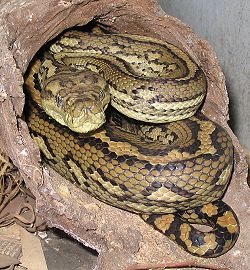
The colouring of M. spilota is highly variable, ranging from olive to black with white or cream and gold markings. The patterning may be roughly diamond-shaped or have intricate markings made up of light and dark bands on a background of grey or a version of brown.
Reproduction
[edit]The species is oviparous, with females laying 10–50 eggs at a time. Afterward, females coil around the eggs to protect them and keep them warm through using muscular contractions to generate heat.[7] This type of maternal care, which is typical for pythons, ceases once the hatchlings have emerged.
Behaviour
[edit]Differences in activity are noted throughout various subspecies; as a whole, the species is generally active during both daytime and nighttime,[7] although the subspecies M. s. variegata is noted to be primarily nocturnal.[8] Carpet pythons favor arboreal living conditions, although they can also be found on the ground, and they commonly use open spaces to bask.[7][8]
Seasonal activity
[edit]In the northern Australian city of Darwin, carpet pythons are significantly more likely to be encountered in suburban areas during the dry season months of May–July.[9] This is indicative of shifts in snake behaviour or movement across the year, with snakes likely moving out of natural forest areas in the later dry season to the more productive suburban areas in search of prey or mates.
Diet
[edit]Carpet pythons kill prey by constriction. Their diet consists mainly of small mammals, birds, and lizards. Incidents of carpet pythons devouring domestic cats and small dogs have been reported.[10]
Distribution and habitat
[edit]The species is found throughout mainland Australia, with the exception of the arid centre and the western regions. It is widely distributed throughout the forest regions of Southwest Australia.[11] It is also found in Indonesia (southern Western New Guinea in Merauke Regency), Papua New Guinea (southern Western Province, the Port Moresby area of Central Province), and on Yule Island. The type locality given is "Nouvelle-Hollande" [Australia].[12]
It occurs in a wide variety of habitats, from the rainforests of northeastern Queensland (M. s. cheynei) through the River Red Gum/Riverbox woodlands of the Murray and Darling Rivers (M. s. metcalfei), to the arid, treeless islands of the Nuyts Archipelago off the South Australian west coast (M. s. imbricata). It is also found in temperate grasslands with hot and dry weather. It is often found near human habitation, where it performs a useful service by eating rats and other vermin. M. spilota is known to occur in areas that receive snowfall.
Conservation
[edit]M. spilota is not threatened as a species.[1] The nominate subspecies, M. s. spilota, is listed as threatened with extinction in Victoria.[13] The subspecies M. s. imbricata is regarded as near threatened in Western Australia, due to loss of habitat.[11]
Captivity
[edit]This species is a popular pet among snake enthusiasts. Some forms can be more irascible than others, such as M. s. mcdowelli and M. s. variegata. Forms that tend to be more even tempered include M. s. spilota and M. s. metcalfei. Although they can be nippy as hatchlings, most grow into docile adults. However, care must be taken when feeding, as these snakes have a strong "feeding response" that can be mistaken for aggression.
The care requirements can be generalized for all subspecies.[14] The subspecies M. s. spilota, the cold-weather diamond python, has some separate requirements and habits.[15] As medium to large snakes, carpet pythons need a proportionately sized enclosure that allows for climbing as well as crawling around on the ground. They generally require moderately high basking temperature and moderate humidity. Captive specimens are normally fed live or frozen (defrosted to room temperature) rats or mice, but it is considered best practice to offer a varied diet which includes other types of rodents and birds to create more balanced nutrition. Young carpet pythons can be fed every 1–2 weeks, but adults have slower metabolisms and should be fed every 2–4 weeks depending on body condition.
With good care, the carpet python is capable of living up to 30 years.
Subspecies
[edit]The geographic distribution and common names can be summarised as the following:[4][12]
| Subspecies[4] | Taxon author[4] | Common name | Geographic range |
|---|---|---|---|
M. s. cheynei
 |
Wells & Wellington, 1984 |
|
Australia in northeastern Queensland |
| M. s. mcdowelli
|
Wells & Wellington, 1984 |
|
Australia in eastern Queensland and northeastern New South Wales |
M. s. metcalfei
 |
Wells & Wellington, 1984 |
|
Australia in the Murray-Darling Basin of Queensland, New South Wales, Victoria and South Australia |
M. s. spilota
 |
(Lacépède, 1804) |
|
Australia in eastern New South Wales and the extreme east of Victoria |
M. s. variegata
 |
Gray, 1842 |
|
New Guinea (Western New Guinea and Papua New Guinea) and Australia in northwestern Western Australia and in the northern portion of the Northern Territory (specimens from New Guinea are referred to by Hoser (2000) as M. harrisoni, but this is not officially recognized as a separate species or subspecies) |
Hybrids
[edit]- Morelia spilota X viridis
Naming and taxonomy
[edit]The first description of M. spilota was by Lacépède (1804), who placed it in the genus Coluber as Coluber spilotus. The species has since been described by various authors as containing a number of subspecies and hybrids; these have also been known by various informal names.[3][5] The attempted arrangement of taxa in this, and other, Australasian Pythonidae has produced numerous synonyms. The discreet and roaming habits of this species have produced a low number of recorded specimens, giving inadequate sample numbers to support descriptions of a taxon's morphology.[13] This is the case with proposed names which are sometimes cited, such as the Papuan Morelia spilota harrisoni (Hoser),[16] despite being unaccepted or invalid.[17] Common names are regional variants of carpet and diamond python or snake.[18][19]
The following is an incomplete list of synonyms:[12][5]
- [Coluber] Arges - Linnaeus, 1758
- [Coluber] Argus - Linnaeus, 1766
- Coluber spilotus - Lacépède, 1804
- [Python] punctatus - Merrem, 1820
- [Coluber (Natrix)] Argus - Merrem, 1820
- [Vipera (Echidna)] Spilotes - Merrem, 1820
- Python Peronii - Wagler, 1828
- Python spilotes - Gray In G. Grey, 1841
- Morelia punctata - Gray, 1842
- Morelia argus - A.M.C. Duméril & Bibron, 1844
- Morelia spilotes - Gray, 1849
- M[orelia]. argus var. fasciolata - Jan In Jan & Sordelli, 1864
- Python spilotes - Boulenger, 1893
- [Python spilotes spilotes] - Werner, 1909
- Python spilotes macrospila - Werner, 1909
- Morelia argus - Loveridge, 1934
- Morelia argus - Stull, 1935
- Morelia spilotes spilotes - Worrell, 1961
- Morelia argus argus - Stimson, 1969
- Python spilotes - McDowell, 1975
- [Python spilotus spilotus] - L.A. Smith, 1981
- Morelia spilota - Cogger, Cameron & Cogger, 1983
- Morelia spilota - Underwood & Stimson, 1990
- Morelia spilota spilota - Barker & Barker, 1994
References
[edit]- ^ a b c d Tallowin, O.; Parker, F.; O'Shea, M.; Vanderduys, E.; Wilson, S.; Shea, G.; Hobson, R. (2017). "Morelia spilota". IUCN Red List of Threatened Species. 2017 e.T62232A21649539. doi:10.2305/IUCN.UK.2017-3.RLTS.T62232A21649539.en. Retrieved 19 November 2021.
- ^ Browne-Cooper, Robert; Bush, Brian; Maryan, Brad; Robinson, David (2007). Reptiles and Frogs in the Bush: Southwestern Australia. University of Western Australia Press. p. 99. ISBN 978-1-920694-74-6.
- ^ a b Cogger, Harold G. Reptiles and Amphibians of Australia.
- ^ a b c d "Morelia spilota". Integrated Taxonomic Information System. Retrieved 19 January 2016.
- ^ a b c Morelia spilota at the Reptarium.cz Reptile Database. Accessed 19 January 2016.
- ^ a b "Carpet Python Morelia spilota (Lacépède, 1804)". FaunaBase. Department of Environment and Conservation. Archived from the original on 2008-08-10. Retrieved 2008-10-20.
- ^ a b c "Carpet Snake or Carpet Python - Queensland Museum". Queensland Museum. The State of Queensland. 2020-02-10. Retrieved 2020-04-09.
- ^ a b "Carpet python - NT.GOV.AU". Northern Territory Government of Australia. 2019-02-05. Retrieved 2020-04-09.
- ^ von Takach, Brenton; Lettoof, Damian Christopher; Parkin, Tom; de Laive, Alana; Allen, Luke; Jolly, Chris J. (2023). "Analysing spatiotemporal patterns of snake occurrence in an Australian city to help manage human-wildlife conflict". Biodiversity and Conservation. 33: 347–360. doi:10.1007/s10531-023-02752-2. ISSN 1572-9710. S2CID 266154299.
- ^ "Snake swallows Australian Chihuahua dog". Telegraph.co.uk. Archived from the original on 2016-03-08. Retrieved 2016-02-10.
- ^ a b Pearson, D.; Shine, R.; Williams, A. (May 2005). "Spatial ecology of a threatened python (Morelia spilota imbricata) and the effects of anthropogenic habitat change". Austral Ecology. 30 (3): 261–274(14). Bibcode:2005AusEc..30..261P. doi:10.1111/j.1442-9993.2005.01462.x.
- ^ a b c McDiarmid RW, Campbell JA, Touré T. 1999. Snake Species of the World: A Taxonomic and Geographic Reference, Volume 1. Herpetologists' League. 511 pp. ISBN 1-893777-00-6 (series). ISBN 1-893777-01-4 (volume).
- ^ a b "Action statement: Diamond Python Morelia spilota" (PDF). Flora and Fauna Guarantee Act 1988 No. 104. Department of Sustainability and Environment. Retrieved 2008-10-20.
- ^ "Carpet pythons (Morelia spilotes sp.)". Care Sheet. Monaro Amphibian & Reptile Keepers (MARK). Archived from the original on 2008-07-19. Retrieved 2008-10-20.
- ^ "Diamond Pythons (Morelia spilota spilota)". Care Sheet. Monaro Amphibian & Reptile Keepers (MARK). Archived from the original on 2008-08-28. Retrieved 2008-10-20.
- ^ Hoser, R. (2000a) A revision of the Australasian pythons. Ophidia Review 1(1): 7-27.
- ^ Wüster, W.; B. Bush; J.S. Keogh; M. O'Shea & R. Shine (2001). "Taxonomic contributions in the "amateur" literature: comments on recent descriptions of new genera and species by Raymond Hoser" (PDF). Litteratura Serpentium. 21: 67–79, 86–91. Archived from the original (PDF) on 2007-08-09.
- ^ Mehrtens JM. 1987. Living Snakes of the World in Color. New York: Sterling Publishers. 480 pp. ISBN 0-8069-6460-X.
- ^ Ditmars RL. 1933. Reptiles of the World. Revised Edition. The MacMillan Company. 329 pp. 89 plates.
Further reading
[edit]- Lacépède, B.G. 1804. Mémoire sur plusieurs animaux de la Nouvelle-Hollande dont la description n'a pas encore été publiée. Annales du Muséum National d'Histoire Naturelle, Paris 4: 184–211. (Coluber spilotus, p. 209.)
- Mattison, C. 1999. Snake. DK Publishing. ISBN 0-7894-4660-X.
External links
[edit] Data related to Morelia spilota at Wikispecies
 Media related to Morelia spilota at Wikimedia Commons
- DPIPWE (2012) Carpet Python (Morelia spilota) PDF — Detailed description and pest risk assessment — Department of Primary Industries, Parks, Water & Environment. Hobart, Tasmania.
Morelia spilota
View on GrokipediaTaxonomy
Etymology and naming
The scientific name Morelia spilota originates from its initial description as Coluber spilotus by Bernard Germain de Lacépède in 1804, based on a specimen from eastern Australia; this remains the valid basionym despite the species' early placement in the colubrid genus Coluber.[10] The genus Morelia was established by John Edward Gray in 1842, with M. spilota designated as the type species by monotypy, separating it from other python taxa.[10] The origin of the genus name was not explained by Gray in 1842, but in 1849, Gray stated it was named after the maiden name of Mrs. Richard Bourke, wife of the Governor of New South Wales.[10] The species epithet spilota stems from the Greek adjective spilōtos (σπιλωτός), meaning "spotted," "stained," or "marked," in direct reference to the distinctive blotched and variegated dorsal patterning characteristic of the species.[10] Over time, the taxon underwent several nomenclatural adjustments, including temporary synonymy under Python spilotus by François Marie Daudin in 1803 (though Lacépède's 1804 publication holds authority), before its modern assignment to Morelia within the Pythonidae family.[10] Morelia spilota is commonly called the carpet python, a name inspired by the elaborate, interwoven dorsal patterns that evoke the motifs of an oriental carpet. Specific subspecies, notably M. s. spilota, bear the vernacular name diamond python due to their prominent yellow or white diamond-shaped blotches outlined in black.[11]Classification history
Morelia spilota was first described in 1804 by Bernard Germain de Lacépède as Coluber spilotus, based on specimens from Australia, placing it within the then-recognized genus Coluber in the family Colubridae.[12] In 1842, John Edward Gray established the genus Morelia with M. spilota (originally Coluber spilotus) as the type species by monotypy, transferring it to this new genus due to shared morphological traits such as labial scale configuration and body patterning distinct from Old World pythons.[13] This reassignment reflected early 19th-century efforts to organize Australasian pythons separately from Eurasian forms, though the family was later elevated to Pythonidae in the late 20th century. Subsequent revisions, such as Wells & Wellington (1985), elevated certain forms like the southwestern carpet python to full species status (Morelia imbricata).[14] A seminal morphological phylogeny by Arnold G. Kluge in 1993 analyzed 121 characters across Pythonidae, confirming Morelia as monophyletic and including M. spilota alongside M. amethistina and M. viridis (with M. azurea recognized as a variant of the latter), positioning the genus as a basal clade within Pythoninae comprising Australo-Papuan species.[15] This work highlighted the paraphyly of broader python groups and supported the separation of Australian-New Guinean pythons from African and Asian lineages based on cranial and vertebral features.[16] Molecular analyses in the 2000s provided robust evidence for the monophyly of Morelia and the Australo-Papuan python clade. A 2008 study by Rawlings et al. integrated mitochondrial DNA sequences from four genes (12S rRNA, 16S rRNA, cytochrome b, and ND4) with morphological data, resolving M. spilota as sister to a clade including M. azurea (northern green tree python lineage) and other Morelia species, with strong bootstrap support (95-100%) for the genus's unity across Australia and New Guinea.[17] This confirmed prior morphological hypotheses while revealing deeper divergences within Pythonidae, attributing the Australo-Papuan group's cohesion to Gondwanan vicariance. Subsequent multilocus phylogenies, such as Reynolds et al. (2014), reinforced these findings using nuclear and mitochondrial markers across 82.5% of pythonid species, placing Morelia spilota within a well-supported Australo-Papuan subclade.[18] As of 2025, M. spilota is accepted as a single species within Morelia (Pythonidae), encompassing six recognized subspecies differentiated by geographic isolation and subtle genetic/morphological variation (though the status of M. s. harrisoni is debated), including M. s. spilota, M. s. mcdowelli, and M. s. variegata.[12] Debates persist on elevating certain subspecies to full species status, driven by 2020s genetic studies revealing cryptic diversity; for instance, analyses of mitochondrial and nuclear loci suggest deep divergences in northern Australian populations warranting further scrutiny, though no formal revisions have been widely adopted pending comprehensive sampling.[19]Description
Morphology and size
Morelia spilota exhibits a robust, muscular body build adapted for constriction, covered in smooth dorsal scales arranged in 40-65 rows at midbody. The head is only slightly distinct from the neck, featuring small, irregular scales and a triangular shape typical of pythons. Thermoreceptive pits are present on the labial scales, enabling detection of infrared radiation from warm-blooded prey, distinguishing it from species with rostral pits like some vipers.[20][21] Adult M. spilota typically attain lengths of 1.5-3 m, though exceptional individuals have been recorded up to 4.2 m, with corresponding weights reaching 15 kg. Neonates measure 30-40 cm at hatching. Scale counts include 240-310 ventrals, 60-95 subcaudals (mostly divided), and a divided anal plate, showing minor variations across subspecies.[20] Growth in M. spilota is rapid during the first few years, with captives gaining up to 20 mm per month initially, slowing to about 5 mm per month by age 4 as individuals approach maturity. Sexual maturity is reached at approximately 1-2 m in length, often around 2 years of age in captivity, after which growth rates decline significantly.[22]Coloration and patterns
The dorsal surface of Morelia spilota features highly variable patterns of intricate blotches, stripes, or bands in shades of brown, yellow, black, and red against a ground color ranging from olive to dark brown or black, often creating an elaborate, carpet-like appearance reminiscent of Persian rugs. This variability occurs both among individuals and across geographic regions, with some forms exhibiting green or even blue tones in addition to the predominant hues.[5][20] The ventral surface contrasts with the dorsal side, typically presenting a cream to yellow background accented by darker speckles or flecks.[20] Ontogenetic changes in coloration are evident, as juveniles often display brighter and more boldly patterned markings that gradually fade or become less vivid with age, resulting in more subdued tones in adults.[23] Regional morphs further highlight this diversity; for instance, southeastern populations tend toward diamond-like spots on a predominantly dark background, while northern forms feature barred patterns with prominent yellow, gold, or rust accents. Subspecies-specific patterns, such as the diamond motifs in M. s. spilota, exemplify this geographic variation.[24][25]Distribution and habitat
Geographic range
Morelia spilota is native to eastern and northern Australia, with its distribution extending from the Cape York Peninsula in far northern Queensland southward along the east coast through New South Wales to Victoria, and also occurring in parts of the Northern Territory and South Australia.[26] The species is absent from the arid central regions of the continent and most of western Australia.[5] In addition to its Australian range, Morelia spilota is found in southern New Guinea, encompassing areas in both Papua New Guinea and Indonesia (specifically in the Merauke Regency of southern Western New Guinea), as well as nearby islands such as the Aru Islands.[27][28] The altitudinal distribution of Morelia spilota spans from sea level to mountainous regions within its native range.[4]Habitat preferences
_Morelia spilota occupies a diverse array of ecosystems across its range, including tropical rainforests, open woodlands, savannas, and rocky outcrops, demonstrating notable adaptability to modified environments such as urban areas and agricultural landscapes.[4][29] In rural settings, populations persist in mosaic habitats where native vegetation has been fragmented, often utilizing artificial shelters like building roof spaces or thickets of introduced tree species to supplement natural cover.[29] The species favors a combination of arboreal and terrestrial microhabitats, frequently selecting trees, vines, rock crevices, hollow logs, and burrows for shelter, with a common association to sites near water bodies such as river floodplains or wetlands.[9][30] In arid or semi-arid regions, individuals preferentially use well-insulated rocky outcrops, particularly those facing north or northwest to maximize solar exposure during cooler periods.[31] Morelia spilota exhibits tolerance to a broad climatic gradient, from tropical and subtropical zones to more temperate areas in southern parts of its distribution, with some subspecies enduring semi-arid conditions.[3] During extended dry seasons, the snakes aestivate in sheltered microhabitats to avoid desiccation, reflecting an adaptation to seasonal aridity.[32] Key adaptations to these varied habitats include effective camouflage patterns that allow blending with diverse substrates, from leafy canopies to rocky terrains, enhancing concealment from predators and facilitating ambush foraging.[29] The species generally avoids open, exposed areas and extreme aridity by confining activity to structurally complex environments that provide thermal regulation and moisture retention.[30]Behavior
Activity patterns
Morelia spilota exhibits primarily nocturnal activity patterns in warmer regions, where individuals emerge at dusk to forage and retreat to shelters during the day to avoid excessive heat.[11] In cooler temperate areas, such as southeastern Australia, the species displays more crepuscular or diurnal tendencies, with radiotelemetric studies revealing a predominance of daytime movements that allow for extended nocturnal ambush foraging periods.[33] This flexibility in diel rhythms is influenced by ambient temperatures, as lower thermal conditions in southern habitats promote increased daytime activity to facilitate thermoregulation. Seasonally, populations in tropical northern ranges remain active year-round, benefiting from consistent warm conditions that support continuous foraging and movement. In contrast, southern temperate populations enter a period of brumation during winter (typically May to September), characterized by reduced metabolic rates and sheltering in insulated burrows or rock crevices to endure low temperatures, though occasional basking may occur on warmer days. This dormancy aligns with the species' distribution across climatically variable habitats, minimizing energy expenditure during periods of environmental stress. Thermoregulation plays a central role in daily activity, with individuals engaging in morning basking sessions—often in trees or on rocks—to elevate body temperatures to 28–30°C, enabling optimal physiological function before activity commences.[34] Post-basking, body temperatures decline gradually through the day and night, without a midday drop typical of some reptiles, and snakes seek shaded retreats or burrows at night to conserve heat.[35] Basking is weather-dependent, occurring less frequently on cloudy days due to limited solar exposure, which correspondingly lowers mean body temperatures.[34] Socially, Morelia spilota is generally solitary outside of the breeding season, maintaining individual home ranges with minimal interaction among conspecifics to reduce competition for resources.[11] During mating periods, however, non-aggressive aggregations form, with up to six males gathering around a receptive female, facilitated by chemoreception via tongue-flicking to detect sex-specific pheromones from larger, more fecund individuals.[36] Occasional non-reproductive aggregations may occur at favorable basking or shelter sites, though these are rare and transient.[37]Locomotion and defense
Morelia spilota exhibits versatile locomotion adapted to its semi-arboreal and terrestrial habitats, employing several distinct modes of movement. On the ground, individuals primarily utilize rectilinear locomotion, a slow, straight-line progression achieved through the ventral scales lifting and contracting in a wave-like manner to propel the body forward without lateral bending.[38] This method allows for stealthy, energy-efficient travel over flat surfaces. For climbing trees, rocks, or structures, the species relies on concertina locomotion, where the snake anchors its head and tail alternately while folding and extending the body in an accordion-like fashion to ascend vertical or near-vertical substrates.[39] As boids, Morelia spilota are also proficient swimmers, using lateral undulation—wavelike side-to-side movements—to navigate water bodies efficiently during dispersal or foraging near aquatic edges.[40] In defense, Morelia spilota employs a repertoire of non-lethal strategies to deter threats, lacking venom like other pythons. When disturbed, individuals often release a foul-smelling musk from cloacal glands, a chemical secretion intended to repel predators through its acrid odor.[41] Additional displays include bluff strikes, where the snake lunges forward with an open mouth but typically refrains from biting, accompanied by body inflation to appear larger and more intimidating.[42] Actual biting is rare and reserved for prolonged provocation, delivering a painful but non-venomous wound. These behaviors are most pronounced in cornered or handled specimens, highlighting the species' preference for avoidance over confrontation. Predators of Morelia spilota include birds of prey such as wedge-tailed eagles (Aquila audax), powerful owls (Ninox strenua), and white-bellied sea-eagles (Haliaeetus leucogaster), as well as mammals like dingoes (Canis dingo) and introduced foxes (Vulpes vulpes).[43] The snakes mitigate these risks through cryptic coloration providing camouflage against bark and foliage, combined with agile climbing to evade ground-based threats. Nocturnal or crepuscular activity further reduces encounters with diurnal predators.[29] Sensory capabilities enhance both locomotion and defense in Morelia spilota. The species uses frequent tongue flicking to gather chemical cues from the environment via the vomeronasal organ, aiding in navigation, mate location, and threat detection through chemoreception.[40] Additionally, specialized scales along the belly detect substrate vibrations, allowing the snake to sense approaching predators or prey from a distance and initiate evasive maneuvers accordingly.Diet and foraging
Prey items
Morelia spilota is a dietary generalist that preys primarily on small mammals such as rodents and bats, birds including nestlings, reptiles like lizards and other snakes, and eggs from both birds and reptiles.[44][45] In one study of gut contents from suburban populations, birds comprised the most frequent prey category (56 items across 32 snakes), followed by mammals (34 items across 29 snakes) and reptiles (1 item across 1 snake), with eggs noted in 6 instances across 2 snakes.[45] Prey size varies ontogenetically, ranging from small lizards consumed by juveniles to larger marsupials such as possums and small wallabies taken by adults, reflecting gape limitations and increased foraging capacity with growth.[46][47] Juveniles exhibit a dietary focus on ectothermic prey, with reptiles comprising 23% and mammals 69% of items in one analysis of the eastern subspecies, while adults shift toward endothermic prey dominated by mammals (91% in that study).[44][47] As opportunistic feeders, Morelia spilota consumes no plant matter.[45] This broad opportunistic strategy allows dietary flexibility across varied environments, though core prey categories remain consistent.[45]Hunting strategies
Morelia spilota primarily utilizes ambush predation as its main hunting strategy, positioning itself motionless in elevated sites such as tree branches, rock crevices, or foliage to await passing prey. Once a suitable target approaches within striking distance, the snake launches a rapid strike to seize it, followed by coiling around the body to constrict and suffocate the victim through asphyxiation and circulatory constriction. This method is highly energy-efficient for the species, allowing prolonged stationary waits that can last days or weeks, with radio-telemetered adults observed spending over 80% of their time immobile during summer foraging periods.[46][44][1] While ambush tactics dominate, active pursuit occurs infrequently, particularly among juveniles who exhibit more mobile foraging behaviors compared to adults. Adults may occasionally engage in targeted pursuits, such as climbing into bird nests to raid eggs or chicks. These active elements complement the primary sit-and-wait approach but are less common due to the snake's reliance on camouflage and patience for success.[44] Following a successful hunt, M. spilota enters a period of post-feeding lethargy, remaining relatively inactive for several days to weeks to facilitate digestion, during which it seeks warmer microhabitats to elevate its body temperature and accelerate metabolic processes. This digestive phase increases the snake's vulnerability, prompting it to avoid movement and potential threats. Under stress, such as from handling or predation attempts, the snake may regurgitate its meal to reduce weight and improve escape capabilities, a defensive response observed in many constricting snakes.[48][49] Feeding frequency varies seasonally and by age, with adults typically consuming prey every 1-2 weeks during active periods in warmer months, while juveniles feed more often to support rapid growth. In temperate regions, foraging peaks in summer, aligning with higher prey availability and optimal temperatures for activity.[46][50]Reproduction
Mating and courtship
Mating in Morelia spilota occurs seasonally in southern populations during spring, typically from September to November, coinciding with warmer temperatures and increased activity following winter dormancy. In contrast, tropical populations in northern Australia and New Guinea exhibit more flexible breeding patterns, with mating possible year-round due to consistent climatic conditions that do not impose a strict seasonal constraint.[51] Courtship behaviors in M. spilota are initiated by males detecting female pheromones through frequent tongue flicking, a chemosensory mechanism that allows them to follow scent trails and identify receptive females. Males often aggregate around a single female, sometimes forming groups of two to six individuals, where competitive interactions such as body intertwining and pushing occur to establish dominance, though outright combat is not always observed and varies by population. These ritualistic displays, common in python species, help secure mating priority without severe injury.[52][53][54] Copulation involves the male inserting one of his hemipenes into the female's cloaca, a process that can last several hours, often up to 12 hours or more, and may be repeated multiple times. Polyandry is prevalent, with a single female potentially mating with several males during a breeding bout, as documented in observations of up to five copulations involving three different males. This mating system enhances genetic diversity in offspring. Sexual size dimorphism favors larger females in many populations, particularly in southern ranges, enabling them to produce and carry substantial egg clutches, while males remain smaller and more agile for locating mates.[54][55][56]Egg laying and parental care
Females of Morelia spilota typically lay a single clutch of eggs annually, with clutch sizes ranging from 10 to 50 eggs and averaging 20 to 30, though extremes up to 54 have been recorded.[54][4] Clutch size is positively correlated with female snout-vent length (SVL), larger individuals producing more eggs, and is also influenced by nutritional status, as females often breed only every 2 to 4 years to accumulate sufficient resources.[54][57] Eggs are deposited in concealed sites such as hollow logs, rock crevices, or under debris, providing protection from predators and environmental extremes; laying usually occurs from late spring to early summer (December to January in Australia), following mating earlier in the season.[4][57] Upon laying, the female coils around the clutch to provide maternal brooding, a form of parental care unique among many Australian snakes, with no involvement from males.[57] Incubation lasts 50 to 60 days (ranging 52 to 75 days depending on conditions), during which the female maintains egg temperatures around 30 to 32°C through behaviors such as periodic basking to absorb solar heat and muscular shivering to generate warmth, achieving relatively constant body temperatures near 31°C.[58][4][57] This active thermoregulation enhances hatching success compared to passive incubation.[58] Hatchlings emerge at lengths of 30 to 40 cm and are immediately independent, receiving no further parental care as the female departs shortly after hatching.[59][4] The neonates scatter rapidly from the nest site, a behavior that likely reduces predation risk by avoiding concentrated vulnerability.[4] Early independence is supported by their fully formed morphology at hatching, enabling solitary foraging on small prey soon after emergence.[59]Conservation
Status and threats
The carpet python (Morelia spilota) is classified as Least Concern on the IUCN Red List, with the assessment indicating an overall decreasing population trend primarily driven by habitat fragmentation and loss across its range. This global status reflects its widespread distribution in Australia and New Guinea, where it remains locally common in many intact habitats, though no comprehensive population estimates exist. Several subspecies face heightened vulnerability, such as M. s. spilota (diamond python) in southeastern Australia, which is considered threatened locally, with suspected population reductions of 50-80% over recent decades attributed to habitat loss from development and frequent fires.[60] Similarly, M. s. metcalfei (Murray-Darling or inland form) is listed as Endangered in Victoria due to habitat loss from agriculture, grazing, and predation by introduced species.[8] Overall population trends are stable in expansive, less-disturbed areas but declining in fragmented habitats, with no major disease outbreaks documented as a significant factor. Primary threats include habitat destruction through deforestation, urbanization, and agricultural expansion, which reduce suitable arboreal and rocky refuges in forests, woodlands, and coastal regions. Road mortality poses an additional risk, particularly in urban-adjacent populations where vehicle collisions contribute to adult mortality.[61] Illegal collection for the international pet trade further pressures certain populations, as M. spilota is popular in captivity and subject to unregulated harvesting, exacerbating declines in accessible areas.[4] In New Guinea, where the species inhabits rainforests, threats are amplified by intensive logging operations that fragment primary forest habitats and facilitate access for collectors.[62] Regional variations highlight greater risks here compared to mainland Australia, with ongoing illegal logging contributing to broader biodiversity losses affecting python populations.[62]Protection and management
In Australia, Morelia spilota is protected under state-specific wildlife legislation, which generally prohibits unlicensed collection, harm, or trade. For instance, in Queensland, the species is classified as Least Concern under the Nature Conservation Act 1992, allowing regulated activities but enforcing no-take policies within national parks and reserves.[1] In Victoria, the subspecies M. s. spilota (diamond python) is listed as Endangered under the Flora and Fauna Guarantee Act 1988, providing stronger safeguards against habitat disturbance and exploitation.[60] Internationally, M. spilota is included in Appendix II of the Convention on International Trade in Endangered Species (CITES), regulating commercial trade to prevent overexploitation while permitting export with permits.[63] Conservation efforts for M. spilota emphasize habitat protection and community involvement rather than targeted species programs, given its overall stable status. In Queensland, initiatives focus on restoring native woodlands and riparian zones through reforestation projects managed by organizations like the Department of Environment, Science and Innovation, which indirectly benefit python habitats by enhancing connectivity and prey availability.[1] Monitoring occurs via citizen science platforms such as the Atlas of Living Australia and ClimateWatch, where public sightings contribute to distribution mapping and population trend analysis across subspecies ranges.[64][65] Key research gaps persist in understanding M. spilota's conservation needs, particularly regarding subspecies delineation and environmental pressures. Post-2020 genetic studies have elevated some former forms, such as Morelia imbricata (previously M. s. imbricata), to full species status based on molecular evidence, highlighting the need for comprehensive genomic assessments to clarify taxonomy and guide localized protections.[10] Additionally, specific impact assessments for climate change—such as altered thermal regimes affecting basking and reproduction—remain limited, with calls for modeling to predict range shifts in vulnerable populations.[66] Successes in protection are evident in core habitats, where enforced no-take zones have supported population stability. In areas like Lamington National Park in Queensland, ongoing habitat management and reduced disturbance have contributed to observed recoveries in local abundances, as documented through long-term surveys showing sustained presence of multiple age classes.[1]Captivity
Husbandry requirements
Husbandry for Morelia spilota, commonly known as the carpet python, requires a spacious enclosure to accommodate its semi-arboreal lifestyle and active nature. For adult specimens, a minimum enclosure size of 2 m length by 1 m width by 1.5 m height is recommended to allow for climbing and exploration, including secure branches at various heights and multiple hides for security.[50][67] Bioactive setups with live plants and substrate organisms can enhance environmental complexity and mimic natural habitats, promoting overall welfare.[68][67] Temperature and humidity gradients are essential to replicate the species' Australian range conditions, with variations possible for subspecies (e.g., higher humidity for jungle forms). A thermal gradient with ambient temperatures of 24–32 °C should be maintained, including a basking spot of 35–38 °C at the warmer end and cooler areas of 22–26 °C for thermoregulation, achieved via overhead heating or heat mats under one-third of the enclosure. Humidity levels of 40–60% are ideal, supplemented by a large water bowl and occasional misting, with a humid hide using damp sphagnum moss to prevent shedding issues. UVB lighting is recommended for vitamin D synthesis and appetite stimulation, provided at low intensity (5.0 UVB).[69][50][70][67] Suitable substrates include cypress mulch or reptile-safe paper products for ease of cleaning and moisture retention, layered to a depth of 5–10 cm to support burrowing or hiding behaviors. Enrichment such as puzzle feeders or scent trails encourages natural foraging instincts, briefly aligning with wild dietary preferences for small mammals.[67][71] Regular health monitoring is crucial, as improper husbandry can lead to common issues like respiratory infections from excessive humidity or low temperatures. Annual veterinary examinations by a reptile specialist, along with observing for signs of lethargy, weight loss, or abnormal shedding, help ensure longevity in captivity.[50][67]Breeding in captivity
Breeding Morelia spilota in captivity typically begins with separating males and females in individual enclosures outside the breeding season to prevent unwanted aggression and ensure health. To induce mating, a cooling cycle mimicking austral winter conditions is often used, gradually reducing ambient temperatures to around 20 °C for 1–2 months to trigger reproductive behaviors, though some setups rely on natural photoperiod and seasonal changes.[72] Once temperatures are raised in spring, the male is introduced to the female's enclosure under close supervision, as courtship can involve combat-like interactions where the male may constrict or bite the female. Successful copulation often occurs multiple times over several weeks, with females becoming gravid shortly thereafter.[73] Gravid females are provided with secure laying boxes containing moist substrate to facilitate egg deposition, typically occurring 4-6 weeks after mating, resulting in clutches of 10-25 eggs depending on the female's size and subspecies. Eggs are carefully removed to an incubator shortly after laying to avoid fungal contamination, maintained at a stable 30–32 °C with high humidity (around 90%) in vermiculite or perlite medium; this setup yields hatching success rates of 80-90% under optimal conditions, with incubation lasting 50-70 days until juveniles emerge.[72][73] Hatchlings are immediately separated to prevent cannibalism and offered small prey items within days. Key challenges in captive breeding include managing inter-sex aggression during pairing, which can lead to injury if not monitored, and ensuring genetic diversity, particularly in programs focusing on color morphs or specific subspecies lines to avoid inbreeding depression. Breeders must track pedigrees and source unrelated individuals to maintain healthy populations. Additionally, in Australia where Morelia spilota is native, legal permits are required for breeding and commercial sale of offspring under wildlife protection laws, with requirements varying by state or territory (e.g., licenses in Queensland and New South Wales), to regulate trade and prevent illegal export.[27][74][75]Subspecies
Recognized subspecies
The carpet python (Morelia spilota) is currently recognized as comprising six subspecies, based on a combination of morphological, geographical, and genetic distinctions, as accepted by major taxonomic authorities such as the Integrated Taxonomic Information System (ITIS) and the Reptile Database.[76][5] These subspecies reflect adaptations to diverse habitats across Australia and New Guinea, with diagnostic traits including scale patterns, coloration, and subtle cranial differences, supported by phylogenetic analyses from the early 2000s onward. No new subspecies have been described as of 2025, though taxonomic revisions in the 2010s confirmed the separation of the southwestern population (M. imbricata) as a full species based on genetic and morphological evidence. The following table summarizes the recognized subspecies, their primary distributions, and key diagnostic features:| Subspecies | Common Name | Distribution | Diagnostic Traits |
|---|---|---|---|
| M. s. cheynei Wells & Wellington, 1984 | Jungle carpet python | Northeastern Queensland, Australia (wet tropics) | Dark brown to black ground color with irregular yellow bands; robust build; genetically distinct from coastal forms via mitochondrial DNA analyses showing divergence in rainforest lineages.[5][77] |
| M. s. harrisoni Hoser, 2000 | Papuan carpet python | Southern New Guinea (Indonesia and Papua New Guinea) | Variegated pattern with bold yellow and black markings; smaller average size; isolated population with limited gene flow from Australian mainland forms, confirmed by allozyme studies.[5][78] |
| M. s. mcdowelli Wells & Wellington, 1984 | Coastal carpet python | Coastal eastern Australia (Queensland to New South Wales) | Barred or striped pattern in juveniles fading to blotches in adults; largest subspecies (up to 3 m); differs from nominate form in vertebral scale row counts and mtDNA haplotypes indicating eastern coastal clade.[5][79] |
| M. s. metcalfei Wells & Wellington, 1984 | Inland carpet python | Central-eastern Australia (Murray-Darling Basin) | Pale, subdued coloration with narrow bands; adapted to arid interiors; genetic studies reveal divergence from eastern subspecies via nuclear markers, supporting isolation in riverine habitats.[5][80] |
| M. s. spilota (Lacépède, 1804) | Diamond python (nominate) | Southeastern Australia (coastal New South Wales to Victoria) | Iridescent black with yellow diamond-shaped spots; smaller size (up to 2.5 m); nominate form distinguished by unique scale microstructure and phylogenetic basal position in M. spilota clade.[5][76] |
| M. s. variegata Gray, 1842 | Darwin carpet python | Northern Australia (Northern Territory to northwestern Queensland) | Highly variable blotched pattern; slender build; northern clade supported by cytochrome b gene sequences showing divergence from southern populations.[5][81] |