Hubbry Logo
Pygmy pythonPygmy pythonMain
Open search
Pygmy python
Community hub
Pygmy python
logo
8 pages, 0 posts
0 subscribers
Be the first to start a discussion here.
Pygmy python
Pygmy python
from Wikipedia

Pygmy python
Scientific classification Edit this classification
Kingdom: Animalia
Phylum: Chordata
Class: Reptilia
Order: Squamata
Suborder: Serpentes
Family: Pythonidae
Genus: Antaresia
Species:
A. perthensis
Binomial name
Antaresia perthensis
Stull, 1932
Synonyms[1]
  • Liasis childreni perthensis - Stull, 1932
  • Liasis perthensis - Cogger, Cameron & Cogger, 1983
  • Bothrochilus perthensis - Cogger, Cameron & Cogger, 1983
  • Morelia perthensis - Underwood & Stimson, 1990
  • Liasis perthensis - Cogger, 1992
  • Antaresia perthensis - Kluge, 1993

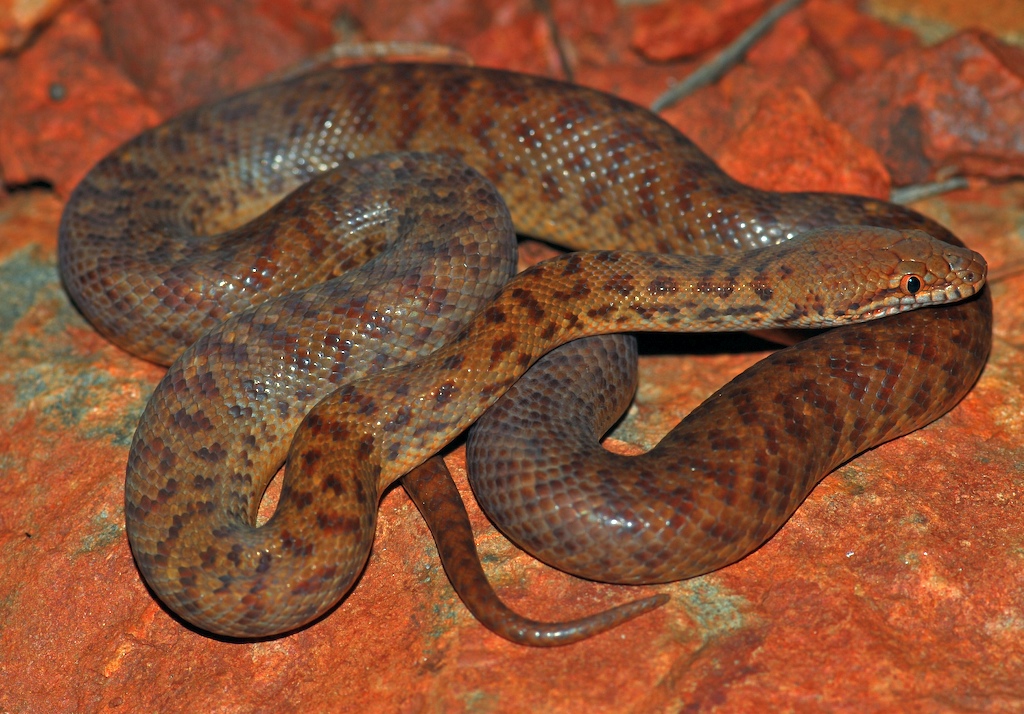
The pygmy python (Antaresia perthensis), also known as the anthill python, is a species of snake found in Western Australia. Their common names are due to their being the smallest member of the family Pythonidae and often being found in termite mounds. No subspecies are currently recognised.[2]

The specific epithet is derived from the Western Australian state capital, Perth—a city which is not, ironically, within the range of the species. The global biodiversity database iNaturalist has documented a number of different visual sightings of the pygmy python within the state of Western Australia, with the nearest physical sighting to Perth having occurred near Reedy, some 680 km (422.53 mi) north and slightly further inland of the capital.[3][4]

Description

[edit]

Adults grow to about 50 cm (19.5 in) in length and have a weight near 210 grams. Neonates are about 8 inches (20 cm) in length and about 4 grams in weight. After a year they average about 25 grams in weight. This makes them smaller than both the Children's python, A. childreni, and the spotted python, A. maculosa. A. perthensis usually has a redder background ground color than these other species and their spots fade, or become less distinct, as they mature. In contrast, the ground color is lighter in childreni and maculosa, while their spots stay better defined throughout their life.

Distribution and habitat

[edit]

The pygmy python is native to Australia, primarily endemic to the northwestern regions of the state of Western Australia and on some coastal islands. The type locality given is "Perth, West Australia" (Western Australia), an erroneous assumption of the place where the specimen was collected. This historical unfamiliarity of Europeans with the place of a specimen's collection has given rise to other 'naming peculiarities'.[4] According to L.A. Smith (1985), the type locality is unknown.[1]

The pygmy python has a number of confirmed visual sightings entered on iNaturalist (a global biodiversity website, app and nature-minded social network); sightings have been documented in and around several areas of Western Australia, including Cape Range National Park, Dampier, De Grey, East Lyons River, the Hamersley Range and Karijini National Park, Marble Bar, the Murujuga (Burrup) Peninsula, Pannawonica, Peedamulla, and Port Hedland.[5]

Housing

[edit]

In captivity anthill pythons can be housed (and bred) in something as small as a 20 gallon tank. Although reptile-specific enclosures are best, a simple fish tank may be used for short- or long-term housing. They may be fed mice as part of their regular diet, supplemented with fuzzy rats. Anything larger is usually a stressor on their system, although they will still try to eat it. Once anthill pythons get started eating they rarely refuse a meal except for breeding season or during part of their shedding cycle.

Reproduction

[edit]

The pygmy python is oviparous, with 5-8 eggs per clutch. The females will stay coiled around the eggs (lifting them off the substrate) and incubate them until they hatch, which is usually after 50–60 days.

In captivity

[edit]

This snake is a popular exotic pet.[citation needed]

References

[edit]
[edit]
Revisions and contributorsEdit on WikipediaRead on Wikipedia
from Grokipedia
The pygmy python ( perthensis), also known as the anthill python, is a small, non-venomous constrictor and the smallest species in the family, endemic to the and Gascoyne regions of Western Australia. Adults typically reach a length of up to 60 cm and weigh around 200 g, with females slightly larger than males, while hatchlings measure about 17 cm and weigh 4 g. Its name derives from its diminutive size and frequent association with mounds, where it seeks shelter in the arid, spinifex-dominated landscapes of its . Characterized by a reddish-brown to sandy yellow-orange dorsal coloration with darker flecks or blotches that fade with age, the pygmy python has a short, wedge-shaped head, thick muscular body, and creamy white ventral surface. Nocturnal and solitary except during breeding, it preys primarily on small reptiles like geckos and skinks in its juvenile stage, transitioning to small mammals such as bats and rodents as an adult, using constriction to subdue victims. This species is oviparous, with females laying clutches of 5–8 eggs that they incubate for 50–60 days by coiling around them, after which the independent hatchlings emerge fully formed. The pygmy python's distribution is limited to rocky outcrops, grasslands, and open plains in the Pilbara and Gascoyne regions of Western Australia, where it hides in spinifex bushes, rock crevices, or hollow termite mounds during the day. With a lifespan exceeding 25 years in the wild and up to 20 years in captivity, it faces minor threats from vehicle strikes, tourism, and illegal collection, but remains common and is classified as Least Concern by conservation assessments. First described in 1932, it exemplifies the diverse adaptations of Australia's unique reptilian fauna.

Taxonomy and nomenclature

Scientific classification

The pygmy python is classified within the family , a group of non-venomous constricting snakes primarily distributed across the . It belongs to the Antaresia, which comprises small-bodied pythons endemic to and nearby regions, including species such as A. childreni () and A. stimsoni (Stimson's python).
TaxonName
KingdomAnimalia
PhylumChordata
ClassReptilia
OrderSquamata
SuborderSerpentes
FamilyPythonidae
GenusAntaresia Wells & Wellington, 1984
SpeciesA. perthensis (Stull, 1932)
The binomial name is Antaresia perthensis, with no recognized subspecies. Originally described as Liasis childreni perthensis by Olive G. Stull in 1932 based on a holotype (MCZ 24426) from an unknown locality erroneously reported as Perth, Western Australia, the taxon was elevated to full species status as Liasis perthensis by F.J. Mitchell in 1965, reflecting its distinct morphology and distribution in the Pilbara region of northwestern Western Australia. Subsequent phylogenetic revisions have confirmed its placement in Antaresia, supported by molecular and morphological data distinguishing it from congeners.

Etymology and common names

The genus was coined by Wells and in 1984 for a group of small Australian pythons—a proposal initially controversial due to publication issues but now widely accepted—deriving its name from , the brightest star in the constellation , a reference to the reddish hues in some species' coloration that evoke the star's appearance. The specific epithet perthensis originates from the type locality designated as Perth, , in the original description by Stull in 1932; however, this was an erroneous attribution based on misleading collector information, with the actual provenance corrected to the region in northwestern . The common name "pygmy python" emphasizes its distinction as the smallest species within the family. Alternatively, it is known as the "anthill python," a name arising from its frequent sheltering and hunting within mounds in its arid habitat. In local Australian contexts, particularly in , "anthill python" predominates due to observed behaviors in the wild. Historically, naming of A. perthensis and related species involved confusion, as small pythons were initially lumped under broader genera like Liasis or Bothrochilus before the 1984 revision separated them; for instance, it was originally described as a of Liasis childreni, with later placements including Bothrochilus perthensis, leading to synonymy issues and misidentification with similar taxa such as the (A. childreni) or Stimson's python (A. stimsoni).

Description

Physical characteristics

The pygmy python, Antaresia perthensis, possesses a slender yet muscular body covered in smooth, glossy scales that facilitate movement through narrow crevices and burrows. Unlike some larger python species, it lacks prominent heat-sensing pits in the form of deep facial depressions, but features shallow labial pits along the upper lip to detect infrared radiation from prey. The overall morphology is cylindrical, with the body tapering gradually toward the posterior. The head is small, short, and wedge-shaped, only slightly distinct from the , which contributes to its streamlined profile for navigating confined spaces. Its includes backward-curving teeth adapted for grasping small, elusive prey, with specific counts of 22 maxillary, 20 mandibular, 8 , and 16 pterygoid teeth, enabling secure hold during . The is short and tapered, comprising approximately 8% of total length, and is supported by 30-45 paired subcaudal scales, while the ventral surface features 213-247 undivided scales for locomotion. Sexual dimorphism is minimal, with females typically slightly larger than males in body length, though both sexes share similar overall proportions. At hatching, neonates exhibit a small egg tooth on the snout tip to aid emergence from the egg, and they fully absorb the yolk sac shortly after, becoming independent without parental care.

Size and coloration

The pygmy python (Antaresia perthensis) is recognized as one of the smallest members of the Pythonidae family, with adults typically averaging 55 cm in total length and reaching a maximum of approximately 62 cm. Their average adult weight is around 200 g, with females generally slightly larger than males. At hatching, neonates measure about 17 cm in length and weigh roughly 4 g, reflecting their diminutive scale from birth. In terms of coloration, the pygmy python features a reddish-brown dorsal background accented by darker spots or blotches, which become less prominent and fade with age as the snake matures. The ventral surface is consistently cream-colored, providing contrast to the more variable upper body. Hatchlings display brighter and more vivid patterns compared to adults, where the markings soften over time. Color variation exists among populations, with individuals from coastal regions often showing sandier yellow-orange hues, while those from inland areas tend toward deeper reddish-brown tones, likely as an for blending with local substrates. This subtle geographic differentiation enhances without altering the ' overall compact morphology.

Distribution and habitat

Geographic range

The pygmy python (Antaresia perthensis) is endemic to northwestern , where it occupies a range primarily centered in the arid region and southward into the adjoining Ashburton areas. This distribution encompasses coastal and inland localities from North West Cape eastward through the to sites near the . The species is confined to this biogeographic zone, with no verified occurrences beyond . Key sites within the range include protected areas such as Cape Range National Park and , where the python is regularly documented amid rocky and spinifex-dominated landscapes. It also inhabits several coastal islands, notably those in the Dampier Archipelago near Karratha, providing isolated populations in similar arid environments. Additional notable localities span from Port Hedland and Dampier southward to Peedamulla and Pannawonica, reflecting the species' adaptation to the region's vast, semi-arid expanses. The pygmy python was first scientifically described in 1932 by Olive G. Stull, based on a type specimen that was erroneously attributed to Perth in southwestern ; subsequent analysis confirmed its origin within the region. Historical records, including early collections from the 19th and early 20th centuries, align with this core distribution, showing no evidence of broader historical extent. Recent citizen-science observations, aggregated through platforms like , confirm the range's stability without signs of contraction or novel expansions. These contemporary data underscore the species' persistence in its native confines, absent from eastern or any international locales.

Habitat preferences

The pygmy python (Antaresia perthensis) primarily inhabits arid to semi-arid zones within the region of northwestern , favoring landscapes dominated by spinifex grasslands, rocky outcrops, and scattered mounds that provide essential cover and structural features. These environments feature sparse vegetation, including stunted trees and flat expanses with low annual rainfall concentrated in summer months, creating a hot, dry setting that influences the snake's shelter choices. Daytime temperatures in these preferred habitats typically range from 25°C to 35°C, with peaks exceeding 40°C in summer, leading the pygmy python to adopt nocturnal activity patterns during cooler evenings when ambient conditions drop to the low 20s°C. The species shows a strong association with abandoned termite mounds, which function as key refuges for —mounds can reach internal temperatures of up to 38°C—and protection from predators and extreme heat. These mounds, often shared with other small reptiles, offer stable microclimates amid the variable arid conditions. In terms of microhabitats, pygmy pythons seek out burrows within mounds, crevices in outcrops, or the dense bases of spinifex tussocks during daylight hours to avoid and overheating. This selective use of microhabitats underscores their adaptation to the region's episodic wet periods within an otherwise desiccating climate.

Behavior and ecology

Activity patterns

The pygmy python (Antaresia perthensis) is primarily nocturnal, emerging after sunset to hunt and move about while avoiding the intense daytime heat of its arid habitat in Western Australia's region. During the day, individuals in rock crevices, termite mounds, or under and spinifex grasses to remain concealed and protected from predators and high temperatures. This secretive lifestyle contributes to the species' low visibility in the wild, with observations often limited to nighttime encounters in suitable habitats. Activity levels vary seasonally, with reduced movement occurring during the cooler dry winter months, when snakes remain near limited water sources to conserve energy. In contrast, activity increases with summer rainfall, allowing greater dispersal and foraging opportunities, though extreme heat may prompt aestivation-like sheltering. In cooler periods, some individuals may exhibit limited diurnal basking to regulate body temperature. Pygmy pythons are largely solitary, interacting with conspecifics only during the breeding season, and no territorial displays or vocalizations have been recorded. Opportunistic aggregations may occur in shared shelters like mounds, but these do not indicate social bonding. Due to their small size, pygmy pythons face predation risks from , carnivorous mammals, monitor lizards, large frogs, spiders, and larger snakes, particularly as juveniles. Defensive responses include adopting an S-shaped posture for striking or coiling to protect the head, along with reliance on cryptic coloration for in reddish substrates.

Diet and foraging

The pygmy python (Antaresia perthensis) is strictly carnivorous, exhibiting an ontogenetic shift in prey preferences that reflects its small body size and gape limitations. Juveniles and hatchlings primarily consume small reptiles, such as geckos and skinks. As they mature, adults transition to a diet dominated by small mammals, including bats and , though they occasionally take amphibians, birds, and reptiles. Prey size is constrained by the snake's narrow gape, typically limited to items like pinky mice or small . These snakes employ ambush predation, relying on to subdue prey through intermittent squeezing until occurs. They position themselves in concealed locations, such as within or near termite mounds, striking rapidly at passing or emerging prey during their nocturnal activity periods, where termite mounds also serve as hotspots for exploiting and small vertebrates. This strategy leverages their cryptic coloration and heat-sensing labial pits for detection, combined with chemosensory cues from the . In the wild, pygmy pythons feed opportunistically, adjusted to prey availability and individual condition, with adults sometimes fasting for extended periods between meals. Foraging intensity increases following rainfall in their arid , when small vertebrates become more active and abundant on the surface.

Reproduction

Mating and breeding

The pygmy python (Antaresia perthensis) breeds seasonally in its native Australian range, with breeding triggered by a cooling period from May to August and mating typically occurring from July to August, as cooler temperatures prompt females to release pheromones that attract males. This environmental cue aligns with the arid conditions of , where reduced rainfall and lower nighttime temperatures signal the onset of reproductive activity. In the wild, individuals are solitary outside this period, but males actively seek out females during the breeding window, following scent trails over considerable distances. Courtship involves males following trails and rubbing cloacal spurs to initiate copulation. Due to their small size—adults rarely exceeding 60 cm—male-male combat is rare and has not been formally documented in this species, reducing the risk of injury during encounters. Copulation, once initiated, can last several hours, with females showing acceptance by elevating their tails and cloacas. The pygmy python is oviparous, with females laying clutches of 5 to 8 eggs approximately 2 to 3 months after , following a period influenced by follicular development in response to seasonal cooling. is reached at 2 to 3 years of age for both sexes, allowing breeding to commence in early adulthood. In the wild, their lifespan exceeds 25 years, with up to 20 years in captivity.

Incubation and development

The pygmy python (Antaresia perthensis) is oviparous, with females typically laying a of 5 to 8 eggs in humid, sheltered chambers, often within mounds that provide stable moisture and protection. These eggs are encased in a thin, parchment-like shell and are unusually large relative to the female's body size, though specific dimensions vary. During incubation, the female coils tightly around the clutch to guard and regulate temperature, maintaining conditions around 30–32°C for approximately 50 to 60 days; males provide no involvement in this process. This maternal brooding not only offers physical protection from predators but also helps prevent desiccation and maintains optimal thermal stability for embryonic development. Hatching occurs after the , with neonates using a temporary on their to slit the soft shell and emerge independently, measuring about 17–20 cm in length and weighing around 4 g. The female provides no further care post-hatching, and the young exhibit rapid initial growth, typically undergoing their first 7–10 days after emergence to accommodate this expansion.

Conservation status

Population and threats

The pygmy python (Antaresia perthensis) is classified as Least Concern on the (as assessed in 2017), reflecting its common occurrence and stable populations across its range in . The species faces no major threats. Localized risks may include vehicle strikes and illegal collection. has been noted as a potential environmental impact in arid zones. Population trends indicate stability, with consistent sightings reported through citizen science platforms like .

Protection measures

The pygmy python (Antaresia perthensis) is protected under Western Australia's Biodiversity Conservation Act 2016, which prohibits the taking, disturbance, or keeping of native reptiles without a permit, ensuring safeguards against illegal collection and interference. International export and trade are regulated under Appendix II of the Convention on International Trade in Endangered Species of Wild Fauna and Flora (), requiring permits to monitor and prevent unsustainable exploitation. Conservation initiatives in the Pilbara region include monitoring within protected areas and post-mining habitat restoration efforts to support reptile biodiversity. Australian zoos, including Taronga Zoo, house pygmy pythons as part of exhibits that promote public education on native reptiles, with captive breeding supporting research into reproductive biology and genetics. Classified as Least Concern by the IUCN due to its stable populations and widespread distribution, the pygmy python receives low targeted priority but benefits from integrated arid reptile conservation strategies addressing regional threats like .

In captivity

Housing requirements

For pygmy pythons ( perthensis) in , a minimum size of 20 gallons (approximately 76 liters or 24 x 18 x 18 inches) is recommended for adults to allow adequate space for movement and , with secure lids essential to prevent escapes due to their small size and exploratory nature. Larger enclosures, such as 36 x 18 x 18 inches, provide better opportunities for , including vertical elements like branches for climbing. These snakes, native to the arid landscapes of where they shelter in mounds, require escape-proof setups with no sharp edges or gaps. In , a is required to keep native reptiles; international owners should check local wildlife regulations and listings. Suitable substrates include aspen shavings or coconut fiber, which maintain cleanliness and allow for burrowing while being easy to replace; avoid loose sands to prevent ingestion risks. Multiple hides are crucial, with at least two per enclosure—one on the warm side and one on the cool side—including replicas of mounds to replicate natural shelter sites and reduce stress. A should be established across the , with a basking spot of 31–33°C (88–92°F) on the warm end using under-tank heaters, heat mats, or ceramic emitters, and a cool end of 24–26°C (75–79°F) to enable proper ; nighttime temperatures may drop to 22°C but should not fall below 20°C. levels of 40–60% are ideal, achieved through substrate moisture and occasional misting, with higher spikes (up to 70%) during shedding; ensure good ventilation to prevent respiratory issues from excess moisture. Low-level UVB lighting is optional but beneficial for overall , provided via a UVB on a 12-hour photoperiod to simulate natural Australian daylight cycles; full-spectrum lighting can enhance appetite and activity without direct basking necessity. Common enclosure issues include overheating from improperly placed heat sources, which can cause burns, and drafts that lead to inconsistent temperatures; always use thermostats for precise control and monitor with digital thermometers and hygrometers placed at substrate level. A draft-free setup with insulated walls helps maintain stable conditions, promoting longevity in captivity where these smallest of pythons can live up to 20 years.

Care and feeding

In captivity, pygmy pythons (Antaresia perthensis) thrive on a diet of appropriately sized frozen-thawed , such as pinky or fuzzy mice for juveniles and small rats or hoppers for adults, which should constitute no more than 10% of the snake's body weight per meal to avoid . For variety and to encourage reluctant feeders, especially hatchlings, prey can be scented with small or their brain matter, though supplementation with actual lizards is optional and rodents remain the staple to ensure nutritional balance. Live prey must be avoided, as it risks injuring the snake during feeding. Feeding frequency aligns with life stage: neonates and juveniles receive meals every 5-7 days to support growth, while adults are fed every 10-14 days, though they may occasionally fast for up to several months without issue, particularly during shedding or breeding. Prey should be thawed in warm water and offered via in the evening to match their nocturnal habits, with uneaten items removed promptly to prevent spoilage. These pythons exhibit strong feeding responses in stable conditions and rarely refuse meals outside of natural cycles. Health care requires vigilant monitoring for common issues like external parasites such as mites, which can be detected through regular inspection of scales and , and internal parasites via fecal during annual veterinary examinations. Respiratory infections, indicated by wheezing, open-mouth , or nasal discharge, often stem from suboptimal (below 40%) or temperatures, emphasizing the need for consistent conditions with a . Other signs to watch include , regurgitation, or incomplete shedding (dysecdysis), prompting immediate professional intervention to ensure longevity up to 20 years. Handling pygmy pythons demands gentleness and infrequency to reduce stress, always fully supporting the body to prevent kinking the spine, and avoiding it immediately after feeding or during shedding when they are most vulnerable. Their compact size—rarely exceeding 60 cm—and inherently docile nature contribute to their popularity as beginner-friendly pets, provided owners wash hands before and after interactions to minimize disease transmission.

References

Add your contribution
Related Hubs
User Avatar
No comments yet.