Hubbry Logo
Amethystine pythonAmethystine pythonMain
Open search
Amethystine python
Community hub
Amethystine python
logo
8 pages, 0 posts
0 subscribers
Be the first to start a discussion here.
Amethystine python
Amethystine python
from Wikipedia

Amethystine python
Scientific classification Edit this classification
Kingdom: Animalia
Phylum: Chordata
Class: Reptilia
Order: Squamata
Suborder: Serpentes
Family: Pythonidae
Genus: Simalia
Species:
S. amethistina
Binomial name
Simalia amethistina
(Schneider, 1801)
Range shown as dark orange and bright orange regions
Synonyms
  • [Boa] Amethistina
    Schneider, 1801
  • Python amethystinus
    Daudin, 1803
  • [Constrictor] amethystina
    Wagler, 1830
  • Boa amethystina
    — Wagler, 1830
  • Python amethystinus
    Schlegel, 1837
  • [Boa Python] amethystinus
    — Schlegel, 1837
  • Liasis amethystinus
    Gray, 1842
  • Liasis amethystinus
    A.M.C. Duméril & Bibron, 1844
  • Liasis (Simalia) amethystinus
    — Gray, 1849
  • Aspidopython Jakati
    A. Meyer, 1874
  • Liasis amethystinus
    W. Peters & Doria, 1878
  • Liasis duceboracensis
    Günther, 1879
  • Hypaspistes dipsadides
    Ogilby, 1891
  • Python amethystinus
    Boulenger, 1893
  • Liasis clarki
    Barbour, 1914
  • Liasis a[methistinus]. amethistinus
    Stull, 1933
  • Liasis amethistinus
    Brongersma, 1953
  • Liasis amethystinus amethystinus
    Kinghorn, 1956
  • Liasis amethistinus
    — Stimson, 1969
  • Python amethistinus
    — McDowell, 1975
  • Morelia amethistina
    H.G. Cogger, Cameron &
    H.M. Cogger, 1983
  • Australiasis amethistinus
    Wells & Wellington, 1984
  • Morelia amethistina
    Underwood & Stimson, 1990
  • M[orelia]. amethistina
    Kluge, 1993
  • Morelia amethystina
    D. Barker & T. Barker, 1994
  • Morelia amethistina amethistina
    O'Shea, 1996[2]
  • Simalia amethistina
    Reynolds et al., 2014[3]

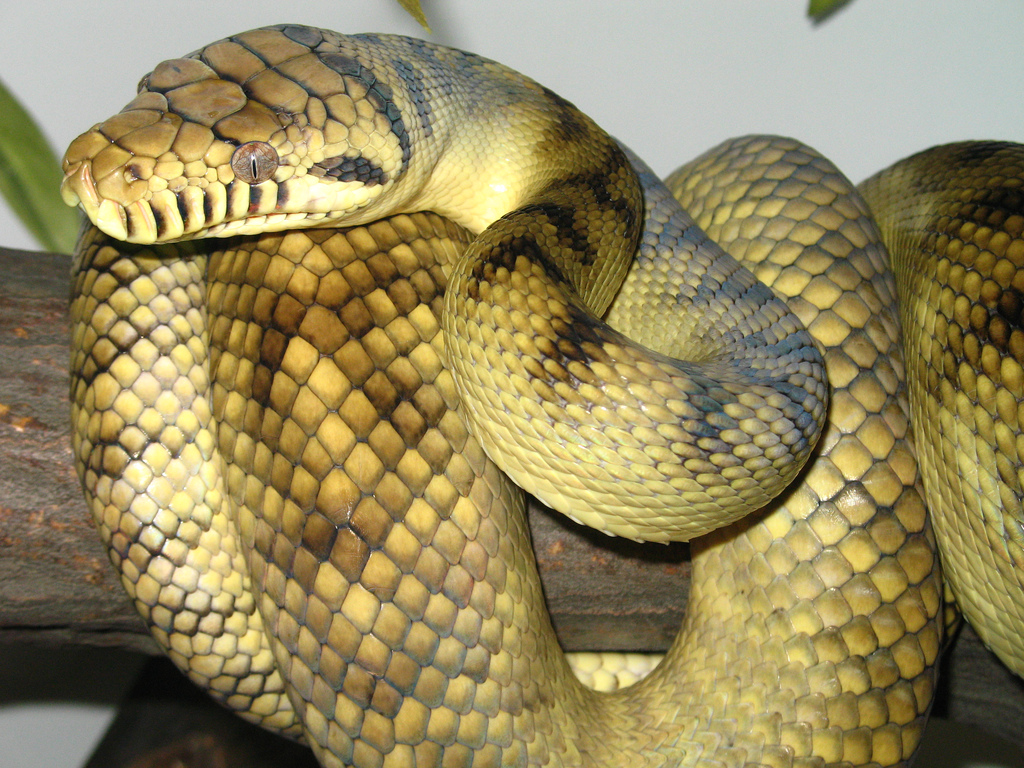
The amethystine python (Simalia amethistina, formerly known as Morelia amethistina), also known as the scrub python or sanca permata in Indonesian, is a species of non-venomous snake in the family Pythonidae. The species is found in Indonesia and Papua New Guinea. Popular among reptile enthusiasts, and noted for its coloration and size, it is one of the largest snakes in the world, as measured either by length or weight, and is the largest native snake in Papua New Guinea. Until 2000, the larger Australian species S. kinghorni was generally considered a subspecies of S. amethistina, and this change of classification has still not been universally reflected in literature. Because of this issue, S. amethistina has often been described as the largest snake in Australia, but this is not accurate since under the current classification, this species does not occur in Australia.[4]

Taxonomy

[edit]

Formerly, five subspecies of Morelia amethistina, including the nominate race, M. a. amethystina, were generally recognized. The Moluccan Islands (including Halmahera, Ternate and Tidore) are home to the former M. a. tracyae. The Tanimbar Islands are home to a smaller subspecies, the former M. a. nauta. On the island of Seram, the former M. a. clastolepis can be found. On mainland of Papua New Guinea (including the Indonesian western half, once called Irian Jaya—now West Papua), and many of its nearby offshore islands, the former M. a. amethystina is quite common. In Australia, the former M. a. kinghorni is represented.[5] American biologist Michael Harvey and colleagues investigated the amethystine python complex and recognised five separate species – Simalia amethistina, Simalia clastolepis, Simalia kinghorni, Simalia nauta, and Simalia tracyae – based on cladistic analysis of cytochrome b sequences and morphology.[6] In 2014 cladistic analysis of nuclear and mitochondrial genes of pythons and boas, R. Graham Reynolds and colleagues supported the distinctness of M. tracyae, M. amethistina, and M. clastolepis, but were less confident of M. kinghorni and M. nauta.[7]

According to McDiarmid et al. (1999), all cases in which the specific name was spelled with a y follow Daudin's (1803) Python amethystinus and are therefore unjustified emendations.[2] The specific name, amethistina, is an allusion to the milky iridescent sheen on its scales, which gives it an amethyst-like colour.

Description

[edit]

Specimens of S. amethistina have reportedly been measured at more than 5.5 m (18.0 ft) in total length (including tail), but this is likely due to confusion with Australian S. kinghorni specimens, as even 4 m (13 ft) specimens of S. amethistina are already considered extremely large. Although the amethystine python is smaller than the Australian scrub python, some sources claim that S. amethistina is able to reach lengths of 6 m (20 ft), with a weight up to 27 kg (60 lb)[8] and perhaps even 30 kg (66 lb).[9]

The smooth dorsal scales are arranged in 39–53 rows at midbody. There are deep, heat-sensing pits on six or seven of the posterior lower labials.[10]

Distribution and habitat

[edit]

The Amethystine python is found in Indonesia (Maluku Islands, Timur Laut Islands, Banda, Kai Islands, Aru Islands, Misool, Salawati, most of Western New Guinea, many islands in Geelvink Bay, such as Biak, Numfor, Yapen, and Supiori), and Papua New Guinea (including Umboi Island, Bismarck Archipelago, Trobriand Islands, the d'Entrecasteaux Islands to Rossel Island, Louisiade Archipelago). The type locality is unknown.[2]

S. amethistina occurs in both bushland and suburbia. In Indonesia, it is found mostly in rainforests. Warm, humid habitats with good water sources are preferred. In New Guinea, it mostly lives in scrublands.

Feeding

[edit]

The diet of the amethystine python generally consists of birds, bats, rats, possums, and other small mammals.[11] Larger Papuan specimens catch and eat wallabies, and cuscus, waiting by creek and river banks for prey seeking drinking water.

On Milman Island, potential prey of amethystine pythons include ghost crabs (Ocypode sp.), green sea turtle hatchlings, hawksbill sea turtle hatchlings, wading birds, and terns.[12]

References

[edit]

Further reading

[edit]
[edit]
Revisions and contributorsEdit on WikipediaRead on Wikipedia
from Grokipedia
The Amethystine python (Simalia amethistina), also known as the scrub python, is a large, non-venomous constrictor belonging to the family , distinguished by its slender body, iridescent scales with an amethyst-like sheen, and mosaic pattern of brown and tan for . Native to tropical regions of Indonesia, , and , it inhabits primarily rainforests, woodlands, and coastal areas, often shifting seasonally between closed-canopy forests and open savannas. One of the world's longest snakes, adults typically measure 3–5 meters but can exceed 5.5 meters in length and 20 kg in weight, with unverified reports of up to 8.5 meters; hatchlings start at around 70 cm and 50 g. This species is semi-arboreal and predominantly nocturnal, employing a sit-and-wait strategy to capture prey, which includes birds, bats, small mammals like possums and rats, and occasionally larger marsupials such as wallabies for bigger individuals. It exhibits sexual dimorphism in spatial , with males maintaining larger home ranges (averaging 0.60 km²) compared to females (0.28 km²), and both sexes showing limited daily movements of less than 10 meters on average. Amethystine pythons are oviparous, with females laying clutches of 5–21 eggs in humid, hidden sites, which they incubate by coiling around them for up to three months without feeding; hatching success is high in suitable conditions. Currently classified as Least Concern on the due to its wide distribution and stable populations, the faces localized threats from , for skins, and the pet , though it remains popular among enthusiasts for its striking appearance and size. Taxonomically, it was formerly placed in the Morelia as M. amethystina, but molecular studies have reclassified it to Simalia, with some Australian populations potentially warranting separation as distinct like S. kinghorni.

Taxonomy

Etymology and common names

The scientific name of the amethystine python is Simalia amethistina. The genus Simalia was introduced by in 1849, but its etymological origin is unknown, as Gray offered no explanation for the term. The species epithet amethistina derives from the Latinized form of "," alluding to the snake's iridescent, purple-violet sheen on its scales that evokes the appearance of the . This was first scientifically described in by German naturalist Johann Gottlob Theaenus Schneider, who named it Boa amethistina based on specimens from Indonesian collections. Schneider's description highlighted the snake's distinctive coloration, contributing to the enduring reference in its . In English, the amethystine python is commonly known as the amethystine python or scrub python, with the latter name prevalent in Australian contexts due to its in scrubland regions. In , where the is native, it is referred to as sanca permata, a name meaning "precious stone snake" that reflects its shimmering, jewel-like appearance.

Classification and synonyms

The amethystine python, scientifically named Simalia amethistina, is classified within the domain Eukarya, kingdom Animalia, Chordata, class Reptilia, order Squamata, suborder Serpentes, family , subfamily Pythoninae, and Simalia. This placement reflects its position among non-venomous constrictor snakes in the Pythonidae family, distinguished by genetic and morphological traits shared with other pythons. The was originally described by Johann Gottlob Theodor Schneider in 1801, based on syntype specimens referenced from earlier illustrations by Albertus Seba, likely originating from Indonesian localities such as Ambon or nearby islands in the Moluccas. Schneider's description under the name Boa Amethistina marked the initial formal recognition of the , drawing from preserved specimens that highlighted its iridescent scalation and large size. Over time, the nomenclature evolved through several synonymies, reflecting shifts in taxonomic understanding of pythonid relationships. Key synonyms include Python amethystinus (Daudin, 1803), Constrictor amethystin (Wagler, 1830), Liasis amethystinus (Gray, 1842), and amethistina (Kluge, 1993). The name amethistina persisted until a major phylogenetic revision in 2014, when Reynolds et al. transferred it to the resurrected genus Simalia based on multilocus molecular data (including mitochondrial and nuclear genes) and morphological analyses that supported a distinct separate from Morelia sensu stricto. This reclassification emphasized deep genetic divergences within the former Morelia amethistina complex, elevating its phylogenetic resolution. Taxonomic revisions have also addressed former subspecies, with Liasis amethystinus kinghorni (originally described by Stull in 1933) and Morelia nauta (described by Harvey et al. in 2000) recognized as full Simalia kinghorni and Simalia nauta, respectively—following a comprehensive systematic study by Harvey et al. in 2000. This elevation was driven by morphometric differences in scalation, coloration patterns, and body proportions, corroborated by preliminary genetic evidence, distinguishing them from the nominate S. amethistina. The current thus recognizes S. amethistina as a distinct primarily distributed in and parts of , with ongoing molecular studies refining boundaries within the Simalia .

Physical characteristics

Size and morphology

The Amethystine python (Simalia amethistina) is among the longest snake species globally, with adults typically attaining total lengths of 3–5 m, though larger individuals exceed 5 m. Reliable records confirm a maximum length of 5.65 m for a specimen from northeastern , . Unverified reports suggest lengths up to 8.5 m, but these lack substantiation. Weights for large adults reach up to 24 kg, reflecting their robust yet relatively slender build relative to other giant constrictors. Neonates emerge from eggs at approximately 70 cm in total length and 50 g, exhibiting rapid growth in their tropical habitats. Physical characteristics vary across the Simalia amethistina ; the following primarily describes the nominal species (S. amethistina), with details on congeners covered in the taxonomy section. Morphologically, the species features a sturdy, elongated body adapted for both terrestrial and , with a distinctly that facilitates climbing and gripping branches. The head is broad and triangular, housing backward-curving teeth suited for securing struggling prey during constriction. Heat-sensing labial pits, located on 6–7 posterior lower labial scales, enhance nocturnal hunting by detecting from animals. Sexual dimorphism includes males possessing proportionally longer anal spurs, vestigial remnants used in and rituals. Reports on size dimorphism vary by population, with some sources indicating females grow larger overall (maturing at snout-vent lengths around 2.3 m, males 1.3–1.5 m) while Australian forms (S. kinghorni) may show males larger.

Coloration and scalation

The amethystine python (Simalia amethistina) is renowned for its iridescent coloration, featuring smooth scales that exhibit a milky sheen capable of reflecting hues of , , and against a predominantly dark brown to black background. This optical effect, most vivid in direct , arises from structural properties of the scales and contributes to the species' distinctive appearance across its range. Juveniles display brighter, more contrasting patterns, often with or bands and blotches on a lighter ground color that enhance visibility but gradually darken with age to a more uniform, subdued tone in adults. Variations in coloration and patterning occur across the , with Australian populations (e.g., S. kinghorni) typically exhibiting bolder, more defined bands and blotches, whereas Indonesian and New Guinean forms (S. amethistina and relatives) show more muted, irregular markings adapted to local environments. These differences reflect interspecific variation and ontogenetic changes observed across the distribution in eastern , , and . In terms of scalation, the amethystine python possesses smooth dorsal scales arranged in 39–53 rows at midbody, facilitating efficient movement through arboreal habitats. Ventral scales number 295–326, while subcaudal scales range from 40–60, with all scales contributing to the snake's streamlined form for and blending with bark and foliage. The arrangement of head scales includes large parietals and typically barred labials, aiding in species identification.

Distribution and habitat

Geographic range

The amethystine python (Simalia amethistina) occupies a broad geographic range spanning parts of , , and , reflecting its adaptation to tropical environments across the Indo-Australian archipelago. In , the closely related species S. kinghorni is restricted to northeastern , primarily the , including the McIlwraith Range and surrounding rainforested areas extending southward to regions near . Recent research has documented smaller-bodied individuals (island dwarfism) on Milman Island off Cape York. In , it is widespread on the mainland and associated islands, such as those in the (including and New Ireland), the , and the . The Indonesian portion of the range encompasses the (e.g., , Bacan, Seram, Ambon, and the ), the Aru Islands, and (West Papua and Irian Jaya), with records also from the bridging and . The overall extent of occurrence for S. amethistina encompasses diverse island and mainland habitats without any documented introduced populations outside this native distribution. Historically, the species' range appears stable with no significant contraction recorded prior to the , though contemporary threats may influence its extent. In , its lowland distribution overlaps with related congeners such as in transitional highland-lowland zones.

Habitat preferences

The Amethystine python (Simalia amethistina) primarily inhabits tropical s, where it favors closed-canopy environments such as primary and secondary regrowth, accounting for over 80% of observed locations in studied populations. These habitats provide dense for cover and foraging opportunities, with individuals also utilizing adjacent woodland, swamp, and sand plain areas during seasonal shifts. In , the species extends into coastal scrubs and forests, while in and , it occupies similar types alongside scrublands. Elevations range from sea level to approximately 1,200 m, though it is most common below 900 m in mesic tropical zones. As a semi-arboreal species, the Amethystine python selects microhabitats that include tree hollows, vines, and emergent canopy layers for diurnal refuges and nocturnal ambushes, often remaining within the same tree or nearby structures for extended periods. , it frequents open edges and grasslands for basking, particularly in cooler months, but avoids arid or highly disturbed zones lacking structural complexity. High humidity levels, typically 70-90% in settings, and proximity to reliable water sources such as or flooded areas are essential for and hydration. The exhibits adaptations to its tropical , tolerating seasonal flooding and cyclones through resilient behaviors, as evidenced by post-disturbance stability. During dry periods (May-November), individuals shift toward more open woodlands to access prey concentrations, while preferring shaded interiors in the (December-April). Daytime temperatures of 23-32°C support its ectothermic , with cooler nights prompting arboreal retreats for warmth retention. poses a significant threat by fragmenting these humid, vegetated habitats, reducing available microhabitats and increasing exposure to drier conditions.

Behavior and ecology

Activity patterns and locomotion

The amethystine python, Simalia amethistina, exhibits primarily nocturnal activity patterns, with individuals typically resting during the day in arboreal sites and becoming active at night for movement and foraging. Larger individuals may engage in more diurnal hunting, particularly for substantial prey, while smaller snakes adhere more strictly to nocturnal routines. Activity often peaks around crepuscular periods, aligning with dim light conditions in their habitats. Locomotion in the amethystine python is versatile, reflecting its semi-arboreal . On the ground, it employs or rectilinear movement for short-distance travel, with average daily displacements under 10 meters, though occasional longer excursions up to 364 meters occur. In trees, it uses climbing, anchoring its head and anterior body on substrates like lianas before contracting the posterior body to advance, enabling access to the forest canopy; this method involves forming secure loops and can take 35–47 seconds per cycle. The species is also proficient at , utilizing rivers and waterways for dispersal when necessary. Socially, amethystine pythons are solitary outside of the breeding period, with considerable overlap in home ranges but no evidence of strong territoriality in non-reproductive contexts. Males become territorial during the mating season (July to November, corresponding to cooler months), engaging in bouts involving and pushing to establish dominance. Seasonally, activity intensifies during the , with increased hunting and movement as prey availability rises, while the prompts more resting and habitat shifts from to open woodlands. Males expand their home ranges by up to 143% in the dry period, potentially to track resources, though this does not constitute true brumation but rather reduced activity akin to .

Reproduction and life cycle

The amethystine python (Simalia amethistina) exhibits seasonal reproduction aligned with the cooler in its tropical range, typically from to . During this period, males actively seek females by following scent trails detected via tongue-flicking and vomeronasal organs, while employing their vestigial spurs to stimulate and court receptive females. Competition among males is intense, often involving physical where rivals grapple and intertwine their bodies in displays of dominance to secure rights, with multiple males frequently courting a single female. Following a period of approximately 44-54 days, gravid females seek out humid nesting sites, such as decaying vegetation piles, tree hollows, or burrows within habitats, to deposit their . Clutch sizes range from 5 to 21 eggs, with an average of around 10-12, and larger females producing proportionally bigger clutches due to greater reserves. Eggs are elongated, averaging about 92 mm in length and 47 mm in diameter in captive specimens, with masses varying from 129 to 345 g. Incubation lasts 60-90 days, during which the female coils protectively around the in the nest, rarely leaving except for brief basking periods to regulate . To maintain optimal temperatures of 30-33°C, females employ thermogenesis—rapid muscular contractions that generate endogenous heat—while abstaining from feeding to avoid disturbing the eggs. This maternal brooding behavior ensures high hatching success in humid, sheltered environments. Hatchlings emerge independent and fully formed, measuring around 70 cm in total length and weighing 50 g, immediately dispersing to forage on small vertebrates without . Sexual maturity is reached at 2-3 years for males (around 1.3-2.5 m in length) and 3-4 years for females (around 2.3 m), based on rapid growth rates observed in both wild and captive populations. In the wild, amethystine pythons have an estimated lifespan of 20-30 years, though exact figures vary with environmental pressures and predation risks.

Diet and hunting strategies

The Amethystine python (Simalia amethistina) is an opportunistic with a diet dominated by small to large mammals such as possums, rats, bandicoots, wallabies, pademelons, and bats (flying foxes), alongside birds including parrots, megapodes, and nestlings like those of metallic starlings, and reptiles such as and occasionally other snakes. Juveniles target smaller prey, including small and , reflecting an ontogenetic shift toward larger items as they grow. As an , the Amethystine python employs a sit-and-wait , often coiling into an "S"-shaped posture near watercourses, animal trails, or sites in canopies to remain camouflaged. It strikes rapidly with recurved teeth to seize prey, then wraps its body in powerful coils to constrict and suffocate the victim by disrupting circulation and respiration, before swallowing it whole head-first. This species possesses heat-sensitive labial pits that detect infrared radiation from prey, enhancing strike accuracy even in darkness. Large adults typically feed every 2–4 weeks in the wild, inferred from limited movement patterns and low energy demands, though frequency varies with prey availability and season—more hunts occur during the . Regional variations are evident in island populations, such as those on Milman Island, where dwarfed individuals incorporate smaller prey like ghost crabs, turtle hatchlings, and seabirds (e.g., rainbow bee-eaters, frigate birds) due to the scarcity of large terrestrial mammals. Nocturnal activity patterns facilitate these hunts by exploiting prey vulnerability at night.

Conservation

Status and population

The Amethystine python (Simalia amethistina) is classified as Least Concern on the of Threatened Species, with the assessment conducted in 2010. This status is attributed to the species' extensive distribution across northeastern , , and parts of , where it occupies a variety of and habitats without facing immediate risks. Precise global population estimates are unavailable due to the challenges of surveying large, arboreal snakes in dense tropical environments, though the population is considered stable, supported by its broad range and lack of widespread threats. Overall, the population remains stable, with no documented significant declines across its range. Local abundances in protected rainforests, such as those in Queensland's Wet Tropics, are typically low, reflecting the species' solitary nature and large home ranges. Monitoring efforts for the Amethystine python include radio-telemetry studies that track individual movements, aiding in the assessment of and suitability.

Threats and protection

The Amethystine python faces habitat loss primarily from and in and , where its habitats are being converted for production and other uses. exacerbates these pressures by altering rainfall patterns in tropical regions, potentially disrupting the species' preferred humid environments. In , from vehicle traffic contributes to mortality, particularly during seasonal movements in wetter periods when rates increase. The species is protected under Appendix II, which has regulated international trade since 1975 to prevent . In , it holds least concern status under state acts and is not listed under the federal Environment Protection and Biodiversity Conservation (EPBC) Act, though permits are required for captive keeping and handling. safeguards it through the Fauna (Protection and Control) Act 1976, which prohibits unauthorized collection and export. Key habitats, such as those in , provide protected areas that support viable populations. Conservation efforts emphasize in indigenous communities to reduce incidental harm and promote coexistence, alongside initiatives in degraded rainforests to restore habitat connectivity. Trade compliance is monitored through mechanisms, including export quotas and inspections in source countries like .

References

Add your contribution
Related Hubs
User Avatar
No comments yet.