
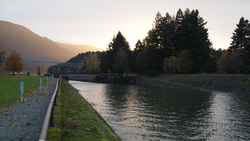


Community hub
Recent from talks
Contribute something
Nothing was collected or created yet.
Cascade Locks, Oregon
View on Wikipedia

Key Information


Cascade Locks is a city in Hood River County, Oregon, United States. The city got its name from a set of locks built to improve navigation past the Cascades Rapids of the Columbia River. The U.S. federal government approved the plan for the locks in 1875, construction began in 1878, and the locks were completed on November 5, 1896. The locks were subsequently submerged in 1938, replaced by Bonneville Lock and Dam, although the city did not lose land from the expansion of Lake Bonneville behind the dam some 4 miles (6 km) downstream of the city. The city population was 1,144 at the 2010 census.[5]


Cascade Locks is just upstream from the Bridge of the Gods, a toll bridge that spans the Columbia River. It is the only bridge across the Columbia between Portland and Hood River. Cascade Locks is a few miles upstream of Eagle Creek Gorge, a popular scenic area that doubles as an alternate route for the Pacific Crest Trail. Cascade Locks is used frequently by hikers along the Pacific Crest Trail (PCT) to cross the Columbia River. Cascade Locks is the lowest point along the trail, which runs from the Mexico–US border in California to the Canada–US border in Washington, and the largest city directly on the trail.[6]
Since 1999 the Confederated Tribes of Warm Springs have been pursuing an off-reservation casino to be sited in Cascade Locks.[7] Starting in 2008, city officials began pursuing an arrangement that would allow them to trade city well water for state-owned spring water and to sell it to Nestlé for bottling. In May 2016, Hood River County voters voted over 68% in favor to stop the project permanently.[8][9][10]
Geography
[edit]Cascade Locks is in the northwest corner of Hood River County, on the south side of the Columbia River. It is bordered to the north (in the middle of the river) by Skamania County, Washington. The city of Stevenson, Washington, is north of Cascade Locks across the river.
U.S. Route 30 passes through the center of Cascade Locks as Wa Na Pa Street, joining Interstate 84 at the east and west end of the downtown. Both exits with I-84 are labeled "44". I-84 and US 30 lead east 19 miles (31 km) to Hood River and west 43 miles (69 km) to Portland. US 30 provides access to the Bridge of the Gods, a toll bridge which crosses the Columbia River to connect with Washington State Route 14 between North Bonneville and Stevenson.
According to the United States Census Bureau, the city of Cascade Locks has a total area of 3.04 square miles (7.87 km2), of which 2.08 square miles (5.39 km2) are land and 0.96 square miles (2.49 km2) are water.[11]
Climate
[edit]This region experiences warm and dry summers, with no average monthly temperatures above 71.6 °F (22.0 °C). According to the Köppen climate classification system, Cascade Locks has a warm-summer Mediterranean climate which is abbreviated as "Csb" on climate maps.[12] The city receives an average of 76.27 in (1,937 mm) of precipitation per year.[13]
| Cascade Locks (1894-2014 Averages) | ||||||||||||||||||||||||||||||||||||||||||||||||||||||||||||
|---|---|---|---|---|---|---|---|---|---|---|---|---|---|---|---|---|---|---|---|---|---|---|---|---|---|---|---|---|---|---|---|---|---|---|---|---|---|---|---|---|---|---|---|---|---|---|---|---|---|---|---|---|---|---|---|---|---|---|---|---|
| Climate chart (explanation) | ||||||||||||||||||||||||||||||||||||||||||||||||||||||||||||
| ||||||||||||||||||||||||||||||||||||||||||||||||||||||||||||
| ||||||||||||||||||||||||||||||||||||||||||||||||||||||||||||
Demographics
[edit]| Census | Pop. | Note | %± |
|---|---|---|---|
| 1940 | 703 | — | |
| 1950 | 733 | 4.3% | |
| 1960 | 660 | −10.0% | |
| 1970 | 574 | −13.0% | |
| 1980 | 838 | 46.0% | |
| 1990 | 930 | 11.0% | |
| 2000 | 1,115 | 19.9% | |
| 2010 | 1,144 | 2.6% | |
| 2020 | 1,427 | 24.7% | |
| U.S. Decennial Census[14][3] | |||
2010 census
[edit]As of the census of 2010, there were 1,144 people, 445 households, and 305 families residing in the city. The population density was 550.0 inhabitants per square mile (212.4/km2). There were 502 housing units at an average density of 241.3 per square mile (93.2/km2). The racial makeup of the city was 87.7% White, 0.5% African American, 1.8% Native American, 0.9% Asian, 0.6% Pacific Islander, 2.7% from other races, and 5.8% from two or more races. Hispanic or Latino of any race were 9.1% of the population.[4]
There were 445 households, of which 30.3% had children under the age of 18 living with them, 47.2% were married couples living together, 13.7% had a female householder with no husband present, 7.6% had a male householder with no wife present, and 31.5% were non-families. 21.6% of all households were made up of individuals, and 7.4% had someone living alone who was 65 years of age or older. The average household size was 2.57 and the average family size was 2.95.[4]
The median age in the city was 40.8 years. 20.8% of residents were under the age of 18; 10.3% were between the ages of 18 and 24; 24.4% were from 25 to 44; 32.9% were from 45 to 64; and 11.5% were 65 years of age or older. The gender makeup of the city was 51.5% male and 48.5% female.[4]
Transportation
[edit]The Historic Columbia River Highway US 30 runs through the city, and can be accessed by exit 44 from I-84. The Bridge of the Gods connects Cascade Locks to Washington State Route 14.
Columbia Area Transit and Skamania County Transit provide local and intercity bus service to surrounding communities.[15][16]
See also
[edit]
- List of cities in Oregon
- Cascade Locks and Canal, historical site after which the city is named
- Starvation Creek State Park
References
[edit]- ^ "ArcGIS REST Services Directory". United States Census Bureau. Retrieved October 12, 2022.
- ^ a b U.S. Geological Survey Geographic Names Information System: Cascade Locks, Oregon
- ^ a b "Census Population API". United States Census Bureau. Retrieved October 12, 2022.
- ^ a b c d "U.S. Census website". United States Census Bureau. Retrieved December 21, 2012.
- ^ "Geographic Identifiers: 2010 Census Summary File 1 (G001): Cascade Locks city, Oregon". American Factfinder. U.S. Census Bureau. Archived from the original on February 13, 2020. Retrieved January 17, 2018.
- ^ Richard, Terry (August 30, 2015). "The softer, gentler approach to Pacific Crest Trail". The Oregonian. p. R4. Retrieved June 22, 2018.
- ^ Partlow, Joshua (March 11, 2008). "Gamble in the Gorge?". The Oregonian. Portland, Oregon.
- ^ "Cascade Locks considers action after Nestle plant voted down". Archived from the original on November 5, 2017.
- ^ "Anti-Nestle ballot measure: Bid to block Cascade Locks water plant succeeds (Election results)". May 18, 2016.
- ^ "Voters pass measure to keep Nestle out of Cascade Locks". Archived from the original on May 10, 2017. Retrieved May 18, 2016.
- ^ "US Gazetteer files 2010". United States Census Bureau. Archived from the original on July 2, 2012. Retrieved December 21, 2012.
- ^ "Cascade Locks, Oregon Köppen Climate Classification (Weatherbase)". Weatherbase.
- ^ a b "Period of Record Monthly Climate Summary for Cascade Locks, Oregon". Western Regional Climate Center. Retrieved January 30, 2015.
- ^ "Census of Population and Housing". Census.gov. Retrieved June 4, 2015.
- ^ "Columbia Gorge Express". Columbia Area Transit. Retrieved April 4, 2022.
- ^ "Transit | Skamania County". www.skamaniacounty.org. Retrieved April 4, 2022.
External links
[edit]
- Entry for Cascade Locks in the Oregon Blue Book
- Cascade Locks Tourism
- Port of Cascade Locks
- Willingham, William. "Cascade Locks". The Oregon Encyclopedia.
Municipalities and communities of Hood River County, Oregon, United States | ||
|---|---|---|
| Cities |  | |
| CDPs | ||
| Other communities | ||
| Indian reservation | ||
| Footnotes | ‡This populated place also has portions in an adjacent county or counties | |
| International | |
|---|---|
| National | |
| Other | |

Cascade Locks, Oregon
View on GrokipediaHistory
Pre-Columbian and Early Settlement
The region of present-day Cascade Locks along the Columbia River was occupied by indigenous peoples for thousands of years before European arrival, with the Cascade Rapids serving as a vital fishery for salmon and other anadromous fish. Upper Chinookan-speaking groups, later termed the Cascades Indians by settlers, maintained villages and controlled portage routes around the rapids, which were formed by a major landslide approximately 1450 AD that temporarily dammed the river and enhanced fish concentrations.[7] [3] [8] These communities derived economic and cultural significance from the site's resources, trading dried salmon regionally and leveraging the natural barrier for tolls on passing groups.[3] European contact began with the Lewis and Clark Expedition, which navigated the Columbia Gorge in October-November 1805, portaging supplies around the formidable Cascade Rapids—described as a perilous five-mile stretch of churning waters and basaltic obstructions—before continuing downstream.[9] Non-indigenous settlement emerged in the 1840s-1850s amid Oregon Trail migration, as emigrants required assistance bypassing the rapids via established native trails upgraded with wooden tramways and mule-powered rails like the Oregon Pony, operational by the early 1860s.[10] The first permanent white families arrived in 1853, establishing homesteads near existing Native American dwellings in an area initially called Whiskey Flats, marking it as one of the Columbia River's earliest Euro-American outposts.[11] Interethnic relations deteriorated amid broader territorial conflicts, notably during the Yakama War (1855-1858), when Cascade and Yakama warriors raided settlements on March 26, 1856, killing at least 13-15 settlers in the Cascades Massacre; U.S. forces retaliated swiftly, executing indigenous leaders and displacing survivors, effectively ending autonomous Native control over the portage.[12] [13] This violence facilitated settler expansion, with the community growing around portage services that supported steamboat traffic and overland freight until federal lock construction later in the century.[4]Navigation Era and Lock Construction
The Cascade Rapids, spanning approximately four miles on the Columbia River near present-day Cascade Locks, Oregon, presented a formidable barrier to river navigation from the mid-19th century onward, necessitating laborious portages of steamboat cargoes and passengers overland.[14] Steamboat traffic, which began in earnest around 1850 with sternwheelers operating between Portland and upstream points like The Dalles, relied on such portages or seasonal low-water navigation attempts, limiting efficient transport of goods such as wheat, lumber, and settlers' supplies to interior regions.[4] These challenges fueled demands for engineered solutions to enable continuous upstream travel, culminating in federal authorization for lock construction in 1875 to bypass the rapids and reduce steamboat monopolies held by portage operators.[15][16] Construction of the Cascade Locks and Canal commenced in 1878 under the U.S. Army Corps of Engineers, involving excavation of a 3,000-foot canal parallel to the rapids and installation of locks capable of lifting vessels up to 110 feet in elevation change across multiple chambers.[17][18] The project, plagued by funding delays and engineering difficulties in the rocky terrain, spanned 18 years and cost over $4 million—equivalent to roughly $130 million in 2023 dollars—before completion in 1896.[15] The locks officially opened on November 5, 1896, allowing the first steamboats to transit without portage, thereby transforming the Columbia into a more viable commercial waterway for freight and passenger service.[14] Daily riverboat operations proliferated, with whistles signaling passages that connected Portland to upstream markets, spurring economic activity and the founding of the town of Cascade Locks as a hub for lock maintenance, shipping, and related industries.[4][16] The locks facilitated safer and more reliable navigation until 1938, when rising waters from Bonneville Dam inundated the facility, though they marked a pivotal advancement in regional commerce during the sternwheeler-dominated era.[18] Annual traffic through the locks peaked in the early 20th century, handling thousands of tons of cargo and underscoring the engineering's role in integrating Oregon's interior with coastal ports prior to widespread rail and highway dominance.[3]Bonneville Dam and Post-Flood Changes
Construction of Bonneville Dam commenced in 1933 under the auspices of the United States Army Corps of Engineers, with the spillway and initial powerhouse operational by September 1937 and the navigation lock completed in 1938.[19][20] The project, spanning the Columbia River about 40 miles east of Portland and five miles downstream from Cascade Locks, aimed primarily at hydropower generation and improved river navigation.[21] The dam's reservoir inundated the Cascade Rapids and the Cascade Locks and Canal, which had facilitated navigation around the rapids since their completion in 1896.[4][15] Rising water levels submerged these structures by 1938, eliminating the need for portage and multiple lock systems previously required for vessels traversing the treacherous section of the river.[4] The Bonneville navigation lock, with a vertical lift of 60 feet, supplanted the older facilities, enabling year-round commercial navigation along a continuous channel from the Pacific Ocean to interior points.[20] This shift rendered the town of Cascade Locks' lock-dependent economy obsolete, transitioning its riverfront from a hub of active shipping portage to a calmer expanse suitable for emerging recreational uses.[16] In response to these changes, the Port of Cascade Locks acquired former U.S. Army Corps of Engineers lands in 1939, repurposing them for marine industrial development, tourism infrastructure, and the establishment of Cascade Locks Marine Park on the site of the submerged locks.[4] The reservoir's formation, locally associated with Lake Bonneville, supported boating and fishing activities, diversifying the local economy away from historical navigation services while preserving the area's strategic riverside position.[16]Geography
Location and Physical Features
Cascade Locks is situated in the northwest corner of Hood River County, in northern Oregon, United States, along the southern bank of the Columbia River. The city lies within the Columbia River Gorge, approximately 44 miles (71 km) east of Portland and 22 miles (35 km) west of Hood River, positioned at coordinates 45°40′12″N 121°53′22″W.[22][23] The municipality encompasses 2.1 square miles (5.4 km²) of land area, with an elevation of about 151 feet (46 m) above sea level at its center.[24][25] The surrounding terrain features the steep-walled Columbia River Gorge, a canyon extending roughly 80 miles (130 km) through the Cascade Range, with basalt cliffs and ridges rising to depths of up to 4,000 feet (1,200 m).[26] This geologic formation, shaped by glacial floods and river erosion, borders the city to the north via the Columbia River and includes forested slopes and high-relief landscapes conducive to landslides due to underlying volcanic rock structures and heavy precipitation.[27][28] The Gorge's orientation facilitates strong east-west wind corridors, influencing local microclimates that transition from wetter western forests to drier eastern zones near Cascade Locks.[29] Historically turbulent rapids adjacent to the city, known as the Cascades, were inundated by the impoundment from Bonneville Dam, located immediately west, altering the river's surface into a reservoir while preserving the gorge's dramatic topography.[30]Climate and Environmental Conditions
Cascade Locks experiences a temperate climate typical of the Columbia River Gorge, with warm, dry summers and cold, wet winters dominated by overcast conditions.[31] Average annual precipitation measures approximately 77 inches, concentrated primarily from October through May, while summers remain arid with minimal rainfall.[32] Temperatures typically range from winter lows around 32°F to summer highs near 82°F, with an annual average of 53°F.[33] The Gorge's east-west orientation funnels strong westerly winds, often exceeding 10-20 mph during fire season, which desiccates vegetation and enhances aridity on the Oregon side relative to windward Cascade slopes.[34] These winds, combined with dry fuels, elevate wildfire risk, as documented in local protection plans assessing high flammability in surrounding coniferous forests.[34] Environmental hazards stem from the region's steep basalt cliffs and unstable slopes, prone to rockfalls, landslides, and debris flows triggered by intense rainfall or post-fire soil erosion.[35] Notable events include debris flows from atmospheric river storms in January 2021 and 2022, which mobilized loose material along the Columbia River corridor.[36] Burned areas from prior wildfires further destabilize terrain, increasing flash flood potential during major storms.[37] Seismic activity from the Cascadia subduction zone poses additional long-term risk, though mitigated by distance from the epicentral trough.[38]| Month | Avg. Max Temp (°F) | Avg. Min Temp (°F) | Avg. Precip (in.) |
|---|---|---|---|
| January | 40.4 | 30.8 | 11.61 |
| February | 45.7 | 33.5 | 9.20 |
| March | 54.1 | 37.3 | 8.50 |
| April | 62.5 | 41.6 | 6.00 |
| May | 71.0 | 47.0 | 4.00 |
| June | 78.0 | 53.0 | 2.00 |
| July | 85.0 | 58.0 | 0.50 |
| August | 85.0 | 57.0 | 0.50 |
| September | 78.0 | 51.0 | 2.50 |
| October | 65.0 | 43.0 | 7.00 |
| November | 50.0 | 36.0 | 11.00 |
| December | 42.0 | 32.0 | 10.00 |
Demographics
Population and Growth Trends
As of the 2020 United States decennial census, Cascade Locks had a population of 1,391.[40] This marked an increase of 21.5% from the 1,145 residents counted in the 2010 census.[40] Historical census data reveal consistent but uneven growth over the prior decades, with the population rising from 930 in 1990 to 1,115 in 2000, a 19.8% gain.[40]| Census Year | Population | Percent Change from Prior Decade |
|---|---|---|
| 1990 | 930 | - |
| 2000 | 1,115 | +19.8% |
| 2010 | 1,145 | +2.7% |
| 2020 | 1,391 | +21.5% |