


Community hub
Recent from talks
Contribute something
Nothing was collected or created yet.
Castle Acre
View on Wikipedia
Castle Acre is a village and civil parish in the English county of Norfolk. On the River Nar, it is 4 miles (6.4 km) north of Swaffham and 26 miles (42 km) west of Norwich.
Key Information


At the 2021 census, the population of Castle Acre was 862, a slight increase from 848 at the 2011 census.[1]
History
[edit]Castle Acre is named for Castle Acre Castle, a Norman castle[2] built in 1085 by William de Warenne in order to enforce his control over his East Anglian lands. By the 12th century, the castle passed into the ownership of Hamelin Plantagenet who hosted both Henry II and Edward I in Castle Acre. By the 16th century, the castle lay mainly derelict, yet had a procession of illustrious owners including Thomas Howard, Thomas Cecil and Edward Coke. Today, the castle is maintained by English Heritage.[3]
In the Domesday Book, Castle Acre is listed with West Acre as a settlement of 130 households in the hundred of Freebridge. It divided between the estates of William de Warenne, Ely Cathedral and Ralph de Tosny.[4]
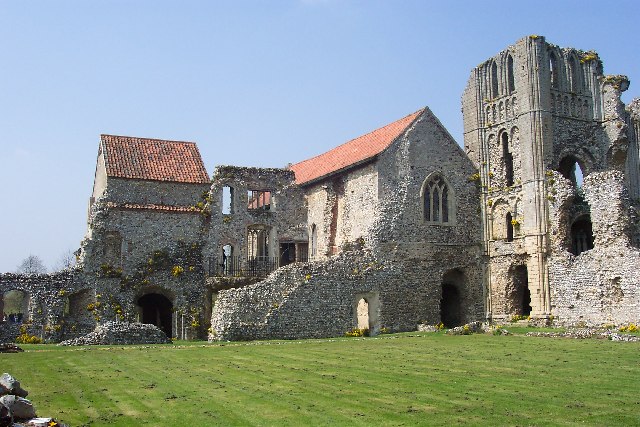
Also in the village are the ruins of Castle Acre Priory, established in 1090 by William de Warenne for an order of Cluniac monks. The monastery fell into disrepair after Dissolution of the monasteries in the 16th century. The priory is maintained by English Heritage.[5]
St. James' Church
[edit]Castle Acre's parish church is dedicated to Saint James and dates to the Fourteenth Century. St. James' is located at the junction between High Street and South Acre and has been a Grade I listed building since 1960.[6] The churchtower was largely rebuilt in the Fifteenth Century in the Perpendicular style with a further restoration in the 1870s by Ewan Christian. The church boasts an ornate font cover and a painted pulpit with damage from firearms dating from the Seventeenth and Eighteenth Centuries.[7]
Notable people
[edit] |
- William de Warenne, 1st Earl of Surrey (1035–1088) Norman nobleman, lived in Castle Acre.
- Gundred, Countess of Surrey (???–1085) Flemish noblewoman, died in Castle Acre.
- William de Warenne, 2nd Earl of Surrey (???–1138) Anglo-Norman nobleman, lived in Castle Acre.
- Hamelin de Warenne, Earl of Surrey (1130–1202) Anglo-Angevin nobleman, lived in Castle Acre.
- Thomas Howard, 4th Duke of Norfolk (1536–1572) nobleman and politician, lived in Castle Acre.
- Thomas Cecil, 1st Earl of Exeter (1542–1623) politician, courtier and soldier, lived in Castle Acre.
- Edward Coke (1552–1634) barrister, judge and politician, lived in Castle Acre.
References
[edit]- ^ "Castle Acre (Parish, United Kingdom) - Population Statistics, Charts, Map and Location". www.citypopulation.de. Retrieved 5 December 2024.
- ^ "Key to English Place-names". kepn.nottingham.ac.uk. Retrieved 10 October 2024.
- ^ "History of Castle Acre Castle and Bailey Gate". English Heritage. Retrieved 10 October 2024.
- ^ "[Castle and West] Acre | Domesday Book". opendomesday.org. Retrieved 5 December 2024.
- ^ "Castle Acre: Castle Acre Priory". English Heritage. Retrieved 10 October 2024.
- ^ "CHURCH OF ST JAMES, Castle Acre - 1342386 | Historic England". historicengland.org.uk. Retrieved 5 December 2024.
- ^ "Norfolk Churches". www.norfolkchurches.co.uk. Retrieved 5 December 2024.
| International | |
|---|---|
| National | |

Castle Acre
View on GrokipediaGeography and Demographics
Location and Setting
Castle Acre is a village and civil parish in the King's Lynn and West Norfolk district of Norfolk, England. It lies on the banks of the River Nar, at the intersection with the ancient Peddars Way Roman road, approximately 4 miles (6.4 km) north of Swaffham and 26 miles (42 km) west of Norwich.[10][11][12] The civil parish encompasses an area of 13.18 km² of predominantly rural terrain.[13] The topography of Castle Acre is characterized by gentle swells and a valley setting along the River Nar, contrasting with the broader flatlands of Norfolk. Surrounding the village is open countryside with light, sandy, and chalky soils overlying chalk bedrock, features typical of the adjacent Breckland region.[14][15][16] These soils contribute to a landscape of arable fields and heath-like patches, with the River Nar providing a vital waterway through the otherwise dry terrain. Castle Acre enjoys a temperate maritime climate, with mild winters, warm summers, and annual rainfall averaging around 600-700 mm, moderated by its inland position yet influenced by proximity to the North Sea.[17] The village's location near Thetford Forest, about 23 miles (37 km) to the south, and amid Norfolk's expansive flatlands fosters a biodiversity-rich environment supporting agriculture, including arable crops suited to the chalky conditions, as well as habitats for wildlife such as birds and insects.[18][19] The River Nar and Peddars Way once functioned as significant trade routes in antiquity.[12]Population and Economy
As of the 2021 United Kingdom Census, Castle Acre had a population of 862 residents living across an area of 13.18 square kilometres, resulting in a population density of 65 inhabitants per square kilometre. The population exhibited a slight increase over the previous decade, with an annual growth rate of 0.16% from 2011 to 2021, contrasting with broader rural migration trends in some parts of Norfolk that have led to stagnation or decline in smaller settlements. This modest growth reflects the village's appeal as a stable rural community amid regional depopulation pressures.[2] Demographically, Castle Acre remains predominantly White, with 98.1% of residents identifying as such in the 2021 Census, including a strong majority of White British heritage. The age distribution skews toward older residents, with 33.7% of the population aged 65 and over—substantially higher than the England and Wales average of approximately 18.5%—and only 15.3% under 18 years old, indicating a median age around 45 years that underscores the village's retiree-friendly character. Household composition is typical of rural Norfolk parishes, featuring a blend of family units (including couples with or without dependent children) and single-person or pensioner households, with about 51.2% of residents in working-age groups supporting local stability.[2] The local economy of Castle Acre is anchored in agriculture, particularly arable farming on the fertile farmlands surrounding the village, which forms part of West Norfolk's broader agri-food sector that employs a significant portion of the rural workforce despite challenges like fluctuating commodity prices. Tourism plays a vital complementary role, drawing visitors to the area's heritage sites such as Castle Acre Castle and Priory, which contribute to the regional visitor economy valued at £565 million annually in 2023 and support seasonal income for accommodations, eateries, and guided services—though exact local shares are not quantified. Small-scale services, including the village's independent shops, pubs, and a post office, sustain day-to-day needs and provide limited on-site employment, while many residents rely on commuting to larger hubs like Swaffham (about 8 km away) or King's Lynn (24 km) for professional, retail, or administrative jobs in sectors such as manufacturing and logistics.[20][21][22]History
Norman Conquest and Early Settlement
Prior to the Norman Conquest, Castle Acre was the site of an established Anglo-Saxon settlement, as evidenced by the presence of a church and a substantial manor house owned by Toki, a notable Saxon thegn and landowner in East Anglia.[5] The Domesday Book of 1086 records the combined manors of Castle and West Acre with 130 households, including villagers, freemen, smallholders, and slaves, marking it as one of the larger settlements in Norfolk and indicating a thriving pre-Conquest community with economic resources such as mills and fisheries.[23] This level of population and infrastructure underscored the area's significance for agriculture and trade in the late Anglo-Saxon period.[23] Following William the Conqueror's victory at Hastings in 1066, the lands at Acre were confiscated from Toki and granted to William de Warenne, who gained control through his wife Gundrada, a trusted Norman noble and companion of the Conqueror who had fought alongside him in the invasion.[5] In the 1070s, William I de Warenne initiated construction of Castle Acre Castle as a motte-and-bailey fortress strategically positioned at the crossing of the River Nar and the ancient Peddars Way to control key routes and secure the region against potential rebellions.[5] By 1085, the castle was habitable, serving as the caput of the Warenne family's honor in Norfolk and symbolizing Norman dominance over former Anglo-Saxon territories.[5] The early religious development of Castle Acre complemented its military foundations when William I de Warenne founded Castle Acre Priory between 1081 and 1085 as a Cluniac house, initially within the castle bailey and drawing on the reformist monastic traditions from the Abbey of Cluny in France.[6] This foundation was confirmed shortly after by his son, William II de Warenne, through a charter granting the monks a new site outside the castle grounds in 1089; it served as a daughter house to Lewes Priory, England's first Cluniac establishment founded by William I in 1077, with initial monks imported directly from Lewes to instill the order's emphasis on liturgical prayer and communal discipline.[6] In its early years, the priory played a vital role in the spiritual life of the region, attracting pilgrims and nobility while managing extensive lands that supported economic activities like farming and milling, thereby integrating religious observance with local prosperity.[24]Medieval Period and Decline
During the 12th to 15th centuries, Castle Acre experienced significant prosperity under the patronage of the de Warenne family, who expanded the Cluniac priory through endowments of land and resources, enabling it to support a community of up to 36 monks and numerous servants.[6] The priory's church was rebuilt in the eastern end during the 14th century, with further improvements to conventual buildings, including a prior's lodging and gatehouse added in the early 16th century, reflecting its growing wealth from temporalities valued at over £130 in Norfolk parishes by 1291.[6][7] Concurrently, the town developed as a fortified settlement, replanned by William III de Warenne in the early 12th century with massive earth banks, deep ditches, and stone walls enhancing defenses, while the Bailey Gate was constructed in the late 12th century to control access.[5] The local economy benefited from the priory's role in the manorial system, managing extensive possessions including churches, tithes, and demesnes across Norfolk, which contributed to agricultural output and positioned Castle Acre within the broader medieval wool trade networks of the region.[7] By 1535, the priory's clear annual value had risen to £306, underscoring its economic influence before the Reformation.[7] Key ownership transitions marked the transition from medieval prosperity to early modern changes. The priory was dissolved on 22 November 1537 during Henry VIII's Suppression of the Monasteries, with Prior Thomas Malling and ten monks signing the deed of surrender, after which it was granted to Thomas Howard, 3rd Duke of Norfolk.[6] The castle, inherited by the Warenne family until 1347 and then passing to the Earls of Arundel, also came under Howard control in the mid-16th century before being sold by Thomas Howard, 4th Duke of Norfolk, to Sir Thomas Gresham in 1558.[5] In 1615, both the priory and castle estates were acquired by Sir Edward Coke, who repurposed the prior's lodging as a residence for his family, maintaining ownership into the present day.[6][24] These shifts aligned with the broader dissolution, which stripped the priory of its monastic functions and led to the demolition of its church for building materials.[6] The post-Reformation period initiated Castle Acre's decline, as the abandonment of the priory removed a major economic and social anchor, causing the town to lose its medieval prosperity.[5] The castle, already little used and possibly derelict by 1397 due to the Warenne family's focus on other estates, fell further into ruin by the 17th century, with its masonry quarried for local construction and roads, leaving it primarily as grazing land.[5] Economically, the area shifted from monastic-supported agriculture and trade to more localized farming amid the broader English enclosure movements of the 16th to 18th centuries, which consolidated lands and reduced communal access, further diminishing the settlement's earlier vibrancy.[24] By the mid-16th century, the priory's monastic buildings were largely removed, though the prior's lodging served domestic purposes into the 17th century before broader decay set in.[6]Landmarks and Heritage
Castle Acre Castle
Castle Acre Castle is a prominent example of early Norman fortification in England, constructed as a motte-and-bailey structure shortly after the Norman Conquest of 1066. Founded by William de Warenne, a key ally of William the Conqueror, in the 1070s, the castle served as both a defensive stronghold and a residential seat for the de Warenne family, who held it until 1347.[5][25] Its strategic location along the ancient Peddars Way, a Roman road traversing Norfolk, enhanced its role in controlling regional trade routes and asserting Norman authority over East Anglia.[26] The castle's architecture exemplifies the motte-and-bailey design typical of 11th- and 12th-century Norman castles, featuring a central motte rising approximately 9.5 meters above the original ground level, topped by a 12th-century shell keep that encloses remnants of an earlier 11th-century domestic building.[25] The inner bailey, covering about 3 hectares, surrounds the motte and is defined by deep ditches up to 4 meters in depth, while the outer bailey to the south is a roughly rectangular enclosure of similar size, reinforced by massive earth banks up to 7 meters high and stretches of surviving stone curtain walls.[8] A notable 12th-century gatehouse, known as the Bailey Gate, provides access to the outer bailey with its pointed archway, semicircular turrets, portcullis grooves, and a timber bridge over the ditch; an early 13th-century great hall once stood within the outer bailey, marked today by turf ridges.[8] Extending from the castle, mid-12th-century town defenses enclose an area of about 3.8 hectares with earthworks and stone-faced walls, including additional gatehouses added around 1200 for enhanced protection.[8][25] Historically, the castle functioned primarily as a military and administrative center, with significant enhancements during the Anarchy (1138–1154), when William de Warenne III raised the earthworks and added stone fortifications to counter civil unrest.[5] It hosted royal visits, including those by Henry III and Edward I, underscoring its residential importance for the de Warenne earls, who used it as a base for managing their extensive estates.[5] By the late 14th century, the site fell into decline, with little use after 1397, and was sold in 1558 following the family's extinction.[5] Today, Castle Acre Castle is preserved as a scheduled ancient monument and Grade I listed site, in state guardianship since 1971 and managed by English Heritage to protect its earthworks and ruins from natural degradation, including erosion of the ditches and banks through ongoing maintenance and vegetation control.[25][27][5] The site offers public access to explore the earthworks and interpretative displays that highlight its Norman heritage.[28]Castle Acre Priory
Castle Acre Priory was founded between 1081 and 1085 by William I de Warenne, Earl of Surrey, as a Cluniac priory, with monks brought from the order's English base at Lewes Priory, making it one of the earliest Cluniac establishments in England after the Norman Conquest.[6] The priory followed the strict Benedictine-influenced Cluniac rule emphasizing liturgical worship, communal living, and reform, and it served as a dependent house under Lewes while maintaining ties to the mother abbey at Cluny in France.[6] At its peak in the 12th and 13th centuries, the community housed approximately 30 to 35 monks, along with lay servants, supporting a vibrant monastic life centered on prayer, study, and hospitality.[7][6] The priory's layout exemplified a typical Cluniac monastic complex, featuring a central church with nave, choir, presbytery, transepts, and crossing tower; surrounding cloisters for contemplation and processions; a refectory for communal meals; a guest house to accommodate pilgrims and visitors; and various domestic buildings including kitchens, a warming house, dormitory, infirmary, and the prior's lodging.[29] Architecturally, the west front of the church, completed in the 1160s, stands as a highlight with its elaborate Norman arches, chevron ornamentation, and figurative carvings reflecting Cluniac artistic flair.[6] Surviving remnants include the undercroft beneath the refectory for storage, the chapter house where monks conducted daily business and readings, and partially intact domestic structures such as the prior's lodging with its chapel and chambers.[29][30] The priory was suppressed on 22 November 1537 during Henry VIII's Dissolution of the Monasteries, when Prior Thomas Malling and his remaining 10 monks surrendered the site.[6] Following dissolution, much of the church was demolished, with stones repurposed for local buildings, while the prior's lodging was converted into a farmhouse.[6] The ruins came under state guardianship in 1929 and have been managed by English Heritage since 1984, featuring interpretive displays, an audio tour, and a recreated herb garden to illustrate monastic daily life.[6] As one of the best-preserved Cluniac priories in England, it attracts history enthusiasts for its insights into 12th-century monastic architecture and the order's influence on Norman England.[31] The de Warenne family, as founders and patrons, provided ongoing endowments that sustained the priory's development.[7]St. James' Church
St. James' Church in Castle Acre is a medieval parish church primarily constructed in the 14th century, featuring a core of Perpendicular Gothic architecture with elements dating to around 1300, such as Early English piers.[32] The structure includes a five-bay nave with clerestory, north and south aisles, a three-bay chancel, and a north porch, built from rubble flint with squared knapped flint and cut stone dressings.[32] The west tower, a prominent Perpendicular feature, was rebuilt in the 15th century, contributing to the church's graceful proportions and lofty arcades with moulded arches.[33] Designated as a Grade I listed building on 15 August 1960, it exemplifies the region's medieval ecclesiastical heritage.[32] The interior preserves several notable 15th-century furnishings, including a plain octagonal font paired with an ornate, towering spire-like cover—one of the finest surviving examples in Norfolk—complete with its original counterbalance mechanism for raising and lowering.[33][34] A late 15th-century hexagonal wine-glass pulpit stands out, its panels painted with depictions of saints including Augustine, Gregory, Jerome, and Ambrose, following restoration to revive its original colors.[33] The church underwent significant Victorian restoration in the 1870s under architect Ewan Christian, which included the insertion of a new east window in the chancel and over-restoration of elements like the rood screen's painted dado panels portraying the apostles.[33][32] Poppyhead benches and chancel stalls from the same period further enhance the well-maintained, light-filled space.[32] Today, St. James' serves as an active Anglican parish church within the Diocese of Norwich, providing regular worship services to the local community and accommodating events such as weddings, baptisms, and seasonal festivals.[35] Positioned on the village green along the Peddars Way long-distance footpath, it remains a focal point for both residents and visitors, supported by the Friends of Castle Acre Church for ongoing maintenance and preservation efforts.[35][36]Governance and Community
Local Administration
Castle Acre is a civil parish within the district of King's Lynn and West Norfolk and the county of Norfolk, governed at the local level by the Castle Acre Parish Council alongside higher-tier authorities including Norfolk County Council, which handles services such as education, highways, and social services, and the Borough Council of King's Lynn and West Norfolk, responsible for housing, planning, environmental services, and refuse collection.[37][38] The parish council consists of nine elected members serving four-year terms, led by a chairman and vice-chairman, with meetings held monthly at the village hall to address community matters.[39] Established as a civil parish under the Local Government Act 1894, which created elected parish councils across England and Wales to manage local affairs, Castle Acre's administrative boundaries have remained consistent since that time, encompassing the village and surrounding areas without significant alteration. The council's primary responsibilities include maintaining village amenities such as greens, commons, street lighting, and allotments; overseeing recreational facilities like playgrounds and the village hall; and managing footpaths and rights of way to support public access.[39][40] It also provides consultative input on planning applications, licensing, and conservation issues, while collaborating with district authorities on initiatives like tourism promotion to highlight the area's heritage sites. The council's annual budget is approximately £20,000 to £22,000 as of 2025, funded primarily through the local precept levied on council tax—£20,308 for 2024-25, for example—and supplemented by grants and other income, enabling operations without reliance on extensive external funding.[39][40][41]War Memorial and Modern Life
The Castle Acre and Newton War Memorial, a rough-hewn granite cross situated in the churchyard of St James' Church, was erected in 1923 to honour local fallen soldiers. It bears inscriptions commemorating 43 names from the First World War and 8 from the Second World War. The structure is maintained by the local Royal British Legion branch, ensuring its ongoing preservation as a site of communal remembrance.[42][43][44] Throughout the 20th and 21st centuries, Castle Acre has experienced gradual modernization that enhanced daily life for residents. Broadband internet rollout in the 2010s improved connectivity and access to services. Annual events such as the Acre Fair, featuring local crafts and makers, and guided history walks along heritage trails foster community spirit and attract visitors. In response to 21st-century environmental pressures, the village has addressed climate-related challenges impacting the River Nar, including altered flow patterns and habitat stress through restoration efforts and monitoring.[45] Up to 2025, recent initiatives in Castle Acre emphasize sustainability and community resilience, including expanded eco-tourism promoting low-impact walking and cycling routes tied to its natural and historic assets, as outlined in the 2021 Neighbourhood Development Plan. Local debates continue over large-scale developments, such as proposed solar farms near the village. With no major disruptive events noted since 2020, the population has remained steady at 862 as recorded in the 2021 census, underpinned by ongoing efforts to preserve heritage sites like the war memorial within the churchyard.[45][46][2]Notable People
- Mark Thomas Ellis (born 19 May 1962), a former English cricketer who played as a right-handed batsman and right-arm fast-medium bowler.[47]
- Kenneth Alexander Keith, Baron Keith of Castleacre (30 August 1916 – 1 September 2004), a British merchant banker and industrialist who was elevated to the peerage in 1980.[48]