




Community hub
Recent from talks
Contribute something to knowledge base
Content stats: 0 posts, 0 articles, 1 media, 0 notes
Members stats: 0 subscribers, 0 contributors, 0 moderators, 0 supporters
Subscribers
Supporters
Contributors
Moderators
Psychro Cave
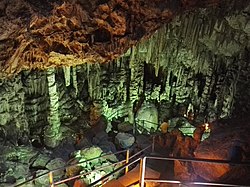
Psychro Cave (Greek: Σπήλαιο Ψυχρού) is an ancient Minoan sacred cave in Lasithi plateau in the Lasithi district of eastern Crete. Psychro is associated with the Dictaean or Diktaian Cave (Greek: Δικταῖον Ἄντρον; Diktaion Antron), one of the putative sites of the birth of Zeus. Other legends place Zeus' birthplace as Idaean Cave (Ἰδαῖον Ἄντρον) on Mount Ida. According to Hesiod, Theogony (477-484), Rhea gave birth to Zeus in Lyctus and hid him in a cave of Mount Aegaeon. Since the late nineteenth century the cave above the modern village of Psychro has been identified with Diktaean Cave, although there are other candidates, especially a cave above Palaikastro on Mount Petsofas.
The cave is located in the prefecture of Lasithi. In Minoan times, the town of Malia was the closest metropolitan center.
The Dictaean Cave is famous in Greek mythology as the place where Amalthea, nurtured the infant Zeus with her goat's milk. The archaeology attests to the site's long use as a place of cult worship. The nurse of Zeus, who was charged by Rhea to raise the infant Zeus in secret here, to protect him from his father Cronus (Krónos) is also called the nymph Adrasteia in some contexts. It is one of a number of caves believed to have been the birthplace or hiding place of Zeus. The mountains, of which the cave are part, are known in Crete as Dikte.
The cave was first excavated in 1886 by Joseph Hatzidakis, President of the Syllogos at Candia, and F. Halbherr. In 1896, Sir Arthur Evans investigated the site.
In 1898 Pierre Demargne conducted brief investigations, followed by David George Hogarth of the British School at Athens in 1900 who carried out more extensive operations. Hogarth's reports published in 1900 give a picture of the destruction wrought by primitive archaeological methods: immense fallen blocks from the upper cave roof were blasted before removal; the rich black earth had been previously ransacked. The stuccoed altar in the upper cave was discovered in 1900, surrounded by strata of ashes, pottery and "other refuse", among which were votive objects in bronze, terracotta, iron and bone, with fragments of some thirty libation tables and countless conical ceramic cups for food offerings. Bones among the ash layer attest to sacrifice of bulls, sheep and goats, deer and a boar.
The undisturbed lowest strata of the upper cave represented the transition between Late Minoan Kamares ware to earliest Mycenaean levels; finds represented the Geometric Style of the ninth century BCE, but few later than that. More recent excavation has revealed the use of the cave reached back to Early Minoan times, and votive objects attest to the cave's being the most frequented shrine by Middle Minoan times (MM IIIA).
The lower grotto falls steeply with traces of a rock-cut stair to a pool, out of which stalactites rise. "Much earth had been thrown down by diggers of the Upper Grotto," Hogarth reported, "and this was found full of small bronze objects." In the vertical chinks of the lowest stalactites, Hogarth's team found "toy double-axes, knife-blades, needles, and other objects in bronze, placed there by dedicators, as in niches. The mud at the edge of the subterranean pool was also rich in similar things and in statuettes of two types, male and female and engraved gems."
In 1961, the art historian and archaeologist John Boardman published the finds uncovered by these and other excavations.[citation needed]
Psychro Cave
Psychro Cave (Greek: Σπήλαιο Ψυχρού) is an ancient Minoan sacred cave in Lasithi plateau in the Lasithi district of eastern Crete. Psychro is associated with the Dictaean or Diktaian Cave (Greek: Δικταῖον Ἄντρον; Diktaion Antron), one of the putative sites of the birth of Zeus. Other legends place Zeus' birthplace as Idaean Cave (Ἰδαῖον Ἄντρον) on Mount Ida. According to Hesiod, Theogony (477-484), Rhea gave birth to Zeus in Lyctus and hid him in a cave of Mount Aegaeon. Since the late nineteenth century the cave above the modern village of Psychro has been identified with Diktaean Cave, although there are other candidates, especially a cave above Palaikastro on Mount Petsofas.
The cave is located in the prefecture of Lasithi. In Minoan times, the town of Malia was the closest metropolitan center.
The Dictaean Cave is famous in Greek mythology as the place where Amalthea, nurtured the infant Zeus with her goat's milk. The archaeology attests to the site's long use as a place of cult worship. The nurse of Zeus, who was charged by Rhea to raise the infant Zeus in secret here, to protect him from his father Cronus (Krónos) is also called the nymph Adrasteia in some contexts. It is one of a number of caves believed to have been the birthplace or hiding place of Zeus. The mountains, of which the cave are part, are known in Crete as Dikte.
The cave was first excavated in 1886 by Joseph Hatzidakis, President of the Syllogos at Candia, and F. Halbherr. In 1896, Sir Arthur Evans investigated the site.
In 1898 Pierre Demargne conducted brief investigations, followed by David George Hogarth of the British School at Athens in 1900 who carried out more extensive operations. Hogarth's reports published in 1900 give a picture of the destruction wrought by primitive archaeological methods: immense fallen blocks from the upper cave roof were blasted before removal; the rich black earth had been previously ransacked. The stuccoed altar in the upper cave was discovered in 1900, surrounded by strata of ashes, pottery and "other refuse", among which were votive objects in bronze, terracotta, iron and bone, with fragments of some thirty libation tables and countless conical ceramic cups for food offerings. Bones among the ash layer attest to sacrifice of bulls, sheep and goats, deer and a boar.
The undisturbed lowest strata of the upper cave represented the transition between Late Minoan Kamares ware to earliest Mycenaean levels; finds represented the Geometric Style of the ninth century BCE, but few later than that. More recent excavation has revealed the use of the cave reached back to Early Minoan times, and votive objects attest to the cave's being the most frequented shrine by Middle Minoan times (MM IIIA).
The lower grotto falls steeply with traces of a rock-cut stair to a pool, out of which stalactites rise. "Much earth had been thrown down by diggers of the Upper Grotto," Hogarth reported, "and this was found full of small bronze objects." In the vertical chinks of the lowest stalactites, Hogarth's team found "toy double-axes, knife-blades, needles, and other objects in bronze, placed there by dedicators, as in niches. The mud at the edge of the subterranean pool was also rich in similar things and in statuettes of two types, male and female and engraved gems."
In 1961, the art historian and archaeologist John Boardman published the finds uncovered by these and other excavations.[citation needed]
Recent media
Recent media