Hubbry Logo
StalactiteStalactiteMain
Open search
Stalactite
Community hub
Stalactite
logo
8 pages, 0 posts
0 subscribers
Be the first to start a discussion here.
Stalactite
Stalactite
from Wikipedia
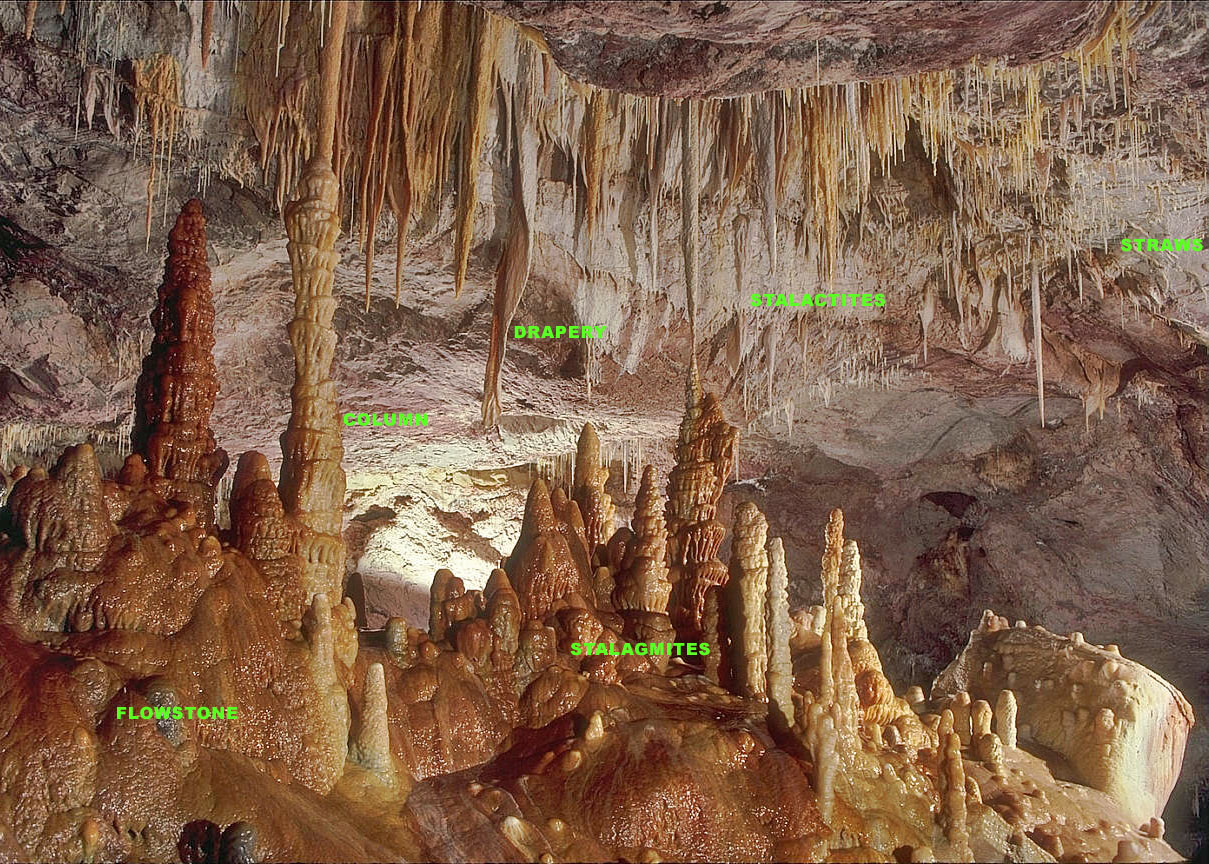
Image showing the six most common speleothems with labels. Enlarge to view labels.

A stalactite (UK: /ˈstæləkˌtt/, US: /stəˈlæktt/; from Ancient Greek σταλακτός (stalaktós) 'dripping', from σταλάσσειν (stalássein) 'to drip')[1] is a mineral formation that hangs from the ceiling of caves, hot springs, or man-made structures such as bridges and mines. Any material that is soluble and that can be deposited as a colloid, or is in suspension, or is capable of being melted, may form a stalactite. Stalactites may be composed of lava, minerals, mud, peat, pitch, sand, sinter, and amberat (crystallized urine of pack rats).[2][3] A stalactite is not necessarily a speleothem, though speleothems are the most common form of stalactite because of the abundance of limestone caves.[2][4]

The corresponding formation on the floor of the cave is known as a stalagmite.

Formation and type

[edit]
Demonstration of drip stone formation in a lab. The blue color is due to the addition of cupric ions (Cu2+) to the mother solution.

Limestone stalactites

[edit]

The most common stalactites are speleothems, which occur in limestone caves. They form through deposition of calcium carbonate and other minerals, which is precipitated from mineralized water solutions. Limestone is the chief form of calcium carbonate rock which is dissolved by water that contains carbon dioxide, forming a calcium bicarbonate solution in caverns.[5] The chemical formula for this reaction is:[6]

CaCO3(s) + H2O(l) + CO2(aq) → Ca(HCO3)2(aq)

This solution travels through the rock until it reaches an edge and if this is on the roof of a cave it will drip down. When the solution comes into contact with air the chemical reaction that created it is reversed and particles of calcium carbonate are deposited. The reversed reaction is:[6]

Ca(HCO3)2(aq)CaCO3(s) + H2O(l) + CO2(aq)

An average growth rate is 0.13 mm (0.0051 inches) a year. The quickest growing stalactites are those formed by a constant supply of slow dripping water rich in calcium carbonate (CaCO3) and carbon dioxide (CO2), which can grow at 3 mm (0.12 inches) per year.[7][8] The drip rate must be slow enough to allow the CO2 to degas from the solution into the cave atmosphere, resulting in deposition of CaCO3 on the stalactite. Too fast a drip rate and the solution, still carrying most of the CaCO3, falls to the cave floor where degassing occurs and CaCO3 is deposited as a stalagmite.

All limestone stalactites begin with a single mineral-laden drop of water. When the drop falls, it deposits the thinnest ring of calcite. Each subsequent drop that forms and falls deposits another calcite ring. Eventually, these rings form a very narrow (≈4 to 5 mm diameter), hollow tube commonly known as a "soda straw" stalactite. Soda straws can grow quite long, but are very fragile. If they become plugged by debris, water begins flowing over the outside, depositing more calcite and creating the more familiar cone-shaped stalactite.

Stalactite formation generally begins over a large area, with multiple paths for the mineral rich water to flow. As minerals are dissolved in one channel slightly more than other competing channels, the dominant channel begins to draw more and more of the available water, which speeds its growth, ultimately resulting in all other channels being choked off. This is one reason why formations tend to have minimum distances from one another. The larger the formation, the greater the interformation distance.

Pillars

[edit]
Pillars in the Caves of Nerja, Spain

The same water drops that fall from the tip of a stalactite deposit more calcite on the floor below, eventually resulting in a rounded or cone-shaped stalagmite. Unlike stalactites, stalagmites never start out as hollow "soda straws". Given enough time, these formations can meet and fuse to create a speleothem of calcium carbonate known as a pillar, column, or stalagnate.[9]

Lava stalactites

[edit]

Another type of stalactite is formed in lava tubes while molten and fluid lava is still active inside.[10] The mechanism of formation is the deposition of molten dripping material on the ceilings of caves, however with lava stalactites formation happens very quickly in only a matter of hours, days, or weeks, whereas limestone stalactites may take up to thousands of years. A key difference with lava stalactites is that once the lava has ceased flowing, so too will the stalactites cease to grow. This means that if the stalactite were to be broken it would never grow back.[2]

The generic term lavacicle has been applied to lava stalactites and stalagmites indiscriminately and evolved from the word icicle.[2]

Like limestone stalactites, they can leave lava drips onto the floor that turn into lava stalagmites and may eventually fuse with the corresponding stalactite to form a column.

Shark tooth stalactites

[edit]
Shark tooth stalactites

The shark tooth stalactite is broad and tapering in appearance. It may begin as a small driblet of lava from a semi-solid ceiling, but then grows by accreting layers as successive flows of lava rise and fall in the lava tube, coating and recoating the stalactite with more material. They can vary from a few millimeters to over a meter in length.[11]

Splash stalactites

[edit]

As lava flows through a tube, material will be splashed up on the ceiling and ooze back down, hardening into a stalactite. This type of formation results in an irregularly-shaped stalactite, looking somewhat like stretched taffy[clarification needed]. Often they may be of a different color than the original lava that formed the cave.[11]

Tubular lava stalactites

[edit]

When the roof of a lava tube is cooling, a skin forms that traps semi-molten material inside. Trapped gases expansion forces lava to extrude out through small openings that result in hollow, tubular stalactites analogous to the soda straws formed as depositional speleothems in solution caves. The longest known is almost 2 meters in length. These are common in Hawaiian lava tubes and are often associated with a drip stalagmite that forms below as material is carried through the tubular stalactite and piles up on the floor beneath. Sometimes the tubular form collapses near the distal end, most likely when the pressure of escaping gases decreased and still-molten portions of the stalactites deflated and cooled. Often these tubular stalactites acquire a twisted, vermiform appearance as bits of lava crystallize and force the flow in different directions. These tubular lava helictites may also be influenced by air currents through a tube and point downwind.[11]

Ice stalactites

[edit]
Ice stalactites on the gutter of a house
Ice stalactites on a frozen beach in Bete Grise, Michigan

A common stalactite found seasonally or year round in many caves is the ice stalactite, commonly referred to as icicles, especially on the surface.[12] Water seepage from the surface will penetrate into a cave and if temperatures are below freezing, the water will form stalactites. They can also be formed by the freezing of water vapor.[13] Similar to lava stalactites, ice stalactites form very quickly within hours or days. Unlike lava stalactites however, they may grow back as long as water and temperatures are suitable.

Ice stalactites can also form under sea ice when saline water is introduced to ocean water. These specific stalactites are referred to as brinicles.

Ice stalactites may also form corresponding stalagmites below them and given time may grow together to form an ice column.

Concrete stalactites

[edit]
Concrete stalactites
Calthemite soda straw stalactites under a concrete slab

Stalactites can also form on concrete, and on plumbing where there is a slow leak and where there are calcium, magnesium or other ions in the water supply, although they form much more rapidly there than in the natural cave environment. These secondary deposits, such as stalactites, stalagmites, flowstone and others, which are derived from the lime, mortar or other calcareous material in concrete, outside of the "cave" environment, can not be classified as "speleothems" due to the definition of the term.[8] The term "calthemite" is used to encompass these secondary deposits which mimic the shapes and forms of speleothems outside the cave environment.[14]

The way stalactites form on concrete is due to different chemistry than those that form naturally in limestone caves and is due to the presence of calcium oxide in cement. Concrete is made from aggregate, sand and cement. When water is added to the mix, the calcium oxide in the cement reacts with water to form calcium hydroxide (Ca(OH)2). The chemical formula for this is:[6]

CaO
(s)
+ H
2
O
(l)
Ca(OH)
2

(aq)

Over time, any rainwater that penetrates cracks in set (hard) concrete will carry any free calcium hydroxide in solution to the edge of the concrete. Stalactites can form when the solution emerges on the underside of the concrete structure where it is suspended in the air, for example, on a ceiling or a beam. When the solution comes into contact with air on the underside of the concrete structure, another chemical reaction takes place. The solution reacts with carbon dioxide in the air and precipitates calcium carbonate.[6]

Ca(OH)
2

(aq)
+ CO
2

(g)
CaCO
3

(s)
+ H
2
O
(l)

When this solution drops down it leaves behind particles of calcium carbonate and over time these form into a stalactite. They are normally a few centimeters long and with a diameter of approximately 4 to 5 mm (0.16 to 0.20 inches).[6] The growth rate of stalactites is significantly influenced by supply continuity of Ca2+
saturated solution and the drip rate. A straw shaped stalactite which has formed under a concrete structure can grow as much as 2 mm per day in length, when the drip rate is approximately 11 minutes between drops.[14] Changes in leachate solution pH can facilitate additional chemical reactions, which may also influence calthemite stalactite growth rates.[14]

Records

[edit]

The White Chamber in the Jeita Grotto's upper cavern in Lebanon contains an 8.2 m (27 ft) limestone stalactite which is accessible to visitors and is claimed to be the longest stalactite in the world.[citation needed] Another such claim is made for a 20 m (66 ft) limestone stalactite that hangs in the Chamber of Rarities in the Gruta Rei do Mato (Sete Lagoas, Minas Gerais, Brazil).[citation needed] However, cavers have often encountered longer stalactites during their explorations. One of the longest stalactites viewable by the general public is in Pol an Ionain (Doolin Cave), County Clare, Ireland, in a karst region known as The Burren; what makes it more impressive is the fact that the stalactite is held on by a section of calcite less than 0.3 m2 (3.2 sq ft).[15]

Etymology

[edit]

Stalactites are first mentioned (though not by name) by the Roman natural historian Pliny in a text which also mentions stalagmites and columns and refers to their formation by the dripping of water. The term "stalactite" was coined in the 17th century by the Danish Physician Ole Worm,[16] who coined the word from the Greek word σταλακτός (stalaktos, "dripping") and the Greek suffix -ίτης (-ites, connected with or belonging to).[17]

[edit]

See also

[edit]

References

[edit]
[edit]
Revisions and contributorsEdit on WikipediaRead on Wikipedia
from Grokipedia
A stalactite is a , or formation, characterized by its icicle-like shape and downward growth from the ceiling of caves, primarily composed of (). It forms when percolates through cracks in the overlying rock, dissolves , and then drips into the , where it loses and deposits the mineral as successive layers build up over time. Stalactites begin as thin, hollow "soda straws" where water drips from the tip, leaving a ring of with each drop, and may evolve into thicker, cone-shaped structures as water flows along the exterior surface. Growth rates vary by environmental conditions but are generally slow, ranging from about 0.03 mm per year laterally for mature forms to around 1 mm per year longitudinally for initial soda straws, often requiring thousands of years to reach noticeable sizes. If undisturbed, a stalactite can eventually meet a corresponding rising from the floor to form a column. These formations are fragile and sensitive to , as skin oils can inhibit further growth, and they play a significant role in scientific research, particularly in , where annual growth layers and isotopic compositions reveal historical patterns of rainfall and climate variability dating back thousands of years. Stalactites are most commonly found in landscapes worldwide, such as those in Mammoth Cave National Park in or Carlsbad Caverns in , where they contribute to the aesthetic and ecological value of cave systems.

Overview

Definition

A stalactite is a mineral formation that hangs from the ceiling of caves, alcoves, or other hollows, typically growing downward under the influence of gravity. These structures are classified as speleothems, secondary mineral deposits formed within subterranean environments. In natural settings, stalactites are primarily composed of calcium carbonate, most commonly in the form of calcite, though aragonite may also occur. They develop through the deposition of dissolved minerals carried by water that drips from the ceiling, with each drop leaving behind a thin layer of precipitate as it loses carbon dioxide and supersaturates. Stalactites form in karst topography or analogous environments, where percolates through soluble such as , dissolving minerals and enabling their redeposition in cavities below. These conditions require a combination of acidic water, sufficient rainfall for infiltration, and stable environments conducive to mineral precipitation. Stalactites have been studied in cave geology since the , when early explorations highlighted their role in understanding subterranean mineral processes. These structures are classified as , secondary mineral deposits formed within subterranean environments; the term "speleothem," derived from Greek roots meaning "cave deposit," was coined in to formalize this classification. While limestone-based stalactites predominate, variations occur in other settings, such as silicate forms in lava tubes.

Distinction from Stalagmites

Stalactites are downward-growing speleothems that form on the ceilings of , whereas stalagmites are upward-growing formations that develop on floors. Over time, these structures often elongate toward each other and may eventually join to create columns or pillars, contributing to the overall architecture of systems. To distinguish between the two, common mnemonics include "stalactites cling tight to the ceiling," emphasizing their attachment to the top, and "stalagmites might reach the top," highlighting their potential upward growth. Both stalactites and stalagmites originate from the same source: mineral-rich water that seeps through ceilings and drips downward under the influence of . The divergent growth paths arise from deposition locations; for stalactites, minerals precipitate along the ceiling where water clings and evaporates, while for stalagmites, the water splashes onto the floor, allowing rapid mineral buildup from the impact and subsequent . This process involves the general of minerals, such as , from supersaturated solutions. In rare instances, hybrid formations occur when stalactites and stalagmites connect midway, though such unions do not alter their fundamental directional distinctions.

Etymology

Origin of the Term

The word "stalactite" originates from the adjective stalaktós (σταλακτός), meaning "dripping" or "oozing," derived from the verb stalássein (σταλάσσειν), "to drip." This root was adapted into Modern Latin as stalactites by the Danish physician and naturalist (Ole Worm) in 1654, initially to describe formations resembling dripping deposits. The term entered English in the late 17th century, with one of the earliest recorded uses appearing in Robert Plot's 1677 The Natural History of Oxfordshire, where he described "stalactites" as dripping stones formed in caves. Plot, an English naturalist and the first keeper of the , employed the word in a geological context to denote hanging formations, marking its transition from Latin scholarly texts to vernacular scientific . By the 18th century, naturalists such as those documenting British caverns further popularized the term in geological literature, applying it descriptively to drips observed in natural settings. In the , as systematic and emerged, "stalactite" evolved from a general descriptor for dripping minerals to a precise term within speleothem nomenclature, distinguishing downward-growing cave formations from related structures like , which derive from the related Greek term stalagmos meaning 'a dropping,' referring to the upward growth from accumulated drips. This formalization was influenced by early cave explorers and mineralogists, including figures like , who integrated the term into studies of landscapes and subterranean deposits during expeditions in and beyond.

Common Mnemonics

One of the most widely used English-language mnemonics to distinguish stalactites, which hang from ceilings, is the phrase "stalactites hold on tight (to the )," emphasizing the "-tite" ending as clinging downward from above. This device aids in recalling that stalactites form by mineral-rich water dripping from overhead surfaces. Alternative rhymes include "'tites come down" and "'mites go up," where the shortened forms highlight the directional growth, while visual cues focus on the letter "c" in stalactite associating it with "" and "g" in with "ground." These mnemonics have been integrated into educational contexts, such as school geography lessons and museum interpretive guides, since the to facilitate learning about formations for students and visitors. For instance, the U.S. employs the "c for ceiling" and "g for ground" association in its programs. Cultural variations appear in non-English contexts, particularly in cave ; in French-speaking regions, guides often use "les tites tombent" (the tites fall) for stalactites and "les mites montent" (the mites rise) for s to describe their positions. In German cave tours, a common aid translates directly as "Stalaktit vom Dach, Stalagmit vom Boden" (stalactite from the ceiling, stalagmite from the floor), simplifying identification for tourists. These practical devices loosely connect to the etymological roots of "stalactite" from "stalaktos," meaning "," evoking the downward-hanging action.

Formation Processes

Chemical Precipitation in Carbonate Systems

The formation of stalactites in carbonate systems begins with the dissolution of , primarily composed of (CaCO₃), by rainwater that has absorbed atmospheric (CO₂). As rainwater percolates through soil and rock, the CO₂ dissolves to form (H₂CO₃), which reacts with CaCO₃ to produce (Ca(HCO₃)₂), a highly soluble compound. This process can be represented by the equilibrium equation: CaCO3+CO2+H2OCa(HCO3)2\text{CaCO}_3 + \text{CO}_2 + \text{H}_2\text{O} \rightleftharpoons \text{Ca(HCO}_3\text{)}_2 This dissolution occurs in the vadose zone above caves, creating supersaturated solutions that drip into the cave environment. Upon reaching the cave, where conditions differ from the surface—such as lower partial pressure of CO₂ due to degassing—the reverse reaction predominates, leading to the precipitation of CaCO₃ as calcite or aragonite, which deposits on the ceiling to initiate stalactite growth. The precipitation equation is the reverse of dissolution: Ca(HCO3)2CaCO3+CO2+H2O\text{Ca(HCO}_3\text{)}_2 \rightleftharpoons \text{CaCO}_3 + \text{CO}_2 + \text{H}_2\text{O} This degassing shifts the equilibrium toward solid carbonate formation, with the released CO₂ diffusing into the cave air. The process is driven by the supersaturation of the drip water with respect to CaCO₃, typically occurring when the saturation index exceeds 1. Microbial activity enhances this precipitation in many cave systems by producing biofilms that nucleate calcite crystals and alter local chemistry. Bacteria and other microorganisms, such as those in genera like Bacillus and Pseudomonas, metabolize organic compounds or utilize urea, increasing pH through ammonia production and promoting CaCO₃ nucleation on their surfaces. These biofilms act as templates for mineral deposition, accelerating initial growth phases before inorganic processes dominate. Studies in Botovskaya Cave, Siberia, have shown that microbial communities in stalactite biofilms initiate deposition even in low-light conditions. Several geochemical factors influence the rate and efficiency of carbonate deposition during this precipitation. Solution is critical, as values above 7.5 favor precipitation by reducing stability and increasing ion availability; acidic drips ( <7) delay deposition until degassing neutralizes them. Temperature affects solubility, with higher cave temperatures (e.g., 15-20°C) decreasing CaCO₃ solubility and thus promoting faster precipitation, while also influencing polymorphic forms— dominates below 25°C. Drip rate modulates deposition by controlling residence time and CO₂ outgassing; slower drips (e.g., <1 drop per minute) allow more complete degassing and thicker deposits, whereas rapid drips lead to thinner films with reduced precipitation efficiency.

Physical and Environmental Factors

Stalactites initiate through gravity-driven dripping of water from cave ceilings, where seepage from overlying rock layers collects and falls in discrete drops, creating initial deposition sites for mineral buildup. This process begins as water percolates through the , emerging at points of lowest resistance on the ceiling, and each successive drop adheres to the surface, gradually elongating the structure downward. The volume and frequency of these drips directly influence the nucleation point, with slower, more consistent dripping favoring elongated forms over broader deposits. Environmental conditions within caves play a critical role in sustaining the physical setup for stalactite development, particularly through controls on humidity, airflow, and temperature stability. High relative humidity, often approaching 100% in well-sealed cave interiors, minimizes premature evaporation of drip water, allowing supersaturated solutions to reach the ceiling and contribute to deposition via chemical precipitation. Airflow, or cave ventilation, modulates carbon dioxide (CO₂) levels by exchanging internal cave air with external atmosphere, which reduces cave-air partial pressure of CO₂ (PCO₂) and enhances the degassing process essential for mineral precipitation; seasonal variations in ventilation can thus accelerate or slow initiation in ventilated passages compared to stagnant chambers. Temperature stability, typically mirroring the mean annual surface temperature (around 10–15°C in temperate karst regions), prevents fluctuations that could freeze drips or promote excessive evaporation, ensuring reliable seepage and drip continuity over time. Stalactite formation often nucleates specifically at cracks, joints, or fractures in rock ceilings, where water seepage rates determine the sites of initial mineral accretion. These structural features in the bedrock act as conduits for groundwater, channeling flow to discrete points; higher seepage rates at wider joints promote faster nucleation and thicker bases, while narrower cracks yield finer, straw-like starts. The variability in seepage, influenced by overlying aquifer recharge and fracture permeability, can lead to clustered formations along linear joints rather than uniform ceiling coverage. Disruptive events like seismic activity and flooding can significantly impede stalactite initiation and development by altering the physical environment. Seismic shaking from earthquakes generates ground motion that fractures or topples nascent stalactites, particularly those under 1 meter in height, and may seal or widen ceiling cracks, redirecting water flow away from established drip sites. Flooding events, often tied to extreme rainfall, submerge cave passages and deposit sediments that clog joints or block seepage paths, halting drip delivery and eroding early deposits through abrasion or dissolution in turbulent waters. Such disruptions are more pronounced in shallow or entrance-proximate caves, where external hydrological changes propagate inward.

Types of Stalactites

Limestone and Carbonate Stalactites

Limestone and carbonate stalactites represent the most prevalent type of these formations, primarily composed of calcium carbonate (calcite) precipitated from groundwater in karst environments. These structures develop through the dissolution of soluble limestone bedrock by acidic water, followed by the redeposition of minerals as water evaporates or degasses carbon dioxide along cave ceilings. Characteristic features include their translucent, icicle-like appearance, which results from the slow accumulation of thin calcite layers, often revealing concentric banding in cross-sections that records episodic growth interruptions similar to tree rings. Impurities in the limestone, such as iron or manganese oxides, can introduce colored bands—ranging from reddish-brown limonite to black wad—adding visual variation to otherwise white or pale formations. Key subtypes include soda straws, which are slender, hollow tubes formed by capillary action drawing mineral-rich water through a central channel; draperies or curtains, sheet-like calcite sheets that develop along inclined surfaces or walls from flowing seepage water; and pillars (also known as columns), which form when a descending stalactite fuses with an ascending stalagmite, creating a continuous vertical structure. These stalactites are globally abundant in limestone karst caves, with prominent examples in the United States such as in New Mexico, where vast chambers host intricate arrays of soda straws and draperies within the Capitan Limestone, and in Kentucky, featuring extensive icicle-shaped deposits and colorful banded formations in its Mississippian-age limestone system.

Lava and Silicate Stalactites

Lava stalactites form in volcanic caves, known as lava tubes, when molten basaltic lava cools and solidifies after dripping from the ceiling or walls during the final stages of flow. This process occurs as the outer crust of a lava flow hardens while the interior remains fluid, creating an insulated tube; subsequent drips of the remaining melt congeal upon contact with cooler surfaces above the flow level. Unlike aqueous precipitation, this rapid solidification results from thermal gradients and gas expansion rather than mineral dissolution, producing brittle, igneous structures. Several subtypes of lava stalactites exist, distinguished by their formation dynamics and morphology. Shark tooth stalactites develop through accretion, where fluctuating lava levels in active tubes coat ceiling protrusions with successive thin layers of cooling lava, yielding broad, tapering forms with pointed tips and layered cross-sections. Splash stalactites arise from explosive splatters of turbulent or frothing lava against ceilings, often during flow through constrictions or from falling breakdown; these create irregular, primary protrusions or add layers to existing features, with rough, hardened ends from dripping remnants. Tubular stalactites, in contrast, form internally within cooling tube walls via gas-driven extrusion of segregated liquid from partially crystallized lava, resulting in hollow, concentric cylinders typically 0.4 to 1 cm in diameter, sometimes featuring growth rings from intermittent dripping. These formations are prevalent in basaltic volcanic regions, such as the lava tubes of Hawaii's Kīlauea Volcano, including , and Iceland's Hallmundarhraun lava field, like Víðgelmir Cave. Their textures often include glassy exteriors from rapid quenching and vesicular interiors due to trapped gases during crystallization, contrasting with the denser, crystalline buildup of slower processes in other environments. The dripping mechanism shares a superficial similarity to water-based stalactites but involves viscous melt at temperatures around 1,000–1,200°C, leading to instantaneous solidification upon exposure.

Ice and Cryogenic Stalactites

Ice stalactites, also known as frozen icicles in cave contexts, form when meltwater drips from cave ceilings in subfreezing environments, freezing upon contact with colder air below. This process mirrors the growth of mineral stalactites but occurs rapidly due to the phase change from liquid to solid water, often influenced by gravity-driven dripping from overhead ice or snowmelt. In ice caves, where temperatures remain at or below 0°C year-round, these structures develop as temporary downward-protruding spikes, typically during winter or in perpetually cold zones. Cryogenic variants of ice stalactites emerge in extreme subzero conditions, such as those associated with , where infiltrating water vapor or liquid refreezes to create layered or hollow formations. These can include delicate, hairline strands or hexagonal crystals from vapor deposition, contrasting with the denser drip-formed types, and often trap air bubbles within well-bedded layers that reflect seasonal freezing cycles. In permafrost-influenced caves, refreezing occurs as meltwater from thawing episodes infiltrates and solidifies, producing stratified ice with inclusions that preserve paleoclimate signals. Such formations are prevalent in polar regions, high-altitude alpine caves, and even seasonal temperate zones during prolonged winters. Notable examples include Eisriesenwelt Cave in the Austrian Alps, where ice stalactites and related congelation ice cover extensive areas and have persisted for millennia before recent retreat, and Fossil Mountain Ice Cave in Wyoming, USA, showcasing ephemeral icicle-like structures in lava tubes. In Arctic permafrost caves like those in Svalbard or the Devaux Cave in the Pyrenees, cryogenic ice stalactites form alongside perennial ice bodies, highlighting their occurrence in stable frozen ground. Unlike durable mineral stalactites, ice and cryogenic variants are highly fragile and ephemeral, prone to melting from minor temperature fluctuations or sublimation, with retreat rates observed at about 6 cm per year in some alpine sites. This transience limits their longevity to seasons or decades, depending on cave microclimates, and often results in distorted remnants as warmer air infiltrates entrance areas. Their presence thus serves as indicators of cold climate persistence, with trapped air bubbles providing insights into past atmospheric conditions without the permanence of carbonate deposits.

Anthropogenic Stalactites

Anthropogenic stalactites, often termed calthemites, arise in human-engineered settings from the dissolution and reprecipitation of minerals in materials like concrete, mortar, and ore deposits, distinct from natural cave formations yet sharing a core carbonate chemistry. These deposits typically form when water percolates through construction elements, leaching soluble calcium compounds and depositing them as downward-hanging structures upon evaporation and carbonation. Unlike speleothems in limestone caves, calthemites develop in artificial environments such as infrastructure and industrial sites, often at accelerated rates due to high initial calcium concentrations and alkalinity. Concrete stalactites emerge prominently from the leaching of calcium hydroxide (Ca(OH)₂, or portlandite) in cement paste, where infiltrating water—such as rainwater—dissolves this compound to form a hyperalkaline solution (pH 10–13.5) rich in Ca²⁺ ions. As the solution drips and contacts air, it absorbs CO₂, triggering the reaction Ca(OH)₂(aq) + CO₂(g) → CaCO₃(s) + H₂O(l), which precipitates calcite (CaCO₃) and builds slender "soda straw" stalactites. This process mirrors natural carbonate systems but proceeds up to 200 times faster, with optimal growth of 1–2 mm per day occurring at drip intervals of 8–17 minutes, beyond which rapid dripping inhibits deposition or causes tip blockage. Examples abound in urban settings like parking garages and bridges, where leaks through cracks yield stalactites exceeding 10 cm in length within years. Beyond concrete, anthropogenic stalactites form in mines through ore dissolution, where acidic waters mobilize metals from sulfide minerals, leading to secondary precipitates. In abandoned Czech Republic mines, for instance, arsenic-laden stalactites (up to 294 g/kg As) develop via microbial oxidation of Fe, As, and S, yielding phases like hydrous ferric arsenate (HFA) and schwertmannite at pH <4.4, or hydrous ferric oxides at higher pH >6.6. These structures layer through cycles of wetting, drying, and recrystallization, such as kaňkite forming from HFA dehydration. In urban drainage systems, buildup creates stalactite-like scales, especially in tunnels where seepage water evaporates, depositing >92 wt% CaCO₃ that clogs pipes and impairs flow. Observed since the mid-20th century in aging like tunnels and underground networks, these formations highlight influence on mineral deposition, with growth documented in sites such as concrete-lined mines and vehicle tunnels cut through rock. Environmentally, industrial stalactites contribute to risks, as seen in mine-derived examples where As and trace metals (e.g., Pb, Zn) desorb from HFA or sorb to iron oxides, contaminating drip waters and . leaching exacerbates this by releasing alkaline effluents that alter local and promote , potentially degrading in urban runoff or dam reservoirs.

Growth and Morphology

Growth Mechanisms and Rates

Stalactites grow through a process of layered accretion, where precipitates in successive layers onto the elongating tip, often forming visible annual bands due to seasonal variations in drip water chemistry and volume. These bands arise from fluctuations in and that affect the influx of solutes, with thicker layers typically corresponding to wetter seasons and higher drip rates. Scientists measure these laminations using , such as δ¹³C and δ¹⁸O ratios, which reveal periodic signals aligned with known climatic cycles, allowing precise dating and reconstruction of environmental conditions over centuries or millennia. Average growth rates for limestone stalactites range from 0.006 to 2.3 mm per year, with a typical value around 0.1 mm per year in temperate environments, though rates can accelerate to several millimeters annually in humid, tropical settings where water supply and content are abundant. These variations highlight the influence of regional , as wetter conditions promote more frequent dripping and higher solute delivery, fostering faster elongation compared to arid regions where growth may stall for years. Key factors governing stalactite growth include drip interval, the degree of in the descending water film, and inhibition by detritus such as particles or . Shorter drip intervals allow for rapid of CO₂, enhancing and efficiency, while longer intervals may lead to equilibration and reduced deposition. levels, driven by the pH rise from CO₂ , directly control the kinetics of formation, with higher values yielding quicker growth. can hinder accretion by adsorbing onto the surface, blocking active sites for and causing irregular or paused development. Mathematical modeling of stalactite growth often employs equations linking vertical elongation to , such as the rate v=k(σ1)v = k (\sigma - 1), where vv is the growth velocity, kk is an empirically derived kinetic constant, and σ\sigma represents the ratio of the solution relative to calcite equilibrium. This , derived from experimental kinetics of carbonate precipitation, captures how excess dissolved calcium and drive layer-by-layer buildup under varying drip conditions. Such models integrate of the thin water film on the stalactite surface to predict overall morphology and response to environmental shifts.

Structural Variations and Shapes

Stalactites exhibit a range of shapes influenced by the dynamics of deposition, including conical forms that taper from a broader base to a pointed tip, cylindrical structures with uniform diameter throughout their length, and irregular morphologies such as branched or vermiform patterns arising from multiple drip points or uneven . Conical shapes predominate in many environments where water flow spreads outward along the surface, promoting symmetric thickening, while cylindrical forms are typical of initial growth phases or conditions with constrained drip channels. Irregular branches often develop when successive drips create secondary deposition sites, leading to clustered or dendritic extensions that diverge from the primary axis. Internally, stalactites commonly feature hollow cores during early development, formed by a central tube through which flows before builds layers outward from the walls. As deposition continues, these hollow structures may partially or fully solidify, with crystals orienting concentrically around the original channel, though remnants of the tube often persist. Variations in shape are further shaped by environmental influences, such as water flow patterns that cause by favoring deposition on one side of the structure due to preferential seepage. Air currents within caves can deflect growth in non-vertical directions, producing twisted helicites that spiral or curve erratically as forces and redirect mineral-laden solutions away from gravity's pull. Over extended timescales, stalactites evolve from slender, hollow soda straws—initial tubes mere millimeters in diameter—into robust conical forms as external flow accumulates sufficient material to widen and solidify the structure, a progression that spans millennia depending on local drip rates. This transformation highlights how sustained, albeit variable, growth rates contribute to increasing thickness and stability.

Notable Examples

Record-Breaking Stalactites

The longest verified free-hanging stalactite measures 28 meters and is located in Gruta do Janelão, a cave in the municipality of Santana do Riacho, , . This record, confirmed by , highlights the exceptional scale achievable through prolonged mineral deposition in humid subtropical environments. Among the heaviest known stalactites, the Great Stalactite in Doolin Cave, , , stands out at 7.3 meters in length and approximately 10 tonnes in weight. Estimated to have formed over 70,000 years during the Pleistocene epoch, its mass results from dense layering accumulated at rates of about 10 centimeters per millennium. This formation, the longest free-hanging stalactite in the , exemplifies how consistent drip-water precipitation can yield robust, weighty structures. Historically, the 8.2-meter stalactite in the White Chamber of , , was once acclaimed as the world's longest following its exploration in 1836 by American missionary Reverend William Thomson. In Slovenia's , notable formations exhibit exceptional thickness, with some reaching diameters exceeding 1 meter, as evidenced by collapsed structures documented in seismic impact studies.

Famous Cave Formations

in New Mexico, United States, features vast underground chambers adorned with numerous stalactites, contributing to its status as a major tourist destination. The park's main cavern, known as the Big Room, showcases an array of these formations hanging from ceilings up to 255 feet high, drawing over 400,000 visitors annually for self-guided and ranger-led tours. Designated a World Heritage Site in 1995, the caverns highlight exceptional geologic beauty and biodiversity, including bat colonies that emerge en masse each evening, enhancing their cultural and ecological appeal. In New Zealand, the Waitomo Caves system is renowned for its integration of limestone stalactites with bioluminescent glowworms, creating a surreal illuminated landscape that attracts adventure seekers worldwide. Visitors explore the glowworm grotto via boat rides, where thousands of Arachnocampa luminosa larvae cling to stalactite ceilings, mimicking a starry sky. The site's popularity extends to blackwater rafting in nearby Ruakuri Cave, involving tubing through underground rivers amid similar formations, with over 500,000 tourists participating yearly in these eco-adventures. Predominantly limestone-based, these caves underscore New Zealand's unique karst heritage. Caves like in hold immense scientific value due to their preserved within karst environments featuring secondary formations such as flowstones. Discovered in 1940, 's walls bear over 600 paintings and engravings from around 17,000 years ago, depicting animals and symbols that provide insights into human cognition and rituals. Although stalactites are scarce, the cave's stable and mineral deposits have aided the art's longevity, making it a cornerstone for archaeological research and inspiring global studies on early symbolic behavior. Designated a in 1979 as part of the Prehistoric Sites and Decorated Caves of the Vézère Valley, exemplifies how cave formations contextualize human history. Conservation challenges in stalactite-rich caves have intensified since the with rising , as human contact disrupts delicate growth processes. Touching formations transfers skin oils and , halting mineral deposition and causing irreversible whitening or breakage; for instance, early visitor access to sites like Carlsbad led to halted growth in affected areas. Increased foot traffic also introduces dust and humidity changes, accelerating in limestone structures. To mitigate this, many caves now enforce no-touch policies, replica tours, and visitor limits, balancing public access with preservation efforts.

References

Add your contribution
Related Hubs
User Avatar
No comments yet.