Hubbry Logo
CentrocercusCentrocercusMain
Open search
Centrocercus
Community hub
Centrocercus
logo
8 pages, 0 posts
0 subscribers
Be the first to start a discussion here.
Centrocercus
Centrocercus
from Wikipedia

Sage-grouse
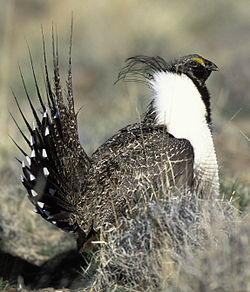
Adult male greater sage-grouse
Scientific classification Edit this classification
Kingdom: Animalia
Phylum: Chordata
Class: Aves
Order: Galliformes
Family: Phasianidae
Tribe: Tetraonini
Genus: Centrocercus
Swainson, 1832
Type species
Tetrao urophasianus[1]
Bonaparte, 1827
Species
Greater sage and Gunnison grouse ranges[2][3]

Sage-grouse are grouse belonging to the bird genus Centrocercus. The genus includes two species: the Gunnison grouse (Centrocercus minimus) and the greater sage-grouse (Centrocercus urophasianus). These birds are distributed throughout large portions of the north-central and Western United States, as well as the Canadian provinces of Alberta and Saskatchewan.[4] The International Union for Conservation of Nature classified the C. minimus species as endangered in 2020[5] and C. urophasianus as near threatened in 2016.[6]

Names

[edit]

The specific epithet is from another Greek word, oura, plus phasianos, pheasant. The noun "pheasant" was originally applied to a bird that was native to the valley of the Phasis River (now the Rioni River), which is located in Georgia. In the time of Lewis and Clark, the word "pheasant" stood for "a genus of gallinaceous birds", according to lexicographer Noah Webster (1806), and the explorers often used it in that sense. "Gallinaceous" then referred to "domestic fowls, or the gallinae"; the family Galliformes (Latin "gallus", cock, and "forma", shape) now includes pheasants, grouse, turkeys, quail, and all domestic chickens.

Sage grouse are also collectively known as "sagehen", "sage grouse", "sage cock", "sage chicken", or "cock of the plains."[7]

History

[edit]

Sage grouse have been widely recognized in Native American culture for some time. [8] The animals were a part of pre-columbian diets and were represented in certain traditional ceremonies, as well. Indeed, Sage Grouse previously inhabited most of what became the western United States, with ranges in 16 different states.[9]

In their day, Lewis and Clark were credited with the discovery of five gallinaceous birds in addition to the sage grouse—the Columbian sharp-tailed grouse, the dusky grouse, Franklin's grouse, the Oregon ruffed grouse, and the mountain quail; they were the first to widely spread knowledge about these birds to European settlers.[10]

US military issues

[edit]

In September 2016, the National Defense Authorization Act (NDAA) stalled in Congress because President Trump indicated he would not let the annual NDAA proceed to a vote in the House of Representatives unless it contained language to bar the sage grouse from the federal endangered species list until at least 2025. President Trump threatened a veto over the issue that Trump, Senate Armed Services Committee Chairman, believed would be sustained. Current US Air Force spending on sage grouse conservation is around US$200,000, with eight known military installations having confirmed grouse populations: Dugway Proving Ground and Tooele Army Depot in Utah; Sheridan Training Area and Camp Guernsey in Wyoming; Hawthorne Army Depot and Nellis Air Force Base in Nevada; Yakima Training Center in Washington, and Mountain Home Air Force Base in Idaho.[11]

Species

[edit]

There are two species:

Genus Centrocercus Swainson, 1832 – two species
Common name Scientific name and subspecies Range Size and ecology IUCN status and estimated population
Gunnison sage-grouse


Male
{{{image2-alt}}}
Female

Centrocercus minimus
Young, Braun, C, Oyler-McCance, Hupp & Quinn, 2000
southwestern Colorado and extreme southeastern Utah
Map of range
Size:

Habitat:

Diet:
 EN 


Greater sage-grouse


Male
{{{image2-alt}}}
Female

Centrocercus urophasianus
(Bonaparte, 1827)

Two subspecies
  • C. u. urophasianus
  • C. u. phaios
western United States and southern Alberta and Saskatchewan, Canada.
Map of range
Size:

Habitat:

Diet:
 VU 


The Mono Basin population may represent a third species.

Anatomical features

[edit]

Males of C. urophasianus are the largest grouse from temperate North America, attaining a maximum weight of 3.2 kilograms (7 lb). Adults have a long, pointed tail and legs with feathers to the toes. As in most Galliformes, there is pronounced sexual dimorphism.[citation needed]

Courtship and mating

[edit]

Centrocercus species are notable for their elaborate courtship rituals. Each spring males congregate on leks and perform a "strutting display." The male puffs up a large, whitish air sack on its chest, makes a soft drumming noise, and struts around with his tail feathers displayed and air sack puffed up. Groups of females observe these displays and select the most attractive males to mate with. Only a few males do most of the breeding. Males perform on leks for several hours in the early morning and evening during the spring months between February and April. Leks are generally open areas adjacent to dense sagebrush stands, and the same lek may be used by grouse for decades.[12]

Offspring

[edit]

Hens build nests and lay and incubate their eggs under the cover of sagebrush. The hen uses grass and forbs between patches of sagebrush for additional cover. During incubation, female Sand Grouse undertake recesses, where they leave the nest to undertake self-maintenance activities, thought these recess activities are typically within 250 m of the nest. [13]

Chicks can walk as soon as they are hatched and are able to fly short distances within two weeks. Within five weeks they are able to fly longer distances.

Conservation status

[edit]

Populations of sage grouse are in decline due to environment loss and decline of the pristine plains environments it requires to mate. The sage grouse is found in significant numbers within only half of the states comprising its original territories. The Biodiversity Conservation Alliance and other organizations have petitioned to list the grouse under the Endangered Species Act.

In March 2010 the U.S. Fish and Wildlife Service (USFWS) concluded that greater sage-grouse are warranted for protection as "threatened" under the U.S. federal Endangered Species Act (ESA). However the USFWS also concluded that immediate listing was "precluded" by higher listing priorities for other jeopardized species. Thus they designated the species a "Level 8 Candidate" for addition to the list of threatened species at some future date. Their finding is being litigated by groups contending the species should immediately receive protections under the ESA.

The Agricultural Research Service (ARS) of the United States Department of Agriculture (USDA) investigated some of the reasons for the declining sage-grouse population. Researchers observed cattle who share grazing land with the sage-grouse. They found that cattle, after consuming about 40% of the tussocks in between sagebrush bushes, will continue to consume the tussocks growing underneath the sagebrush, thereby destroying the nesting habitat for the sage-grouse.[14] In order to preserve the population of sage-grouse, ranchers can monitor the rate at which cattle consume the tussocks in between sagebrush bushes. Once cattle have consumed around 40% of the tussocks in between bushes, researchers ask that ranchers move their cattle to new grazing trail.

GPS trackers show that sage grouse congregate in small areas with certain resources, rather than being widely spread.[15]

US federal conservation plans have been met with lawsuits from wildlife organizations.[16]

On December 6, 2018, according to the New York Times:[17]

The Trump administration on Thursday published documents detailing its plan to roll back Obama-era protections for the vast habitat of the greater sage grouse, a chickenlike bird that roams across nearly 11 million acres [4.5 million hectares] in 10 oil-rich Western states.

The earlier proposal to protect the bird, whose waning numbers have brought it close to endangerment, was put forth under the Interior Department in 2015 and set out to ban or sharply reduce oil and gas drilling in 10.7 million acres [4.3 million hectares] of its habitat.

The Trump plan, by contrast, would limit the grouse’s protected habitat to just 1.8 million acres [730,000 hectares], essentially opening up 9 million acres [3.6 million hectares] of land to drilling, mining and other development.

As a mascot

[edit]

The sagehen is the mascot of the Pomona-Pitzer Sagehens, the joint athletics program for Pomona College and Pitzer College, two of the Claremont Colleges.[18][19]

References

[edit]
[edit]
Revisions and contributorsEdit on WikipediaRead on Wikipedia
from Grokipedia
Centrocercus is a genus of large, ground-dwelling grouse in the family Phasianidae, consisting of two extant species: the greater sage-grouse (C. urophasianus) and the Gunnison sage-grouse (C. minimus), both endemic to sagebrush-dominated landscapes of western North America. These birds are characterized by their chunky bodies, long pointed tails, and strong reliance on Artemisia sagebrush species for foraging, shelter, and nesting, with males exhibiting pronounced sexual dimorphism and inflatable yellow air sacs used in courtship. The greater sage-grouse, the larger of the two, inhabits vast sagebrush steppe from southern Alberta and Saskatchewan through the western United States to northern Arizona and New Mexico, while the Gunnison sage-grouse occupies a more restricted range in southwestern Colorado and southeastern Utah. Both species engage in lek mating systems, where males gather on communal display grounds to perform synchronized strut displays, vocalizations, and posturing to attract females, a behavior that underscores their evolutionary adaptation to open habitats. Populations of Centrocercus species have declined significantly since European settlement, primarily due to habitat fragmentation and loss from agricultural conversion, energy extraction, altered fire regimes, and invasive grasses, though proactive management has stabilized greater sage-grouse numbers in some areas without federal endangered listing. The Gunnison sage-grouse faces greater peril, with its range reduced to less than 10% of historical extent and ongoing threats prompting consideration for threatened status under the Endangered Species Act. Conservation efforts emphasize preserving contiguous sagebrush mosaics, as empirical data link population viability to large, unfragmented habitats rather than politically driven narratives.

Taxonomy and Nomenclature

Etymology

The genus name Centrocercus is derived from the Ancient Greek words kéntron (κέντρον), meaning "spine," "prick," or "point," and kérkos (κέρκος), meaning "tail," referring to the sharp, pointed tail feathers prominently featured in the males' courtship displays. This nomenclature highlights a key morphological trait distinguishing the genus from other grouse. The common name "sage-grouse" originates from the birds' ecological dependence on sagebrush (Artemisia spp.) for foraging, shelter, and nesting in the sagebrush steppe ecosystems of western North America. Early European-American observers, including Meriwether Lewis and William Clark, documented the species during their 1805 expedition near the continental divide, noting its occurrence amid extensive sagebrush stands and dubbing it the "cock of the plain" or "prairie cock" in reference to its habitat and robust form. These accounts preceded formal scientific description but underscored the habitat linkage central to the vernacular name.

Species Classification

The genus Centrocercus includes two extant species of sage-grouse: the greater sage-grouse (C. urophasianus), the type species described by Samuel F. Baird in 1852, and the Gunnison sage-grouse (C. minimus), formally described as a distinct species in 2000. These species are distinguished by morphological, genetic, and behavioral differences, with the greater sage-grouse exhibiting larger body size and broader tail feathers compared to the more compact form of the Gunnison sage-grouse. The greater sage-grouse occupies a wide range across sagebrush ecosystems in 11 western U.S. states—California, Colorado, Idaho, Montana, Nevada, North Dakota, Oregon, South Dakota, Utah, Washington, and Wyoming—and southern portions of Alberta and Saskatchewan in Canada. In contrast, the Gunnison sage-grouse is geographically restricted to seven counties in southwestern Colorado and one county in extreme southeastern Utah, reflecting its more limited historical distribution. Prior to 2000, the Gunnison population was classified as a subspecies (C. urophasianus minimus) of the greater sage-grouse, but taxonomic reevaluation based on mitochondrial DNA sequencing revealed significant genetic divergence, minimal gene flow, and reproductive isolation between the populations. This evidence, combined with differences in plumage patterns, lek display behaviors, and vocalizations, led the American Ornithologists' Union to recognize C. minimus as a full species, resolving prior debates over its status.

Phylogenetic Relationships

Centrocercus belongs to the subfamily Tetraoninae within the family Phasianidae and order Galliformes, a classification supported by mitochondrial and nuclear DNA analyses that place it among the Holarctic grouse and ptarmigan clade. Within Tetraoninae, molecular phylogenies consistently recover Centrocercus as part of a North American prairie grouse radiation, forming a clade with Tympanuchus (prairie-chickens) and sometimes Dendragapus (blue grouse), distinct from Eurasian forest-dwelling tetraonines like Tetrao and Lagopus. This positioning reflects shared synapomorphies such as lekking behavior and open-habitat adaptations, though early restriction fragment length polymorphism studies suggested deeper separation, a view superseded by multi-locus sequencing data. Fossil-calibrated molecular clocks estimate the divergence of Centrocercus from Tympanuchus at approximately 5 million years ago during the late Miocene to early Pliocene, coinciding with intensified aridification in western North America that expanded sagebrush-dominated steppes. This temporal framework aligns with genomic evidence of gene flow and shared polymorphisms among prairie grouse, indicating incomplete lineage sorting rather than recent hybridization as the primary driver of similarity. The evolution of specialized traits, such as cecal fermentation for detoxifying terpenes in Artemisia sagebrush, likely arose post-divergence as causal responses to these habitat shifts, enabling ecological niche specialization absent in woodland relatives. The fossil record for Centrocercus is sparse, with direct remains limited to Quaternary deposits, such as radiocarbon-dated bones from late Pleistocene sites in the Great Basin, providing minimal insight into ancestral forms. Indirect evidence points to Miocene ancestors among undifferentiated prairie-like phasianids in North America, where unconfirmed early to middle Miocene fossils suggest the Tetraoninae radiation originated in response to grassland expansion and cooling climates, though precise attribution to Centrocercus precursors remains tentative due to fragmentary osteology. This paucity underscores reliance on molecular data for reconstructing phylogeny, highlighting how Miocene aridification causally promoted speciation through habitat fragmentation and dietary pressures.

Physical Characteristics

Anatomical Features

Centrocercus species display a large-bodied, ground-oriented morphology adapted to sagebrush-dominated habitats, with adults weighing 0.9–2.0 kg for females and 2.0–3.2 kg for males, yielding a total range of approximately 2–7 pounds. The body is chunky and rounded, featuring a proportionally small head, short stout legs, and broad feet that support efficient walking and scratching on open terrain. These traits emphasize terrestrial specialization over flight capability, with wings rounded but rarely used for sustained travel. The digestive tract reflects specialization for consuming fibrous sagebrush leaves, which comprise much of the diet; unlike seed-eating galliformes, sage-grouse possess a non-muscular gizzard lacking the ability to grind hard items and do not ingest gizzard stones. Instead, digestion relies on a capacious crop for storage, acidic proventriculus secretions, and extensive cecal fermentation by symbiotic microbes to detoxify terpenes and degrade cellulose in tough foliage. This physiological configuration enables year-round folivory despite the plant's chemical defenses. Males exhibit distinctive structures including paired inflatable yellow esophageal sacs derived from the esophagus, sharp-pointed tail feathers with spiny tips, and prominent yellow supraorbital combs overlying the eyes. Filoplumes extend from the nape, contributing to the overall feathering. These features are integral to the species' morphology, varying slightly between C. urophasianus and the smaller C. minimus. Plumage provides crypsis against sagebrush backdrops, consisting of mottled gray, brown, and buff tones on the upperparts and sides, with darker underparts for both sexes. White or pale undertail coverts contrast subtly, aiding concealment in sparse vegetation. Feathering extends onto the legs, insulating against cold arid conditions.

Sexual Dimorphism and Plumage

Centrocercus species, including the greater sage-grouse (C. urophasianus) and Gunnison sage-grouse (C. minimus), display marked sexual dimorphism in size and plumage, with males averaging 35–50% heavier than females; adult males typically weigh 2.0–3.0 kg and measure 65–75 cm in length, while females weigh 1.0–1.8 kg and measure 50–60 cm. This size disparity emerges early in juveniles and intensifies with maturity, reflecting sexual selection pressures in lek-based mating systems. Male plumage features exaggerated traits adapted for visual signaling, including bright yellow subgular air sacs, vivid yellow lores surrounding the eyes, a white ruff of feathers on the neck, and elongated, stiff central tail feathers forming a pointed, spiny fan. In contrast, females exhibit cryptic, barred brown-gray plumage that provides concealment during nesting and brood-rearing, with less pronounced coloration overall. Both sexes undergo a complete prebasic molt after the breeding season, during which males shed ornamental structures like the air sacs and filoplumes, aligning with elevated energy demands for feather replacement and body maintenance. Field studies link male dimorphic traits to reproductive outcomes in leks, where phenotypic attributes such as tail feather morphology and plumage markings correlate positively with mating success; for instance, in greater sage-grouse, males with specific strut display traits and secondary sexual characteristics sire more offspring. In Gunnison sage-grouse, analogous traits show similar correlations, though overall body size is reduced compared to conspecifics, underscoring the role of sexual selection in maintaining dimorphism despite population-level variations. Female plumage crypsis, meanwhile, empirically supports higher nest survival rates by reducing detection by predators.

Habitat and Distribution

Geographic Range

The Greater Sage-Grouse (Centrocercus urophasianus) historically occupied approximately 1,200,483 km² of presettlement habitat across sagebrush ecosystems in western North America, spanning portions of 13 U.S. states and 3 Canadian provinces from southeastern Alberta and Saskatchewan southward to eastern Washington, Oregon, California, Nevada, Utah, Colorado, Wyoming, Montana, Idaho, and into New Mexico. Currently, its range has contracted to about 668,412 km², fragmented across 11 western U.S. states including Washington, Oregon, California, Nevada, Idaho, Utah, Montana, Wyoming, Colorado, and others, with extirpations noted in peripheral areas through lek monitoring data collected since the mid-20th century. The Gunnison Sage-Grouse (Centrocercus minimus), a species endemic to the southern periphery of the sagebrush belt, historically ranged over roughly 46,521 km² in southwestern Colorado, southeastern Utah, and possibly adjacent parts of Arizona and New Mexico, distributed patchily across up to 22 counties in Colorado. Its current distribution is severely restricted to approximately 4,787 km², primarily in seven isolated populations in southwest Colorado and a small area in southeast Utah, characterized by discrete leks separated by unsuitable terrain. Range overlap between the two Centrocercus species is minimal, confined to transitional zones in southern Wyoming and northern Colorado where historical distributions marginally intersected, though contemporary populations remain largely allopatric due to fragmentation patterns observed in lek surveys dating back to the 1950s and intensifying in the late 20th century. Fossil and subfossil evidence indicates post-glacial expansion of sage-grouse lineages across the Great Basin and intermountain west following the Pleistocene, with 20th-century range contractions substantiated by serial lek counts revealing peripheral lek abandonments.

Habitat Requirements

Centrocercus species, comprising the greater sage-grouse (C. urophasianus) and Gunnison sage-grouse (C. minimus), are obligate residents of sagebrush steppe ecosystems, where big sagebrush (Artemisia tridentata) dominates and fulfills core requirements for forage, thermal cover, and nesting substrate. These birds depend on contiguous stands of Wyoming big sagebrush or similar subspecies, typically with 15-38% canopy cover for nesting and early brood cover, as lower densities reduce concealment from predators while excessive cover impedes mobility. Dietary needs center on big sagebrush, which constitutes 70-100% of annual intake, providing essential nutrients and hydration, especially during winter when herbaceous alternatives are unavailable or snow-covered. Hens select pre-nesting sites with intermixed taller sagebrush (40-80 cm) at 15-25% cover to access emerging forbs, transitioning to mesic meadows or wet areas post-hatching for succulent forbs and arthropods critical to chick survival in their first weeks. Lekking arenas demand open, flat terrains such as ridges, benches, or valley floors with short vegetation for acoustic and visual signaling, often adjacent to sagebrush edges exceeding 15% cover to facilitate female approach and male post-display foraging. These sites range from 0.5-4 hectares, prioritizing visibility over dense shrubbery to minimize obstruction during courtship. Habitat suitability spans elevations of 1,200-2,750 meters (4,000-9,000 feet), with populations showing sensitivity to fragmentation; intact patches below approximately 2,000 hectares (5,000 acres) correlate with reduced lek persistence and nesting success in Gunnison sage-grouse studies, underscoring the need for expansive, unfragmented mosaics to support seasonal movements and genetic connectivity.

Ecology and Behavior

Foraging and Diet

Greater sage-grouse (Centrocercus urophasianus) and Gunnison sage-grouse (C. minimus) rely primarily on the leaves of sagebrush (Artemisia spp.) as their dominant food source year-round, comprising up to 95% or more of the diet during winter months when other vegetation is scarce. This herbaceous reliance provides essential energy and cover but requires physiological adaptations to counter the plant's high terpene content, which acts as a chemical defense against herbivores. In spring and summer, adults supplement sagebrush with forbs, flowers, buds, and invertebrates such as ants (Formicidae), beetles (Coleoptera), and grasshoppers, which contribute protein and reduce dependence on low-nutrient foliage. Invertebrates constitute a minor portion (around 2%) of adult diets even in these seasons, serving more to balance nutrition than replace sagebrush. Daily foraging involves consuming 10-20% of body weight in vegetation, influencing energy allocation for thermoregulation and movement in arid habitats. Chicks exhibit pronounced dietary shifts, with invertebrates dominating early brood requirements for rapid growth; studies indicate arthropods (primarily beetles, ants, and caterpillars) form nearly 100% of intake for the first 1-4 weeks post-hatch, declining as forbs increase. Brood-level diets, including hens, incorporate 30-50% invertebrates during peak rearing periods, as evidenced by stable isotope analysis of tissues reflecting higher protein sourcing from insects. Young sage-grouse up to three weeks old require approximately 15 grams of insects daily to support development, with reduced growth if access is limited. Sage-grouse possess enlarged ceca harboring specialized microbial communities that detoxify sagebrush terpenes and other secondary metabolites via enzymatic degradation, enabling efficient nutrient extraction from otherwise toxic forage. These bacteria produce volatile fatty acids and inhibit herbivore enzymes less effectively than in non-adapted species, supporting year-round sagebrush consumption without acute toxicity. Seasonal cecal volatile fatty acid levels peak in winter, correlating with exclusive sagebrush diets and lower bacterial diversity.

Daily and Seasonal Movements

Greater Sage-Grouse (Centrocercus urophasianus) typically maintain small daily movement ranges within core habitat areas, with males traveling up to 1.8 km between leks and feeding or resting sites during the breeding season. Telemetry studies reveal that individuals remain largely sedentary during non-migratory periods, confining routine activities to areas often less than 1 square mile, as evidenced by GPS location clusters in contiguous sagebrush landscapes. Seasonal patterns vary by population, with non-migratory groups using overlapping ranges year-round, while partial migrants undertake elevational shifts, descending to lower winter habitats for snow-free sagebrush access; in Utah, average nest-to-winter distances reach 11.77 km, with maxima exceeding 40 km. Longer migrations occur in some regions, averaging 15-48 km between summer and winter ranges or up to 100 miles in extreme cases like Montana populations, driven by forage availability and topography. Gunnison Sage-Grouse (Centrocercus minimus) exhibit more restricted movements overall, reflecting fragmented habitats that limit dispersal; daily ranges mirror those of the greater species, remaining small and localized within home areas. Seasonal shifts are generally limited and nonmigratory in many populations, with fall and early winter descents from higher-elevation breeding sites to lower, protected valleys prompted by snow depth accumulation, though specific distances average under 10 km based on radio-tracking observations. GPS and VHF telemetry confirm high site fidelity, particularly among adults, with juveniles showing modest dispersal but rarely exceeding localized bounds due to habitat barriers.

Social Organization

Outside the breeding season, Centrocercus species, including the greater sage-grouse (C. urophasianus) and Gunnison sage-grouse (C. minimus), form loose winter flocks typically numbering 10 to 100 individuals, often segregated by sex. These aggregations support anti-predator strategies via increased vigilance and confusion of predators, as well as enhanced foraging through shared information on sagebrush patches exposed above snow. Flock formation correlates with availability of high-quality forage, such as sagebrush with 10-30% canopy cover protruding 25-35 cm above snow, rather than solely density-dependent factors like population size. As spring approaches, these flocks disintegrate, with males dispersing into pairs or solitary individuals en route to display grounds, while females generally maintain solitary behavior to minimize competition for resources ahead of nesting. Male groups feature linear dominance hierarchies established through agonistic fights and displays, prioritizing access to preferred foraging areas and reducing intra-sexual conflict. Such hierarchies reflect causal advantages in resource defense, with dominant males securing better nutritional status for subsequent energy demands. Females, by contrast, exhibit minimal social structuring outside winter flocks and brood attendance, foraging independently to optimize energy intake in patchy habitats.

Reproduction and Life Cycle

Courtship Displays

Males of Centrocercus species, including the greater sage-grouse (C. urophasianus) and Gunnison sage-grouse (C. minimus), congregate on communal leks typically comprising 20 to 100 individuals to perform courtship displays during the breeding season. These leks form in open sagebrush habitats, facilitating visual and acoustic signaling over distances. Displays primarily occur in the pre-dawn hours from late winter through spring, peaking between March and May, with males arriving before sunrise to establish territories and initiate strutting behaviors. The strut display involves a coordinated sequence of movements: males erect and fan their pointed tail feathers to expose white terminal tips, rapidly flutter or strum wings over stiffened breast feathers to generate mechanical whirring or swishing sounds, and inflate prominent yellow subgular air sacs while producing popping and cooing vocalizations through air expulsion and syringeal mechanisms. These actions create a multimodal signal combining visual exaggeration of body size via air sac inflation and auditory cues, with the tail fan enhancing individual recognition through pattern variation. The "spit-shaking" component refers to the vibratory expulsion from air sacs, manifesting as sharp popping noises that punctuate the display. Strut rates serve as proxies for male vigor, as sustained high-frequency repetition demands substantial energetic investment tied to physiological condition. Acoustic elements of the display, such as coos and pops, feature fundamental frequencies in the 300–600 Hz range, which propagate effectively over long distances in open, low-vegetation habitats due to minimal attenuation of low-frequency sounds. Spectrographic analyses reveal directional radiation patterns, with coos projecting anteriorly to reach observing females positioned at lek peripheries, while mechanical swishes span broader spectra up to several kHz for close-range sensory integration. This biomechanical configuration optimizes signal detection in sparse sagebrush environments, where visual cues may be obscured but low-frequency acoustics carry reliably, underpinning the evolutionary efficacy of lekking for mate attraction.

Mating Systems

Sage-grouse (Centrocercus spp.) exhibit a classic lek-based polygynous mating system, characterized by males aggregating at communal display grounds (leks) to court females, with no subsequent pair bonding or paternal care. Females typically mate with a single dominant male per clutch, resulting in low rates of multiple paternity; genetic analyses of greater sage-grouse (C. urophasianus) clutches revealed multiple fathers in only 7.9% of cases (15 of 191 clutches), with 92.1% showing single paternity. Observational data confirm that a small proportion of dominant males—often the top 2–5% on a lek—account for the majority of copulations, skewing reproductive success heavily toward central, vigorous individuals while peripheral males rarely sire offspring. This extreme polygyny reduces effective population size, as evidenced by genetic studies showing that while 45.9% of sampled adult males in C. urophasianus populations fathered at least one brood annually, most sired only one, with few monopolizing multiple broods across females. The persistence of heritable variation in male display traits despite intense female preference—the "lek paradox"—challenges simplistic models of directional sexual selection, which predict rapid fixation of preferred alleles. Empirical resolution favors mechanisms like good-genes indicators, where traits signal heritable viability; in sage-grouse, vigorous display performance correlates with sires producing offspring of higher fledging success, suggesting indirect genetic benefits to choosy females rather than arbitrary runaway escalation alone. Condition-dependent expression of traits captures underlying genetic variance for fitness, maintaining polymorphism under fluctuating environmental pressures, including parasite loads invoked by Red Queen dynamics observed in lekking grouse. In Gunnison sage-grouse (C. minimus), leks are notably smaller (typically 10–20 males versus 50+ in C. urophasianus), potentially elevating multiple paternity rates due to reduced male competition and increased female discretion across fewer options, though direct genetic confirmation remains limited compared to the greater species. Dominant males still monopolize most copulations, mirroring the polygynous skew, but smaller arena sizes may facilitate higher intraspecific nest parasitism or remating, contributing to marginally less extreme effective population sizes relative to the greater sage-grouse.

Nesting and Offspring

Females of Centrocercus species construct simple ground nests, typically shallow scrapes lined with feathers and plant debris, concealed under sagebrush (Artemisia spp.) cover for camouflage against predators. Clutch sizes range from 6 to 13 eggs, with averages of 7-9 reported across studies; incubation, performed solely by the female, lasts 27-29 days. Upon hatching, chicks are precocial, covered in down, and capable of following the hen from the nest within 24 hours, though they remain dependent on her for brooding and protection during early development. Apparent nest success rates vary from 15% to 40% annually, with predation accounting for the majority of failures, as documented in radio-telemetry monitoring of marked hens. Common predators include mammalian carnivores and corvids, whose access is influenced by nest-site vegetation structure; success declines as incubation progresses due to increased exposure risks. Following hatch, female-only parental care continues, with no male involvement, as brood-rearing hens lead chicks to habitats richer in forbs and insects to meet the high-protein demands of rapidly growing young. Chick survival to late summer or fall averages 20-30% in radio-collared cohorts, constrained by predation, starvation, and environmental stressors, though rates fluctuate yearly based on weather and forage availability. Hens select brood-rearing areas with shorter vegetation heights (under 15 cm) and diverse understory plants supporting insect prey, shifting from denser nesting sagebrush to facilitate foraging and predator evasion. This investment pattern reflects adaptation to variable arid environments, prioritizing quantity over intensive care per offspring.

Population Dynamics and Threats

Prior to European settlement, Greater Sage-Grouse (Centrocercus urophasianus) s were estimated at approximately 1.1 million individuals across their historical range spanning about 1.2 million km² of in western . By the early , settlement-related conversion had reduced occupied range to roughly 56% of presettlement extent, correlating with substantial decreases, though precise counts were to anecdotal observations rather than systematic surveys. Systematic lek counts, initiated in the 1930s but more consistently from the 1960s onward, provide the primary verifiable data on abundance trends; these peak male counts at breeding leks serve as indices of breeding population size, with over 108,000 observations across thousands of leks by 2023. From 1966 to 2021, range-wide lek data indicated an average annual decline of 2.8%, culminating in an approximately 80% reduction since 1965, yielding estimated total populations of 200,000–500,000 by the 2010s. Following regulated hunting closures and restrictions starting in the 1950s across most states, lek trends showed continued declines into the 2000s, with no reversal attributable to harvest reductions alone. For Gunnison Sage-Grouse (Centrocercus minimus), lek monitoring established in the 1990s estimated total populations at 4,000–5,000 individuals, primarily in southwestern Colorado, with relative stability in core areas despite variability in satellite populations. Annual lek counts through the 2010s revealed slight declines in some units (e.g., running averages dropping below 1,600 males by 2020), but overall numbers remained within the 3,000–5,000 range, without evidence that post-1950s hunting regulations—largely prohibiting harvest—prevented observed fluctuations. Range-wide analyses, including 2024 USGS reviews of lek data through 2023, document persistent declines for Greater Sage-Grouse but note short-term increases in male counts during 2022–2023 following a 2021 nadir, suggesting potential stabilization in select managed clusters amid ongoing monitoring. These trends underscore the value of lek-based indices over modeled extrapolations for tracking verifiable changes, as absolute population censuses remain challenging due to the species' cryptic behavior and vast habitats.

Primary Threats

The primary threats to populations of Centrocercus urophasianus (greater sage-grouse) and C. minimus (Gunnison sage-grouse) stem from habitat loss and fragmentation within the sagebrush ecosystem, which constitutes essential cover, forage, and nesting substrate for both species. Conversion of native sagebrush to agricultural croplands has eliminated habitat across substantial portions of the historic range, with tillage and cultivation accounting for approximately 38% of documented sagebrush losses on public lands in recent decades. Energy development, particularly oil and gas extraction, introduces infrastructure such as well pads and roads that fragment leks and brood-rearing areas; empirical data indicate sage-grouse avoid areas with development densities exceeding one well pad within 2 km of leks, with effects extending to 3-4 km and correlating with lek abandonment rates up to 40% in high-density fields. Altered fire regimes exacerbate habitat degradation, as invasion by exotic annual grasses (e.g., Bromus tectorum) creates continuous fine fuels that shorten fire return intervals from historic levels of 60-110 years to 3-5 years in affected areas, preventing sagebrush regeneration and amplifying loss through repeated burns. For C. minimus, small and isolated populations—confined to seven units in Colorado and Utah totaling fewer than 5,000 individuals—experience amplified genetic risks, with effective population sizes below thresholds that induce inbreeding depression, evidenced by reduced hatching success rates averaging 43% compared to 47% in greater sage-grouse. Encroachment by native conifers such as pinyon-juniper further displaces sagebrush, with even low tree cover (1.5-4%) prompting habitat avoidance and nest site abandonment in sage-grouse. Population modeling and lek count analyses attribute the majority of observed declines—rangewide reductions of 80% since 1965—to these habitat factors rather than biological agents like predation, as habitat metrics consistently explain greater proportions of variance in trends across empirical studies.

Predation and Disease

Predation constitutes a significant biological mortality factor for Centrocercus species, with nest failure rates often exceeding 50%, primarily due to depredation by mammalian and avian predators. Common nest predators include coyotes (Canis latrans), raptors such as ferruginous hawks (Buteo regalis) and golden eagles (Aquila chrysaetos), and corvids like common ravens (Corvus corax), which collectively account for 50-70% of nest losses based on telemetry and eggshell DNA analyses across multiple studies in sagebrush ecosystems. Nest success improves in areas with dense sagebrush and grass cover, which enhances concealment and reduces detectability, though overall rates remain low even in optimal habitats. Adult survival for greater sage-grouse (C. urophasianus) averages 60-80% annually, with predation responsible for 50-80% of confirmed mortalities in radiomarked individuals, particularly during breeding and brood-rearing seasons when birds are more exposed. Mammalian carnivores and raptors dominate causes, but survival rates increase in intact habitats where visual barriers limit predator efficiency, as evidenced by lower predation indices in unfragmented sagebrush stands. Experimental predator removals, such as targeted culling of coyotes and ravens, have shown minimal to no sustained increases in adult or juvenile survival, supporting the compensatory mortality hypothesis wherein predation acts as a density-dependent regulator rather than an additive force driving population declines. Among diseases, West Nile virus (Flavivirus) represents the most impactful acute pathogen since its emergence in sage-grouse populations around 2004, with epizootic outbreaks causing 10-30% mortality in affected leks and broods, as documented in Wyoming and Montana through serosurveys and necropsy data from 2003-2007. These events, peaking in late summer, reduced female survival by up to 25% in multi-year studies, though incidence varies with mosquito vector abundance tied to wetland conditions. No chronic infectious diseases, such as bacterial or parasitic conditions, dominate necropsy findings or long-term tagging data; while haemosporidians and other parasites occur, they rarely exceed incidental levels and do not correlate with widespread mortality patterns.

Conservation Efforts

Regulatory Status

The greater sage-grouse (Centrocercus urophasianus) was determined by the U.S. Fish and Wildlife Service (USFWS) not to warrant listing under the Endangered Species Act (ESA) in a 12-month finding published on October 2, 2015, concluding that ongoing state-led and federal conservation efforts had sufficiently mitigated threats across its range. This decision followed a 2010 warranted-but-precluded finding and relied on landscape-level plans developed by 11 western states, which prioritize protection of key habitats such as lek complexes and seasonal use areas, collectively addressing conservation needs without federal listing. The species was subsequently removed from the ESA candidate list, with judicial reviews upholding the non-listing determination, including a 2019 federal court ruling affirming the adequacy of the 2015 management framework. In contrast, the Gunnison sage-grouse (Centrocercus minimus) was listed as threatened under the ESA effective December 22, 2014, based on assessments of persistent habitat fragmentation, small population sizes, and inadequate regulatory mechanisms at the time. Federal protections include restrictions on take and requirements for habitat conservation on public lands, supplemented by a 2024 Bureau of Land Management (BLM) resource management plan amendment that designates additional priority habitats and buffers around leks to support recovery objectives. Internationally, the greater sage-grouse is classified as Near Threatened by the International Union for Conservation of Nature (IUCN), reflecting range-wide declines but acknowledging stabilizing factors from habitat protections, though assessments note challenges in baseline data for lek persistence that could affect future evaluations. State-level regulations in core range areas, such as lek disturbance setbacks and habitat mitigation, continue to play a primary role in averting broader federal intervention for the greater sage-grouse, emphasizing localized management over national ESA oversight.

Management Strategies

Habitat restoration efforts prioritize sagebrush recovery after wildfires, a primary driver of habitat loss for Centrocercus species, through seeding and planting initiatives. Post-fire seeding employs modified rangeland drills to broadcast big sagebrush (Artemisia tridentata) seeds, often combined with herbicide treatments to suppress invasive annual grasses like cheatgrass (Bromus tectorum), enhancing establishment rates in burned areas. Planted container-grown sagebrush seedlings, protected by caging against herbivory, demonstrate higher survival than direct seeding under average precipitation, requiring 3-4 years to achieve densities supportive of sage-grouse nesting habitat. These techniques are integrated into Bureau of Land Management (BLM) restoration projects across sagebrush ecosystems, focusing on strategic site selection based on pre-fire cover and soil conditions to accelerate recovery. Energy development mitigation relies on spatially explicit buffers around leks to limit disturbance, as outlined in the 2015 BLM and U.S. Forest Service land use plan amendments across 67 million acres of habitat. These plans mandate no-surface-occupancy buffers of 0.6 miles (1 km) for leks in priority areas, expanding to 2 miles (3.2 km) for seasonal habitats during critical periods like lekking and nesting, with exceptions granted through rigorous review processes involving industry and state agencies. Voluntary candidate conservation agreements with energy operators further enforce these buffers, prioritizing lek avoidance and habitat connectivity over prescriptive federal mandates. Population augmentation for the Gunnison sage-grouse (C. minimus) involves translocation of wild-caught adults and broods from source populations to isolated units, with programs active since the early 2000s to bolster small groups at risk of local extirpation. Efforts target age and sex ratios favoring yearling females for higher post-release survival and recruitment, conducted under rangewide conservation plans coordinated by state wildlife agencies and BLM. Hunting management adapts quotas annually to lek count data, as in Idaho where 2024 permit allocations followed a 22% increase in male attendance, ensuring harvest aligns with population trends while maintaining recreational access. BLM's 2024 plan amendments shift emphasis to adaptive monitoring frameworks, including lek surveys and habitat metrics, to guide interventions without Endangered Species Act listing, enabling compatible land uses that sustain economic sectors like grazing and energy on public lands. These strategies, developed through multi-stakeholder collaborations among states, federal agencies, and industry, balance conservation with $90 billion in annual economic contributions from western rangelands.

Successes and Challenges

Conservation easements have stabilized sage-grouse leks in key areas of Wyoming and Montana by protecting millions of acres of core habitat from development and conversion, with initiatives like the Sage Grouse Initiative enrolling over 9.7 million acres through NRCS programs as of 2023. In Wyoming, policy protections for high-abundance core areas combined with easements have maintained population levels by reducing potential losses by up to 80% in targeted investments. For Gunnison sage-grouse, translocations into isolated populations have reversed declines, with post-release survival and recruitment enabling metapopulation persistence, including documented increases in augmented areas approaching 20-25% in recent monitoring. Persistent challenges include incomplete compliance on private lands, which comprise a substantial portion of the range and often lack enforced habitat protections, leading to fragmentation despite voluntary incentives. Altered fire regimes exacerbate this, as invasive annual grasses fuel larger, more frequent wildfires that hinder sagebrush recovery even after seeding and treatment efforts, particularly in low-resilience sites where post-fire habitat suitability remains poor for years. Voluntary conservation frameworks have delivered economic benefits by averting Endangered Species Act listing restrictions, which could have imposed billions in annual compliance costs across western states through curtailed land uses, while promoting rancher-led stewardship that sustains working landscapes. These approaches demonstrate that targeted, incentive-based measures can yield measurable population stability without the regulatory burdens of federal mandates, though sustained monitoring is required to address ongoing habitat stressors.

Human Interactions

Historical Uses

Native American tribes inhabiting sagebrush ecosystems harvested Centrocercus species for subsistence, utilizing the birds primarily for food and feathers in traditional practices. Tribes such as the Eastern Shoshone and others employed methods including communal drives and decoys to capture grouse during lekking seasons, with ethnographic records indicating sustainable yields that did not appreciably diminish populations prior to European contact. Feathers from sage grouse were incorporated into regalia and ceremonies, reflecting the bird's cultural integration without evidence of systematic overharvest in pre-colonial archaeological assemblages. Explorers Meriwether Lewis and William Clark documented abundant sage grouse populations during their 1805 expedition across the western interior, observing flocks and collecting specimens near the Continental Divide and Columbia River basin. Their journals describe the birds as numerous in sagebrush habitats, with hunters procuring them for camp provisions, underscoring the species' prevalence before widespread settler impacts. These accounts, corroborated by later natural history surveys, indicate that indigenous and early expeditionary harvests remained localized and did not precipitate range-wide declines. In the 19th century, Euro-American market hunting intensified exploitation, with commercial hunters shipping sage grouse to urban markets in quantities that locally depleted flocks in accessible areas of Wyoming, Montana, and Idaho by the 1880s. Harvest logs from state game wardens, though sparse, record annual takes exceeding 100,000 birds in peak years before regulatory closures, contributing to patchy population reductions prior to dominant habitat conversion via agriculture and grazing. However, analyses of lek count data and settler narratives reveal no substantiation for overexploitation as the primary driver of genus-wide contraction, attributing sustained abundance in remote ranges to limited access rather than harvest pressure alone.

Hunting and Harvest

Regulated sport hunting of Greater Sage-Grouse (Centrocercus urophasianus) occurs in seven western states—Idaho, Montana, Nevada, North Dakota, Oregon, South Dakota, and Wyoming—with seasons typically spanning 2 to 7 days and daily bag limits of 1 to 2 birds per hunter since regulatory reforms in the mid-20th century. Possession limits are set at 2 to 3 birds, and seasons often open in September or October to target post-breeding dispersal while avoiding lekking periods. These quotas are determined annually based on lek count data and population models to maintain harvest below sustainable thresholds. Annual harvest of Greater Sage-Grouse averages several thousand birds across open states, with state-specific caps designed to limit take to under 10% of estimated fall populations in management zones. Population models and recovery analyses indicate this regulated harvest constitutes less than 1% of total abundance and does not drive overall declines, which are primarily attributed to habitat fragmentation rather than hunting pressure. Hunters support monitoring efforts by voluntarily submitting wings from harvested birds at "wing-bee" events, providing data on age ratios, sex composition, and reproductive success for refining population estimates and season recommendations. In Oregon, for instance, such submissions have exceeded 30,000 wings since 1980, integrating with lek surveys to track productivity trends. These contributions enable agencies to detect variations in juvenile survival and adjust quotas accordingly. Hunting generates economic benefits through license fees, travel expenditures, and related activities, contributing millions annually to state wildlife funds via federal excise taxes under the Pittman-Robertson Act, which bolsters habitat management. For Gunnison Sage-Grouse (Centrocercus minimus), hunting has been prohibited since 2000 in Colorado's primary populations and since 1989 in Utah, following recognition of its restricted range and subsequent federal threatened listing, thereby concentrating any residual harvest on Greater Sage-Grouse stocks.

Military and Land Use Conflicts

The Nevada Test and Training Range in Nevada supports Greater Sage-Grouse habitat, including active leks utilized during breeding seasons. Military operations incorporate protocols to minimize disturbances, such as restricting low-altitude overflights and ground activities near leks during peak courtship periods from March to May, and coordinating with wildlife monitoring to avoid direct impacts from bombing or live-fire exercises. Assessments of these practices have not linked them to measurable population declines in the local subpopulation. Dugway Proving Ground in Utah overlaps with Gunnison Sage-Grouse range, where chemical and munitions testing has contributed to habitat fragmentation through infrastructure development and restricted access zones. In response, the U.S. Army has implemented mitigation measures, including habitat enhancement projects, surveys coordinated with state wildlife agencies, and efforts to maintain connectivity via protected corridors adjacent to active testing areas. Population monitoring on Department of Defense installations, including those with sage-grouse, indicates relative stability in lek attendance and occupancy compared to adjacent non-military lands, where private development, energy extraction, and unregulated grazing exert greater pressures. This contrast arises from military lands' exclusion of commercial activities, enabling incidental conservation benefits despite training demands, and challenges assumptions favoring uniform restrictions over site-specific accommodations.

Cultural and Symbolic Role

The greater sage-grouse has been adopted as the mascot "Cecil the Sagehen" by Pomona College in Claremont, California, with the nickname first documented in a 1913 issue of the student newspaper The Student Life, linking the bird to the local sagebrush habitat and athletic spirit. This association persists in Pomona-Pitzer athletics, where the grouse symbolizes regional identity without direct ties to utilitarian uses. Among Indigenous peoples of the western United States, sage-grouse appear in oral traditions, songs, and dances as elements of ecological and seasonal narratives. The Shoshone term "Sisk-a-dee" for the bird denotes the rhythm of life, reflected in cultural artworks blending grouse lek dances with tribal motifs, such as those titled after "The Month When the Sage Hen Dance." Nez Perce elder Wilson Wewa recounted stories featuring the grouse aiding grieving women, embedding the species in lore tied to seasonal cycles rather than anthropomorphic reverence. In broader Western American symbolism, sage-grouse embody sagebrush rangelands and open landscapes, serving as motifs in art and literature that evoke the region's unmodified expanses. Conservation campaigns leverage the bird's lekking displays as an icon for habitat integrity, yet this role sparks contention when symbolic appeals prioritize preservation over evidence-based management accommodating grazing or energy development. Such debates highlight tensions between the grouse's emblematic value and pragmatic assessments of population viability amid habitat fragmentation.

References

Add your contribution
Related Hubs
User Avatar
No comments yet.