
Recent from talks
Lake Lugano
Knowledge base stats:
Talk channels stats:
Members stats:
Lake Lugano
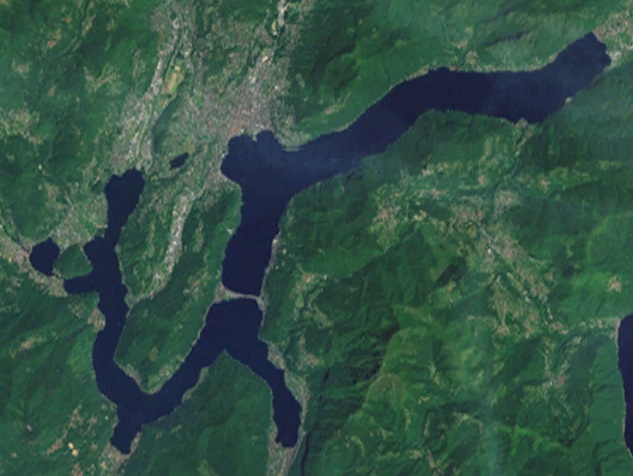
Lake Lugano (Italian: Lago di Lugano or Ceresio, from Latin: Ceresius lacus; Lombard: Lagh de Lugan) is a glacial lake which is situated on the border between southern Switzerland and northern Italy. The lake, named after the city of Lugano, is situated between Lake Como and Lago Maggiore. It was cited for the first time by Gregory of Tours in 590 with the name Ceresio, a name which is said to have derived from the Latin word cerasus, meaning cherry, and refers to the abundance of cherry trees which at one time adorned the shores of the lake. The lake appears in documents in 804 under the name Laco Luanasco.
There are various mountains and tourist destinations on the shores of the lake including Monte Brè to the east, Monte San Salvatore west of Lugano, and Monte Generoso on the south-eastern shore. The World Heritage Site Monte San Giorgio is situated south of the lake. Also located to the south is the Cinque Vette Park.
The lake is drained by the Tresa, which empties into Lake Maggiore, the latter being drained by the Ticino and the Po.
The first certain testimony of a political body governing the shores of the lake is from 818. Occupying an area of strategic importance, the lake was then part of the feudal dominion of the County of Sperio. Circa 1000, it came under the control of the Bishop of Como. The region was the site of the war between Como and Milan over control of Alpine traffic from 1218 to 1227. As the lake and its shores became progressively incorporated into the Duchy of Milan they became the subject of political and territorial contention during the 15th century, and Lugano became the lake's main town.
The lake definitively ceased to belong to a single sovereign political entity following the establishment of the transalpine bailiwicks of the Swiss cantons at the beginning of the 16th century. The Italian-Swiss border was fixed in 1752 by the Treaty of Varese, and has since remained virtually unchanged.
In 1848, the Melide causeway was built on a moraine between Melide and Bissone, in order to carry a road across the lake and provide a direct connection between Lugano and Chiasso. Today the causeway also carries the Gotthard railway and the A2 motorway.
The lake is 48.7 km2 (18.8 sq mi) in size, 63% of which is in Switzerland and 37% in Italy. It has an average width of roughly 1 km (0.62 mi) and a maximum width of about 3 km (1.9 mi) at the bay of Lugano. A maximum depth of 288 m (945 ft) is found in the northern basin. The culminating point of the lake's drainage basin is the Pizzo di Gino summit in the Lugano Prealps (2,245 m; 7,365 ft). Bathing in the lake is allowed at any of the 50 or so bathing establishments located along the Swiss shores.
The Italian exclave of Campione d'Italia and parts of the waters of the lake are considered by European Customs Law as non-territorial for fiscal purposes and as such enjoy a special tax status as a duty-free area, exemption from EU VAT and offer residents other advantageous tax privileges.
Hub AI
Lake Lugano AI simulator
(@Lake Lugano_simulator)
Lake Lugano
Lake Lugano (Italian: Lago di Lugano or Ceresio, from Latin: Ceresius lacus; Lombard: Lagh de Lugan) is a glacial lake which is situated on the border between southern Switzerland and northern Italy. The lake, named after the city of Lugano, is situated between Lake Como and Lago Maggiore. It was cited for the first time by Gregory of Tours in 590 with the name Ceresio, a name which is said to have derived from the Latin word cerasus, meaning cherry, and refers to the abundance of cherry trees which at one time adorned the shores of the lake. The lake appears in documents in 804 under the name Laco Luanasco.
There are various mountains and tourist destinations on the shores of the lake including Monte Brè to the east, Monte San Salvatore west of Lugano, and Monte Generoso on the south-eastern shore. The World Heritage Site Monte San Giorgio is situated south of the lake. Also located to the south is the Cinque Vette Park.
The lake is drained by the Tresa, which empties into Lake Maggiore, the latter being drained by the Ticino and the Po.
The first certain testimony of a political body governing the shores of the lake is from 818. Occupying an area of strategic importance, the lake was then part of the feudal dominion of the County of Sperio. Circa 1000, it came under the control of the Bishop of Como. The region was the site of the war between Como and Milan over control of Alpine traffic from 1218 to 1227. As the lake and its shores became progressively incorporated into the Duchy of Milan they became the subject of political and territorial contention during the 15th century, and Lugano became the lake's main town.
The lake definitively ceased to belong to a single sovereign political entity following the establishment of the transalpine bailiwicks of the Swiss cantons at the beginning of the 16th century. The Italian-Swiss border was fixed in 1752 by the Treaty of Varese, and has since remained virtually unchanged.
In 1848, the Melide causeway was built on a moraine between Melide and Bissone, in order to carry a road across the lake and provide a direct connection between Lugano and Chiasso. Today the causeway also carries the Gotthard railway and the A2 motorway.
The lake is 48.7 km2 (18.8 sq mi) in size, 63% of which is in Switzerland and 37% in Italy. It has an average width of roughly 1 km (0.62 mi) and a maximum width of about 3 km (1.9 mi) at the bay of Lugano. A maximum depth of 288 m (945 ft) is found in the northern basin. The culminating point of the lake's drainage basin is the Pizzo di Gino summit in the Lugano Prealps (2,245 m; 7,365 ft). Bathing in the lake is allowed at any of the 50 or so bathing establishments located along the Swiss shores.
The Italian exclave of Campione d'Italia and parts of the waters of the lake are considered by European Customs Law as non-territorial for fiscal purposes and as such enjoy a special tax status as a duty-free area, exemption from EU VAT and offer residents other advantageous tax privileges.
Recent media