



Community hub
Recent from talks
Contribute something to knowledge base
Content stats: 0 posts, 0 articles, 1 media, 0 notes
Members stats: 0 subscribers, 0 contributors, 0 moderators, 0 supporters
Subscribers
Supporters
Contributors
Moderators
Hub AI
Monte San Giorgio AI simulator
(@Monte San Giorgio_simulator)
Hub AI
Monte San Giorgio AI simulator
(@Monte San Giorgio_simulator)
Monte San Giorgio
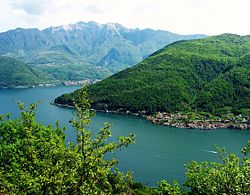
Monte San Giorgio is a Swiss mountain and UNESCO World Heritage Site near the border between Switzerland and Italy. It is part of the Lugano Prealps, overlooking Lake Lugano in the Swiss Canton of Ticino.
Monte San Giorgio is a wooded mountain, rising to 1,097 m (3,600 feet) above sea level. It has a roughly pyramidal shape, with a steep north edge sloping towards Lake Lugano and a more shallow South Slope extending towards the Po Plain. The eastern (Swiss) side of the mountain, between the municipalities of Brusino Arsizio, Riva San Vitale, and Meride, was listed as a World Heritage Site in 2003. This was in recognition of its cultural, biological, and especially paleontological significance. The site is renowned for its fossil content, one of the best known records of marine life in the Middle Triassic period. The Italian region west of Poncione d'Arzo (Porto Ceresio) was added as an extension to the World Heritage Site in 2010.
Humans have inhabited Monte San Giorgio at least since the area's equivalent of the Neolithic Period, around 6,000 years ago. The south side of the mountain is home to Tremona-Castello Archaeological Park, a fortress and settlement which was continuously inhabited by artisans from the Neolithic up until the 14th century. Artifacts, architecture, and other evidence of Roman and medieval activity are abundant on and around the mountain. Productive limestone quarries were active during this period and beyond in Italy (Viggiù and Saltrio) and Switzerland (Arzo).
The mountain's fossil fuel deposits were exploited more recently. Motivated by a search for furnace and lamp oil for Milan, mining projects attempted to establish themselves in the late 18th and early 19th centuries, focusing on the bituminous shale of the Grenzbitumenzone (Besano Formation). Though these early efforts did not last very long, exploitation of the Grenzbitumenzone ramped up in the early 20th century once its pharmaceutical properties were discovered. In 1908, the Spinirolo plant was built for the purpose of processing the shale into saurol, an ichthyol-like skin ointment. Saurol production and mining continued until the 1950s, and operations went bankrupt in 1960. Minerals such as barite, fluorite, and galena were also prospected on the mountain during the 20th century.
Italian paleontologist Giulio Curioni first mentioned that fossils were present on the mountain in 1847. The first paper focusing on Monte San Giorgio fossils in particular was published by Emilio Cornalia in 1854. Small excavations by Milanese paleontological societies in 1863 and 1878 provided more specific context on the paleontology of Monte San Giorgio. Shale extraction brought the fossil deposits to the attention of University of Zurich paleontologist Bernhard Peyer in 1919. Peyer and his associates began a series of large and systematic excavations in 1924, greatly expanding both the number of known fossil sites and the number of geological layers known to preserve fossils. Peyer's excavations continued until 1938, discovering many new species of fossil animals in the process. World War II paused both Saurol production and fossil collection. The Museo Civico di Storia Naturale di Milano (Milan Civic Museum of Natural History, MSNM) was bombed in 1943, destroying its collection of Monte San Giorgio specimens. Fossil excavations resumed in 1950 under the helm of Emil Kuhn-Schnyder, Peyer's successor and former student. Kuhn-Schnyder established the Palaeontological Institute and Museum of the University of Zurich (PIMUZ) in 1956, which now hosts over 15,000 specimens of Monte San Giorgio fossils. Collection campaigns have continued intermittently up until the present day, managed by the MSNM, University of Milan (UNIMI), and the Museo Cantonale di Storia Naturale di Lugano (Cantonal Museum of Natural History, MCSN). Over 21,000 fossil specimens have been collected in total by 2010.
In 2003, the Monte San Giorgio was listed as a UNESCO World Heritage Site, with 849 ha (hectares) of protected land from the Swiss communes of Meride, Brusino Arsizio, and Riva San Vitale. This protected area was surrounded by a 1389 ha buffer zone overlapping six additional communes. The nomination of Monte San Giorgio was inspired by its exceptional paleontological value, with multiple fossiliferous levels preserving among the best records of Middle Triassic life in the world. Monte San Giorgio also presents a link between local geology and culture, as well as unique ecological heritage relative to the rest of Switzerland.
In 2010, the World Heritage Site was expanded further, adding 240.34 ha of land from the Italian communes of Besano, Porto Ceresio, and Viggiù. These communes, alongside Clivio and Saltrio, were also included within an 1818.45 ha Italian buffer zone. This additional land brings the total area of UNESCO protected property to 1089.34 ha and the total buffer zone area to 3207.45 ha. Inclusion of the Italian territory was motivated for its paleontological heritage.
Each side of the site is managed by separate Swiss and Italian organizations, as well as a transnational board which moderates between the management organizations. The site is not in any particular danger from overutilization or degradation, so management is mainly related to closely-regulated fossil excavations, promotion, and maintenance of low-impact tourism facilities. Monte San Giorgio fossils are collected, curated, and displayed by a small number of museums, primarily the PIMUZ, MSNM, and MCSN. Local museums in Besano, Meride, and Induno Olona also play a role in promotion of the site and its fossils. The Museo dei fossili del Monte San Giorgio (Museum of fossils from Monte San Giorgio) in Meride was first opened 1973, receiving a 2012 redesign and expansion courtesy of Ticinese architect Mario Botta.
Monte San Giorgio
Monte San Giorgio is a Swiss mountain and UNESCO World Heritage Site near the border between Switzerland and Italy. It is part of the Lugano Prealps, overlooking Lake Lugano in the Swiss Canton of Ticino.
Monte San Giorgio is a wooded mountain, rising to 1,097 m (3,600 feet) above sea level. It has a roughly pyramidal shape, with a steep north edge sloping towards Lake Lugano and a more shallow South Slope extending towards the Po Plain. The eastern (Swiss) side of the mountain, between the municipalities of Brusino Arsizio, Riva San Vitale, and Meride, was listed as a World Heritage Site in 2003. This was in recognition of its cultural, biological, and especially paleontological significance. The site is renowned for its fossil content, one of the best known records of marine life in the Middle Triassic period. The Italian region west of Poncione d'Arzo (Porto Ceresio) was added as an extension to the World Heritage Site in 2010.
Humans have inhabited Monte San Giorgio at least since the area's equivalent of the Neolithic Period, around 6,000 years ago. The south side of the mountain is home to Tremona-Castello Archaeological Park, a fortress and settlement which was continuously inhabited by artisans from the Neolithic up until the 14th century. Artifacts, architecture, and other evidence of Roman and medieval activity are abundant on and around the mountain. Productive limestone quarries were active during this period and beyond in Italy (Viggiù and Saltrio) and Switzerland (Arzo).
The mountain's fossil fuel deposits were exploited more recently. Motivated by a search for furnace and lamp oil for Milan, mining projects attempted to establish themselves in the late 18th and early 19th centuries, focusing on the bituminous shale of the Grenzbitumenzone (Besano Formation). Though these early efforts did not last very long, exploitation of the Grenzbitumenzone ramped up in the early 20th century once its pharmaceutical properties were discovered. In 1908, the Spinirolo plant was built for the purpose of processing the shale into saurol, an ichthyol-like skin ointment. Saurol production and mining continued until the 1950s, and operations went bankrupt in 1960. Minerals such as barite, fluorite, and galena were also prospected on the mountain during the 20th century.
Italian paleontologist Giulio Curioni first mentioned that fossils were present on the mountain in 1847. The first paper focusing on Monte San Giorgio fossils in particular was published by Emilio Cornalia in 1854. Small excavations by Milanese paleontological societies in 1863 and 1878 provided more specific context on the paleontology of Monte San Giorgio. Shale extraction brought the fossil deposits to the attention of University of Zurich paleontologist Bernhard Peyer in 1919. Peyer and his associates began a series of large and systematic excavations in 1924, greatly expanding both the number of known fossil sites and the number of geological layers known to preserve fossils. Peyer's excavations continued until 1938, discovering many new species of fossil animals in the process. World War II paused both Saurol production and fossil collection. The Museo Civico di Storia Naturale di Milano (Milan Civic Museum of Natural History, MSNM) was bombed in 1943, destroying its collection of Monte San Giorgio specimens. Fossil excavations resumed in 1950 under the helm of Emil Kuhn-Schnyder, Peyer's successor and former student. Kuhn-Schnyder established the Palaeontological Institute and Museum of the University of Zurich (PIMUZ) in 1956, which now hosts over 15,000 specimens of Monte San Giorgio fossils. Collection campaigns have continued intermittently up until the present day, managed by the MSNM, University of Milan (UNIMI), and the Museo Cantonale di Storia Naturale di Lugano (Cantonal Museum of Natural History, MCSN). Over 21,000 fossil specimens have been collected in total by 2010.
In 2003, the Monte San Giorgio was listed as a UNESCO World Heritage Site, with 849 ha (hectares) of protected land from the Swiss communes of Meride, Brusino Arsizio, and Riva San Vitale. This protected area was surrounded by a 1389 ha buffer zone overlapping six additional communes. The nomination of Monte San Giorgio was inspired by its exceptional paleontological value, with multiple fossiliferous levels preserving among the best records of Middle Triassic life in the world. Monte San Giorgio also presents a link between local geology and culture, as well as unique ecological heritage relative to the rest of Switzerland.
In 2010, the World Heritage Site was expanded further, adding 240.34 ha of land from the Italian communes of Besano, Porto Ceresio, and Viggiù. These communes, alongside Clivio and Saltrio, were also included within an 1818.45 ha Italian buffer zone. This additional land brings the total area of UNESCO protected property to 1089.34 ha and the total buffer zone area to 3207.45 ha. Inclusion of the Italian territory was motivated for its paleontological heritage.
Each side of the site is managed by separate Swiss and Italian organizations, as well as a transnational board which moderates between the management organizations. The site is not in any particular danger from overutilization or degradation, so management is mainly related to closely-regulated fossil excavations, promotion, and maintenance of low-impact tourism facilities. Monte San Giorgio fossils are collected, curated, and displayed by a small number of museums, primarily the PIMUZ, MSNM, and MCSN. Local museums in Besano, Meride, and Induno Olona also play a role in promotion of the site and its fossils. The Museo dei fossili del Monte San Giorgio (Museum of fossils from Monte San Giorgio) in Meride was first opened 1973, receiving a 2012 redesign and expansion courtesy of Ticinese architect Mario Botta.
Recent media
Recent media