Hubbry Logo
Chez PanisseChez PanisseMain
Open search
Chez Panisse
Community hub
Chez Panisse
logo
8 pages, 0 posts
0 subscribers
Be the first to start a discussion here.
Chez Panisse
Chez Panisse
from Wikipedia

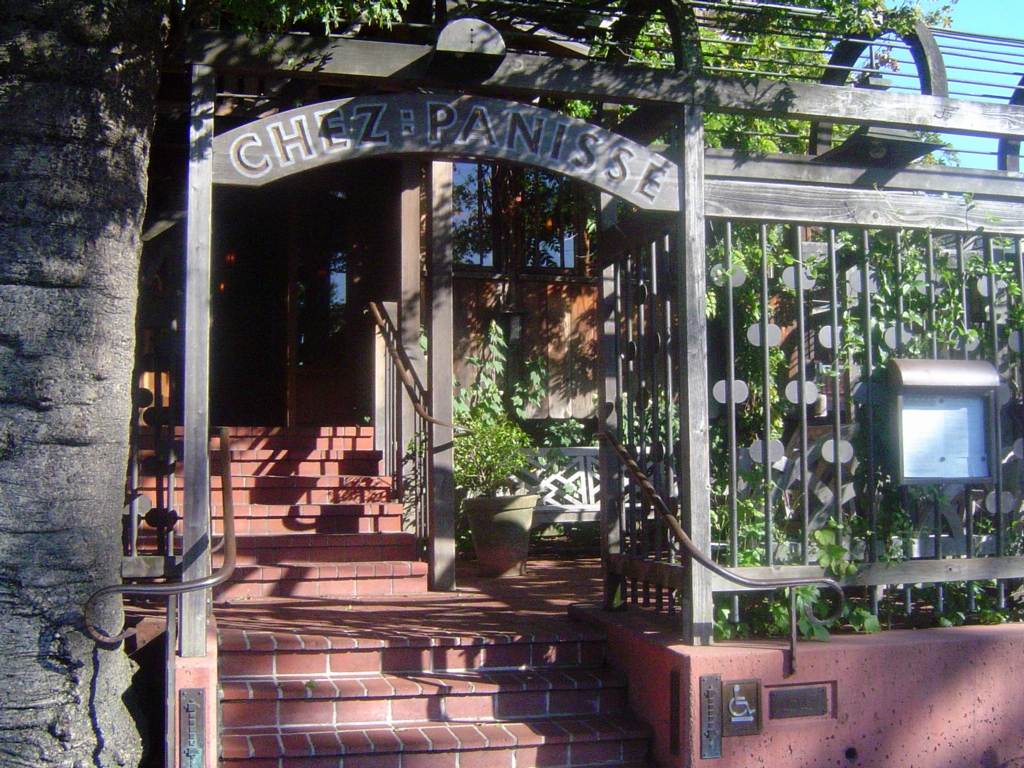
Chez Panisse is a Berkeley, California, restaurant, known as one of the originators of California cuisine and the farm-to-table movement, opened and owned by Alice Waters. The restaurant emphasizes ingredients rather than technique and has developed a supply network of direct relationships with local farmers, ranchers, and dairies.

Key Information

The main restaurant, located downstairs, serves a set menu that changes daily and reflects the season's produce.[1] An upstairs cafe offers an a la carte menu at lower prices.

History

[edit]

The restaurateur, author, and food activist Alice Waters opened Chez Panisse in 1971 with the film producer Paul Aratow, then a professor of comparative literature at the University of California, Berkeley. It is named for a character in Marcel Pagnol's Marseille Trilogy [fr].[2][3] They set up the restaurant and its menu on the principle that it was of primary importance to use food that was fresh and in season, grown locally, organically and sustainably.

Victoria Wise was the first chef.[4][5] Waters and the restaurant began building up their network of local producers. Many of these local farmers, ranchers, and dairies continue to provide the restaurant with the majority of its ingredients today.[3][6] This approach was extremely innovative.[7] Later chefs de cuisine were Jeremiah Tower and Paul Bertolli and Jean-Pierre Moulle. The building was remodeled twice following fires in 1982 and 2013.[8]

Influences

[edit]
The Chez Panisse downstairs kitchen and dining room

The culinary influences for Chez Panisse were largely French, inspired by the 1920s cookbook of French cuisine bourgeoise, La bonne cuisine de Madame E. Saint-Ange. This book has been translated into English by Paul Aratow, who was also the first chef de cuisine at Chez Panisse. Waters, who had been an exchange student in France in the early 1960s, was influenced by French food-related values and customs, including buying local produce and frugality in avoiding waste.[9] Other influences included vineyard owners Lulu and Lucien Peyraud and the writings of Richard Olney and Elizabeth David.

Critical reception

[edit]

In 2001, Gourmet magazine named Chez Panisse the Best Restaurant in America.[10] From 2002 to 2008 it was ranked by Restaurant magazine as one of the top 50 restaurants in the world and was ranked number 12 in 2003.[a][b][c] Michelin awarded the restaurant a one-star rating in its guide to San Francisco Bay Area dining from 2006 through 2009, but the restaurant lost its star in 2010.[13][14] In 2007, Alice Waters won Restaurant Magazine's Lifetime Achievement Award, and was cited as one of the most influential figures in American cooking over the past 50 years.[15]

Culinary innovations

[edit]

Artwork and branding

[edit]

Berkeley designer and printmaker David Lance Goines has illustrated many of the Chez Panisse posters and defined the visual brand in the 1970s and 1980s.[19][20] The aesthetic for the brand was influenced by Ukiyo-e and the German Art Nouveau movement (German: Jugendstil).[20]

Patricia Curtan has been the designer and artist of many of the menus and some of the cookbooks for Chez Panisse, which were created as linocut prints.[21] Curtan published the book Menus for Chez Panisse (2011).[22][23]

Notable alumni

[edit]

Cookbooks

[edit]
  • Waters, Alice (1982). The Chez Panisse Menu Cookbook. New York: Random House. ISBN 978-0-394-51787-2.
  • Bertolli, Paul; Waters, Alice (1994). Chez Panisse Cooking. New York: Random House. ISBN 978-0-679-75535-7.
  • Shere, Lindsey Remolif (1994). Chez Panisse Desserts. New York: Random House. ISBN 9780679755715.
  • Waters, Alice (1996). Chez Panisse Vegetables. New York: HarperCollins. ISBN 978-0-06-017147-6.
  • Waters, Alice (1999). Chez Panisse Café Cookbook. New York: HarperCollins. ISBN 978-0-06-017583-2.
  • Waters, Alice (2002). Chez Panisse Fruit. New York: HarperCollins. ISBN 978-0-06-019957-9.
  • Waters, Alice; Curtan, Patricia; Labro, Martine (2011). Chez Panisse Pasta, Pizza & Calzone. New York: Random House. ISBN 978-0-394-53094-9.
  • Waters, Alice (2011). 40 Years of Chez Panisse: The Power of Gathering. New York: Clarkson Potter/Publishers. ISBN 978-0-307-71826-6.

See also

[edit]

References

[edit]
[edit]
Revisions and contributorsEdit on WikipediaRead on Wikipedia
from Grokipedia
Chez Panisse is a in , founded by in August 1971. It consists of an upstairs café serving à la carte pizzas, pastas, and that vary daily, and a downstairs dining room featuring a four-course prix-fixe that emphasizes seasonal ingredients sourced from local farms and producers. The establishment's philosophy prioritizes simplicity, freshness, and direct relationships with suppliers, drawing inspiration from French provincial cooking adapted to California produce. Widely regarded as a pioneer of , Chez Panisse helped establish the movement by insisting on organic, sustainably grown ingredients long before such practices became mainstream in . Its influence extends to training notable chefs like and , and it has earned accolades including a Green Star for in 2020 and the James Beard Foundation's Design Icon Award in 2020. However, the restaurant has drawn criticism for its high prices—often exceeding $150 per person for dinner—and for embodying an elitist approach to dining that prioritizes ideological purity over accessibility. In recent years, plans to expand with a new bar adjacent to the original site have sparked controversy among Berkeley residents concerned about increased traffic, noise, and disruption to the historic neighborhood. Despite such pushback, Chez Panisse remains a touchstone for locavore ethics and regional culinary innovation.

History

Founding and Early Years (1971–1980)

founded Chez Panisse on August 28, 1971, in a converted at 1517 Shattuck Avenue in , initially partnering with film producer and UC Berkeley professor Paul Aratow. , then 27 and a former Montessori teacher who had transferred to UC Berkeley in 1964, drew inspiration from her travels in , particularly , to create a restaurant emphasizing simple, ingredient-focused French provincial cooking amid the Bay Area's countercultural ferment. The opening menu featured baked in pastry, roast duck with olives, a green salad, and almond tart, served as a fixed-price, multi-course meal for $3.95, with no à la carte options. To launch the venture, Waters raised approximately $28,000 through unconventional loans from friends, family—including $10,000 from her parents—and even local drug dealers, supplemented by volunteer labor from acquaintances for renovations. Early operations centered on a daily-changing, prix-fixe prioritizing high-quality, seasonal ingredients sourced locally when possible, an approach that departed from the era's prevalent reliance on standardized, mass-produced foodstuffs and foreshadowed cuisine's emphasis on freshness over heavy sauces or elaborate techniques. This model faced logistical hurdles, including inconsistent supply chains for premium produce and proteins, but fostered an open-kitchen dynamic that encouraged collaboration between staff and diners, embedding innovation through direct feedback and experimentation. Throughout the 1970s, Chez Panisse navigated financial precarity as a small, ideologically driven operation in politically turbulent Berkeley, yet gained acclaim for elevating simple preparations of local bounty, such as wood-fired pizzas and vegetable-centric dishes, which influenced emerging chefs like . By 1980, to broaden accessibility and stabilize revenue, the restaurant added an upstairs café offering more casual, meals alongside the downstairs fixed-menu dining room, marking a pivotal without diluting its core commitment to seasonal sourcing. This expansion reflected pragmatic responses to operational demands while solidifying Chez Panisse's role in shifting American dining toward regional, sustainable practices.

Expansion and Institutionalization (1980s–2000s)

In 1980, Chez Panisse expanded by opening the upstairs , which provided a more casual dining option alongside the downstairs fixed-menu restaurant. This addition, launched on , introduced flexible menus featuring seasonal dishes like baked with garden lettuces and California-style pizzas from an in-house oven. The aimed to broaden accessibility while maintaining emphasis on local ingredients, helping stabilize operations amid earlier financial strains. Throughout the 1980s and 1990s, the restaurant's influence grew through its alumni network, with former chefs and staff establishing ventures like Acme Bakery by Steve Sullivan and Zuni Café under Judy Rodgers, disseminating Chez Panisse's ingredient-focused approach across the Bay Area and beyond. Publications reinforced this institutionalization: Alice Waters released The Chez Panisse Menu Cookbook in 1982, compiling seasonal recipes, followed by the Chez Panisse Café Cookbook in 1999, which earned an IACP award and further codified the restaurant's philosophy. By the mid-1990s, institutional efforts extended beyond cuisine, with Waters founding the Edible Schoolyard Project in 1995 at Middle School in Berkeley to integrate and cooking . This initiative, supported by the Chez Panisse Foundation established in 1996, promoted and school food , influencing policy discussions on organic meals. Under chefs like Paul Bertolli in the 1990s, menus incorporated rustic Italian elements such as spit-roasted pork, evolving the core model while prioritizing seasonal sourcing. These developments solidified Chez Panisse as a pivotal in American , emphasizing empirical sourcing over industrialized alternatives.

Recent Developments (2010s–2025)

In 2010, Chez Panisse lost its single star, which the restaurant had held since the guide's introduction to in 2007, amid critiques of inconsistent execution despite its historical influence. The restaurant marked its 40th anniversary in 2011 with events including dinners at the Berkeley Art Museum and nationwide collaborations tied to the Edible Schoolyard Project. Throughout the 2010s, Chez Panisse maintained its fixed-price format in the downstairs dining room and options upstairs, emphasizing seasonal ingredients from local suppliers, though it faced ongoing economic pressures from high operational costs in Berkeley. The COVID-19 pandemic forced Chez Panisse to close indoor dining in March 2020, shifting to takeout lunches, dinners, and limited Sunday suppers to sustain staff and farmers. Reopening plans were repeatedly delayed due to health concerns and staffing challenges, postponing from fall 2021 to early 2022. The dining room resumed operations on March 8, 2022, after a two-year hiatus, with adaptations including pooled tipping distributed directly to cooks and continued support for local producers through adjusted procurement. In 2021, Chez Panisse celebrated its 50th anniversary, highlighting its role in pioneering practices, though founder Alice Waters stated she had no plans to retire, viewing the concept as incompatible with her ongoing commitment. Post-reopening, the restaurant pursued expansion by acquiring the adjacent César space after its closure in July 2022, sparking neighborhood controversy over noise, parking, and preservation of the original site's character. In October 2025, detailed plans emerged for a new bar and casual dining concept called Bar Panisse in the expanded footprint, aiming to broaden accessibility while adhering to sustainable sourcing. In April 2025, Chez Panisse was omitted from the Chronicle's new Top 100 Bay Area restaurants list, alongside other high-profile establishments, reflecting shifts in critical evaluations toward newer or more innovative venues. Despite this, the restaurant continued operations under Waters' oversight, with no formal handover announced, prioritizing adaptations to post-pandemic economics and supply chain resilience.

Culinary Philosophy

Core Influences

The culinary philosophy of Chez Panisse was profoundly shaped by founder ' experiences in during the , where she encountered the ingredient-focused cooking of provincial bistros and the emphasis on fresh, market-sourced produce in regions like . , who studied abroad and immersed herself in cultures, was struck by the of dishes that highlighted natural flavors without elaborate sauces or techniques, a departure from the formal French prevalent in the U.S. at the time. This influence manifested in the restaurant's opening menu in August 1971, which drew directly from French traditions while prioritizing seasonality and quality over uniformity. A key aspect of these influences was the Mediterranean aesthetic of restraint and harmony, inspired by Waters' appreciation for rustic preparations that let ingredients speak for themselves, as seen in early dishes featuring grilled fish, fresh herbs, and vegetables simply dressed. Literary figures such as , whose works on cooking emphasized and minimal intervention, and , who advocated for authentic European home cooking, further informed Waters' approach, bridging traditional recipes with an intuitive, sensory-driven method. These elements rejected industrialized food systems, favoring instead a philosophy of beauty in edibility and connection to the land, which Waters adapted by forging relationships with Bay Area farmers to source hyper-local equivalents of French varietals. In adapting these European roots to , Chez Panisse pioneered a synthesis that became foundational to , blending French and broader Mediterranean techniques—such as wood-fired roasting and herb-infused preparations—with the state's abundant, diverse produce like heirloom tomatoes, wild greens, and Pacific . This evolution underscored a commitment to organic and sustainable practices, influenced by Waters' holistic view of food as intertwined with and community, though always grounded in the practical realities of flavor primacy over ideology. By 1973, with the hiring of chef , these influences expanded to incorporate more adventurous interpretations, yet retained the core tenet of deference to the ingredient's inherent qualities.

Innovations in Sourcing and Preparation

Chez Panisse pioneered the prioritization of locally sourced, seasonal ingredients in starting with its opening on August 28, 1971, when it shifted emphasis from imported staples to fresh, artisanal produce available from nearby urban gardeners, foragers, and niche markets such as wild mushrooms from Chinese and Japanese vendors. This approach created demand that encouraged farmers to cultivate high-quality, region-specific goods, laying groundwork for broader adoption. The restaurant restricts produce sourcing to within a 50-mile radius of Berkeley, favoring regenerative and biodynamic methods to ensure flavor intensity and . A primary supplier, Green String Farm in Sonoma operated by Bob Cannard, provides approximately three-quarters of its using soil-observant biodynamic techniques that minimize synthetic inputs and adapt to natural cues. Long-term supplier partnerships underscore this model, with academic analysis identifying 54 producers maintaining deliveries for over 20 years and 31 for more than 30 years as of the early , enabling consistent quality through shared knowledge and mutual adaptation. Menus explicitly name these farms and ranches, promoting transparency and incentivizing suppliers to innovate in response to restaurant feedback. In preparation, daily menus are constructed around the day's arrivals, rejecting fixed recipes in favor of techniques like , , or minimal seasoning that preserve ingredient integrity rather than masking flaws. This philosophy, articulated by as relying on "the best and tastiest ingredients" for "very simply" executed dishes, evolved from early French-inspired preparations—such as or duck with olives—to California-style s including wood-fired pizzas with local or salads featuring foraged greens, all calibrated to seasonal peaks. Such methods demanded direct chef-farmer , as former forager Sibella Kraus integrated visits into kitchen routines to inform technique adjustments for varietal nuances.

Evolution of Farm-to-Table Model

Upon its founding in 1971, Chez Panisse established a sourcing model centered on direct of the freshest, most flavorful seasonal ingredients from local Area farmers, diverging from the era's dominant reliance on uniform, industrially produced goods transported long distances. This approach, driven by ' emphasis on taste derived from ripe, varietally diverse produce, initially involved relationships with 14 farmers in the , prioritizing personal connections over volume. By the early , the restaurant employed foragers such as Sibella Kraus (1981–1984), who linked it to approximately 100 additional farms, expanding the network to 15 primarily crop-focused suppliers while introducing practices like menu attribution to specific producers for transparency and loyalty. A pivotal shift occurred in 1985 toward explicitly sustainable and organic ingredients, accelerating in the with supplier growth to 71 farms and active promotion of varieties like mixes and tomatoes through chef feedback. This era saw bidirectional influence: of 29 interviewed farmers, 18 modified production methods in response to restaurant demands, including 6 achieving and 8 experimenting with new crops to meet specifications for flavor and . Examples include suppliers converting to organic production at Waters' request around 2000 and hubs like Monterey Market facilitating connections that embedded social ties in the . Into the 2000s and , the network stabilized at 44 farms in the 2000s before expanding to 81 in the (70% crop-oriented), with 65% of 114 total suppliers located within 100 miles, averaging 76.2 miles—reinforcing locality amid fluctuating numbers. Practices evolved to include compost return to farmers and sustained advocacy, such as the 1995 Edible Schoolyard Project, which complemented internal sourcing by educating on , though the core model remained rooted in direct, feedback-driven relationships rather than scaled industrialization. This progression transformed initial taste-focused procurement into a resilient ecosystem where restaurant specifications causally advanced supplier without sole reliance on Chez Panisse for broader systemic change.

Operations and Business Model

The Chez Panisse Restaurant, located downstairs, operates with a fixed four-course prix fixe menu that changes daily to feature seasonal ingredients sourced from local producers. This format emphasizes the chef's selection without options, with the designed around available high-quality produce, seafood, and meats, typically progressing from an appetizer to a or main course, followed by a main protein and . Pricing for the four-course stands at $175 per person as of 2025, excluding beverages, tax, and a 17% service charge, though a three-course option is offered on Mondays for $135. Reservations, required well in advance, accommodate dietary needs like with prior notice, but the fixed structure limits customization. In contrast, the upstairs Café provides a more accessible menu that also rotates daily, offering dishes such as grilled salads, pizzas, pastas, and entrees priced from around $20 for starters to $35 or more for mains. Open for lunch Tuesday through Saturday and dinner Monday through Saturday, the Café serves as a casual counterpart to the downstairs experience, with a lively atmosphere suitable for walk-ins or easier bookings compared to the . Both venues share a single kitchen, ensuring consistency in ingredient-driven preparations focused on simplicity and freshness. The dining format reflects Chez Panisse's commitment to a structured yet adaptive approach, where the absence of printed menus in advance underscores reliance on immediate market conditions, though this has drawn occasional critiques for inflexibility in accommodating preferences. Service in the maintains a formal pace over several hours, fostering an intimate setting in the original dining room, while the Café allows for quicker, more varied pacing.

Supply Chain and Sustainability Claims

Chez Panisse's relies on direct relationships with small-scale farmers and producers, emphasizing of seasonal, organic, and minimally processed ingredients to minimize intermediaries and transport distances. The traces over 40 years of such sourcing, with continuity among suppliers documented through repeated partnerships that prioritize quality and flavor over standardized supply. Menus explicitly name these suppliers, a practice intended to build and incentivize farming methods among them. A key component is sourcing from biodynamic farms, such as that of Bob Cannard, which provides approximately 75% of the restaurant's produce using soil-focused regenerative techniques that avoid synthetic inputs. This approach aligns with claims of , including support for practices that enhance and , though third-party audits or quantitative reductions remain undocumented in public records. Sustainability assertions extend to broader advocacy, such as ' opposition to composted distribution by authorities in 2010, citing risks of chemical and microbial contaminants in purportedly organic materials. Empirical studies of the restaurant's influence suggest it has encouraged farmers to adopt more ecologically sound practices, but attribute limited causal impact on systemic changes, positioning Chez Panisse as one actor among multiple influences rather than a primary driver. Critiques of these claims highlight potential performative elements, with some observers noting that locavore sourcing, while reducing certain emissions, does not address issues or overall agricultural inefficiencies, and may overlook energy-intensive aspects of small-farm production. No comprehensive verification of full-menu local sourcing percentages exists, with produce heavily localized but proteins and other items drawing from regional networks without specified metrics.

Pricing, Management, and Economic Realities

Chez Panisse operates on a fixed-price format in its downstairs restaurant, with prices typically ranging from $135 to $175 per person as of 2024–2025, excluding beverages, a 10.25% , and a 17% service charge. The upstairs café offers options at lower individual item prices, such as $20 for salads, though full meals there approximate $50–$100 per person based on selections. These rates reflect the restaurant's emphasis on premium, seasonally sourced ingredients, which drive elevated costs compared to standard . Management at Chez Panisse features a collaborative, non-hierarchical structure atypical for high-end restaurants, fostering staff loyalty through shared decision-making and an "" approach involving farmers, suppliers, and cooks. , the founder and co-owner since 1971, maintains oversight but delegates daily operations to executive chefs and a core team, emphasizing quality over conventional business metrics. This "Berkeley-style" model prioritizes ideological commitment to sustainable sourcing, which Waters credits for resilience amid operational disruptions like the 2013 kitchen fire. Economically, the sustains viability through that offsets high ingredient and labor expenses, as Waters has noted a anything" for superior rather than on . Despite fixed menus limiting revenue flexibility and elevated costs from local, organic supply chains, Chez Panisse has endured for over five decades by leveraging reputation-driven rather than or cost-cutting. No public reveal consistent profitability margins, but the model's dependence on affluent and cultural cachet underscores vulnerabilities to economic downturns, as evidenced by partial closures during the —though recovery relied on pre-existing supplier networks rather than subsidies. This approach contrasts with scalable chains, prioritizing long-term ecosystem building over short-term fiscal optimization.

Reception

Acclaim and Awards

Chez Panisse has garnered significant recognition for its pioneering role in and sustainable dining practices. In 1992, the awarded it the Outstanding Restaurant designation, honoring its influence on American gastronomy. The same year, founder received the Outstanding Chef award for her work at the restaurant, marking her as the first woman to achieve this honor. In 2020, the foundation further acknowledged the venue with its Design Icon Award, recognizing the enduring architectural and aesthetic impact of its Berkeley location after five decades of operation. The restaurant earned a single star upon the guide's expansion to the Bay Area in , retaining it through before losing it in the 2011 edition, which reflected evolving criteria for consistency and innovation under 's evaluation standards. More recently, it received a Green Star starting in 2020 for its commitment to , an accolade it maintained in subsequent guides, including 2022, emphasizing environmental responsibility in sourcing and operations over traditional culinary excellence. Additional honors include placement among Gourmet magazine's top tables in San Francisco and Berkeley in 1998, underscoring its early prominence in fine dining rankings. In 2015, TripAdvisor's analysis of traveler reviews ranked it among the top 25 restaurants nationally, highlighting sustained public esteem. These awards collectively affirm Chez Panisse's foundational status in dining, though they often intertwine the institution's legacy with Waters' personal achievements.

Criticisms of Quality and Relevance

In 2019, San Francisco Chronicle critic described Chez Panisse as evoking a "fantasy" of idyllic dining that often fails to materialize in reality, critiquing the restaurant's simple, ingredient-focused approach and daily rotating menu for revealing executional drawbacks, such as inconsistent flavor depth and frustratingly vague server explanations of dishes. Ho's review highlighted specific instances where high-quality ingredients did not translate into cohesive or memorable meals, labeling the overall experience as stale despite the venue's storied reputation. This assessment echoed broader sentiments among diners and observers that the food, while using premium organic produce, can come across as delicately understated to the point of underwhelming, lacking the "wow" factor expected at prices exceeding $200 per person for the upstairs café and $300-plus for the downstairs fixed menu. Critics have also pointed to service inconsistencies and an aloof atmosphere that detract from the dining , with some accounts noting discomfort from seating and a perceived attitude of entitlement that prioritizes pedigree over hospitality. User reviews on platforms like and frequently describe meals as average or not particularly inventive relative to the cost, with complaints of overpricing for what amounts to competent but unexceptional California-style fare. Even long-time patrons have reported quality decline over decades; for instance, diners who praised visits in the found a 2015 return disappointing, suggesting that while technical proficiency persists in dishes like or lamb, the restaurant struggles to maintain peak innovation amid evolving culinary standards. Regarding relevance, Ho questioned in 2021 whether Chez Panisse's defining ""—centered on seasonal, local sourcing—remains distinct in an era where practices are ubiquitous across upscale dining, arguing that the model's foundational tenets now feel rote rather than revolutionary. As competitors have adopted and refined similar philosophies with greater diversity in technique and flavor profiles, Chez Panisse has been characterized by some as a preserved relic, influential historically but potentially stifling stylistic evolution in the Bay Area by dominating narratives around sustainable eating without adapting to contemporary demands for broader cultural fusion or affordability. This view posits that its rigid adherence to original principles, while ethically grounded, limits for diners seeking more dynamic or globally inflected interpretations of locality in 2020s cuisine.

Controversies

Expansion Disputes

In 2022, Chez Panisse announced plans to expand by converting the adjacent space at 1515 Shattuck Avenue in Berkeley—previously occupied by the independent bar César—into a new establishment called Bar Panisse. César, which had operated for 24 years since its opening in 1998, specialized in Spanish-style and was co-owned by restaurateurs including the late Richard Mazzera, who had ties to Chez Panisse's early history. The decision to terminate César's and repurpose the space drew immediate backlash from the local community, who viewed the move as an eviction of a beloved neighborhood institution to accommodate growth by the more upscale Chez Panisse. Protests erupted shortly after the January 2022 disclosure by Berkeleyside, with demonstrators accusing Chez Panisse of prioritizing expansion over preserving César's cultural role in Berkeley's dining scene. On March 9, 2022—the day Chez Panisse resumed indoor dining after pandemic restrictions—approximately 35 protesters gathered outside, holding signs reading "shame on Chez" and launching a Change.org petition that amassed around 3,000 signatures urging Alice Waters to "save César." César's closure proceeded in July 2022 following unsuccessful negotiations, amid claims from supporters that the bar had been a pioneer of accessible tapas in the area and a counterpoint to Chez Panisse's exclusivity. Critics argued the expansion exemplified gentrification pressures in Berkeley, displacing a longstanding tenant despite shared ownership history under the same property umbrella. Despite the opposition, which included calls for boycotts and public shaming, Chez Panisse advanced the project without public commentary from . Bar Panisse is conceptualized as a casual venue offering snacks such as potato chips and duck liver mousse, heartier options like , and a full —contrasting Chez Panisse's restriction to and wine. By 2025, city permit records indicated final inspections were complete, plywood coverings had been removed, and the space was prepared for opening, signaling resolution of logistical hurdles even as community resentment lingered. The episode highlighted tensions between preserving independent eateries and institutional expansion in a competitive urban food landscape.

Elitism and Cultural Critiques

Chez Panisse and its founder have endured longstanding accusations of elitism, centered on the restaurant's and advocacy for labor- and cost-intensive practices like sourcing exclusively local, organic ingredients, which critics contend alienate working-class diners and overlook systemic barriers to healthy eating. As of 2024, the upstairs restaurant's prix-fixe is priced at $175 per person, excluding beverages, tax, and a 17% service charge, rendering a full for two upwards of $400 before wine. This model, while influential in elevating ideals, has been faulted for embodying a form of culinary exclusivity that prioritizes sensual, small-batch experiences over scalable affordability, particularly as economic pressures intensified post-2008 , amplifying perceptions of detachment from everyday realities. Specific flashpoints underscore these charges: Waters' 2009 proposal to triple the U.S. federal school lunch budget from $9 billion to $27 billion for fresh, sustainable meals was decried as an imposition of standards on underfunded systems, ignoring practical constraints like distribution and regional . Similarly, the 2018 launch of a $250 hand-forged egg spoon for open-flame cooking—touted as a tool for "mindful" preparation—provoked backlash as a of indulgent irrelevance, with observers like labeling such accoutrements pretentious and disconnected from modern kitchens. Detractors, including food writers, argue Waters rarely caveats her prescriptions with acknowledgments of urban food deserts or income disparities, fostering an image of prescriptive idealism that dismisses cheaper, processed alternatives as inherently inferior without causal evidence of their net harm when nutritional baselines are met. Culturally, Chez Panisse is critiqued for perpetuating a rarified "preciousness" in American food discourse, where its emphasis on Provençal-inspired simplicity and seasonal purity has ossified into a formula stifling broader innovation and diversity in Bay Area gastronomy. A 2019 San Francisco Chronicle review by Soleil Ho characterized the restaurant as "stale," noting its cultural ideas—profitable for imitators—yet rigid adherence to 1970s aesthetics fails to evolve amid multicultural influences and casual dining trends, positioning it as a museum piece rather than a dynamic force. This extends to perceptions of Waters as a lightning rod for "Berkeley liberal elitism," where high-cultural food evangelism intersects with socioeconomic insulation, romanticizing peasant traditions without grappling with their historical context of necessity rather than choice, and arguably marginalizing non-European culinary narratives in the sustainable food canon. Waters has rebutted such views, insisting critiques misapprehend the core pursuit of nourishment over status, though empirical data on the model's downstream accessibility—such as rising organic produce costs averaging 20-50% premiums—lends weight to accessibility concerns.

Legacy

Notable Alumni

Chez Panisse has produced numerous influential chefs who advanced farm-to-table practices and regional American cooking. Jeremiah Tower served as head chef and partner from 1972 to 1978, pioneering elements of California cuisine during his tenure before opening the influential Stars restaurant in San Francisco in 1984, which emphasized fresh, local ingredients and casual fine dining. Judy Rodgers, after early collaboration with Alice Waters, became chef and owner of Zuni Café in San Francisco starting in 1987, where she developed iconic dishes like roast chicken with bread salad, earning widespread acclaim for her focus on simplicity and quality sourcing until her death in 2013. Deborah Madison worked as a prep and line cook in the late 1970s and mid-1980s, later founding Greens Restaurant in in 1979, the first vegetarian restaurant to emphasize seasonal, organic produce, and authoring multiple s such as Greens Cookbook (1987), which promoted vegetable-forward cooking. Paul Bertolli held the role of executive chef from 1982 to 1992, co-authoring Chez Panisse's first , before opening Oliveto in Oakland and founding Fra’ Mani Handcrafted Foods in 2006, specializing in made from sustainably raised meats. Michael Tusk cooked at Chez Panisse in the 1990s for four years, gaining expertise in Mediterranean-influenced techniques, then opened in in 2003, which earned three stars by 2016 for its precise, ingredient-driven and dishes. Suzanne Goin began as a prep cook in the early 1990s, advancing to line cook, and subsequently co-founded restaurants including Lucques (1998) and A.O.C. (2002), known for wood-fired cooking and California-Mediterranean fusion using local farms. David Tanis worked over 20 years intermittently from 1981, rising to co-chef, and later became a New York Times food columnist while authoring cookbooks like A Platter of Figs (2008), advocating intuitive, market-driven home cooking. Samin Nosrat progressed from intern to cook, then authored the bestselling Salt, Fat, Acid, Heat (2017), which systematized cooking fundamentals and inspired a Netflix series of the same name, reaching wide audiences with practical, sensory-based techniques. Other alumni include , who cooked in the late 1970s and opened influential spots like Barbuto in New York (2003), emphasizing grilled meats and seasonal vegetables, and , who staged there before co-founding in 2004, a leader in and farm-integrated dining.

Broader Influence and Causal Impacts

Chez Panisse's emphasis on sourcing ingredients directly from local farmers and prioritizing seasonal produce catalyzed a broader adoption of practices across the U.S. restaurant industry, contributing to the rise of as a distinct style focused on ingredient quality over complex preparation. By 2021, this approach had become a foundational element of , with the restaurant's model inspiring menus at establishments nationwide that highlight regional . However, empirical analysis indicates that while Chez Panisse encouraged some farmers to shift toward sustainable methods—such as reduced use and enhancement—the restaurant's influence was one among multiple drivers, including concurrent market demands and policy incentives, rather than a singular causal force. The restaurant's practices also stimulated demand for organic and varieties, bolstering small-scale producers in regions like Sonoma County, where suppliers have maintained long-term partnerships since the 1970s, enabling farm expansions and diversification into specialty crops. This economic ripple effect supported the viability of over 100 direct suppliers by the early 2000s, though scalability challenges limited penetration into mass-market agriculture. Critiques note that the slow-food ethos propagated by Chez Panisse, while elevating culinary standards, has not measurably curbed industrial food dominance; U.S. per capita spending on food away from home remained skewed toward convenience options, with representing a niche premium segment as of 2021. In educational and policy spheres, Chez Panisse indirectly advanced sustainable food systems through advocacy for programs like the Edible Schoolyard, launched in 1995, which by 2023 had replicated in over 50 U.S. schools, fostering hands-on learning in gardening and nutrition to counter processed-food prevalence among youth. Yet, causal attribution remains tempered; broader shifts in school lunch reforms owe more to federal initiatives like the 2010 Healthy, Hunger-Free Kids Act than to any single restaurant's model. Overall, the establishment's legacy lies in normalizing ethical sourcing as a competitive edge in elite dining, though systemic barriers—such as high costs and supply inconsistencies—have constrained wider causal transformation in agriculture and consumer habits.

References

Add your contribution
Related Hubs
User Avatar
No comments yet.