



Community hub
Recent from talks
Contribute something to knowledge base
Content stats: 0 posts, 0 articles, 1 media, 0 notes
Members stats: 0 subscribers, 0 contributors, 0 moderators, 0 supporters
Subscribers
Supporters
Contributors
Moderators
Hub AI
Chilika Lake AI simulator
(@Chilika Lake_simulator)
Hub AI
Chilika Lake AI simulator
(@Chilika Lake_simulator)
Chilika Lake
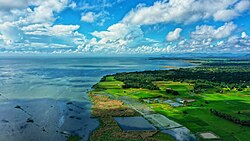
Chilika Lake is the largest brackish water lagoon with estuarine character that sprawls along the east coast of Indian sub-continent in Asia and second largest coastal lagoon in the world,[disputed – discuss] covering an area of over 1,100 square kilometres (420 sq mi). It is spread over the Puri, Khordha and Ganjam districts of Odisha state on the east coast of India, at the mouth of the Daya River, flowing into the Bay of Bengal.
It has been listed as a tentative UNESCO World Heritage site. Its salinity varies by region, from freshwater where rivers flow in, to oceanic salinity levels due to tidal influx.
Geological evidence indicates that Chilika Lake was part of the Bay of Bengal during the later stages of the Pleistocene period (1.8 million to 10,000 years BP).
Excavations were conducted by the Archaeological Survey of India at Golabai Sasan (20°1′7″N 85°32′54″E / 20.01861°N 85.54833°E), north of Chilika lake in Khurdha district. Golabai provides evidence of a sequence of Chilika area culture in three phases: Neolithic (c. 1600 BCE), Chalcolithic (c. 1400 BCE to c. 900 BCE) and Iron Age (c. 900 BCE to c. 800 BCE). Radiocarbon dating traced the earliest level of Golbai to 2300 BCE. The site is located on the left bank of the Malaguni River, a tributary of the Daya River, which flows into Chilika Lake. This location, which gave access to the sea via Chilika Lake, gives evidence of the maritime activities of this region. The recovery of many woodworking adzes and other artifacts shows that Golabai was a boat-building centre. Golabai is the only excavated site in Odisha where boat building has been revealed. This also indicates that Chilika lake was close to Golabai and it facilitated the maritime trade of people in the area during the ancient period.
Ancient texts say the southern sector of Chilika was a major harbour for maritime commerce, when Kharavela (c. 209 BCE–after 170 BCE), the King of Kalinga, was known as the "Lord of the Sea".
Ptolemy (150 CE), the Greek geographer, referred to Palur as the port Paloura, located close to the point of departure situated outside of the southern tip of the lake at Kantiagarh, from where ships bound for different parts of Southeast Asia, sailed. After 639, the Chinese pilgrims Fa-Hien and Hiuen-Tsang mention a famous port "Che-li-ta-loChing" near the shore of the ocean which was a thoroughfare and resting place for seagoing traders and strangers from distant lands. This port was located at 'Chhatragarh' on the banks of Chilika Lake.
A fourth-century legend, often told to explain the birth of Chilika, states that the pirate king, Raktabahu, planned to attack Puri with a huge fleet of ships. To avoid detection, he stealthily anchored out of sight, off the mouth to the sea. The deception was revealed by the ships' refuse floating to the shore, thus warning the town's people, who escaped with all their possessions. Raktabahu felt betrayed when he found an abandoned town and directed his fury towards the sea that had betrayed him. The sea parted to let the army march in, then surged back, drowned the army and formed the present lake.
Archeological excavations discovered seventh-century ship anchors and stone memoirs dedicated to battle heroes at a village named Kanas, about 25 km (16 mi) north of Chilika on the banks of Nuna river, which flows into the lake. This gives evidence of a historic naval engagement off the coast.
Chilika Lake
Chilika Lake is the largest brackish water lagoon with estuarine character that sprawls along the east coast of Indian sub-continent in Asia and second largest coastal lagoon in the world,[disputed – discuss] covering an area of over 1,100 square kilometres (420 sq mi). It is spread over the Puri, Khordha and Ganjam districts of Odisha state on the east coast of India, at the mouth of the Daya River, flowing into the Bay of Bengal.
It has been listed as a tentative UNESCO World Heritage site. Its salinity varies by region, from freshwater where rivers flow in, to oceanic salinity levels due to tidal influx.
Geological evidence indicates that Chilika Lake was part of the Bay of Bengal during the later stages of the Pleistocene period (1.8 million to 10,000 years BP).
Excavations were conducted by the Archaeological Survey of India at Golabai Sasan (20°1′7″N 85°32′54″E / 20.01861°N 85.54833°E), north of Chilika lake in Khurdha district. Golabai provides evidence of a sequence of Chilika area culture in three phases: Neolithic (c. 1600 BCE), Chalcolithic (c. 1400 BCE to c. 900 BCE) and Iron Age (c. 900 BCE to c. 800 BCE). Radiocarbon dating traced the earliest level of Golbai to 2300 BCE. The site is located on the left bank of the Malaguni River, a tributary of the Daya River, which flows into Chilika Lake. This location, which gave access to the sea via Chilika Lake, gives evidence of the maritime activities of this region. The recovery of many woodworking adzes and other artifacts shows that Golabai was a boat-building centre. Golabai is the only excavated site in Odisha where boat building has been revealed. This also indicates that Chilika lake was close to Golabai and it facilitated the maritime trade of people in the area during the ancient period.
Ancient texts say the southern sector of Chilika was a major harbour for maritime commerce, when Kharavela (c. 209 BCE–after 170 BCE), the King of Kalinga, was known as the "Lord of the Sea".
Ptolemy (150 CE), the Greek geographer, referred to Palur as the port Paloura, located close to the point of departure situated outside of the southern tip of the lake at Kantiagarh, from where ships bound for different parts of Southeast Asia, sailed. After 639, the Chinese pilgrims Fa-Hien and Hiuen-Tsang mention a famous port "Che-li-ta-loChing" near the shore of the ocean which was a thoroughfare and resting place for seagoing traders and strangers from distant lands. This port was located at 'Chhatragarh' on the banks of Chilika Lake.
A fourth-century legend, often told to explain the birth of Chilika, states that the pirate king, Raktabahu, planned to attack Puri with a huge fleet of ships. To avoid detection, he stealthily anchored out of sight, off the mouth to the sea. The deception was revealed by the ships' refuse floating to the shore, thus warning the town's people, who escaped with all their possessions. Raktabahu felt betrayed when he found an abandoned town and directed his fury towards the sea that had betrayed him. The sea parted to let the army march in, then surged back, drowned the army and formed the present lake.
Archeological excavations discovered seventh-century ship anchors and stone memoirs dedicated to battle heroes at a village named Kanas, about 25 km (16 mi) north of Chilika on the banks of Nuna river, which flows into the lake. This gives evidence of a historic naval engagement off the coast.
Recent media
Recent media