Hubbry Logo
search
logo
802785

Cinemagraph

logo
Community Hub0 Subscribers
Read side by side
from Wikipedia
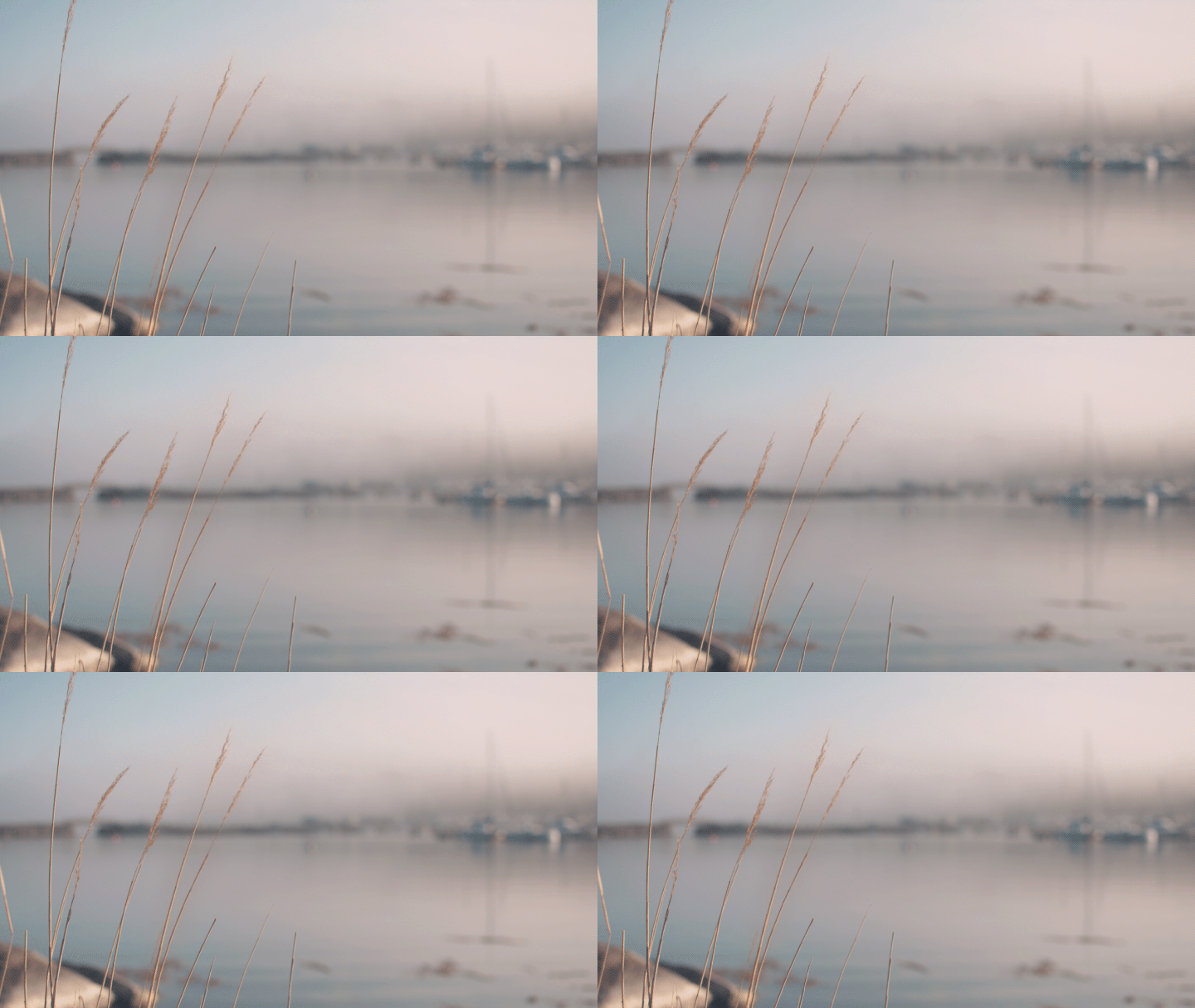
A cinemagraph; the grass in the foreground is moving slightly.

Cinemagraphs are still photographs in which a minor and repeated movement occurs, forming a video clip. They are published as an animated GIF or in other video formats, and can give the illusion that the viewer is watching an animation. A variation is a video snapshot (clip composed like a still photo, but instead of a shutter release it is captured using the video recording function with its audio track and perhaps showing minor movement such as the subject's eye blinks). Another variation is an audio snapshot (still photo linked to an audio file created at the moment of photo capture by certain cameras that offer this proprietary function).[1]

Cinemagraphs are made by taking a series of photographs or a video recording, and, using image editing software, compositing the photographs or the video frames into a seamless loop of sequential frames. This is done in such a way that motion in part of the subject between exposures (for example, a person's dangling leg) is perceived as a repeating or continued motion, in contrast with the stillness of the rest of the image.

The term "cinemagraph" was coined by U.S. photographers Kevin Burg and Jamie Beck, who used the technique to animate their fashion and news photographs beginning in early 2011.[2][3]

History

[edit]

The first cinemagraph was recorded in 2011 when two photographers – Kevin Burg and Jamie Beck – put some movement into a photograph of model Coco Rocha for fashion photography for New York Fashion Week. “In the editing process, there’s a moment when it all starts to come together, and it’s magical every time. Even a simple blink is just so cool. It’s like giving life to a marble statue”, they commented.[4]

See also

[edit]

References

[edit]
[edit]
Revisions and contributorsEdit on WikipediaRead on Wikipedia
from Grokipedia
A cinemagraph is a hybrid medium that blends still photography with subtle, looping video motion, where a portion of the image animates repeatedly while the surrounding elements remain static, typically formatted as an animated GIF or short video clip.[1] This technique creates a "living photo" effect, capturing the viewer's attention by isolating dynamic details—such as steam rising from a coffee cup or hair fluttering in the wind—against an otherwise frozen scene.[2] Originating from video footage shot on a tripod for stability, cinemagraphs are edited using software like Adobe Photoshop to mask and loop the moving parts seamlessly.[2] The term "cinemagraph" was coined in 2011 by New York-based photographers Jamie Beck and Kevin Burg during a fashion shoot at New York Fashion Week, marking the first widely recognized use of the format in digital media.[1] Although conceptual precursors exist—such as isolated motion effects in David Bowie's 1980 music video "Ashes to Ashes"—Beck and Burg's innovation popularized the style through social media and editorial work, trademarking it via Flixel Photos Inc. in 2014.[1] Building on historical advancements in photography and early cinematography from the 19th century, cinemagraphs represent a convergence of static and temporal imagery in the digital age.[1] Cinemagraphs have since evolved into a versatile tool for advertising, social media, and visual storytelling, supported by platforms like Instagram and Facebook for optimized playback.[1] Their subtle motion disrupts traditional time perception in images, blending the permanence of photography with the rhythm of video to evoke a sense of endless moment.[3] Notable early adopters include fashion brands and celebrities, with applications expanding to e-commerce, film teasers, and scientific communication due to their engaging yet non-intrusive aesthetic. As of 2025, cinemagraphs continue to gain popularity in photography and web design trends, with emerging integrations in AI-driven tools and virtual reality for enhanced storytelling.[1][4][5]

Definition and Characteristics

Definition

A cinemagraph is a still photograph in which a minor, repeated movement occurs within a specific portion of the image, while the rest remains static, typically published as an animated GIF, short video loop, or similar format.[6][7] This form blends the compositional precision of traditional photography with selective elements of video animation, resulting in a seamless loop that captures an endless, frozen moment.[8][9] The hybrid nature of cinemagraphs creates an illusion of a "living photo," where subtle motion—such as steam rising from a cup of coffee—draws the viewer's eye without overwhelming the static frame, evoking a sense of surrealism or heightened focus.[10][8] Unlike full-motion video, cinemagraphs emphasize minimalism by isolating movement to small, intentional details, preserving the photograph's overall stillness while adding a layer of dynamism.[7][9] Common formats for cinemagraphs include animated GIFs, which use pixel-based loops for broad compatibility but may limit quality, and MP4 videos, which offer higher resolution and smoother playback; emerging options like WebM provide web-optimized compression for efficient distribution.[9][11][12]

Key Characteristics

Cinemagraphs feature seamless looping, where the motion repeats indefinitely without discernible start or end points, achieved through careful frame compositing to ensure fluidity and continuity. This looping mechanism typically spans short durations of 3-10 seconds, creating an infinite cycle that enhances the illusion of a living moment within a static frame.[7] A defining attribute is selective animation, where only a small portion of the image exhibits motion while the remainder remains frozen, often isolated via masking techniques to highlight dynamic elements like blowing hair against an otherwise still portrait. This limited animation focuses viewer attention on subtle details, blending photographic stillness with isolated video-like movement to produce a hybrid visual effect.[6][7] Cinemagraphs maintain high resolution derived from still photography bases, commonly starting at 4K or higher to preserve sharpness and realism, with motion rendered at frame rates of 24-30 FPS to evoke a cinematic quality without disrupting the photo-like aesthetic.[13][14] The perceptual impact arises from the stark contrast between stasis and subtle motion, generating a hypnotic or mesmerizing focus that draws the eye and creates cognitive dissonance, making the image feel alive yet contained. Additionally, their compact file sizes—often under 5 MB when exported as GIFs—facilitate easy sharing across digital platforms while retaining visual impact.[15][16] Variations in cinemagraph scope include "video snapshots," derived from a single short video clip stabilized on a tripod, and "constructed" versions assembled from multiple photographs composited with added motion elements for more controlled or complex effects.[7][17]

History

Invention

The term "cinemagraph" was coined in 2011 by New York-based photographers Jamie Beck and Kevin Burg during New York Fashion Week, marking the birth of a new visual medium that combines elements of still photography and video. Beck, a fashion photographer, and Burg, a motion graphics artist, developed the technique to create looping animations where a subtle portion of an otherwise static image appears to move seamlessly. This innovation emerged from their collaborative experiments with animated GIFs, which they refined to produce more elegant and controlled effects suitable for high-fashion contexts.[18][19] The inaugural cinemagraph, titled "Les Tendrils," featured two models from a New York Fashion Week presentation, with subtle motion in one model's hair while the rest of the image remained frozen, capturing a sense of living elegance. This piece was first posted on Tumblr in early 2011 and quickly gained attention when shared by The Washington Post, introducing the medium to a broader audience through its hypnotic subtlety. The creators captured the footage using high-resolution cameras and edited it in software like Adobe After Effects to isolate the motion, ensuring the loop felt natural and infinite.[20] Beck and Burg were motivated by a desire to merge the timeless elegance of still photography with the narrative potential of video, particularly for storytelling in the fashion industry, while drawing inspiration from early GIF art but emphasizing refined, understated motion over overt animation. Their goal was to evoke a sense of "living moments" that drew viewers in without overwhelming the composition, addressing the limitations of traditional media in conveying subtle emotion. This approach stemmed from Burg's prior Tumblr experiments with GIFs starting around 2009, which evolved into the more sophisticated cinemagraph format during Fashion Week collaborations.[21] The initial reception was overwhelmingly positive, with the "Les Tendrils" cinemagraph going viral on Tumblr and social platforms in 2011, amassing thousands of shares and reblogs that highlighted its mesmerizing quality. This buzz led to immediate professional opportunities, including commissions from luxury brands such as Tiffany & Co. for animated advertising and features in Vogue, solidifying cinemagraphs as a fresh tool for visual storytelling in fashion and media. Early coverage in outlets like The Atlantic and CBS News further amplified its appeal, praising the technique's ability to captivate without the intrusiveness of full video.[18][19][22]

Evolution and Popularization

Following their invention in 2011 by photographers Kevin Burg and Jamie Beck, cinemagraphs experienced early growth in the 2010s through adoption in the fashion industry and news media, where they enhanced visual storytelling in photographs.[10] Fashion campaigns, such as those during New York Fashion Week, showcased cinemagraphs to blend subtle motion with static elegance, marking their initial commercial appeal.[23] News outlets similarly integrated the technique to animate portraits and events, contributing to broader visibility among creative professionals.[10] The rise of social media platforms accelerated popularization, particularly with Instagram's introduction of video sharing in 2013, which aligned perfectly with cinemagraphs' looping format for seamless, attention-grabbing posts.[24] By the mid-2010s, brands began leveraging cinemagraphs for advertising, exemplified by Netflix's promotional campaigns for films and series starting around 2015, where the format's hypnotic quality boosted engagement without full video production costs.[25] The emergence of dedicated software like Flixel Cinemagraph Pro in 2014, which won an Apple Design Award, further democratized creation and fueled expansion into marketing visuals. Flixel Photos Inc., founded by Beck and Burg, trademarked the term "Cinemagraph" in 2014.[26][1] In the 2020s, technological advancements, including AI-driven tools, transformed cinemagraph production by automating masking and editing processes, as seen in Adobe's Sensei integrations for video workflows announced in 2023.[27] This shift enabled more efficient generation of complex effects, paving the way for emerging innovations like 3D cinemagraphs and augmented reality (AR) applications, where subtle animations can overlay real-world environments for immersive experiences.[28] Globally, cinemagraphs gained traction in Europe through artistic photography that emphasized atmospheric motion, while in Asia, they became popular in e-commerce by the mid-2010s as a superior alternative to GIFs for product visuals, enhancing user engagement on platforms like those in China.[29]

Creation Process

Shooting Techniques

Cinemagraphs are created by recording a short video clip lasting 3-10 seconds on a tripod, capturing isolated subtle movement in one area (such as steam rising) while keeping the rest of the scene completely static, providing sufficient footage for isolating subtle motions while maintaining a still-image aesthetic. These clips can be shot with digital single-lens reflex (DSLR) cameras, smartphones, or action cameras, offering flexibility for various shooting scenarios. Alternatively, sequences of burst photographs can serve as source material, particularly for scenarios involving larger movements where continuous video might introduce unwanted variability.[30][31][32] To ensure stability essential for seamless loops, a tripod is indispensable during capture, preventing camera shake that could disrupt the static elements. High frame rates of 60 frames per second (FPS) or higher are recommended to finely capture nuanced motions, such as flickering lights or flowing water, allowing for smoother playback and easier selection of loop points. For a more cinematic feel, shooting at 24 or 30 FPS can be effective, though higher rates provide greater flexibility in post-selection without delving into editing.[33][31][34] Effective planning involves pre-visualizing the "live" elements—such as smoke rising, hair swaying in the wind, or liquid pouring—against a predominantly static background to create contrast that draws the eye. Shooting in controlled environments, like indoors or with minimal external interference, helps minimize unintended movements from passersby or wind, ensuring the footage aligns with the looping requirement where actions visually reset.[30][32][33] Best practices include maintaining even lighting across the scene to avoid shadows that complicate motion isolation, and employing a shallow depth of field to sharply focus on the subject while softly blurring the background, enhancing the illusion of stillness. Capturing multiple takes is crucial, allowing selection of the most loopable actions—for instance, pouring liquid that appears to continuously refill without visible interruption—thereby increasing the chances of obtaining flawless raw footage.[31][33][30]

Editing and Production

The editing and production phase of cinemagraph creation transforms raw video footage into a polished, looping animation where isolated elements exhibit subtle motion against a static backdrop. This post-production workflow, originally developed by photographers Jamie Beck and Kevin Burg, emphasizes precision in isolating and refining motion to achieve hypnotic seamlessness, often requiring iterative adjustments to blend dynamic and frozen areas naturally.[35][10][21] Frame extraction initiates the process by importing the video clip into a timeline and identifying a concise segment—typically lasting a few seconds—that captures the desired movement. A representative still frame from this segment is selected and duplicated across the timeline to serve as the unchanging base image, effectively freezing the majority of the composition while preserving the potential for motion in targeted areas. This step ensures the static elements align perfectly, drawing from stable video sources like tripod-mounted shots to minimize initial instability.[36][37] The masking process then isolates moving elements by applying precise layer masks to the timeline, revealing video frames only within designated regions while the surrounding areas remain locked to the duplicated static frame. Non-moving sections are reinforced by additional frame duplications, creating a composite where motion appears confined and integrated without edges or artifacts; this technique demands careful feathering of mask boundaries to achieve a fluid merge between active and inert parts.[36][37][38] Looping creation follows by trimming the masked sequence and aligning its endpoints for infinite repetition, often through bounce (playing forward then reverse for bidirectional motion such as swaying hair) or repeat (continuous forward looping for unidirectional motion such as rising steam, optionally with crossfade transitions for seamlessness) to simulate natural oscillation, such as a gentle sway or ripple. Timing adjustments, including subtle fade-ins or opacity transitions, are applied to eliminate perceptible jumps, ensuring the loop cycles smoothly and indefinitely while maintaining the illusion of perpetual subtlety.[36][37][35][6][39] Export optimization concludes production by rendering the loop into a web-friendly format like GIF or a compact video file, with compression tailored to preserve visual fidelity amid size constraints. Techniques such as reducing frame rates to around 15 fps, capping the color palette at 256 shades, and incorporating dithering help retain color accuracy and smoothness, while cropping to the composition's core dimensions further balances quality against file efficiency for digital distribution.[36][40][41]

Tools and Software

Desktop Software

Desktop software plays a crucial role in professional cinemagraph production, offering robust tools for precise masking, animation, and export that surpass mobile alternatives in control and complexity. These applications, primarily from established creative suites, enable creators to transform video footage into seamless loops while maintaining the aesthetic of still photography.[6][37] Adobe Photoshop is a cornerstone for cinemagraph creation, leveraging its layer-based masking to isolate moving elements within a static frame. Users import video footage as layers via File > Import > Video Frames to Layers, trim the clip to a looping segment, and apply masks to reveal motion selectively, such as steam rising from a coffee cup while the surroundings remain frozen. The timeline panel provides frame-by-frame control for refining animations, ensuring smooth loops by duplicating and reversing frames as needed. Final output occurs through Export > Save for Web, optimized as a GIF to preserve the hybrid photo-video quality.[6][37][42] For more intricate compositions, Adobe After Effects excels in advanced compositing, allowing complex motion integration beyond basic masking. Creators import footage, duplicate layers, and use masks to define animated regions, freezing the top layer with Time > Freeze Frame to establish the still base. Opacity animations and pre-compositions facilitate seamless looping, while the effects library supports enhancements like particle simulations for added realism in elements such as fog or reflections. Plugins like loopFlow further streamline the process by automating looped animations from still images, integrating effects for professional polish. Exports can be rendered as video files or GIFs, ideal for high-resolution outputs.[6][37][43] Other desktop tools extend accessibility for specific workflows. Final Cut Pro, optimized for macOS users, incorporates masking within its video editing timeline to blend static and dynamic elements, often paired with Motion for refined animations like subtle environmental movements. As a free alternative, GIMP supports cinemagraphs through its layer-based animation system, where each layer represents a frame; users import video frames, apply masks, and export optimized GIFs, though it requires supplementary tools like Olive for initial video handling due to limited native video import.[42][44][45] Workflow integration in these tools enhances efficiency for professional pipelines. Batch processing in Photoshop, via recorded actions applied through File > Automate > Batch, allows simultaneous treatment of multiple cinemagraphs, automating masking and export steps across folders. Color grading, essential for aligning motion with still aesthetics, utilizes adjustment layers in Photoshop or effects like Curves and Lumetri Color in After Effects to balance exposure, contrast, and tones without disrupting the loop integrity.[46]

Mobile and Specialized Apps

Mobile apps have significantly democratized cinemagraph creation by providing accessible, intuitive tools that allow users to produce animated stills directly from smartphones without requiring professional equipment or software. These applications typically process short video clips captured on mobile devices, enabling quick isolation of motion elements through user-friendly interfaces like touch-based masking and automated effects.[47] Flixel's Cinemagraph Pro, available for iOS devices, serves as a leading mobile tool for generating professional-quality cinemagraphs from phone videos. The app features auto-loop detection to ensure seamless repetition of motion, along with one-tap export options for formats optimized for social media and web use, allowing users to create and share content in under a few minutes. It supports instant processing of footage shot via the device's camera, making it ideal for on-the-go creation.[48][49] Cinemagraph Pro also includes advanced mobile editing capabilities, such as video stabilization to reduce handheld shake and precise masking tools for selecting static versus moving areas. These features enable fine-tuned control over the final output, with direct integration for sharing to platforms like Instagram and Facebook, streamlining the workflow from capture to publication.[50][51] AI-powered mobile apps like VIMAGE and Motionleap, first released in 2018, continue to be popular options in 2026 for automated cinemagraph production, particularly for non-professionals seeking simplicity. VIMAGE, available on both iOS and Android, uses AI-driven overlays and 3D parallax effects to animate still photos or short videos, applying hundreds of preset moving elements such as flowing water or flickering lights with minimal user input. This allows for rapid transformation of static images into looping cinemagraphs, emphasizing ease over manual editing. VIMAGE also offers a free web-based version known as VIMAGE Online (accessible at app.vimageapp.com), which enables users to create cinemagraphs and live photos directly in the browser on PC or Mac, extending the tool's accessibility beyond mobile devices.[52][53][54][55][56] Similarly, Motionleap by Lightricks, compatible with iOS and Android, employs AI for motion editing, where users can animate specific photo regions by drawing paths for elements like sky or objects to follow. The app's brush tools and live effects facilitate quick cinemagraph-style animations from stills, with export options for GIFs or videos suitable for social feeds. These tools represent a shift toward AI-assisted isolation of motion, reducing creation time to seconds for basic projects.[57][58][59][54] The primary advantages of these mobile and specialized apps lie in their portability and speed, enabling cinemagraphs to be crafted in under five minutes directly on devices, which contrasts with more time-intensive desktop methods. Many incorporate cloud syncing via integrated galleries or third-party services, allowing seamless handoff to desktop editors for further refinement while maintaining accessibility for casual users focused on social media content.[60][61]

AI-Driven Tools

Emerging AI-driven tools have expanded options for creating cinemagraphs and similar animated photographs by allowing users to upload static images and generate motion through AI predictions, prompts, templates, or area selections. These tools often produce subtle, looping effects suitable for cinemagraph-like results, though many focus on broader photo animation and require careful prompting to achieve isolated, subtle motion characteristic of traditional cinemagraphs. NightCafe provides a dedicated AI Cinemagraph Loop Animation Generator that transforms static images into seamless animated GIFs by letting users upload a photo, select areas for motion, and generate subtle, natural-looking loops.[62] Runway ML supports prompt-based motion addition and image-to-video capabilities, enabling creators to add or enhance motion in stills for loopable outputs, often used for custom cinemagraph effects through its editing workflows.[63] YouCam Online Editor's AI Animate Photo feature allows uploading images and applying animations via templates or text prompts, generating videos with realistic motion including subtle effects like parallax or gentle movements, which can approximate cinemagraphs when restrained.[64] Viggle AI animates uploaded photos by mapping motion from templates or reference videos, producing dynamic animations that can be adapted for cinemagraph-style effects with appropriate selection, though it generally emphasizes full-character motion over isolated subtlety.[65] Additionally, free and freemium online tools have increased accessibility for cinemagraph creation. In 2026, popular free online tools for converting static photos to cinemagraphs include VIMAGE Online (a free web-based cinemagraph animator) and WoFox's online cinemagraph maker (with 27 editable templates from images).[56][66] For live photo-style conversions (AI-animated photos), free options include Virbo AI Live Photo Maker, which animates static photos into live photos with realistic motion and sound, and Canva's photo animation features, which allow users to animate still photos online with various dynamic effects.[67][68] VIMAGE Online is a free web-based tool that allows users to create cinemagraphs and live photos directly in the browser on PC or Mac, featuring animation effects, text, shapes, and editing capabilities.[56] WoFox offers an online cinemagraph maker with 27 editable templates, supporting creation from images or videos, customization, and exports in a freemium model.[66] AI-powered tools such as AnimateMyPic enable the animation of still images into videos using AI models, prompts, and effects, which can produce cinemagraph-like results with careful application.[69] These AI tools complement traditional methods by simplifying creation from static photos alone, reducing reliance on video capture and manual masking, while advancing accessibility in 2026.

Applications

Commercial and Marketing Uses

Cinemagraphs have become a staple in commercial advertising campaigns, particularly in email marketing, where they enhance visual appeal and drive user interaction. A 2018 study by Flixel showed that cinemagraphs can generate 5.6 times higher click-through rates compared to still images in advertising content.[70] Brands such as Microsoft leveraged cinemagraphs for dynamic product shots in their 2016 Twitter campaigns, achieving a 110% increase in engagement rates over still images, while PepsiCo reported a 75% lift in click-through rates using cinemagraphs in Facebook ads for beverage promotions.[71][72] These applications, popularized in the 2010s, allow marketers to convey product vitality efficiently, reducing production costs relative to full video while boosting transactional outcomes, with 72% of email marketers noting higher transaction-to-click rates per an Experian report.[73] In social media marketing, cinemagraphs facilitate immersive storytelling on platforms like Instagram and TikTok through seamless looping product demos that encourage prolonged viewing and shares. For instance, luxury footwear brand Stuart Weitzman employed cinemagraphs on Instagram to highlight sandal details, resulting in elevated post interactions and brand recall.[74] E-commerce platforms such as Amazon integrate cinemagraph hover effects to animate product images on hover, providing a video-like experience that simulates usability—such as steam rising from coffee—without requiring clicks, thereby streamlining the shopping journey and increasing add-to-cart actions.[75] This format's lightweight nature supports quick loading on mobile feeds, contributing to higher engagement metrics across short-form content ecosystems. Cinemagraphs also enhance website design for luxury brands, serving as subtle background elements that add sophistication without disrupting user experience. For example, watchmakers emulate ticking hands in cinemagraphs to showcase timepieces akin to Rolex models, creating an illusion of mechanical precision that draws visitors deeper into product explorations.[76] Compared to full videos, cinemagraphs file sizes are significantly smaller—often under 1 MB—leading to faster page load times that improve SEO rankings, as search engines prioritize sites with load speeds under three seconds to reduce bounce rates.[77] Overall, these commercial uses yield measurable impacts, including a 100% increase in dwell time over static images on websites.[78] Case studies have reported 3.9 times higher click-to-install rates and up to 3.8 times overall conversions due to enhanced visual persuasion.[79][80] As of 2025, cinemagraphs continue to feature in advertising trends, contributing to higher click-through and conversion rates in e-commerce and social media campaigns.[81]

Artistic and Media Applications

Cinemagraphs have gained traction in fine art photography, where they enable artists to craft surreal effects in portraits and landscapes by isolating subtle, looping movements within otherwise static compositions. Pioneers Jamie Beck and Kevin Burg, who coined the term in 2011, have showcased their cinemagraphs in gallery settings, including the 2018 ICP Projected: Woman program at the International Center of Photography, where their works highlighted the medium's potential for emotional depth and visual poetry.[82] These pieces often blend fashion, lifestyle, and travel elements to create "living moments" that mesmerize viewers, as seen in their viral series of animated portraits that capture fleeting expressions or environmental details like drifting smoke or fluttering fabrics.[21][83] In film and journalism, cinemagraphs function as supplementary media to enrich narratives and interactive storytelling. Artists have reimagined classic movie scenes through the medium, animating isolated elements like steam rising from coffee in a tense diner moment from Pulp Fiction or snow falling eternally in Fargo's bleak landscapes, thereby extending the cinematic legacy into digital art forms.[84] Such applications also appear in behind-the-scenes content, where looping clips of set preparations or actor gestures provide immersive glimpses into production processes without full video commitment. In journalism, the format supports interactive articles by adding subtle dynamism to photo essays, enhancing reader engagement in outlets focused on visual innovation.[85] Cinemagraphs extend into digital media, particularly for book covers and album art, where their subtle animations infuse static designs with life to evoke mood or intrigue. For instance, looping elements like flickering candlelight on a novel's cover or rippling water in album artwork create hypnotic previews that align with thematic content, drawing audiences deeper into the narrative. Creative techniques in these applications emphasize symbolic motion, such as eternal rain in melancholic scenes to symbolize persistent emotion, surpassing the limitations of traditional still images by layering subtle animation for enhanced expressiveness.[86][87]

Impact and Reception

Cultural Influence

Cinemagraphs have profoundly influenced visual culture by challenging conventional notions of still imagery, transforming static photographs into subtle animations that evoke an "eternal moment" through layered motion and illusion. This hybrid form, emerging from the 2011 invention by artists Jamie Beck and Kevin Burg, bridges photography's frozen perspectives with cinematic dynamism, echoing early 20th-century Cubist deconstruction and fostering new perceptions of reality and illusion in media. By animating select elements within a still frame, cinemagraphs inspire hybrid formats in digital content, such as looping memes and social media feeds that blend stasis and movement to heighten engagement and narrative depth.[88][3] Adoption of cinemagraphs increased in the 2020s, becoming a tool in social media and digital marketing by 2024, with brands leveraging their auto-play compatibility on platforms like Instagram and Facebook to achieve up to 5.6 times higher click-through rates compared to static images.[5] This trend aligns with broader shifts toward dynamic visuals in professional and remote work contexts, where subtle animations enhance profile presentations and content feeds for greater visual appeal. As of early 2025, cinemagraphs are included in social media design trends as micro-animations that capture attention, contributing to immersive storytelling and user retention.[89] The high-resolution processing required for creating and sharing cinemagraphs contributes to environmental concerns, amplifying energy consumption in data centers and devices akin to broader video streaming impacts, which account for approximately 1% of global greenhouse gas emissions.[90]

Notable Examples and Case Studies

One of the seminal examples in fashion photography came in 2011 when New York-based artists Jamie Beck and Kevin Burg collaborated with supermodel Coco Rocha to produce a series of cinemagraphs that introduced the medium to high-fashion audiences. In one notable portrait, Rocha is depicted in a poised pose with the subtle animation of her foot swinging gently, creating a mesmerizing loop that highlights the elegance of movement within stillness and garnered widespread attention for elevating GIFs to an art form.[19][91] In the commercial realm, Microsoft utilized cinemagraphs effectively in its 2015 Surface advertising campaign, particularly in social media promotions where a static image of the device featured an animated screen glow to emphasize its display capabilities amid an otherwise immobile setup. This approach was part of a broader strategy tested in subsequent campaigns, where cinemagraphs on platforms like Twitter and Facebook achieved up to 110% higher engagement rates compared to static photos, demonstrating the format's potential for product visualization in tech marketing.[92][93]

References

User Avatar
No comments yet.