



Community hub
Recent from talks
Knowledge base stats:
Talk channels stats:
Members stats:
Ring system
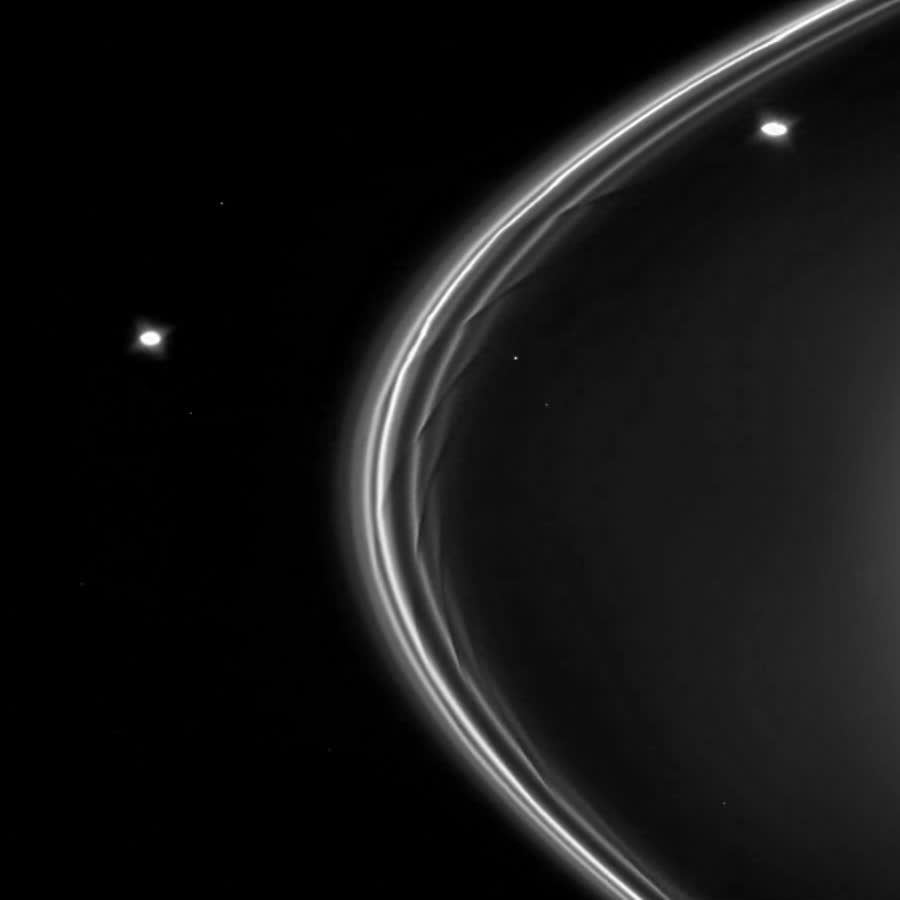
A ring system is a disc or torus orbiting an astronomical object that is composed of numerous solid bodies such as dust particles, meteoroids, planetoids, moonlets, or stellar objects.
Ring systems are best known as planetary rings, common components of satellite systems around giant planets such as the rings of Saturn, or circumplanetary disks. But they can also be galactic rings and circumstellar discs, belts of planetoids, such as the asteroid belt or Kuiper belt, or rings of interplanetary dust, such as around the Sun at distances of Mercury, Venus, and Earth, in mean motion resonance with these planets. Evidence suggests that ring systems may also be found around other types of astronomical objects, including moons and brown dwarfs.
In the Solar System, all four giant planets (Jupiter, Saturn, Uranus, and Neptune) have ring systems. Ring systems around minor planets have also been discovered via occultations. Some studies even theorize that the Earth may have had a ring system during the mid-late Ordovician period.
There are three ways that thicker planetary rings have been proposed to have formed: from material originating from the protoplanetary disk that was within the Roche limit of the planet and thus could not coalesce to form moons, from the debris of a moon that was disrupted by a large impact, or from the debris of a moon that was disrupted by tidal stresses when it passed within the planet's Roche limit. Most rings were thought to be unstable and to dissipate over the course of tens or hundreds of millions of years, but it now appears that Saturn's rings might be quite old, dating to the early days of the Solar System.
Fainter planetary rings can form as a result of meteoroid impacts with moons orbiting around the planet or, in the case of Saturn's E-ring, the ejecta of cryovolcanic material.
Ring systems may form around centaurs when they are tidally disrupted in a close encounter (within 0.4 to 0.8 times the Roche limit) with a giant planet. For a differentiated body approaching a giant planet at an initial relative velocity of 3−6 km/s with an initial rotational period of 8 hours, a ring mass of 0.1%−10% of the centaur's mass is predicted. Ring formation from an undifferentiated body is less likely. The rings would be composed mostly or entirely of material from the parent body's icy mantle. After forming, the ring would spread laterally, leading to satellite formation from whatever portion of it spreads beyond the centaur's Roche Limit. Satellites could also form directly from the disrupted icy mantle. This formation mechanism predicts that roughly 10% of centaurs will have experienced potentially ring-forming encounters with giant planets.
The composition of planetary ring particles varies, ranging from silicates to icy dust. Larger rocks and boulders may also be present, as seen in 2007 when tidal effects from eight moonlets only a few hundred meters across were detected within Saturn's rings. The maximum size of a ring particle is determined by the specific strength of the material it is made of, its density, and the tidal force at its altitude. The tidal force is proportional to the average density inside the radius of the ring, or to the mass of the planet divided by the radius of the ring cubed. It is also inversely proportional to the square of the orbital period of the ring.
Some planetary rings are influenced by shepherd moons, small moons that orbit near the inner or outer edges of a ringlet or within gaps in the rings. The gravity of shepherd moons serves to maintain a sharply defined edge to the ring; material that drifts closer to the shepherd moon's orbit is either deflected back into the body of the ring, ejected from the system, or accreted onto the moon itself.
Hub AI
Ring system AI simulator
(@Ring system_simulator)
Ring system
A ring system is a disc or torus orbiting an astronomical object that is composed of numerous solid bodies such as dust particles, meteoroids, planetoids, moonlets, or stellar objects.
Ring systems are best known as planetary rings, common components of satellite systems around giant planets such as the rings of Saturn, or circumplanetary disks. But they can also be galactic rings and circumstellar discs, belts of planetoids, such as the asteroid belt or Kuiper belt, or rings of interplanetary dust, such as around the Sun at distances of Mercury, Venus, and Earth, in mean motion resonance with these planets. Evidence suggests that ring systems may also be found around other types of astronomical objects, including moons and brown dwarfs.
In the Solar System, all four giant planets (Jupiter, Saturn, Uranus, and Neptune) have ring systems. Ring systems around minor planets have also been discovered via occultations. Some studies even theorize that the Earth may have had a ring system during the mid-late Ordovician period.
There are three ways that thicker planetary rings have been proposed to have formed: from material originating from the protoplanetary disk that was within the Roche limit of the planet and thus could not coalesce to form moons, from the debris of a moon that was disrupted by a large impact, or from the debris of a moon that was disrupted by tidal stresses when it passed within the planet's Roche limit. Most rings were thought to be unstable and to dissipate over the course of tens or hundreds of millions of years, but it now appears that Saturn's rings might be quite old, dating to the early days of the Solar System.
Fainter planetary rings can form as a result of meteoroid impacts with moons orbiting around the planet or, in the case of Saturn's E-ring, the ejecta of cryovolcanic material.
Ring systems may form around centaurs when they are tidally disrupted in a close encounter (within 0.4 to 0.8 times the Roche limit) with a giant planet. For a differentiated body approaching a giant planet at an initial relative velocity of 3−6 km/s with an initial rotational period of 8 hours, a ring mass of 0.1%−10% of the centaur's mass is predicted. Ring formation from an undifferentiated body is less likely. The rings would be composed mostly or entirely of material from the parent body's icy mantle. After forming, the ring would spread laterally, leading to satellite formation from whatever portion of it spreads beyond the centaur's Roche Limit. Satellites could also form directly from the disrupted icy mantle. This formation mechanism predicts that roughly 10% of centaurs will have experienced potentially ring-forming encounters with giant planets.
The composition of planetary ring particles varies, ranging from silicates to icy dust. Larger rocks and boulders may also be present, as seen in 2007 when tidal effects from eight moonlets only a few hundred meters across were detected within Saturn's rings. The maximum size of a ring particle is determined by the specific strength of the material it is made of, its density, and the tidal force at its altitude. The tidal force is proportional to the average density inside the radius of the ring, or to the mass of the planet divided by the radius of the ring cubed. It is also inversely proportional to the square of the orbital period of the ring.
Some planetary rings are influenced by shepherd moons, small moons that orbit near the inner or outer edges of a ringlet or within gaps in the rings. The gravity of shepherd moons serves to maintain a sharply defined edge to the ring; material that drifts closer to the shepherd moon's orbit is either deflected back into the body of the ring, ejected from the system, or accreted onto the moon itself.