



Community hub
Recent from talks
Contribute something
Nothing was collected or created yet.
Clapp oscillator
View on WikipediaThe Clapp oscillator or Gouriet oscillator is an LC electronic oscillator that uses a particular combination of an inductor and three capacitors to set the oscillator's frequency. LC oscillators use a transistor (or vacuum tube or other gain element) and a positive feedback network. The oscillator has good frequency stability.
History
[edit]The Clapp oscillator design was published by James Kilton Clapp in 1948 while he worked at General Radio.[1] According to Czech engineer Jiří Vackář, oscillators of this kind were independently developed by several inventors, and one developed by Gouriet had been in operation at the BBC since 1938.[2]
Circuit
[edit]
The Clapp oscillator uses a single inductor and three capacitors to set its frequency. The Clapp oscillator is often drawn as a Colpitts oscillator that has an additional capacitor (C0) placed in series with the inductor.[3]
The oscillation frequency in Hertz (cycles per second) for the circuit in the figure, which uses a field-effect transistor (FET), is
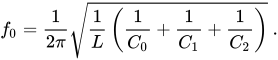
The capacitors C1 and C2 are usually much larger than C0, so the 1/C0 term dominates the other capacitances, and the frequency is near the series resonance of L and C0. Clapp's paper gives an example where C1 and C2 are 40 times larger than C0; the change makes the Clapp circuit about 400 times more stable than the Colpitts oscillator for capacitance changes of C2.[4]
Capacitors C0, C1 and C2 form a voltage divider that determines the amount of feedback voltage applied to the transistor input.
Although the Clapp circuit is used as a variable frequency oscillator (VFO) by making C0 a variable capacitor, Vackář states that the Clapp oscillator "can only be used for operation on fixed frequencies or at the most over narrow bands (max. about 1:1.2)."[5] The problem is that under typical conditions, the Clapp oscillator's loop gain varies as f −3, so wide ranges will overdrive the amplifier. For VFOs, Vackář recommends other circuits. See Vackář oscillator.
Practical example
[edit]
The schematic shows an example with component values.[6] Instead of field-effect transistors, other active components such as bipolar junction transistors or vacuum tubes, capable of producing gain at the desired frequency, could be used.
The common drain amplifier has a high input impedance and a low output impedance. Therefore the amplifier input, the gate, is connected to the high impedance top of the LC circuit C0, C1, C2, L1 and the amplifier output, the source, is connected to the low impedance tap of the LC circuit. The grid leak C3 and R1 sets the operating point automatically through grid leak bias. A smaller value of C3 gives less harmonic distortion, but requires a larger load resistor. The supply current for J1 flows through the radio frequency choke L2 to ground. The oscillator radio frequency current uses C2, because for the oscillator frequency this component has less reactance. The load resistor RL is part of the simulation, not part of the circuit.
References
[edit]- ^ Clapp, J. K. (March 1948). "An inductance-capacitance oscillator of unusual frequency stability". Proc. IRE. 367 (3): 356–358. doi:10.1109/JRPROC.1948.233920. S2CID 51652881.
- ^ Vackář, Jiri (December 1949). LC Oscillators and their Frequency Stability (PDF) (Report). Prague, Czechoslovakia: Tesla National Corporation. Tesla Technical Report. Archived from the original (PDF) on 2009-01-24. Retrieved 2008-12-20.
- ^ Department of the Army (1963) [1959]. Basic Theory and Application of Transistors. Dover. pp. 171–173. TM 11-690.
Modification of the Colpitts oscillator by including a capacitor in series with winding 1–2 of the transformer results in the Clapp oscillator.
- ^ Clapp 1948, p. 357
- ^ Vackář 1949, pp. 5–6
- ^ Hayward, Wes (1994). "Figure 7.8 The Clapp variation of the Colpitts oscillator". Introduction to Radio Frequency Design. US: ARRL. p. 274. ISBN 0-87259-492-0.
Further reading
[edit]- Ulrich L. Rohde, Ajay K. Poddar, Georg Böck "The Design of Modern Microwave Oscillators for Wireless Applications ", John Wiley & Sons, New York, NY, May, 2005, ISBN 0-471-72342-8.
- George Vendelin, Anthony M. Pavio, Ulrich L. Rohde " Microwave Circuit Design Using Linear and Nonlinear Techniques ", John Wiley & Sons, New York, NY, May, 2005, ISBN 0-471-41479-4.
- A. Grebennikov, RF and Microwave Transistor Oscillator Design. Wiley 2007. ISBN 978-0-470-02535-2.
External links
[edit] Media related to Clapp oscillators at Wikimedia Commons
- EE 322/322L Wireless Communication Electronics —Lecture #24: Oscillators. Clapp oscillator. VFO startup

Clapp oscillator
View on GrokipediaOverview
Definition and Key Features
The Clapp oscillator is an LC electronic oscillator that functions as a variation of the Colpitts design, incorporating a transistor or other active gain element and a positive feedback network formed by two capacitors connected in series across the tuned circuit, with an additional capacitor placed in series with the inductor to enhance performance.[2][5] This configuration taps the feedback from the junction of the series capacitors to the input of the gain element, ensuring phase alignment for sustained oscillation.[2] Key features of the Clapp oscillator include its superior frequency stability, primarily due to the series isolating capacitor that decouples variations in the active device's parasitic capacitances from the resonant tank circuit, thereby reducing drift over temperature and voltage changes.[5] It is particularly suited for operation in the radio frequency (RF) range, typically from a few MHz to hundreds of MHz, and produces a clean sinusoidal output waveform suitable for signal generation in communication systems. The design also offers a useful tuning range of approximately 1.8:1 while maintaining stability, making it advantageous for applications requiring precise frequency control without excessive complexity.[5] In terms of basic structure, the oscillator comprises an amplification stage—often a common-base transistor configuration—that provides the necessary gain, coupled with a feedback loop consisting of the series LC resonator and capacitive divider to satisfy the Barkhausen criteria for oscillation (loop gain of unity and 0° or 360° phase shift at the resonant frequency).[2] The resonant frequency is determined by the formula where is the inductance and represents the equivalent capacitance arising from the series combination of the feedback capacitors and the isolating capacitor.[2] This equation highlights the oscillator's reliance on the LC tank for frequency setting, with stability enhanced by selecting the isolating capacitor much smaller than the feedback pair to minimize sensitivity to external perturbations.[5]Comparison to Colpitts Oscillator
The Colpitts oscillator utilizes a voltage divider formed by two capacitors in series across an inductor to provide regenerative feedback in an LC tank circuit, without incorporating an additional series capacitor.[7] This configuration relies on the parallel resonance of the inductor and the effective capacitance of the divider for oscillation, making it suitable for a range of frequencies but susceptible to shifts from external influences. In contrast, the Clapp oscillator builds upon the Colpitts topology by introducing a small capacitor, typically denoted as , connected in series with the inductor to form a series-resonant branch.[5] This modification isolates the primary resonant tank—composed of the tapped capacitors and —from the varying capacitances of the active device, such as a transistor's base-emitter or collector-base junctions. Schematically, while the Colpitts places the inductor directly shunting the capacitor divider, the Clapp inserts between the inductor and the divider's junction, enhancing the circuit's insensitivity to parasitic effects. This design difference yields superior frequency stability in the Clapp oscillator, particularly against variations in transistor parameters, temperature fluctuations, and phase shifts, where frequency changes can be reduced to about half or even 100 times less than in the Colpitts configuration.[5] The Clapp's narrower transfer function peak further minimizes spurious responses and spectral noise, making it preferable for variable-frequency applications requiring precise control.[1]History
Invention by James K. Clapp
The Clapp oscillator was invented by James Kilton Clapp (December 30, 1897 – February 9, 1965), an American electrical engineer who graduated from the Massachusetts Institute of Technology in 1923 with an S.B. degree in electrical engineering and became a Fellow of the Institute of Radio Engineers (I.R.E.) in 1933.[8] He had a long career at the General Radio Company in Cambridge, Massachusetts, contributing to advancements in electronic instrumentation and frequency standards.[9] The invention occurred in the late 1940s, shortly after World War II, amid growing demands for reliable electronic components in radio communications. Clapp developed the oscillator as part of efforts at General Radio to create stable frequency sources for applications such as broadcast monitoring and radio systems. Similar circuits were independently developed by other engineers, including Jiří Vackář, whose comparable design was published in 1949.[10] The primary motivation stemmed from the limitations of existing LC oscillator designs, particularly the Colpitts oscillator, which suffered from frequency variations due to factors like tube resistances and supply voltage fluctuations. Clapp sought to enhance stability in these circuits to meet the requirements of radio engineering, building on earlier LC oscillator principles. Clapp first disclosed the design in an influential paper titled "An Inductance-Capacitance Oscillator of Unusual Frequency Stability," published in the March 1948 issue of the Proceedings of the I.R.E. (manuscript received April 16, 1947).[9] This publication marked the initial technical presentation of the oscillator, originating from internal work at General Radio and influencing subsequent developments in stable frequency generation.Development and Early Publications
Following the initial publication in 1948, the Clapp oscillator gained prominence through further literature detailing its design and advantages for frequency stability in LC circuits. Working at the General Radio Company, Clapp expanded on the design in a 1954 paper, "Frequency Stable LC Oscillators," published in the Proceedings of the Institute of Radio Engineers, which recommended component selections such as high-Q tuned circuits and tubes with low interelectrode capacitance variations to achieve higher Q-factors and reduced phase modulation effects, improving stability over frequency ranges up to 1.8:1.[5] These advancements addressed limitations in earlier Colpitts-style oscillators and aligned with the transition to transistor-based RF engineering in the 1950s, influencing stable signal generation in both amateur and professional contexts. The design evolved from earlier quartz-crystal applications at General Radio, such as the Type 475-C oscillator introduced in 1940, adapting crystal stability principles for tunable LC operation to minimize variations from tube capacitances.[11] By the early 1950s, the design saw wider dissemination in amateur radio circles, particularly for variable frequency oscillators (VFOs). A notable explanatory article, "The Clapp Oscillator—and How!" by Rex Cassey (ZL2IQ), appeared in the February 1953 issue of QST magazine, describing the series-tuned Colpitts variant and its practical benefits for hobbyists seeking reliable tuning stability.[12] This contributed to its adoption among radio amateurs, where the Clapp circuit became a preferred choice for VFOs in homebrew transmitters by the mid-1950s due to its low sensitivity to component drift. In parallel, commercial equipment at General Radio incorporated the design for RF signal generation, leveraging its use in precision instruments. By the late 1950s, the Clapp oscillator's stability characteristics had become integral to advancements in RF engineering, supporting the shift from vacuum tubes to semiconductors in communication equipment.Circuit Design
Basic Schematic
The basic schematic of the Clapp oscillator utilizes an NPN transistor, such as the 2N3904, in a common-base configuration to provide amplification and feedback for sustained oscillation.[2] The core components include the transistor, an inductor , two capacitors and connected in series to form a feedback voltage divider, and a third capacitor in series with the inductor to constitute the resonant tank circuit. Additional elements typically comprise biasing resistors for the base, a radio frequency choke (RFC) in the collector path to isolate DC supply from RF signals, and decoupling capacitors as needed for stability. In the standard layout, the transistor's base is biased via a resistor divider and AC-grounded through a bypass capacitor, establishing the common reference point. The emitter connects to the junction (tap) between and , receiving a portion of the AC voltage for positive feedback. The collector serves as the output node and links to the positive supply voltage through the RFC, which permits DC current flow while presenting high impedance to RF. The series combination of and connects from the collector to ground, forming the primary resonant element, while the - divider spans in parallel from the collector to ground, with typically positioned between the collector and the tap, and between the tap and ground. An emitter resistor provides DC bias current and aids in stabilization. This topology positions the series LC tank ( and ) in parallel with the capacitive divider ( and ) across the transistor's collector-to-ground terminals, ensuring the feedback signal is derived from the tank's voltage and applied to the emitter. The feedback fraction, denoted as , is determined by the ratio , which sets the portion of the collector voltage fed back to the emitter. The Clapp design adapts the Colpitts oscillator topology by incorporating the series capacitor with the inductor to enhance isolation from transistor parasitics.[2]Component Selection and Practical Variations
In practical implementations of the Clapp oscillator, the feedback capacitors C1 and C2 are typically selected to be equal for balanced voltage division and optimal feedback, with values around 100 pF suitable for high-frequency (HF) applications in the 3-30 MHz range. The series capacitor C3 is chosen much smaller than C1 and C2, often in the 10-50 pF range, to provide temperature and voltage isolation for the resonant tank while minimizing its impact on the overall capacitance. The inductor L is selected based on the target frequency, typically 1-10 µH for HF band operation, using high-Q, low-loss types to ensure efficient energy storage and reduce damping.[13] The active device is usually a bipolar junction transistor (BJT) or field-effect transistor (FET) biased for class A operation via base/gate and emitter/source resistors, with the collector/drain connected to the supply through a radio-frequency choke. For VHF applications, high-frequency NPN BJTs like the BF199 are preferred due to their transition frequency exceeding 1 GHz and low parasitic capacitance, enabling stable operation up to several hundred MHz.[14] Bias resistors are chosen to set a quiescent collector current of 1-5 mA, depending on the supply voltage and desired output power.[3] A representative practical example for HF use is a 10 MHz oscillator employing an MPF102 JFET, with L = 10 µH, C1 = C2 = 100 pF, and C3 ≈ 25 pF (approximating f = 1/(2π √(LC3))), biased at a 9-12 V supply to achieve reliable startup and output amplitudes exceeding 1 V peak-to-peak across a 50 Ω load.[2] Common variations include substituting a JFET, such as the MPF102, for the BJT to reduce phase noise and improve linearity in low-power applications, as the higher input impedance minimizes loading on the tank circuit. Another modification involves replacing the series LC tank with a quartz crystal in parallel with a small capacitor (typically 10-30 pF) for fixed-frequency operation, though this deviates from the standard variable Clapp design and is more akin to a crystal Colpitts variant.[13]Operation and Analysis
Principle of Operation
The Clapp oscillator initiates oscillation through the amplification of inherent thermal noise or transient disturbances in the circuit. This noise is amplified by the transistor's gain, typically configured in a common-base arrangement, and fed back to the input via a capacitive voltage divider network consisting of capacitors C1 and C2 connected across the LC tank circuit. As the signal builds, the positive feedback reinforces the oscillations until they reach a steady-state amplitude limited by nonlinearities in the active device.[15] The feedback loop in the Clapp oscillator relies on the LC tank circuit for frequency selection and phase alignment. The common-base transistor provides an inherent 0° phase shift between its input (emitter) and output (collector), while the resonant tank circuit and capacitive feedback network contribute the necessary phase alignment to result in a total loop phase shift of 360° to satisfy the condition for positive feedback. This configuration ensures that only the resonant frequency experiences constructive reinforcement, as the capacitive divider taps the tank voltage to provide the appropriate feedback signal to the transistor emitter.[9][16] A key distinguishing feature is the series capacitor C3 in the tank circuit, which connects between the inductor L and ground (or the transistor collector). This capacitor isolates the main resonant elements from the transistor's variable junction capacitances, such as those at the collector-base and collector-substrate junctions, thereby maintaining a constant feedback ratio across C1 and C2 regardless of operating conditions or device variations. Without C3, these parasitic capacitances would alter the effective division ratio, degrading performance; its presence ensures the feedback remains stable and predictable.[15][9] For sustained oscillation, the circuit must meet the Barkhausen criterion: the loop gain (product of the transistor current gain β and the amplifier voltage gain A) equals unity (βA = 1) at the resonant frequency, where the total phase shift is an integer multiple of 360°. Initially, the loop gain exceeds 1 to build up the signal from noise, but circuit nonlinearities, such as transistor saturation or automatic gain control elements, reduce it to exactly 1 in steady state, preventing amplitude runaway while preserving sinusoidal output.[2][9]Frequency Calculation
The oscillation frequency of the Clapp oscillator is determined by the resonant frequency of its LC tank circuit, where the inductor is connected in parallel with the series combination of three capacitors , , and .[3] To derive this, first compute the equivalent capacitance of the series capacitors, which follows from the standard formula for impedances in series: Solving for yields The impedance of this capacitive branch is , and the inductive branch has impedance . The tank impedance is the parallel combination: Resonance occurs when the imaginary part of is zero, which requires the susceptance terms to balance: . Solving gives , so the resonant angular frequency is and the oscillation frequency is In practice, is chosen much smaller than the parallel equivalent of and , specifically where . Under this condition, , so and the frequency simplifies to This approximation enhances frequency stability, as parasitic capacitances (such as those from the transistor) primarily affect and , altering minimally when and are large, while remains isolated from these variations.Stability Characteristics
The Clapp oscillator demonstrates exceptional frequency stability among LC oscillators, primarily due to its low sensitivity to variations in temperature, supply voltage, and active device parameters such as transistor capacitances. This stability arises from the circuit's design, which minimizes frequency pulling effects, ensuring relative frequency changes (df/f) remain below 0.01% per °C under typical operating conditions.[17] A critical element contributing to this performance is the small series capacitor , which effectively isolates the main tuned LC tank from the variable capacitances of the transistor (or vacuum tube in original designs). By reducing the influence of these parasitic capacitances, mitigates the pulling effect, where frequency shifts would otherwise occur due to changes in device parameters. This isolation results in a higher effective Q-factor compared to the Colpitts oscillator, enhancing overall stability without significantly degrading the circuit's efficiency.[17] Quantitatively, the temperature coefficient of the Clapp oscillator is improved by a factor of 10 to 100 over basic LC designs like the Colpitts, with supply voltage variations causing frequency shifts reduced by more than 100 times through the use of a high L/C ratio in the tuned circuit. The stability factor, defined as , approaches zero due to this capacitive isolation, theoretically eliminating sensitivity to transistor capacitance fluctuations.[17] Tuning in the Clapp oscillator is achieved by varying the inductance or introducing a parallel capacitor to the tank circuit, allowing a useful frequency range of approximately 1.8:1 while exhibiting minimal hysteresis and maintaining stability.[17]Applications and Performance
Typical Uses
The Clapp oscillator is primarily utilized as a variable frequency oscillator (VFO) in amateur radio transceivers operating across the high frequency (HF) bands from 1 to 30 MHz, where its design provides reliable frequency tuning for transmission and reception.[18][19] This application leverages the circuit's inherent stability to maintain consistent performance during operation.[20] In addition to VFO roles, the Clapp oscillator serves as a local oscillator in superheterodyne receivers, particularly in designs requiring low-power and stable signal generation for frequency mixing.[21] It finds further employment in signal generators for producing precise RF test signals and in frequency synthesizers as a core oscillating element to achieve tunable outputs.[22][23] For instance, in amateur radio kits such as the 30m QRP transceiver designed by PA3HCM, it enables stable analog tuning without relying on digital synthesis techniques.[19]Advantages and Limitations
The Clapp oscillator offers excellent frequency stability compared to the Colpitts oscillator, as the series capacitor isolates the frequency-determining element from transistor and stray capacitances, minimizing variations due to amplifier input capacitance.[1] This design results in a narrower transfer function peak, which suppresses off-frequency energy and provides a cleaner signal with lower phase noise, making it suitable for analog RF applications requiring precise oscillation.[1] Additionally, its simple topology uses few components, enabling high stability at low cost relative to more complex alternatives like crystal oscillators, though it exhibits higher harmonic distortion.[24] Despite these strengths, the Clapp oscillator has limitations, including low output power typically in the milliwatt range (around 0 dBm into 50 Ω), which restricts its use in applications needing higher drive levels.[25] It is sensitive to inductor Q-factor losses, where low-Q components degrade performance, and becomes less suitable for ultra-high frequencies (UHF) due to parasitic resonances introduced by the additional series capacitor.[24] In precision applications, it has been largely superseded by phase-locked loops (PLLs), which offer superior tunability and stability without the tuning nonlinearity that can increase harmonics and phase noise in varactor-tuned Clapp designs.[25] Hybrid configurations incorporating varactors for tuning remain relevant in niche RF front-ends.[26] Overall, while the Clapp provides a cost-effective balance of stability and simplicity for moderate-frequency analog uses, its performance metrics lag behind PLL-based synthesizers in demanding, high-precision scenarios.[1]References
- https://wiki.analog.com/university/courses/[electronics](/page/Electronics)/comms-lab-clapp-osc